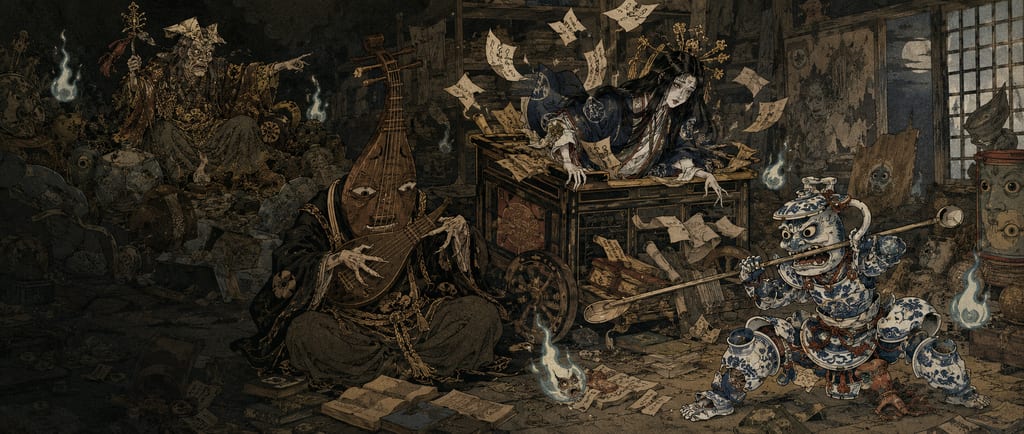
Hōkigami is a tutelary spirit believed to dwell in household brooms. In folk belief, the act of sweeping carries powers of purification and gathering, tying the broom to rites of cleansing doorways and childbirth. In some areas the broom is venerated as a sacred vessel, and taboos warn against stepping over or on it. Practices include standing a broom upside-down to send lingering guests home and placing one by the pillow as a charm for safe delivery. Toriyama Sekien also depicted it as a tsukumogami (tool-turned-spirit).
Folklore & Legends
Common rites include lightly brushing a pregnant woman’s belly with a broom to pray for an easy birth and sweeping the birthing room to dispel impurity. A broom placed at the entrance serves as apotropaic protection. Stepping over or on a broom is said to bring misfortune, while setting a broom upside-down is a trick to hasten a guest’s departure. Details vary by region, but the themes center on purity and guarding thresholds.
Yokai Cards1
Broom Spirit (Hōkigami) across multiple art-style decks
Emphasizing the household cult image of the broom deity, this spirit uses the broom as a sacred vessel to govern domestic purity and the safety of childbirth. Sweeping is seen as a rite of purification that orders boundaries and drives out misfortune and impurity, while the power to gather scattered things back together also symbolizes recalling souls and inviting good fortune. At life’s turning points—New Year, moving house, pregnancy and postpartum—people renew the broom and dispose of the old one with thanks. Mistreating a broom is taboo, and stepping over it, treading on it, or leaving it upside down is inauspicious. Yet the upside-down broom can be used deliberately as a charm to gently send lingering guests home. In art, Toriyama Sekien depicts it as a tsukumogami in Hyakki Tsurezure Bukuro, but in folk practice it is revered as a divine presence dwelling in the tool, a household deity, both practical implement and object of faith. Regional details vary, but it is understood as a local guardian of cleansing and boundaries.
Character Profile
This section is our own creative profile for storytelling. It is not historical fact or scholarship.
harmonious with households that value cleaning and seasonal rites
Abilities
banishing impurity and malign energygathering what is scattered and summoning good fortuneprotection before and after childbirthguarding the household boundary
Weaknesses
abhors disrespectful handling such as stepping over or on it, loses power when a broom is long neglected and ill kept
Habitat
corners of the earthen floor or tatami room, thresholds and entryways, birthing huts and maternity spaces
The diagram below is a diagnostic evaluation chart for Folk Belief Version – Broom Deity. The higher the value of each item, the stronger that characteristic is expressed.