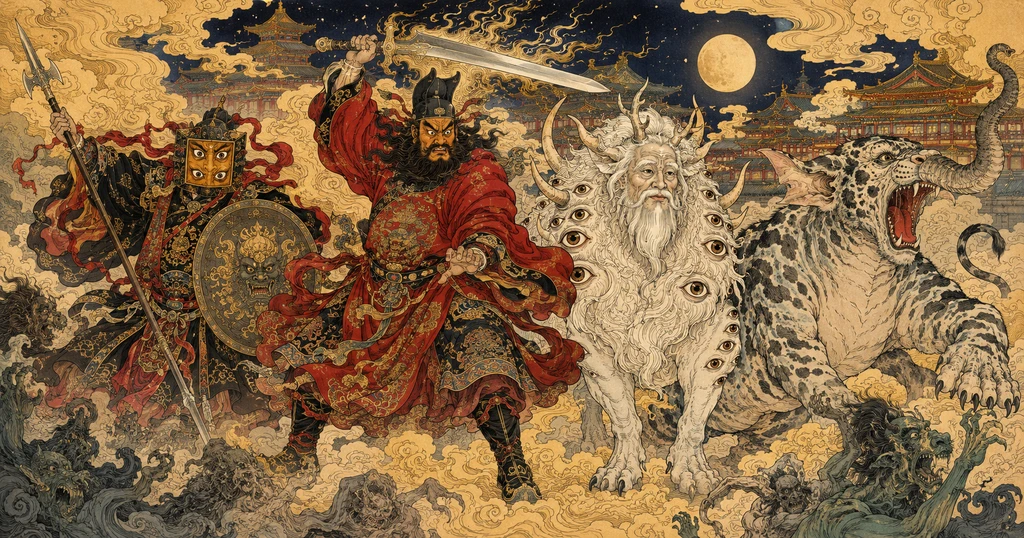
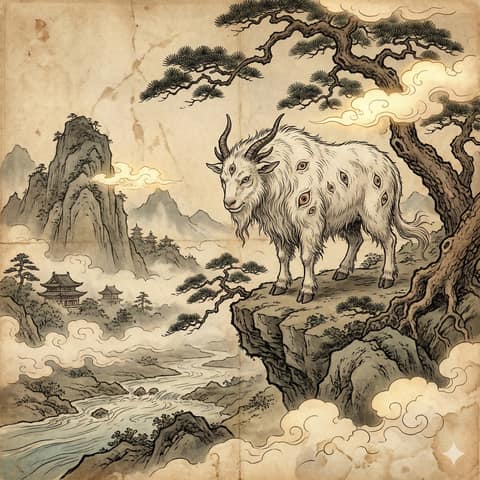
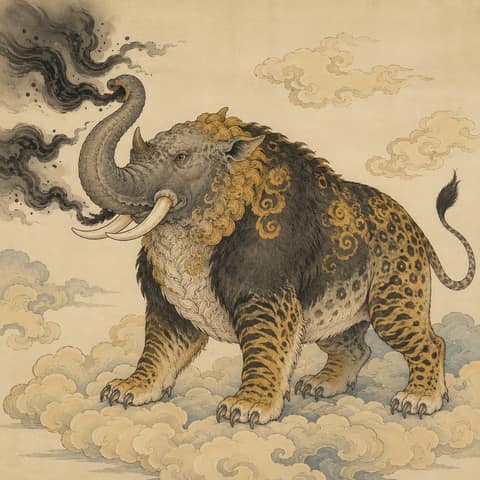
The Baku is an imaginary creature whose womb was the spirit-beast “mo” (貘) recorded in the Chinese classics, and which grew in Japan into something of its own: a beast that devours bad dreams. From of old it has been drawn as a composite creature pieced together from several animals — the trunk of an elephant, the eyes of a rhinoceros, the tail of an ox, the feet of a tiger, the body of a bear. This formula reaches back to “an elephant’s trunk, a rhino’s eyes, an ox’s tail, a tiger’s feet” in the preface that the Tang poet Bai Juyi attached to a screen, his Eulogy on the Mo Screen[1]. Older still, the Shuowen Jiezi[2] records it as “resembling a bear, yellow-black in color, dwelling in the land of Shu,” while Guo Pu’s commentary on the Erya reports that it “gnaws on copper, iron, and the stalks of bamboo.” This strange habit of eating iron is thought to reflect a real beast of Sichuan — the giant panda — and the Japanese name “baku” for the real animal (the tapir) was given later, because it resembled this legendary baku: a naming run in reverse.
In China the mo was originally a beast that warded off evil — repelling plague and noxious influences. To sleep on a bed laid with its pelt was believed to fend off epidemics, and to hang up a picture of its form was to drive off evil. The notion of this spirit-beast reached Japan through the Collected Works of Bai Juyi, beloved reading ever since the Heian court, and by around the Muromachi period it had changed in character into “a beneficial beast that devours bad dreams and purges them away.” In the Edo period, picture-charms of the baku and “baku pillows” inscribed with the character for baku came into wide use, even among the common folk, as lucky charms that guarded peaceful sleep and kept evil at bay. The very opposite of the Western nightmare-demon that brings bad dreams to the sleeper, the baku is an auspicious beast that stands not on the side that steals dreams away, but on the side that eats bad dreams and makes them vanish.
Folklore & Legends
At the heart of the lore surrounding the baku lies a custom peculiar to Japan: warding off a bad dream by entrusting it to the baku. Its headwaters were in the Chinese cult of evil-warding. In the preface to his Eulogy on the Mo Screen[1], the Tang poet Bai Juyi wrote that sleeping on a bed laid with the mo’s hide wards off plague and that drawing its form drives off evil — adding, too, that “in common speech this is called the baize.” The source of the baku’s frequent confusion with the baize, another evil-warding beast, goes all the way back to this passage. In Japan an early instance appears in the Enkyō-bon text of the Tale of the Heike (1309–10)[3], and encyclopedic works such as the Wakan Sansai Zue (Terashima Ryōan, 1712)[4] spread its composite form and its evil-warding nature far and wide.
In the early-modern era, the belief in dream-eating came into full bloom, bound up with the New Year custom of the first dream of the year. From the night of New Year’s Day into the second, people slept with a picture of the treasure ship — laden with the Seven Lucky Gods and their treasures — tucked beneath the pillow. On its sail, or on the back of the paper, the single character for baku was written, so that even a bad dream could be fed to the baku and the calamity cut off. The treasure-ship picture bore a palindrome poem — “naka-kiyo no / tō no neburi no / mina mezame / nami nori-fune no / oto no yoki kana” — and reciting it three times before sleep was said to bring a good dream. On the morning after a bad dream, people also performed a “dream release,” floating the treasure-ship picture from beneath the pillow down a river to wash the misfortune away. Charms recited at the bedside — “I give last night’s dream to the baku,” “Eat it, baku, eat it” — are handed down in many regions as well. There is a tradition that Toyotomi Hideyoshi used a baku pillow, and examples of sleep-guarding furnishings, such as pillows worked in baku maki-e lacquer, survive to this day.
In folklore studies, works such as Yano Ken’ichi’s Cultural History of the Pillow (1985)[5] trace these baku pillows and dream-eating customs with great care. It is sometimes said that a baku appears among Toriyama Sekien’s yokai pictures, but no baku is drawn in either the Gazu Hyakki Yagyō or the Konjaku Gazu Zoku Hyakki — a common error. The image of the baku has shifted with the ages; in modern times a real animal was named after the legendary baku, and even today it remains cherished as a creature that eats dreams.
Yokai Cards3
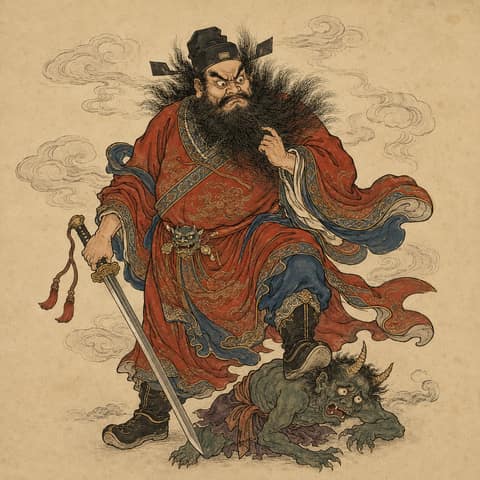
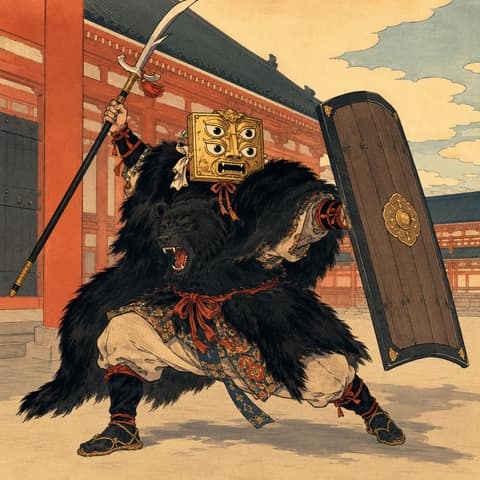
Baku (Dream Eater) across multiple art-style decks
The name “Baku of the Pillow” comes from this beast having been cherished, above all, as a guardian charm at the bedside. Here, rather than the tale of eating dreams, let us turn to the baku drawn upon the pillow itself. A baku pillow is a pillow on whose box-shaped side a picture of the baku or the character for baku was drawn, or on which a baku was worked in maki-e lacquer; rest your head on it to sleep, it was believed, and through the whole night nothing evil would draw near. According to Yano Ken’ichi’s study of the pillow[5], the baku pillow was no mere ornament but a practical charm, made to guard the most defenseless stretch of time — the hours of sleep.
Trace the baku’s form to its roots and two streams run mingled within it. One is the figure transmitted by the Shuowen Jiezi and the commentary on the Erya[2]: a bear-like body mottled black and white that eats even copper, iron, and bamboo. This derives from a real beast of Sichuan in China (most likely the panda). The other is the figure in the text Bai Juyi attached to a screen painting[1] — “trunk of an elephant, eyes of a rhinoceros, tail of an ox, feet of a tiger.” Japanese painters and encyclopedias drew the baku by joining these two. That familiar figure — a black-and-white mottled bear’s body with a long trunk and short legs — is the result of the two becoming one.
The baku was drawn on more than pillows and charm-cards. Carvings of the baku are often found on shrine and temple buildings as well. On the kibana that support the roof and on the kaerumata (the gable-shaped member above the beam), baku were carved, charged with keeping fire and calamity at a distance. As the baku at the bedside guards sleep, the baku on the building guards the house. Both arise from the same idea — placing a baku at the threshold where evil would enter — and so it appears on pillow and on building alike.
The baku is often mistaken for another spirit-beast, the baize, and here too I would make the difference plain. The baize is a beast said to understand human speech and to know every yokai in the world — originally a thing apart from the baku. The trigger for the confusion lay in the line Bai Juyi added about the baku, that “in common speech this is called the baize.”[1] Because both were alike in being “beasts that drive off evil,” the mix-up occurred in pictures too, and there is even a known case where an image called the “Baku King” was in fact a baize to begin with. The baku and the baize are best kept apart in thought as separate beasts — alike in office, but different in origin.
Seen this way, the Baku of the Pillow is neither a monster that steals dreams nor a yokai that attacks people. It is a sentinel, charm-like, set at the “gaps where evil slips in” — the bedside as one sleeps, the doorway of the house. Together with the way the Wakan Sansai Zue[4] spread the baku’s form and its evil-warding power through the world, people drew the baku on pillows, on charms, and on the beams of shrines and temples, setting it to keep watch over bad dreams and calamity without end. What the name “pillow-beast” reflects is this face of the baku as a quiet keeper of watch.
Character Profile
This section is our own creative profile for storytelling. It is not historical fact or scholarship.
Calm and protective. Rather than menacing people, it takes on the task of quieting disturbed sleep and noxious influences.
Compatibility
Well suited to pillows, treasure-ship charm-cards, nandina patterns, and a purified sleeping place.
Abilities
Said to devour nightmares and quiet ill dreamingSaid to ward off evil through the character and image of the bakuBears the classical Chinese trait of eating copper, iron, and bambooBound to treasure-ship charms and pillows, it guards the fortune of the first dream
Weaknesses
Tales of bodily appearance are few; parted from a vessel such as a charm-card or pillow, its character grows vague
Confused with the real tapir, the baize, or Boqi, the outline of its lore easily breaks down
Being an auspicious beast, it does not sit with readings that treat it as a man-harming nightmare-demon
Habitat
The bedside; the border of dreams; baku charm-cards and treasure-ship pictures; bedding designs such as baku maki-e pillows; and furnishings and bedroom décor (not graveyards)
The diagram below is a diagnostic evaluation chart for The Baku of the Pillow. The higher the value of each item, the stronger that characteristic is expressed.