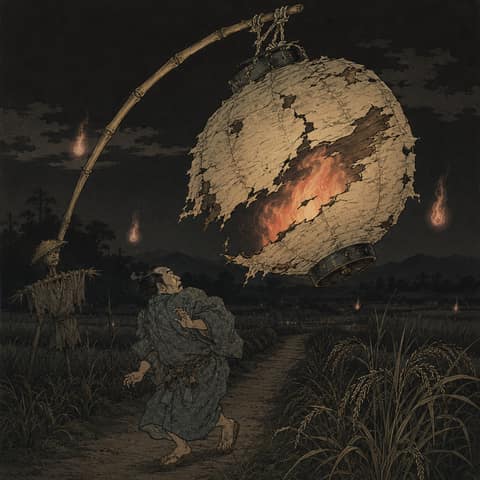
The Chochin-obake is one of Japan's most famous Tsukumogami, an old paper lantern that has transformed into a yokai. Its typical appearance features a large mouth torn open in the middle of the lantern, a long tongue sticking out, and one or two eyes. Although it appears frequently in Edo period yokai paintings and kusazōshi (illustrated storybooks), there are surprisingly few specific legends or folktales associated with it. It is primarily depicted as a "visual yokai" existing within artwork and toys, and it has become an iconic symbol of humor and the supernatural.
As a Tsukumogami, it belongs to the category of "discarded old tools gaining life," and the origins of the Chochin-obake can be seen in the Hyakki Yagyo (Night Parade of One Hundred Demons) scrolls. However, the familiar design of the "large-eyed lantern sticking out a long tongue" was primarily established in Edo period ukiyo-e and Kabuki props. The "Oiwa-chochin" depicted in Katsushika Hokusai's "One Hundred Ghost Stories" overlaps the vengeful spirit of Oiwa from the "Tokaido Yotsuya Kaidan" with the lantern, portraying the Chochin-obake with a strong image of resentment, but this is an exception combined with a specific ghost story rather than a standard Chochin-obake.
The role of the Chochin-obake in yokai culture is that of a small prop connecting the everyday with the otherworld. Lanterns were originally tools to bring light to the darkness and guide humans. The inversion where this light-providing tool itself becomes a yokai to frighten humans is precisely its anomalous nature. However, it is not a terrifying yokai that threatens human life; in most cases, it is depicted as a mischievous prankster with a sense of humor. It can be said to be a character that allows one to feel the relaxed distance between the everyday life of the common people in the Edo period and yokai.
Folklore & Legends
Regarding the Chochin-obake, there are not many specific oral traditions like "this happened in such-and-such village" as seen with other folkloric yokai. Its primary stage of activity was in Edo period kusazōshi (illustrated books), nishiki-e (colored woodblock prints), Kabuki, and toys like sugoroku (board games). Particularly in the late Edo period, it was drawn as a regular feature in "yokai pictorial guides" and "tests of courage," making it a yokai that grew out of visual culture.
In the Muromachi period's "Hyakki Yagyo Emaki" (Night Parade of One Hundred Demons Scroll), while various artifact Tsukumogami are depicted, and lantern-like beings can be seen among them, they do not possess the typical design of a long tongue and large eyes seen today. That humorous appearance is a pop design created by Edo period painters and toy makers to make the yokai image more popular among the masses. A lantern is made of bamboo strips and paper, hollow inside, with a candle burning within. Equating a tear in the lantern to a mouth and the red flame of the candle inside to a tongue is a highly ingenious design.
The "Oiwa (Oiwa-chochin)" from Katsushika Hokusai's "One Hundred Ghost Stories" is very famous, depicting the poisoned face of Oiwa emerging on a lantern. In the "Tokaido Yotsuya Kaidan," this is also a famous stage trick called "Chochin Nuke," where the lantern burns and transforms into a vengeful spirit's face within the flames, a visual shock that was extremely popular in Kabuki. However, this is the result of Oiwa's grudge possessing the lantern, which belongs to a different context than the ordinary Chochin-obake that bears no grudge itself.
In modern times, the Chochin-obake remains one of the classic characters representing Japanese yokai. Along with the Karakasa-kozo (Umbrella Ghost), it is the most representative icon of Tsukumogami in haunted houses, yokai masks, and character merchandise. The reason the Chochin-obake is loved across eras is precisely because of the approachability of the concept of an everyday tool turning into a yokai, and its slightly comical visual design.
This version focuses on the most classic image of the Chochin-obake, possessing large eyes and a long tongue, frightening humans with a humorous demeanor. It does not bring deep terror or disaster, but rather plays small pranks on humans after an everyday tool gains life. This casualness is precisely the charm of the Chochin-obake. Opening a large mouth where the lantern is torn and sticking out a red tongue is a pop design that symbolizes the visual culture of the Edo period.
Lanterns were originally tools to illuminate the darkness and provide peace of mind. However, when it transforms into a yokai, the flame inside overlaps with the fire of life, flickering in the wind. Although there are no clear folktales stating that it harms humans, the sight of a lantern suddenly opening its eyes and sticking out its tongue on a dark night road undoubtedly brings a sense of surprise, allowing one to intuitively realize that the tool they thought was under their control actually possesses its own will. This is a small but tangible anomaly.
This version of the Chochin-obake can be seen as a guiding light connecting humans and the world of yokai. It does not carry a tragic grudge like the Oiwa-chochin. It merely emerges in the darkness of the night, using pranks to make humans aware of the existence of the otherworld. In YOKAI.JP, it is highly appropriate to treat it as such an iconic existence representing the unique humor and approachability of Tsukumogami.
If made into a card, the background should depict a dim Edo period night road or a dilapidated temple, with the Chochin-obake's own flame flickering in the wind and its long tongue exaggeratedly extended. Rather than horror, the comicality that makes one want to laugh should be emphasized. It will teach people that not all yokai are terrifying enemies, and that there are yokai like this that just play with humans in the night.
Character Profile
This section is our own creative profile for storytelling. It is not historical fact or scholarship.
Comical and loves to play pranks. It focuses entirely on surprising people, but harbors no malicious intent to harm them.
Compatibility
祭りや怪談を楽しむ人とは相性がよく、道具を粗末に扱う人には破れた口でにやりと笑う。
Abilities
Suddenly appearing in the dark to surprise humansAgilely extending and retracting its long tongueMaking the flame burning inside flicker like lifeBlending in with ordinary lanterns
Weaknesses
Because its true form is just an old lantern made of paper and bamboo, it is very vulnerable to fire and rain. It cannot move at all during the day.
Habitat
Dim night roads, ruined old temples, forgotten corners of storehouses. Within the sketchbooks of Edo period painters.
The diagram below is a diagnostic evaluation chart for The Typical Lantern Ghost with a Long Tongue. The higher the value of each item, the stronger that characteristic is expressed.