A *sokushinbutsu* is the mummified remains of an ascetic monk who, at the end of rigorous training, entered the earth alive in order to transform their physical body into a Buddha. This practice was particularly prevalent among the ascetics of the Mount Yudono lineage, who considered Mount Yudono in the Dewa Province[1] as their sacred ground. It is said that they underwent "mokujikigyō" (tree-eating asceticism) for thousands of days, surviving solely on nuts, roots, and tree bark to eliminate body fat and moisture. To prevent their bodies from decomposing after death, they would condition their flesh and then enter an underground stone chamber. There, they would ring a bell and fast until they passed away. Death was not seen as the end, but rather as entering eternal meditation (dhyana) to save all sentient beings. The excavated bodies were then enshrined in temples as living Buddhas. Even though they were mortal humans, they became partially deified after death, embodying the unique view of the afterlife nurtured by the mountain worship of Yamagata. The *sokushinbutsu* of the Mount Yudono lineage are still enshrined today at temples such as Dainichibō[2] and Chūren-ji, where they remain objects of worship and veneration.
Folklore & Legends
Among the *sokushinbutsu* of the Mount Yudono lineage, the most famous is Tetsumonkai Shōnin[3] of Chūren-ji. Born in Tsuruoka, Shōnai, in the 9th year of Hōreki (1759), he entered Chūren-ji at the age of 21. He devoted himself to the revival of the Mount Yudono faith, completing a 2,000-day tree-eating asceticism. It is recorded that he entered the earth on December 8 in the 12th year of Bunsei (1829), at the age of 71[3]. Shinnyokai Shōnin[2], enshrined at Dainichibō, is said to have been born in Asahi Village (now Tsuruoka City) in the 4th year of Jōkyō (1687). After more than 70 years of austere practices, he entered the earth and became a *sokushinbutsu* in the 3rd year of Tenmei (1783) at the age of 96[2]. It is also told that before entering the earth, the ascetics would drink the sap of the urushi (lacquer) tree to embalm their internal organs. This unimaginably grueling process was revered as an act of ultimate self-sacrifice, undertaken with the desperate hope of saving the common people suffering from famine. In the Meiji period, entering the earth was outlawed, so only a limited number of Mount Yudono *sokushinbutsu* have survived to the present day. Also called "living Buddhas" or "mummy Buddhas," they continue to gather the faith of the people of Yamagata as demigod beings forever bound to the sacredness of the mountains.
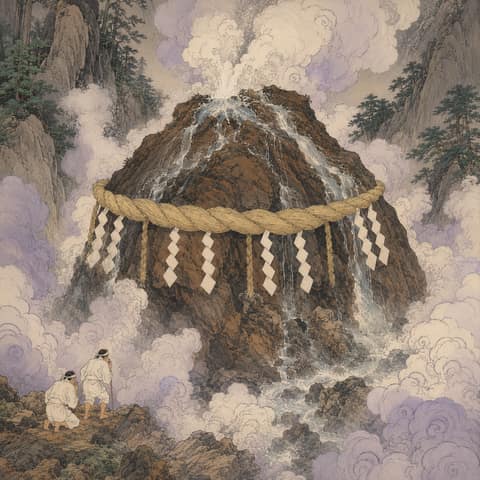
Unlike other yokai that are purely imaginary aberrations, the *sokushinbutsu* is a rare existence—a real, historical ascetic who ascended halfway to godhood through absolute faith. The inner sanctuary of Mount Yudono has no shrine building; instead, a giant, brownish-red sacred rock gushing hot water serves as the object of worship itself, and pilgrims must walk the approach barefoot. In this sacred area that preserves the archetype of nature worship, ascetics aimed for *sokushin-jōbutsu*—becoming a Buddha in this very life. The "tree-eating asceticism" was a preparation for self-mummification: first giving up grains, and eventually restricting salt and water to the absolute limit to wither the body. In the final stage, they confined themselves in an underground stone chamber connected to the outside world only by a bamboo tube with a bell. The moment the sound of the bell ceased, the ascetic was considered to have successfully entered eternal meditation. Exhumed without having decayed, their bodies became Buddhas, enshrined beside the main temple deities to continuously shoulder the suffering of the masses. They are not objects of terror, but the physical incarnations of a will to save humanity that transcended death itself, most vividly demonstrating the Dewa Sanzan region's views on death and the concept of the mountains as the otherworld.
Character Profile
This section is our own creative profile for storytelling. It is not historical fact or scholarship.
Overflowing with the mercy of ultimate self-sacrifice. A seeker of truth who offers their own life for the salvation of all sentient beings. Silent and uncompromisingly stern, yet radiating a profound warmth.
Compatibility
苦難の中で祈る者、覚悟を決めた求道者と深く響き合う。怠惰や偽りを最も嫌う。
Abilities
Self-mummification and an incorruptible body achieved through tree-eating asceticism (mokujikigyō)Entering eternal meditation (dhyana) by being buried alive in the earthPrayers of salvation to shoulder the illnesses and hardships of all living beings
Weaknesses
Because it is an act of ultimate self-sacrifice that completely terminates the physical body, they can never return to the mortal realm. Furthermore, since the Meiji era, the act of entering the earth itself has been legally prohibited.
Habitat
Enshrined within the halls of temples of the Mount Yudono lineage (such as Dainichibō and Chūren-ji), forever existing alongside the sacredness of the holy mountains.
The diagram below is a diagnostic evaluation chart for Sokushinbutsu, the Living Buddha Enshrined in the Earth. The higher the value of each item, the stronger that characteristic is expressed.