Mt. Yudonoゆどのさん

2 yokai rooted in Mt. Yudono. Explore the legends tied to this land.

Also known as: 湯殿山神社 / 出羽三山奥の院
  • Yudonosan-daigongen

    Yudonosan-daigongen

    Divine

    Yudonosan-daigongen

    The Unspeakable Deity of the Sacred Rock of Mount Yudono

    Divine Spirits / DeitiesMount Yudono (Present-day Tsuruoka City, Yamagata Prefecture) / The Three Mountains of Dewa (Dewa Sanzan)

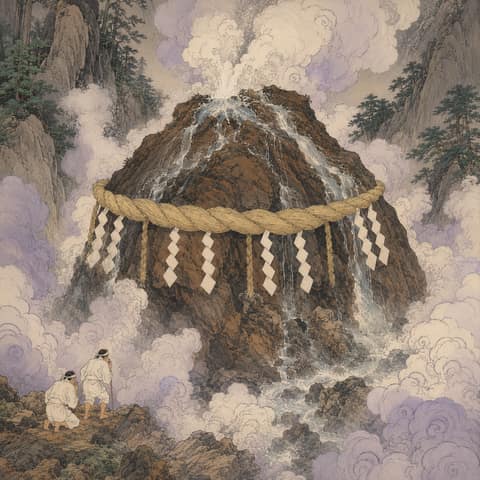
    Yudonosan-daigongen does not have a tangible statue form; instead, a giant, brownish-red sacred rock spewing hot water serves directly as the object of worship, preserving the oldest form of nature worship in Japanese mountain faith. The Dewa Sanzan are considered a trinity of ascetic training grounds: Mount Haguro symbolizes worldly happiness in the present, Mount Gassan represents the afterlife, and Mount Yudono signifies the future of rebirth. Therefore, Mount Yudono, as the inner sanctuary, is positioned as the final destination of the three-mountain pilgrimage. The object of worship has neither a shrine building nor a roof. Pilgrims must take off their footwear and walk barefoot on the approach mixed with earth and stones to climb the sacred rock. The strict taboo against disclosing one's experiences on the mountain—"Do not speak of it, do not ask of it"—is still observed today, and photography is strictly prohibited. Although it lost the title of "gongen" during the Meiji era's anti-Buddhist movement and became a shrine dedicated to deities like Ōyamatsumi-no-Mikoto, the faith itself—pressing one's hands together in prayer to the silent sacred rock—has never been broken. It is the silent divine entity of Dewa that presides over rebirth and *sokushin-jōbutsu*.
  • Sokushinbutsu

    Sokushinbutsu

    Epic

    Sokushinbutsu

    Sokushinbutsu, the Living Buddha Enshrined in the Earth

    Humans-Turned-Yokai / DemigodsMount Yudono (Present-day Tsuruoka City, Yamagata Prefecture) / Dainichibō & Chūren-ji Temples (Present-day Oami, Tsuruoka City, Yamagata Prefecture)

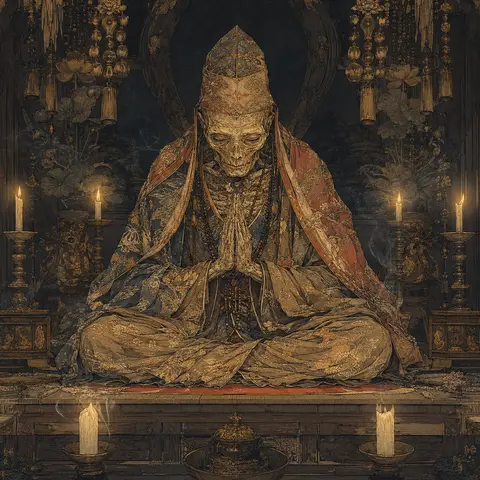
    Unlike other yokai that are purely imaginary aberrations, the *sokushinbutsu* is a rare existence—a real, historical ascetic who ascended halfway to godhood through absolute faith. The inner sanctuary of Mount Yudono has no shrine building; instead, a giant, brownish-red sacred rock gushing hot water serves as the object of worship itself, and pilgrims must walk the approach barefoot. In this sacred area that preserves the archetype of nature worship, ascetics aimed for *sokushin-jōbutsu*—becoming a Buddha in this very life. The "tree-eating asceticism" was a preparation for self-mummification: first giving up grains, and eventually restricting salt and water to the absolute limit to wither the body. In the final stage, they confined themselves in an underground stone chamber connected to the outside world only by a bamboo tube with a bell. The moment the sound of the bell ceased, the ascetic was considered to have successfully entered eternal meditation. Exhumed without having decayed, their bodies became Buddhas, enshrined beside the main temple deities to continuously shoulder the suffering of the masses. They are not objects of terror, but the physical incarnations of a will to save humanity that transcended death itself, most vividly demonstrating the Dewa Sanzan region's views on death and the concept of the mountains as the otherworld.