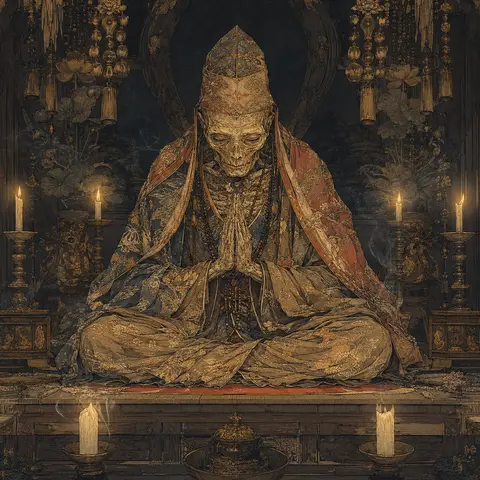
Yudonosan-daigongen is the syncretic deity (gongen) enshrined at Mount Yudono[1], the inner sanctuary of the Three Mountains of Dewa (Dewa Sanzan). Before the government-ordered separation of Shinto and Buddhism in the Meiji era, the Dewa Sanzan were sacred mountains of Shugendō (ascetic mountain worship). They enshrined "gongen," which were manifestations of Buddhas appearing in the form of Shinto deities. Mount Haguro, Mount Gassan, and Mount Yudono constituted a single ascetic training ground, symbolizing the past, present, and future, respectively. There is no shrine building on Mount Yudono; the object of worship itself is a giant, brownish-red sacred rock from which hot water gushes out. Pilgrims are not allowed to wear footwear; they must climb this sacred rock barefoot to directly receive the power of the earth. Since ancient times, there has been a strict taboo against revealing what one sees or hears on this mountain, encapsulated in the saying, "Do not speak of it, do not ask of it"[1]. Although the title of "gongen" was abolished during the separation of Shinto and Buddhism and the anti-Buddhist movement (haibutsu kishaku) in the 6th year of Meiji (1873), and the site was reorganized into the Yudonosan Shrine enshrining the deities Ōyamatsumi-no-Mikoto, Ōnamuchi-no-Mikoto, and Sukunahikona-no-Mikoto[2], the core of the faith—worshipping the silent sacred rock as the divine body—remains unchanged to this day.
Folklore & Legends
The founder of the Dewa Sanzan is said to be Prince Hachiko, the son of Emperor Sushun. He is believed to have established the Dewa Shrine on Mount Haguro, laying the foundation for the Three Mountains faith[2]. The three mountains served as ascetic training grounds for the Haguro Shugendō lineage, aiming for *sokushin-jōbutsu*—attaining enlightenment and becoming a Buddha in this very life. Ascetics would delve deep into the mountains, repeatedly undergoing austerities symbolizing rebirth. Mount Yudono, in particular, was positioned as the inner sanctuary and the deepest, most absolute sacred ground of the three mountains, with Dainichi Nyorai (Vairocana Buddha) considered to be its original Buddhist form (honji-butsu). In the 2nd year of Genroku (1689), the famous haiku poet Matsuo Bashō visited the Dewa Sanzan during his journey recorded in *Oku no Hosomichi* (The Narrow Road to the Deep North). Regarding Mount Yudono, he wrote: "In general, the details of this mountain are strictly forbidden from being spoken of, according to the rules of the ascetics. Therefore, I will stop my brush and record no more," deliberately leaving no detailed account of the place[3]. The haiku he composed at that time, "Unable to speak / I wet my sleeves with tears / At Mount Yudono," is renowned for expressing the tears of deep emotion shed in a sacred realm that cannot be put into words[3]. As the red sacred rock of which one is forbidden to speak, Yudonosan-daigongen continues to reside quietly in the mountains of Dewa, gathering the awe and prayers of pilgrims.
Yudonosan-daigongen does not have a tangible statue form; instead, a giant, brownish-red sacred rock spewing hot water serves directly as the object of worship, preserving the oldest form of nature worship in Japanese mountain faith. The Dewa Sanzan are considered a trinity of ascetic training grounds: Mount Haguro symbolizes worldly happiness in the present, Mount Gassan represents the afterlife, and Mount Yudono signifies the future of rebirth. Therefore, Mount Yudono, as the inner sanctuary, is positioned as the final destination of the three-mountain pilgrimage. The object of worship has neither a shrine building nor a roof. Pilgrims must take off their footwear and walk barefoot on the approach mixed with earth and stones to climb the sacred rock. The strict taboo against disclosing one's experiences on the mountain—"Do not speak of it, do not ask of it"—is still observed today, and photography is strictly prohibited. Although it lost the title of "gongen" during the Meiji era's anti-Buddhist movement and became a shrine dedicated to deities like Ōyamatsumi-no-Mikoto, the faith itself—pressing one's hands together in prayer to the silent sacred rock—has never been broken. It is the silent divine entity of Dewa that presides over rebirth and *sokushin-jōbutsu*.
Character Profile
This section is our own creative profile for storytelling. It is not historical fact or scholarship.
Silent and uncompromisingly stern. Refuses to be spoken of, sharing the power of the earth only with those who approach barefoot.
Compatibility
再生と覚悟を求める巡礼者、自然への畏れを忘れぬ者と深く結ぶ。軽々しく秘事を語る者を退ける。
Abilities
Residing in the sacred rock that gushes hot water, granting the power of the earth to those who climb itThe divine authority over rebirth and sokushin-jōbutsu (becoming a Buddha in this life)Casting a taboo barrier that strictly forbids speaking of the mountain's secrets
Weaknesses
The object of worship must never be artificially altered, and speaking of it or photographing it is a strict taboo. It lost the title of "gongen" during the separation of Shinto and Buddhism in the Meiji era.
Habitat
Resides on the sacred rock of Mount Yudono, the inner sanctuary of the Dewa Sanzan. Pilgrimage is only permitted during the mountain's open season (from early summer to late autumn).
The diagram below is a diagnostic evaluation chart for The Unspeakable Deity of the Sacred Rock of Mount Yudono. The higher the value of each item, the stronger that characteristic is expressed.