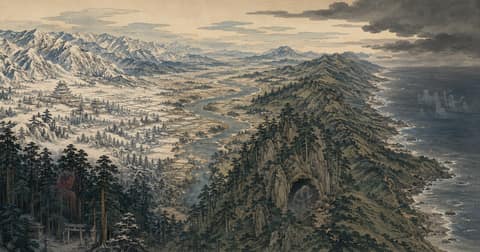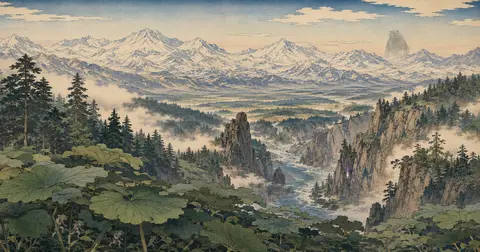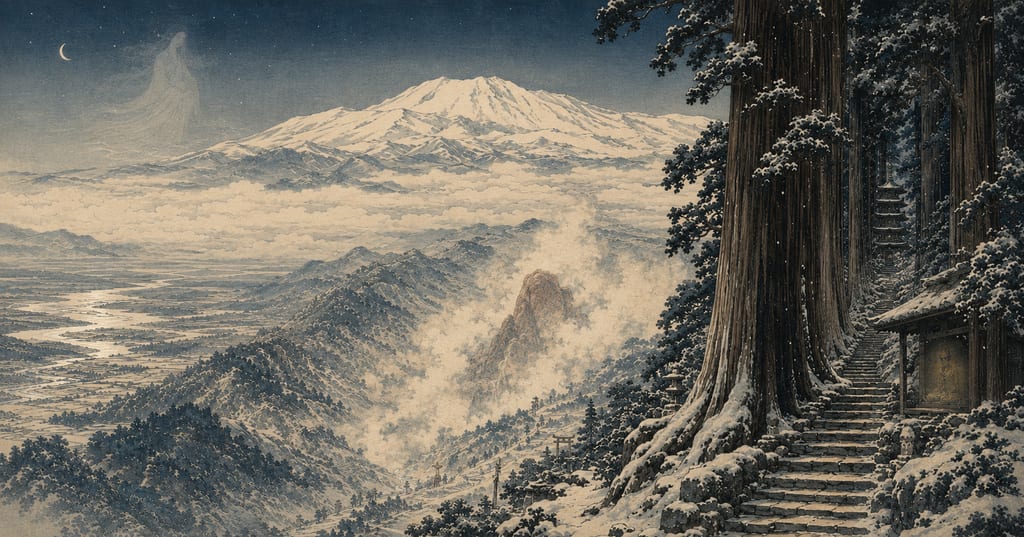
The Three Mountains of Dewa—Mount Haguro, Mount Gassan, and Mount Yudono—towering over the lands of Ouu, are not merely sacred peaks. The Haguro Shugendo tradition designates these three mountains as training grounds, equating Mount Haguro with the present, Mount Gassan with the past, and Mount Yudono with the future. A pilgrimage through them constitutes the "Sankan Sando[1]" (Three Barriers, Three Crossings), a journey to die once and be reborn[1]. The yokai culture of Yamagata emerges from this view of the otherworld centered on death and rebirth. The *gongen* residing in the unspoken red sacred rock, the ascetics who transformed their living bodies into buddhas and vanished into the earth, and the woman who descended from the lunar world with the snow—all are manifestations born of a lifestyle where mountains, snow, and death are close neighbors.
Yamagata consists of four regions: Shonai, Mogami, Murayama, and Okitama. Shonai is the granary facing the Sea of Japan; Murayama opens up in the basin of the mid-Mogami River; Mogami is the snowy inland area; and Okitama lies in the south, centered around Yonezawa. Each has a different climate and history, yet all look up to the Three Mountains of Dewa in the distance and are connected by the single great Mogami River. The mountains, the river, and the snow have bound together the otherworld views of the people in this land. Focusing on three pillars passed down in Dewa Province (the old province encompassing the Dewa Sanzan), this article carefully distinguishes between divine figures, yokai, and historical ascetics, tracing why such beings were spoken of in this region.
The Otherworld of the Dewa Sanzan ── A Journey of Rebirth
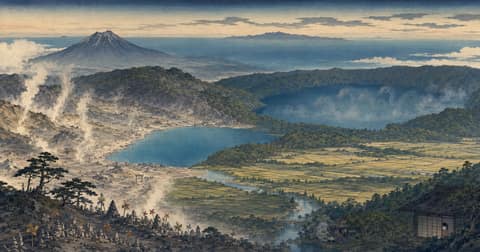
In the center of Yamagata Prefecture stand Mount Gassan (1,984 meters) as the main peak, Mount Haguro (414 meters), and Mount Yudono (1,500 meters)[1]. Haguro Shugendo, which views these three mountains as a unified training ground, is a unique Japanese mountain religion formed by the blending of nature worship with esoteric and exoteric Buddhism. Its founder is said to be Prince Hachiko, the son of Emperor Sushun. Legend has it that in the first year of Empress Suiko's reign (593), guided by a three-legged crow, he landed at Yaotomeura[2] in Yura and opened Mount Haguro[2]. Fleeing a political coup in which his father the Emperor was assassinated by Soga no Umako, the prince hid in the remote mountains and discovered sanctity there—a founding legend rather than strict historical fact, but this story perfectly reflects the sentiment that the remote frontiers, furthest from the center of royal power, are closest to the otherworld.
In Haguro Shugendo, Mount Haguro was seen as the mountain of the present to pray for happiness in this life, Mount Gassan as the mountain of the past to pray for peace after death, and Mount Yudono as the mountain of the future to pray for rebirth[1]. Commoners in the Edo period believed that by visiting these three mountains in order, they would die once while living and resurrect with youthful vitality. This is the journey of the *Sankan Sando*, the "journey of rebirth"[1]. Considered an ascetic practice transmitting rituals of death and rebirth dating back to the Middle Ages, whenever yokai or divine figures are spoken of in Yamagata, this circuit of "passing through death to return to life" always lies in the background—this is the axis running through this article.
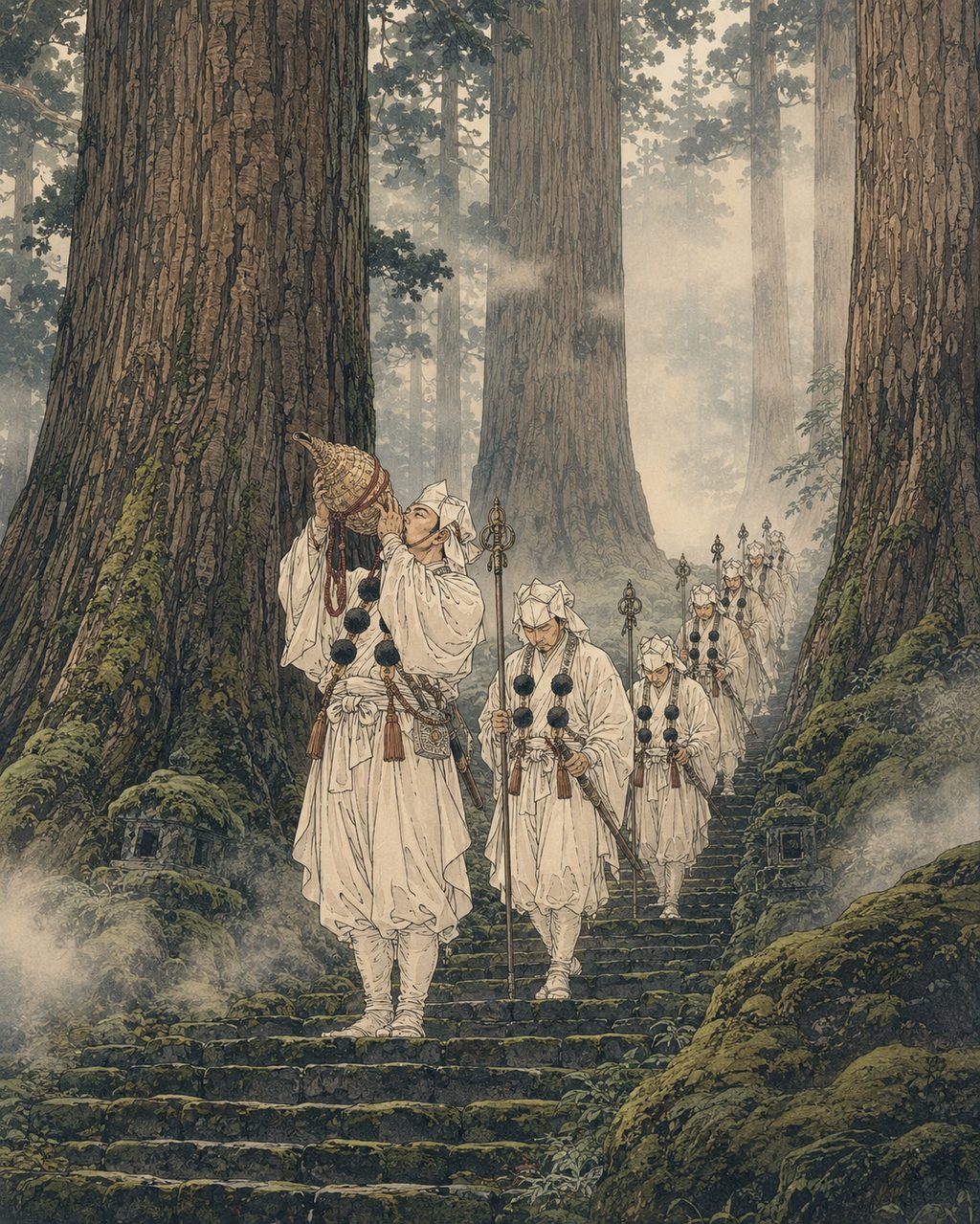
Those who live this faith of death and rebirth most intensely through their bodies are the *yamabushi* (mountain ascetics). In the "Akinomine-iri" (Autumn Peak Entry) ritual that continues to this day, practitioners confine themselves in the mountains, likened to fetuses in a mother's womb. Through the "asceticism of the Ten Realms"—including fasting, abstaining from water, and enduring burning peppers (nanban-ibushi)—they are ultimately believed to be reborn anew[1]. Entering the mountain was death, and descending the mountain was rebirth. This ritual of simulated death and resurrection is said to be the only ascetic practice in Japan that preserves its medieval form, illustrating that the mountains of Dewa have been experienced by the people not merely as scenery, but as a mechanism to reconstruct life and death. The reason Yamagata's apparitions and divine figures are uniformly tied to "the beyond of death" is because this physical experience serves as the foundation.
The Mountain of the Past:
Mount Gassan and the Realm of the Dead
Mount Gassan, the highest and steepest of the three mountains, was regarded as the mountain of the "past," where one prayed for peace and salvation after death. Under the syncretism of Shinto and Buddhism, the fundamental buddha of the Gassan deity was conceived as Amida Nyorai (Amitabha), and Mount Gassan has been worshipped as a mountain where ancestral spirits reside, and where the dead journey[3]. The place name "Midagahara" (Field of Amida) in the mountains still conveys that this was considered a past world likened to Amida's Pure Land[3]. Piling stones at the riverbed of the Sanzu River and pressing hands together for deceased parents or children—climbing Mount Gassan was the very act of simulated death and rebirth, stepping into the realm of the dead and returning to this world. For the people of Yamagata, death was not a distant abstraction but the name of a mountain they could climb in the summer. This tangibility lies at the core of Dewa's view of the otherworld.
Do Not Speak of It ── Yudonosan Daigongen
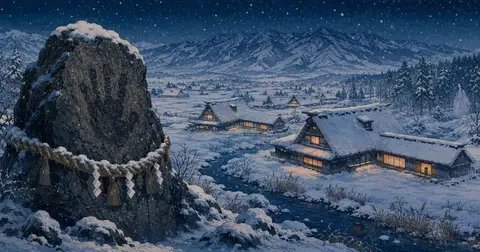
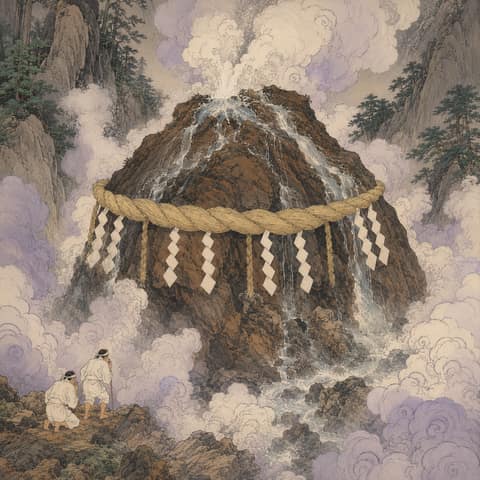
The innermost sanctuary, the deepest sacred site of the three mountains, was Mount Yudono. There is no shrine building here. The object of worship is a massive reddish-brown sacred rock itself, spouting boiling water. Worshippers are not allowed to wear footwear; they must climb this rock barefoot, stepping directly on the earth's heat. Since ancient times, they have been strictly admonished not to speak a word of what they see and hear on this mountain, passing down the saying, "Speak not, ask not[4]"[4].
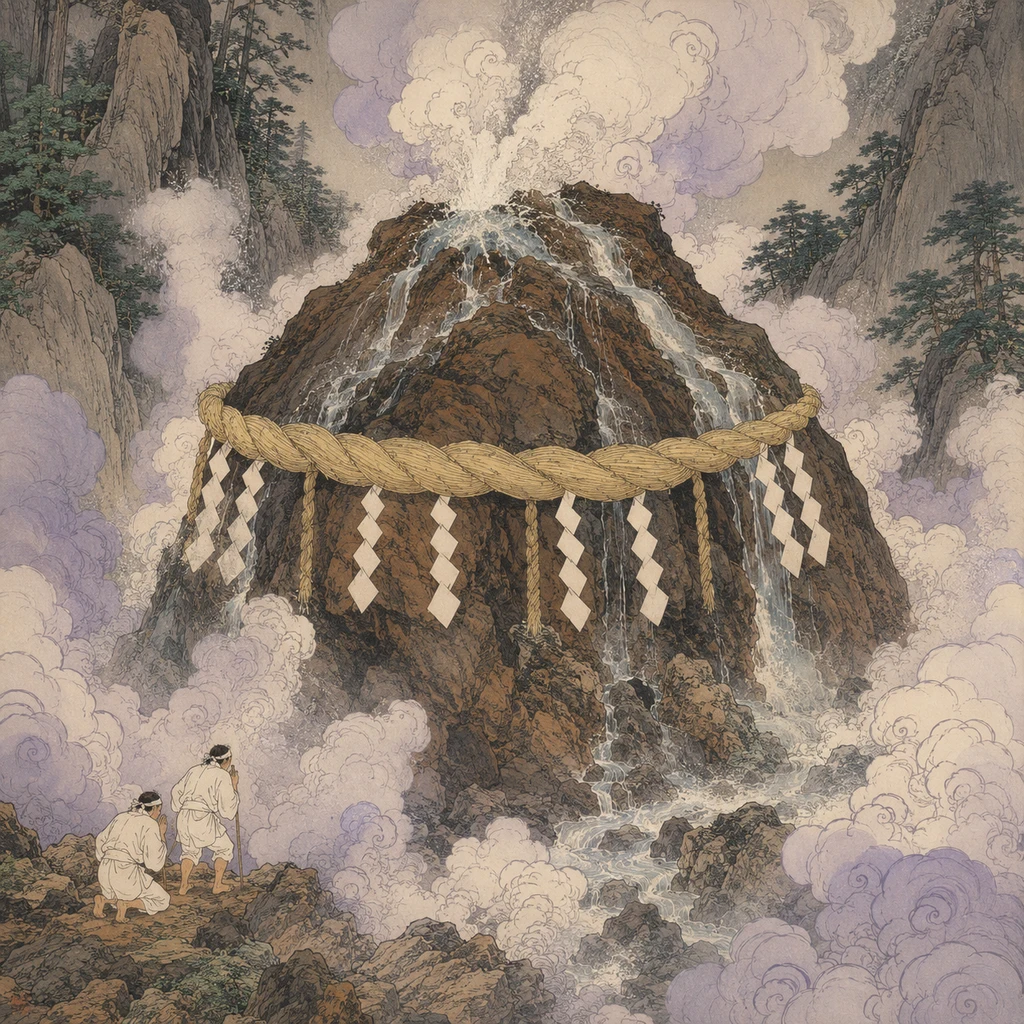
Yudonosan-daigongen
Yudonosan-daigongen is the syncretic deity (gongen) enshrined at Mount Yudono, the inner sanctuary of the Three Mountains of Dewa (Dewa Sanzan). Before the government-ordered separation of Shinto and Buddhism in the Meiji era, the Dewa Sanzan were sacred mountains of Shugendō (ascetic mountain worship). They enshrined "gongen," which were manifestations of Buddhas appearing in the form of Shinto deities. Mount Haguro, Mount Gassan, and Mount Yudono constituted a single ascetic training ground, symbolizing the past, present, and future, respectively. There is no shrine building on Mount Yudono; the object of worship itself is a giant, brownish-red sacred rock from which hot water gushes out. Pilgrims are not allowed to wear footwear; they must climb this sacred rock barefoot to directly receive the power of the earth. Since ancient times, there has been a strict taboo against revealing what one sees or hears on this mountain, encapsulated in the saying, "Do not speak of it, do not ask of it". Although the title of "gongen" was abolished during the separation of Shinto and Buddhism and the anti-Buddhist movement (haibutsu kishaku) in the 6th year of Meiji (1873), and the site was reorganized into the Yudonosan Shrine enshrining the deities Ōyamatsumi-no-Mikoto, Ōnamuchi-no-Mikoto, and Sukunahikona-no-Mikoto, the core of the faith—worshipping the silent sacred rock as the divine body—remains unchanged to this day.
Read moreBefore the Meiji era, the Dewa Sanzan were sacred mountains of Shinto-Buddhist syncretism that enshrined *gongen* (buddhas manifesting in the form of gods), and the fundamental buddha of Mount Yudono was considered to be Dainichi Nyorai (Mahavairocana). That divine figure is Yudonosan Daigongen. It is incorrect to call the unspoken red sacred rock a yokai. Yudonosan Daigongen is clearly a deity, and in this article, it is strictly distinguished from yokai. However, the fact that it exists solely as a rock spouting hot water without any shrine or statue, and that even speaking of its appearance is forbidden, connects it in the nature of awe to apparitions, as a being standing in a realm beyond human words. For the fear of the unnamed and the unspeakable is also the source of the mind that creates yokai.
In the second year of Genroku (1689), Matsuo Basho toured the Dewa Sanzan on his journey of *Oku no Hosomichi[5]*. Having composed poems for Haguro and Gassan, Basho noted regarding Mount Yudono alone, "In general, the details of this mountain are forbidden to be spoken of by the rules of the ascetics. Therefore, I put my brush to rest and record nothing," deliberately leaving nothing written[5]. The only thing he left was the haiku, "Tears wet my sleeves at Yudono, of which I cannot speak"[5]. Before the sacred domain of which he could not speak, he had no choice but to wet his sleeves with tears of emotion—it is famous as the poem that conveyed the unspeakable sanctity most powerfully precisely by not writing. The haiku master, who exhausted all forms of expression, chose silence here. That silence illuminates the essence of Mount Yudono's object of worship from the reverse.
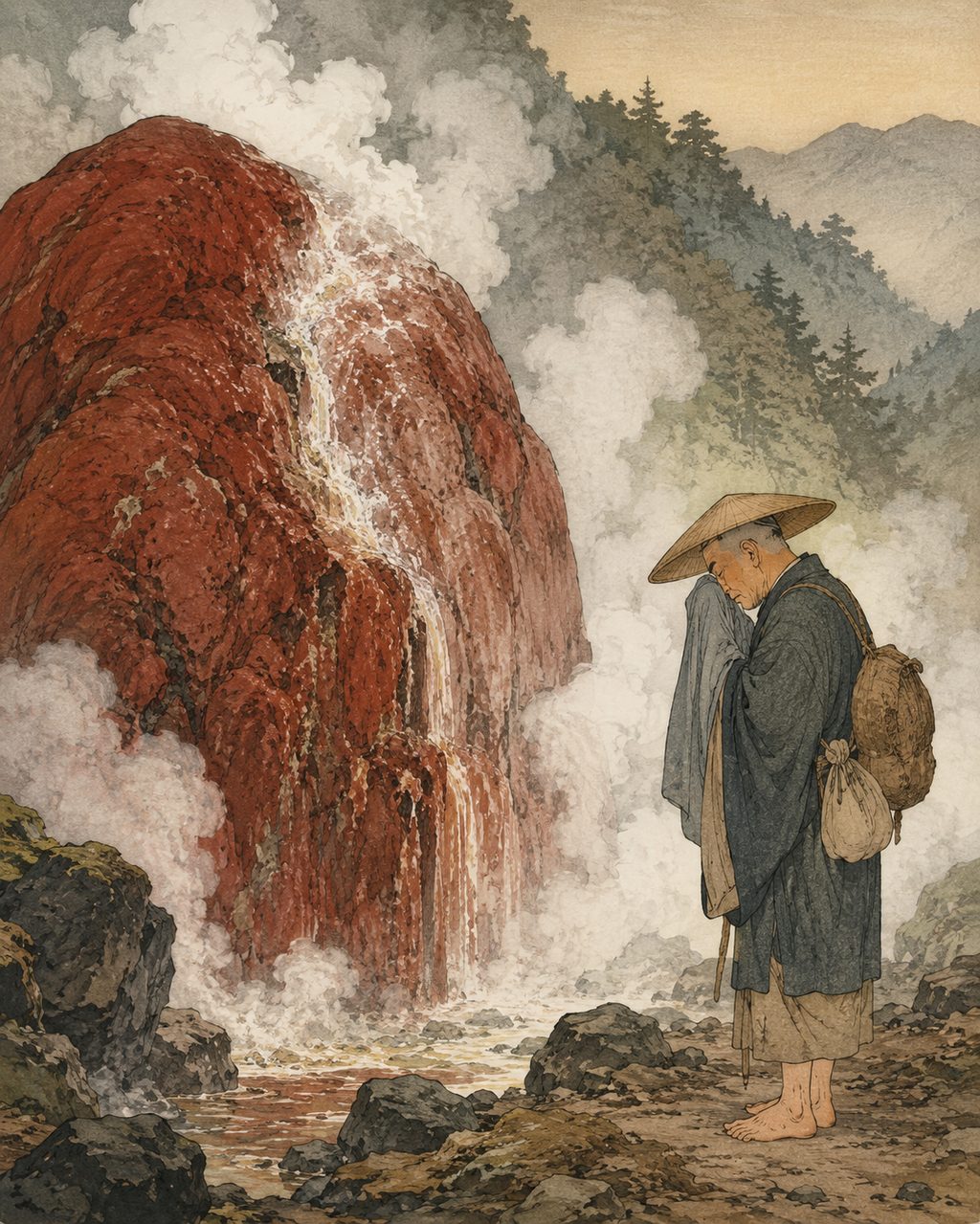
With the separation of Shinto and Buddhism and the abolition of Buddhism in the sixth year of Meiji (1873), the title of *gongen* was abolished, and the Yudonosan Shrine was altered to enshrine Oyamatsumi-no-Mikoto, Onamuchi-no-Mikoto, and Sukunahikona-no-Mikoto[6]. At the other shrines of the three mountains, Buddhist elements were thoroughly stripped away, and many precious halls and Buddhist statues were lost. Yet, the core of the faith that worships the unspoken sacred rock remained unchanged[7]. Deep in the mountains of Tsuruoka City, that red rock continues to spout hot water today. That place, where photography and speaking are still refrained from, remains as a single point unreachable by modern words, even amidst contemporary touristification.
Buddhas Disappeared into the Earth ── Sokushinbutsu
The faith of death and rebirth of Mount Yudono manifested in its most rigorous form as the *sokushinbutsu*. This is neither a yokai nor a myth, but the historical fact of real ascetics, and here we record it with respect, distinguishing faith from historical fact.
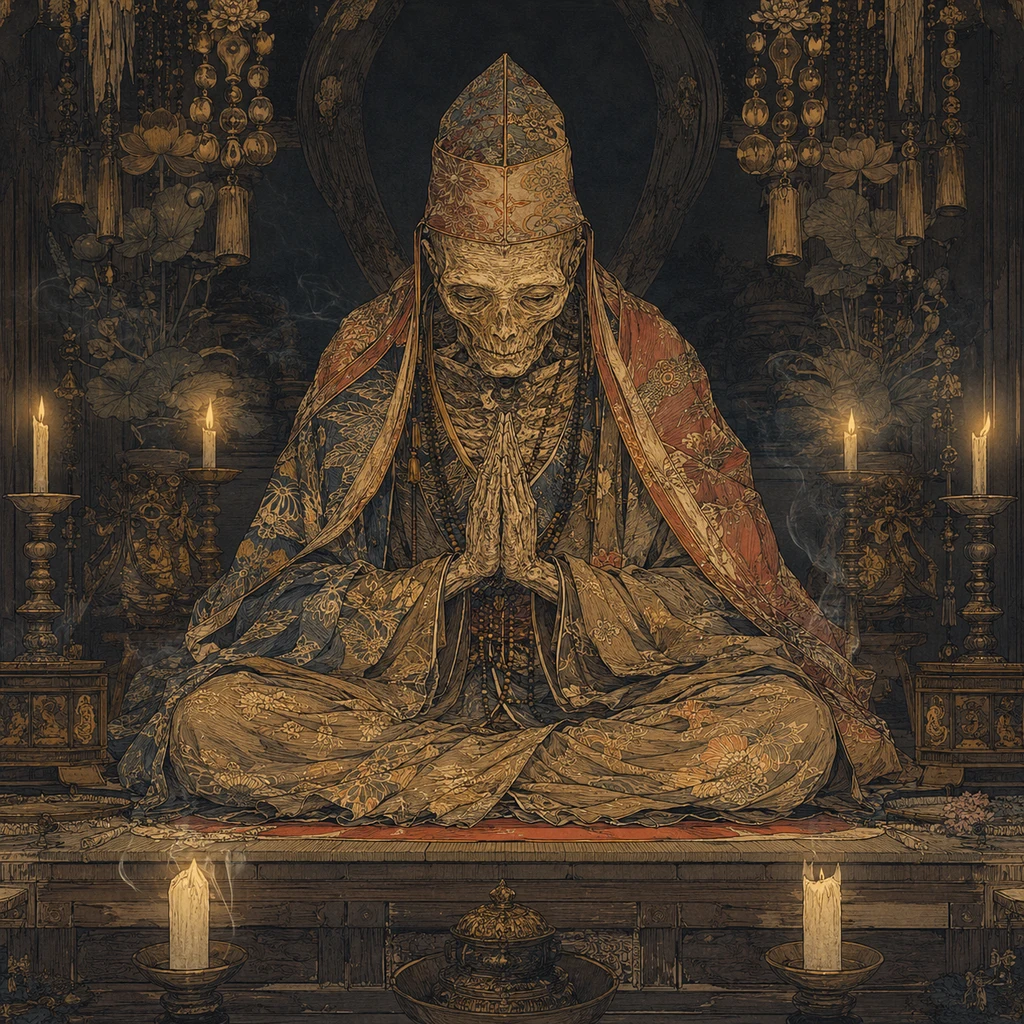
Sokushinbutsu
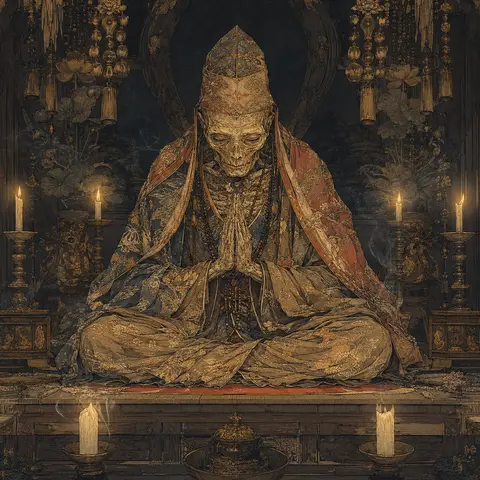
A *sokushinbutsu* is the mummified remains of an ascetic monk who, at the end of rigorous training, entered the earth alive in order to transform their physical body into a Buddha. This practice was particularly prevalent among the ascetics of the Mount Yudono lineage, who considered Mount Yudono in the Dewa Province as their sacred ground. It is said that they underwent "mokujikigyō" (tree-eating asceticism) for thousands of days, surviving solely on nuts, roots, and tree bark to eliminate body fat and moisture. To prevent their bodies from decomposing after death, they would condition their flesh and then enter an underground stone chamber. There, they would ring a bell and fast until they passed away. Death was not seen as the end, but rather as entering eternal meditation (dhyana) to save all sentient beings. The excavated bodies were then enshrined in temples as living Buddhas. Even though they were mortal humans, they became partially deified after death, embodying the unique view of the afterlife nurtured by the mountain worship of Yamagata. The *sokushinbutsu* of the Mount Yudono lineage are still enshrined today at temples such as Dainichibō and Chūren-ji, where they remain objects of worship and veneration.
Read moreSokushinbutsu refers to the remains of an ascetic who, at the end of severe training, entered the earth alive to transform his living body into a buddha and was left as a mummy. The ascetics who considered Mount Yudono their sacred ground undertook "Mokujikigyo[8]" (tree-eating asceticism), often repeated over thousands of days, abstaining from the five grains like rice and wheat, and eating only nuts, roots, and tree bark to whittle away the fat and moisture in their bodies to the absolute limit. After preparing the body so it would not decay after death, they entered a stone chamber dug into the earth, breathing through a single bamboo tube, striking a bell and chanting sutras, and eventually passed away during their fast, as the tradition goes[8]. If the body dug up after three years and three months had not decayed, it was welcomed as a buddha.
Mokujikigyo is not an ascetic practice of merely reducing food. It is said that they cut off grains, eventually transitioned to nuts, buckwheat, and horse chestnuts, and finally consumed pine bark and lacquer. It was a meticulous and systematic practice to drain the body's fat and moisture to the extreme, creating a body that would resist putrefaction after death. Its harshness is nothing less than the act of bringing oneself closer to a mummy while still alive.
What is important is that they did not conceptualize this as "death." Becoming a sokushinbutsu was not an end, but was seen as the figure entering eternal meditation to save all living beings. A living person becomes partially deified even after dying—this directly embodies Dewa's unique view of the otherworld. In Mount Yudono, the mountain of rebirth, the ascetics sought to stand between death and rebirth with their own bodies, striving to become beings who would continue to save the people for all eternity. The sokushinbutsu is the utmost extreme point of the faith of Sankan Sando. If Yudonosan Daigongen exists in the mountains as the "unspoken god," the sokushinbutsu exists in the villages as the "unmoving buddha," both receiving the prayers of the people of Dewa.
Those who bore this severe practice were the lay ascetics placed at the lowest tier of Mount Yudono's hierarchical society of shrine lands, monks, and practitioners, known as "Issei Gyonin[9]"[9]. Not the prestigious monks of the temples, but the common ascetics who devoted their lives to the mountain faith took it upon themselves to save the commoners suffering from famine and plague, and entered nirvana[9]. The sokushinbutsu was the self-sacrificing prayer of those standing in the lowest places, rather than high-ranking clergy. Amidst the repeated famines of the Edo period, the idea of vicariously taking on the suffering of all beings was inextricably linked to the desperate desire for salvation among the cornered populace.
Tetsumonkai Shonin and Shinnokai Shonin
The most well-known among the Yudono lineage sokushinbutsu is Tetsumonkai Shonin[10] of Churen-ji Temple. Born in the ninth year of Horeki (1759) in Tsuruoka, Shonai (formerly Daihoji Village), he worked as a river laborer before entering Churen-ji at the age of twenty-one and mastering a two-thousand-day Mokujikigyo at Senninzawa[10]. Legend has it that when an eye disease spread in Edo during the Bunsei era, he drew a short sword on Ryogoku Bridge, gouged out his own left eye, and offered it to the dragon god of the Sumida River, praying for the "healing of eye diseases." It is said that the people suffering from eye diseases were subsequently healed one after another, and he received the title "Keigan-in" (This anecdote of the eye offering is a tradition with chronology from secondary sources and cannot be concluded as historical fact). He is also said to have devoted himself to difficult construction projects like tunnels and bridges in his hometown, being an ascetic who stood by the people in both faith and social works. It is transmitted that he entered nirvana at dawn on December 8, the twelfth year of Bunsei (1829), at the age of seventy-one[10].
On the other hand, Shinnokai Shonin[8], enshrined at Dainichibo, is said to have been born in the fourth year of Jokyo (1687) to a farming family in Etsuchuyama, Asahi Village (now Tsuruoka City)[8]. Deeply worshipping Yudonosan Daigongen, he repeatedly preached based at Dainichibo, and after over seventy years of asceticism, in the third year of Tenmei (1783), he entered the earth and became a sokushinbutsu at the age of ninety-six[8]. Exactly in that era when the Great Tenmei Famine struck the Tohoku region, living a long life and finally offering himself as a buddha to the people, his life is still spoken of today as the ideal form of the Mount Yudono faith.
In the Shonai region, six such sokushinbutsu of the Mount Yudono lineage exist today[11]. At Kaiko-ji of the Chisan sect of Shingon Buddhism in Sakata City, two figures, Chukai Shonin and Enmyokai Shonin, are enshrined[11], and together with Churen-ji and Dainichibo in Tsuruoka, worshippers still press their hands together before the living buddhas. The very fact that such a number is concentrated in the limited land of Shonai, looking up to Mount Yudono, indicates that this was the center of the sokushinbutsu faith. Entering the earth was legally banned in the Meiji period, and only a limited number of the Mount Yudono lineage sokushinbutsu are passed down to today. To call them merely "living buddhas" or "mummy buddhas" and look at them with curious eyes is to misjudge the views on life and death of this land. The sokushinbutsu are not a spectacle, but the crystallization of prayers born of Dewa's mountain faith, and we must not forget that they are still enshrined in temples as objects of worship today. The unearthed bodies of the ascetics are the most eloquent witnesses to this land's conviction that humans can become buddhas.
Marrying the Dead ── Mukasari Ema
Dewa's sense of death and rebirth is deeply rooted not only in the mountains but also in the folk customs of the villages. In the Murayama and Okitama regions, there is a memorial custom known as the "Mukasari Ema[12]," where votive tablets depicting a fictional bride (or groom) in a wedding ceremony are dedicated at shrines and temples for those who died young and unmarried[12]. "Mukasari" is a dialect word derived from "mukaerare" (being welcomed), meaning marriage.
Marrying the unmarried dead in a picture to make them full-fledged adults—the historian Hiroo Sato explains that this is motivated by the parental desire to make a child who passed away incomplete into a full-fledged person[12]. Connected to the custom of "ghost marriage" widely seen in East Asia, many Mukasari Ema are still dedicated today at Wakamatsu-ji in Tendo City and other places[12]. The bride depicted is a fictional character that does not actually exist, a consideration to avoid involving any real person.
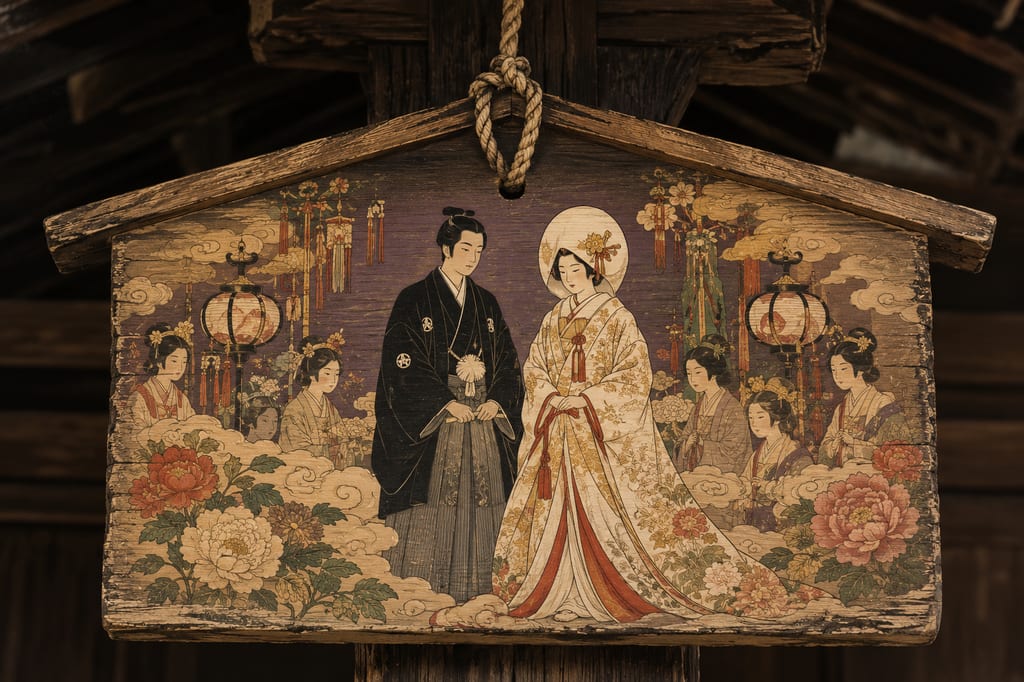
This is not a yokai. However, the feeling that the dead are suspended between this world and the next—the workings of the mind trying to send that person to their rightful place through ritual—grows from the same soil that welcomed the sokushinbutsu as buddhas and saw the realm of the dead in Mount Gassan. For the people of Dewa, death was not a severance, but a contiguous domain where the living could still act upon it. The wedding in the votive tablet was a prayer to fulfill an unfulfilled life in the next world, and it was also a ritual for those left behind to accept that death and move forward. Yokai, divine figures, and memorial services for the dead resonate together within a single climate—that overlap is precisely the depth of Yamagata's spiritual culture. Even looking across the entire country, there are not many lands where the imagination surrounding death branches out so diversely.
That Which Dwells in the Snow ── Yukijoro
Dewa is one of the regions with the heaviest snowfall. The long, deep winters nurtured a sense of seeing spirits in the snow itself from an angle different from the views on life and death of Mount Yudono. The crystallization of this is the Yukijoro.
Yukijoro
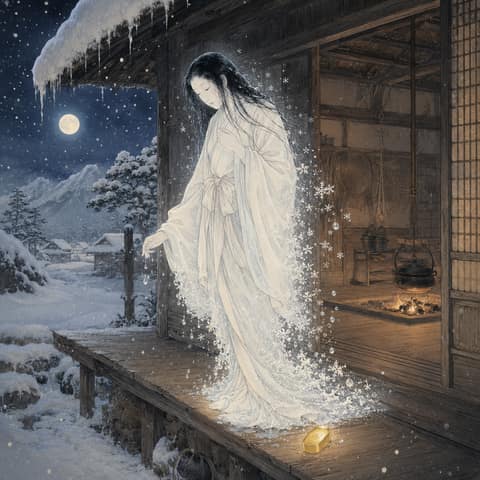
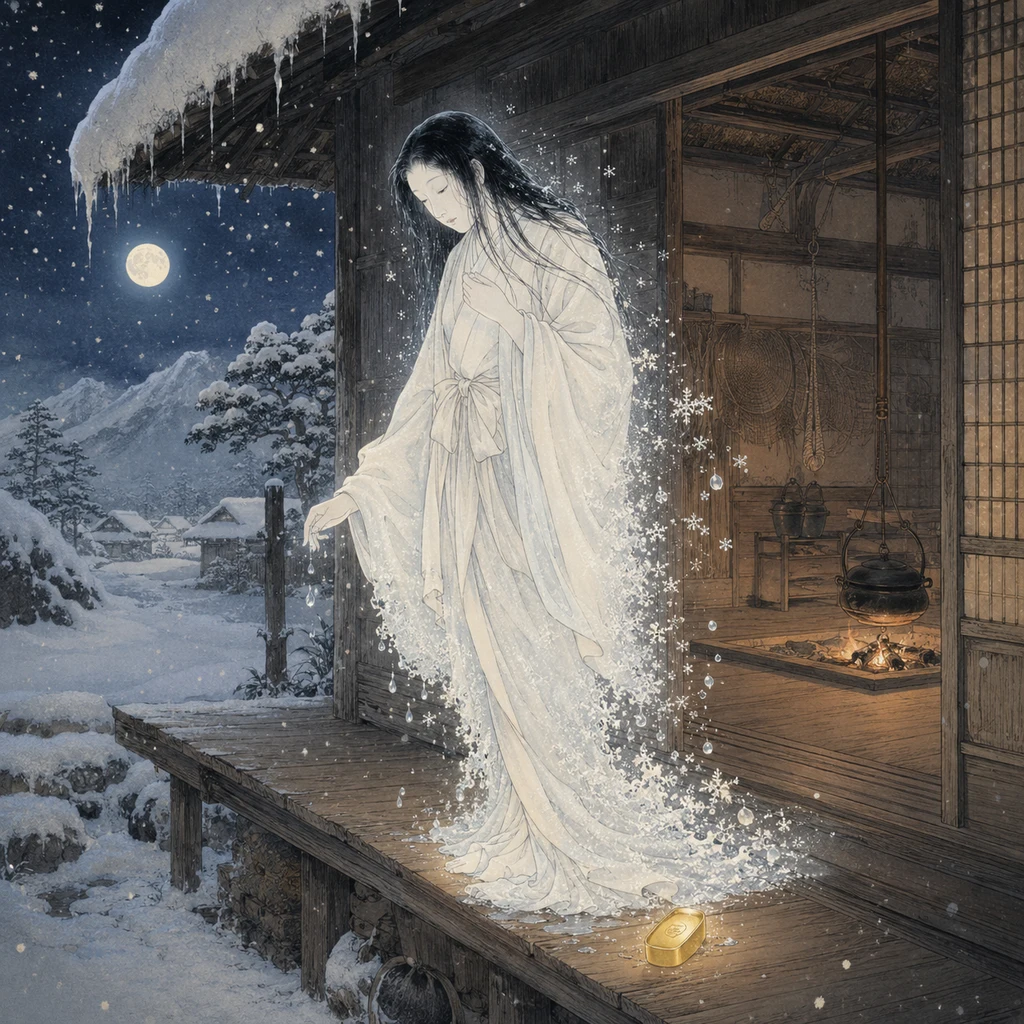
The *Yukijoro* is a lineage of snow women (*yuki-onna*) passed down in Yamagata, the heavy snowfall region of Dewa Province. While snow women across the country are generally spoken of as terrifying beings that freeze people to death, Yamagata's *Yukijoro* has a distinct regional flavor: she has a side that rewards human compassion with blessings, and a unique origin story claiming she descended from the world of the moon . On snowy nights, she appears as a woman wrapped in white garments, visiting houses to ask for lodging. In the Oguni region, it is said that the *Yukijoro* was originally a princess of the moon world who descended to earth with the snow but became unable to return, showing her form only on nights illuminated by the snow's glare . The sensibilities of people surviving heavy snow and long winters—fearing the snow yet also cherishing it—are projected onto the image of this *Yukijoro*.
Read moreWhile Yuki-onna (snow women) transmitted throughout the country are generally spoken of as terrifying beings who freeze people to death, Yamagata's Yukijoro has an aspect of bringing fortune in response to human compassion, as well as a unique origin story that she descended from the lunar world[13]. It is said that on snowy nights, she appears as a woman in white robes, visiting houses to beg for lodging. In the Oguni region[13] of Nishi-Okitama, the Yukijoro was originally a princess of the lunar world who descended to the earth with the snow but could not return to the moon, and it is said that she only reveals her form on snow-lit nights[13]. The origin as a woman from the moon seems to resonate somewhere with Dewa's faith in the moon, which saw the mountain of the past, Mount Gassan, as the realm of the dead.
In a folktale passed down in Oguni, a woman in white robes visits two houses on a snowy night[13]. The master of the east house coldly turns her away, saying, "We have a sick person," while the old couple in the west house warmly welcomes her, serves tea, and prepares a bed. The next morning, the woman is gone, and only a lump of gold wrapped in a wet white robe is left behind—it is said the woman was a snow spirit who melted away in the warmth of human compassion[13]. The kind-hearted west house prospered for life, while the east house that coldly turned her away suffered illness and grew poor. Not an apparition that freezes to death, but a spirit that rewards compassion—the hearts of the people surviving the heavy snows of winter, who both feared and cherished the snow, are projected onto this figure. The snow can kill people, but its meltwater also nourishes the rice paddies the following spring. The ambivalence of the snow, which holds both fortune and misfortune, has become the very personality of the Yukijoro.
Even as the same "woman of the snow," her image is not uniform within Yamagata. In the Mogami region, there are legends akin to the *ubume* (birthing woman), where the snow woman appears holding a child and tries to make passersby hold that child[14]. The child held grows heavier and heavier, or is said to be as cold as ice. Around Shinjo, stories of a snow woman appearing leading a cow (*beko*) are also transmitted[14]. The lunar princess in Oguni, the one entrusting a child in Mogami, the one leading a cow in Shinjo—the reason the regional differences of the snow woman are so layered within a single prefecture is likely because the different hearts facing the snow in each land crystallized into separate stories. Even with the same heavy snow, the texture of winter is entirely different in the Mogami basin, the Shonai coast, and the mountainous Okitama. The diversity of the Yukijoro is precisely the diversity of the topography of Yamagata Prefecture itself.
Rivers,
Frost-Covered Trees,
and Ancient Temples ── Climate Nurtures Apparitions
What supported Yamagata's yokai culture was not just mountain worship. The very shape of the land determined the distance between humans and the otherworld.
The Mogami River, piercing through the prefecture to pour into the Sea of Japan, is counted as one of the three most rapid rivers in Japan, and became the main artery for river transport in the Edo period. From Yonezawa upstream to Murayama in the middle reaches and Sakata downstream, "Benimochi[15]," the raw material for dye, was gathered by boat and transported from Sakata to Kyoto by Kitamaebune ships[15]. Mogami safflower was traded in the capital at high prices equal to or exceeding gold, and in the mid-Edo period, it is said to have accounted for about forty percent of the total national production[15]. Shonai and Sakata, opened up by the river and the sea, became nodal points where the culture and wealth of Kamigata (the Kyoto-Osaka region) flowed in, and the economic and cultural thickness that supported the sokushinbutsu faith and the shrines and temples grew there. The faith of the unspoken mountains and the trade of the bustling river ports—this contrast itself is the climate of Dewa. Precisely because there was wealth, the surplus to support ascetics, dedicate votive tablets, and give form to faith was born in the villages.
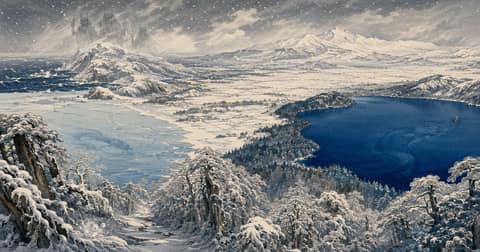
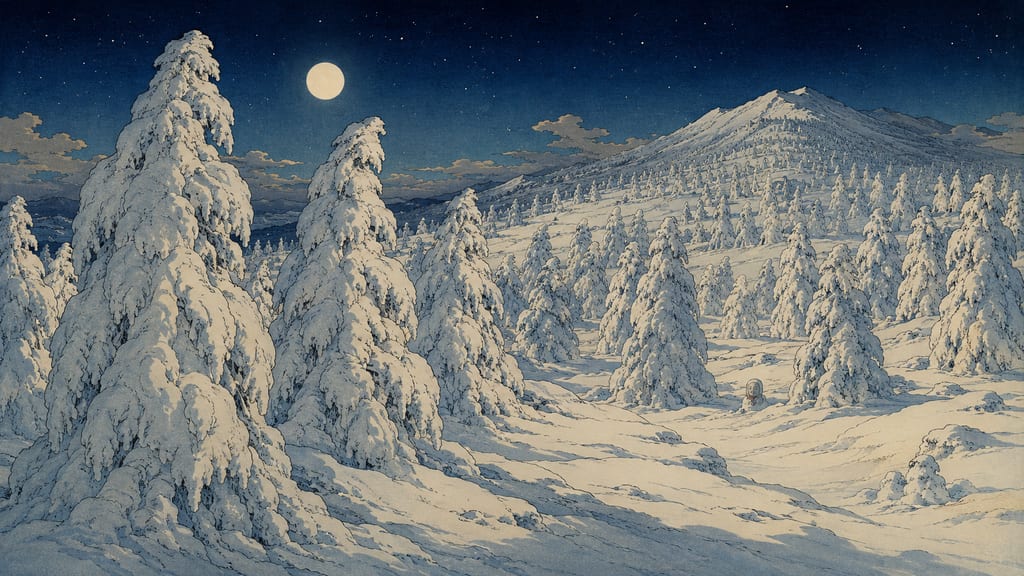
When winter comes, that climate completely changes. On the Yamagata side of the Zao mountain range, just below the summit of Mount Jizo, the forest of Maries' firs puts on rime ice and snow, turning into a cluster of white giants known as "Juhyo[16]" (snow monsters)[16]. Water droplets below freezing point repeatedly freeze to the branches, snow is incorporated into the gaps, and they solidly sinter together, growing far beyond human height[16]. This natural phenomenon, also called snow monsters because it resembles the human form, can be said to be a visible grotesque shape molded by the exact same force of heavy snow that birthed the Yukijoro. Growing toward the windward side from January to early March, their figures look almost like a herd of beings walking across the snowfields at night. At the summit of Mount Jizo, the Zao Jizo deity is enshrined[16], quietly watching over people amidst the deep snow—the sense of seeing the otherworld in the snow lives on here as faith as well. Nature molds the grotesque, and beside it, humans place a buddha. The mentality of Yamagata is well expressed in this combination.
And one more place indispensable when talking about Yamagata's sense of the otherworld is Yamadera (the Mountain Temple), Hoshusan Risshakuji. An ancient temple of the Tendai sect founded by Jikaku Daishi Ennin in the second year of Jogan (860), halls are carved into the mountain slopes where strangely shaped rocks line up, and the approach itself, climbing over a thousand stone steps, constitutes a simulated experience of death and rebirth[17]. As one climbs from the base, leaving the secular world, the journey to the inner sanctuary at the peak seems to condense the rebirth journey of the Dewa Sanzan into a single mountain. When Basho visited here in the second year of Genroku (1689), he left the famous haiku, "Ah this silence / sinking into the rocks / voice of cicada," and the "Semi-zuka" (Cicada Mound) where he buried a tanzaku strip inscribed with that poem still stands on the approach today[17]. In the voice of the cicada sinking into the rock, Basho heard the silence of the boundary between life and death. Choosing silence at Mount Yudono, and composing poems about quietness at Yamadera—the land of Dewa was a land that continued to question the boundary between what can be spoken and what cannot be spoken, even to a haiku master who exhausted all words. In this province surrounded by rocks, forests, and snow, the boundaries between the sacred and the secular, and life and death, were always close and thin. There could be no land more fitting for yokai to be born, gods to reside, and the dead to return.
Dewa Within Tohoku ── What Can Be Seen Through Comparison
Placing Dewa's view of the otherworld within the entirety of Tohoku makes its individuality stand out all the more. Mount Osore in Tsugaru is known as a mountain where the spirits of the dead gather, a place where the living exchange words with the dead through the spirit channeling of the *itako*. Tono in Iwate, as depicted in Kunio Yanagita's *Tono Monogatari*, is the world of yokai dwelling in the villages, such as kappa, zashiki-warashi, and yama-otoko. Both convey the dense sense of the otherworld in Tohoku, but what the Dewa Sanzan demonstrates is slightly different. At the core of Dewa is neither the Osorezan-style interaction of "meeting" the dead, nor the Tono-style coexistence of "living" with the strangers of the village, but an active faith of simulated death and rebirth, where the living themselves pass through death and are "reborn."
That is precisely why Dewa gave rise to the extreme ascetic practice of the sokushinbutsu, going to become a buddha oneself. That is precisely why the Yukijoro was spoken of not merely as an apparition that freezes people to death, but as an ambivalent being that responds to compassion and brings fortune. Not fearing and distancing oneself from death, but seeing salvation in passing through death—this way of facing it gives a unique brightness, or a sense of quiet affirmation, common to the yokai and divine figures of Yamagata. To survive in the harsh nature of heavy snow and rapid rivers, the people may have cultivated the wisdom to accept death not as an enemy, but as a pathway to rebirth.
Conclusion ── The Land That Passes Through Death and Returns to Life
The yokai, divine figures, and holy men of Yamagata do not stand separately. The red sacred rock of the unspoken Yudonosan Daigongen, the self-sacrifice of the sokushinbutsu disappearing into the earth, the Mukasari Ema marrying off the unmarried dead, and the Yukijoro descending with the snow and rewarding compassion—all branch out from the single otherworld view of "passing through death to return to life." What the Dewa Sanzan nurtured was a heart that does not merely fear death, but sees rebirth beyond death.
In this land surrounded by heavy snow, rapid rivers, and sacred peaks, the people have climbed the mountains to die once, welcomed guests from the otherworld on snowy nights, worshipped the ascetics returned to the earth as buddhas, and married off the children who passed away young in pictures. One must not confuse divine figures, yokai, and historical ascetics—yet it is also certain that they are siblings born from the soil of the same climate. Those who visit Yamagata can still walk and trace that circuit of death and rebirth with their own feet today.