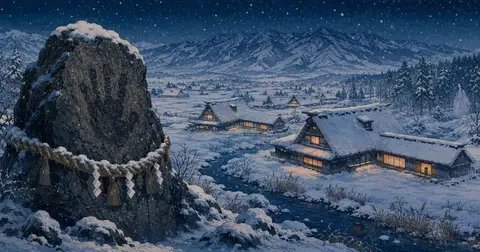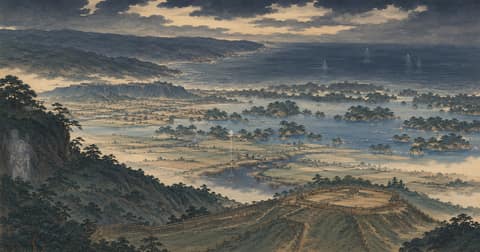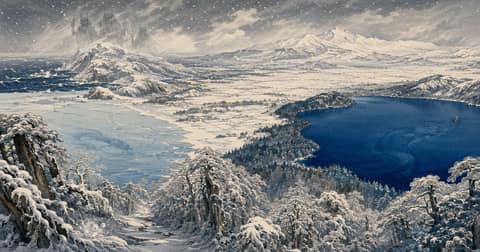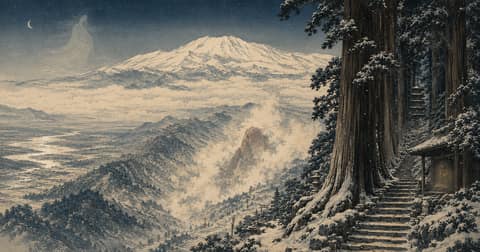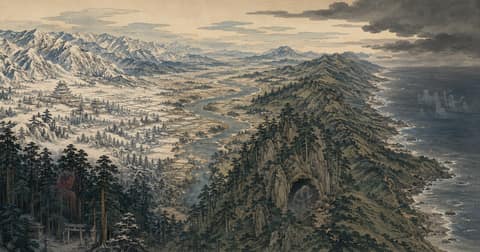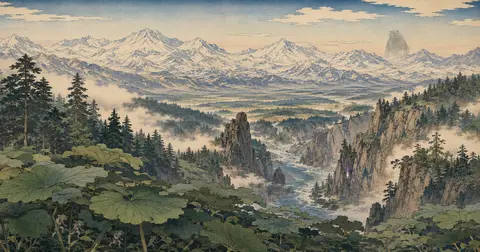
Aomori Prefecture, the northernmost point of Honshu overlooking the Tsugaru Strait, is a land with two faces. The Tsugaru region in the west, centered around Hirosaki and Goshogawara, and the Nanbu region in the east, which includes Hachinohe, Towada, and Mutsu. Since Oura (Tsugaru) Tamenobu gained independence from the Nanbu clan at the end of the Sengoku period, these two cultural spheres have developed as separate domains for 400 years and still coexist within a single prefecture today[1]. In this land where dialects and festivals differ, anomalies that cross the boundary between yokai and gods have firmly taken root.
Its backbone consists of "mountains" and "water." Mount Osorezan, embracing Lake Usoriyama on the Shimokita Peninsula, has been a sacred site where the dead gather since ancient times, as people have said, "When a person dies, they go to the mountain"[2]. Mount Iwaki, towering over the Tsugaru Plain, was a sacred peak worshipped as an agricultural god, drawing crowds of worshippers[3]. And from Lake Towada to the rivers of Tsugaru, the water god worship of dragons and kappa forms a vast network. At the northern edge encompassing the mountain of the dead, Zashiki-warashi protects houses, and Suiko-sama commands the kappa. This is the landscape of anomalies in Aomori.
Osorezan,
the Mountain of the Dead:
A View of Life and Death Connected to Yokai
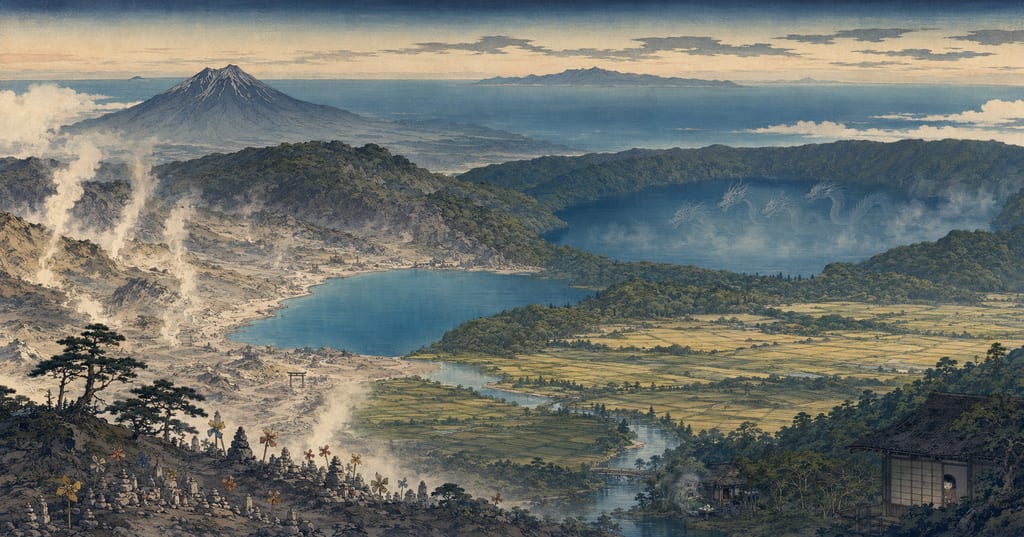
When discussing the anomalies of Aomori, one must first turn to Osorezan on the Shimokita Peninsula. Counted alongside Mount Hiei and Mount Koya as one of Japan's three major sacred grounds, this mountain presents a landscape where hell and paradise seem to manifest on earth, characterized by the stark contrast between the desolate terrain venting volcanic gases and the cobalt blue clarity of Lake Usoriyama. Passing through the sulfur-scented rocky areas suddenly opens up to the quiet, white sands of Gokurakuhama (Paradise Beach) ── this extreme contrast itself has shown people the geography of the underworld. Temple lore states that it was founded in 862 (the fourth year of the Jogan era) by Ennin (Jikaku Daishi), a disciple of Saicho who founded the Tendai sect, after receiving a divine revelation. It later converted to the Soto sect, and its current main temple is affiliated with Entsu-ji Temple in Tanabu, Mutsu City[2].
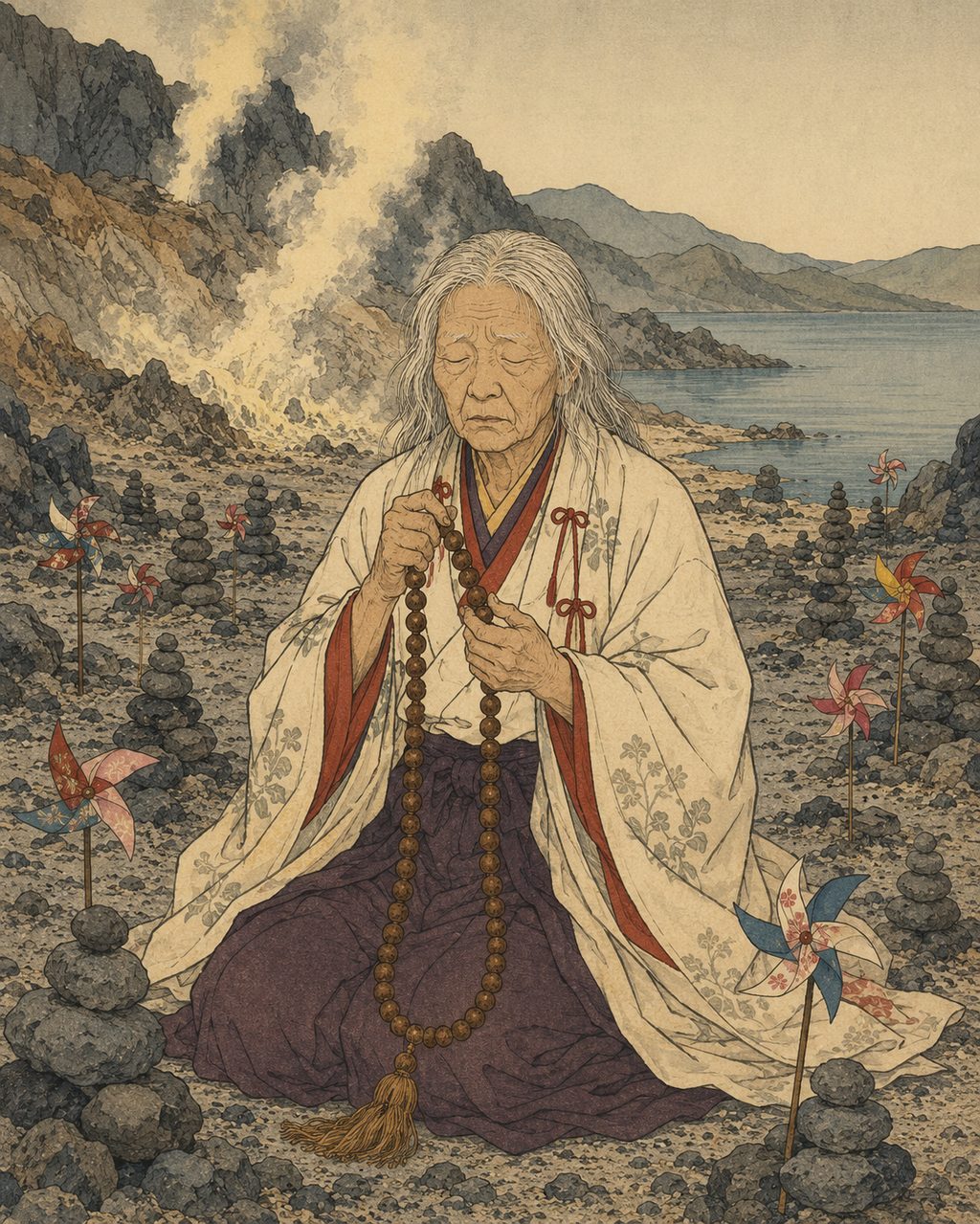
What sets Osorezan apart from ordinary temples and shrines is that it has been believed to be a "place to meet the dead." In Shimokita, it has been passed down that "when a person dies, their soul goes to the mountain (Osorezan)," and Gokurakuhama on the lakeside has been likened to the Sanzu River and Sai no Kawara (the riverbed of the underworld). The sight of countless pinwheels spinning dryly beside piles of pebbles built as memorials for young children who passed away is a direct earthly reflection of the world described in the *Jizo Wasan*, where children who predecease their parents stack stones at Sai no Kawara only for demons to knock them down. Walking step by step across the desolate, stony plain reveals hot springs bubbling beneath your feet and sulfurous fumes rising ── at the end of this hellish journey stands Jizo Bosatsu, ready to save the children. It is this Jizo worship that has fundamentally supported the memorial services for the dead[2]. Even today, worshippers stand at the water's edge of Gokurakuhama, stacking stones and clasping their hands in prayer for the peaceful rest of their deceased loved ones in the afterlife.
And it is the itako, the shrine maidens who perform spirit mediums, who made this mountain famous nationwide. Blind or visually impaired women apprentice themselves to a master itako, and after years of grueling training, they acquire the power to invite gods into themselves. Those who completed the training received from their master the "Odaiji,"[4] a certificate of full mastery, and itako prayer beads. Their arts are said to include "Kamikuchi," which asks the gods for fortunes, and "Hotokekuchi," which conveys the words of the departed who have achieved enlightenment to their bereaved families[4]. The fact that blind women chose this path was accompanied by the pressing circumstance that in an era of poor medical care, it was a livelihood for those who had lost their sight to make a living[4].
In truth, the connection between itako and Osorezan is not ancient; it is said that they began to gather at Osorezan in large numbers only after World War II[2]. During the grand festival from July 20 to 24 each year, and the autumn festival in October, itako traveling from Hachinohe and Aomori line up in tents pitched within the precincts. Worshippers seeking the words of their deceased loved ones form lines, sometimes waiting for hours, even nearly half a day, for their turn[2]. In an era that lost many family members to war, Osorezan's itako suddenly rose to prominence as a place where people could reunite with the dead through voices.
The dead of Osorezan are not yokai. However, it can be said that precisely because this is a land where the boundary between the living and the dead has become so thin, and where it is believed that the dead return with voices, tales of children's spirits taking up residence in houses and beings pulling people at the water's edge have been told with a particularly urgent reality. Osorezan serves as the "canopy of views on life and death" covering the entirety of anomalies in this prefecture.
Kuzuryu and Seiryu:
The Battle for the Dragon God of Lake Towada
If Osorezan is the mountain of the dead in Shimokita (Nanbu), Lake Towada is the lake of the dragon god in Nanbu. Straddling the border of Aomori and Akita prefectures, this caldera lake harbors the grand narrative that runs throughout the entire northern Tohoku region ── the Three Lakes Legend[5].
Kuzuryū
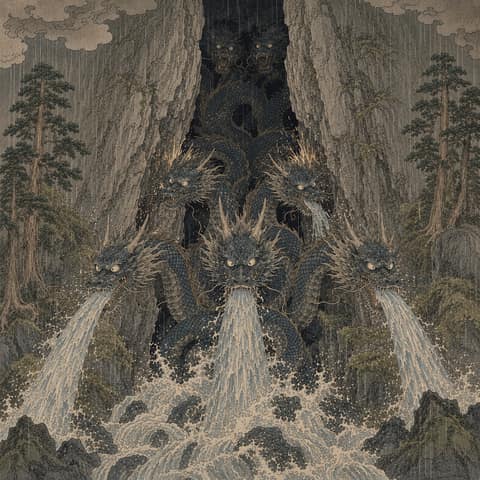
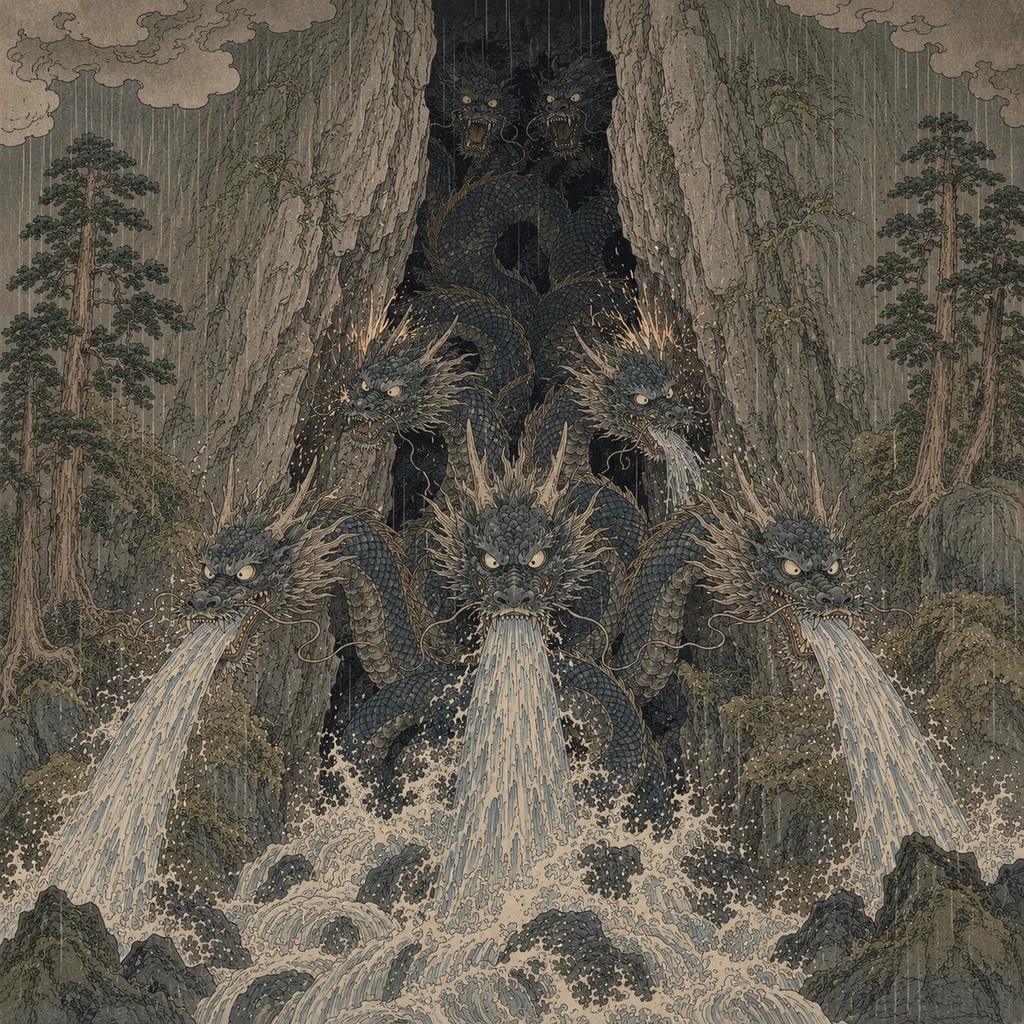
Kuzuryū, also written with the character for 'dragon' in an older form, is a nine-headed dragon worshipped as a water and rain deity and as a guardian of particular landscapes. Many traditions turn on the same transformation: a poisonous or violent dragon that once harmed people is subdued by an ascetic or eminent monk, abandons its demonic nature, and becomes a benevolent god. At Togakushi in Nagano, a nine-headed, dragon-tailed demon is said to have been sealed in a rock chamber through the merit of the Lotus Sutra by the ascetic Gakumon, also known as Gakumon Gyōja. It then settled as the local tutelary deity Kuzuryū Ōgami. At Hakone in Kanagawa, the monk Mangan is said to have subdued the poisonous dragon of Lake Ashi in the Nara period and enshrined it as the lake's guardian. In Echizen, Fukui, a Hakusan Gongen origin story tells of a nine-headed dragon swimming with a sacred image on its head, an episode said to explain the name of the Kuzuryū River. Rainmaking and flood control remain central, but regional worship also seeks relief from toothache, good relationships, and peace for the realm.
Read moreThe origin of the story was a single young man. Hachirotaro, a matagi (traditional hunter) who lived in Kazuno, went fishing for char in the mountains with his companions one day. While watching over the camp, he roasted three fish. They were so delicious that he ate one, then another, and eventually devoured all three, including his companions' shares. Suddenly struck by an intense thirst, he lay down by the mountain stream and continued to drink, but the thirst would not subside. As he drank, his body grew larger and larger, until he finally transformed into a dragon and became the master of Lake Towada ── the sorrow unique to those who live in these Tohoku mountains, unwillingly transforming into something inhuman, lies at the core of the Hachirotaro tale.
Then appeared Nansobo, a monk who trained under the Kumano Gongen. He received iron straw sandals and a khakkhara (monk's staff) from the god, along with an oracle: "Live in the land where the strap of these sandals breaks." After a long wandering journey, the strap of his iron sandals finally broke on the shores of Lake Towada[6]. This was the land of the oracle.
Hachirotaro, refusing to yield the seat of the lake's master, and Nansobo, who determined this as his dwelling. The two dragons fought fiercely for seven days and seven nights. It is said that Nansobo chanted sutras and transformed himself into a dragon with nine heads ── Kuzuryu, and with his body stretched to twenty hiro (about 36 meters), he bent it into ten (towa) to defeat Hachirotaro. The place name "Towada" is also said to originate from the "ten bends (towada)" where this dragon writhed its body[6]. Defeated, Hachirotaro was driven from the lake, drifted away, and settled in Hachirogata in Akita. Eventually, he married Princess Tatsuko of Lake Tazawa ── this dragon god tale that connects the three lakes of Towada, Hachirogata, and Lake Tazawa is the Three Lakes Legend[5]. One theory suggests that because Hachirotaro leaves Hachirogata to visit Tatsuko in Lake Tazawa during the winter, Hachirogata freezes shallowly and easily, while Lake Tazawa, where Tatsuko resides, runs deep and does not freeze. Even the local nature of the land has been explained by this story.
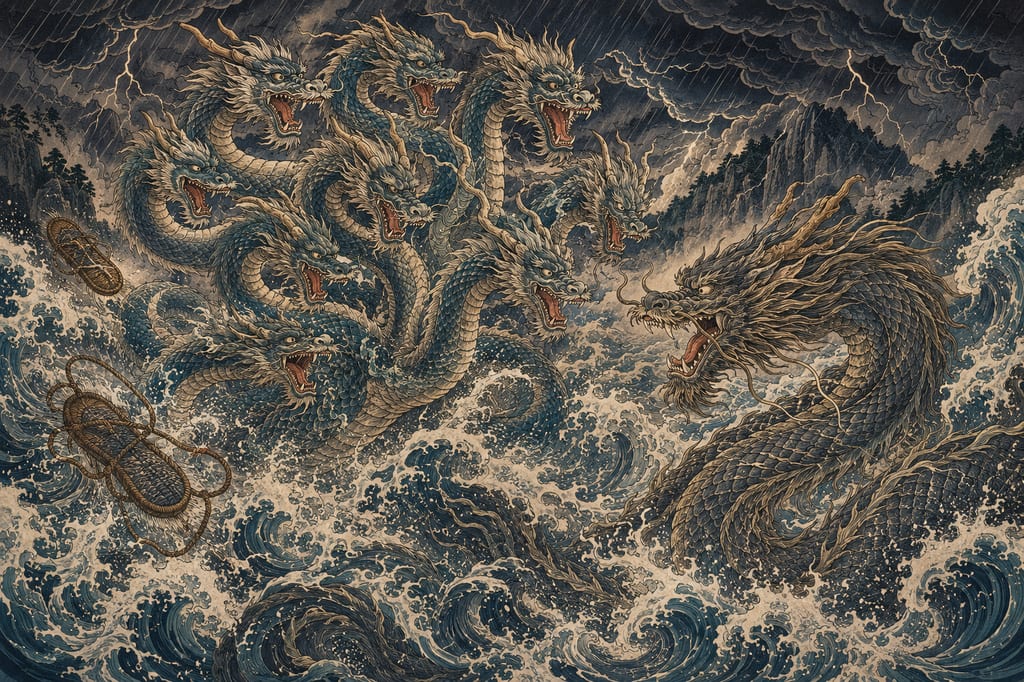
The victor, Nansobo, settled in the lake and was enshrined at Towada Shrine as Seiryu Daigongen. Although the shrine's tradition identifies the enshrined deity as Yamato Takeru no Mikoto, there are two theories regarding its founding: one claiming it was established by Sakanoue no Tamuramaro in 807 (the second year of Daido), and another attributing it to Nansobo. Formerly known as Kumano Gongen or Seiryu Gongen, it thrived as a training ground for yamabushi (mountain ascetics) since before the Kamakura period, and as a sacred site of the Nanbu domain during the Edo period[6]. Even today, iron straw sandals are dedicated at the Kumano Shrine within the precincts in honor of the founder, Nansobo.
The most vivid traces of dragon god worship still remain at this lake. "Uranaba (Divination Spot)," located by walking from the shrine into the mountains and descending an iron ladder to the lakeshore ── at this rocky area, also said to be the spot where Nansobo threw himself into the water, people cast "oyorigami" (paper infused with prayers) onto the lake surface. It has been believed that if the wish will come true, the paper sinks as if sucked to the bottom of the water, and if it won't come true, even heavy offerings will float away offshore[6]. A raging dragon subdued by a monk with spiritual power, or the monk himself turning into a dragon and transforming into a benevolent deity ── while this structure underlies the Kuzuryu worship of Togakushi, Hakone, and the Kuzuryu River in Echizen[7], in Towada it is rewoven into a fierce narrative uniquely characteristic of a northern mountain lake: "a death match between two dragons over the seat of the lake's master." Kuzuryu is spoken of in this land precisely as the core of such tales of water god struggles.
Zashiki-warashi:
The Child of Fortune Residing in Old Houses of Nanbu
While dragons fought over the mastery of the lake, a much smaller spirit resided inside the houses of Aomori. It is the Zashiki-warashi.
Zashiki-warashi
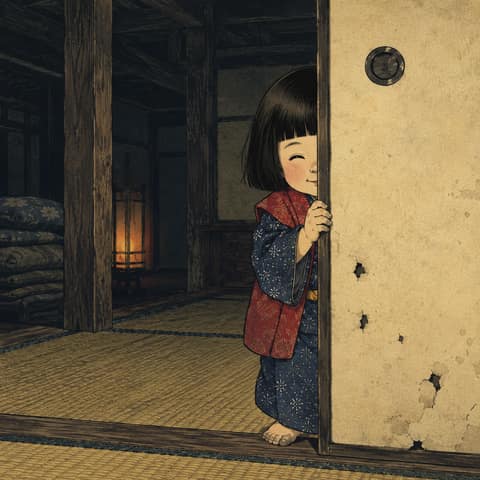
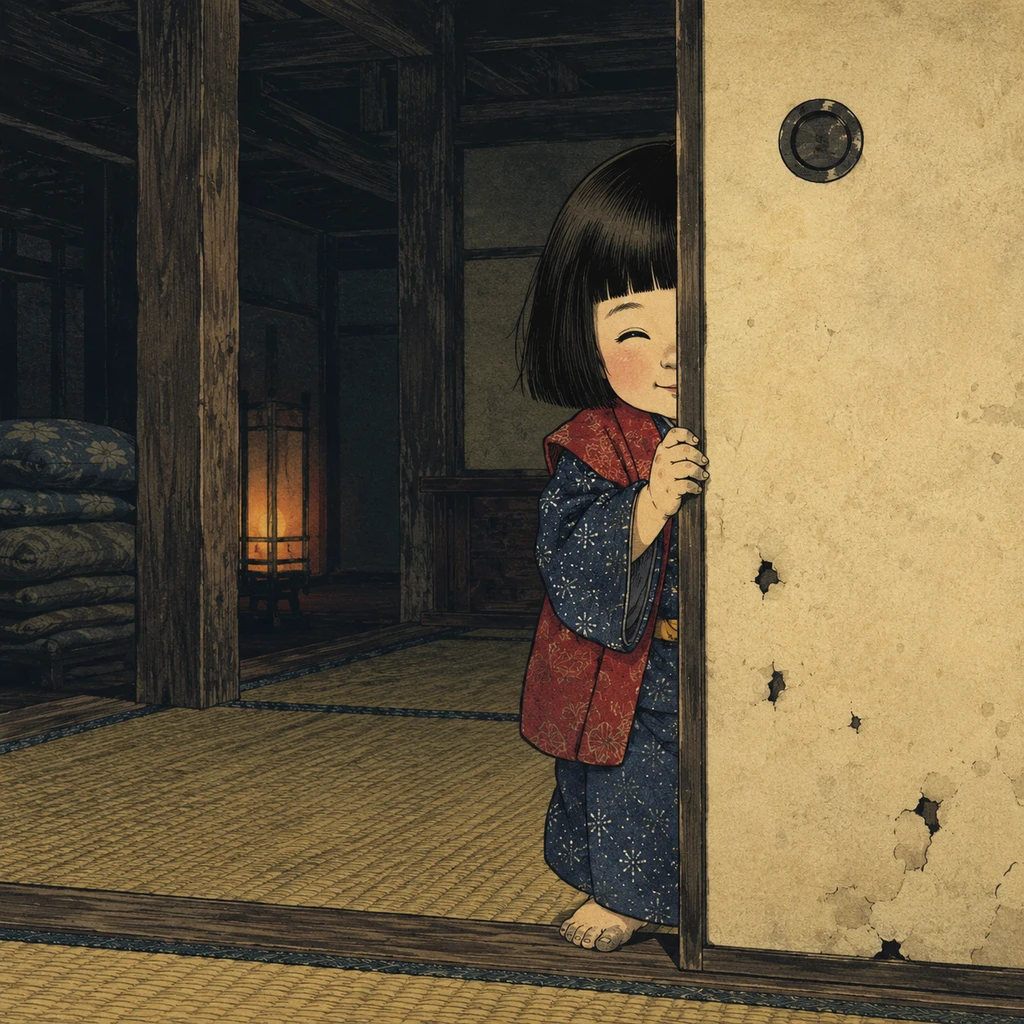
The zashiki-warashi is a household kami or uncanny presence said to dwell in old homes in Tōhoku, especially Iwate. It is often described in a child’s form, but no single appearance defines it. Kunio Yanagita’s Tales of Tōno, Tale 17 records a boy of about twelve or thirteen; in the same tale, an unseen presence makes itself known only by the rustle of paper in the next room and the sound of snuffling. Tale 18 speaks of two young girls, while later local accounts include a child in a red kosode, an old woman, an old man, and beings that show only long, slender hands. The zashiki-warashi is also associated with a household’s prosperity and decline. Tales of Tōno calls it a “kami” and says that a home where it dwells may enjoy wealth and distinction; other stories tell of a household’s fortunes failing after the child has left. This is not a uniform portrait of a capricious being that metes out punishment. It is a folkloric way of linking an inhuman presence felt within a home with that home’s flourishing and decline. The name “zashiki-warashi” seems to have functioned less as the proper name of one being than as an umbrella term for uncanny presences described inside the home. The setting may be a formal room, storehouse, kitchen area, earthen-floored room, or beneath the floor—spaces at the edge of daily life and the house itself. Such a presence may meet a person, or be reported only as a sound, an oppressive sensation, or an unfamiliar shadow. The child figure is an important representative image, not a standard form that erases the range of these accounts. Kizen Sasaki’s collected accounts do not reduce the zashiki-warashi to a simple “child who brings happiness.” They encompass distinct stories associated with formal rooms, storehouses, kitchens, and underfloor spaces, and their names vary from place to place. Some records consider links with the deaths of infants or infanticide, but Sasaki presents these as matters for comparison rather than declaring them the origin of every zashiki-warashi. The term names a broad and varied body of tradition: a sense that someone else is present within the home, carried forward through local memory and stories of a household’s fortunes.
Read moreWhen speaking of Zashiki-warashi, Iwate Prefecture, especially Tono and Kindaichi, is known as its heartland. However, the spirit of this child was widely distributed throughout the Tohoku region, centering on the former Nanbu domain, and the Nanbu region of Aomori Prefecture was also within that sphere. A child about five or six years old settles in the inner parlor or dirt floor of an old house, indicating its presence with the sound of footsteps running down the corridor at night or laughter. A house with a Zashiki-warashi prospers and flourishes, but a house abandoned by the child immediately declines and falls into ruin ── it was feared not merely as a child's ghost, but as a god of destiny that dictates the rise and fall of the household itself. For this very reason, old houses would set out meals for the unseen child and even leave an inner room empty for it.
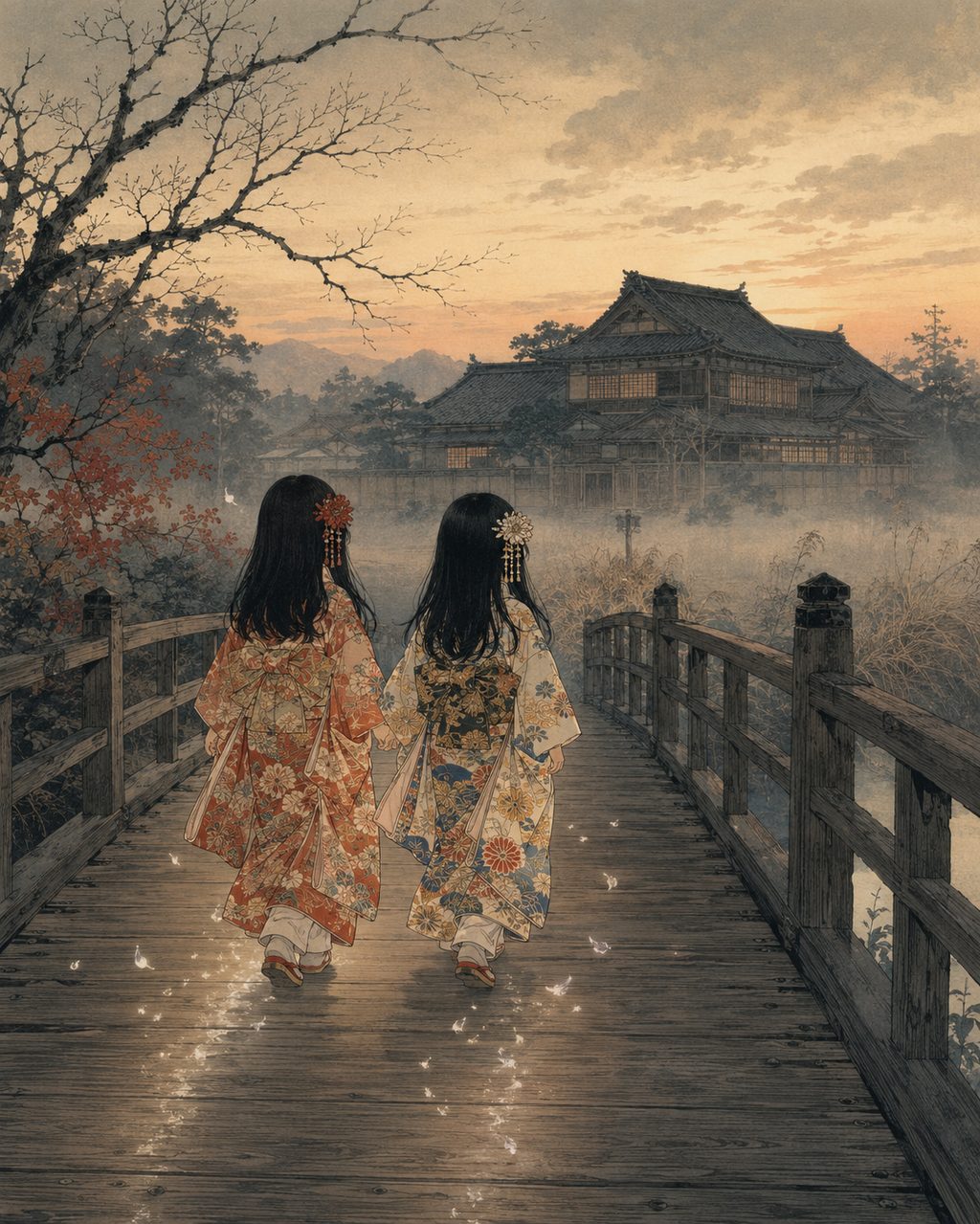
The one who spread the name of this child to the world was Kunio Yanagita in his *Tono Monogatari*[8] (1910). Particularly the scene where two young girls leave the house of Yamaguchi Magozaemon, an old family in Tsuchibuchi Village ── villagers passed two unfamiliar beautiful girls on a bridge, and when asked, "Where are you going?" they replied, "We came from Yamaguchi Magozaemon's house." The anecdote that shortly after, the entire family accidentally ate poisonous mushrooms and all twenty-plus members, including masters and servants, perished in a single day, illustrates the cruel absolute nature of a Zashiki-warashi's departure. The storyteller of *Tono Monogatari*, Kizen Sasaki, later authored *Tales of the Zashiki-warashi of Oshu*[9] (1920), recording that this spirit has clear ranks, ranging from the fair-skinned and beautiful upper-class "Chopirako" appearing in the inner parlor, to the "Notabariko" crawling on the dirt floor, and the "Usutsukiko" making sounds of pounding a mortar in the kitchen. Even among children of the same house, their rank was divided by where they appeared and how they behaved.
The background against which this child was spoken of with particular urgency in the Nanbu region lies in the cold weather damage and famines that repeatedly struck the northern Tohoku region. In years when the *yamase* (cold east wind) prevented rice from ripening, people lived side by side with starvation. Folklore studies have repeatedly interpreted the lower-ranking Zashiki-warashi as the spirits of infants who were culled to reduce the number of mouths to feed and buried under the floorboards. A spirit where the desperate desire for the family's prosperity merges with the dark guilt of having killed one's own child ── Kunio Yanagita viewed this as a localized version of Buddhism's Gohou-doji (guardian boy), while Shinobu Orikuchi argued it was an indoor version of a marebito (visiting deity) who visits the house from the outside. In the climate of Aomori, backed by the view of life and death of Osorezan, this reading resonates with particular gravity. The complete picture of Zashiki-warashi originating in the Tono region of Iwate is deferred to the Encyclopedia of Yokai in Iwate Prefecture.
Suiko-sama:
Tsugaru's Elevation of the Kappa to a God
If the east in Nanbu features dragon gods and Zashiki-warashi, the water god symbolizing Tsugaru in the west is Suiko-sama. This is a unique belief without parallel even within Aomori's yokai culture.
Suiko-sama (Water Tiger Deity)
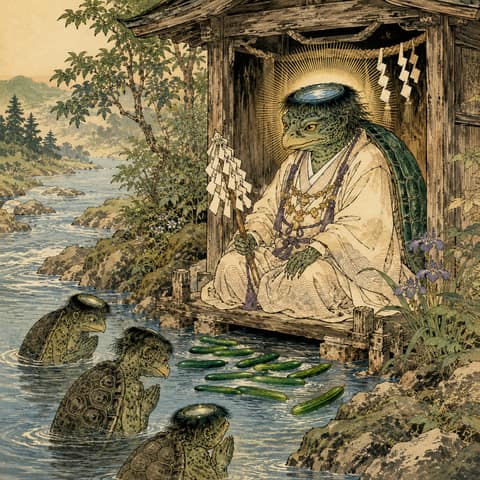
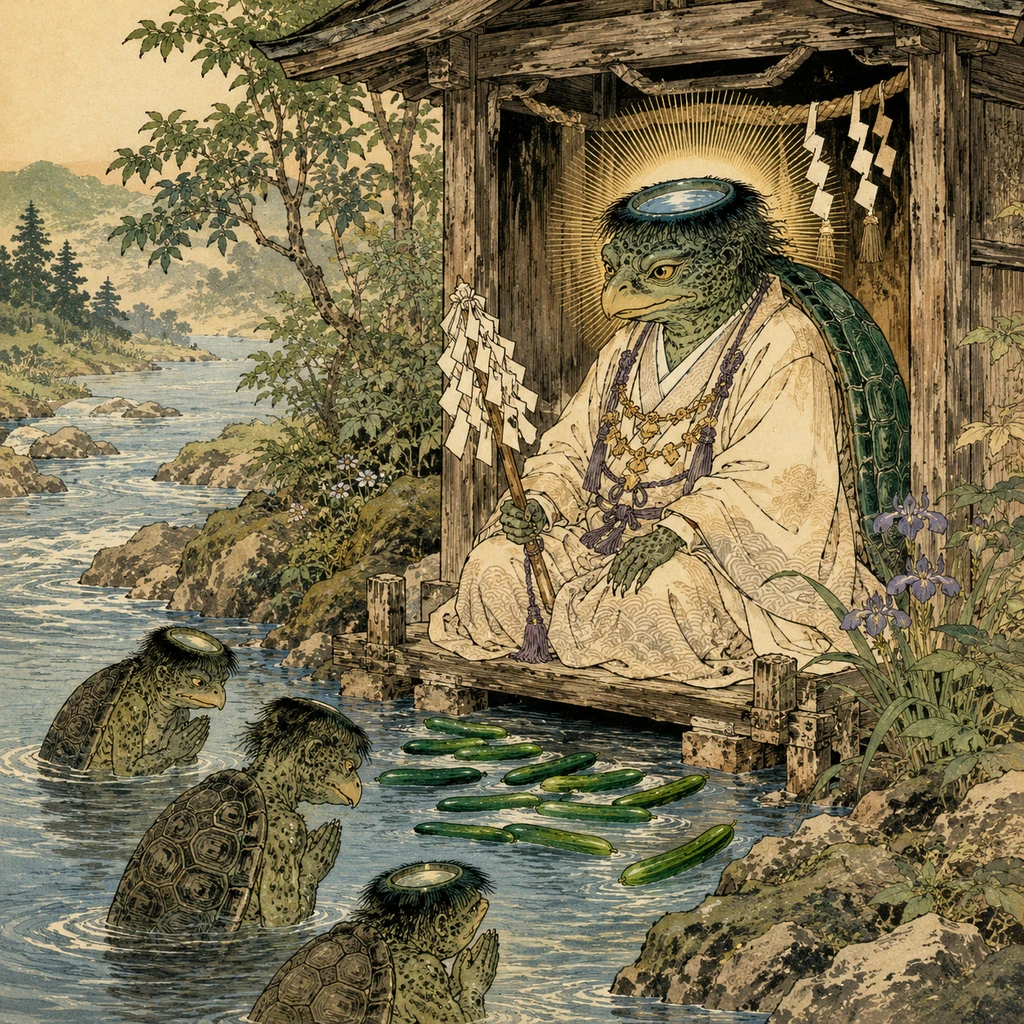
Suiko-sama is a water deity worshipped in the Tsugaru region of Aomori as a guardian against drowning; the formal name is "Suiko Daimyōjin". Counted among the retinue of the Dragon Palace (Ryūgū), it is described both as a higher being that commands the local kappa — here called *medochi* — and, in other tellings, as a kappa itself. Its sacred images are enshrined in small wayside shrines and halls, sometimes in the form of a kappa and sometimes borrowing the form of Benzaiten. In early summer by the old lunar calendar, people offered the first cucumbers of the year and set them adrift on the river, praying that their children would not lose their lives to the water. It shares only its written name with the Chinese "suiko" of the materia medica; in truth it is a water-deity faith that grew up on its own in Tsugaru.
Read moreIn the Tsugaru region, the kappa is called "Medochi" (also Medotsu or Mizushi). This name is thought to be a corruption of the ancient water spirit "Mizuchi" and belongs to a rather old lineage among the names for kappa[10]. With the height of a child and a black body resembling a monkey, it is a water-side demon that pulls people, especially children, to the bottom of the water. An essay *Tani no Hibiki*[11] written at the end of the Edo period by Rosen Hirao, a rural samurai of Hirosaki, Tsugaru, contains a vivid eyewitness account of a flat-bodied creature with a large head, about one *shaku* six or seven *sun* (around 50 cm), running out of the anus of a child who had been attacked by a Medochi and made to vomit water ── the nationwide superstition that a kappa extracts a person's shirikodama (a mythical ball in the anus) was spoken of in Tsugaru as a concrete anomaly tale.
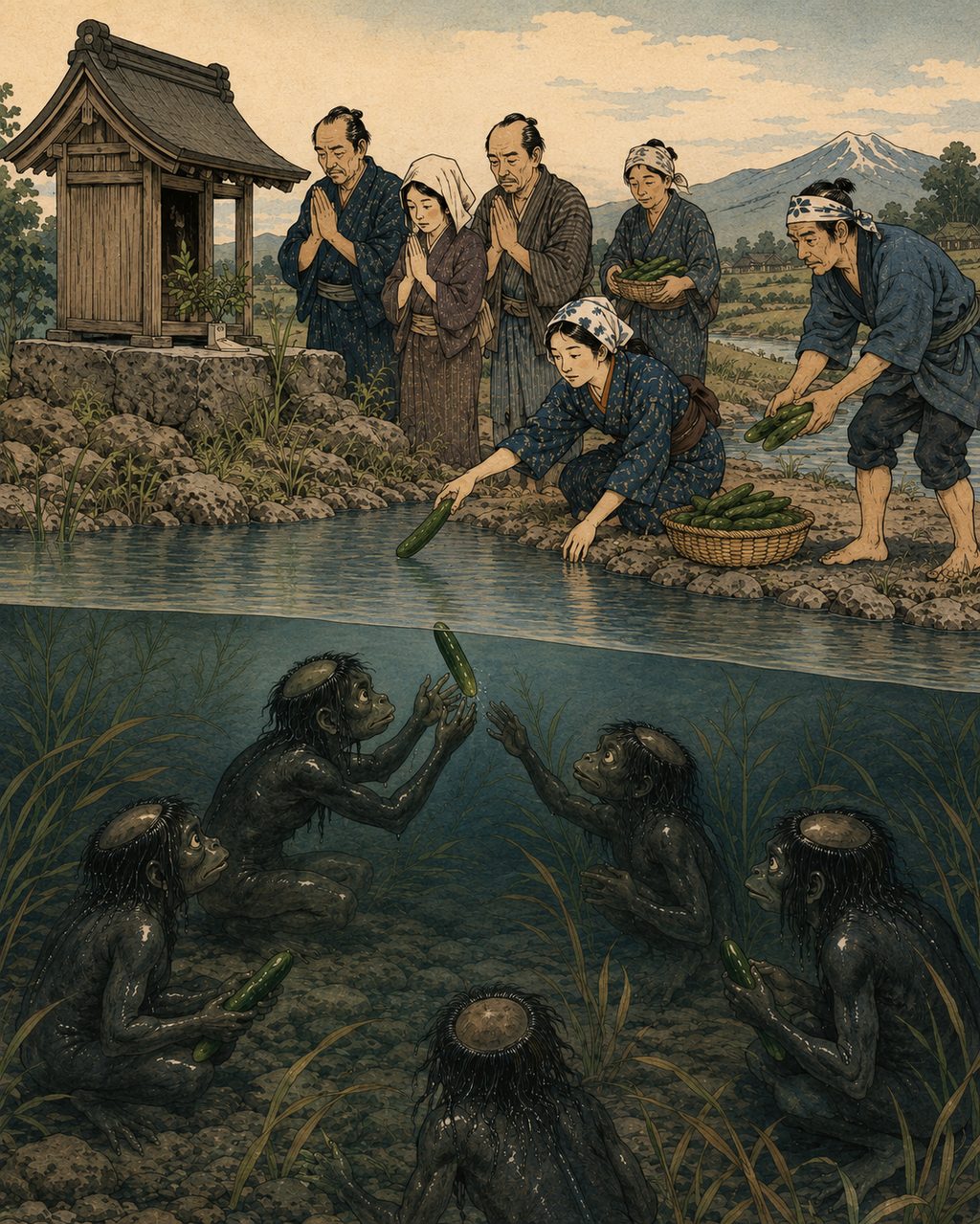
However, the people of Tsugaru did not exterminate this terrifying Medochi, but rather elevated it to a god. That is "Suiko Daimyojin" ── Suiko-sama[10]. Its origin is said to be Jisso-ji Temple of the Nichiren sect located in Kizukuri Village, Nishitsugaru District, present-day Tsugaru City. In the early Meiji period, the chief priest, pained by a series of water accidents in the river, performed incantations and determined the cause to be the curse of a kappa. It is said that by giving the kappa the divine status of Daimyojin, carving a pair of male and female kappa statues to enshrine, holding memorial services for those who lost their lives in water accidents, and quelling the curse, the Tsugaru belief in Suiko originated[12]. Folk shamans eventually began to use the name "Suiko Daimyojin" as the name for the Medochi (kappa) itself that had been in the land all along. Thus, Suiko-sama became a dual entity, both "the god that commands the kappa" and "the kappa itself."
The worship of Suiko-sama dots the riverbanks of the Tsugaru Plain around the foot of Mount Iwaki as small shrines and halls. Several halls enshrining Suiko-sama still remain in the Iwaki River basin from Tsugaru City to Goshogawara City. It was said that a single Suiko-sama, as a familiar of the Dragon Palace, commands forty-eight Medochi to quell disasters near the water[10]. From the fifth to the sixth month of the lunar calendar, when children begin to play in the river, people floated the first cucumbers of the season down the river, and each household received an amulet to guard against carelessness near the water. The nationwide superstition that kappa love cucumbers crystallized here as "offerings to Suiko-sama." The reason the divine statue sometimes takes the form of a kappa and other times borrows the appearance of Benzaiten is that they were superimposed as gods governing water. The detailed origins of the halls of Suiko-sama, including Jisso-ji Temple, are deferred to the section on Jisso-ji (Suiko Daimyojin).
What the belief in Suiko-sama demonstrates is the unique posture taken by the people of Tsugaru toward water, which is both a blessing and a threat. Rather than putting an end to it by extermination, they coexist with the object of awe by elevating it directly to a god ── Suiko-sama can be said to be the existence in Aomori that most fluidly traverses the boundary between humans and yokai. Distinct from Iwate where the kappa is spoken of as a mischief-maker, and Kyushu where it is familiarized as a water spirit fond of sumo wrestling, the pinnacle of northern water god belief lies here.
Mount Iwaki,
a Sacred Peak:
The Axis Piercing Tsugaru's Beliefs
In the center of the Tsugaru Plain dotted with shrines to Suiko-sama, Mount Iwaki (elevation 1,625 meters) towers as if overlooking the entire area. Affectionately called "O-Iwaki-sama" and "Tsugaru Fuji," this independent peak has been an object of mountain worship since ancient times. As the *ichinomiya* (highest-ranking shrine) of Tsugaru Province encompassing the Okumiya (inner shrine) at the summit and Mount Iwaki Shrine at the foot, it has formed the spiritual backbone of Tsugaru. On the northeastern foot of the mountain, a folk belief called "Akakura Belief," centered on shamans and ascetics and distinct from the Association of Shinto Shrines-approved Mount Iwaki Shrine, has also taken root, indicating that Mount Iwaki has gathered people's awe in both official and unofficial aspects[3]. This mountain, visible from anywhere on the Tsugaru Plain, was an indicator for farmers to divine crop yields and a landmark for fishermen to measure their position from the sea.
Indispensable in discussing Mount Iwaki is the grand festival "Oyama-sankei," held annually on the first day of the eighth lunar month. Crowds of people in white attire gather by village, raise banners, and ascend the mountain in groups late at night to pray for a bountiful harvest and family safety, viewing the sunrise from the summit. This procession advancing with the chant "Saigi Saigi" is Tsugaru's largest agricultural prayer festival, previously forbidden to women and allowed only for men to ascend, and is designated as a significant intangible folk cultural asset of the country. While it is uncertain when it began, its current form is said to have been established around the mid-Edo period, in 1719 (the fourth year of Kyoho)[3].
This sacred peak also carries legends tied to anomalies. Anju and Zushiou, known from the tale of Sansho Dayu ── because Anju is enshrined at Mount Iwaki, the god of Mount Iwaki loathed the people of Tango Province (present-day northern Kyoto Prefecture). It has long been passed down as a taboo that if someone from Tango entered Tsugaru, wind and rain would invariably continue, making even the entry and exit of ships impossible, and any Tango person who wandered in was strictly interrogated and driven away[3]. The tragedy of Anju, who was sold to slave traders and perished after hardships in Tango, was welcomed by the people of Tsugaru as their own mountain god, turning her grudge into a taboo of the land. Seeing a god in the mountain and superimposing human tragedy onto that god ── Mount Iwaki worship shows how intensely the people of Tsugaru have interacted with the mountain. The water belief of Suiko-sama and the mountain belief of Mount Iwaki. Tsugaru's anomalies are pierced by these two axes of water and mountain.
The Strait at the Northern Edge:
Sotogahama and the Terminality of the Tsugaru Strait
The land of Tsugaru possesses a place where the land finally ends. At Cape Tappi on the northern tip of the Tsugaru Peninsula, Honshu abruptly cuts off, and beyond that lies the Tsugaru Strait, swirling with rough tides. This sense of "the end" gives Aomori's anomalies a unique intensity. The world of the dead and this world, Honshu and Ezochi (Hokkaido), the realm of the living and the realm of the dead ── all boundaries overlap at this northern edge.
Symbolizing this terminality is the Yoshitsune Legend remaining in Minmaya at the northern end of the peninsula. The legend that Minamoto no Yoshitsune, who supposedly committed suicide in Hiraizumi, actually survived, crossed the Tsugaru Strait, and escaped to Ezochi has taken deep root in this land since the early modern period[13]. The place name Minmaya itself is said to originate from the "stable (umaya)" where Yoshitsune tied his horse before crossing the sea, and Gikeiji Temple, which enshrines Yoshitsune, stands on the cape. This story of a hero disappearing beyond the sea at the edge of the land tells us that the northern edge was simultaneously "the end of this world" and a "ferry port to the otherworld"[13].
Osorezan, where the souls of the dead gather, Towada, where dragons fight over the mastery of the lake, and the rivers of Tsugaru, where kappa are elevated to gods, are none unrelated to this sense of "the end." Because it is the place where the land ends and the sea begins, people have found passages to the otherworld there and felt the dead and yokai even closer. The Tsugaru Strait is the edge of the earth upon which Aomori's anomalies stand.
The Traveling Recorder,
Sugae Masumi:
The Eyes That Penned Tsugaru's Superstitions
The fact that these folklore traditions survive in concrete forms today is largely due to the existence of recorders who visited the land. Among them, Masumi Sugae, a traveler in the late Edo period, is particularly noteworthy.
Born in Mikawa Province (present-day Aichi Prefecture) in 1754 (the fourth year of Horeki), Masumi's real name was Hideo Shirai. After leaving his hometown in 1783 (the third year of Tenmei), he spent his life traveling throughout the Tohoku region, from Shinano, Dewa, and Ezochi to Mutsu. After 1796 (the eighth year of Kansei), he stayed in Tsugaru for an extended period, carefully recording his journey throughout the Sotogahama area ── from the eastern shore of Lake Jusan through Cape Tappi, Kodomari, and below Mount Byobu, reaching Ajigasawa ── in dated diaries and realistic illustrations[14]. His travelogues, which recorded with calm observation not only geography and scenic spots but also people's daily lives, festivals, and even waterside superstitions ── a series of excursion records including *Sotogahama Kisho*, serve as first-class testimony for understanding Tsugaru folklore[14].
Because travelers like Masumi diligently wrote things down, and because local rural samurai like Rosen Hirao recorded the incident of the Medochi in *Tani no Hibiki*[11], local narratives such as the mystery of the kappa, Suiko-sama, and the taboos of Mount Iwaki did not disappear beyond oral tradition but were passed down to the present. Yokai live by being spoken of and survive by being recorded. The richness of Aomori's anomalies stands upon the depth of the people who continued to speak of them and those who recorded them.
Conclusion:
Two Aomoris,
One Boundary
Osorezan, the mountain of the dead, and the dragon god struggle of Lake Towada. The Zashiki-warashi residing in the old houses of Nanbu, and the Suiko-sama elevated to a god by Tsugaru. The mountain worship of Mount Iwaki, and the water superstitions of Sotogahama ── while taking root in their respective cultural spheres of Tsugaru and Nanbu, the anomalies of Aomori stand commonly upon boundaries such as "the dead and the living," "humans and water," and "mountains and villages"[1].
In this land at the northern edge of Honshu, where the land ends at the Tsugaru Strait, the distance between the otherworld and this world is closer than anywhere else. For this very reason, the dead gather on the mountain, dragons fight over the lake, kappa are elevated to gods, and children hold the fate of houses. Amidst harsh nature and memories of starvation, people did not distance the objects of their fear but welcomed them as gods, offered them tribute, and tried to hear their voices. To visit the yokai of Aomori is nothing less than to ask how the people of the north have faced death, water, and mountains.