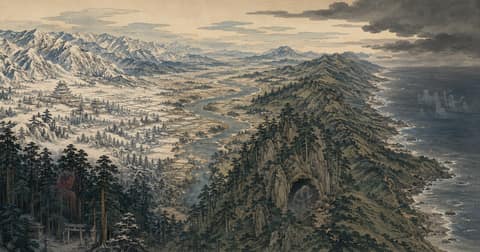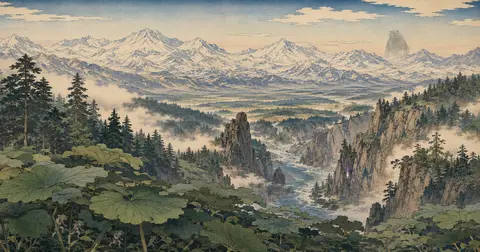
Miyagi Prefecture was the center of Mutsu Province in ancient times. In the first year of Jinki (724), the Inspector Ono no Azumabito built Taga Castle, establishing it as both the provincial capital of Mutsu and the Chinjufu, a military stronghold for the management of the Emishi peoples[1]. The present-day Sendai Plain is the place where the power of the capital penetrated deepest into the northeast. When discussing its yokai culture, Miyagi presents a double exposure: "how the capital viewed the frontier" layered upon "how the frontier reinterpreted the capital's narratives." The Seii Taishogun (Commander-in-Chief of the Expeditionary Force Against the Barbarians), dispatched from the central government, subjugates the demons—yet behind the triumphant telling of this victory quietly lie the mountains and seas of the vanquished.
The strange phenomena of this land can be broadly read in three distinct layers. First are the tales of heroes and fierce demons born from Sakanoue no Tamuramaro's northern expeditions, known as the "Tamura narratives." Second are the shape-shifting anomalies residing in the Hirose River and the deep pools flowing through the castle town, emerging after Date Masamune's founding of Sendai in the sixth year of Keicho (1601). Third are the massed spirits of those lost to shipwrecks, harbored by the ria coast stretching from Matsushima Bay to the Sanriku region. The ancient provincial capital, the early modern castle town, and the sea that has repeatedly brought tsunamis—Miyagi's yokai manifest in precise correspondence with these three geographies.
The Center Called Taga Castle — A Wedge Driven into the Northeast by the Capital
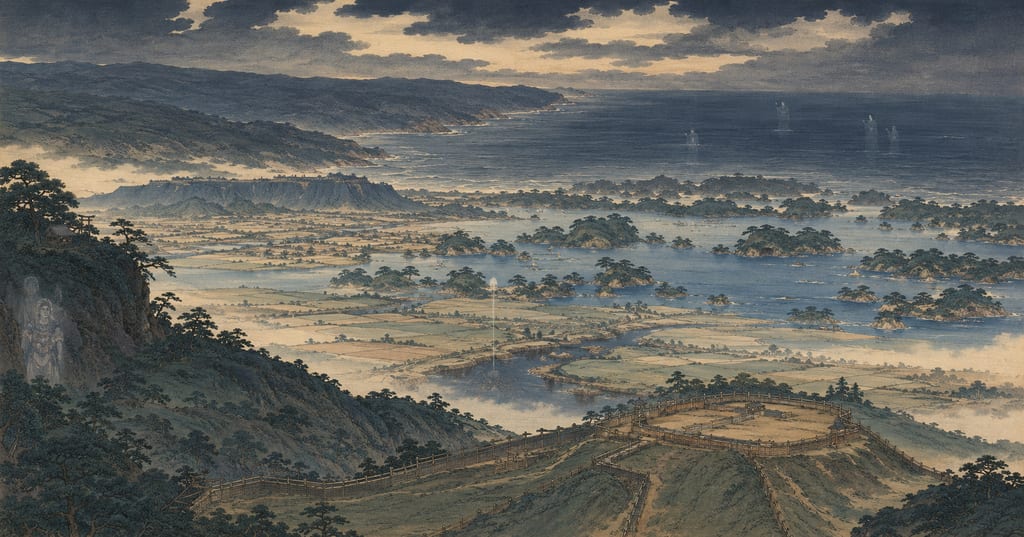
Before delving into Miyagi's yokai, one must first look at a single fortress. The ruins of Taga Castle, located in present-day Tagajo City northeast of Sendai, stand as a testament to history. In the first year of Jinki (724), the Inspector and Commander-in-Chief of the Defense Establishment Ono no Azumabito constructed Taga Castle here, serving as both the provincial capital of Mutsu and the Chinjufu throughout the Nara period[1]. The castle was an irregular square of about one kilometer on each side, situated on a hill overlooking the Sendai Plain. Surrounded by a pounded earth wall, it had gates opening to the south, east, and west. In the center lay the government office for administration, rituals, and banquets, surrounded by various official buildings and soldiers' dwellings. This castle was the deepest wedge the capital's power ever drove into the northeast.
According to archaeological excavations, the government office underwent four major phases of transformation. Phase I was its foundation by Ono no Azumabito; Phase II was a major renovation by Fujiwara no Asakari in the sixth year of Tenpyo Hoji (762); Phase III was its reconstruction following its destruction during the rebellion of Korehari no Azamaro in the eleventh year of Hoki (780); and Phase IV was its restoration after the great earthquake of Mutsu Province in the eleventh year of Jogan (869). The latter two phases—the process of recovering from two destructions: the Emishi rebellion and a massive earthquake—would directly form the soil of Miyagi's yokai culture. The memories of the northern conquest, and the memory of the sea swallowing the land. Both are etched into the strata of Taga Castle.
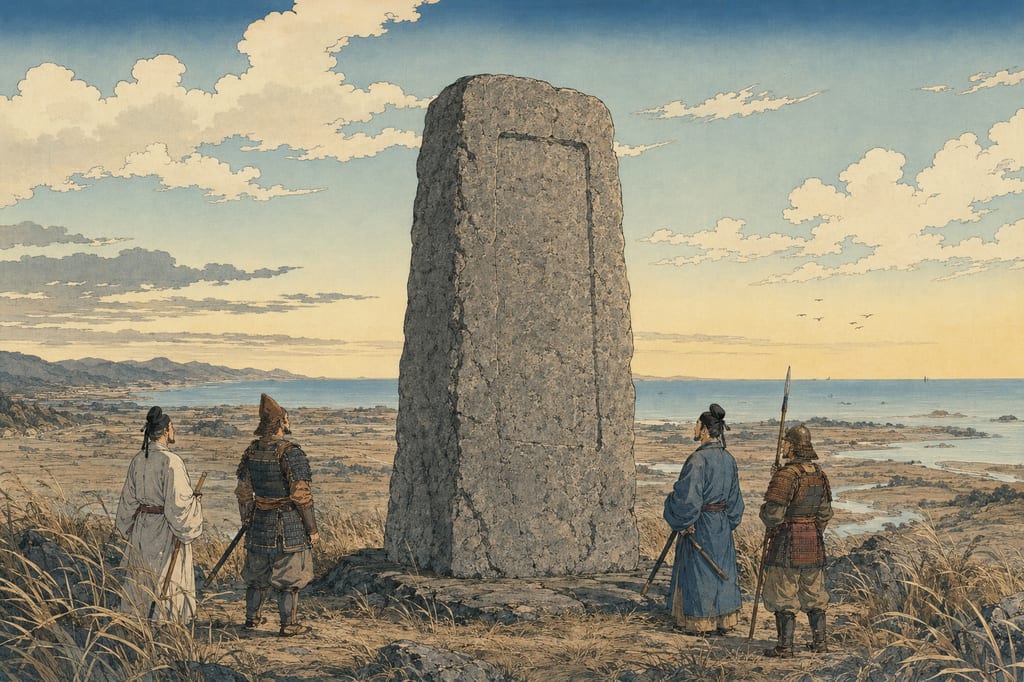
Near the front of the castle, the Taga Castle Monument (Tsubo no Ishibumi) still stands today. This granite-like sandstone monument commemorates the castle's foundation by Ono no Azumabito in the first year of Jinki and its renovation by Fujiwara no Emi no Asakari in the sixth year of Tenpyo Hoji. Standing over two meters tall, it is counted as one of the "Three Ancient Monuments of Japan," alongside the Nasu Kuni-no-Miyatsuko Monument and the Tago Monument[1]. Since it was excavated from the earth in the early Edo period, it has been widely known, often likened to the poetic place (utamakura) "Tsubo-no-Ishi." Although theories of forgery were proposed after the Meiji era, the dates of the government office renovations revealed by excavations closely matched the monument's inscriptions, and it is now recognized as authentic.
The Memory of Conquest — Tamuramaro and the Demons of the Northeast
The backbone of Miyagi's yokai culture is Sakanoue no Tamuramaro's northern expeditions. The historical Tamuramaro led an army of forty thousand as Seii Taishogun in the twentieth year of Enryaku (801) and secured the surrender of the Emishi leaders Aterui and More in the following year (802). Both Aterui and More were sent to the capital, and despite Tamuramaro's pleas for their lives, they were reportedly executed in Kawachi Province that same year[2]. In that year, Tamuramaro built Isawa Castle, and in the third year of Daido (808), the Chinjufu was moved from Taga Castle to Isawa Castle.
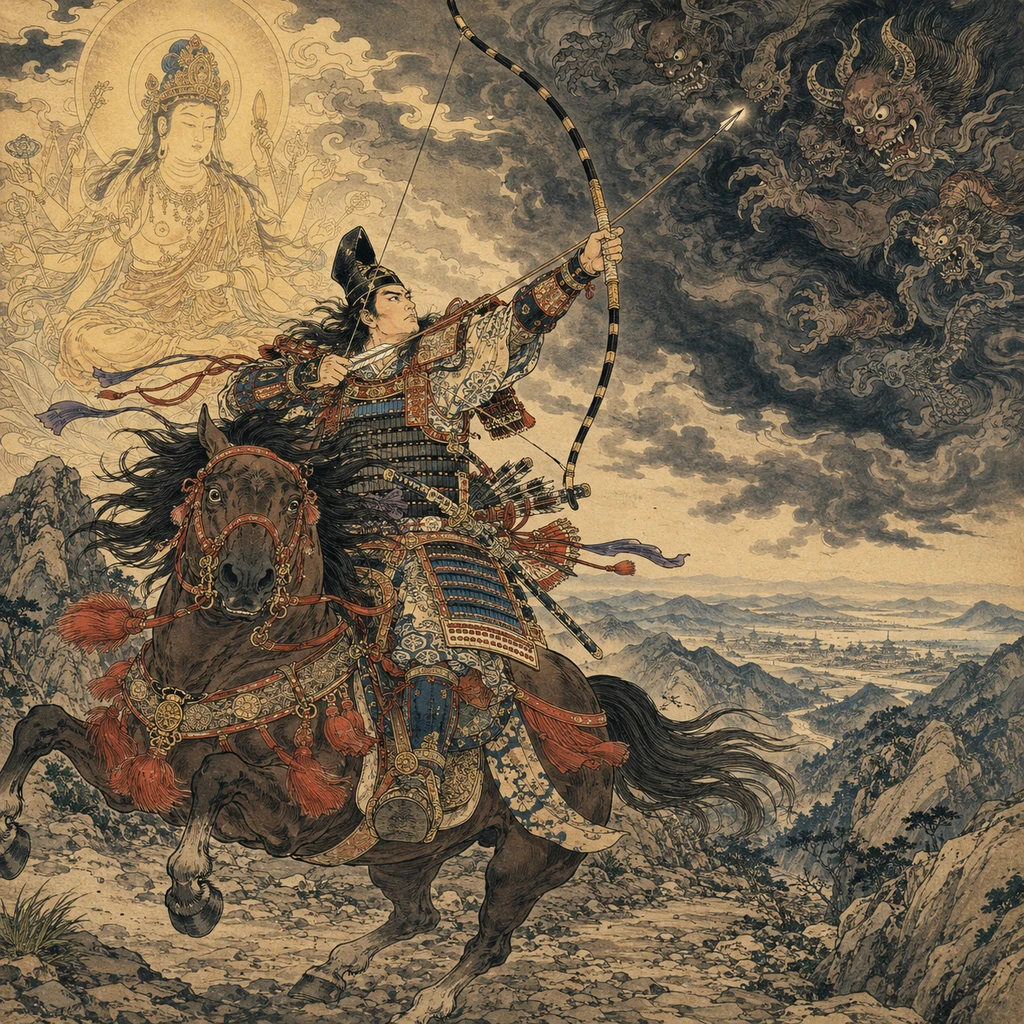
Sakanoue no Tamuramaro
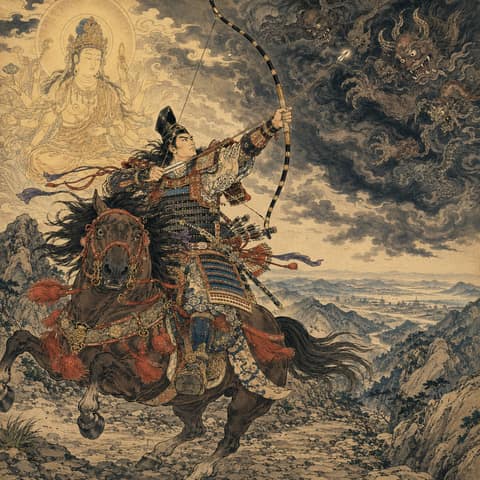
Sakanoue no Tamuramaro was a real military official who was active from the late Nara to the early Heian period, and after his death, he was enshrined as a divine general, Tamura Daimyojin, and a god of war to protect the capital. Historically, he served Emperors Kanmu, Heizei, and Saga, was involved in the Tohoku policy as Seii Taishogun (Commander-in-Chief of the Expeditionary Force Against the Barbarians), and was heavily relied upon during the Kusuko Incident. However, in the tales, war chronicles, and temple origins from the Middle Ages onwards, his figure departed from historical facts, transforming into Tamuramaru or General Tamura, who subjugates demons and ogres under the divine protection of Kiyomizu Kannon and Vaisravana (Bishamonten). Joined with Suzuka Gozen, he is the central figure of the "Tamura-gatari" (Tales of Tamura) that defeats Otakemaru, serving as the axis of heroic legends connecting Kyoto, Suzuka, and Tohoku.
Read moreWhat is important here is that the Sakanoue no Tamuramaro we discuss is not the historical military official himself, but his deified figure in later beliefs and narratives. Over the years, the historical subjugation was transformed into a heroic tale: "A general, blessed by the Kannon of Kiyomizu, quells fierce demons such as Akuro-o, Otakemaru, Takamaru, and Otakemaru."
One example where this tale crystallized into a sacred site is Takkoku no Iwaya in neighboring Mutsu (present-day Hiraizumi, Iwate Prefecture). It is said that in the twentieth year of Enryaku (801), Tamuramaro defeated Akuro-o, who had used this cave as a base. To commemorate the victory, he built a Bishamondo temple modeled after Kyoto's Kiyomizu-dera on the cliff face beneath the rock wall. Akuro-o is told to have led Emishi warriors like Akagashira and Takamaru, ravaging the vicinity and even appearing in the capital to abduct princesses. It is noteworthy that Akuro-o and Aterui are often conflated, yet have been treated as separate figures in tradition—the memory of the historical leader Aterui subtly shifted and survived as the vanquished demon "Akuro-o." The fact that manuscripts of the Akuro-o legend are distributed widely from Kurihara District in Miyagi Prefecture to Minochi District in Nagano Prefecture and Takasaki City in Gunma Prefecture indicates that this demon tale had a vast transmission sphere extending from the eastern provinces to the northeast.
Another suggestive image is carved into the rock wall of Takkoku no Iwaya. West of the hall is a giant Buddha face carved into the approximately sixteen-meter-high rock surface—the "Ganzen Daibutsu" (Rock-Face Great Buddha). Known as the "northernmost cliff Buddha," tradition holds that Minamoto no Yoshiie, the Governor of Mutsu, carved it with his bow from horseback to mourn the spirits of both allies and enemies who fell in the Later Three Years' War and the Former Nine Years' War. At the sacred site of conquest, a Buddha stands to mourn not only the victors but also the spirits of the defeated. This composition—where striking down and enshrining are inextricably intertwined—is the core sentiment of the northeastern demon tales, leading directly to the Makijo of Mount Maki in Ishinomaki, which we will examine next.
The Tamura narrative as a story is best crystallized in the Oku joruri (northeastern puppet theater) *Tamura Sandaiki* (The Tale of Three Generations of Tamura). The story of Mount Suzuka intersects with northeastern place names like Takkoku no Iwaya, Isawa, and Sanhasama, repositioning General Tamura as a hero who pacifies evil demons in various regions[3]. It should be noted that this was not a one-sided narrative from the center. The local regions actively drew the Tamura legends to their own shrines, temples, mountains, and mounds, retelling them in their own ways[4]. The memory of being conquered subtly inverts into a faith that worships the conqueror—this complex paradox is etched into the Tamura narratives of the northeast.
This paradox survives in its most vivid yokai form in the Makijo of Mount Maki in Ishinomaki.
The Makijo of Mount Maki in Ishinomaki — The Mountain of the Defeated
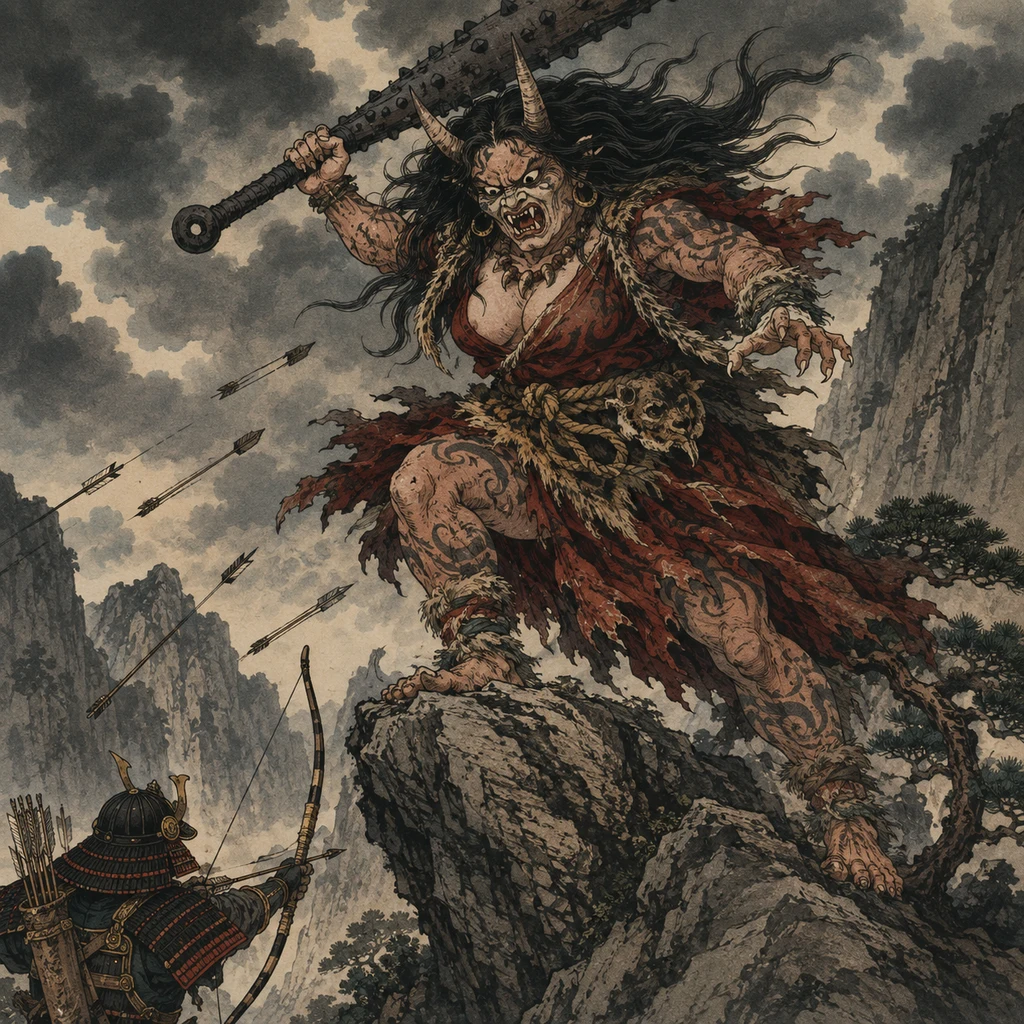
Maki-jo (Demon Woman)
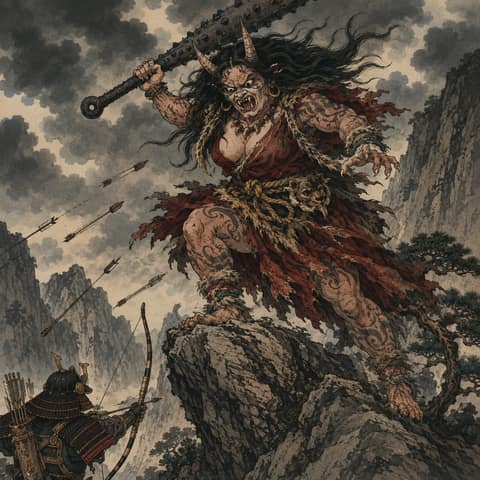
Maki-jo is a female oni said to dwell on Makiyama in Ishinomaki, Miyagi. She is described as one of the wives or concubines of the demon lord Ōtakemaru of Mount Nogakuzan. Her tale became tied to legends of the general Sakanoue no Tamuramaro’s oni-slaying campaign. On his return, the general is said to have enshrined a Kannon image in thanks, and Makiyama was once called “Maki-yama” (Demon Mountain). While temple-origin legends vary by source, the name Maki-jo appears in local records.
Read moreMount Maki is a mountain approximately 247 meters above sea level, located about three kilometers east of central Ishinomaki City[5]. It is said that the mountain was originally named "Makiyama" (Demon Mountain) or "Tatsumakiyama" (Tornado Mountain), which eventually changed to "Makiyama" (Pasture Mountain), and supposedly even became the origin of the place name "Ishinomaki." The *Makiyama Kannon Engi* (Origins of the Mount Maki Kannon Temple) recounts that Tamuramaro subjugated the demon clan that had entrenched itself in the Ishinomaki area, and finally pacified the region by slaying the chieftain's wife, the Makijo[5].
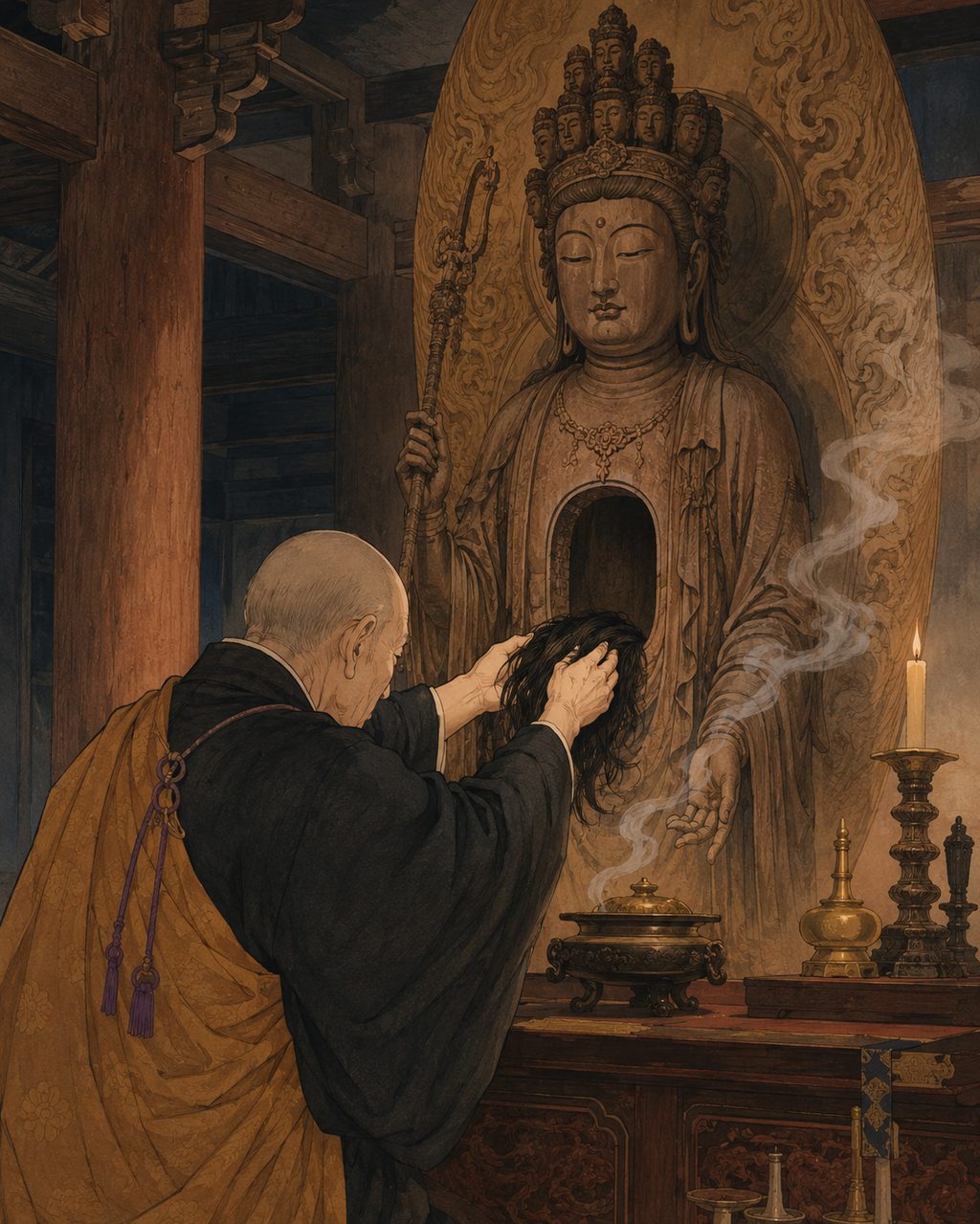
What is remarkable is that the slain Makijo does not merely end up as a defeated demon. The origin story conveys that Tamuramaro prayed to Kannon for the success of his demon-slaying expedition, and in gratitude for the divine favor, he enshrined a Kannon on every mountain where demons had resided. At Mount Maki, it is said that the Makijo's hair was placed inside the Kannon statue, and the Makiyama Temple was built. Some origin stories claim that three Eleven-Faced Kannon statues—at Tomiyama in Matsushima, Nonodake in Wakuya, and Mount Maki in Ishinomaki—were arranged to form a precise triangle. During the separation of Shinto and Buddhism in the Meiji era, the hall at the summit of Mount Maki became Reiyozaki Shrine, and the Eleven-Faced Kannon was moved to Chozen-ji Temple at the foot of the mountain. Yet here, alongside the statue of Tamuramaro, a statue representing the slain demoness has also been passed down[5].
The tradition of the Makijo lacks a solid core in historical documents. There are lineages of origin stories where the name Makijo itself does not appear, and some Three Kannon origin stories of Oshu speak of the sealing of Otakemaru but make no mention of the Makijo. The *Makiyama Kannon Engi* and *Oshika-gun Yorozu Oaratame-sho*[5] mention in a local gazetteer from the eleventh year of Genroku (1698) that "Tamuramaro established it in the seventeenth year of Enryaku," but this is a record from nine hundred years after the event, and cannot be considered evidence of historical fact. Precisely for this reason, what is certain is the fact that the land of Ishinomaki continued to remember the origin of its own name by linking it to "a demoness slain in the northern conquest." The mountain of the conquered takes on the narrative of conquest and re-enshrines it as Kannon. The Makijo is a yokai that condenses the paradox harbored by the Tamura narratives of the northeast into the name of a single mountain.
The Sendai Castle Town and the Hirose River — The Jorogumo of Kashikobuchi
In the sixth year of Keicho (1601), right after the Battle of Sekigahara, Date Masamune began constructing a castle on Mount Aoba, overlooking the Sendai Plain, and initiated the building of a castle town. Mount Aoba was a natural fortress, flanked by cliffs over sixty meters high to the east and a deep valley to the south, where Masamune placed his main enclosure (honmaru). The characters used for "Sendai" (仙臺) were said to carry the wish that the domain and its people would prosper peacefully forever, much like the world of divine hermits. Flowing right through this castle town is the Hirose River. And in the deep pools of this river dwelt Miyagi's most representative shape-shifting yokai.
Jorōgumo
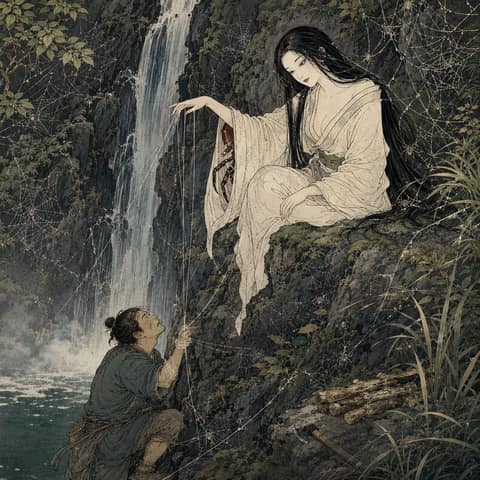
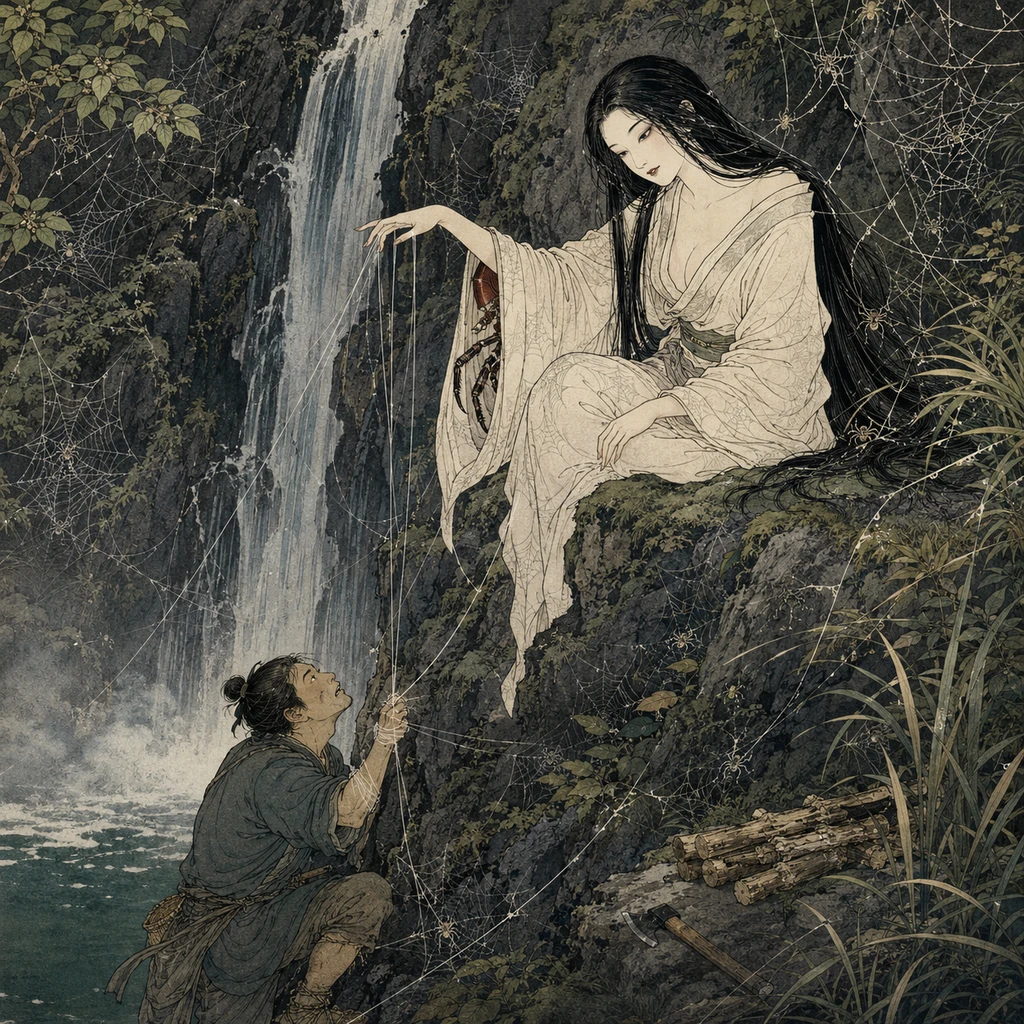
The jorōgumo is a Japanese yokai whose popular image coalesced from several distinct traditions: the name of a living spider species, early modern ghost stories of spiders transforming into women, Toriyama Sekien’s woodblock illustrations, and regional legends of spider pools (*kumobuchi*). Rather than a single beautiful woman dwelling at a specific waterfall, its appearance and behavior vary widely across historical eras and literary records. The written title 絡新婦 was not coined as a literal description meaning "a bride who entangles people." The *Wakan Sansai Zue* glosses the characters 絡新婦 with the reading *chorōkumo* and notes that it is "commonly called *jorōgumo*". The written name represents an intersection between a spider name found in classical Chinese materia medica and the spoken Japanese word *jorōgumo*. Tales of spiders appearing in female form predate Sekien’s art. In the 1677 collection *Tonoigusa*, a samurai grows suspicious of a young woman carrying a child and strikes her with his sword; the following day, he finds a slashed, dead *jorōgumo* alongside numerous human skeletons in the ceiling crawl space. In the 1732 collection *Taihei Hyaku Monogatari*, a man named Magoroku from Sakushū Takada is invited by an older woman into an illusory mansion where a young maiden urges him to marry her; when he flees, he returns to his own veranda, only to discover a tiny *jorōgumo* and an enormous cluster of webs beneath the eaves. Magoroku is not devoured; the narrative centers instead on the hazy boundary between dreams and illusions. In his 1776 work *Gazu Hyakki Yagyō*, Toriyama Sekien gave the title "Jorōgumo" (絡新婦) to an illustration depicting a long-haired woman in flowing robes overlaid with spider legs, surrounded by a swarm of tiny spiders. Wavy lines extending from the spiderlings suggest silk threads, smoke, or fire, but the print includes no explanatory text, nor does it depict a musician seducing a man. A bibliographic investigation conducted by the National Diet Library likewise found no classical literary source that matches the popular modern story of a beautiful woman playing a biwa lute to lure men and ultimately devour them. Waterside traditions of the jorōgumo reflect an entirely separate layer of folklore. Tales of "spider pools" (*kumobuchi*)—in which a spider attaches a thread to a person's foot, only for the individual to shift the silk onto a tree that is then dragged into the water—are distributed throughout Japan. At Jōren Falls, this thread-shifting motif merged with a taboo legend about a woodcutter who retrieves his dropped hatchet from a beautiful woman and dies after breaking his promise of silence, creating the famous Jorōgumo lore known today. Recognizing the differences among these sources reveals the jorōgumo not as a simple seductress, but as a yokai that mirrors human carelessness toward tiny creatures, the boundary between dreams and reality, the hazards of waterside terrain, and the cultural process by which names and images weave disparate legends together.
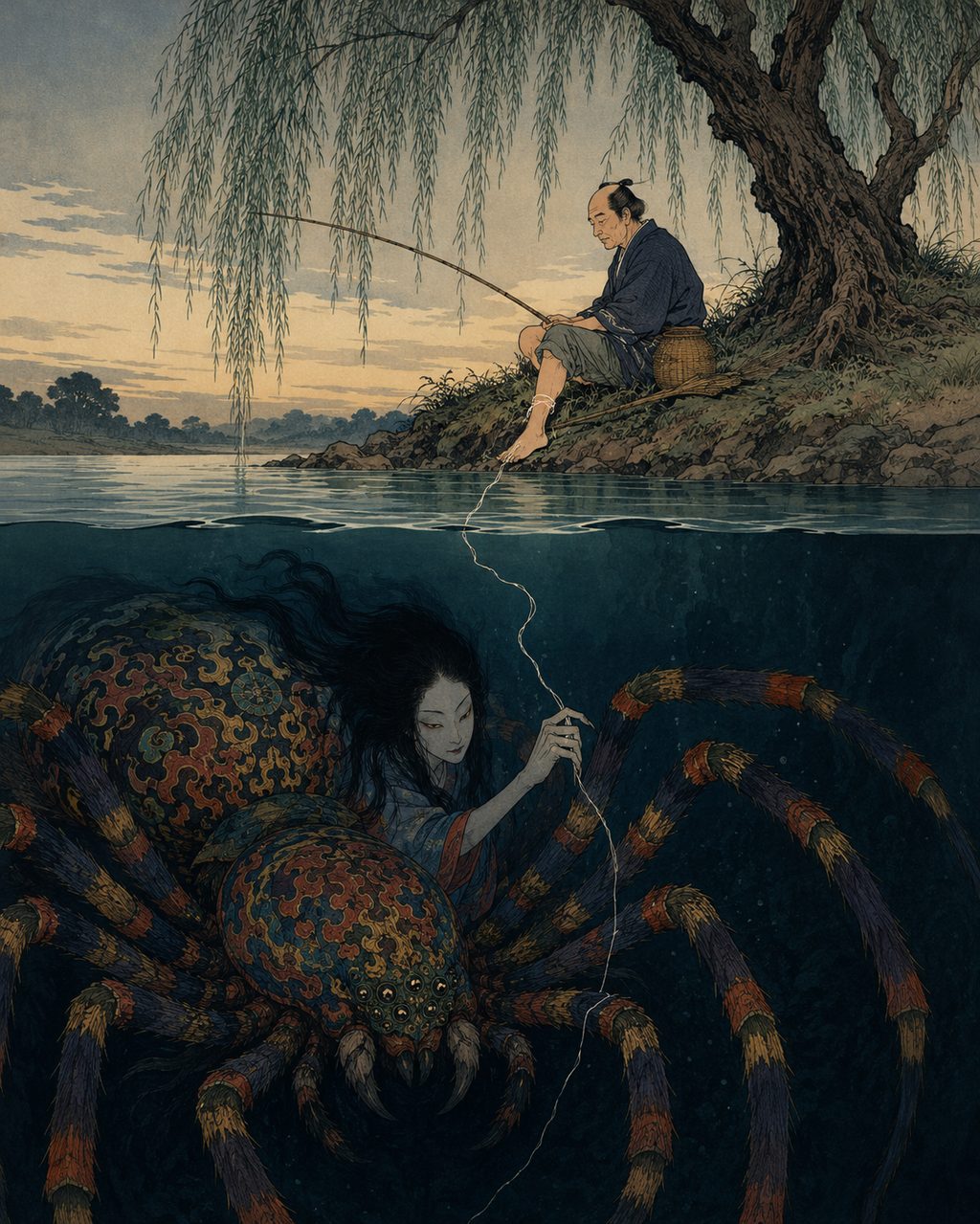
Read moreKashikobuchi, located near the Ushigoe Bridge in Aoba Ward, Sendai City, is known nationwide as a site of Jorogumo (Entangling Bride / Spider Woman) legends. A spider repeatedly cast its thread onto the leg of a man fishing in the pool. Each time, the man moved the thread to the base of a large willow tree beside him. Suddenly, that willow tree was dragged into the depths of the pool, and a voice could be heard from the bottom of the water: "Kashikoi, kashikoi" (Clever, clever). This is said to be the origin of the pool's name, "Kashikobuchi" (Clever Pool). By his quick wits, the man had attached the thread to a proxy stump (the willow) and escaped disaster.
This structure of the "proxy stump" is common to Jorogumo pool legends found across the country, such as at Joren Falls in Izu. The *Tonoi Gusa* (Night Watch Grass) tells of a young warrior seduced by a woman holding a child; when he slashes the woman, he finds a giant spider, one or two shaku in size, dead in the ceiling[6]. The *Taihei Hyaku Monogatari* (A Hundred Tales of Great Peace) records that Magoroku of Takada in Mimasaka Province was lured by a woman to a phantom mansion, only to wake up finding the eaves covered in spider webs[7]. It is believed that the actual ecology of the Nephila clavata (Jorō spider), which spins webs to catch its prey, was superimposed upon the monstrous allure of a beautiful woman ensnaring men. However, what makes Miyagi's Kashikobuchi stand out is the subsequent development. People who escaped disaster eventually began to worship the spider of this pool as a deity protecting against water-related calamities. Even today, a monument inscribed with "Myoho Kumo no Rei" (Spirit of the Wondrous Dharma Spider) and a torii gate remain on the cliff overlooking the pool. Around the Hirose River, there is also a legend of a fierce territorial dispute between the spider upriver at Ushigoe Bridge and an eel downriver at Tosukebuchi. The Jorogumo was thus elevated from a mere terrifying monster to a dependent of the river master, a water deity. Much like the Makijo who was slain and then enshrined, the Jorogumo of Kashikobuchi is another Miyagi anomaly that stands in the space between awe and faith.
It should be noted that Sendai's urban mysteries are not limited to its river pools. The prosperity of the castle town brought about by Masamune inevitably invited rumors characteristic of a bustling human settlement. By the time Basho visited Sendai in the second year of Genroku (1689) during his journey for *The Narrow Road to the Deep North*, the town was already thriving as a starting point for tours of poetic places (utamakura), with the artist Kaemon gifting Basho a map of famous places in Matsushima and Shiogama. The early modern city of Sendai functioned as a space where the city, utamakura, and the supernatural overlapped.
Oshima in Matsushima — The Island of the Pure Land Where the Dead Gather
Heading out to the sea from Sendai, Matsushima Bay opens up before you. It is famous as one of Japan's Three Most Scenic Views, alongside Amanohashidate and Miyajima, but its status as a tourist destination is relatively recent, dating from the mid-Edo period onwards when Basho's *The Narrow Road to the Deep North* became widely read. Before then, Matsushima was primarily a sacred ground for mourning the dead.
At its core is Oshima, a small island connected by the vermilion-lacquered Togetsukyo Bridge. Medieval Matsushima was a site of memorial services for the dead, sometimes called the "Koya of Oshu." Once, 108 caves were carved into Oshima, and about fifty still remain today[8]. Around the caves, numerous stone stupas—known as itabi—were erected to pray for the deceased's rebirth in the Pure Land. It is said that in the first year of Choji (1104), the monk Kenbutsu Shonin, who had traveled from Hoki Province (present-day western Tottori Prefecture), built the Myokakuan hermitage on this island and continued to chant the Lotus Sutra for twelve years. The fame of Kenbutsu Shonin, who was said to have gained spiritual power after reciting the Lotus Sutra 60,000 times, reached all the way to the capital, and Emperor Toba bestowed upon him a thousand pine saplings. This is said to be the origin of the name "Sen-Matsushima" (Thousand Pine Islands), which eventually became "Matsushima"[8].
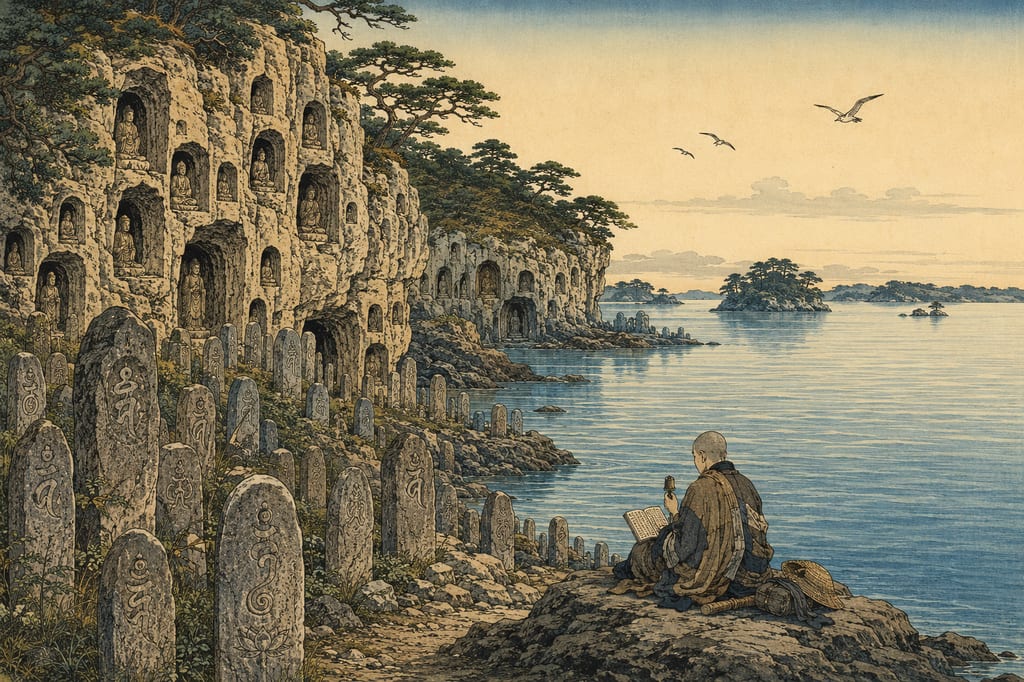
What becomes apparent here is the fact that the sea of Miyagi was conceptually viewed from the very beginning as a "gathering place for the dead." The same sensibility by which the fishing villages of Sanriku mourned the dead claimed by tsunamis had crystallized in an older layer as the island of stone stupas in Matsushima Bay, praying for rebirth in paradise. If the Funayurei are spirits wandering the sea, Oshima is the island of prayer that welcomes the dead to the shore and sends them off to the Pure Land. Wandering spirits and departing spirits. The sea of Miyagi encompasses both these extremes. Basho and his companions also crossed over by boat from Shiogama, touring Oshima, Zuigan-ji, and Godaido, touching the spirituality of this sea.
The Sanriku Sea — The Memory of Funayurei and Tsunamis
The third geography of Miyagi's yokai culture is the sea. From the archipelago of Matsushima Bay to the ria coast of Sanriku. The intricately indented bays and the rich fishing grounds where warm and cold currents collide have simultaneously invited shipwrecks and tsunamis time and time again. It is on this sea that the massed spirits of the shipwrecked—the Funayurei (Boat Ghosts)—appear.

Funayūrei
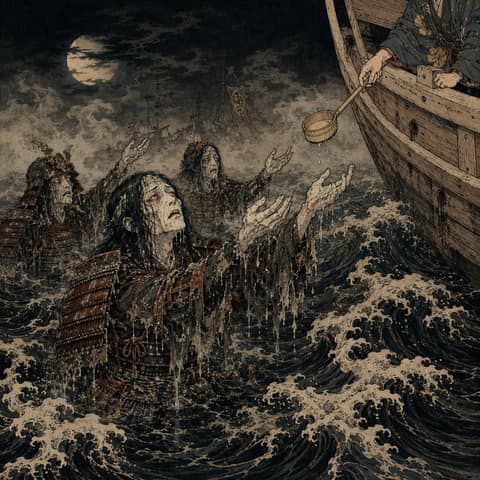
Funayūrei are maritime apparitions formed from the spirits of people who died by drowning or shipwreck. Depending on the region, they may appear as ghosts, phantom boats, eerie lights, or dark figures resembling Umibōzu. They most often emerge on stormy or fogbound nights, when they try to sink a vessel by ladling seawater aboard or confuse its course until it runs aground. Local defenses include offering a ladle with its bottom removed, throwing rice balls or ash, or meeting the ghosts with an unwavering stare. Mōjabune, Bōko, and Ayakashi are among the names applied to such spirits. Toriyama Sekien also depicted Funayūrei in Konjaku Gazu Zoku Hyakki.
Read moreThe Funayurei are said to be the spirits of people who perished at sea due to storms or disasters, lingering on the ocean as ghosts because of their worldly attachments. They are passed down in legends along coasts nationwide, but the methods of dealing with them show strong regional variations. Takehara Shunsensai's *Ehon Hyaku Monogatari* (Picture Book of a Hundred Tales) depicts the Funayurei appearing in the Western Sea as the vengeful spirits of the Heike clan, armored ghosts demanding, "Give us a dipper!"[9]. The most widely known defense is to knock the bottom out of a dipper or bowl in advance, handing them a bottomless vessel so they cannot bail water into the boat to sink it. In Miyagi, the Funayurei have an alternate name, "Akatori Kase" (Lend me a bailer), and a unique countermeasure is also passed down: if you stop the boat and glare at them intently, they will disappear. In Kochi, people throw ash or mochi; in Nagasaki, woven mats or ash; and in Chiba, when called out to "Lend us an inada (bailer)," they hand over a bottomless dipper. A taboo is also spoken of: if you fish on the sixteenth day of the Bon festival, the dead will gather at the gunwales and try to sink the boat[9]. The Funayurei have been feared as the collective spirits of the drowned, appearing precisely on the seas of the Bon festival or during foul weather.
This memory of the sea carries a weight in Miyagi that transcends mere yokai. The ria coast features a topography that funnels waves into the depths of its V-shaped bays, amplifying their height, and the fishing villages of Sanriku have been repeatedly swallowed by tsunamis since ancient times. The Meiji Sanriku Earthquake Tsunami of June 15, the twenty-ninth year of Meiji (1896), recorded a run-up height of over twenty-four meters in Ryori, Iwate Prefecture (present-day Sanriku-cho, Ofunato City), and claimed more than half the population of Kamaishi. The Showa Sanriku Earthquake Tsunami of March 3, the eighth year of Showa (1933), also reportedly reached a run-up height of over twenty-eight meters in Ryori. The lore of the Funayurei, seeing the massed spirits of the dead in the stormy or Bon festival seas, is born from nothing other than the indelible, lived reality of the coastal people who have repeatedly had their flesh and blood stolen from them.
However, the sea of Miyagi is not solely a place of terror. Kinkasan, a sacred island with a circumference of 26 kilometers and an elevation of 445 meters floating off the coast of the Oshika Peninsula, has been counted as one of the "Three Great Sacred Grounds of the Eastern Deep North" alongside Mount Osore and the Three Mountains of Dewa[10]. Koganeyama Shrine is enshrined on the island, dedicated to Kanayamahiko no Mikoto and Kanayamahime no Mikoto, deities who govern minerals, commemorating the first gold production in Japan that occurred in Mutsu during the Nara period. The memory of the land that offered gold for the construction of Emperor Shomu's Great Buddha made the island itself a sacred precinct. The belief that three consecutive years of pilgrimage will ensure one never suffers from financial hardship in life continues to draw endless worshippers to this day[10]. The sea that steals the dead in tsunamis, and the sea that grants gold and turns an entire island into a divine domain. One must not overlook the fact that beneath the dark surface of the sea where the Funayurei appear, this faith in the sacred sea lies contiguous. Fear and wealth, disaster and blessing—the sea of Miyagi simultaneously holds two contradictory faces.
The memory of the sea swallowing the land dates back over a millennium. In the eleventh year of Jogan (869), a massive earthquake struck Mutsu Province, and the *Nihon Sandai Jitsuroku* (The True History of Three Reigns of Japan) records that the seawater rushed up the rivers, turning wilderness and roads alike into an endless ocean, reaching all the way to the castle town[11]. This "castle town" is thought to refer to the area around Taga Castle, where the provincial capital of Mutsu was located at the time. The Phase IV reconstruction of the Taga Castle government office was precisely the recovery from this Jogan disaster. The memory of the sea swallowing the land was etched into text in this region over a thousand years ago.
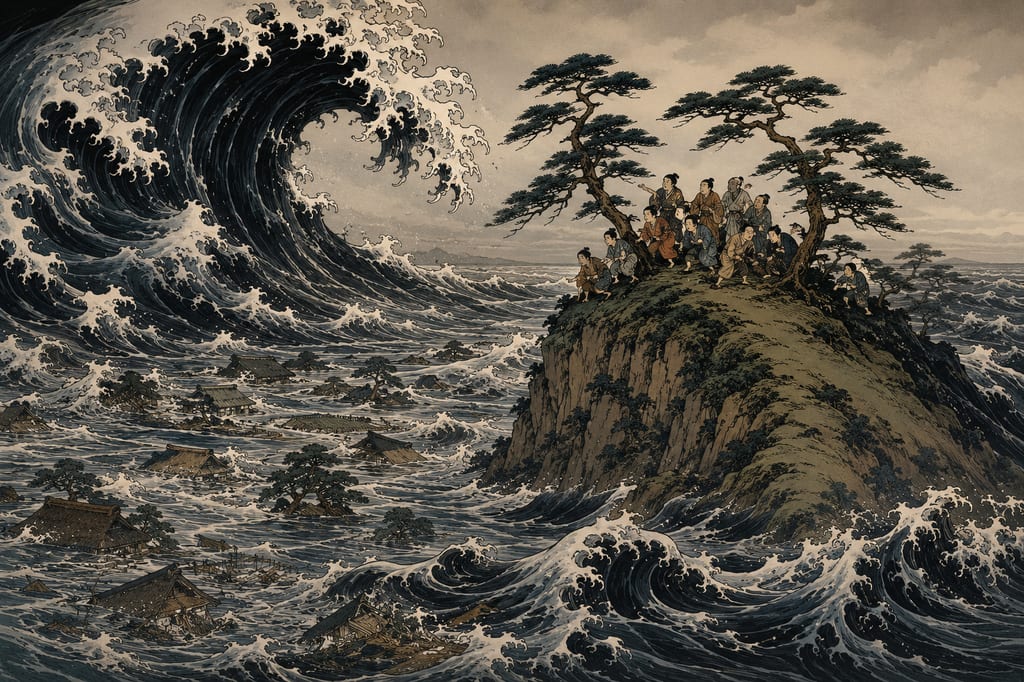
And conveying that memory to the present as an utamakura is "Sue-no-Matsuyama" (The Pine Mountain of Sue) in Tagajo. Kiyohara no Motosuke's poem, "Pledging our love, wringing our sleeves / Even if waves were to cross Sue-no-Matsuyama, our bond will not break," uses the impossibility of waves crossing Sue-no-Matsuyama as a metaphor for an unbreakable vow. In the second year of Genroku (1689), Matsuo Basho visited the Taga Castle Monument (Tsubo-no-Ishi), Sue-no-Matsuyama, and Oki-no-Ishi during his journey for *The Narrow Road to the Deep North*, shedding tears of emotion upon encountering the ancient monument surviving across a thousand years[12]. What is fascinating is that both the Jogan tsunami and the tsunami of the Great East Japan Earthquake in 2011 are recorded as having reached the foot of this Sue-no-Matsuyama, but never crossing the hill itself. The thousand-year-old poetic motif of "the waves shall not cross" stands in Miyagi today as a memory of disaster prevention, indicating the tsunami's reach line. The taboo of the Funayurei mourning those lost at sea, and the memory of the waves entrusted to an utamakura, are two sides of a culture born from the very same awe of the sea.
Conclusion — The Anomalies of Miyagi Woven by the Provincial Capital,
the Castle Town,
and the Sea
When overlooking the yokai of Miyagi, their placement is astonishingly faithful to the geography. The memory of the Emishi subjugation based at the ancient Mutsu provincial capital of Taga Castle elevated Sakanoue no Tamuramaro into a martial deity quelling demons, while the name of the Makijo was etched into the defeated side's Mount Maki in Ishinomaki. The Jorogumo dwelt in Kashikobuchi of the Hirose River flowing through the Sendai castle town, eventually turning into a deity protecting against water accidents. And in the sea stretching from Matsushima to Sanriku, the Funayurei appear, and the memory of the Jogan tsunami was entrusted to the poetic motif of "Sue-no-Matsuyama."
The hero of the Tamura narratives, the demoness slain and enshrined, the spider that lived in the pool and became a god, the massed spirits of the dead appearing at sea—what threads through all four is the dynamic of the frontier, where "conqueror and conquered," "awe and faith," and "disaster and memory" invert upon each other time and time again. How the center depicted the frontier. How the frontier accepted the center's narratives, re-enshrining them in their own mountains, rivers, and seas. The Miyagi yokai encyclopedia is nothing other than a record of that reciprocal movement.
Come to think of it, the four phases of the Taga Castle government office seen at the beginning precisely foreshadowed the structure of Miyagi's anomalies. Phases I and II were the eras when the capital governed the northeast, from which the narratives of Tamuramaro's northern conquest and the Makijo were born. Phase III was the reconstruction from the Emishi counterattack known as Korehari no Azamaro's rebellion, mirroring the composition where the memory of the defeated side inverts into Kannon or river gods. And Phase IV was the recovery from the Great Jogan Earthquake—the origin of that memory of Funayurei and tsunamis, where the sea swallows the land and people rise once more. Conquest, inversion, and disaster. For exactly as many times as Taga Castle was rebuilt, the people of this land absorbed the violence of power and nature, transforming it into narratives. Yokai are the very shape of that absorption. To see a demoness in the mountain, a spider in the pool, and a multitude of the dead in the sea was nothing but the endeavor of those powerless against overwhelming forces, still trying to reclaim meaning in the world. Regarding the Taga Castle ruins, please also read the article on the Taga Castle Ruins.