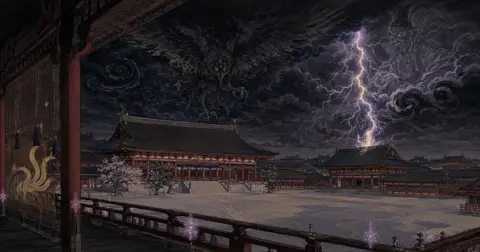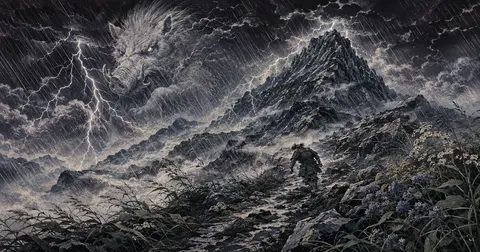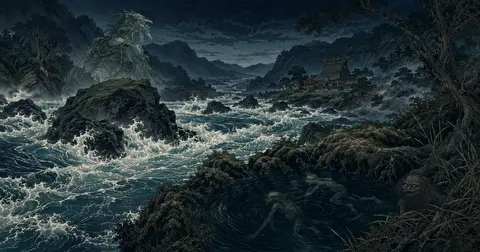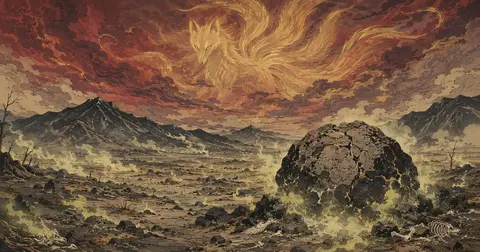
When attempting to discuss the yokai of Hokkaido, applying the standards of Honshu quickly leads one astray. Originally, there were no ascetic Tengu, no palace-dwelling shapeshifting foxes, and no urban legends of Tsukumogami here. Before the Meiji era, this island was called Ezo (Ezochi), a world where the Ainu people lived by forming *kotan* (settlements) along the river systems. At the center of their worldview was not 'yokai,' but rather kamui[1].
In Ainu thought, bears, owls, fire, water, and even diseases were all kamui possessing souls of their own. In contrast to Ainu Mosir (the land of humans) where humans live, there was Kamui Mosir (the land of gods) where the deities reside. It was believed that in Kamui Mosir, bears and orcas had the same appearance as humans, but they would descend to Ainu Mosir as 'guests,' bringing the gifts of fur and meat[2]. This is precisely why, while there were kamui who brought blessings to people, those who brought harm were feared and called wenkamui (evil kamui). The 'monsters' of Hokkaido are entities that stand on the shadow side of this dualistic view of good and evil kamui.
This encyclopedia establishes a single axis — the anomalies of Hokkaido are born not from the Japanese ledgers of yokai, but at the intersection where the Ainu view of spirits and the later surge of pioneer memories converged upon the northern landscape. Little people living under butterbur leaves, a demon sword that cries for blood, and a monster bear that stands upright to attack villages. Before lumping these together as 'yokai,' one must first listen closely to how the Ainu themselves spoke of them. Ainu culture is a living culture to this day, and we strive to record their traditions with respect, within the bounds supported by historical sources.
An encyclopedia-like system that categorizes yokai into a list has never inherently suited Ainu storytelling. Anomalies were conveyed by blending them into *kamuy yukar* (divine epics), where the gods recount their circumstances in the first person, or in village folktales called *uwepeker*, and the details would waver depending on the storyteller[1]. Apehuchi Kamui (the old woman fire deity) governing fire dwells in the hearth of the house, the owl is revered as the village's guardian deity, and the orca is looked up to as the great kamui offshore — it was on the extension of such daily faith that the dread toward things that bring harm to people existed. While the yokai of Honshu have 'names, appearances, and origins' in their ledgers, the outlines of many of Hokkaido's anomalies are soft. If one forgets this difference and lines them up in perfect order, the essential texture will slip away.
Little People Under Butterbur Leaves — Koropokkuru and a Scholar's Ambition
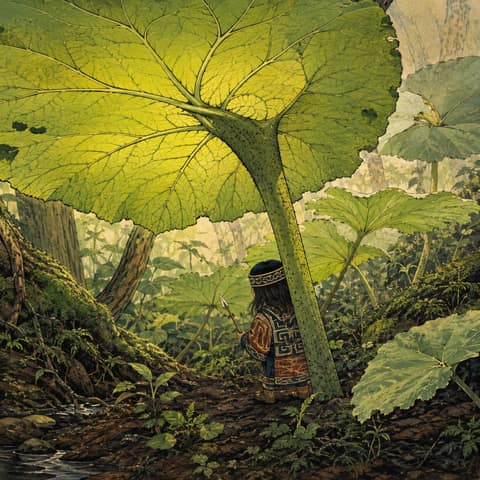
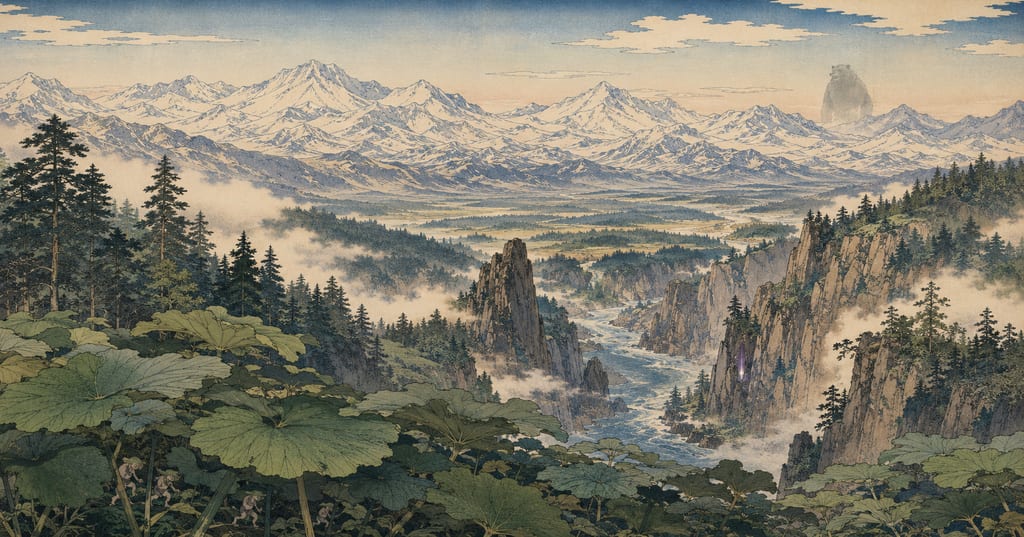
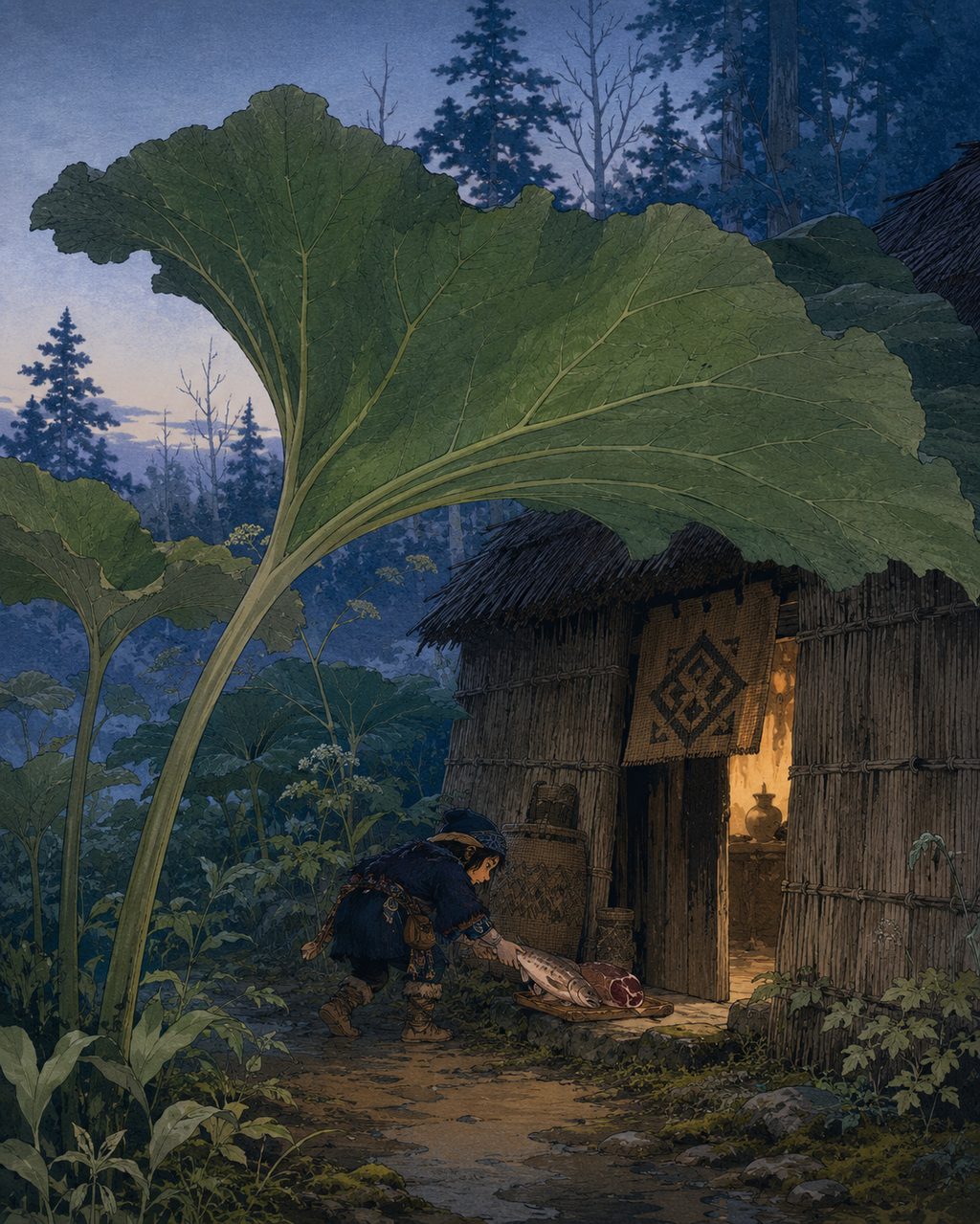
The most famous anomaly of Hokkaido is perhaps the little people known as Koropokkuru. In the Ainu language, *korpokkur* breaks down into *kor* (butterbur), *pok* (under), and *kur* (person) — translating to people under the butterbur leaves[3]. This is not a poetic naming. In Hokkaido and Sakhalin, there are massive colonies of giant butterburs called *rawanbuki*, whose leaves grow as large as umbrellas. The image of tiny people taking shelter beneath their shade rises from the very vegetation of the north.

Koropokkuru
The Koropokkuru are a race of little people appearing in the oral traditions of the Ainu people in Hokkaido, Sakhalin, and the Southern Kuril Islands. In the Ainu language, they are written as "Korpokkur" or "Korpok un kur," constructed from "Kor" (butterbur plant), "Pok" (under), and "Kur" (person), meaning "the people under the butterbur leaves." According to legend, they were smaller than the Ainu, incredibly agile, and highly skilled in fishing and hunting. They lived in pit dwellings roofed with massive butterbur leaves. They engaged in "silent trade" with the Ainu, secretly leaving game or goods outside under the cover of night to avoid direct contact. However, a famous legend states that an Ainu youth, driven by curiosity, grabbed the hand of a Koropokkuru woman and dragged her into his hut. Deeply shamed, the entire Koropokkuru tribe departed across the northern sea, never to be seen again. During the Meiji period, anthropologist Shogoro Tsuboi proposed the "Koropokkuru Hypothesis," claiming they were the original Stone Age inhabitants of Japan before being driven out by the Ainu. This sparked the "Koropokkuru Controversy," a massive academic debate that dominated Japanese anthropology from the Meiji through the Taisho eras.
Read moreThe Koropokkuru of legend were smaller and more agile than the Ainu, skilled in fishing and hunting, and said to live in pit dwellings roofed with butterbur leaves. They purportedly engaged in silent trade with the Ainu — leaving venison or fish at the doors of the Ainu during the night, exchanging goods without ever showing their faces. One day, however, a curious young Ainu man grabbed the hand of a Koropokkuru woman as she offered goods through the door, pulling her into the hut. Ashamed that her ugly face had been seen, the entire tribe departed for the far northern seas, never to return — this is the representative archetype of the separation tales passed down in various regions.
What catapulted these little people to fame was not the folklore itself, but the ambition of a Meiji-era scholar. Anthropologist Shogoro Tsuboi serialized "A Study on Koropokkuru Customs" in the *Fuzoku Gaho* (1895–1896)[4], advocating the indigenous theory that "the inhabitants of Japan's Stone Age were the Koropokkuru, and the later-arriving Ainu drove them north." Yoshikiyo Koganei and Ryuzo Torii fiercely countered this, sparking the Koropokkuru controversy that split Japanese anthropology from the Meiji to Taisho eras. The dispute continued until Tsuboi died abroad in St. Petersburg in 1913. Because subsequent archaeology established the consensus that "the inhabitants of the archipelago's Stone Age = the Jomon people, whose lineage leads to the Ainu," the theory of the Koropokkuru as the indigenous people is no longer supported today. Yet, Tsuboi's serial served as a seedbed, scattering the image of the Koropokkuru into paintings, literature, and textbooks.
A representative modern study is archaeologist Takuro Segawa's *Who Are the Koropokkuru: The Medieval Kuril Islands and Ainu Legend* (Shintensha, 2008)[5]. Because the folkloric details of silent trade, pit dwellings, pottery, and wide-ranging migration in search of potting clay all correspond to the realities of the medieval Northern Kuril Ainu, and based on the biased distribution that the Koropokkuru legend is not told in the Northern Kurils (as they do not fictionalize themselves), Segawa deduced that "the true identity of the Koropokkuru is the Northern Kuril Ainu." This represents a paradigm shift, reinterpreting the legend not as a "memory of a vanished indigenous people," but as a "memory of a separate lineage of Ainu." We should add that this remains a compelling hypothesis rather than a definitive conclusion.
The regional distribution of the lore is also worth noting. While tales of the Koropokkuru are widely confirmed in Hokkaido, Sakhalin, and the Southern Kurils, they are not passed down in the Northern Kurils — a bias that attracted scholarly attention early on. Why do the northernmost people alone not tell the tale? Segawa's theory reads this as "because they were the very group considered to be the Koropokkuru." It is a paradox where the narrative blank ironically points to the true identity. The details of the separation tale also fluctuate by region; there are variations where the one whose hand is grabbed is a husband, or where they were ashamed of having the tattoos around their mouths seen.
Post-war, the Koropokkuru have been widely embraced as denizens of children's culture, divorced from Ainu oral tradition, through literature such as Satoru Sato's *No One Knows This Little Country* (1959) and the subsequent *Korobokkuru Monogatari* series, as well as Taisho-era works like Yuriko Miyamoto's *The Koropokkuru Riding on the Wind* (1918) and Koji Uno's *The Gods Under the Butterbur* (1921), and even as product names for sweets. The little people of the north, having undergone two reincarnations through anthropological debate and children's literature, continue to live on. However, it must also be noted that their adorable image sometimes masks the weight embedded in the original folklore and the indigenous debates that surrounded it.
The Sword That Cries for Blood — Ipetam and Kamuikotan
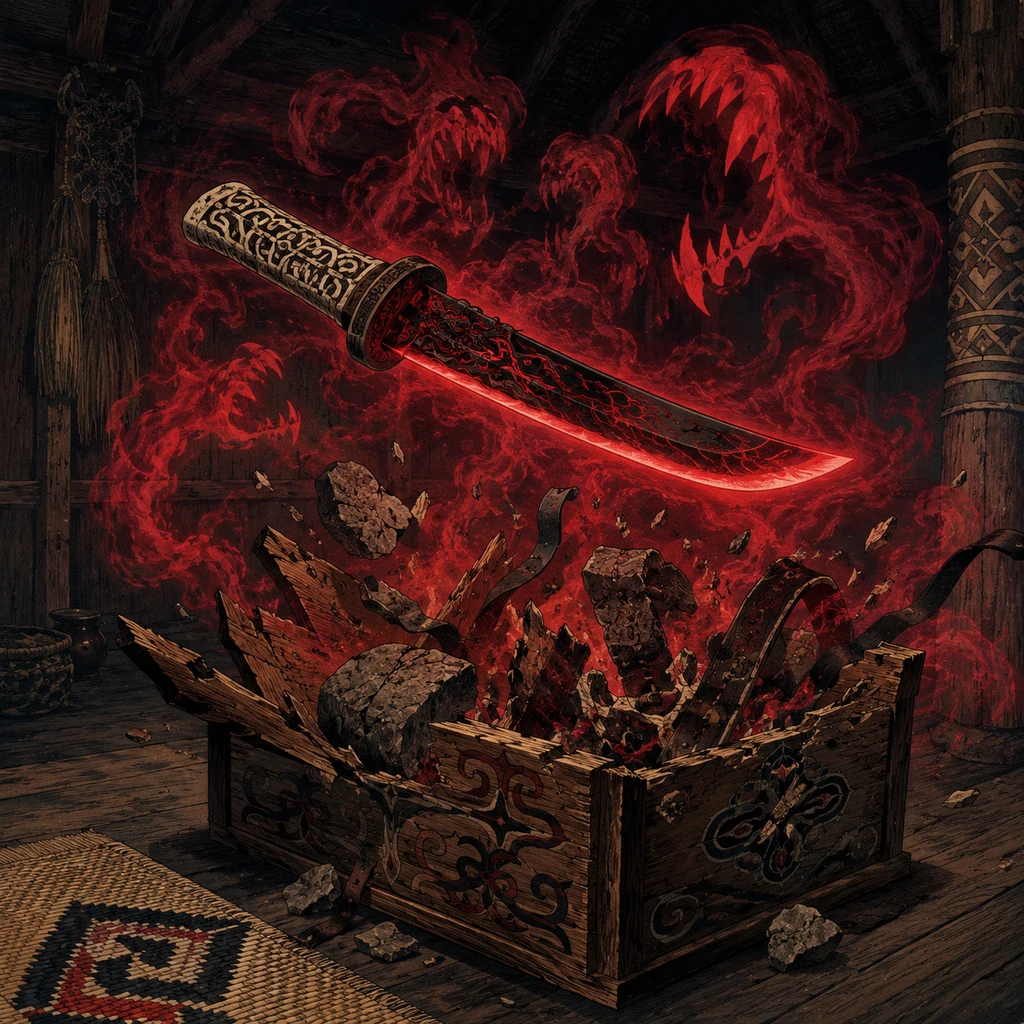
The sense that objects possess souls is akin to the Tsukumogami of Honshu, but in Hokkaido, it crystallized with a unique menace surrounding bladed weapons. Ipetam is a general term for demon swords, meaning **eating sword** in Ainu (from *ipe* [eat] + *tam* [sword])[6].
Ipetam (The “Eating Blade”)
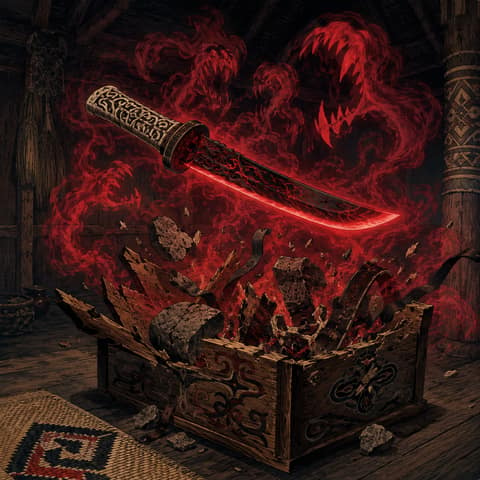
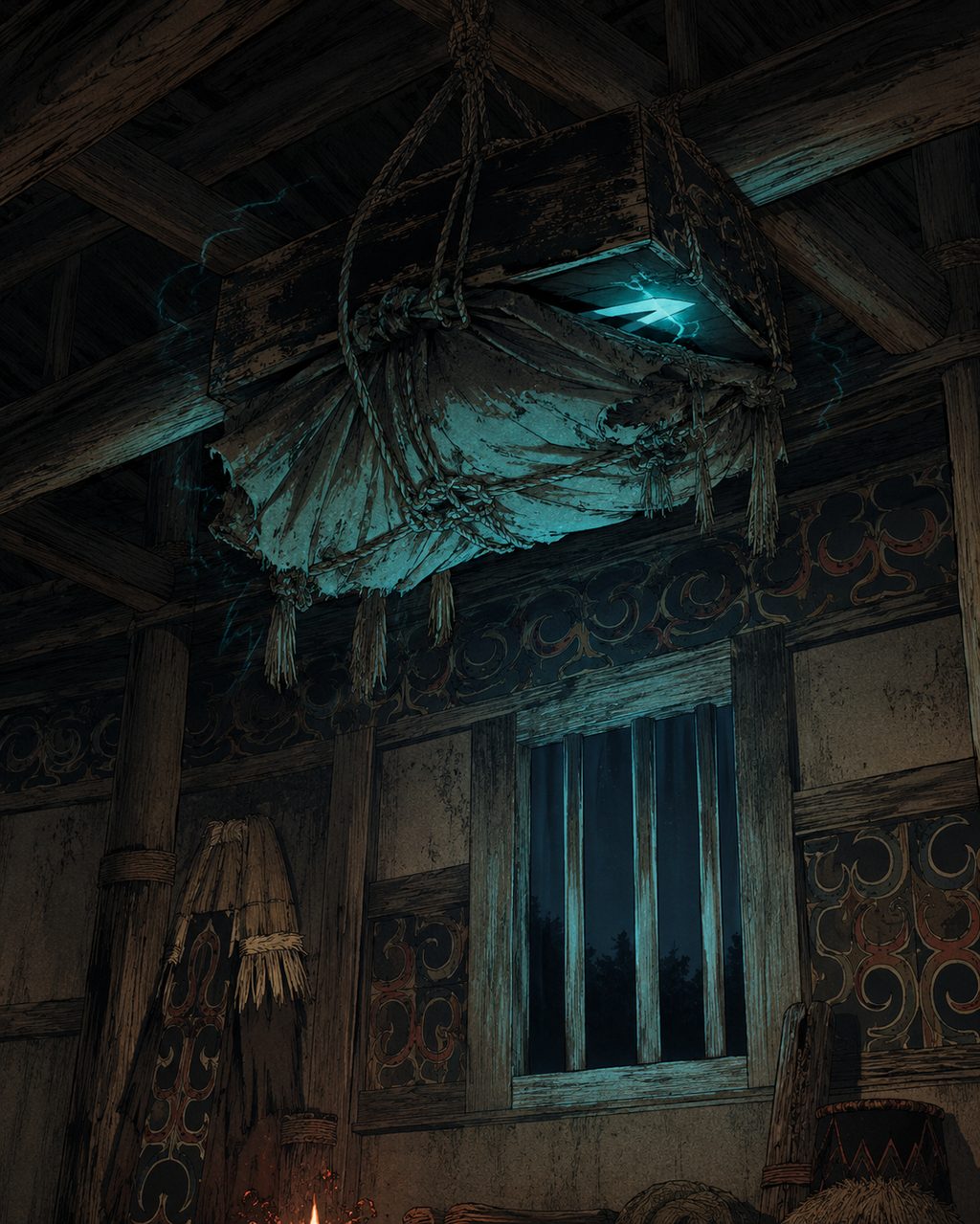
Ipetam is a collective name in Ainu lore for cursed swords meaning “eating blade.” Kept in a box, they clatter as if biting stones or leather thongs, thirsting for blood. Once drawn, they were feared never to return to the sheath until they cut a person, and some tales say they fly through the air to strike. Regarded as ominous, they were often cast into bottomless bogs to quell their malice, yet even in storage they rattled and menaced their owners.
Read moreThe legendary Ipetam was feared because it would make a rattling sound in its box on its own, as if chewing on stones or leather straps, and once drawn, it would not return to its scabbard until it had killed someone. Some stories even claim it flew through the air to cut people down. A common thread across various regions is the conclusion where, to quell its curse, it is sunk into a bottomless marsh. In the Saru region, a tale recounts that when the sword was placed in a box alongside leather straps, a rattling, chewing sound emanated from it, causing terrified bandits who had broken in to flee. In Katsurakoi of Kushiro, the sword was given a gruesome moniker for having supposedly slashed a pregnant woman.
The tale types carry regional distinctiveness. In Asahikawa and Kamikawa, it is said that two Ipetam continuously made sounds like scraping stones inside a box; when their terrified owner threw them into a bottomless marsh, a sword-shaped rock towered up on the shore. According to Kamui legends, a sword wrapped in a straw mat emitted an eerie light night after night, resulting in a succession of human deaths; only after it was cast into a marsh following prayers was it finally appeased. Behind the notion of a blade demanding blood, some read the underlying circumstance that iron swords, brought in through trade with the Japanese, were objects of awe and terror for a society that originally possessed no iron tools. However, this is an interpretation, not the origin preached by the folklore itself.
Where this demon sword takes root most deeply is west of Asahikawa, in the gorge where the Ishikari River flows from the Kamikawa Basin onto the Ishikari Plain — the area of Kamuikotan. In Kamikawa Ainu tradition, there was an old, soot-stained bundled sword hanging at the sacred window of a chief's house; in a certain generation, an eerie light began to leak from the bundle, and the household members illuminated by it were slashed to death one after another[7]. The desperate chief received a divine oracle, built an altar on a giant rock by the marsh to pray, and an Ezo stoat appeared and threw the demon sword into the marsh, bringing an end to the disasters. Today, an eight-meter-tall crimson rock known as Tateiwa (the Man-Eating Sword Rock) soars over the spot where a bottomless marsh is said to have once spread.
In Ainu storytelling, Kamuikotan itself was a crossroads of anomalies. The place name implies "the place where kamui live" (Kamui Kotan), and a heroic epic is passed down here about the evil god Ninnekamui attempting to wipe out the Kamikawa Ainu by damming the Ishikari River with giant boulders[7]. The heroic god Samaikur stood against this, kicking the rocks and drawing his sword to slash the evil god; it is said that the evil god's torso and head turned into the massive boulders along the riverbed — *teshi* (dam rocks), *netopake* (torso), and *sapa* (head), with traces of the struggle inscribed into every piece of the topography. The marsh where the demon sword Ipetam is sunk and the heroic god who slashes the evil god resonate within the same gorge. The characteristic of Hokkaido's sword anomalies is that the cursed object does not stand alone, but is woven into the web of the land's kamui narratives.
The Monster Bear Descending from the Mountain — Onikuma and Wenkamui
Standing at the pinnacle of Hokkaido's view of nature is the bear, particularly the Ussuri brown bear. The Ainu revered the brown bear as Kimun Kamui (God of the Mountain), placing it in the highest rank of kamui. Most notable is the ritual of Iomante (sending off the bear). A captured bear cub was carefully raised in the village for a time, and at the right moment, a grand festival was held to return its soul to Kamui Mosir along with the gifts of meat and fur — the mindset being not to kill it, but to politely send a deity who had been welcomed as a guest back to its homeland. The bear was not an enemy, but the temporary form of a god descending with blessings.
However, when that sacred bear crosses the line — when it attacks humans and develops a taste for human flesh — the bear plummets into becoming a wenkamui (evil kamui). There is no specific deity named Wenkamui. Anything that brings harm to humans is called such, and a bear that has killed a human was the prime example. This very structure, where the highest-ranking god can invert into the most terrifying monster, is the soil that spawns the "monster bears" of Hokkaido. Unlike the oni or tengu of Honshu, which reside on the non-human side from the beginning, the monster bears of the north are born by falling from the continuous spectrum of the divine.
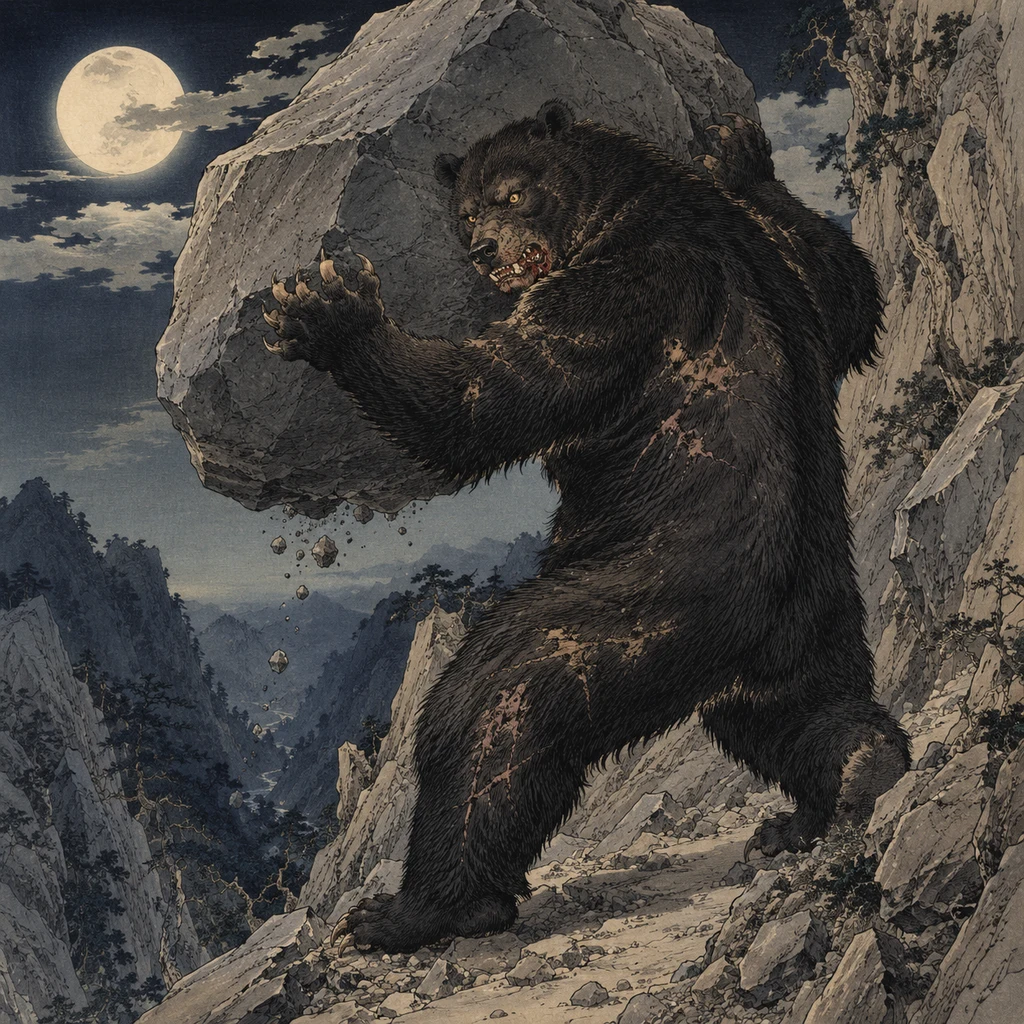
Oni Bear
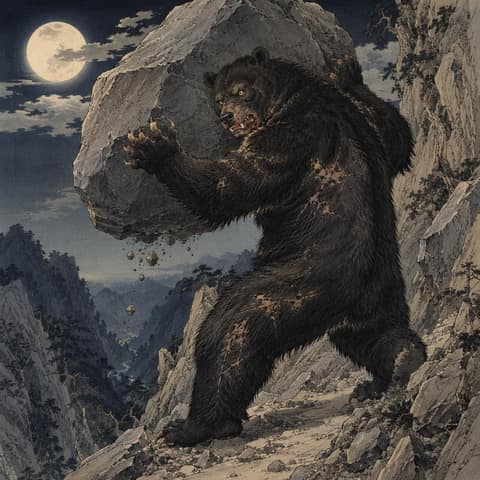
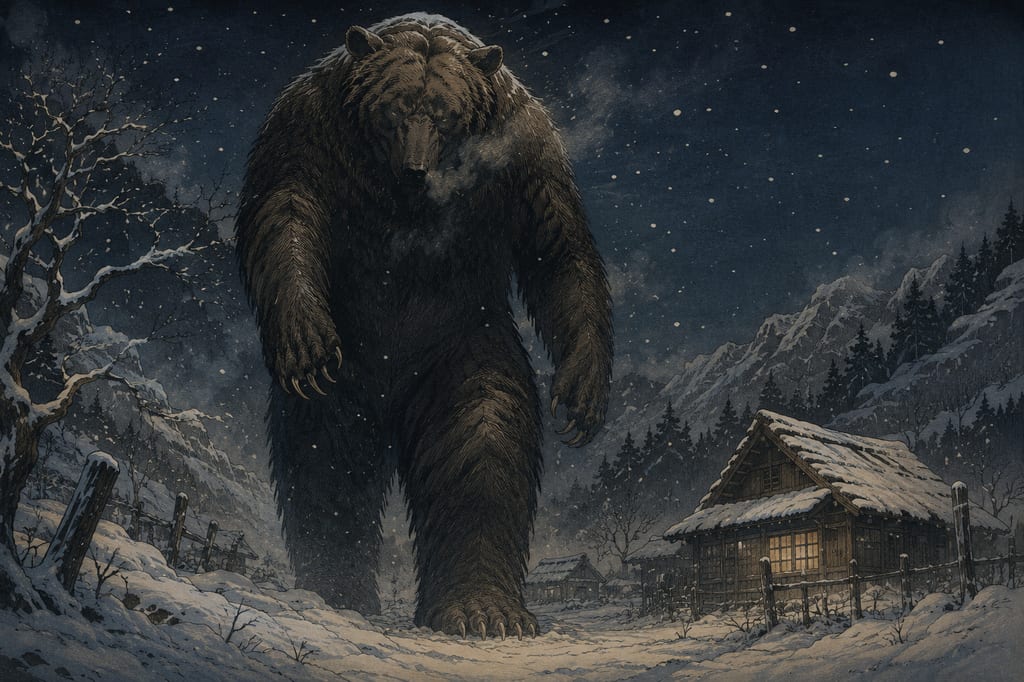
The Oni Bear is an aged bear said to have turned into a yokai in the Kiso Valley. It rarely shows itself to people, but at night it descends from the mountains, walks upright, and carries off cattle or horses to devour in the hills. Its strength is superhuman—stories tell of it heaving great boulders into ravines. It appears in the Edo-period miscellany Ehon Hyaku Monogatari and later yokai picture encyclopedias. In some regions the term was also used for especially ferocious bears.
Read moreThe yokai named Onikuma is not originally from Hokkaido. Mentioned in sources like the 1841 yokai picture book *Ehon Hyakumonogatari* (Momoyama Jin'ya-wa)[8], it is a bear from the Kiso Valley of old Shinano Province that transformed into a yokai in its old age. Late at night, it was said to descend from the mountains to the villages, walking upright, and abducting horses and cattle to devour deep in the hills. There are many tales of its monstrous strength, with witnesses claiming they saw it drop a boulder six or seven *shaku* large into a ravine—a rock that even ten men could not move, which came to be known as the "Onikuma Stone." To defeat it, lore dictates blocking its den with a well-crib of large logs, luring it out, and striking it down with spears or guns. It is even told that the pelt of an individual slain around the beginning of the Kyoho era was roughly the size of six tatami mats.
This intense moniker, "Onikuma," was used in Hokkaido as an alias for real giant brown bears, particularly individuals that attacked humans. The yokai of folklore connected with the actual terror of beast attacks in the northern lands. The extreme of this was the Sankebetsu brown bear incident that occurred in December of 1915 (Taisho 4) at Rokusensawa in Tomamae Village, Tomamae District[9]. An Ezo brown bear measuring about 2.7 meters in length and weighing approximately 340 kilograms attacked a pioneer settlement twice, leaving seven dead and three injured. Gruesome records remain of the bear returning to the wake of a wife it had already slaughtered, attempting to snatch her corpse away, cementing this as the worst beast attack in Japanese history. The bear was ultimately shot dead by the hunter Heikichi Yamamoto. *The Valley of Lamentation* (Doukoku no Tani) — reconstructed through the tenacious reporting of former forestry officer Moritake Kimura[10] — continues to be read today.
What occurs here is the dissolution of the boundary between yokai and actual incident. If the Onikuma of Honshu is a "monster in a weird tale collection," the Onikuma of Hokkaido — the man-eating brown bear — possesses a specific location on a map and a date. In the modern Ezochi where Japanese pioneering encroached deeply into the bears' territory, the Ainu concept of wenkamui, the imported name Onikuma, and the terror of real-world beast attacks overlapped into a single massive shadow. The monster bears of the north are not purely fictional; they are also the aliases of the scars of pioneer history itself.
The Shadow Pressing Down on Empty Houses — Ainu Kaisei and the Unspeakable Things
Among the anomalies of Hokkaido, there are not only those that have crystallized into clear forms like the Koropokkuru or Onikuma, but also entities whose outlines remain undefined, lingering in the corners of oral tradition. One such entity is the Ainu Kaisei.
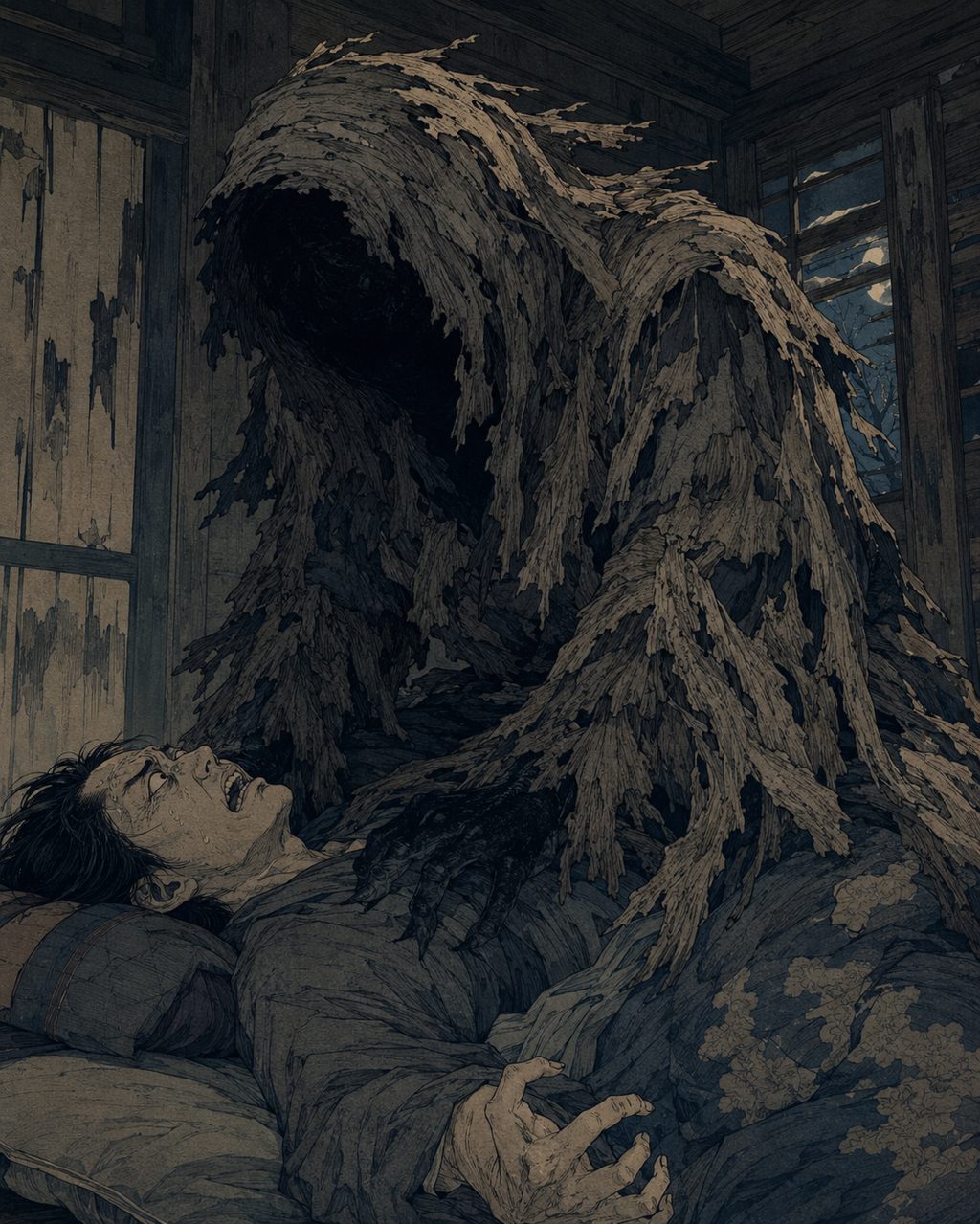
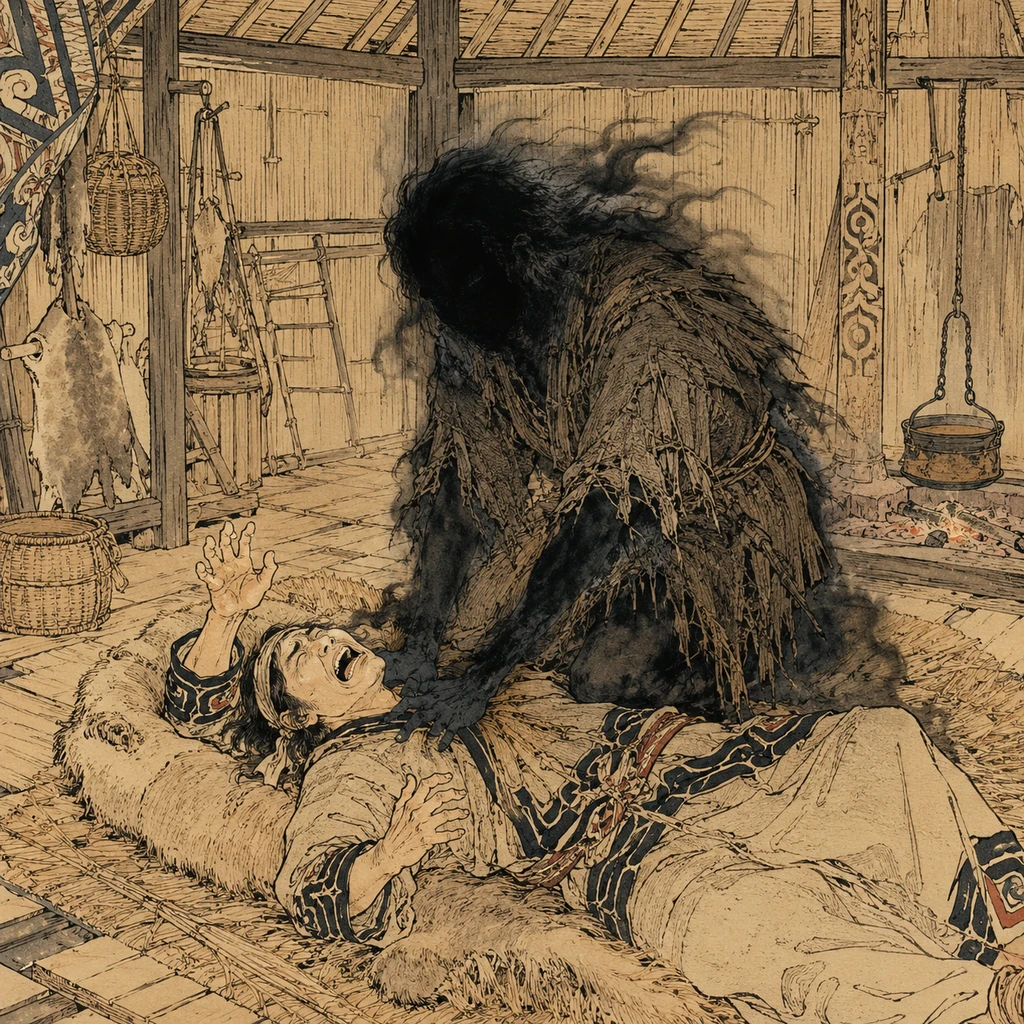 Ainu KaiseiEYE-noo KAI-say
- Koropokkurukoropokkuru
- Ipetam (The “Eating Blade”)EE-peh-tahm
- Oni BearOH-nee KOO-mah
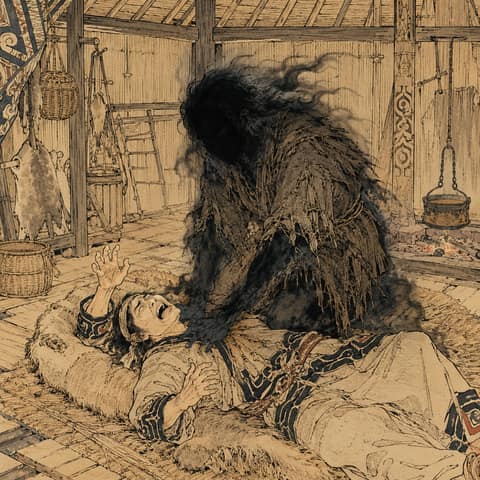
According to tradition, the "kaisei" in its name is said to mean a corpse in the Ainu language, but its true etymology is unknown[11]. Clad in tattered *attush* (garments woven from bark fiber), it is said to appear in deserted empty houses or old dwellings. Late at night, a heavy weight presses down on the chest or neck of those sleeping in the house, leaving them immobilized — it is recounted as an anomaly of pressure similar to what is commonly known as sleep paralysis. It is said to vanish when one cries out, or to leave only its presence behind when a light is kindled. Among researchers, similarities to the Zashiki-warashi of Honshu are sometimes pointed out, but it has not been confirmed to possess a character that bestows good fortune; rather, it leans toward the side of afflicting people.
To be honest, neither the true identity nor the origin of the Ainu Kaisei is detailed. It is not thickly backed by primary sources, but merely remains as oral tradition fragmentarily picked up by later yokai encyclopedias — here, we wish to trace the outline of the lore rather than asserting it as confirmed fact. The motif of an anomaly pressing down on one's chest is a universal experience (sleep paralysis) widely seen across Honshu and the world, and it is most reasonable to view this as a recounting of that experience clad in the northern motifs of an Ainu empty house and a shadow draped in bark cloth. The interpretation reading the meaning of "corpse" into its name cannot entirely rule out the possibility of it being an afterthought drawn by the sound, rather than solid etymology. What is important when discussing the anomalies of Hokkaido is not to forcibly systematize such "unspeakable things." While the yokai encyclopedias of Honshu have neatly compiled names, appearances, and origins into ledgers, many of the Ainu anomalies have breathed within the narratives of *yukar* (epics) and *uwepeker* (folktales), transmitted while wavering along with the storytellers.
It was an Ainu brother and sister who devoted their lives to the task of committing this oral tradition to text. The sister, Yukie Chiri, recorded 13 *kamuy yukar* where the gods speak of themselves in the first person, culminating in the *Ainu Shinyoshu* (Collection of Ainu Epics of the Gods, 1923)[1], but she passed away at age 19 in 1922, immediately after finishing the proofs. The brother, Mashiho Chiri, reached a monumental achievement as a linguist with his *Classified Dictionary of the Ainu Language*[2], describing the names of kamui and anomalies dwelling in natural objects through the hands of the people themselves. Combined with the *yukar* research of linguist Kyosuke Kindaichi[12] who guided them into academia, the fact that the anomalies of Hokkaido are passed down with even a slight form today is entirely thanks to such efforts of preservation. For entities to remain ambiguous like the Ainu Kaisei is, in fact, the natural state of this oral culture.
The Line Drawn by Pioneering — From Ezo to Hokkaido
Finally, we must touch upon the reason why Hokkaido's yokai culture differs decisively from that of Honshu — the fault line of history.
In 1869 (Meiji 2), the Meiji government renamed Ezochi to Hokkaido, established the Development Commission (Kaitakushi), and advanced mass settlement by the Japanese[13]. While tondenhei (farmer-soldiers) and pioneers cultivated the wilderness, the Ainu were subjected to assimilation policies such as the prohibition of traditional customs and rituals and the forced use of the Japanese language, while the modification of rivers and forests stripped them of their hunting and fishing grounds. The Hokkaido Former Natives Protection Act, enacted in 1899, constrained the Ainu's land, livelihood, and language under the guise of relief, inflicting profound damage upon their culture[13].
This fault line carved a dual nature into the anomalies of Hokkaido. On one hand, there are the spirits and monsters born from within the Ainu worldview, like the Koropokkuru, Ipetam, and Ninnekamui of Kamuikotan. On the other hand, there are entities where the Japanese view of yokai was reassembled upon the landscape of Ezo, just as the name "Onikuma" was brought from Honshu and reborn by merging with the northern reality of beast attacks. Shogoro Tsuboi's Koropokkuru controversy was also an event where a Japanese scholar appropriated and utilized Ainu folklore as material for his own indigenous theories. Therefore, discussing the yokai of Hokkaido cannot be separated from the history of settlement and assimilation.
If one peers closely at the place names, those layers can still be read today. Sapporo (*sat poro* = dry, large thing), Wakkanai (*yam wakka nay* = cold water river), Kamuikotan (*kamui kotan*) — many of Hokkaido's place names are Japanese characters applied to Ainu words, and the land itself cradles the fossils of the Ainu worldview. The Tateiwa soars over the remnants of the marsh where the demon sword was sunk, and the scars of slashing the evil god become massive rocks by the river. The fact that anomalies are not abstract tales but are seared into the very topography one can walk upon is nothing but an extension of the Ainu sensibility that viewed every element of nature as a kamui. The railways laid by the Japanese pierced straight through that very gorge of Kamuikotan — the modern iron tracks passed directly through the place where the gods live.
In this regard, Hokkaido belongs to a different lineage from any land in Honshu. While the spectral horrors of Kyoto were born from the urbanity of Heian-kyo and Onmyodo, the mysteries of Izumo shoulder the memories of the Kojiki and Nihon Shoki mythologies, and the tanuki of Shikoku are woven into island battle tales, the roots of Hokkaido's anomalies lie in the spiritual culture of the Ainu, who possessed no writing and passed down their world through oral tradition. The duality of this island's anomalies began when the Japanese attempted to force them into the foreign framework of "yokai." That is exactly why the "encyclopedia" here should make it its duty not to end with neat categorizations, but to preserve the textures that defy classification.
Little people vanishing under butterbur leaves, a demon sword sinking into a marsh, a monster bear descending from the mountains, and a shadow pressing down on an empty house. These are not disjointed ghost stories, but the memories of the northern otherworld that arose in the process of the island ruled by kamui being overwritten by another narrative called modernity. That very difference in lineage, which cannot be measured by the rulers of Honshu's yokai encyclopedias, is the unique depth possessed by the anomalies of this land called Hokkaido.