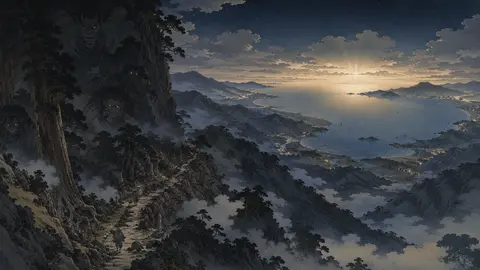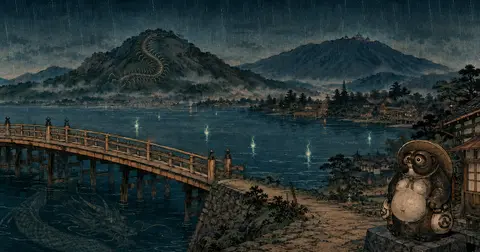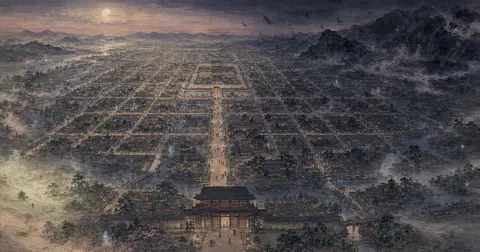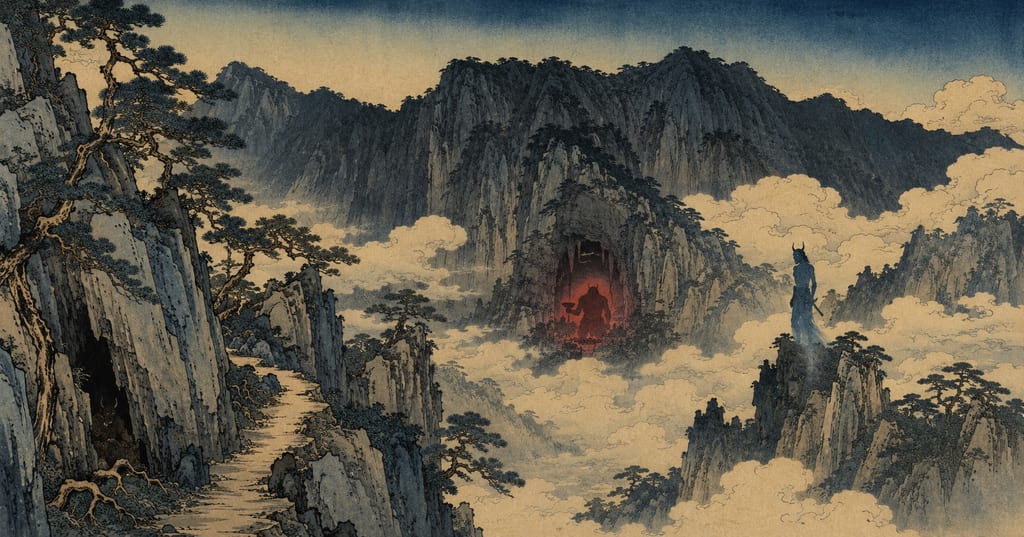
Towering over the border between Tango and Tamba in northwestern Kyoto Prefecture, Mount Oeyama has been spoken of since ancient times as the "dwelling place of demons." This mountain massif, standing at an elevation of around 800 meters, lies to the northwest of Heian-kyo—outside the spiritual barriers protecting the capital, in a frontier beyond the reach of imperial authority. This very geopolitical reality of dividing the inner sanctuary from the untamed outside propelled the mountain into becoming the most famous demon stronghold in all of Japan.
Mount Oeyama constitutes a major pillar of Kyoto Prefecture's yokai culture. For a comprehensive overview of the capital, refer to the Kyoto Yokai Encyclopedia. This article journeys into the mountain of demons standing at the capital's edge and the overlapping tales of demon subjugation that have accumulated there.
Shuten-doji ── The Demon Chieftain Who Terrorized the Capital

Shuten-dōji
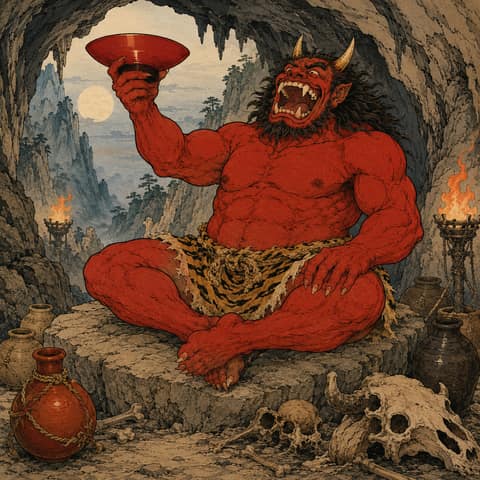
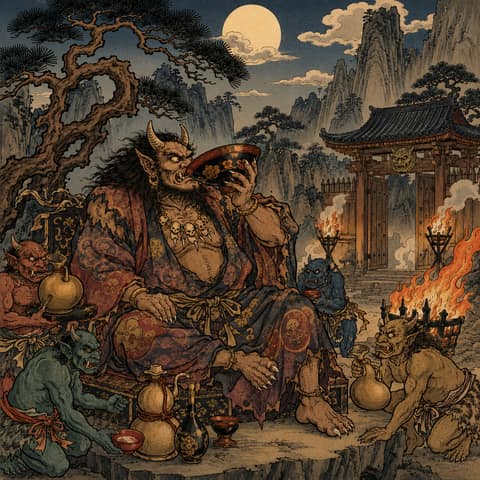
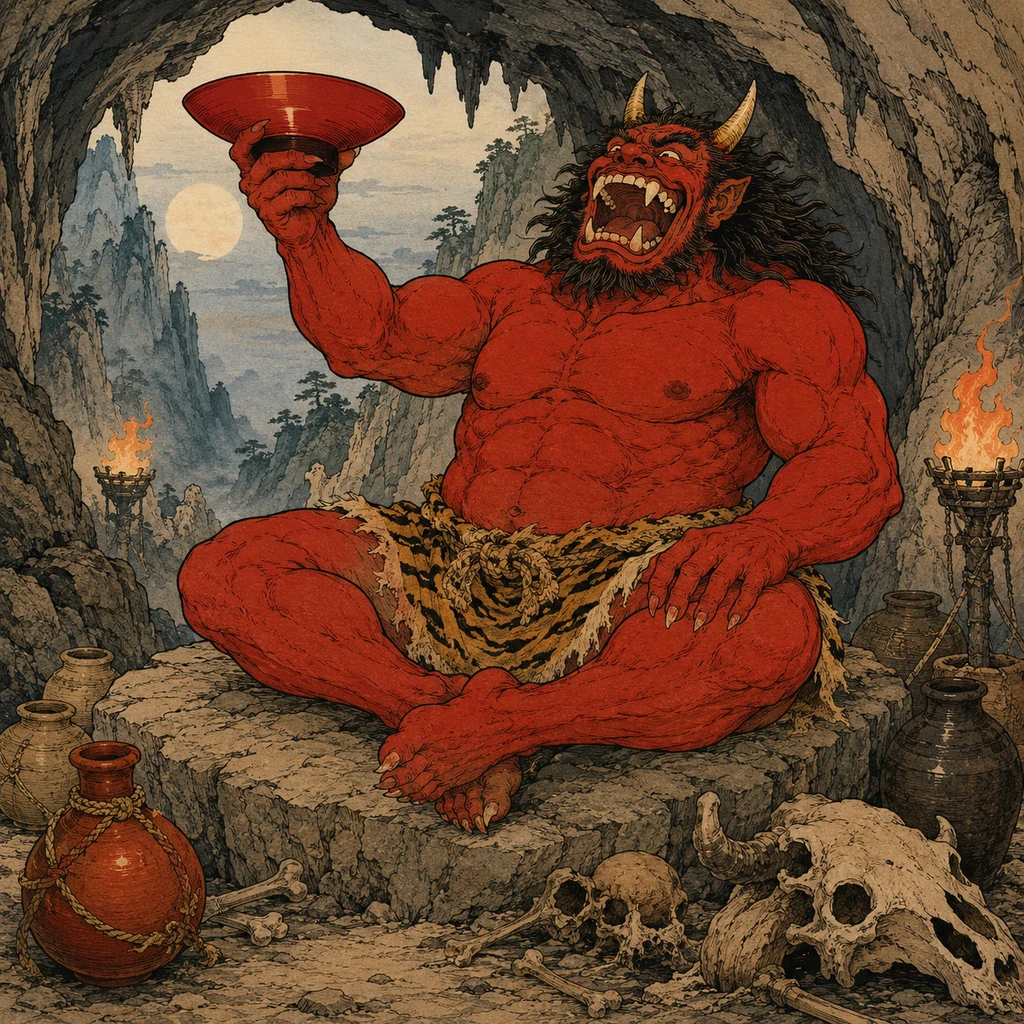
Shuten-dōji is the central figure in medieval oni-slaying tales that pit an oni king, who carries people away from the capital, against warriors sent into the mountains by imperial command. The stories are set in the reign of Emperor Ichijō and include the historical commanders Minamoto no Yorimitsu and Fujiwara no Yasumasa, but they are not contemporary Heian-period records. The Important Cultural Property *Ōeyama Ekotoba*, held by the Itsuō Art Museum, is the oldest surviving picture scroll of the Ōeyama tradition; it was made in the fourteenth century, during the Northern and Southern Courts period. Reading the Heian setting separately from the work's medieval creation prevents the tale from being mistaken for a record of an actual bandit suppression. Instead, it reflects the world later audiences imagined through Heian warriors and an oni king. His name, too, has never had a single spelling. *Ōeyama Ekotoba* chiefly writes 酒天童子, and the dōji himself says that his retainers call him Shuten-dōji because of his deep love of drink. Other spellings include 酒伝童子 and 酒顛童子 (酒顚童子); 酒呑童子 is now the most widely used. The word *dōji* alone does not establish a particular age, hairstyle, or clerical status. In the Noh play *Ōeyama*, the first-half shite appears in the guise of a youth, while *Ōeyama Ekotoba* portrays his daytime form as a dignified figure about one *jō* tall. The tale broadly divides into a tradition that places the oni king at Ōeyama and another that places him at Mount Ibuki in Ōmi Province. The *Shuten-dōji Emaki* (酒伝童子絵巻) at the Suntory Museum of Art, made in 1522, is considered the oldest surviving example of the Mount Ibuki tradition. These are not simply the same story with one mountain name substituted for another: the cast of characters, the name of the sake, and the oni king's appearance and past all differ among copies. Accounts of Ōeyama, Mount Ibuki, Echigo, and Oinosaka therefore cannot be joined into one certain biography for a single Shuten-dōji. In the oldest text of the Ōeyama tradition, disappearances continue in the capital until Abe no Seimei's divination points to the oni king of Ōeyama. Imperial orders go to the two commanders Yorimitsu and Yasumasa, who head for the mountain with their retainers. Reducing the story to the later, familiar tale of Yorimitsu and his Four Heavenly Kings obscures the structure of the early copies. In the mountains the party receives yamabushi dress and special sake from manifestations of deities and buddhas, enters the oni castle, and joins the dōji's banquet. By day the oni king takes the form of a dōji about one *jō* tall, displaying dignity and wisdom; at night he becomes an oni roughly five *jō* tall. His head and torso are red, his left foot black, right hand yellow, right foot white, and left hand blue; he has fifteen eyes and five horns. Once he has grown drunk and fallen asleep, the divine manifestations hold him down and Yorimitsu, Yasumasa, and their followers cut off his head. The head still flies through the air and bites the three helmets Yorimitsu wears one over another. Shuten-dōji is not merely a straightforward evil oni overcome by drink. He receives guests as the master of a splendid oni castle and tells of his own wanderings, even as he uses his captives for food. Courtesy toward guests and cruelty, intelligence and an immense oni body, defeat and the flying head stand together in the same story. Noh, *otogi-zōshi*, picture scrolls, printed books, jōruri, and kabuki each circulated different images of Shuten-dōji. Toriyama Sekien also depicted Shuten-dōji, under the spelling 酒顛童子, in his 1779 *Konjaku Gazu Zoku Hyakki*, placing the drunken, reclining dōji and other oni on a page of his yōkai picture book. Rather than a monster fixed in a single form, Shuten-dōji is one of Japan's best-known oni kings, retold through manuscripts, performing arts, and the memories of particular places.
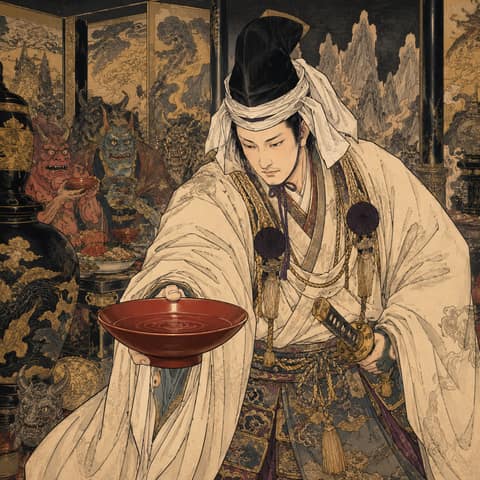
Read moreDuring the mid-Heian period, the capital was plagued by the mysterious disappearances of youths and princesses. Through the divinations of the onmyoji Abe no Seimei, the culprit was identified as Shuten-doji, the leader of the demons nesting within Mount Oeyama. Under the imperial decree of Emperor Ichijo, Minamoto no Yorimitsu and his Four Heavenly Kings—Watanabe no Tsuna, Sakata no Kintoki, Usui Sadamitsu, and Urabe no Suetake—disguised themselves as mountain ascetics and ventured deep into the demons' rugged mountain stronghold. Along the way, Yorimitsu and his men encountered three old men—whom the *Otogizoshi* describes as incarnations of the gods of Sumiyoshi, Hachiman, and Kumano. These elders bestowed upon Yorimitsu a star-studded helmet and "Jinben Kidoku-shu," a divine poisonous sake that would strip demons of their supernatural powers while granting strength to humans. Lowering his guard, Shuten-doji welcomed the ascetic-clad party into his fortress and hosted a grand banquet. Yorimitsu repeatedly offered the poisonous sake, and once the demons had drunkenly collapsed, the warriors revealed their true nature. They struck off Shuten-doji's head while he was immobilized by divine bindings. Legend claims the severed head still flew through the air to bite into Yorimitsu's helmet. According to the *Otogizoshi*, the slain Shuten-doji left behind a final curse: "Demons know no falsehoods"—a bitter reproach that humans would stoop to deceit by masquerading as ascetics. This accusation of human treachery by a demon slain through deception adds a lingering bitterness to the heroic epic.
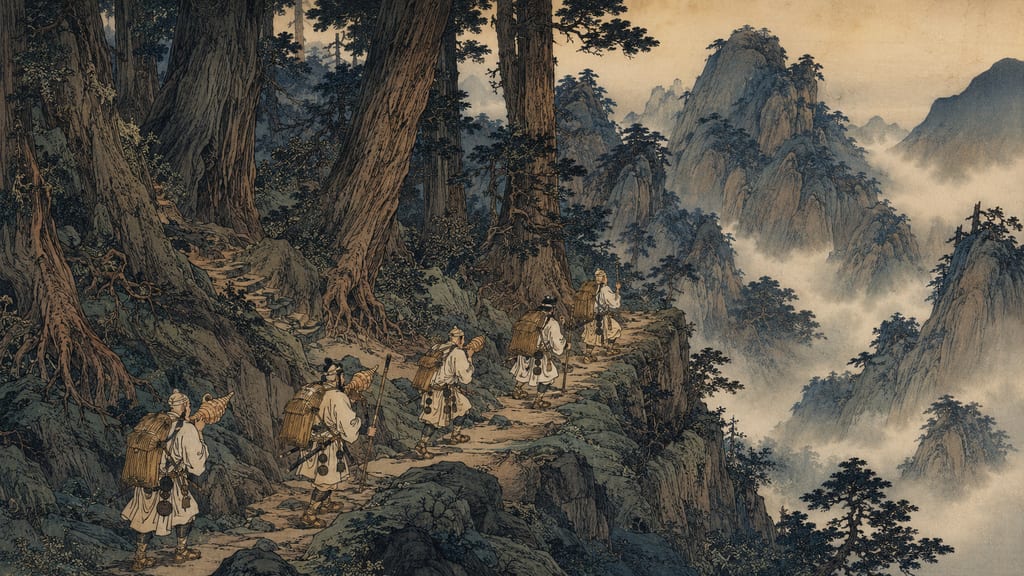
The earliest iteration of this tale appears in the late fourteenth-century picture scroll *Oeyama Ekotoba* (Katori version)[1]. Interestingly, in that text, the demons' dwelling is not the Mount Oeyama of Tango, but rather "Oeyama" (often read as Oeyama or Oezan) on the border of Omi and Tamba. The exact location of the demon mountain was not fixed initially; it was only later conflated with Mount Oeyama in Tango. The mountain's essential nature was its topographical status as a "mountain on the capital's border," while its specific geographic location remained fluid. Widely read as the *Otogizoshi* tale *Shuten-doji*[2] from the Muromachi through the Edo period, Shuten-doji would eventually be counted among the "Three Great Evil Yokai of Japan" alongside the Nue and Tamamo-no-Mae.
There are also multiple accounts of Shuten-doji's origins. One claims he was born in Echigo (modern-day Niigata) as a strikingly beautiful youth who, after receiving countless love letters from infatuated women, burned them and was transformed into a demon by the smoke of their accumulated malice. Another tale suggests he was chased from Mount Hiei by the monk Saicho and fled to Mount Oeyama. Such origin stories, where a beautiful boy morphs into a demon, illustrate just how precarious the boundary between human and demon truly was.
Ibaraki-doji and the Night of the Severed Arm
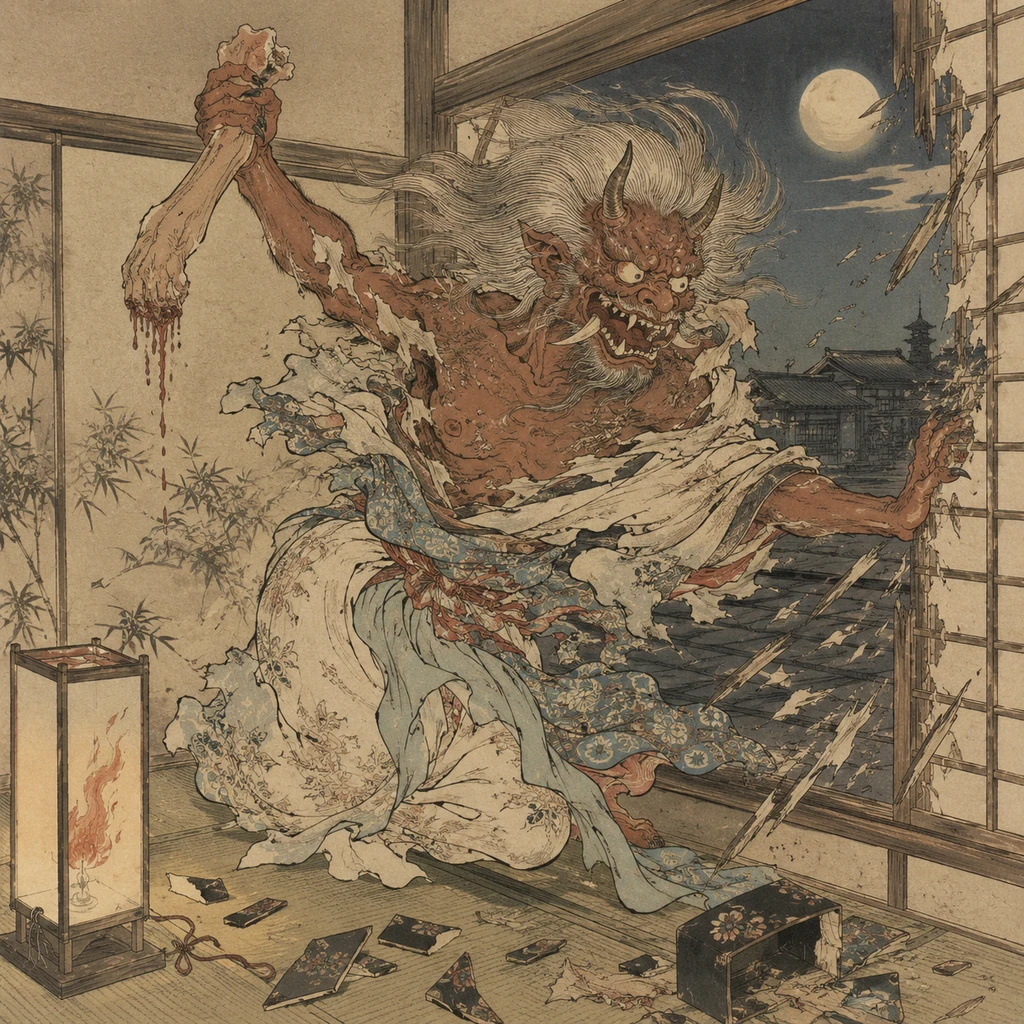
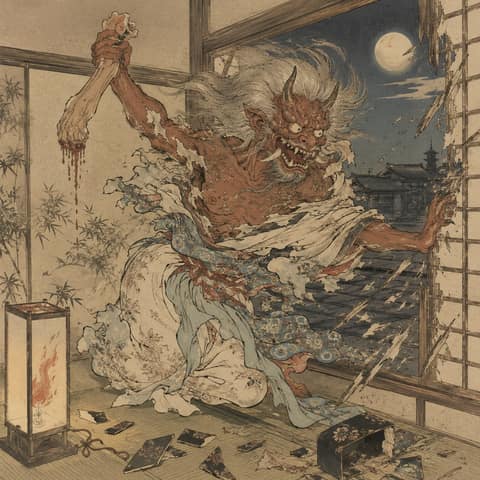
Shuten-doji's most renowned subordinate was Ibaraki-doji. According to legend, Watanabe no Tsuna, one of Yorimitsu's Four Heavenly Kings, was attacked one night at the foot of Ichijo Modoribashi (or Rajomon in alternative variants) by a demon disguised as a beautiful woman, and struck off its arm with his famed sword[3]. This arm was said to belong to Ibaraki-doji. Days later, the demon disguised itself as Tsuna's adoptive mother, visited his estate, and snatched back the severed arm—which had been kept strictly guarded inside a Chinese chest—before instantly reverting to its demonic form, tearing through the roof, and vanishing into the sky. This tale of the severed arm, passed down in the Sword Scroll of *The Tale of the Heike*, continues to be performed today as the Noh plays *Rashomon* and *Ibaraki*, and has been repeatedly depicted in kabuki and ukiyo-e woodblock prints. Ibaraki-doji is said to have been born either in Ibaraki in Settsu Province (modern-day Ibaraki City, Osaka) or in Echigo, and is remembered as Shuten-doji's most loyal vassal—and the sole demon to survive. In later *joruri* and kabuki, Ibaraki-doji returning to reclaim the arm was frequently portrayed as a bewitching woman, and audiences favored this eerie transformation that transcended the boundaries of human and demon, male and female.
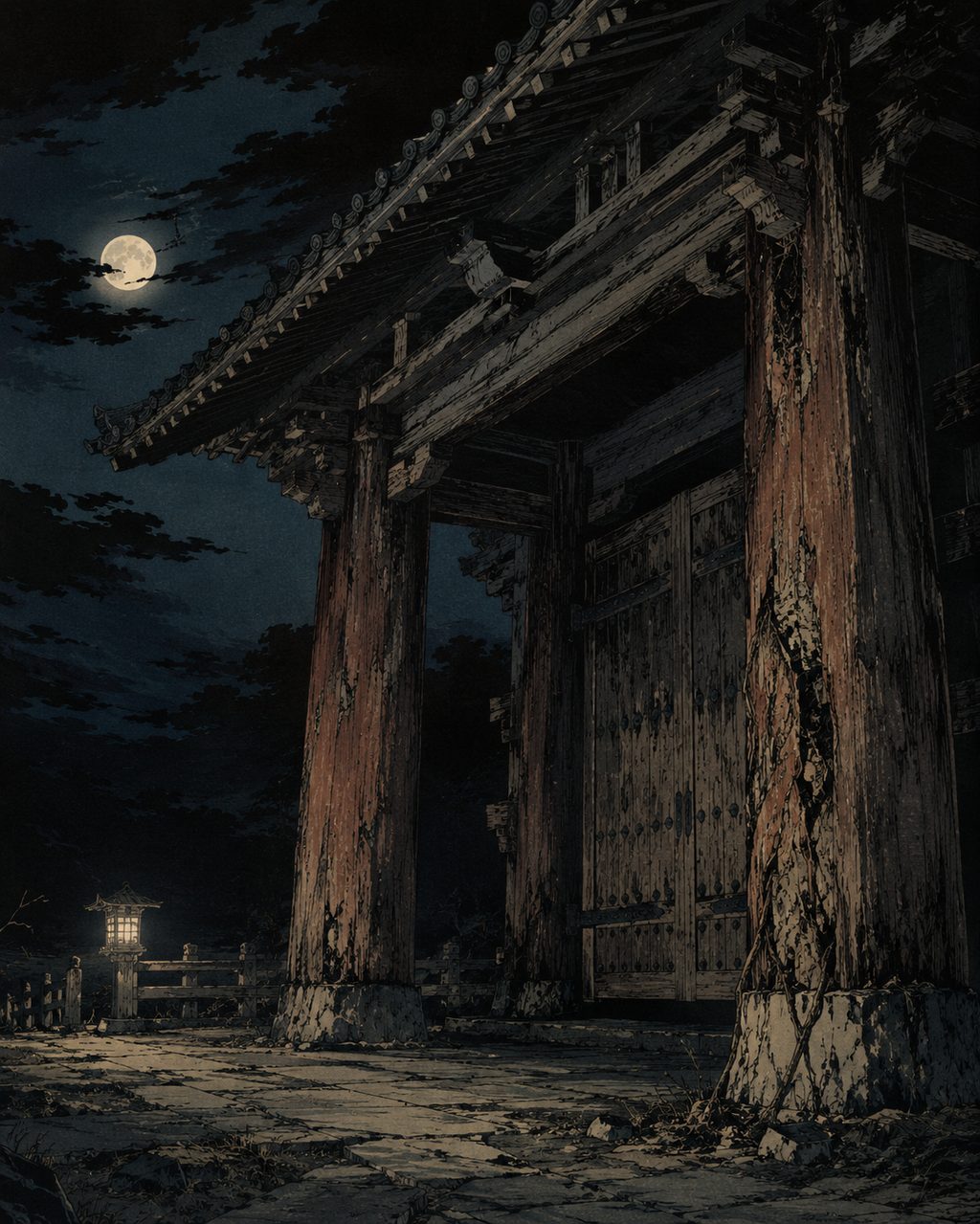
The demons of Mount Oeyama were not imagined as isolated, solitary monsters. They were envisioned as a "Kingdom of Demons" where Ibaraki-doji and countless others gathered under their chieftain, Shuten-doji. But who exactly were the *oni* spoken of here? They were the shadows of those cast out from the capital's order. Indigenous people driven into the mountains, the unvanquished who refused to submit to the imperial court, bandits, and mountain folk. The fear and disdain directed at them coalesced into the image of horned, man-eating demons. Some texts even record Shuten-doji bitterly stating, "We too were originally human, but having been chased from the capital, we dwell here." Beneath the tales of demon subjugation, the low murmurs of the vanquished can always be heard.
A Mountain Piled High with Three Demon Hunts
Mount Oeyama actually holds three overlapping demon subjugation legends from entirely different eras. This is perhaps the mountain's most unique characteristic.
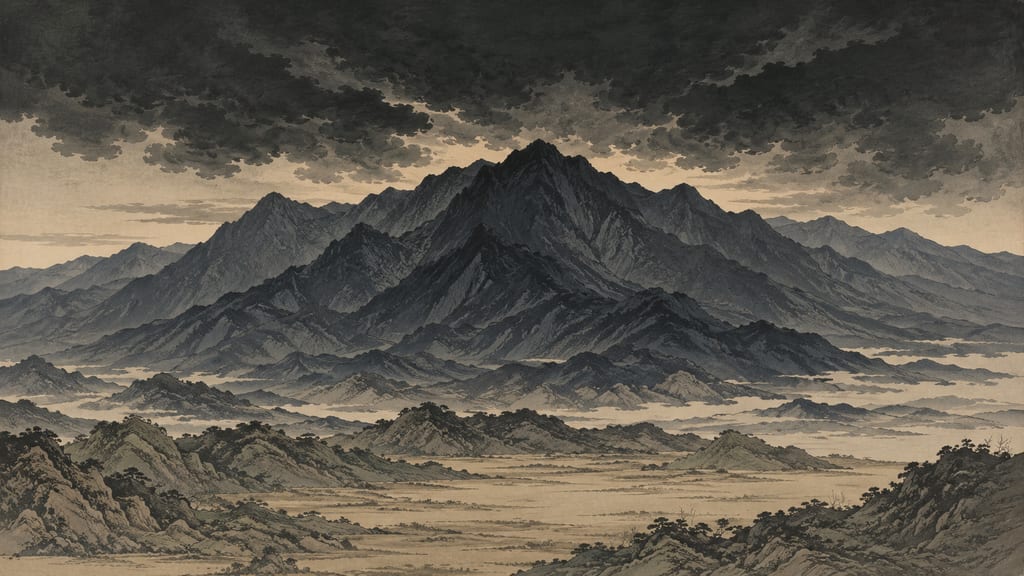
The oldest layer stretches back to the mythological era connected to the *Kojiki* and *Nihon Shoki*. According to surviving fragments of the *Tango no Kuni Fudoki*, Prince Hikoimasu vanquished a *Tsuchigumo* (earth spider) named "Kugamimi no Mikasa" nesting in this area during the reign of Emperor Sujin. *Tsuchigumo* was an ancient, derogatory term for indigenous peoples who did not obey the imperial court, meaning that here, too, the "unvanquished" were the ones being slain.
The next layer belongs to the Middle Ages, with the legend of Prince Maroko, the younger brother of Prince Shotoku, subduing the three demons Eiko, Karuashi, and Tsuchiguma. Passed down as temple origin stories, it is said that a white dog appeared to guide the way to the demons, and a divine mirror revealed their true forms. The seven temples of Yakushi Nyorai—the "Tango Seven Buddhas of Healing"—which the prince supposedly built to pray for victory, still bear their names across the Tango region today, etching the memory of the demon hunt into the land itself.
The most recent and most famous layer is Yorimitsu's subjugation of Shuten-doji. It is no accident that three layers of demon hunting piled up on a single mountain. Its location on the border of Tamba and Tango—neither too close nor too far from the capital—remained an ideal stage for projecting the "others to be slain" across various eras. The mythical Tsuchigumo, the medieval three demons, and the dynastic Shuten-doji—every time the era shifted, the capital found new "demons" upon this mountain.
A Mountain Where History is Viewed from the Demons' Side
For a long time, the demon subjugation tales of Mount Oeyama were passed down as heroic epics of the slayers. The martial valor of Yorimitsu and his Four Heavenly Kings, divine protection, and the cunning use of poisonous sake—these form a proud narrative of imperial authority crushing frontier threats. However, in the modern era, these stories began to be read differently.
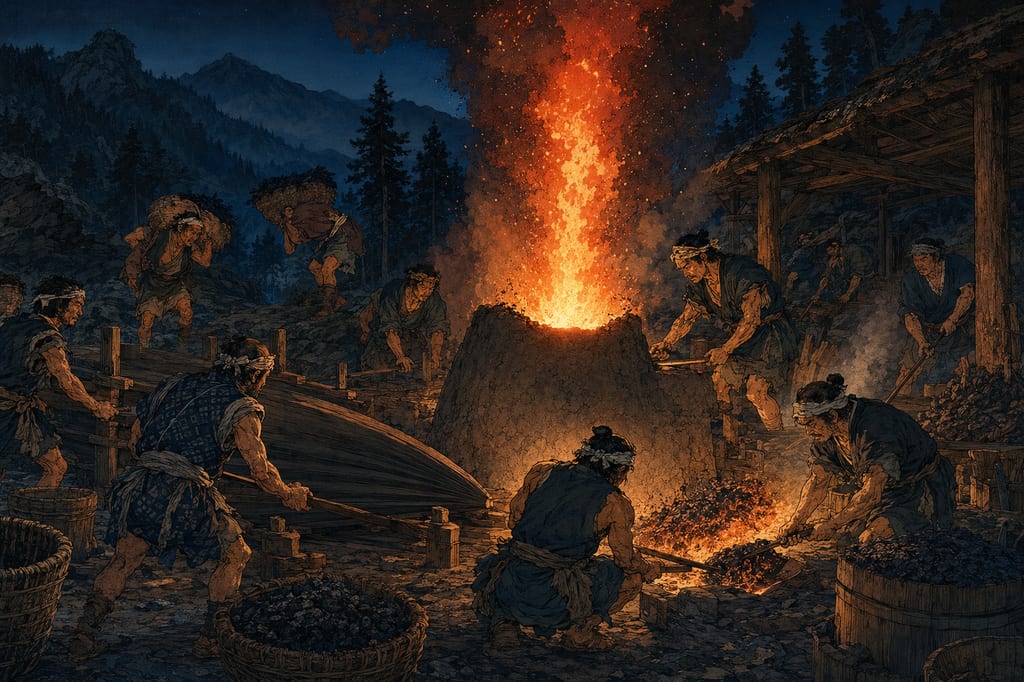
Were the demons truly man-eating monsters? Or were they perhaps marginalized people involved in ironworking and mining who had retreated into the mountains, indigenous groups who refused to yield to the capital's rule, or even foreigners from across the sea? Could it be that these "unvanquished ones" were painted as demons by the victors' pens? The tales stating that Shuten-doji was born in Echigo and chased from the capital, and that he built a "Kingdom of Demons" with his followers, seem to lend credence to this interpretation.
Today, the Japanese Oni Exchange Museum stands in Oecho, Fukuchiyama City, gathering and exhibiting demon masks and artifacts from all over the country. Proclaiming itself the "Hometown of Demons," Mount Oeyama has become a place to re-examine history from the perspective of the vanquished—the side of the demons. Shuten-doji, who lost his head while drunk on poisonous sake, is both a monster embodying evil and the memory of those destroyed by the capital. For a thousand years, this mountain standing on the capital's edge has harbored both the heroic tales of the victors and the sorrow of the defeated along the very same ridge. If one turns the tales of demon subjugation inside out, the voices from the frontier that were swallowed up by the center can still faintly be heard today.