A Portrait of an Oni King at His Banquet
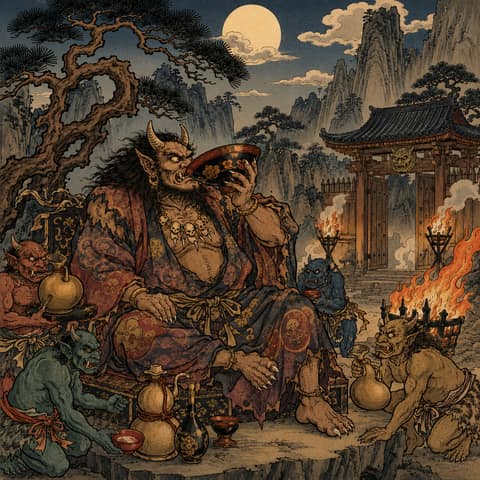
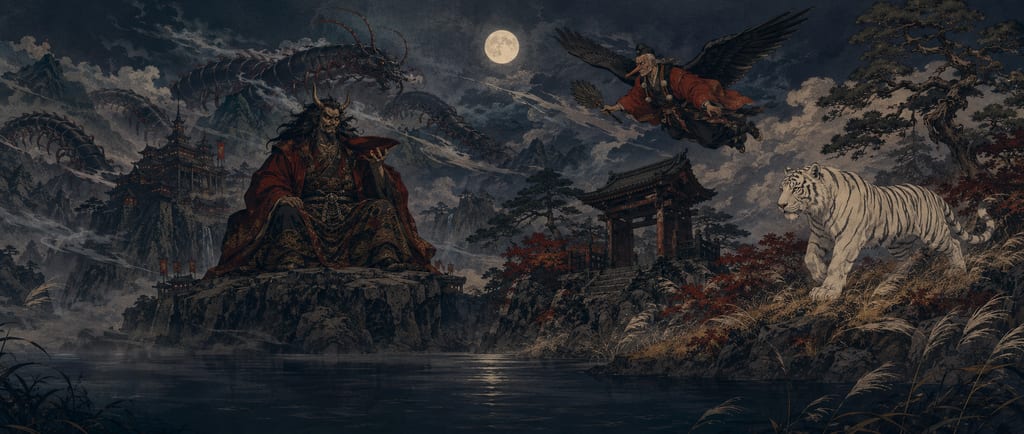
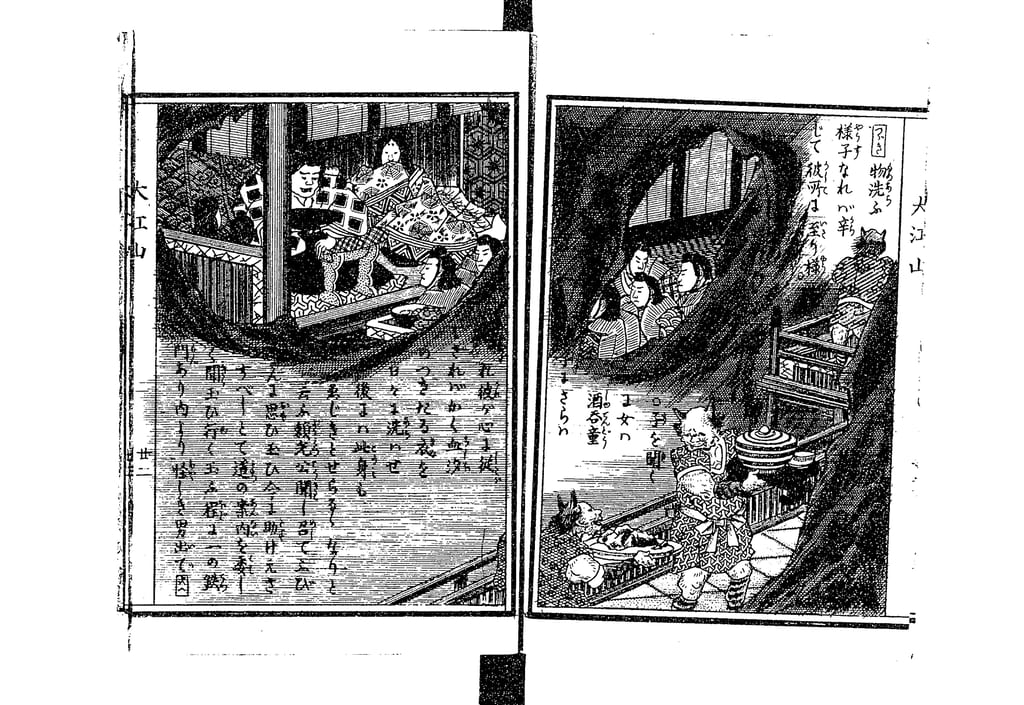
In *Ōeyama Ekotoba*, Shuten-dōji does not enter a battlefield with his horns raised. He first appears as the host receiving visitors dressed as yamabushi in an oni castle beyond a rocky opening. By day he is about one *jō* tall. He wears patterned kosode, white hakama, and a fragrant suikan robe; ladies-in-waiting carry round cushions and armrests for him, and the text describes his bearing as dignified and wise.[2] The splendid clothes, prepared seating, and attending women show that he is not a solitary oni wandering the mountains, but the master of an oni castle with many retainers and captives.
He asks who his visitors are and, rather than attacking at once, tells his history at length. In the account of being driven from his former dwelling by Dengyō Daishi and reaching Ōeyama through the mountains of Ōmi, a monster slain from the capital's side is allowed time to retell his past in his own words. The tale depicts him as a cruel eater of people, but it also lets us hear the voice of a defeated figure with memory and pride.
The Cup That Gives Him the Name Shuten-dōji
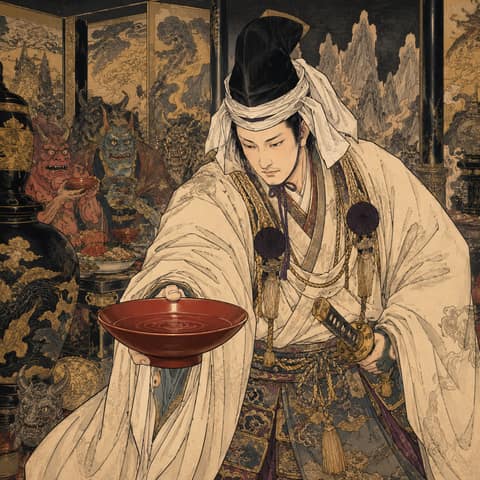
The origin of the name Shuten-dōji is also revealed through conversation at the banquet. He says that his retainers gave him the byname Shuten-dōji because of his deep love of drink.[2] Yorimitsu flatters him by saying that a *dōji* must be a child and invites the host to take the first cup. The dōji finds this amusing and drinks three cups. His self-introduction, the courtesies of hosting, and the slayers' maneuvering converge in the exchange over a single cup.
What defeats him here is not ordinary sake. In the earliest Ōeyama text, the sake prepared by the divine manifestations is called 死筒の酒.[2] This differs in both name and textual layer from 神変鬼毒酒, the Mount Ibuki tradition’s special sake,[6] and from 神便鬼毒酒, commonly rendered Jinben Kidoku-shu, found in *otogi-zōshi* traditions and other later retellings.[7] Once the origin of his drink-loving name is separated from the special sake prepared to intoxicate an oni, the banquet emerges not as the discovery of a simple weakness but as a stratagem that turns a host's courtesy against him.
Dōji by Day,
Five-Colored Oni by Night
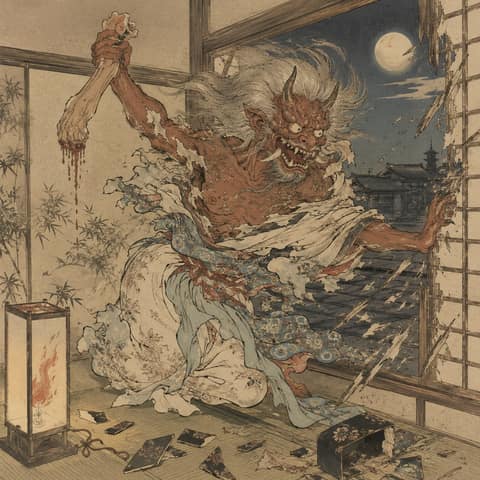
His splendid daytime appearance sharply contrasts with the oni body that appears at night. As he sleeps, the dōji reveals his true form, roughly five *jō* tall: a red head and torso, black left foot, yellow right hand, white right foot, blue left hand, fifteen eyes, and five horns.[2] He is neither a uniformly red oni nor a symmetrical giant. Color divides the body part by part, and the number of his eyes and horns lies far beyond human measure.
The text does not explain these five colors through a particular compass direction or the five phases. Yet the movement from a daytime body that can receive human guests to a nighttime body excessive in color, eyes, and horns strongly conveys that the oni king cannot be wholly contained within human order. In Noh, the youthful and oni forms occupy successive halves of the play, while later picture scrolls and ukiyo-e select a large man or a red oni; Shuten-dōji therefore has no single standard portrait.
A Palace Where Courtesy and Cannibalism Coexist
The master of the oni castle leads his visitors to their seats, hears them out, and shares cups with them. Yet the castle confines captives, and its garden contains old and fresh corpses and tubs for making sushi from people. Knowing the rules of courtesy does not make him merciful. Shuten-dōji's banquet is a place where refined, courtly conduct and the violence of treating people as food exist within the same order.
His decision to admit the party in yamabushi dress cannot be explained as simple foolishness. He questions the arrivals, directs the banquet, and tries to make them follow the customs of his realm. That pride in his role as host gives the party a chance to come close and is ultimately used against him. His dignity, eloquence, ruler's pride, and a predator's cruelty form an inseparable and unsettling whole.

The Conditions That Decided the Slaying
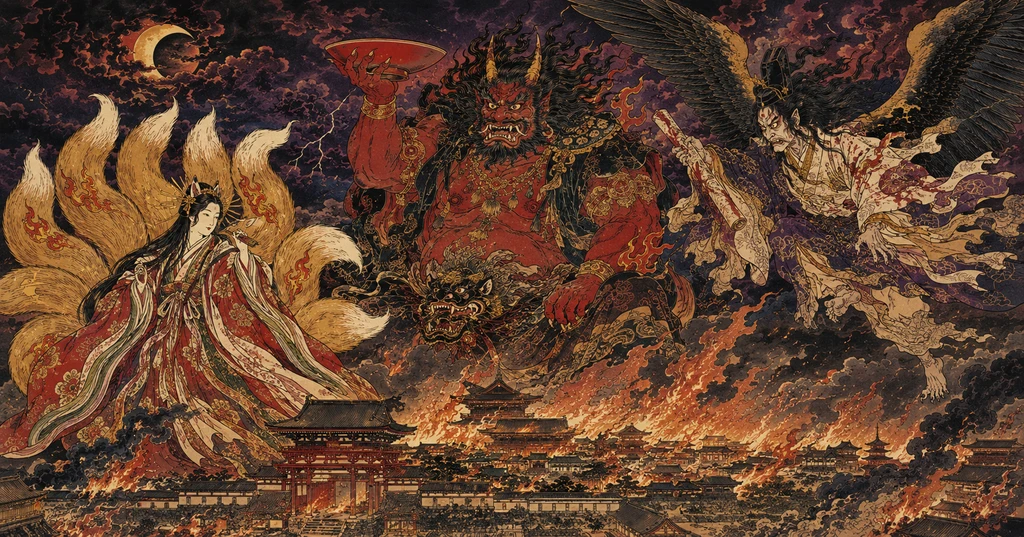
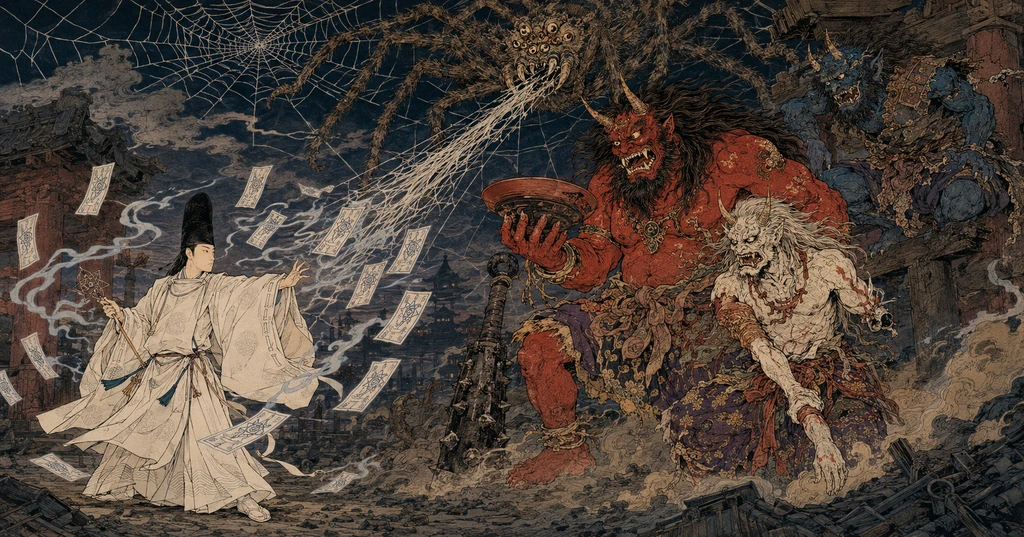
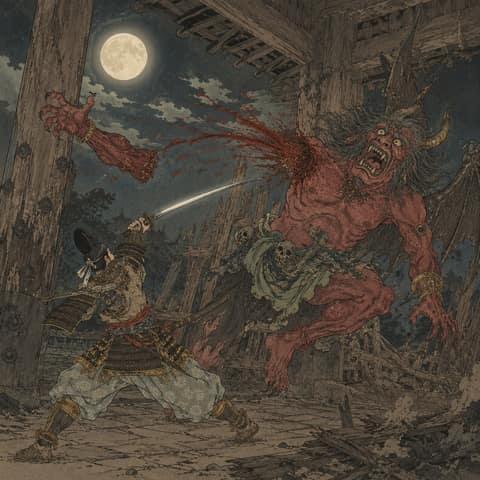
The slaying was not accomplished by one weapon or one weakness. Yorimitsu and Yasumasa, acting under imperial command, pray to deities and buddhas; in the mountains they obtain yamabushi clothing and special sake from divine manifestations. They hide their weapons, enter the oni castle, avoid revealing themselves at the banquet, and wait for the night when the dōji sleeps. Divine manifestations hold the drunken oni king's hands and feet, and Yorimitsu, Yasumasa, and their retainers strike together. Only when force, disguise, sake, timing, and divine intervention all coincide does the oni king's head fall.
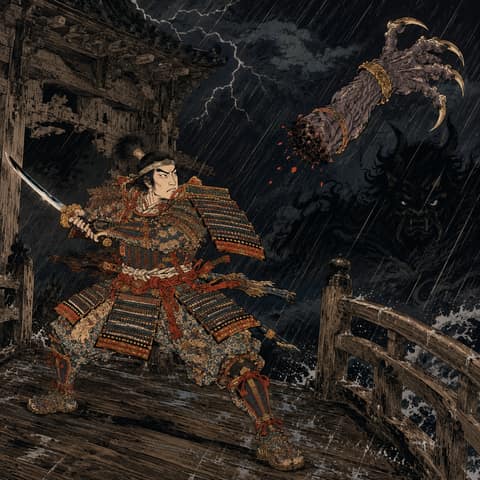
Even then the struggle is not over. The severed head flies into the air and bites the three helmets Yorimitsu wears one over another. Tsuna and Kintoki gouge out its left and right eyes; only then does it stop moving, after biting through the outer two helmets but not the innermost one.[2] Its attack on the enemy after beheading preserves the defeated oni king's power to the end. The episode celebrates the slayers' victory while also showing the strength of an opponent for whom the victors needed divine aid and multiple layers of preparation.

The Village of Oni-Hiding Beyond the Rocky Opening
The oni castle of Ōeyama does not map directly onto an actual mountain fortress. In yamabushi dress, the party passes through a rocky opening and enters "Oni-kakushi no sato," the Village of Oni-Hiding, beyond it. There are shining gates; mountains and ground like lapis lazuli and crystal; a garden where plants of all four seasons grow at once; and a prison holding captives from foreign lands as well as Japan.[2] A beautiful otherworld and a man-eating hell overlap without cancelling one another out.
The rocky opening works as a threshold between the capital's order and the oni king's order. The present Ōeyama range is a leading place for the Shuten-dōji legend, but the story's gate, prison, and sleeping chamber cannot be assigned to a single point on a modern map. Ōeyama is both a mountain name and a narrative otherworld that confines what the capital cannot see and gathers foreign lands and nonhuman beings into one castle.
Two Endings Left by the Head
In *Ōeyama Ekotoba*, the slain head is taken to the capital, shown to the people, and then placed in the Uji treasure storehouse.[2] The body of the oni king who defied imperial authority does not disappear; it is kept as proof of victory. At Oinosaka, by contrast, a later head-mound tradition tells that the head became suddenly heavy, could not enter the capital, and was buried there.[8] The two endings give the head different significance: one places it in the capital’s treasure house, while the other stops it at the capital’s boundary.
The Uji ending places the oni king under imperial control; the Oinosaka ending leaves the landscape marked by a force and ritual impurity that cannot enter the capital even after his death. They are not events from the same period, but both preserve Shuten-dōji's presence beyond the beheading. After the body is lost, the head's destination generates further tradition.
A Body Changed Each Time It Was Depicted
To read later images, their dates of production must be kept alongside Shuten-dōji's body. In the third scroll of Kanō Shōun's *Shuten-dōji*, painted in 1700, a lavish banquet and the slaying of an enormous oni body unfold across a long color picture scroll.[11] This is not the fourteenth-century Itsuō scroll itself, but an Edo-period retelling of the Ōeyama tale.
In his 1779 *Konjaku Gazu Zoku Hyakki*, Toriyama Sekien placed the drunken, reclining "Shuten-dōji" and surrounding oni on one page.[5] Tsukioka Yoshitoshi's 1865 *Wakan Hyaku Monogatari* depicts the master of a splendid banquet while incorporating an Echigo birth theory in its accompanying text.[12] The 1889 *Ōeyama Shuten-dōji* brought the story to new readers as a popular illustrated book.[13]
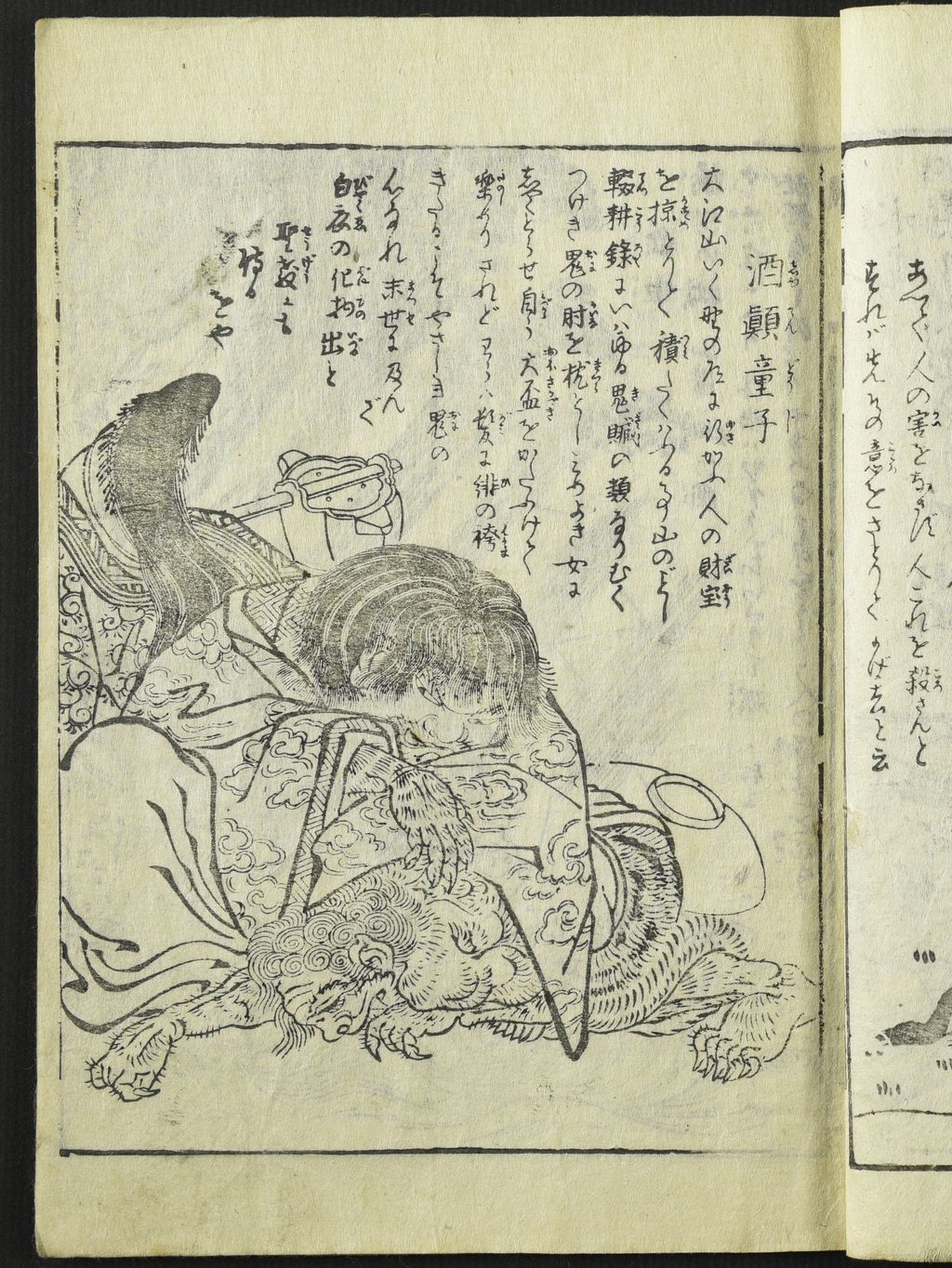
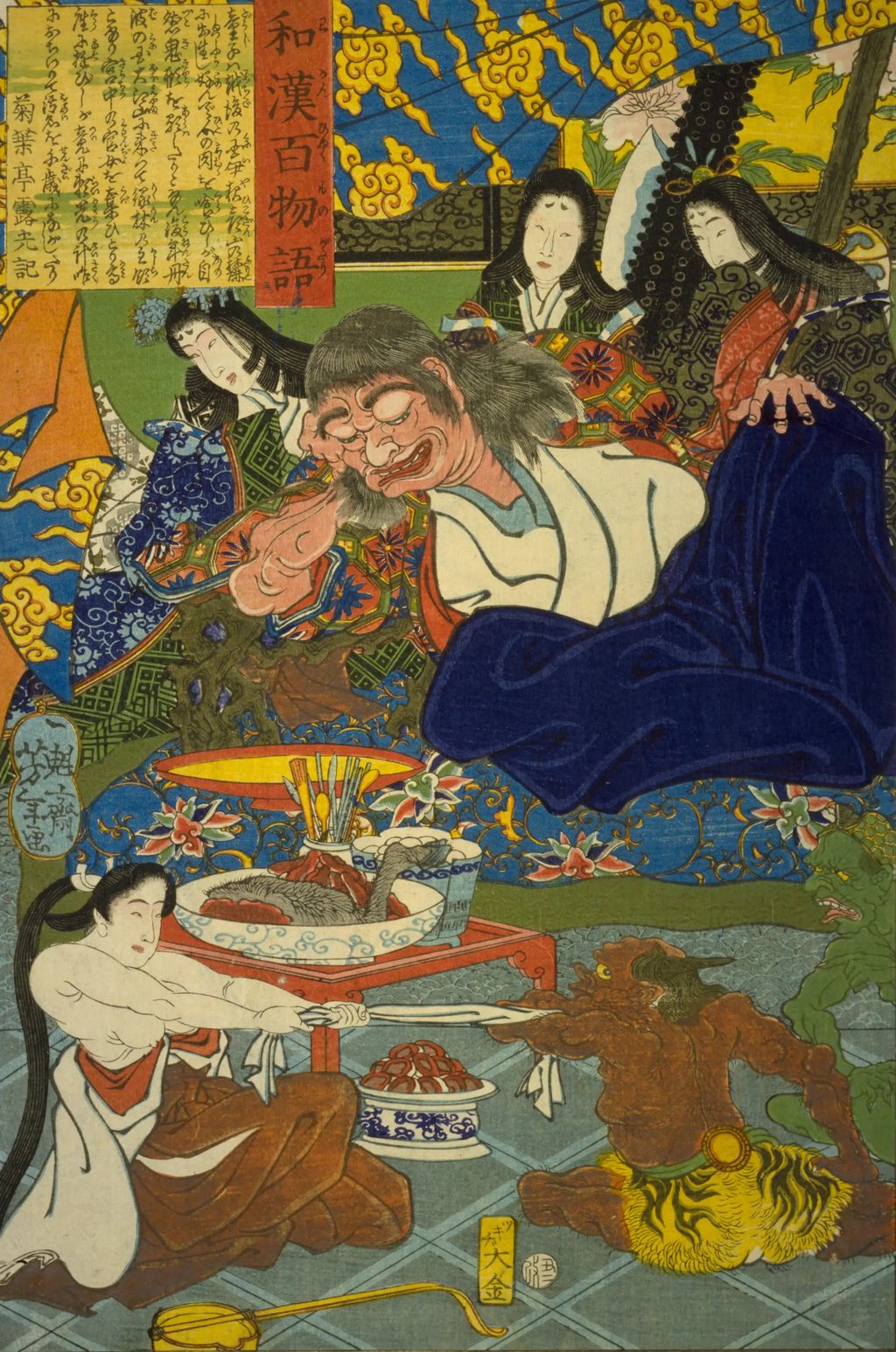
A dōji one *jō* tall; a five-colored oni body with fifteen eyes and five horns; a boyish Noh performer; a large man at a banquet; Sekien's drunken reclining yōkai; an ukiyo-e print that incorporates an Echigo birth tale. These different bodies under the same name are not a confusion in the tradition. They show how Shuten-dōji has survived by receiving the fears, heroic ideals, entertainments, and local memories of each period.
Character Profile
This section is our own creative profile for storytelling. It is not historical fact or scholarship.
Yokai Type - Traditional Yokai
Category - Demons & Giants
Rarity - Legendary
Personality - A ruthless oni king with dignity and wisdom: he receives guests formally and recounts his wanderings, yet uses the people he has captured as food. Proud of his rule, he continues to bite at his enemies even after his head is cut off.
Compatibility - He could sustain a wary, lasting exchange with someone who sees beyond empty bravado, recognizes courtesy and danger at once, and can still listen for the defeated person’s voice within a victor’s heroic tale.
Abilities - Takes the form of a dōji about one jō tall by day and reveals an oni body roughly five jō tall at nightHas a five-colored body, fifteen eyes, and five hornsCommands many retainers and rules the oni castle in the Village of Oni-HidingIn his own account of his past, becomes destructive winds and drought, harming the realmHis severed head flies through the air and bites the three helmets Yorimitsu wears one over another
Weaknesses - No general vulnerability is specified. In *Ōeyama Ekotoba*, he grows drunk on 死筒の酒, the special sake named in the oldest text; divine manifestations pin him down as he sleeps, and Yorimitsu, Yasumasa, and their followers cut off his head.
Habitat - In the Ōeyama tradition, he rules an oni castle in the Village of Oni-Hiding beyond a rocky opening. The Mount Ibuki tradition places his dwelling at Mount Ibuki in Ōmi Province.