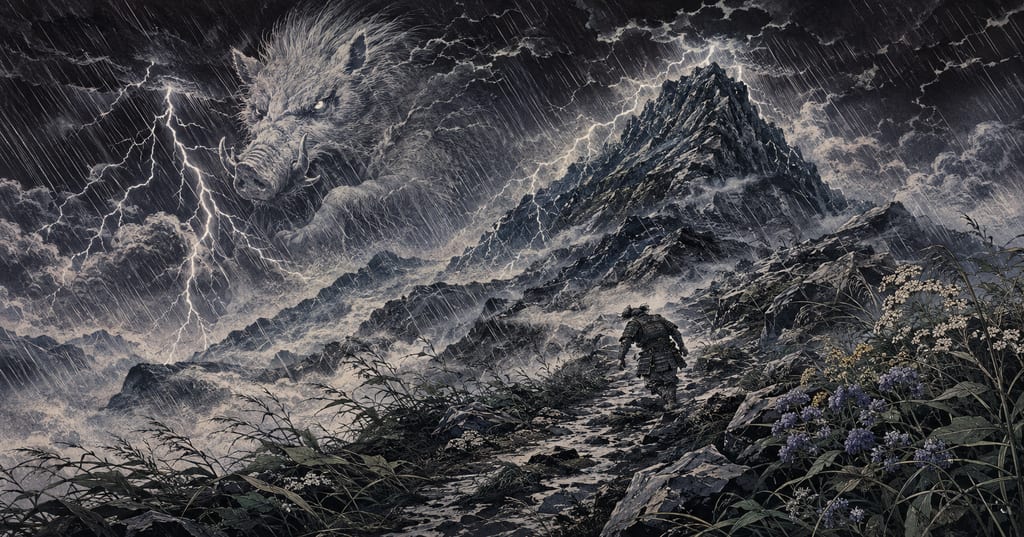
Rising on the border between Shiga and Gifu Prefectures, Mount Ibuki stands 1,377 metres high. Two major stories of very different character have accumulated around it. One is the confrontation between Yamato Takeru and the deity of Mount Ibuki recorded in the *Kojiki* and the *Nihon Shoki*. The other belongs to the Ibuki branch of the Shuten Doji tales, which places the demon king's stronghold not on Oeyama in Tamba but on Mount Ibuki in Omi.
These two stories cannot be compressed into a single myth in which Shuten Doji was born from Ibuki Daimyojin. The myths of the early chronicles and the medieval picture scrolls differ in both period and cast. This article reads them in their own layers: the mountain deity who defeats a hero, Shuten Doji who builds a fortress on Mount Ibuki, and the medicinal plants that sustained everyday life.
The Mountain Deity Who Defeated a Hero
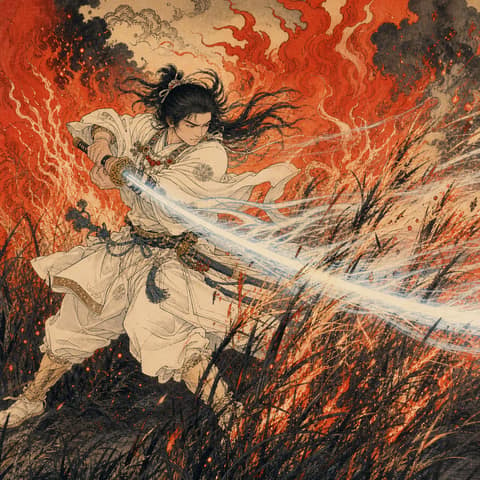
Mount Ibuki entered the permanent landscape of Japanese myth through the final story of Yamato Takeru, one of its greatest heroes. According to the *Kojiki* and the *Nihon Shoki*, Yamato Takeru set out to subdue the deity of Mount Ibuki on his way home from his eastern campaign[1]. The *Kojiki* says that he went up the mountain almost empty-handed, having left the sacred sword Kusanagi-no-Tsurugi with his wife Miyazu-hime in Owari. To challenge a god after laying aside the divine sword that had helped pacify the east—such overconfidence would decide the hero's fate.
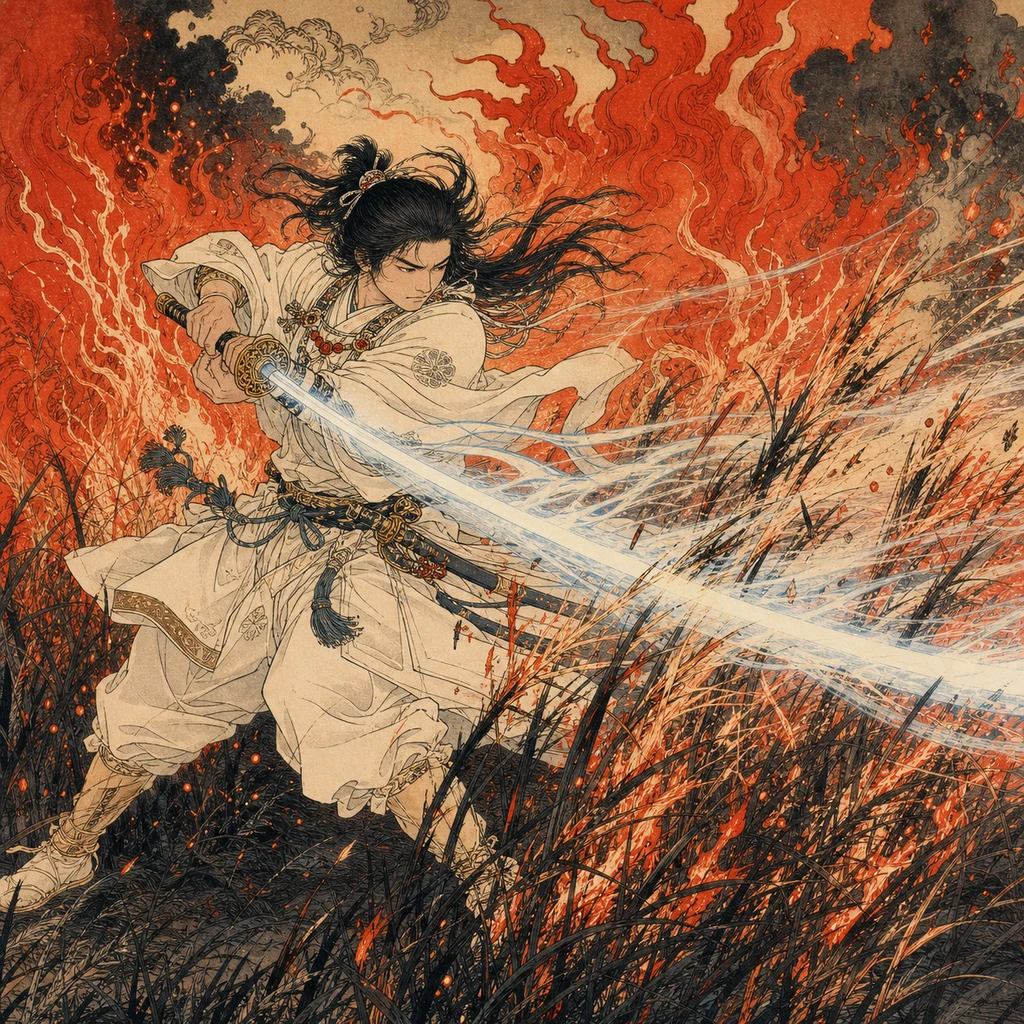
Yamato Takeru
Yamato Takeru is one of ancient Japan's greatest deified heroes, known from the Kojiki and Nihon Shoki as a tragic prince, the son of the twelfth emperor Keiko. In the Kojiki he appears as Yamato Takeru no Mikoto and Ousu no Mikoto; in the Nihon Shoki he is written as Nihon Buyson, Ousu no Mikoto, Yamatooguna, and other forms. After killing his elder brother, Ousu is feared and rejected by his father, Emperor Keiko. He is sent on one campaign after another: west to Kumaso in southern Kyushu and Izumo, then east to the Tokai, Kanto, and Tohoku regions, subduing local gods and powerful clans along the way. In the Kumaso campaign, he disguises himself as a woman, slips into the enemy camp, and kills the Kumaso Takeru brothers; at the moment of death, Kumaso Takeru grants him the name Yamato Takeru. With the Kusanagi sword, given to him by his aunt Yamato-hime, ancestress of the Ise Shrine saigu, he escapes the grass-fire attack at Yaizu in Suruga. At the sea of Hashirimizu, his consort Ototachibana-hime throws herself into the waves to calm the sea god. Finally, after being cursed by the mountain deity of Mount Ibuki in Omi, he falls gravely ill and dies at Nobono in Ise, now Kameyama in Mie Prefecture. The legend that he became a white bird after death and flew away is one of ancient Japan's major tales of heroic ascent and transformation. Shrines, tomb traditions, Shiratori shrines, and Atsuta Jingu, where the Kusanagi sword is enshrined, preserve his memory across Mie, Aichi, Gifu, Shizuoka, and beyond.
Read moreIt proved fatal. When Yamato Takeru encountered a white boar as large as an ox—or, in another account, a great serpent—he dismissed it as the deity's messenger rather than the deity itself, and made a rash declaration. Enraged, the mountain deity sent down a fierce storm of icy rain. Struck by it, Yamato Takeru fell so gravely ill that he lost his senses[1]. A hero who had defeated countless formidable foes could not even cross blades with this opponent; he simply buckled beneath rain driven by divine anger. That helpless defeat makes the power of the Ibuki deity all the more terrifying. He managed to descend, but after recovering somewhat at a spring at the mountain's foot, he finally died at Nobono[1]. The deity needed no weapon to defeat him; it exacted the price of a single act of contempt. The tale concentrates all of the mountain deity's terror in that reversal.
Ibuki Daimyojin,
a Fierce Deity
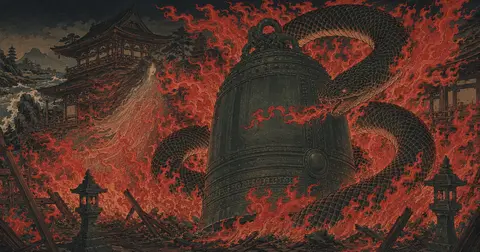
The mountain deity who defeated Yamato Takeru is known as Ibuki Daimyojin. A great white boar, or perhaps a vast serpent—its form is not fixed, but either image embodies a ferocious natural force beyond human understanding.
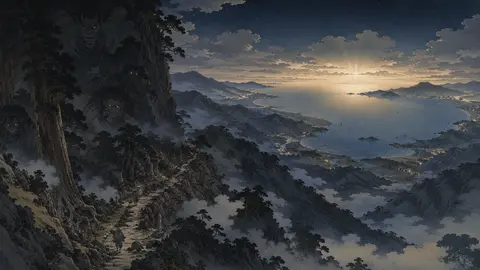
Mount Ibuki is a mountain of severe weather: among Japan's heaviest snowfalls in winter, then mist and thunder in summer. The icy rain that struck down the hero may well have been a mythic expression of that very climate. For ancient people, such uncontrollable force revealed the will of a fierce deity. Disrespect the god, and punishment comes at once: the story of Ibuki Daimyojin gives mythic form to awe before nature. The Mount Ibuki passages in the *Kojiki* and the *Nihon Shoki* neither identify the mountain deity as Yamata no Orochi nor name it as Shuten Doji's father. Later origin tales of Shuten Doji sometimes give him a mountain deity or serpent deity as a parent, but those traditions should not be projected back onto the early chronicles. The god who defeats Yamato Takeru and the demon king who lives in the Ibuki picture-scroll tradition are best met first as figures from different stories.
Mount Ibuki as the Demon King's Stronghold
Mount Ibuki's connection with Shuten Doji is not merely an alternative claim for his birthplace. Tales of Shuten Doji divide into two broad currents: one makes Oeyama the demon king's stronghold, while the other places it on Mount Ibuki in Omi. The stories themselves follow two distinct lines.

Shuten-dōji
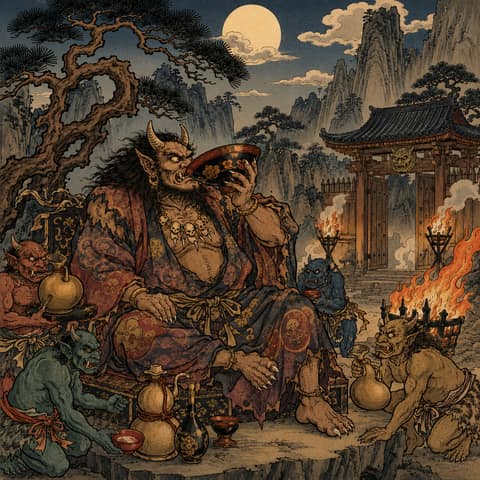
Shuten-dōji is the central figure in medieval oni-slaying tales that pit an oni king, who carries people away from the capital, against warriors sent into the mountains by imperial command. The stories are set in the reign of Emperor Ichijō and include the historical commanders Minamoto no Yorimitsu and Fujiwara no Yasumasa, but they are not contemporary Heian-period records. The Important Cultural Property *Ōeyama Ekotoba*, held by the Itsuō Art Museum, is the oldest surviving picture scroll of the Ōeyama tradition; it was made in the fourteenth century, during the Northern and Southern Courts period. Reading the Heian setting separately from the work's medieval creation prevents the tale from being mistaken for a record of an actual bandit suppression. Instead, it reflects the world later audiences imagined through Heian warriors and an oni king. His name, too, has never had a single spelling. *Ōeyama Ekotoba* chiefly writes 酒天童子, and the dōji himself says that his retainers call him Shuten-dōji because of his deep love of drink. Other spellings include 酒伝童子 and 酒顛童子 (酒顚童子); 酒呑童子 is now the most widely used. The word *dōji* alone does not establish a particular age, hairstyle, or clerical status. In the Noh play *Ōeyama*, the first-half shite appears in the guise of a youth, while *Ōeyama Ekotoba* portrays his daytime form as a dignified figure about one *jō* tall. The tale broadly divides into a tradition that places the oni king at Ōeyama and another that places him at Mount Ibuki in Ōmi Province. The *Shuten-dōji Emaki* (酒伝童子絵巻) at the Suntory Museum of Art, made in 1522, is considered the oldest surviving example of the Mount Ibuki tradition. These are not simply the same story with one mountain name substituted for another: the cast of characters, the name of the sake, and the oni king's appearance and past all differ among copies. Accounts of Ōeyama, Mount Ibuki, Echigo, and Oinosaka therefore cannot be joined into one certain biography for a single Shuten-dōji. In the oldest text of the Ōeyama tradition, disappearances continue in the capital until Abe no Seimei's divination points to the oni king of Ōeyama. Imperial orders go to the two commanders Yorimitsu and Yasumasa, who head for the mountain with their retainers. Reducing the story to the later, familiar tale of Yorimitsu and his Four Heavenly Kings obscures the structure of the early copies. In the mountains the party receives yamabushi dress and special sake from manifestations of deities and buddhas, enters the oni castle, and joins the dōji's banquet. By day the oni king takes the form of a dōji about one *jō* tall, displaying dignity and wisdom; at night he becomes an oni roughly five *jō* tall. His head and torso are red, his left foot black, right hand yellow, right foot white, and left hand blue; he has fifteen eyes and five horns. Once he has grown drunk and fallen asleep, the divine manifestations hold him down and Yorimitsu, Yasumasa, and their followers cut off his head. The head still flies through the air and bites the three helmets Yorimitsu wears one over another. Shuten-dōji is not merely a straightforward evil oni overcome by drink. He receives guests as the master of a splendid oni castle and tells of his own wanderings, even as he uses his captives for food. Courtesy toward guests and cruelty, intelligence and an immense oni body, defeat and the flying head stand together in the same story. Noh, *otogi-zōshi*, picture scrolls, printed books, jōruri, and kabuki each circulated different images of Shuten-dōji. Toriyama Sekien also depicted Shuten-dōji, under the spelling 酒顛童子, in his 1779 *Konjaku Gazu Zoku Hyakki*, placing the drunken, reclining dōji and other oni on a page of his yōkai picture book. Rather than a monster fixed in a single form, Shuten-dōji is one of Japan's best-known oni kings, retold through manuscripts, performing arts, and the memories of particular places.
Read moreThe *Shuten Doji Picture Scroll* in the Suntory Museum of Art, made in 1522, is a three-scroll work and is regarded as the oldest surviving example of the Ibuki tradition. Commissioned by Hojo Ujitsuna, the second head of the Odawara Hojo clan, it was painted in sumptuous colour by Kano Motonobu and his pupils[2]. This is not a brief origin episode added at a later date. From Raiko's departure through the demon fortress, the banquet, and the final slaying, it is a self-contained work built around the Ibuki tradition.
In a preparatory drawing whose surviving designs have been catalogued by the Hyogo Prefectural Museum of History, one can trace the disappearance of the daughter of Ikeda, a Middle Counsellor; Abe no Seimei's divination; Minamoto no Raiko, his Four Heavenly Kings, and Fujiwara no Yasumasa; the manifestations of the deities of Iwashimizu Hachimangu, Sumiyoshi, and Kumano; the helmet and Shinpen Kidokushu, the divine demon-poisoning sake; and finally the imperial command against Shuten Doji, who dwells on Mount Ibuki[3]. The oldest *Oeyama Ekotoba* of the Oeyama tradition calls its drink “Shizutsu no sake”; here it is called “Shinpen Kidokushu.” Not only the mountain name but the name of the sake and the composition of each scene differ from one textual lineage to another.
It is therefore impossible to treat a continuous migration—from a birth on Mount Ibuki, through expulsion from Mount Hiei, and finally to Oeyama—as Shuten Doji's standard biography. In the Ibuki tradition, Mount Ibuki is the demon king's home base; in the Oeyama tradition, Oeyama is. Read together, the two show not a single plot carried unchanged from mountain to mountain, but a demon-king story repeatedly reworked by writers in different places and eras. For the Oeyama tradition, see Oeyama and Shuten Doji.
A Mountain of Medicinal Herbs
The mountain of a fierce deity was also a source of sustenance. Mount Ibuki has long been known as a treasury of medicinal herbs. Mugwort, Japanese angelica, and Cnidium rhizome are counted among the “three great medicinal herbs of Ibuki”; most notably, Ibuki moxa, used in moxibustion, was distributed throughout Japan in the Edo period. Around 280 species of medicinal plant still grow at the mountain's foot[1]. It is also said that during the Warring States period Oda Nobunaga, on the advice of missionaries, had an extensive medicinal-herb garden established on Mount Ibuki. From antiquity into the early modern era, the plants nourished by this severe mountain quietly supported people's lives and health.
A mountain deity that sends icy rain to kill a hero also raises plants that heal the sick. That apparent contradiction is central to Mount Ibuki. Fierce weather and abundant vegetation are simply two sides of the same mountain. Its untamed power brings calamity, but also abundance. Awe before Ibuki Daimyojin and gratitude for medicinal herbs were two complementary prayers addressed to one mountain.
A Mountain of Flowers and Myth Today
Today Mount Ibuki is cherished as a mountain of flowers. In summer, endemic alpine plants bloom across its summit, and it is counted among Japan's celebrated flower mountains. Heavy winter snow and summer blossoms: the very severity of its climate has fostered luxuriant vegetation. A stone statue of Yamato Takeru stands at the summit, quietly watching over hikers who come to the place where the mythic hero challenged a deity and suffered the defeat that led to his death.
Once told as the mountain of the deity who defeated a hero, and made the site of the demon king's castle in the Ibuki picture-scroll tradition, it has become a renowned peak climbed by many throughout the year for its seasonal landscapes. Yet when mist suddenly engulfs the slopes and thunder rolls across them, climbers may understand why the early chronicles imagined this mountain's power as something no human valour could fully master.
A Mountain Where Stories of Gods,
Demons,
and Herbs Converge
Mount Ibuki gathers together stories from different moments in history: the mountain deity who defeated a hero, Shuten Doji, whose demon fortress stood in Omi, and the medicinal plants that supported daily life. They are not bound by a single chain of cause and effect in which a god gave birth to a demon, whose force then made herbs grow. Rather, the mountain's harsh climate, rich vegetation, and position between the capital and the eastern provinces drew different meanings to it in different ages.
In the *Kojiki* and the *Nihon Shoki*, a mountain deity beyond human valour defeats Yamato Takeru. In the *Shuten Doji Picture Scroll* of 1522, Mount Ibuki is Shuten Doji's stronghold, and Raiko, Yasumasa, and their companions make for the demon fortress with aid from gods and buddhas. From the early modern period onward, medicinal herbs such as Ibuki moxa made the mountain's gifts available for healing. Kept distinct and set side by side, these stories reveal Mount Ibuki as a mountain of multiple histories, too complex to be contained by the single phrase “untamed power.” For the wider Omi Province, see An Encyclopedia of Yokai in Omi Province; for Shiga Prefecture as a whole, see An Encyclopedia of Yokai in Shiga Prefecture.