Sumiyoshi Taisha 一寸法師が生まれた社 ── 住吉大社

住吉三神·一寸法師·航海の神。海と物語の聖地

一寸法師が生まれた社 ── 住吉大社

Sumiyoshi Taisha · すみよしたいしゃ

View on map

大阪市住吉区、「すみよっさん」の愛称で親しまれる住吉大社(すみよしたいしゃ)。全国に約二千三百社ある住吉神社の総本社であり、海の神·住吉三神(すみよしさんじん)を祀る、由緒ある古社である。

航海の安全を守る神として、古代から朝廷の篤い崇敬を受けてきたこの社は、もう一つ、誰もが知る昔話の故郷でもある ── 子のない夫婦が神に祈って授かった小さな子、一寸法師(いっすんぼうし)が生まれた地として。海の守護と、小さな英雄の物語。本稿は、住吉大社に重なる二つの顔をたどる。

海の神の総本社

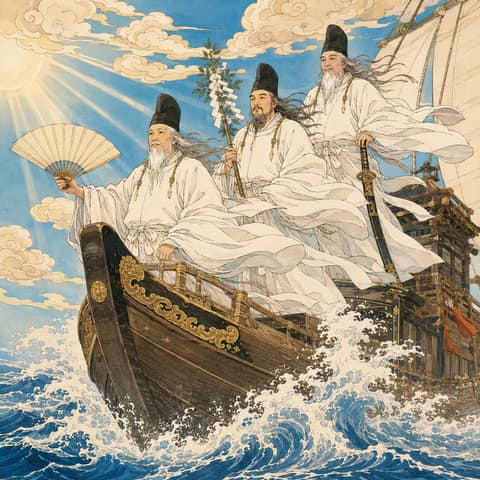
住吉大社は、大阪市住吉区に鎮座する、全国の住吉神社の総本社である。主祭神は、底筒男命(そこつつのおのみこと)·中筒男命(なかつつのおのみこと)·表筒男命(うわつつのおのみこと)の住吉三神、そして神功皇后(じんぐうこうごう)の四柱で、それぞれ第一から第四までの本宮に祀られている

大阪湾にほど近いこの地は、古来、瀬戸内海をへて大陸へとつながる、海上交通の要衝であった。海の神を祀る住吉大社が、この地に鎮座したのは、決して偶然ではない。難波津(なにわづ)から船出する人々は、まずこの社に旅の無事を祈ったのである。住吉の神への信仰は、海を生業とする人々を中心に全国へと広がり、港や海辺の町には、いたるところに住吉神社が祀られた。航海の守り神であると同時に、和歌の神として、また禊祓(みそぎはらえ)の神としても、住吉の神は広く崇敬されてきた。

禊から生まれた神

住吉三神は、その出自からして、海と分かちがたく結びついた神である。
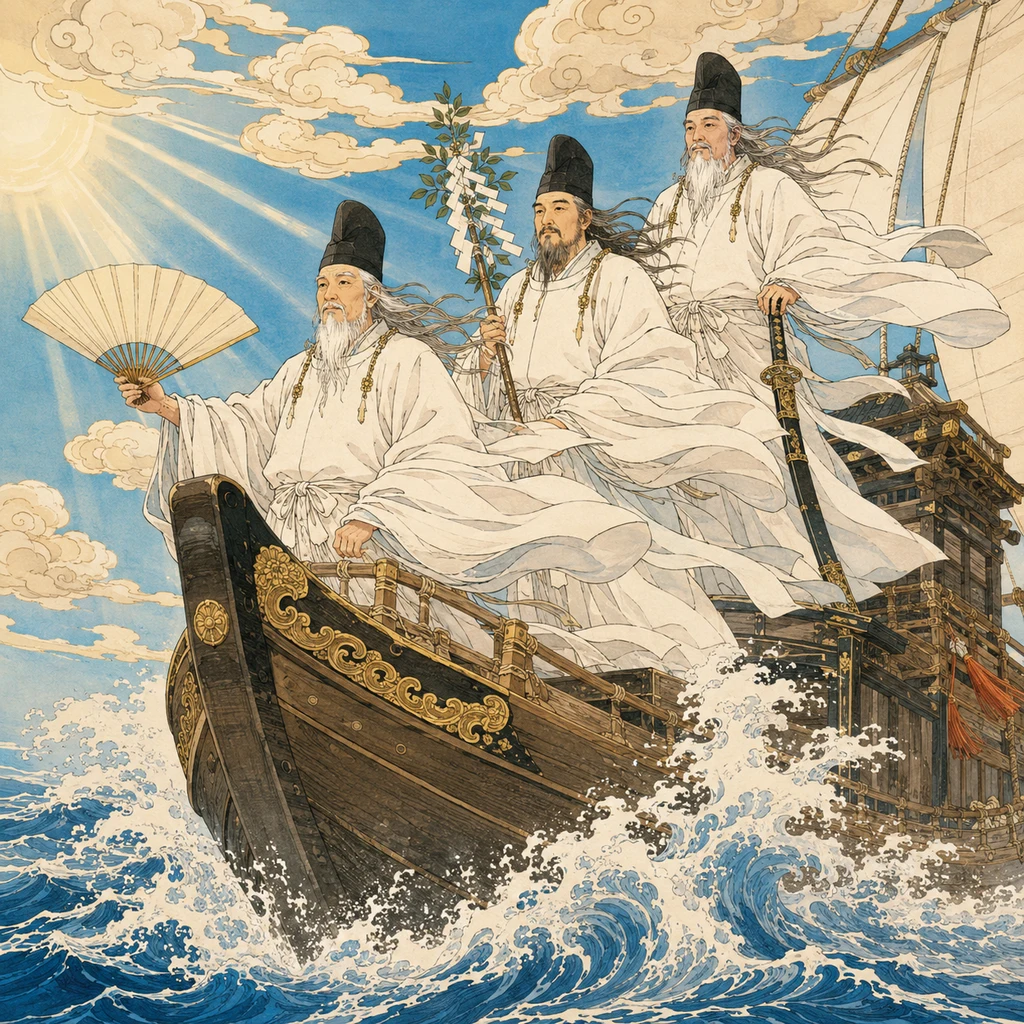
Sumiyoshi Sanjin

すみよしさんじん

According to the first volume of the Kojiki and the Age of the Gods section of the Nihon Shoki (Fifth Section, First Alternate Writing), they are the three kami born from three different depths of seawater when Izanagi-no-Mikoto purified himself in the sea at Ahagihara, the river mouth of Tachibana in Himuka of Tsukushi, after returning from the underworld, Yomi. — Sokotsutsu-no-o-no-Mikoto, Nakatsutsu-no-o-no-Mikoto, and Uwa- (or Omote-)tsutsu-no-o-no-Mikoto (written as 'Soko-, Naka-, and Uwa-tsutsu-no-o-no-kami' in the Kojiki). They are enshrined together as guardian deities of the sea. They were born simultaneously with the three Watatsumi kami (Sokotsu-, Nakatsu-, and Uwatsu-Watatsumi) in the Kojiki, and the two groups are often spoken of in pairs. The etymology of 'Tsutsu' has not been academically resolved. Multiple theories coexist, including the star theory (deification of Orion's Belt, originated by Hoei Nojiri in 1936), the 'tsu' (port) theory, the honorific spirit 'tsuchi' phonetic change theory, the ship spirit theory, the Tsutsu toponym theory in Tsushima, and the literal bamboo tube theory. They are the principal deities in the myth of Empress Jingu's conquest of the Three Han states (Sankan Seibatsu). They delivered an oracle to the Empress and reportedly protected her sea route. Sumiyoshi Taisha, the head shrine (Ichinomiya of Settsu Province), comprises four main halls (the first, second, and third enshrine the three kami, and the fourth enshrines Empress Jingu), and it is the principal deity of over 2,300 Sumiyoshi shrines nationwide. From ancient times to the present, they have been widely revered as deities of sea protection, maritime safety, martial fortune, and waka poetry (as the Three Deities of Waka).

Read more

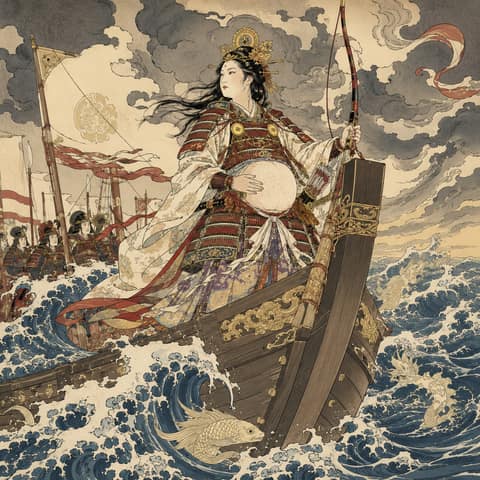
『古事記』『日本書紀』によれば、イザナギが黄泉の国から戻り、筑紫の日向(ひむか)の小戸(おど)で禊(みそぎ)をしたとき、水の底·中ほど·表面のそれぞれから、底筒男·中筒男·表筒男の三神が生まれた。『日本書紀』は、これを「住吉大神」であると記している。海水による禊から生まれた、まさに海そのものの化身というべき神々である。第四本宮に祀られる神功皇后は、住吉三神の加護を受けて海を渡り、新羅へと遠征したと『日本書紀』は伝える。皇后の遠征を導いた住吉の神は、こうして国家を守る航海の守護神として、いっそう篤い信仰を集めることになった。

住吉三神は、航海·海上の守護神として、古代から広く信仰された。遣唐使の船にも祀られ、危険な航海の無事が祈られたと伝わる。大陸との交流を支えた海の神 ── それが住吉の神の、最も古く重要な姿であった。

住吉造と、反橋

住吉大社は、その建築においても、際立った古さを今に伝えている。

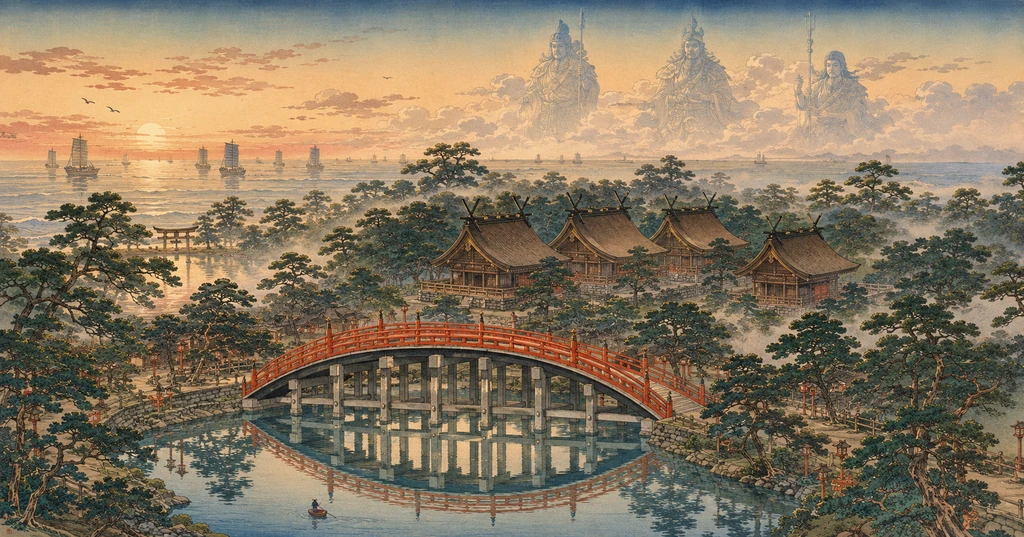
四棟の本殿は「住吉造(すみよしづくり)」と呼ばれる独特の様式で、これは飛鳥時代にまでさかのぼる、神社建築の最古の様式の一つに位置づけられ、国宝に指定されている。仏教伝来以前の、日本古来の建築の姿をとどめる貴重な遺構である。住吉造は、出雲大社の大社造や伊勢神宮の神明造とならぶ古い様式とされ、四棟の本殿が、三棟は縦に、一棟だけ横に並ぶ独特の配置をとる。この並びは、大海原を進む船団になぞらえられるともいう。

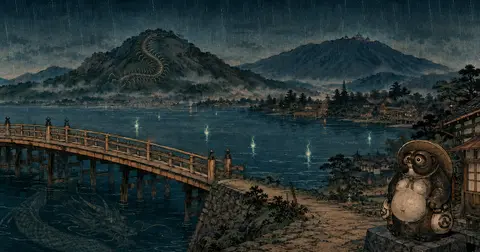
そして、住吉大社を象徴するのが、境内の入口に架かる「反橋(そりはし)」である。太鼓橋(たいこばし)とも呼ばれるこの橋は、その名のとおり半円を描くように大きく反り返り、朱塗りの美しい姿で参拝者を迎える。橋を渡ることそのものが、お祓いの意味をもつとされ、聖なる神域への入口を、視覚的にも印象づけている。

一寸法師、住吉に祈る

海の神の社·住吉大社は、同時に、日本でもっとも親しまれた昔話の一つ、一寸法師の物語が始まる地でもある。
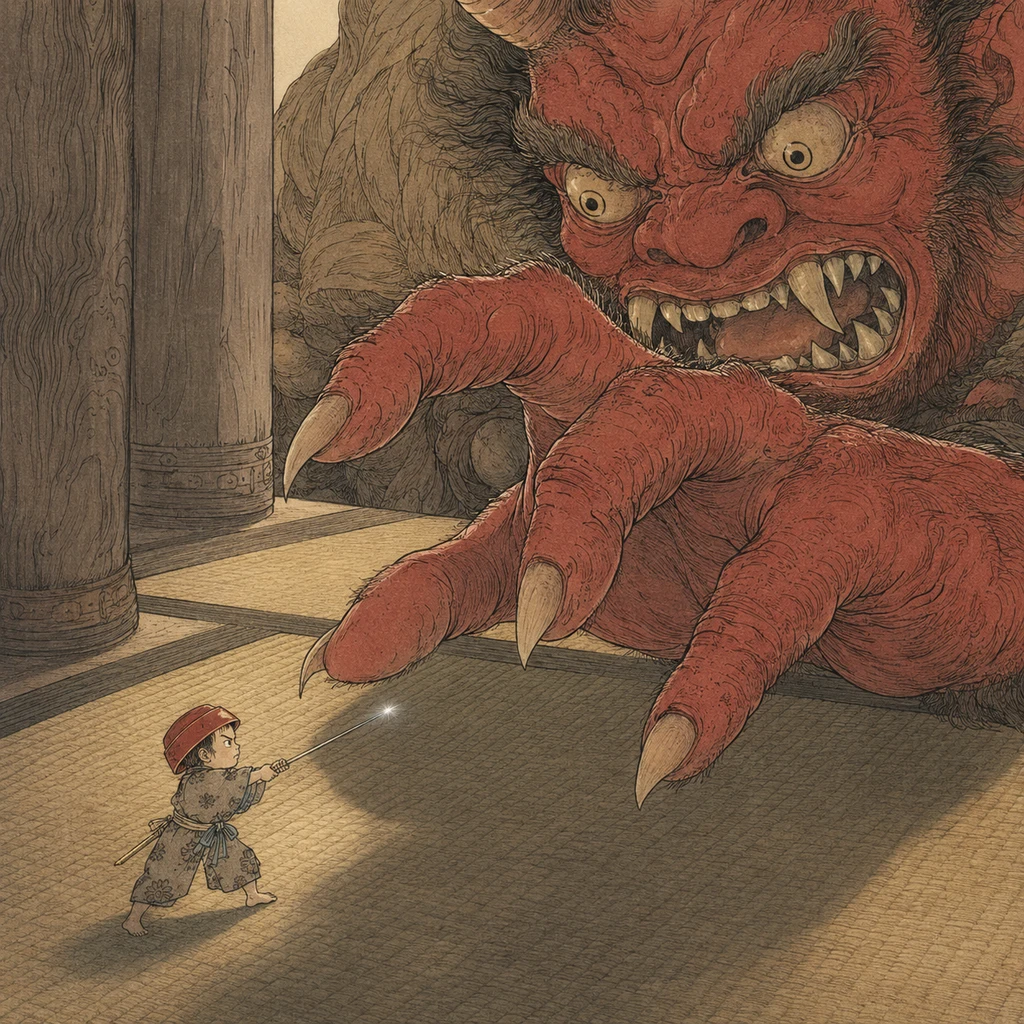
Issun-boshi

EE-soon BOH-shee

Issun-boshi is widely recognized in modern times as a pure and righteous fairytale hero for children—a "brave little boy who rides in a bowl-boat and defeats oni with a needle-sword." However, his original depiction in the Muromachi period literature *Otogizoushi* reveals a dark hero (or a half-human, half-yokai trickster) overflowing with ambition and cunning, fully willing to employ despicable schemes to achieve social advancement. In folkloric classification, he belongs to the "Chiisako" (Little Child) archetype connected to Japanese mythology. Born from an abnormal prayer by an old couple and retaining a physical stature of merely one sun (about 3 centimeters) no matter how many years pass, this trait indicates he is not purely human, but a "liminal existence" belonging to the realm of the otherworld or divine spirits. The motif of arriving from the waterside (Naniwa Bay) in a bowl deeply inherits the mythological lineage of Sukunabikona-no-Kami, a tiny deity who crossed the sea from the eternal land (Tokoyo) riding in a Metaplexis pod boat. He compensates for his overwhelming physical handicap with abnormal intelligence, glibness, and a lack of ethical constraint. Upon ascending to the capital and infiltrating the mansion of a powerful chancellor, he uses not martial prowess but "scheming" to claim a beautiful princess as his own. Ultimately, by stealing the oni's treasure (the Miracle Mallet), he literally transforms into a "human man of great power." This is no mere adventure tale, but an extremely realistic, Machiavellian story of social upheaval, where a deformed existence at the very bottom of society climbs to the absolute pinnacle using intellect and deceit.

Read more

御伽草子『一寸法師』によれば、摂津国·難波の里に住む老夫婦には、長らく子がなかった。二人が住吉の神に「どうか子を授けてください」と祈ったところ、まもなく子を授かる。だが生まれた子は、身の丈わずか一寸(およそ三センチ)しかなかった。それゆえ「一寸法師」と名づけられた

住吉の神は、海を守るだけでなく、子宝を授ける神としても信仰されていた。願いに応えて、神は確かに子を授けた ── ただし、人並み外れて小さな子を。この意外な授かりものから、小さな英雄の冒険が始まるのである。体の小さな子が、その小ささを逆手にとって活躍するという「小さ子(ちいさご)」の物語は、日本各地に伝わる昔話の一類型である。なかでも一寸法師は、その代表として、長く子どもたちに愛されてきた。

お椀の舟、京へ

小さな体に大きな志を抱いた一寸法師は、やがて都を目指して旅立つ。

一寸法師は、お椀(わん)を舟に、箸(はし)を櫂(かい)に、針を刀の代わりに、麦藁(むぎわら)を鞘(さや)の代わりにして、京へと上った。身近な道具を見立てて旅立つこの場面は、子どもたちの想像力を、今なおかきたててやまない。針の刀を腰に差し、お椀の舟で川をさかのぼっていく小さな姿は、その健気さで人々の心をつかんだ。やがて都にたどり着いた一寸法師は、その才覚で宰相の信頼を得ていく。

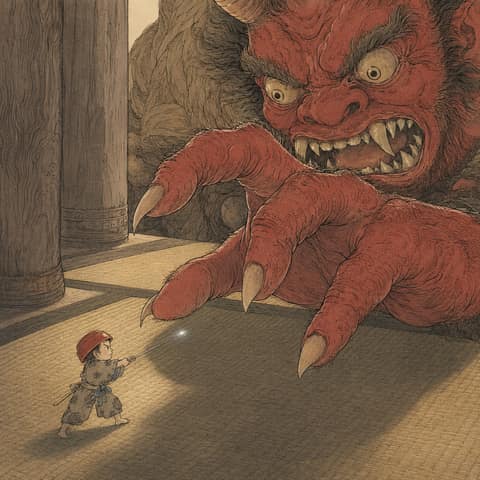
京で宰相(さいしょう)の家に仕えた一寸法師は、その娘のお供をする道中で鬼に襲われる。鬼に飲み込まれてしまうが、腹の中で針の刀を突き立てて暴れ、ついに鬼を退散させた。鬼が落としていった「打出(うちで)の小槌(こづち)」を振ると、一寸法師の背はみるみる伸びて六尺の立派な若者となり、やがて娘と結ばれた。小さき者が知恵と勇気で鬼を打ち負かし、幸いを手にする ── この痛快な物語の出発点に、住吉の神への祈りがあったのである。

物語を生んだ社、今も

海の安全を守る住吉三神と、小さな英雄を授けた子授けの神。住吉大社は、雄大な海の信仰と、心温まる昔話とを、一つの境内に抱いている。

今日も住吉大社は、初詣には毎年二百万人を超える参拝者を集める、関西を代表する大社でありつづけている。朱塗りの反橋を渡り、住吉造の社殿に手を合わせる人々のなかには、海の無事を願う者もあれば、子の幸いを祈る者もあろう。古代の航海者が旅の無事を託し、昔話の老夫婦が子を願った社は、千年を越えて、今も人々のさまざまな祈りを受けとめている。境内では、御田植神事(おたうえしんじ)をはじめとする古い神事の数々が、今なお大切に受け継がれ、住吉の杜に古代からの祈りの形を伝えている。大阪の妖怪と信仰の全体像は大阪府の妖怪事典も参照されたい。
All yokai of Sumiyoshi Taisha3

Complete list of yokai linked to Sumiyoshi Taisha, including those not featured in the article above.

  • Sumiyoshi Sanjin

    Sumiyoshi Sanjin

    Divine

    すみよしさんじん

    Guardian of the Sea & Waka Kami (Default)

    Divine Spirit / KamiSumiyoshi Taisha (Sumiyoshi, Sumiyoshi-ku, Osaka; Ichinomiya of Settsu Province, head shrine, site of Empress Jingu legends) / Sumiyoshi Shrine (Ichinomiya, Shimonoseki, Yamaguchi; Ichinomiya of Nagato Province, enshrinement of the Aramitama via oracle upon Empress Jingu's return) / Sumiyoshi Shrine - Japan's First Sumiyoshi-gu (Sumiyoshi, Hakata-ku, Fukuoka; Ichinomiya of Chikuzen Province, oldest theory identified with Ahagihara) / Hon-Sumiyoshi Shrine (Sumiyoshi-miyamachi, Higashinada-ku, Kobe, Hyogo; ancient shrine theory in Motoori Norinaga's Kojiki-den)

    The true identity of the Sumiyoshi Sanjin is the three kami of purification belonging to Izanagi-no-Mikoto, appearing in the first volume of the Kojiki (Age of the Gods). When Izanagi returned from Yomi (the underworld) and performed misogi (purification) at Ahagihara in Himuka of Tsukushi, he submerged himself in seawater to cleanse his body. From three different depths, three deities were born: recorded as 'Sokotsutsu-no-o-no-kami, Nakatsutsu-no-o-no-kami, Uwatsutsu-no-o-no-kami' in the Kojiki, and as 'Sokotsutsu-no-o-no-Mikoto, Nakatsutsu-no-o-no-Mikoto, Omotetsutsu-no-o-no-Mikoto' in the Nihon Shoki. The orthographic difference between 'Uwa' (upper) in the Kojiki and 'Omote' (surface) in the Shoki is one basis for the later interpretation of 'tsutsu' as layers of water. Simultaneously, the three Watatsumi kami (Sokotsu, Nakatsu, Uwatsu Watatsumi) were born, making Sumiyoshi and Watatsumi a paired dual structure—bottom = Sokotsutsu/Sokotsu Watatsumi; middle = Nakatsutsu/Nakatsu Watatsumi; surface = Uwatsutsu/Uwatsu Watatsumi. This tripartite structure is common to both texts. The etymology of 'Tsutsu' has not been academically resolved. Major theories are listed alongside each other: ① Star theory — 'Tsutsu' is an archaic word for 'star' (hoshi); it deifies the three central stars of Orion (ancient name 'Miboshi') as navigational stars for ancient seafaring clans. However, this is a modern theory advocated by Hoei Nojiri in "Japanese Stars" (1936), and there are no direct supporting primary texts from early folklorists like Orikuchi or Yanagita; treating it as the 'accepted folkloric theory' is academically inaccurate. ② Tsu (port) theory — 'Tsu' is a particle meaning 'of', and the second 'tsu' means 'port/sea route', an interpretation from Orikuchi's lineage; ③ Tsuchi phonetic change theory — 'Tsu' is a particle, and 'chi' is an honorific spirit suffix (akin to Orochi or Nozuchi); ④ Tsutsu-ro theory — 'Tsuchi' equals 'tsuji' meaning sea route; ⑤ Ship spirit theory — ancient ship spirit worship enshrined at the bottom of a boat; ⑥ Tsutsu toponym theory — derived from Tsutsu at the southern tip of Tsushima, the origin of seafaring clans; ⑦ Literal tube theory — using bamboo tubes as a yorishiro (vessel). Listing multiple theories is academically accurate, and it is particularly imprecise to refer solely to the 'star theory' as the accepted view. The Empress Jingu legend is the most important narrative in the history of Sumiyoshi Sanjin worship. According to the Nihon Shoki, when Empress Jingu became possessed after Emperor Chuai's death, the Sumiyoshi kami delivered an oracle: "Conquer Silla, a land filled with gold and silver. If you worship us three deities, Silla and Kumaso will submit." They protected her maritime expedition (subjugating Silla, Baekje, and Goguryeo), and upon her return, a second oracle commanded: "Enshrine our Aramitama (rough spirit) in Yamada village of Anato (Nagato)" — this became the origin of the Shimonoseki Sumiyoshi Shrine. Enshrining the Nigimitama (gentle spirit) in Settsu became the origin of Sumiyoshi Taisha. The structure of jointly enshrining Empress Jingu and Sumiyoshi Sanjin originated here, establishing the unique four-hall structure of Sumiyoshi Taisha. However, the dating of the Empress Jingu chronicles is heavily debated by scholars, and treating the legendary date (211 AD) as historical fact requires extreme caution—archaeologically, it is pointed out as potentially reflecting events from the 4th century onwards. Sumiyoshi Taisha, the head shrine (2-9-89 Sumiyoshi, Sumiyoshi-ku, Osaka), is the Ichinomiya of Settsu Province, one of the Twenty-Two Shrines (Middle Seven Shrines), and a former Kanpei-taisha. Its official history dates its founding to the 11th year of Empress Jingu's regency (211 AD) on the first Day of the Hare in the Month of the Hare — a legendary date without archaeological proof. Its four main halls have a unique layout: the First, Second, and Third Halls line up vertically (facing west, toward the sea), while the Fourth Hall sits south of the Third, forming an L-shape. The First Hall enshrines Sokotsutsu-no-o, the Second Nakatsutsu-no-o, the Third Uwatsutsu-no-o, and the Fourth Empress Jingu. "Sumiyoshi-zukuri" is considered the oldest style in shrine architectural history, characterized by a gabled roof, cypress bark thatch, and red and white walls. The current main halls were built in 1810 and are all designated National Treasures. The steeply arched red Sorihashi (Taiko Bridge) is the iconic visual symbol of the Sumiyoshi faith, frequently appearing in ukiyo-e, paintings, and waka poetry. There are over 2,300 branch shrines nationwide (the official number from Sumiyoshi Taisha, whereas Wikipedia undercounts at ~600). The distribution is concentrated along coastlines, ports, the Seto Inland Sea, Kyushu, and northern Japan, proving it to be the most vital faith for fishermen, shipping merchants, and navy personnel from ancient to modern times. The "Three Great Sumiyoshi" and ancient shrine dispute: ① Sumiyoshi Taisha (Osaka) = Settsu Ichinomiya, Nigimitama, Head Shrine; ② Sumiyoshi Shrine (Shimonoseki, Yamaguchi) = Nagato Ichinomiya, Aramitama, site of Empress Jingu's return oracle; ③ Sumiyoshi Shrine (Hakata, Fukuoka) = Chikuzen Ichinomiya, self-proclaimed "Japan's First Sumiyoshi-gu", oldest theory identified with Ahagihara. Additionally, Hon-Sumiyoshi Shrine in Kobe is based on an influential Edo-period theory by Motoori Norinaga (1764-1798) identifying Settsu's Sumiyoshi village as the ancient "Nanakura's Long Strait". Academically, the "first Sumiyoshi" cannot be determined, with each shrine claiming primacy based on its own legends. In ancient and medieval times, it was customary for Japanese envoys to Sui and Tang China to pray at Sumiyoshi Taisha before departing. The "Tosa Nikki" (Ki no Tsurayuki, 935) also notes prayers for maritime safety to the Sumiyoshi deities. In Heian-period waka by poets like Izumi Shikibu, Ki no Tsurayuki, and Ono no Komachi, Sumiyoshi frequently appears, positioning the kami at the head of the "Three Deities of Waka". In the medieval and early modern periods, the Noh play "Takasago" featured the "Pines of Sumiyoshi and Takasago" as a symbol of marital harmony and longevity, often performed at shrine weddings. The Noh play "Sumiyoshi Mode" is another masterpiece representing this faith. The rice-planting ritual (Otaue Shinji), a National Important Intangible Folk Cultural Property, is Sumiyoshi Taisha's most representative festival, sanctifying the entire rice-farming cycle from planting to harvest. As a samurai faith from the medieval to Edo periods, they garnered reverence from warrior clans like the Minamoto due to Empress Jingu's Sankan Seibatsu legends. During the Muromachi and Sengoku periods, Sumiyoshi Taisha received immense veneration from the shipping industry in the Seto Inland Sea, Settsu, and Izumi, actively participating in both commercial and military affairs as the guardian of maritime traffic in Osaka Bay. Today, visits by the Maritime Self-Defense Force, merchant ships, fishermen, and shipping businesses remain robust. It is one of Osaka's premier spots for New Year's visits, Shichi-Go-San, and shrine weddings. Affectionately called "Sumiyoshi-san" in the Kansai region, the Sumiyoshi Sanjin are a national divine presence offering wide-ranging blessings for maritime protection, safety at sea, poetry, scholarship, marital harmony, safe childbirth, and business prosperity. The 2,300 branch shrines, known as Sumiyoshi Shrine, Sumiyoshi-sha, Sumie Shrine, or Sumiyoshi Jinja, line Japan's coastlines and ports, forming the backbone of an uninterrupted maritime faith from ancient times to the present day.

  • Jingu-kogo

    Jingu-kogo

    Divine

    jingu-kogo

    The Empress Who Received an Oracle and Crossed the Sea

    Deity / Divine SpiritKashii-gu (Fukuoka City, Fukuoka Prefecture) / Sumiyoshi Taisha (Sumiyoshi Ward, Osaka City) / Usa Jingu & Hachiman Belief

    This version of Empress Jingu is read not as an introduction to a historical figure, but as a body that receives divine oracles. In the scene where divine will descends before Emperor Chuai, the empress is not merely a consort, but a vessel through which the voice of the gods passes. In ancient kingship, politics and ritual were not separated. Her decisions were simultaneously military actions and rituals executing divine will. The mythological nature of the Three Han conquest tale is the core of this version. The plot of crossing the sea while pregnant, delaying childbirth with a stone, and returning to give birth to Emperor Ojin seems bizarre from a modern realistic perspective. But viewed as myth, it is the story of a woman carrying a future king in her womb, crossing the outer seas under the protection of the gods. The mother's body itself becomes the ship carrying the nation's future. The sweetfish fishing at Matsura is important as a scene that grounds her myth to the land. Within the large-scale expedition tale, a subtle action of fishing at Tamashima village to divine fortunes is included. Here, Empress Jingu becomes a shamanistic figure reading waterside omens, concurrently with being the protagonist of a maritime military myth. Grand epic and minute folklore overlap in the same person. Empress Jingu in the Hachiman belief is not only the mother of Emperor Ojin but a deity supporting Hachiman's spiritual authority. When the Hachiman god spreads as the protector of the samurai, there is an underlying complex structure of mother and child, oracles and military, maritime transport and national protection. Extracting the empress alone, severing the relationship lines with Hachiman and the three Sumiyoshi deities, halves her power. To visualize this version, an armored queen alone is insufficient. The forest of Kashii, the rough sea, the divine majesty of Sumiyoshi, the prince in her womb, the caught sweetfish, the expedition fleet. By layering these elements, Empress Jingu emerges not as a fighting woman, but as a presence imbued with mythological kingship. In modern diagnoses and articles, Empress Jingu becomes a symbol of the "power to bear a role." Her story resonates strongly when one must accept a massive flow even if undesired, or when one must proceed while holding what must be protected in the womb or heart. However, it requires the honesty to treat her not as a historical fact, but as a deity created by the Kiki myths and shrine beliefs. The terror of Empress Jingu lies in divine will larger than personal emotion passing through her body. One who receives an oracle is simultaneously bound by it. She is not a hero adventuring freely, but an existence pushed forward by the gods and the future of kingship. Including that weight ensures the legend is not merely a tale of victory. The relationship with Emperor Ojin is the most crucial line connecting Empress Jingu to the Hachiman belief. The prince residing in her womb is at the center of the story even before birth. The mother's expedition, the gods' protection, and the birth upon return connect to prepare the sacredness of the Hachiman god. The empress is the entity that carries Hachiman's prehistory within her body. Furthermore, Empress Jingu is a deity that moves locations. Place names like Kashii, Matsura, Sumiyoshi, and Usa hold meaning in the story, each remaining as modern sites of worship. Linking this with YOKAI.JP's place articles allows one to walk the actual geography while reading the myth. There is practical value in adding this page there.

  • Issun-boshi

    Issun-boshi

    Legendary

    EE-soon BOH-shee

    Issun-boshi of the Needle-Sword and Schemes

    Human-Yokai / Half-Human Half-YokaiSettsu Sumiyoshi/Naniwa (Otogizoushi's Sumiyoshi prayer tale) → Capital (Kyoto)

    This interpretation shatters the illusion of the "innocent and brave little person" sanitized by later children's literature, restoring his true nature as the "extremely ambitious and cunning trickster" depicted in the original Muromachi *Otogizoushi*. This version of Issun-boshi carves out his destiny not through martial force, but through advanced psychological manipulation (off-board tactics) and amoral scheming. His greatest defining trait is his abnormal "upward mobility." Burdened with the supreme handicap in human society—a height of merely one sun (about 3 cm)—he never abandons his ambition to take a powerful man's daughter as his wife and achieve worldly success. His method of framing the princess using the "rice grain scheme," having her disowned by her father to socially isolate her, and creating a state of complete dependence on him, displays a cold-blooded Machiavellianism that puts modern psychopaths and con artists to shame. Even in his battle with the oni, he does not fight fair and square. He turns the desperate situation of being swallowed whole to his advantage, executing a gruesome internal destruction (assassination technique) by continuously stabbing the oni's internal organs from the safety of its body (stomach and eyeballs) with his needle-sword. Finally, he robs the oni of its treasure, the "Miracle Mallet," using it to rapidly grow his body and ultimately obtain the ultimate social status of a "perfect human man." He represents the darkest and most realistic rags-to-riches hero in Japanese literary history, overturning his inherent, irrational handicaps entirely through intellect, lies, and the plunder of otherworldly power (the oni's treasure).

Read on ── other regions