Shigaしが
22 yokai rooted in Shiga (Kinki region). Explore the legends tied to this land.
Legendary places in this prefecture
Specific places within Shiga — mountains, shrines, pools — where yokai are told. Visit each.

伝説 Izanagi
Izanagi
Izanagi no Mikoto, ancestral god of creation, land-birth, and purification
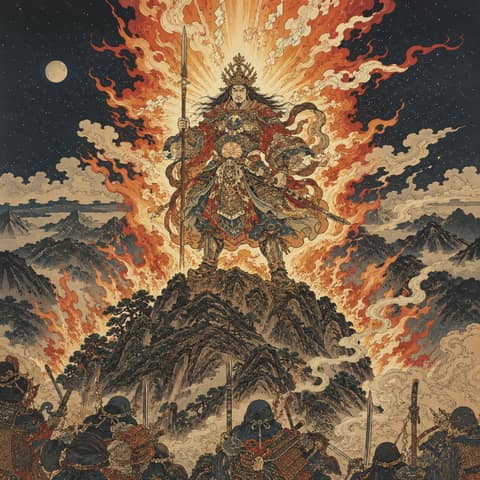
Deity / divine spiritIzanagi Jingu in Awaji, Hyogo / Taga Taisha in Shiga / mythically, Takamagahara and the final generation of the Age of the GodsThe Seven Generations of the Gods and the cosmology of creation. The basic account covers land-birth and god-birth. Looking more closely, the Seven Generations of the Gods form a creation sequence in their own right. The Kojiki says that after heaven and earth open, the three creator deities and the Separate Heavenly Deities appear, followed by the divine generations beginning with Kuni-no-tokotachi. The line moves from solitary, abstract deities toward paired gods, then finally reaches Izanagi and Izanami as husband and wife. Myth moves from abstraction into relation, sex, marriage, and birth. Their marriage and the birth of the land are the decisive passage from divine potential into a concrete world. The Floating Bridge, the jeweled spear, and Onogoro Island. The scene in which the two gods stand on the Floating Bridge of Heaven and stir the sea with Ame-no-nuboko is one of the most important images in ancient Japanese cosmology. The bridge joins heaven and earth as a vertical world axis. The spear is an instrument of creation. Brine hardening into an island marks the passage from liquid to solid, from formlessness to form. Onogoro Island means something close to an island that congealed by itself, suggesting that creation is not only divine command but also natural self-formation. The scene can be read beside Pangu's separation of heaven and earth, the Indian cosmic egg, and Eurasian myths of stirring primordial waters. The descent to Yomi, an early East Asian Orpheus myth. Izanagi's descent to Yomi, his broken taboo, and his flight from the dead belong to the mythic type in which someone enters the underworld to recover a lost wife and fails after violating a prohibition. The Greek story of Orpheus and Eurydice is the most famous example, while Izanagi's version, written in the Kojiki in 712, is one of East Asia's earliest textual witnesses to the type. The stolen glimpse, the broken command, the pursuing dead, and the protective peaches all echo underworld narratives from India, China, and Europe, suggesting deep affinities across ancient Eurasian religious imagination. Misogi, the origin myth of Shinto purification. After escaping Yomi, Izanagi washes away its pollution at Awagihara. This is the origin myth of misogi and harae. Gods are born as he removes garments and objects from his body; sea deities are born as he washes in the stream; finally, the highest deities emerge from his eyes and nose. The structure binds body, impurity, purity, and divine birth together. The hand-washing before shrine worship, the Nagoshi no Oharae summer purification, and ritual ablutions before major ceremonies all find a mythic source here. Eda Shrine and Izanagi Jingu honor him as the ancestral deity of purification, showing how an ancient myth continues inside living Shinto practice. The Three Precious Children and ancient Japan's cosmic order. Izanagi divides the sky, night, and sea among the Three Precious Children. Amaterasu Omikami receives Takamagahara, the realm of heaven, daylight, and light. Tsukuyomi no Mikoto receives the realm of night, quiet, and calendrical rhythm. Susanoo no Mikoto receives the sea plain, the ocean and its violent force. This threefold division is not only a mythic plot point. It later supports the legitimacy of the imperial line and Ise Shinto. Medieval, early modern, and modern political thought in Japan repeatedly return to this narrative. It is a central line running through Japanese ideas of state, religion, and cosmic order. Taga Taisha, Izanagi Jingu, and Eda Shrine. The three major sacred places of Izanagi correspond to different moments in the myth. Izanagi Jingu in Awaji marks the beginning of land-birth, the marriage of the two gods, and Izanagi's hidden palace. Eda Shrine in Miyazaki marks Awagihara, purification, and the birth of the Three Precious Children. Taga Taisha in Shiga became a popular early modern shrine of long life and vitality. Together these sites turn the sequence of creation, purification, and longevity into geography and pilgrimage, sustaining Izanagi worship across Japan. Motoori Norinaga's Kojiki-den and the formation of kokugaku. Motoori Norinaga, the Edo-period kokugaku scholar, completed the forty-four-volume Kojiki-den in 1798, using rigorous philology and historical linguistics to interpret the Kojiki, including the myths of Izanagi. Debate continues over whether such myths should be read as history, symbolic narrative, or cultural memory, but Norinaga's method laid an important foundation for modern Japanese humanities. Izanagi therefore extends beyond myth alone. He belongs to the intellectual history of kokugaku, Shinto, modern national thought, and postwar folklore studies, and remains a symbolic figure in Japanese religion, scholarship, politics, and culture.

伝説 Shuten-dōji
SHOO-ten DOH-jee
Shuten Dōji of Mount Ōe
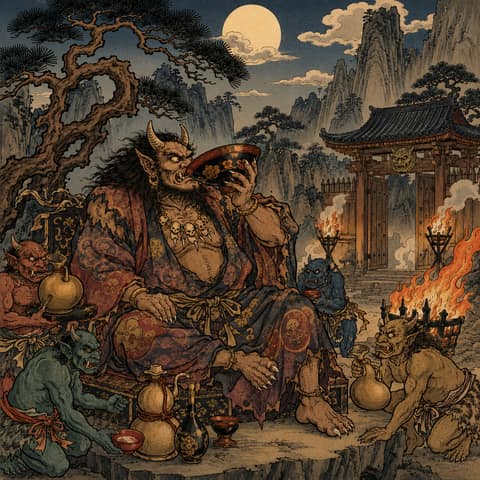
Half-Human BeingsTamba Province and Yamashiro Province (Mt. Ōe, Mt. Atago; various theories)Modeled on the chieftain who ruled ogres from Mount Ōe. He descends to villages disguised as a monk or young warrior, exploiting lust, drink, and human weakness. At banquets he feigns hospitality, but in truth he is a raging ogre who abducts people. In the slaying tale, his foes turned a sacred oath against him and sapped his strength with poisoned sake. Letting in guests dressed as mountain ascetics proved fatal.

伝説 Daikokuten
Daikokuten
Daikokuten, Fortune God of Two Thousand Years of Transformation
Deity / divine spiritAncient India, as Mahakala / Hieizan Enryakuji in Otsu, Shiga / Izumo Taisha as a center of syncretism with OkuninushiFrom Mahakala to Daikokuten: two thousand years of cultural transformation. The basic profile introduced Daikokuten's main attributes; the deeper story is the long transformation from ancient Indian Mahakala to modern Japanese Daikokuten. Mahakala is the wrathful, nocturnal, destructive aspect of Shiva, and in ancient Indian society he was associated with war, cemeteries, blackness, and fear. Once received into Buddhism, he became a Dharma guardian and moved through Central Asia, China, Korea, and Japan, taking on new meanings in each cultural sphere. In Japan especially, syncretism with Okuninushi, inclusion among the Seven Lucky Gods, and transformation into a wealth deity created a form so new that it almost amounts to rebirth. Daikokuten is a model case of how a foreign deity can be remade inside Japanese religion. Sanmen Daikokuten: Hieizan and Saicho's religious design. The Sanmen Daikokuten enshrined by Saicho at Hieizan Enryakuji, combining Daikokuten, Bishamonten, and Benzaiten into one three-faced deity, is one of the distinctive creations of Japanese Buddhist history. All three deities come from Indian Buddhist guardian traditions, but Saicho's placement of the combined figure as guardian of the temple kitchen and economy connected Buddhist ideals of compassion and protection with the practical realities of food, training, and institutional survival. Sanmen Daikokuten later spread through Hieizan, Tendai, Shingon, Zen, and related lineages, becoming an important symbol of Japanese Buddhism's ability to integrate practice and material support. The logic of syncretism through the sound daikoku. The merging of Daikokuten, the Indian-derived Buddhist deity, and Okuninushi, the Japanese Shinto deity, through their shared reading daikoku is a classic example of medieval Japanese religious syncretism through sound. The written forms, doctrines, and origins were unrelated, but the identical reading of "great black" and "great land" was enough to make them overlap. The new deity was not a simple addition of two figures; it gained new life in popular practice. The case reveals a flexible logic in Japanese religion, where sound, image, folk association, and practical benefit can matter more than strict doctrinal consistency. The civilizational meaning of the Seven Lucky Gods. The Seven Lucky Gods cult, shaped from the Muromachi and Azuchi-Momoyama periods into the Edo period, gathers Daikokuten, Ebisu, Bishamonten, Benzaiten, Fukurokuju, Jurojin, and Hotei around the shared wish for fortune, wealth, and prosperity. Its origins are deliberately mixed: Ebisu is native Japanese, Daikokuten, Bishamonten, and Benzaiten come from Indian religious worlds, and Fukurokuju, Jurojin, and Hotei come from Chinese Daoist, Buddhist, and popular traditions. Edo commoners did not demand a neat theory. They wanted luck, and that pragmatic wish created one of Japan's most inclusive religious combinations. Rice bales, mallet, and sack: medieval Japanese symbolism of fortune. Daikokuten's three main attributes, rice bales, the uchide no kozuchi mallet, and the great sack, compress medieval Japanese ideas of wealth. Rice bales symbolize harvest, food, land, and tax revenue in an agrarian society, entering Daikokuten through Okuninushi's agricultural layer. The mallet appears in classical tales such as the Konjaku Monogatari Shu and Uji Shui Monogatari as a magical tool that produces what one desires, a symbol of inexhaustible resources. The sack combines elements of Mahakala's treasure bag, Hotei's cloth sack, and Japan's seven-treasures imagery, holding gold, silver, lapis lazuli, tridacna shell, agate, pearl, and coral. These objects hold Indian, Chinese, and Japanese symbolism in a single image. Edo treasure-ship prints and collective wishes for prosperity. Treasure-ship prints became popular in the Edo period, showing the Seven Lucky Gods riding a ship of riches. Placing such a picture under the pillow on the second night of the New Year was believed to bring a lucky first dream. These images circulated widely as New Year charms for townspeople and merchants, and Daikokuten was often drawn near the center because he best embodied wealth, harvest, and thriving business. Through treasure-ship prints, Edo publishing, ukiyo-e, popular religion, and commercial culture converged. Even today, the motif survives in New Year decorations, greeting cards, and shop talismans. Daikokuten in the twenty-first century: a fortune god in a global age. Daikokuten remains a familiar god of wealth, business, and harvests. His image is used in New Year Seven Lucky Gods pilgrimages, first shrine visits, prayers for business success, and new-shop celebrations; merchants, restaurants, companies, and private homes still place him on altars. Even in an age of globalization, economic anxiety, and individualization, the desire for fortune, wealth, and prosperity remains universal. Daikokuten gathers that desire into one deity through a two-thousand-year chain linking ancient Indian Mahakala, medieval Sanmen Daikokuten, Edo Seven Lucky Gods worship, and the modern Japanese fortune god. He is one of the clearest symbols of cultural transformation in Japanese religion.

伝説 Tengu
Tengu
What Is a Tengu? An Overview of Types and Iconography
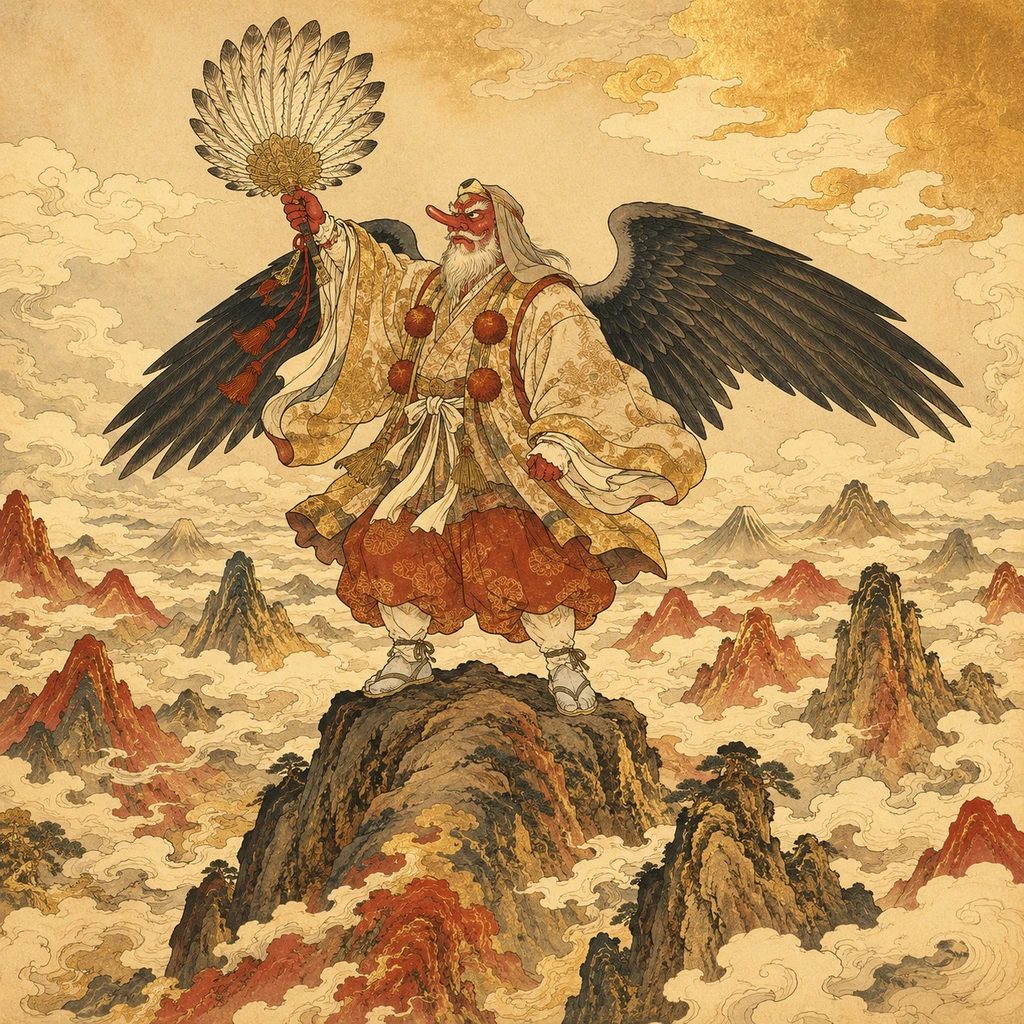
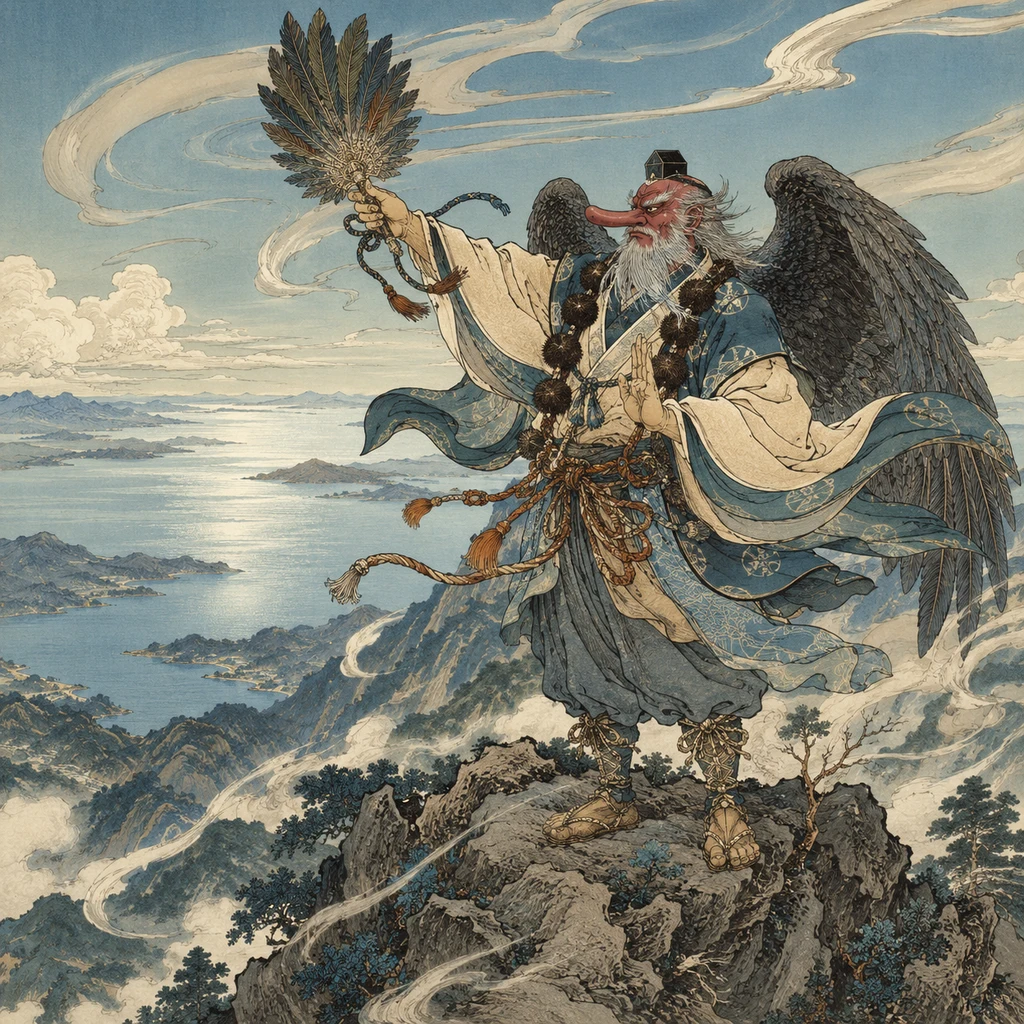
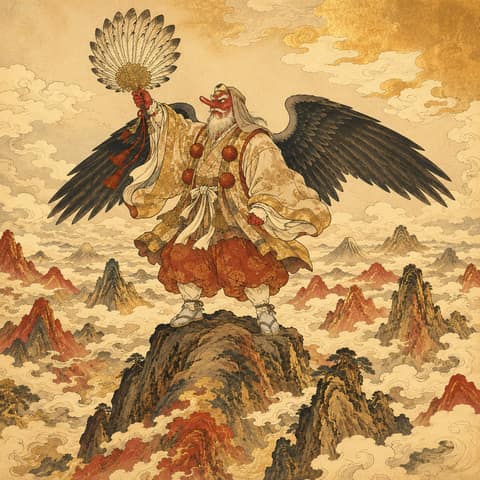
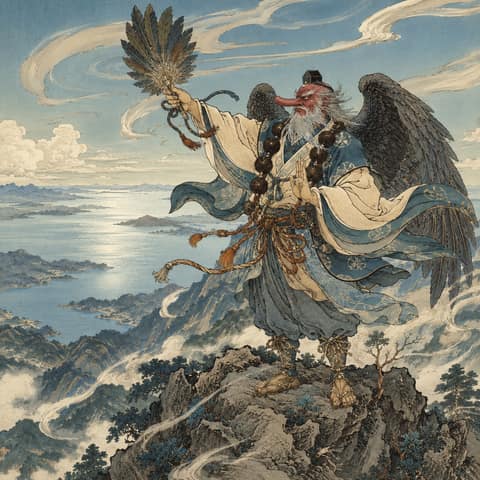
Mountain & Wilderness SpiritsKyoto, Shiga, and Wakayama Prefectures (the seats of the great tengu on the various sacred mountains)This edition is not about a single seat on a particular sacred mountain, but a general treatise that thoroughly unravels "what a tengu is" from the history of its iconography and types. The individual traditions of each seat are left to the page of each great tengu. The form of the tengu is not uniform. The first type is the long-nosed tengu—ruddy face and high nose, clad in the ascetic's headcloth (tokin) and the suzukake robe, a feather fan in hand and one-toothed high clogs on the feet. The second is the crow tengu, with a crow's beak and wings, grasping a sword or a vajra staff. The third are the lesser tengu called leaf tengu and wood-chip tengu, held to be weak and numerous kin. Rather than a fixed classification, these reflect the breadth of the tengu image across eras and regions. The iconography shifted over time. The Heian-period tengu was first conceived as a bird like a black kite, and the image of the crow tengu retains that vestige. The long nose grows prominent only from the late Kamakura period; the Zegaibō Emaki depicts a scene in which a tengu that had disguised itself as a human has its nose lengthen as it returns to bird form. As for the origin of the long nose, there are theories that derive it from the high-nosed Jidō mask of gigaku and link the crow tengu to the Karura (Garuda) mask, and a view that sees the long nose as an iconographic vestige of a bird's beak—but none can be called settled doctrine. It was overlaid with the god Sarutahiko, described in the Nihon Shoki as having a nose seven hand-spans long, and the custom arose of using a tengu mask for the role of Sarutahiko in festivals. The tengu's dual nature is rooted in the Buddhist notion of the way of the tengu. Because it studies the Buddhist path it does not fall into hell, and because it handles heterodox arts it cannot reach paradise either—an intermediate state, and the one who falls there was held to be the arrogant monk. The Tengu Zōshi depicts this notion as satire of the monks of the seven great temples, yet Chigiri Kōsai too warns that the simplification "only arrogant monks become tengu" goes too far. Demon though it is, once subdued it turns to guardianship, and it was held that if a Shugendō practitioner recites the Tengu Sutra he may summon the tengu of the various provinces to grant his wishes—this amplitude between guardian and demon is the very core of the tengu. The certain medieval source for the grouping called the "Eight Great Tengu" lies in the libretto of the Muromachi-period Noh play Kurama Tengu. The passage in which the great tengu calls up the tengu of the provinces he commands in geographical order—"In Tsukushi, Buzenbō of Hiko-san; in the four provinces of Shikoku, Sagamibō of Shiramine; Hōkibō of Ōyama; Saburō of Iizuna… the host of Zenki of Ōmine, Takama of Katsuragi"—shows that the Eight Great Tengu were rooted in medieval belief and performing arts, not an Edo invention. Still, the composition wavers by source, with a variant that adds Hōkibō of Ishizuchi-san; it is no fixed roster.

伝説 Hira-san Jirōbō
Hira-san Jirōbō
The Second-Seat Great Tengu — Hira-san Jirōbō
Mountain & Wilderness SpiritsMt. Hira, Ōmi Province (Shiga; western shore of Lake Biwa)The key to reading Hira-san Jirōbō lies in the meaning of the rank "second seat, next after Tarōbō," and in the medieval sources particular to Mt. Hira. In the tengu hierarchy, Jirōbō is held to be the second after Atago-san Tarōbō. This ordering appears almost in common both in the forty-eight tengu of the Tengu-kyō and in the Eight Great Tengu framework, and the very names Tarōbō and Jirōbō derive from the ordinals "one" and "two." Rather than being told of alone, Jirōbō appears more often paired with Tarōbō as the twin pillars of the tengu world. The firm ancient layer of Hira's tengu lies in the Hirasan Kojin Reitaku (by Keisei, 1239). This dialogue, in which the aged tengu of Mt. Hira answers Keisei's questions and speaks of the tengu world and the afterlife, is a primary source particular to Mt. Hira, showing that Hira held a firm place as a tengu sacred mountain in the medieval age. Here one common confusion should be set right. Jirōbō is often bound to the tale of the Chinese tengu Chira Eiju (= Zegaibō), but the original story in the Konjaku Monogatarishū, Book 20 runs on the plot of a tengu of Shintan defeated by a monk of Mt. Hiei, and does not name Mt. Hira as the seat of the Japanese tengu. Making Chira Eiju the tengu of Hira is a later arrangement; the tradition proper to Mt. Hira itself should rather be sought in the aforementioned Kojin Reitaku. The tale of relocation from Mt. Hiei is likewise understood not as historical fact but as a later narrative telling the changeover of a sacred mountain's leadership. Based at Mt. Hira, the sacred peak of Ōmi, fearing Buddhist law while testing human conceit—this coexistence of modesty and fortitude is the image of Jirōbō. Chigiri Kōsai of tengu scholarship, too, set Jirōbō in the place next after Tarōbō.

伝説 Benzaiten
べんざいてん
Default
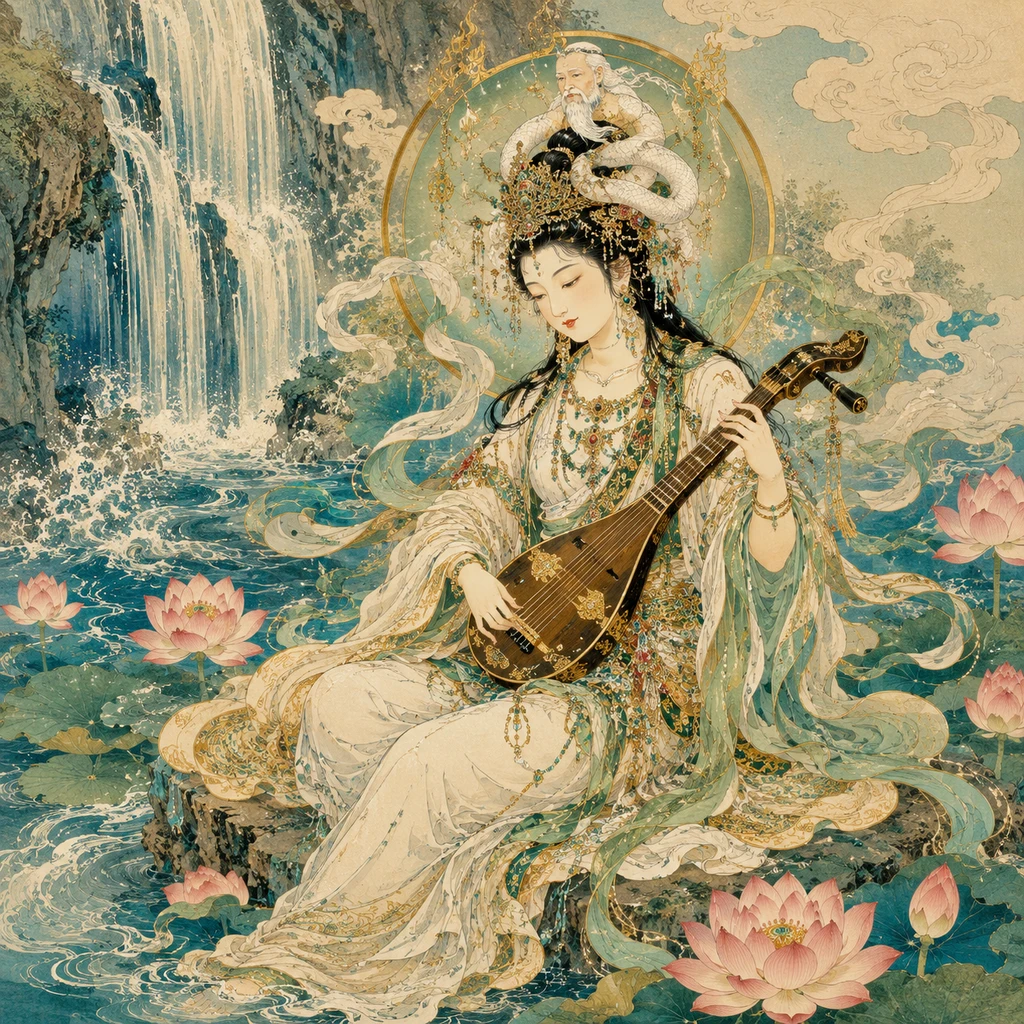
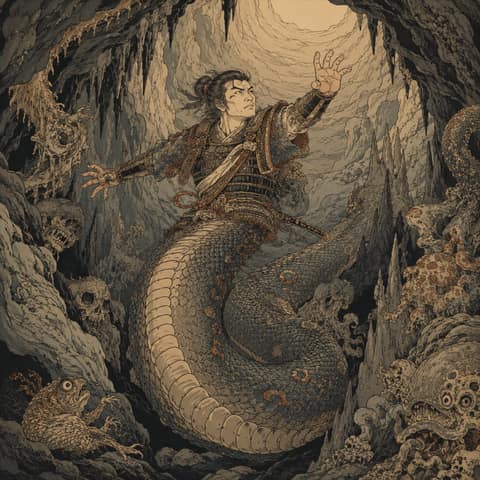
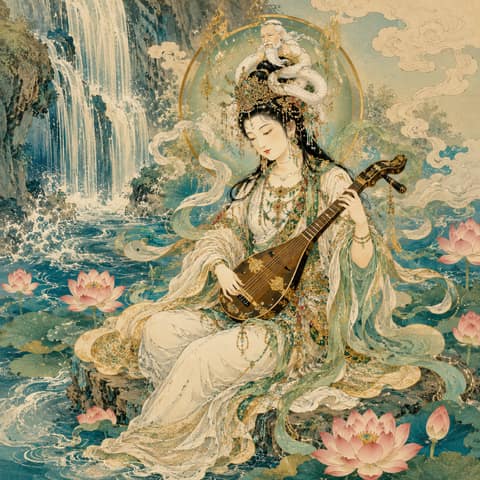
Deities & Divine SpiritsAncient India (Sarasvatī) / Enoshima Shrine (Fujisawa City, Kanagawa; founded 552) / Itsukushima Shrine (Hatsukaichi City, Hiroshima) / Hogon-ji Temple on Chikubu Island (Nagahama City, Shiga) / Tenkawa Daibenzaiten-sha (Tenkawa Village, Nara)From Sarasvatī to Benzaiten — Two Thousand Years of Cultural Transformation. While the basic description touches on Benzaiten's major sanctuaries and folk beliefs, this in-depth analysis explores her cultural evolution spanning over two millennia from ancient India's Sarasvatī to modern Japan's Benzaiten. Sarasvatī is one of the oldest deities in the Rigveda (c. 1500–1200 BCE), governing river flows, music, arts, language, and poetry. After being adopted into Buddhism, she was transformed into a tutelary deity in the Golden Light Sutra and Lotus Sutra, spreading to China, Korea, and Japan. In Japan, she evolved through several stages: (1) as a scriptural protector during the ancient Ritsuryo Buddhist period (7th–9th centuries); (2) merging with Ugajin to form Uga-Benzaiten in the medieval Kamakura period; (3) becoming a deity of wealth and a member of the Seven Lucky Gods in the early modern Edo period; (4) having her enshrined identity frequently altered to Ichikishimahime during the Meiji era's separation of Shinto and Buddhism; and (5) transitioning into a subject of modern superstitions, tourism, and subculture. She stands as a prime example of an ancient deity's cultural evolution, continuously transmitting her legacy while altering her appearance, attributes, and name over two millennia. Ugajin — The Mysterious Human-Headed Snake Deity. Ugajin, who merged with Benzaiten from the Kamakura period onward, is a bizarre figure depicted with a human head and a coiled snake body, and remains a mystery in academic studies. While the etymology of "Uga" points to the grain deity Ukanomitama from the Kojiki and Nihon Shoki, the origins of the serpent imagery are debated, with theories citing influences from the Chinese creator deities Fuxi and Nuwa, the Indian Naga (serpent gods), and indigenous Japanese snake worship from sites like Mount Miwa and Suwa. The amalgamation of a "uniquely Japanese snake deity of unknown origin" with a "Buddhist goddess of Indian origin" to form Uga-Benzaiten is a symbolic testament to the syncretism, creativity, and mysticism of medieval Japanese religious culture. Two-Armed vs. Eight-Armed Statues — Dual Iconographic Lineages. There are two main lineages of Benzaiten statues. (1) Two-Armed Statues: Depicting an elegant heavenly maiden playing a biwa (lute). This lineage inherits the original musical goddess nature of Sarasvatī and has been the traditional form in Japan since the Heian period. (2) Eight-Armed Statues: Depicting a heavily armed warrior goddess holding eight weapons and ritual implements such as a sword, jewel, bow, arrow, axe, halberd, dharma wheel, and vajra. This form, described in the 5th–6th century Chinese translation of the Golden Light Sutra, emphasizes her role as a protector of the state. The eight-armed figure embodies a fierce martial nature quite distinct from the "elegant goddess of arts" image. Combined with the medieval serpentine form of Ugajin, Benzaiten evolved into an immensely complex deity integrating "elegance, martial prowess, magic, and wealth." The Folklore of Serpentine Transformation — A Layering of Water, Wealth, and Fertility Gods. The transformation of Benzaiten (Uga-Benzaiten) into a snake deity is a folkloric phenomenon deeply intertwined with ancient Japanese snake worship (Mount Miwa, Suwa, Usa, Kumano, etc.). In ancient Japan, the snake was revered as a deity uniting four attributes: water (shrines by rivers, ponds, and the sea), wealth (shedding skin, infinite multiplication), fertility (grain and land), and healing (medicine and taboos). As a result of Benzaiten's fusion with Ugajin and acquisition of snake deity traits, all layers of ancient snake worship—waterside shrines, snakes in wallets, shed skin amulets, and prayers for healing—have been inherited as part of "Benzaiten faith." Even today, modern superstitions like "money-washing water, wallet snakes, and relationship-severing" vividly demonstrate the living heritage of a folk culture where ancient snake gods, medieval Benzaiten, early modern wealth deities, and modern tourism intersect. The Couples' Taboo — Modern Superstition of a Jealous Goddess. At major Benzaiten sanctuaries (especially Enoshima and Itsukushima), a modern superstition prevails that "couples who visit together will incur the beautiful goddess's jealousy and break up." This is a modern variation of an ancient Indian fierce goddess nature (Sarasvatī is sometimes depicted as the wife of Brahma, possessing jealousy and passion), medieval Japanese snake attributes (snakes were symbols of jealousy and attachment), and ascetic taboos such as the historic ban on women on sacred mountains. Going beyond mere superstition, it stands as a fascinating phenomenon condensing the complex religious, folkloric, and psychological history from antiquity to the present, making it a subject of study in 21st-century folklore, psychology, and tourism studies. At the same time, connections with "relationship-severing shrines" (like Yasui Konpiragu in Kyoto) have been noted, showing how Benzaiten's taboo nature integrates with modern cultural practices of seeking separation. The Seven Lucky Gods Faith and Edo Commoner Culture. As the only female member of the Seven Lucky Gods (Ebisu, Daikoku, Bishamonten, Benzaiten, Fukurokuju, Jurojin, and Hotei) established in the Edo period, Benzaiten became a central figure in commoner culture. Practices such as the New Year's Seven Lucky Gods pilgrimage, placing a treasure ship picture under one's pillow, hatsumode (first shrine visit of the year), and praying for business prosperity deeply permeated Edo daily life. This represents a significant cultural shift from the medieval Uga-Benzaiten faith (esoteric Buddhism, mysticism, aristocratic culture) to the early modern Seven Lucky Gods faith (commoners, commerce, urban culture). Benzaiten's early modern worship marks a crucial milestone in an epic cultural transformation spanning over two millennia: from an ancient Indian goddess of arts, to a medieval Japanese esoteric deity, to an early modern Japanese deity of wealth, and finally into a subject of modern tourism and subculture. Benzaiten in the 21st Century — Tourism, Subculture, and Severing Ties. In the 21st century, Benzaiten's legacy continues as a tourism resource through the Three Great Benten Shrines, nationwide Benten shrines, and Seven Lucky Gods pilgrimages. Simultaneously, she is repeatedly reimagined in subculture works, such as the video games *Okami* and *Megami Tensei*, and the manga *Nura: Rise of the Yokai Clan*. She has become a multifaceted icon where ancient Indian goddess traits, medieval Japanese snake attributes, early modern wealth associations, and modern relationship-severing taboos intersect. As a rare example of a single deity embodying over two thousand years of cultural evolution—from Sarasvatī in ancient India to Benzaiten in modern Japan—she remains a vital subject of study in yokai studies, folklore, religious history, and comparative mythology.
名妖 Itsumade
e-tsu-mah-deh
Itsumaden (Classical Form)
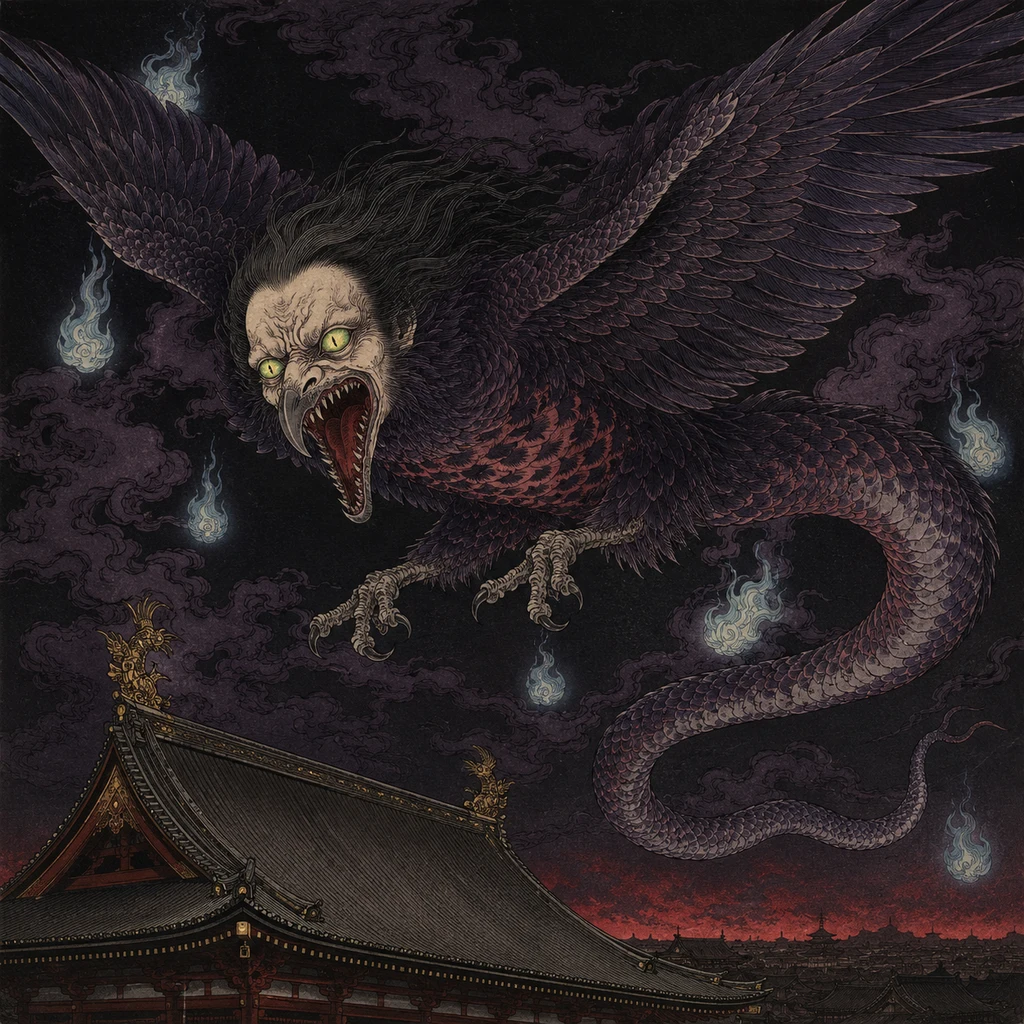
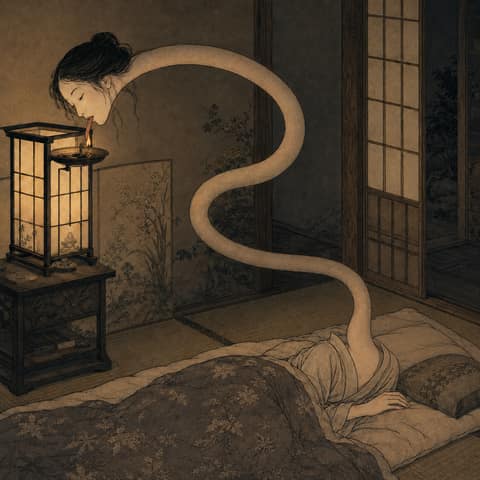
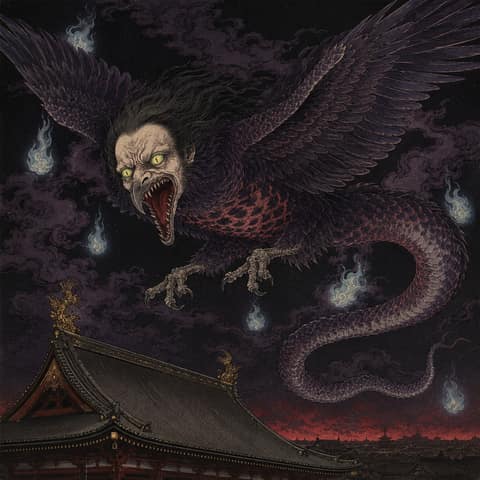
Animal ShapeshiftersHira Mountains, Shiga PrefectureItsumaden slips into the night as if dissolving into darkness, flying while wreathed in black and violet miasma. Its wings are unnaturally large, its eyes gleam eerily, and its gaze instills a crushing sense of dread. Its voice rings out like human speech, whispering “itsu made…”—how long remains—foretelling the listener’s lifespan. It is said to appear before calamities and wars, inspiring both fear and reverence among the people.

名妖 Sarugami (Monkey Deity)
sah-roo-GAH-mee
Simian Deity in Medieval Tales
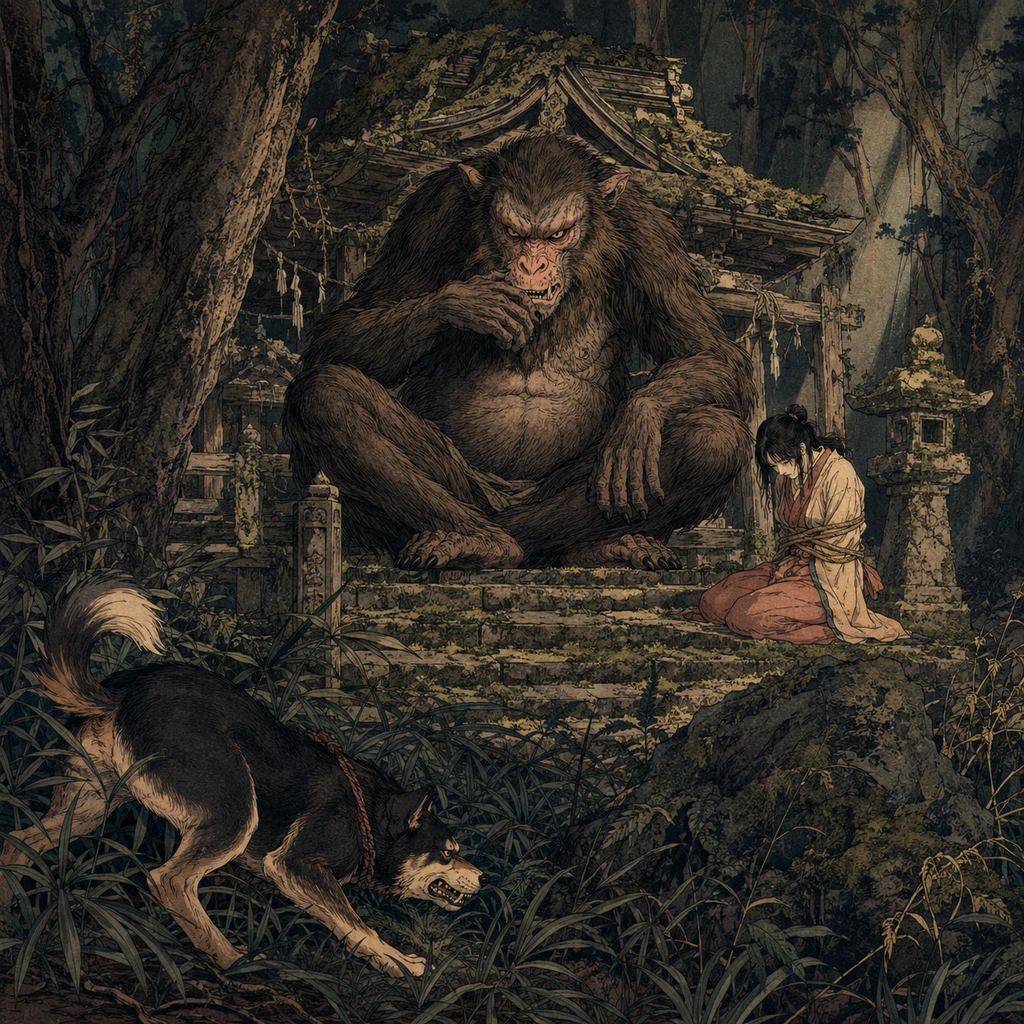
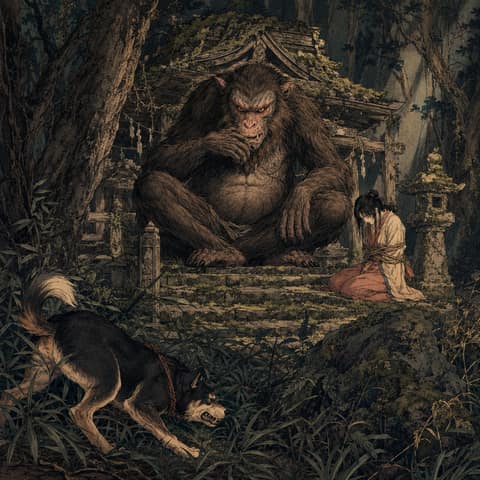
Deities & Divine SpiritsAcross Japan, especially Kinki and Chugoku regionsIn medieval Japan, the monkey deity was told as a fusion of mountain divinity and simian monster. It ruled mountain domains and demanded offerings like a calendar ritual, seen as a relic of ancient sacred marriage rites, yet storytelling emphasized its brutality as a yokai. In slaying tales, a passing hunter or a monk with sacred power stands in as a substitute, and a trained dog plays the decisive role. The defeated deity sometimes possesses a shrine official to beg forgiveness, hinting at lingering sanctity. In some regions it was known as a possessing spirit, with sudden rages blamed on its curse. Early modern ghost stories pair man‑eating ferocity with comic butt‑fondling, portraying the ambivalent scorn and fear directed at monkeys.

名妖 Hashihime (Bridge Princess)
HAH-shee-HEE-meh
Hashihime of Uji (Traditional Form)
Half-Human BeingsYamashiro Province (Uji River, Uji Bridge)An integrated portrayal of Hashihime as a local divinity of Uji Bridge on the Uji River and as the jealous demon-woman of medieval war tales and Noh. As a local deity she was venerated at the bridgehead as a water and land guardian, protecting crossings and safe passage. Traditions forbid praising other regions or singing lines that stir jealousy upon the bridge, reflecting the belief that local gods dislike talk that exalts elsewhere. In the later tale, a woman visits Kifune, undergoes purificatory austerities in the Uji River, becomes a demon, and encounters a warrior at Ichijō Modori-bashi. Toriyama Sekien noted the shrine at Uji Bridge, and the Noh play Kanawa fixed the image of a demon-woman crowned with an iron trivet. Folklorically, bridges are liminal spaces, linked to water deities, female divinities, and warnings against jealousy, so ritual and storytelling long coexisted. While invented details vary by source, devotion to Uji Bridge, the Modori-bashi encounter, and the dual nature of taboo and protection form the core.

名妖 Azuki-arai (Bean Washer)
ah-ZOO-kee ah-RAH-ee
Azukiarai of the Mountain Stream
Ghosts & SpiritsVarious regions—especially mountain valleys in Kanto, Chubu, and KinkiRooted in the classic image of the Azukiarai, it blends with the sounds of ravines and flumes, washing red beans through the midnight hours. It lures with sound and tests the curious who peer in. Drawing on early modern notes that it excels at counting and judges vessel measure and bean quantity at a glance, it is not wantonly harmful, but serves as a keeper of taboos along the water’s edge.

名妖 Giant Centipede
OH-oh-MOO-kah-deh
Giant Centipede (Mikami-yama Tradition)
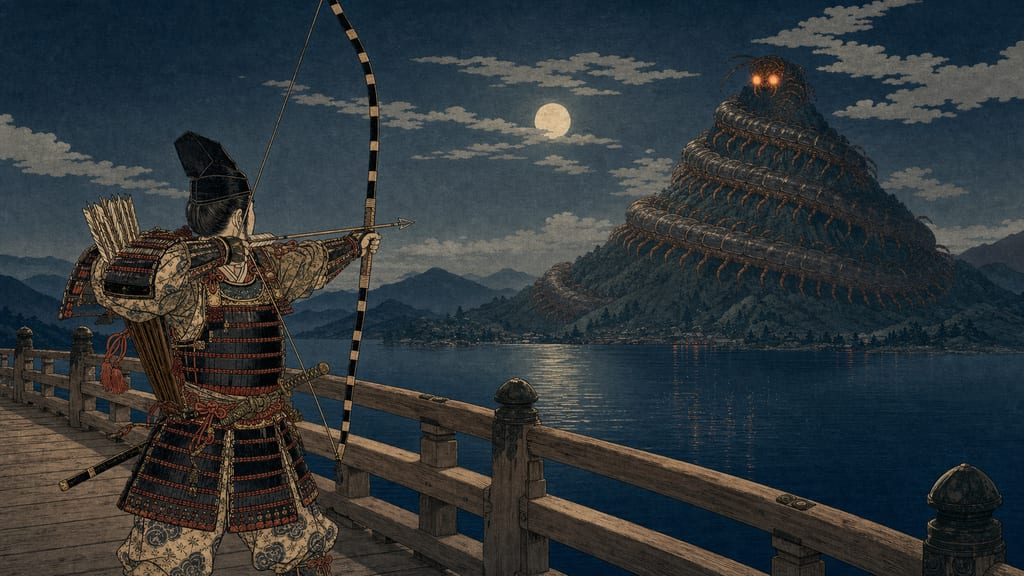
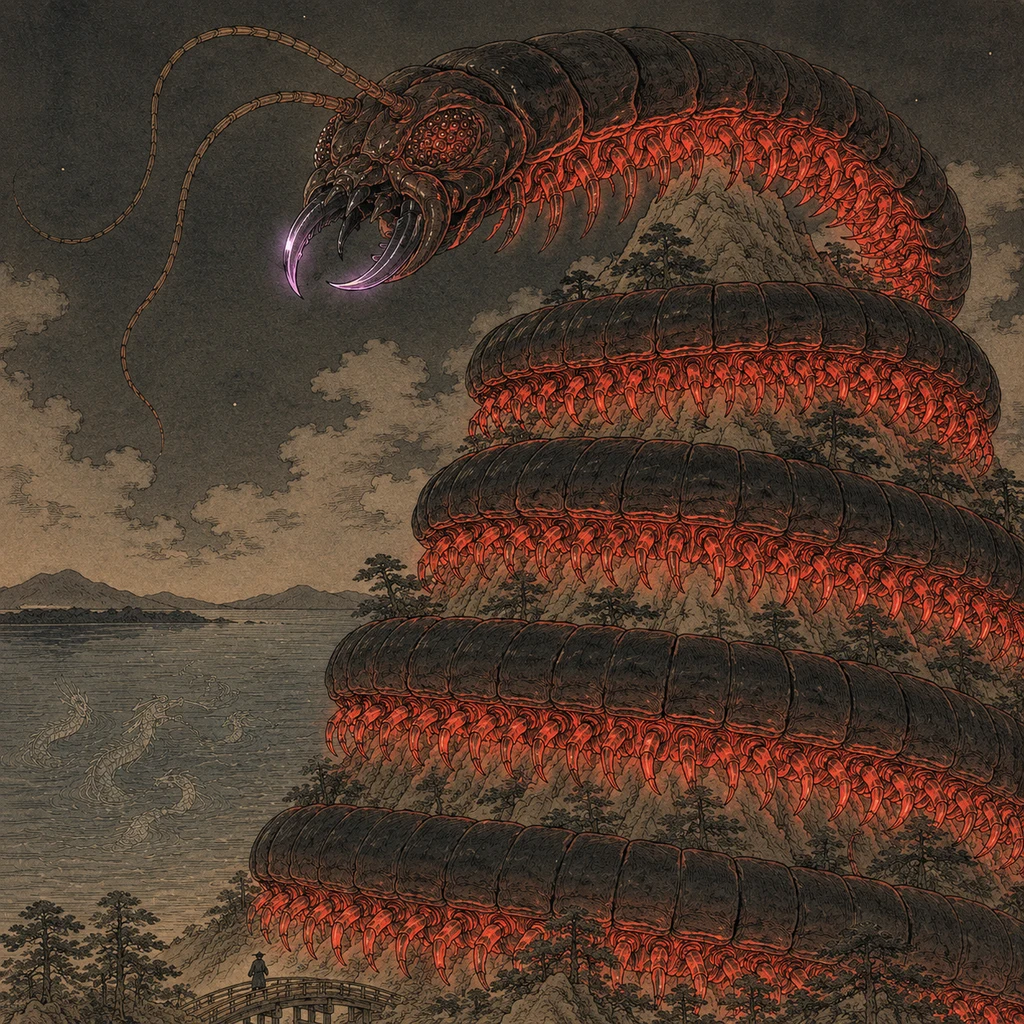
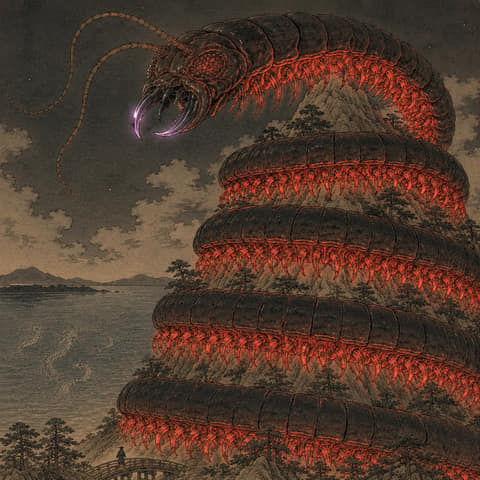
Demons & GiantsŌmi Province (Lake Biwa and Mount Mikami), and other regions across JapanA famed form tied to legends of Mount Mikami in Ōmi and the shores of Lake Biwa. Said to coil around the mountain seven and a half times, its shell is as hard as metal or stone, impervious to arrows and blades. At night its legs gleam crimson, casting a long shadow over the lake and mountain skirts. Tales of its slaying are linked to martial valor and understood in relation to dragon-god worship and the numinous power of bridges. Connections to mining and blacksmith lore have been noted, though details remain unclear.

名妖 Great Catfish
oh-nah-MAH-zoo
Traditional Version: The Great Catfish Subdued by the Keystone
Weather & Calamity SpiritsAcross Japan (traditions linked to Kashima, Katori, Aso, and Chikubu Island in Omi)An image based on the early modern belief that a great catfish causes earthquakes and is held down by the keystones of Kashima and Katori Shrines. The ancient notion of an underworld dragon-serpent was reworked in early modern urban society into imagery for interpreting disasters and critiquing the times. After the Ansei Earthquake, many namazu-e prints were published, adding allegories of recovery and debt relief. Here the great catfish lies in the subterranean mud, at times shuddering to cause quakes, yet is pacified when pressed by the keystone. Regional lore links it to origin tales of stones, landforms, and river courses, serving as markers of shrine-temple origins and local spiritual power. It appears in early modern documents, broadsides, and origin tales without fixed personal names or lineage, told as a symbolic personification of earthquakes rather than an observed creature, with a yokai framework for interpreting calamities at its core.

名妖 Raigō
RAI-goh
Iron Rat (Raiyō’s Vengeful Spirit Tale)
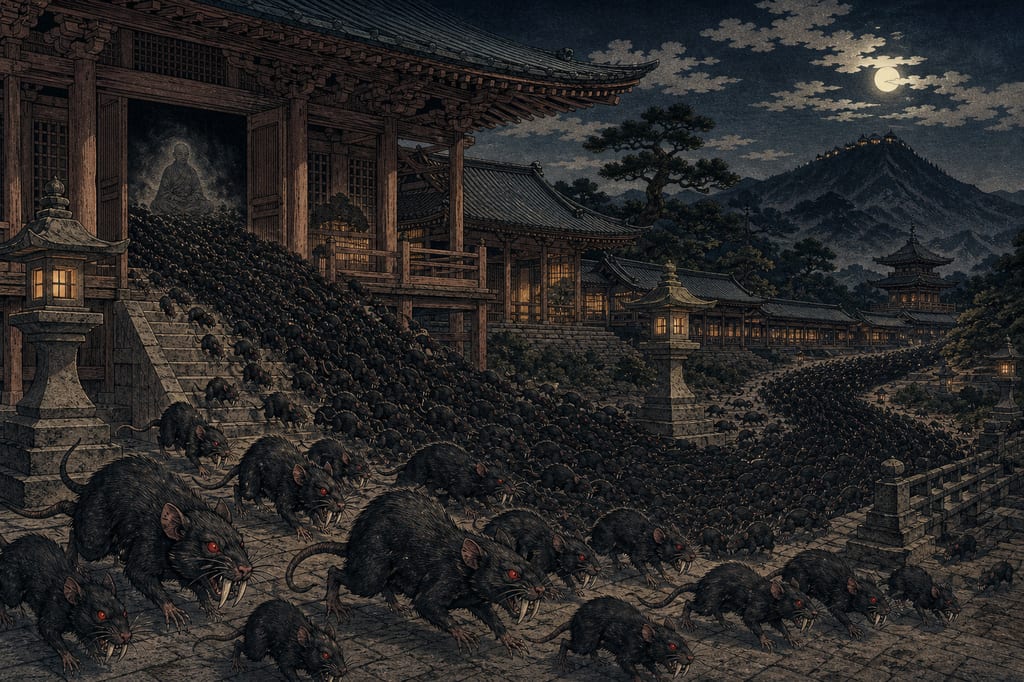
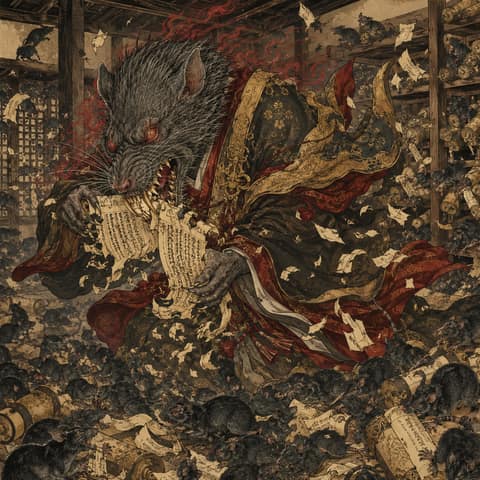
Ghosts & SpiritsŌmi Province (Enryaku-ji/Onjō-ji, Mii-dera)A version grounded in medieval tales where the spirit of the monk Raiyō becomes a swarm of rats or a monstrous iron-furred rat known as the Tesso and gnaws through the sutra repository of Enryaku-ji. Rivalries among temple powers are projected onto a narrative of vengeful deification, linking ritual efficacy with retribution. In literature it appears mainly in war chronicles, blending a real monk’s biography with a settled ghost-vengeance legend. Later yomihon and paintings amplified this image, symbolizing rat blight and the ruin of sutra scrolls, yet at its core lies a folk pattern of a rancorous spirit bringing calamity upon sacred objects and scriptures.

稀少 Ningyo
ningyo
The Water Yokai Evolving from Ancient to Modern Times
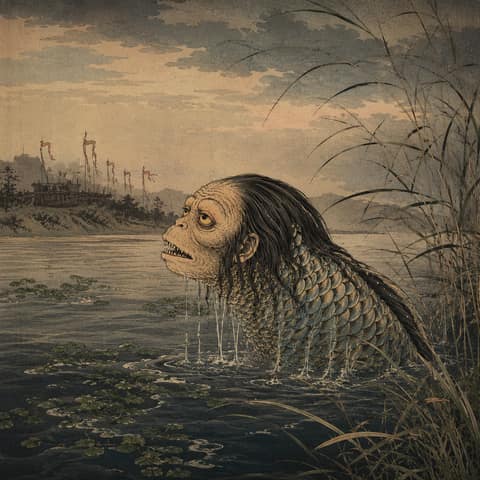
水の怪近江国蒲生川 (現·滋賀県東近江市~近江八幡市·『日本書紀』 推古 27 年 619 初出) / 摂津国堀江 (現·大阪市中央区~北区·『日本書紀』 推古 27 年 619) / 観音正寺 (現·滋賀県近江八幡市安土町繖山·聖徳太子人魚成仏縁起·西国 32 番札所)Iconographic Disconnect from Western Mermaids. The image of a Ningyo that modern Japanese people envision—a "beautiful female upper body and a fish lower body"—is a product of Western mermaid legends (such as Hans Christian Andersen's *The Little Mermaid*) being imported and taking root from the modern era onward. Prior to this, traditional Japanese Ningyo iconography, as depicted in texts like the *Kaikoku Heidan*, was exceedingly bizarre and grotesque: "a human-like (or monkey-like) face on a scale-covered fish body." The facial features were not necessarily those of a beautiful woman; they were generally depicted as terrifying men, women, young, or old, bearing sharp fangs. The sheer ugliness of this design emphasized the visceral reality of the Ningyo as a "creature from the Other World" and the taboo, grotesque nature of the act of eating its flesh. Biological Models and the Natural History Perspective. The core of Japanese Ningyo folklore is believed to contain no small amount of misidentification of actual biological creatures. For example, a prevalent theory suggests that sirenians like dugongs and manatees, or pinnipeds like sea lions and seals, served as the models for the Umibozu and Ningyo. Additionally, in inland (river or swamp) Ningyo legends, there are cases where the true identity is speculated to have been the Japanese giant salamander. Edo period herbalists (Honzogakusha) meticulously collected and classified records of these unknown marine creatures washing ashore, attempting to re-examine yokai through the lens of "science" (natural history). The Curse of "Eternal Life". The "eternal youth and longevity" brought about by Ningyo meat is a universal human desire, yet in Japanese folklore, it is always depicted as two sides of the same coin alongside "tragedy." As the legend of Yao-bikuni demonstrates, one who obtains eternal youth by eating Ningyo meat must repeatedly watch their beloved family members and husbands age and die, forcing them to experience unbearable loneliness and despair (temporal isolation). The Ningyo is a yokai that acts as a cruel mirror, thrusting the "terror of escaping death" directly in humanity's face.

稀少 Oil Baby
AH-boo-rah AH-kah-go
Sekien Iconography Edition
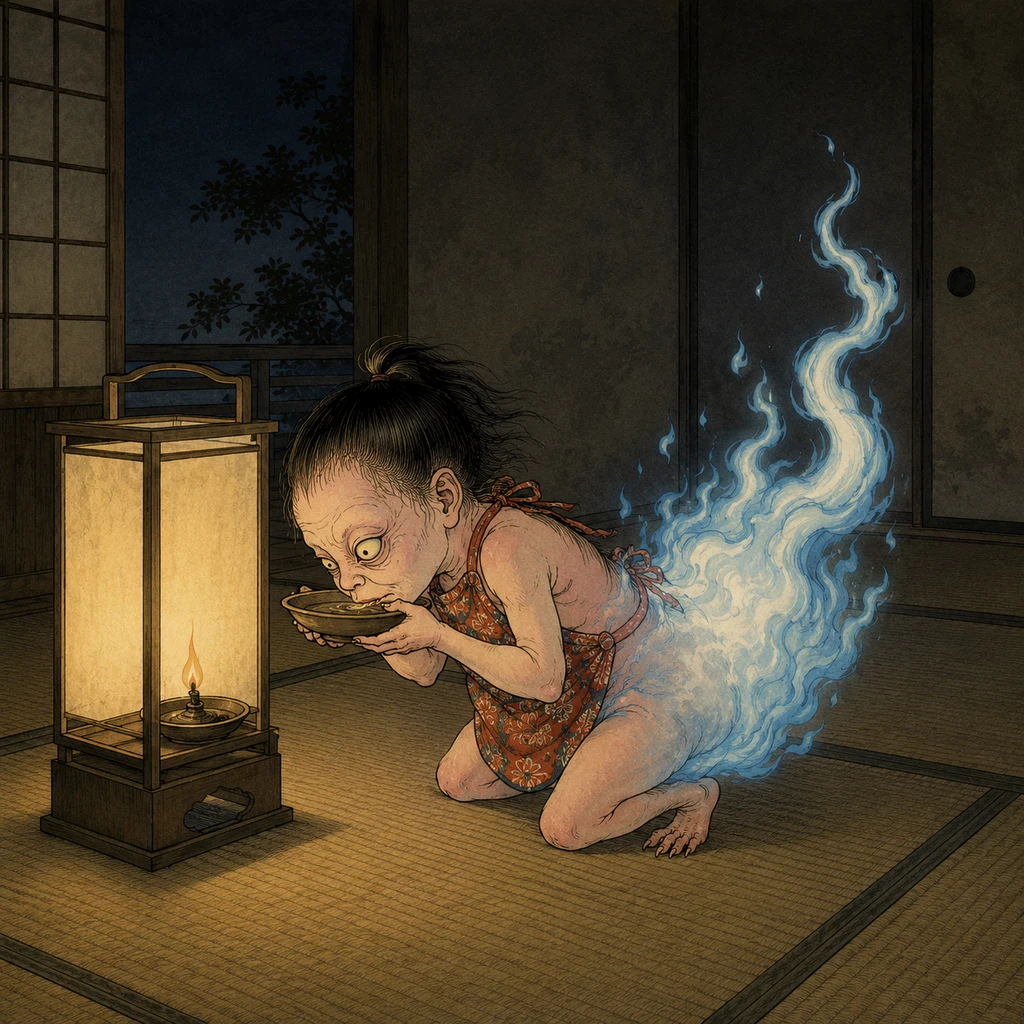
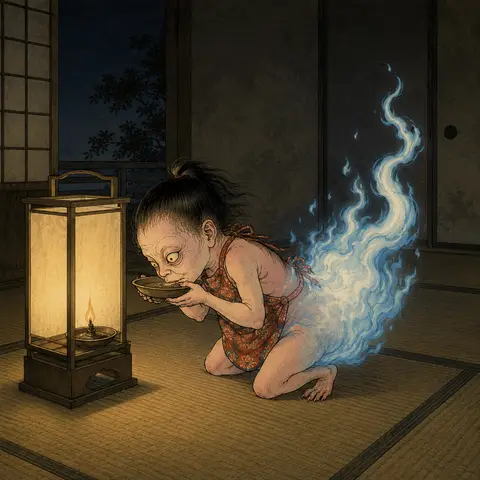
Household SpiritsŌmi Province (around present-day Ōtsu, Shiga Prefecture)This version is grounded in Toriyama Sekien’s imagery and the Edo-period essays cited in his notes, interpreting the infant form as a minimal personification of a ghostly fire. Its core is the idea of an oil-thieving flame, with the baby figure best read as Sekien’s visual cue. Lamp oil was a daily necessity, and offerings of oil at temples and shrines were held in special regard. Stealing oil violated religious and ethical taboos and was told as a fire that wanders after death. Later handbooks retell it as a fireball entering a house, becoming a baby, and licking oil, but region-specific oral examples are scarce and no widespread template is certain. Accordingly, this version presents a three-step pattern—phantom fire appears (at crossroads or within shrine-temple precincts), the infant image manifests (gesturing as if licking oil before a lamp), then departs again as flame—while avoiding unverified details and foregrounding its symbolism as a warning against defiling offered oil.

珍しい Tsurube-otoshi
つるべおとし
Severed Head Falling from Ancient Trees: Tsurube-otoshi
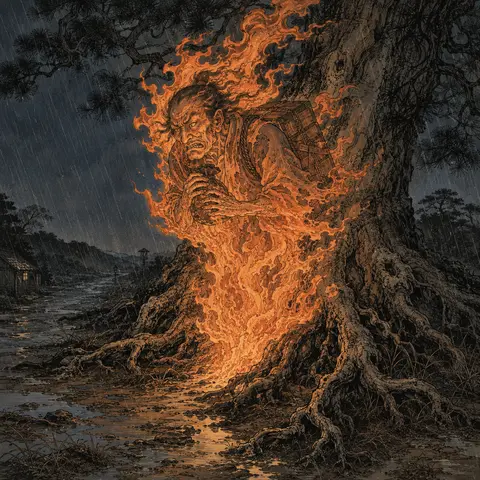
Monsters of Mountains and FieldsSogabe Village, Minamikuwada District (present-day Sogabe-cho, Kameoka City), Tomimoto Village, Funai District (present-day Yagi-cho, Nantan City), and Ooi Village Tsuchida (present-day Ooi-cho, Kameoka City), Kyoto Prefecture / Kuze Village, Ibi District (present-day Ibigawa-cho), Gifu Prefecture / Hikone City, Shiga Prefecture / Kuroe, Kainan City, Wakayama Prefecture / Tamba-Sasayama City, Hyogo Prefecture / Mikawa mountainous region, Aichi PrefectureAcademic Correction (Most Important Note for this Species): The monsters included in the "Mei" volume of Toriyama Sekien's *Konjaku Gazu Zoku Hyakki* (1779) are Nue, Itsumade, Jami, Moryo, Mujina, Nobusuma, Nozuchi, Tsuchigumo, Hihi, Dodomeki, Buruburu, Gaikotsu, Tenjo-sagari, Ohaguro-bettari, Okubi, Dodomeki, Kanedama, and Amanozako (18 entities in total), and Tsurube-otoshi is not included. What Sekien drew was the related yokai Tsurubebi, which was included in *Gazu Hyakki Yagyo* (1776) — the predecessor to Zoku Hyakki. The original text for Tsurubebi is Yamaoka Genrin's *Kokon Hyaku Monogatari Hyoban* (published in 1686; the "Tsurube-oroshi of Nishinooka" tale in Nishiyama, Kyoto), which theorized the strange phenomenon of a large tree's spirit turning into a fireball and descending from the tree on rainy nights using the Five Elements theory (Wood generates Fire). In other words, the "Yokai Tsurube-otoshi (a severed head or demon mask falling from a tree)" and "Sekien's Tsurubebi (a mysterious fire dropping from a large tree)" are separate lineages that diverged after the Showa era, and Sekien did not directly depict the former. No primary visual sources with the name "Tsurube-otoshi" from the Edo period exist, and it mainly appears as local folklore in Taisho period topographical records and folklore collections. This is a critical correction that must be specified to maintain the academic quality of yokai.jp, and the widespread "1779 Sekien iconification theory" should be explicitly denied. The primary records of Tsurube-otoshi are Taisho period local materials and folklore collections. The Kyoto regional study *Kuchidanba Kohishu* (a Taisho era collection of folklore from Minamikuwada and Funai Districts) serves as the core historical document, recording it as a local legend of mountain roads, passes, and old trees in the Chubu and Kinki regions. The fact that the primary source is not Edo period iconography but local folklore oral collection is a unique characteristic of this yokai, making it an exceptional case that does not fit the generalization that "yokai originate from Edo period iconification." The local folklore of Tsurube-otoshi is concentrated in the Chubu and Kinki regions: 1. Kyoto Prefecture — Hoki, Sogabe Village, Minamikuwada District (present-day Sogabe-cho, Kameoka City; drops from a kaya tree, laughs "Finished your night work? Shall I drop the bucket? Squeak, squeak" and rises again), Tera, Sogabe Village (a severed head descends from an old pine, devours people, and disappears for 2-3 days when full), Tomimoto Village, Funai District (present-day Yagi-cho, Nantan City; a pine tree covered in ivy), Tsuchida, Ooi Village (present-day Ooi-cho, Kameoka City; eats people) — documented in the Taisho period regional study *Kuchidanba Kohishu*. 2. Kuze Village, Ibi District, Gifu Prefecture (present-day Ibigawa-cho) — drops a bucket from a large tree that is dim even during the day. 3. Hikone City, Shiga Prefecture — drops a bucket from tree branches aiming at passersby. 4. Kuroe, Kainan City, Wakayama Prefecture — similar lore. 5. Tamba-Sasayama City, Hyogo Prefecture. 6. Mikawa mountainous region, Aichi Prefecture (folklore in Toyone Village, etc.). It has a geographic characteristic of concentrating around ancient trees (pine, kaya, cedar, zelkova) along mountain roads, passes, and shrine grounds in the Chubu and Kinki areas. Its behavior is bifurcated by region: The Kyoto lineage is predatory (eating people and staying full for 2-3 days), making it a lethal yokai; the Gifu-Shiga lineage is intimidating (only dropping a bucket to scare people), causing little real harm. The Kyoto lineage features a specific predatory pattern of "not appearing for 2-3 days when satiated," and was feared as a murderous monster rather than a mere scarer. On the other hand, the Gifu-Shiga lineage, as its name suggests, simply drops a "tsurube (well bucket)" from a tree to startle people, a relatively harmless yokai positioned between a "supernatural threat" and a "laughing matter." Despite sharing the name "Tsurube-otoshi," the entity itself varies significantly depending on the region, providing an excellent example of the regional diversity of local legends. The modern visual of a "red-faced, bearded, disheveled old man's head" depends heavily on Shigeru Mizuki's artwork and is not the original standard form in local folklore. The original form varies widely by region, splitting into three lineages: 1. A solitary severed head (Tera, Sogabe Village, Kyoto), 2. A formless monster that drops a well bucket itself (Gifu and Hikone, Shiga), and 3. A spirit type accompanied by laughter and speech (Hoki, Sogabe Village, Kyoto). The image of the "red severed head" was popularized through Shigeru Mizuki's manga and anime such as *GeGeGe no Kitaro* and *Akuma-kun*, becoming fixed as the modern general image, but from a folkloric perspective, the standard form changed pre- and post-Mizuki. This is also a perfect illustration of the decisive impact "Mizuki Yokai Culture" had on Japanese people's perception of yokai. The idiom "autumn days drop like a tsurube" (a metaphor comparing the rapid darkening of the autumn sunset to the motion of a well bucket and rope plunging down at once) has no direct lineage connection to the yokai Tsurube-otoshi. They share the same metaphorical source of "a well bucket = something that falls rapidly," but the idiom was established independently as a meteorological expression. However, the fact that the concept behind the yokai's naming (the three elements of falling speed, darkness, and surprise) stands on the same metaphorical foundation as the idiom is noteworthy in cultural history — demonstrating the richness of Japanese metaphorical culture, where an everyday tool like a "well bucket" evolved into both a meteorological phrase and a yokai name. Distinctions from similar yokai: 1. Tsurubebi (the mysterious fire dropping from a tree in Sekien's *Gazu Hyakki Yagyo*, which, as mentioned, is the Edo period origin lineage that diverged from Tsurube-otoshi in modern times), 2. Kodama (tree spirits in general; Tsurube-otoshi is an "individual monster dwelling in a specific ancient tree," a variant of the kodama lineage), 3. Kosoma (an acoustic supernatural phenomenon making axe and falling tree sounds in the mountains, different in nature from Tsurube-otoshi which primarily relies on visual dropping attacks), 4. Severed head lineages (Otoshikubi, Kubikireuma, etc.; they share the "head" aspect, but the Kyoto lineage's severed head in Tsurube-otoshi is an independent yokai entity, not a monster of decapitation). Toriyama Sekien's four-part yokai series consists of *Gazu Hyakki Yagyo* (1776) -> *Konjaku Gazu Zoku Hyakki* (1779) -> *Konjaku Hyakki Shui* (1781) -> *Hyakki Tsurezure Bukuro* (1784), and all images are publicly available on the National Diet Library's NDL Image Bank. Tsurubebi is included in the "In" volume of *Gazu Hyakki Yagyo*. When listing Tsurube-otoshi on yokai.jp, it should be clearly stated that typeOfSource = "Local folklore (Chubu/Kinki)" and firstAttestedSource = Taisho period *Kuchidanba Kohishu*, while explicitly denying the widespread misinformation of the "Edo period Sekien iconification theory." In modern yokai culture, it was popularized by Shigeru Mizuki's *Yokai Zukan* and the bronze statue on *Mizuki Shigeru Road* (Sakaiminato City, Tottori Prefecture), and appears as a Kyoto yokai in *GeGeGe no Kitaro* (3rd season VA: Masato Hirano, 5th season: Hisao Egawa) and *Nura: Rise of the Yokai Clan*. As an excellent example of a grassroots yokai originating from local oral tradition being popularized by Shigeru Mizuki's artwork, Tsurube-otoshi is an important case study showing the modernization mechanism of Japanese yokai culture — a fascinating yokai situated at the intersection of folklore studies, art history, and media theory, demonstrating a modern yokai circulation route from unillustrated Edo period local folklore to Taisho period oral collection, Mizuki's popularization, and modern anime and games.

珍しい Chōchin-bi (Lantern Fire)
CHOH-cheen-bee
Chochin-bi (Lantern-Flame, regional will-o’-the-wisp type)
Natural Phenomena SpiritsAcross Japan (notably Shikoku, Yamato, and Ōmi traditions)A regional catch-all name for ghostly lights about the size of a paper lantern. In some areas it is conflated with kitsune-bi and tanuki-bi, its name stemming from the idea of monsters lighting lanterns. It appears on rainy nights along riverbanks, dikes, and graveyards, drifting at a fixed height. Accounts vary by era and locale: vanishing when approached, splitting when struck, or marching in clusters. In folklore it portends untimely death or a curse and marks taboos along the roadside, anchoring tales that warn against pursuit or striking it. It appears in early modern essays and kaidan, sometimes gaining proper names (such as Koemon-bi) and lodging in local memory. Natural ignition and animal-origin theories coexist, and its true nature remains unsettled.

珍しい Tesso
TEH-soh
Edo Picture-Book Standard, Traditional Iconography
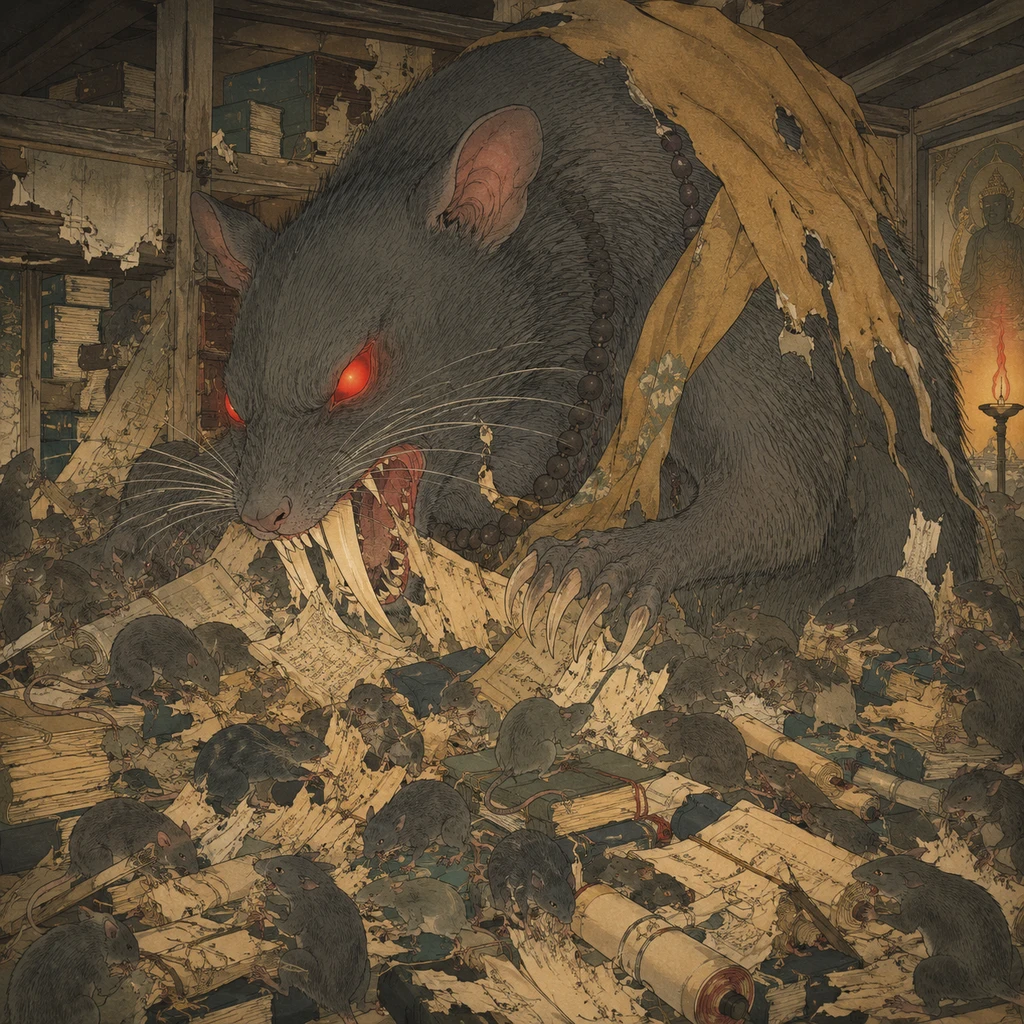
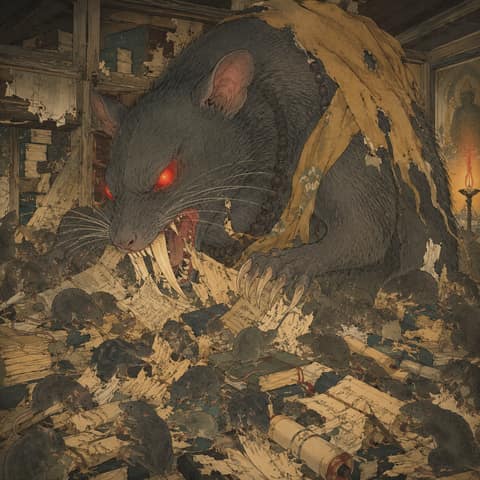
Ghosts & SpiritsŌmi Province (modern Shiga Prefecture)Based on Toriyama Sekien’s “Tesso” motif, it appears as a giant rat draped in robe-like shadows, with red eyes and teeth said to be iron-hard. Its origin lies in the vengeful spirit tale of Raigō tied to disputes over the ordination platform at Onjōji, where rivalry between Enryakuji’s Sannō faction and the Miidera side was cast into story and overlapped with real rat damage to temple sutras and treasures. Names vary by period and source, with “Raigō Nezumi” and “Miidera Nezumi” coexisting. Medieval war tales exaggerate its numbers into a calamity of swarming rats, while from early modern times it links to shrine legends of pacification and blessings. Chronologies in records do not always align and the tale is highly narrative, yet shrine and temple names, linked verse, and oral lore support a core tradition. In some regions, extermination stories feature a great cat of Mount Hiei or guardian deities, reflecting the boundary-conscious rivalry between two religious centers.

珍しい Katawaguruma (One-Wheeled Carriage)
kah-tah-wah-GOO-roo-mah
Kyo’s One-Wheeled Fire Cart
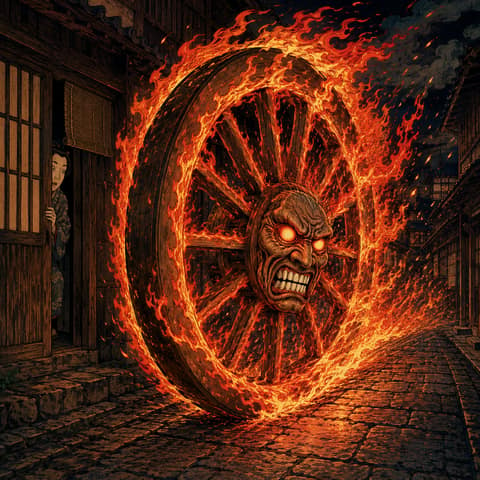
Household SpiritsYamashiro Province, Omi Province, and surrounding regionsA variant of the Katakuruma said to haunt Kyoto’s Higashi-no-Toin, marked by a strong urge to chasten with words. In the Enpo era, disliking the city’s taste for night roaming and nosy tongues, it rolled through the streets as a single ring of fire. It appears as one lone ox-cart wheel, cypress spokes sooted and red-hot, with a broad-jawed man’s face set in the hub. Its eyes flicker like lantern flames, its teeth gleam like a comb, and it often arrives biting a child’s single foot. Its first cry is always “Look to your child before you look at me,” both a threat and a plain command to tend the home; those who rush inside sometimes avert harm. But peep out of curiosity and, before rumor can spread, calamity befalls the household’s child. The foot it holds is not some stranger’s far away but is bound to the onlooker’s own child—the terror of this type—its fire slipping thinly through the door crack, drawing blood like beriberi in the sleeping room, leaving a tear. This speech-making Katakuruma is often confused with the Wheel Monk, yet it prefers admonition to mockery, and a single line of speech sets both the cause and the end. When a housewife once peered through a slit on Higashi-no-Toin, the wheel halted before the home, pressed its nose to the door, uttered a verse, and left; she ran to the parlor and found the child only lightly harmed, cured by prayer and decoctions. Thereafter, from the bell at sunset, households barred lattices tight, hung dim lamps within, and vowed not to speak of the strange at their lips. Sightings waned, yet during festivals and pilgrimages it returns, rolling as if stepping on the shadows of paper lanterns. It feeds above all on named gossip; if one whispers “katawa-guruma” thrice, its flame licks the eaves and seeks the lattice gap. Elders avoided the name, saying “the one-wheeled fire” or “the wheel’s voice.” Still, a gate warded with waka or votive words can halt it; honoring the power of speech, it eases if the text is orderly and heartfelt for the child. In towns thick with rumor it grows strong, in towns that mind their words and households it wanes, a monster mirroring Kyoto’s temperament.

珍しい Minobi (Rain-cloak Fire)
MEE-noh-bee
Canonical Folklore Standard
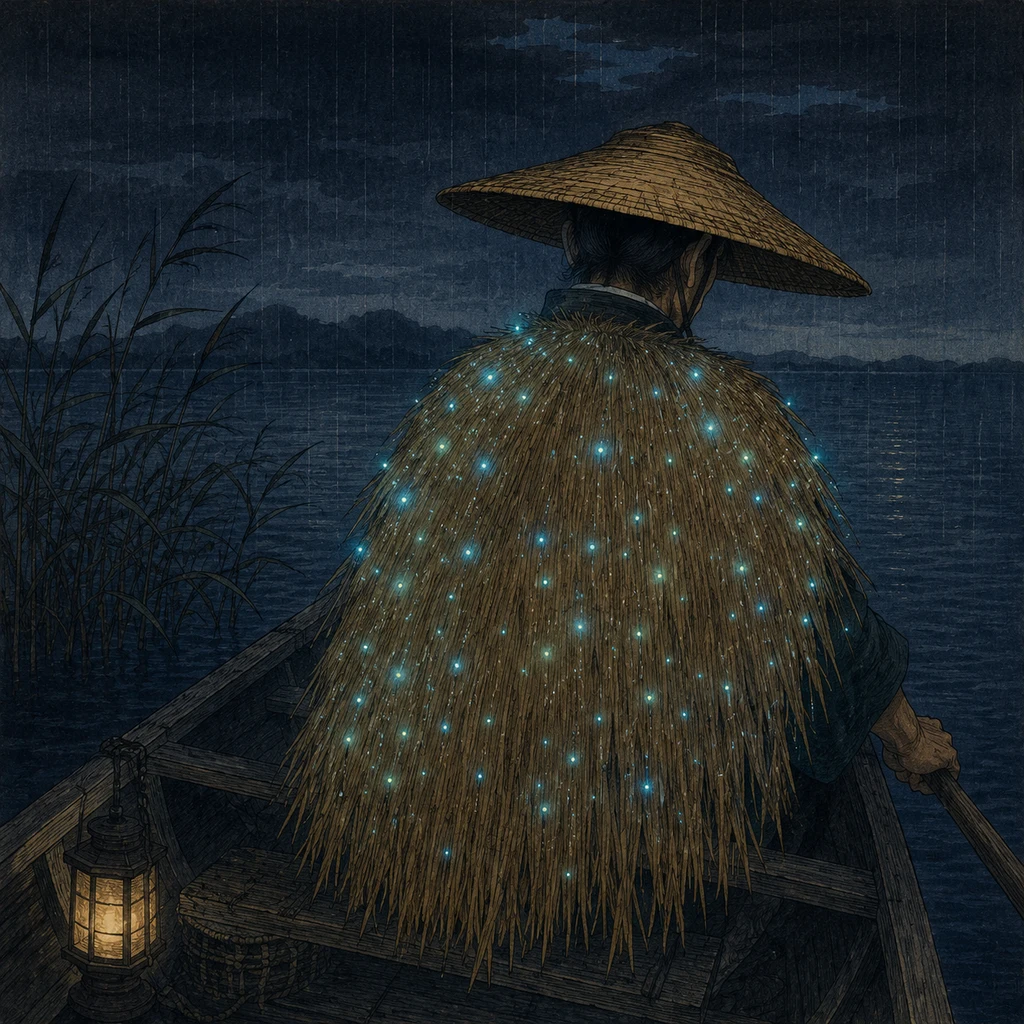
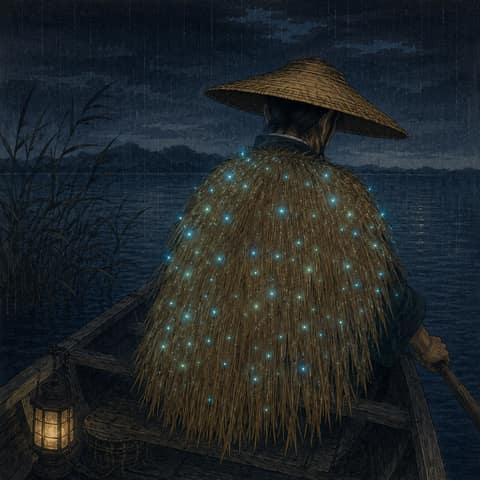
自然現象・自然霊Omi Province (modern Shiga Prefecture), around Hikone and Lake BiwaTypified by records tracing to Lake Biwa, it is a collective form of strange lights that cling in faint specks to rain cloaks, umbrellas, and garments on rainy nights. They carry no heat and increase in brightness and number when brushed at, yet disperse naturally when garments are removed, a flame is lit, or time passes. Names and interpretations vary by region, with some seeing them as spirits of drowning victims, others as animal tricks or natural bioluminescence. Rather than causing harm, they are said to bewilder and unsettle, and are often visible only to solitary individuals.

珍しい Aburabō (Oil Wraith)
ah-boo-rah-BOH
Abura-bō (Traditional Form)
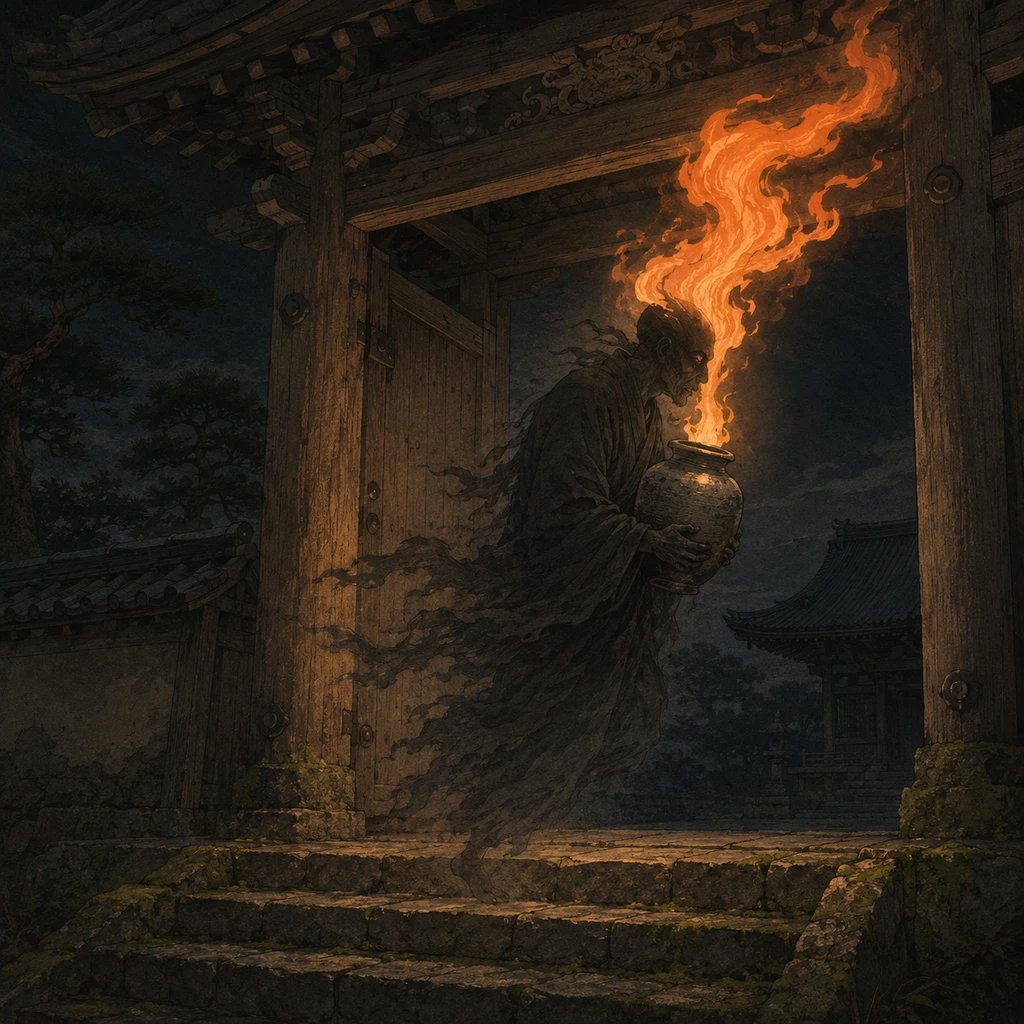
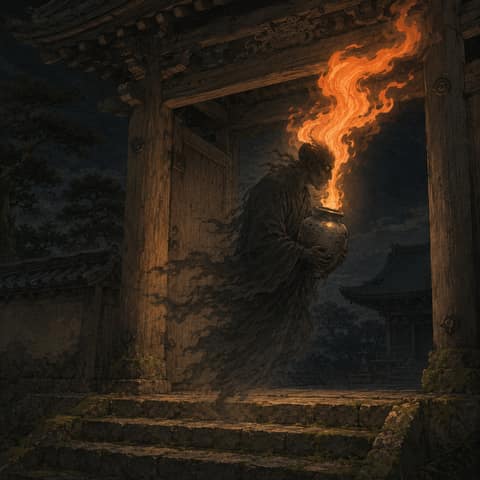
Half-Human BeingsŌmi Province (Shiga), Yamashiro Province (Kyoto), and surrounding regionsAt the core of Abura-bō is the guilt of misappropriating oil meant for temple and shrine lamps, manifesting as a spirit flame. Early modern records and local lore place its appearances around the foothills of Mount Hiei and temple precincts across Ōmi, most often from dusk to midnight in late spring through early summer. It takes the form of a small orange to yellow fireball, or the shadow of a monk cradling an oil jar, following a set course over gates, halls, and pond embankments before vanishing. Its voice is uncertain, though some regional tales mention indistinct murmurings. Names vary by area—“Abura-bō,” “Oil Thief,” “Oil Returned”—all carrying a folk warning about taboos surrounding oil and the need for proper rites. Specific individuals or temple names differ across sources, but the strict management of lamp oil in temple society likely fostered these tales. Methods to calm it include sutra chanting, burial of offerings, and restoring lamp offerings, though no fixed formula is known.

珍しい Dancing Head
oh-DOH-ree-KOO-bee
Classical Tale-Conforming
Ghosts & SpiritsAcross Japan (records in Harima Province and Ōmi)A depiction of the Dancing Head based on scenes found in classical ghost stories and collections of strange tales. A powerful will from life takes form, with only the head detaching and swelling as it appears. It opens and closes its mouth to moan, laugh, or chatter its teeth, emphasizing an auditory menace. Direct physical harm is not always clear, yet it is said to bring misfortune such as falls from fright or sudden fever. Sightings cluster at old temples, graveyards, crossroads, and at the foot of bridges, places where human presence thins or around the hours of a wake. Lineage or personal names are rarely specified, and the strangeness of the incident itself is what lingers in the telling.