Giant Footsteps Imprinted on Musashino
At the heart of the Daidarabotchi traditions of Musashino lies not a face-to-face encounter with a colossal being, but the physical terrain said to remain long after his passage. By connecting hollows identified as footprints, spring-fed ponds, and hills or barrows explained as dumped earth, local imagination reconstructs the invisible giant’s stride, stance, and scale directly upon the land.
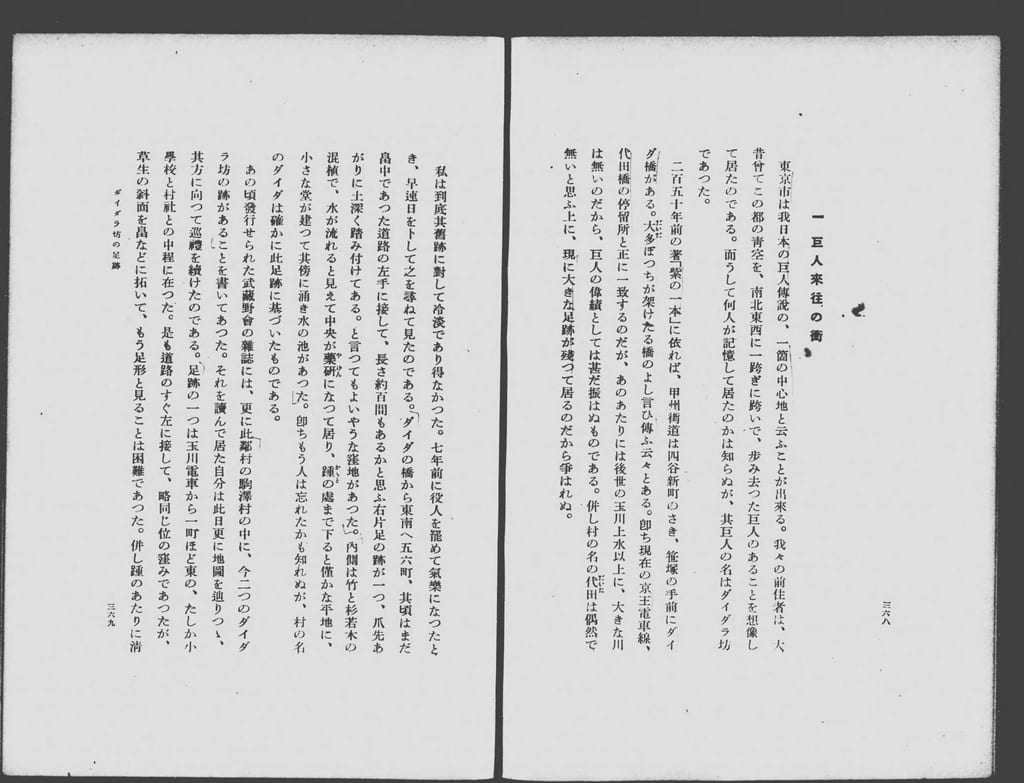
In his essay “Daidara-bō no Ashiato” (The Footprints of Daidara-bō), included in the 1934 volume *Hitotsume Kozō Sonota*, folklorist Kunio Yanagita identified Tokyo as one of Japan’s foremost centers of giant lore. Surveying the suburban landscape on foot from Daita toward Komazawa, Yanagita recorded concrete details of an area undergoing rapid residential development: roadside depressions, silt gathering at the bottom of hollows, natural springs, and small ponds. Rather than relying on claims of firsthand sightings, communities deduced the giant’s immense scale in reverse from the contours and uneven elevations of the earth[1].
The 1919 Record:
Senzoku Pond as a Staff Mark
One of the earliest recorded testimonies from the area surrounding Senzoku Pond appears in “Musashino no Kyojin Mintan” (Folk Tales of Musashino’s Giants), published in December 1919 in *Musashino* (vol. 2, no. 3) by Tanigawa Iwao. Tanigawa changed his surname to Ōba in 1928 and subsequently gained renown as the archaeologist Ōba Iwao[3].
In a farmer’s narrative cited from that article by Toshiaki Nagasawa, Suribachiyama in Ōokayama and Mujinakubo in Senzoku are framed as the spots where Daidarabotchi planted his feet to brace himself. The giant reached out with one hand to scoop sediment from the sea at Shinagawa, deposited it on the opposite side to form Mount Fuji, and planted his walking staff to create the hollow that became Senzoku Pond. Within this single coordinated stance and gesture, two inland depressions, Senzoku Pond, the bay at Shinagawa, and Mount Fuji are arranged together in one coherent narrative[4].
In this 1919 recorded tradition, Senzoku Pond is designated specifically as the mark of a walking staff. While a staff is not a universal attribute of Daidarabotchi across the country, here it fulfills a crucial structural role, drawing Senzoku Pond into the giant’s bodily movement where two feet alone would have been insufficient to link the sites.
The 1983 Published Account:
Reassigning Koike and Senzoku Ponds
A different narrative tradition, cited by Nagasawa from page 484 of the folklore source volume of the 1983 *Ōta-ku shi* (History of Ōta Ward), presents a contrasting posture and spatial arrangement. Earth heaved up under the giant’s braced right foot to form Suribachiyama, while his left foot carved the hollow of Mujinakubo. His staff plunged into the earth to create Koike Pond, and the pool where his urine collected became Senzoku Pond. Although this account shares most of its landmarks with the 1919 record, the bodily actions assigned to each feature are notably different[8].
- The 1919 record: Suribachiyama and Mujinakubo represent the giant bracing both feet, while Senzoku Pond is the mark of his walking staff.
- The 1983 published account: Suribachiyama is earth heaved up by his right foot, Mujinakubo is the depression left by his left foot, Koike Pond is the staff hole, and Senzoku Pond is where urine collected.
- The 1996 children’s book: A modern retelling for young readers that adapts the later tradition of Senzoku Pond originating from urine.
The children’s picture book *Daidarabotchi*, written by Shōji Nomura and illustrated by Kōyō Abe,[9] illustrates how this later tradition was carried forward into contemporary juvenile literature. That storyline, however, cannot be projected backward onto the 1919 record. Keeping the publication dates and narrative structures of each source distinct prevents the multiple folklore layers attached to Senzoku Pond from being conflated.
What Variant Traditions Reveal Over Time
The 1919 record and the account published in 1983 represent variants that map different bodily actions onto the same geographical features. Oral lore naturally shifts in detail according to the narrator, the audience, physical changes in the landscape, and the circumstances under which the story was collected. At the same time, no transitional records directly linking the two have been discovered, making it impossible to prove that the 1919 tradition gradually evolved step-by-step into the 1983 narrative.
The two dates do not indicate when the respective tales were first conceived, but rather the points in time when their specific narrative arrangements can be verified in print. In the absence of intermediate documentation bridging that gap, it is most rigorous to treat them as distinct variants organizing the same cluster of landmarks. What they share is a technique of narrative composition: drawing Suribachiyama, Mujinakubo, Senzoku Pond, and—in the later telling—Koike Pond into a single dramatic tableau of a giant striding, planting a staff, and shifting his weight. In the 1919 record, which incorporates Shinagawa Bay and Mount Fuji, modest local depressions are expanded across an epic scale spanning the Kantō region.
Valley-Floor Ponds and Natural Springs
Folklore origins and geological processes do not cancel each other out. Environmental surveys conducted by Ōta Ward describe Senzoku Pond and Koike Pond as bodies of water situated at the bottom of valleys incised into the Ebara Plateau by running water, framed by mortar-shaped slopes that plunge toward the valley floors. In another municipal overview, Ōta Ward explains that Senzoku Pond is primarily fed by natural springs emerging from the terminal edge of the Musashino Plateau, noting that it was historically known as the “Great Pond” (Ōike) of Senzoku Village. Ponds formed in low-lying basins where water naturally gathered, leading their conspicuous depressions to be interpreted as the physical marks of a giant’s feet or staff[5].
Geomorphology reconstructs how plateaus, ravines, flowing runoff, and artesian springs generated these water bodies over time. Giant lore, by contrast, preserves how inhabitants experienced that physical environment through bodily intuition and encoded it into place-name mythology. The account attributing Senzoku Pond to the giant’s urination does not present a geological argument; rather, it represents an imaginative leap that conceptualizes an immense volume of water and an imposing depression as the consequence of a single bodily action. While the walking-staff tradition and the urination tradition identify different causes, both share the fundamental instinct of reading the pond as a physical trace left by a titanic body.
Comparisons with Ancient “People of Antiquity” and “Great Men”
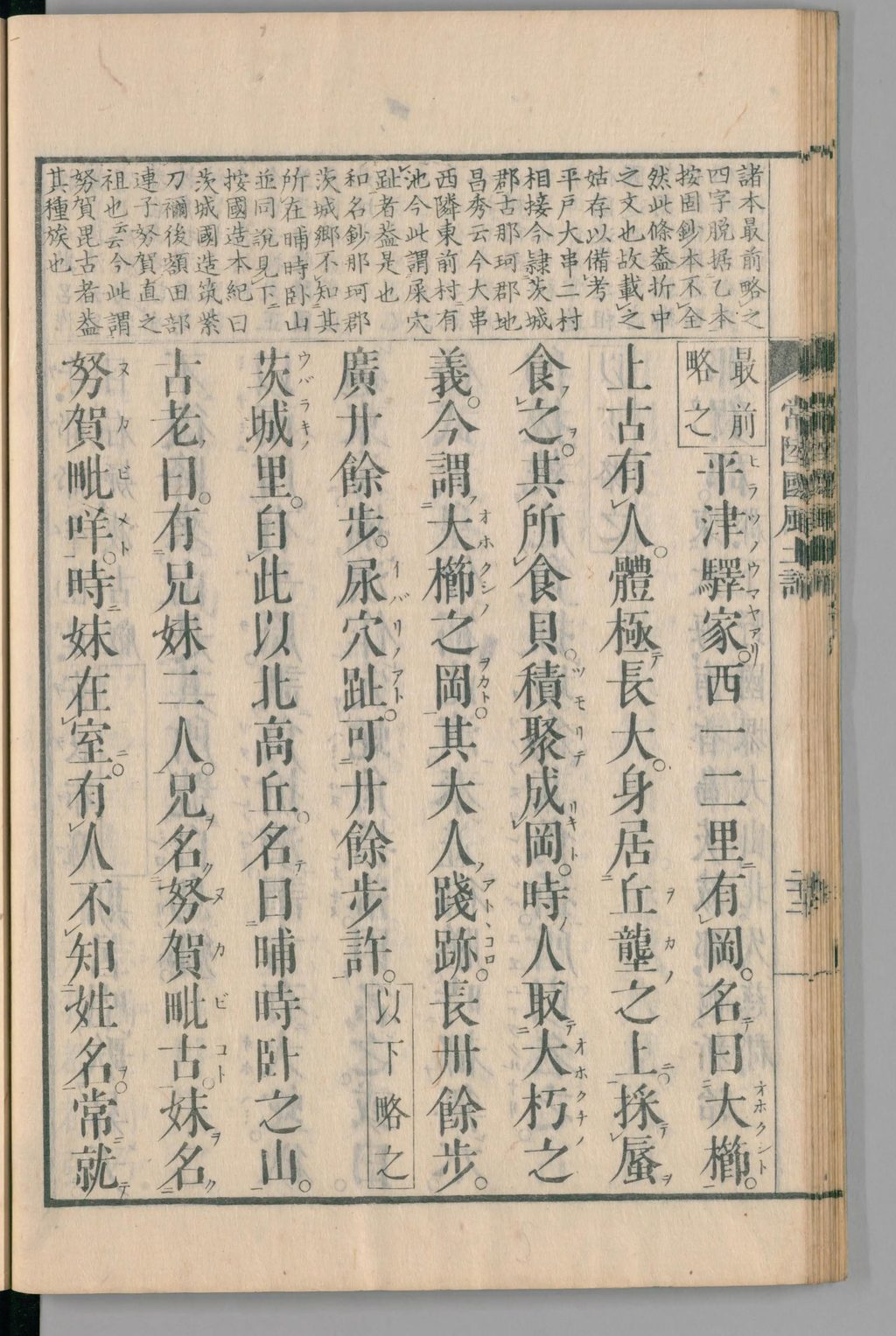
The conceptual framework of explaining regional landforms through the anatomy of a giant appears as early as Japan’s ancient provincial gazetteers (*fudoki*). In the entry for Ōkushi Hill in Naka District within the *Hitachi no Kuni Fudoki*, an unnamed “person of high antiquity” (*jōko no hito*) is depicted as large enough to scoop shellfish from the seashore while seated atop the hill. The discarded shells accumulated into a hill, and surviving manuscript recensions record the giant’s footprint as measuring more than forty paces in length and more than twenty paces in width, while the hole created by his urine measured more than twenty paces in diameter. Surviving texts assign distinct measurements of more than twenty paces to both the width of the footprint and the diameter of the urine hole[2]. Although Ōkushi Hill corresponds to the Early Jōmon Ōgushi Shell Mound, the *fudoki* text never calls this ancient giant Daidarabotchi.
Similarly, the entry for Taka District in the *Harima no Kuni Fudoki* preserves a toponymic legend concerning a “great man” (*ōbito*) who stooped low in hollows and walked upright across highlands, leaving footprints in various locations that transformed into marshes. Here too, the proper name Daidarabotchi is entirely absent from the text[10]. These two ancient examples do not represent early attestations of the later folklore creature itself, but rather are comparative evidence that the idea of explaining physical topography through a giant’s body and bodily waste was recorded long ago.
Kunio Yanagita and the Memory of a Giant Deity
Comparing local appellations across Japan alongside tales of footprints, transported peaks, spilled loads of soil, bubbling springs, and bodily excretion, Kunio Yanagita pondered whether these motifs might preserve an archaic memory of an ancient giant deity who cleared and fashioned the wilderness. He also discussed the possibility that sacred cosmogonic narratives of land creation gradually eroded over centuries into folktales of clumsy giants dropping mountains or humorous rustic anecdotes.
This proposition was a working hypothesis within comparative folklore aimed at explaining scattered traditions historically; it does not prove that a specific land-creating deity from the *Kojiki* or *Nihon Shoki* devolved directly into Daidarabotchi. Yanagita himself maintained a cautious stance toward simplistic theories of unbroken continuity that would treat modern folklore in Hitachi as an identical preservation of the *Hitachi no Kuni Fudoki* record across a thousand years[1]. While figures such as the “person of antiquity,” the “great man,” Daidarabō, and Deedarabotchi can be meaningfully compared because they fulfill similar explanatory roles, they cannot be equated in their names, geographic settings, or historical contexts of recording.
Physical Traces That Precede a Face
Most early folklore collections offer little detail regarding Daidarabotchi’s facial features, hair, or clothing. What people actually encountered was not the giant in the flesh, but the depressions, natural springs, ponds, barrows, and peaks already etched into the earth. Modern iconography—a shaggy, long-haired colossus clad in rough garments, gripping a staff, or hauling a mountain on his back—is best understood as a creative synthesis compiling motifs scattered across disparate regional traditions onto a single frame. A walking staff serves effectively to illustrate the variants around Senzoku and Koike Ponds, yet it is not a shared attribute among the ancient giants of Hitachi or Harima.
In this respect, Daidarabotchi stands apart from encounter-based apparitions such as Mikoshi Nyūdō, an uncanny figure encountered along roadsides that reportedly grows taller the higher a traveler looks up. Where Mikoshi Nyūdō traditions revolve around a face-to-face confrontation between a traveler and an apparition, in the majority of Daidarabotchi lore, the colossus has already departed. The landforms left behind invite the observer to envision an immense body far too vast to be directly contained within the scene.
Multiple Origins Layered at a Single Pond
At least two distinct giant traditions overlap at Senzoku Pond: the 1919 record identifies it as the imprint of a walking staff, whereas the tradition recorded in 1983 explains it as the pool of the giant’s urine, transferring the role of the staff hole to Koike Pond. When examined according to documentary date and narrative structure, these two explanations do not represent mutually exclusive contradictions; rather, they stand as distinct variants that reimagined the same geographic features through alternative bodily gestures.
The lowlands, mortar-shaped ravines, rising knolls, subterranean springs, orientation toward the sea, and distant vistas of Mount Fuji across Musashino were recast into the footsteps, walking staff, hands, and bodily functions of a colossus. Folklore is not a cartographic survey. Nevertheless, by binding scattered place names and subtle contours of the terrain to a single titanic frame, these stories functioned as narrative maps that helped communities comprehend their shared environment. Rather than a monster confined to a fixed shape, Daidarabotchi is a giant repeatedly outlined afresh by the contours of the land itself.
Character Profile
This section is our own creative profile for storytelling. It is not historical fact or scholarship.
Yokai Type - Traditional Yokai
Category - Demons & Giants
Rarity - Rare
Personality - Regional accounts describe immense physical feats in vivid detail while saying virtually nothing about emotions or social demeanor. The traditions center on carrying mountains and earth, stamping the ground, and planting a walking staff, offering no nationwide consensus regarding moral disposition or intelligence.
Compatibility - No surviving traditions describe personal affinity or compatibility with human beings. Daidarabotchi is characterized not through social relationships, but as a mythical agency accounting for the origins of landforms and place names.
Abilities - Leaving depressions, ponds, and marshes with a single stepTransporting mountains or vast quantities of earth to deposit elsewhereForming hills and barrows from spilled earth or soil shaken from footwearLeaving holes punched by a walking staff to become ponds or wellsLeaving hollows and ponds formed from bodily waste
Weaknesses - No credible historical records mention methods of subjugation, taboos, or specific weaknesses. Daidarabotchi’s physical form and degree of divinity vary widely from region to region, and the absence of a fixed, uniform monstrosity is itself the defining hallmark of the tradition.
Habitat - Sites across Musashi, Sagami, Hitachi, and neighboring provinces where hollows, ponds, marshes, wells, barrows, or relocated mountains are remembered as a giant’s footsteps. Rather than occupying a permanent dwelling, he is conceptualized almost entirely through the physical traces left in his wake.