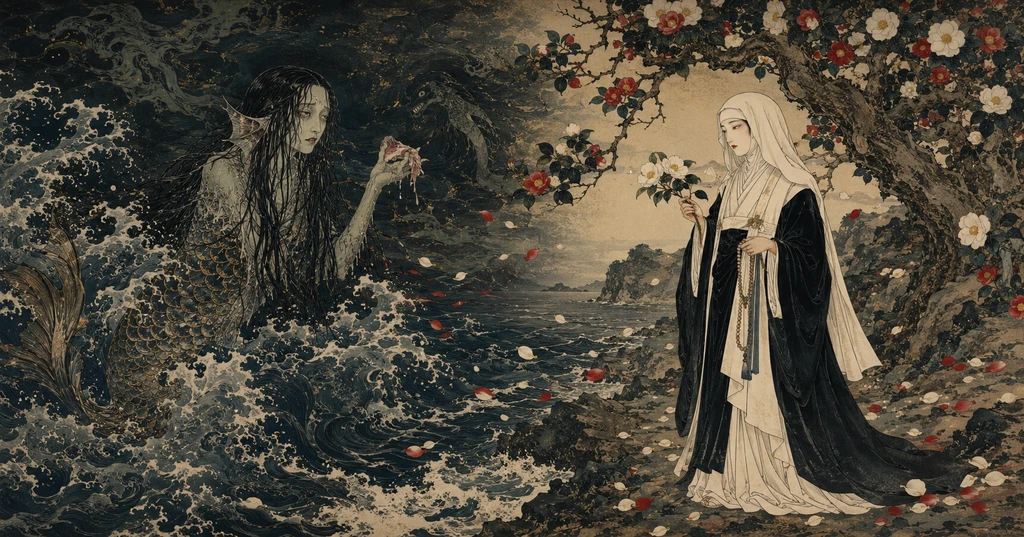
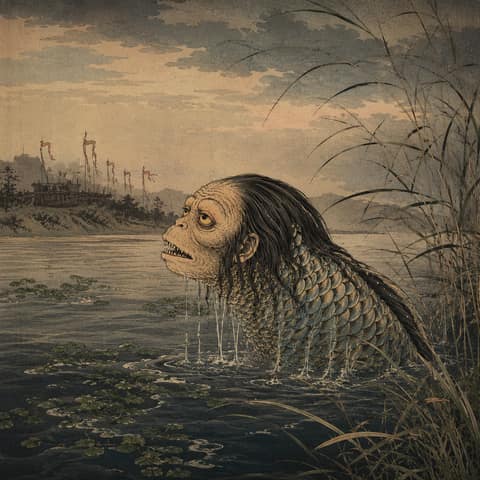
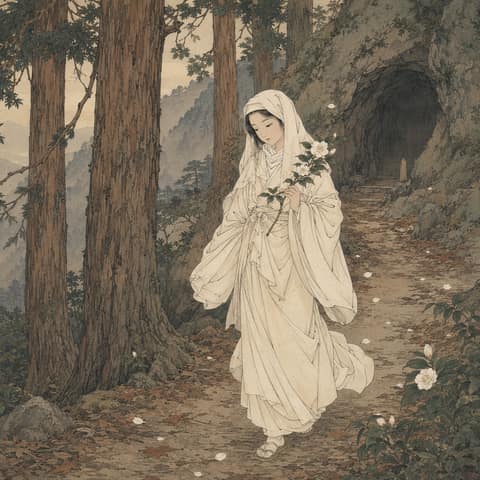
Ningyo (lit. "Human-Fish") are half-human, half-fish yokai said to inhabit the seas and rivers. In Japanese folklore, they are peculiar entities bearing two completely opposing faces: "eternal youth" and "an omen of disaster." Unlike beautiful Western mermaids, the Ningyo appearing in ancient Japanese texts are often depicted as grotesque creatures with "monkey-like faces and fish bodies" and "sharp teeth and horns." When washed ashore, they were regarded as a dark omen predicting ominous events such as wars and plagues. Conversely, there was an intense belief that their meat acted as an "elixir of immortality"; the legend of "Yao-bikuni," a woman who allegedly lived for 800 years after eating Ningyo meat, is widely distributed throughout Japan. Entering the Edo period, Ningyo suddenly transformed from an object of fear into a "sideshow attraction" and a "rare beast" of curiosity. Craftspeople manufactured massive quantities of "Ningyo mummies" by ingeniously stitching the upper half of a monkey to the lower half of a fish, sparking a massive boom as these artifacts circulated both domestically and internationally.
Folklore & Legends
Appearance as a Bad Omen and the Nihon Shoki. Records of Ningyo (or similar monstrous fish) in Japan are ancient; an entry from the reign of Empress Suiko (Asuka period) in the *Nihon Shoki* (Chronicles of Japan) mentions a "fish with a human-like form" caught in a net. In folklore up to the medieval period, a Ningyo washing ashore was considered an "omen (bad omen)" of natural disasters or great wars. The rulers of the time feared this deeply and conducted prayers to Shinto and Buddhist deities in an attempt to ward off the calamity.
A Gift from the Other World and "Ningyo Meat". From a folkloric perspective, Ningyo legends are interpreted not simply as sightings of unidentified creatures, but as tales indicating contact with the "Other World" (Ikai). Many legends share a structure where a fisherman is invited to the Other World (like the Dragon Palace) on a night such as the Koshin-ko gathering. He is served "Ningyo meat" but, feeling disgusted, secretly hides it and brings it home. This meat is the embodiment of the Other World's immense vitality; the story serves as a tale of taboo and consequence, where the one who eats it is permanently severed from the flow of time (aging and death) in the real world.
The Edo Period Ningyo Boom and the Export of Mummies. In the peaceful Edo period, Ningyo transformed from an "ominous yokai" into an "object of natural history curiosity." In sideshow tents (misemono-goya), "living Ningyo" and "Ningyo mummies" drew massive crowds, while Dutch-learning scholars (Rangakusha) seriously debated their existence by comparing them with Western natural history books. Furthermore, when figures like Philipp Franz von Siebold and the directors of the Dutch trading post acquired elaborately crafted "Ningyo mummy artifacts" and brought them back to Europe, the Japanese Ningyo achieved worldwide fame as an object of wonder symbolizing the "mysterious country of Japan."
Iconographic Disconnect from Western Mermaids. The image of a Ningyo that modern Japanese people envision—a "beautiful female upper body and a fish lower body"—is a product of Western mermaid legends (such as Hans Christian Andersen's *The Little Mermaid*) being imported and taking root from the modern era onward. Prior to this, traditional Japanese Ningyo iconography, as depicted in texts like the *Kaikoku Heidan*, was exceedingly bizarre and grotesque: "a human-like (or monkey-like) face on a scale-covered fish body." The facial features were not necessarily those of a beautiful woman; they were generally depicted as terrifying men, women, young, or old, bearing sharp fangs. The sheer ugliness of this design emphasized the visceral reality of the Ningyo as a "creature from the Other World" and the taboo, grotesque nature of the act of eating its flesh.
Biological Models and the Natural History Perspective. The core of Japanese Ningyo folklore is believed to contain no small amount of misidentification of actual biological creatures. For example, a prevalent theory suggests that sirenians like dugongs and manatees, or pinnipeds like sea lions and seals, served as the models for the Umibozu and Ningyo. Additionally, in inland (river or swamp) Ningyo legends, there are cases where the true identity is speculated to have been the Japanese giant salamander. Edo period herbalists (Honzogakusha) meticulously collected and classified records of these unknown marine creatures washing ashore, attempting to re-examine yokai through the lens of "science" (natural history).
The Curse of "Eternal Life". The "eternal youth and longevity" brought about by Ningyo meat is a universal human desire, yet in Japanese folklore, it is always depicted as two sides of the same coin alongside "tragedy." As the legend of Yao-bikuni demonstrates, one who obtains eternal youth by eating Ningyo meat must repeatedly watch their beloved family members and husbands age and die, forcing them to experience unbearable loneliness and despair (temporal isolation). The Ningyo is a yokai that acts as a cruel mirror, thrusting the "terror of escaping death" directly in humanity's face.
Character Profile
This section is our own creative profile for storytelling. It is not historical fact or scholarship.
The Ningyo itself is rarely depicted as having a clear personality or will. It strongly possesses the characteristics of flotsam from the Other World, or a cursed object/symbol harboring immense spiritual power (immortality).
Compatibility
Because the appearance of a Ningyo is a bad omen for natural disasters and wars, it is an object of fear and avoidance for rulers and local residents. However, for those who seek its flesh (eternal life), it represents the ultimate temptation they wish to obtain even at the risk of their own ruin.
Abilities
Grants eternal youth (or immortality) to those who eat its flesh.By washing ashore, it prophesies the arrival of calamities such as massive tsunamis, plagues, and wars.When exhibited (in forms like mummies) in sideshow tents, it gathers people's curiosity and money.
Weaknesses
Since it is not an amphibious yokai, it is powerless once washed ashore or caught in a net, and can be easily captured by human fishermen.
Habitat
The seas around Japan, and the Other World (such as the Dragon Palace). Alternatively, inside the tents of sideshows (misemono-goya) or in overseas Cabinets of Curiosities (Wunderkammer).
The diagram below is a diagnostic evaluation chart for The Water Yokai Evolving from Ancient to Modern Times. The higher the value of each item, the stronger that characteristic is expressed.