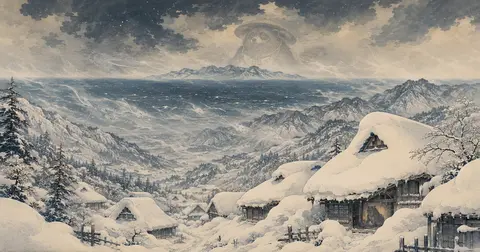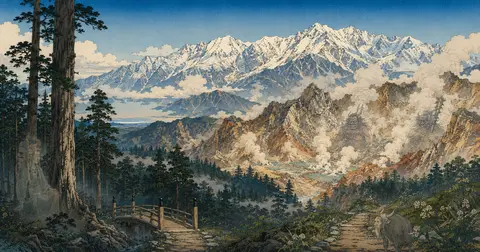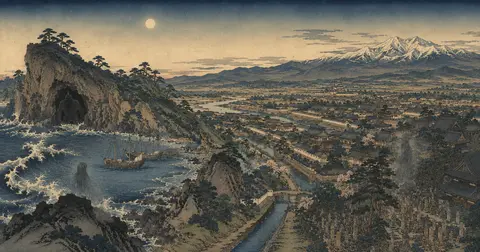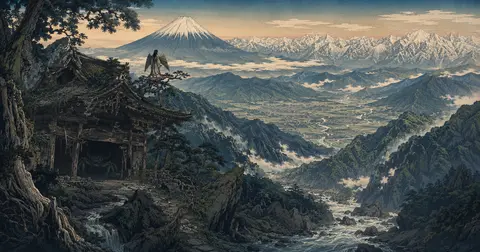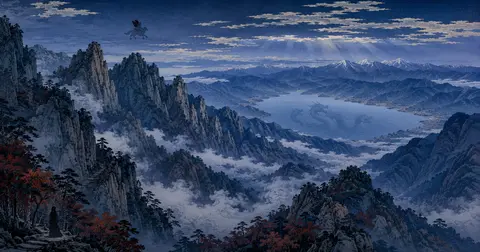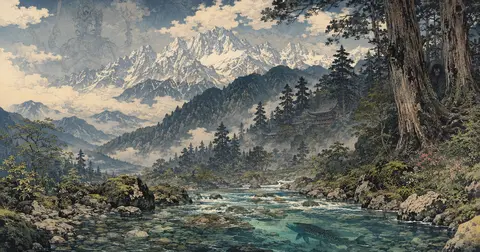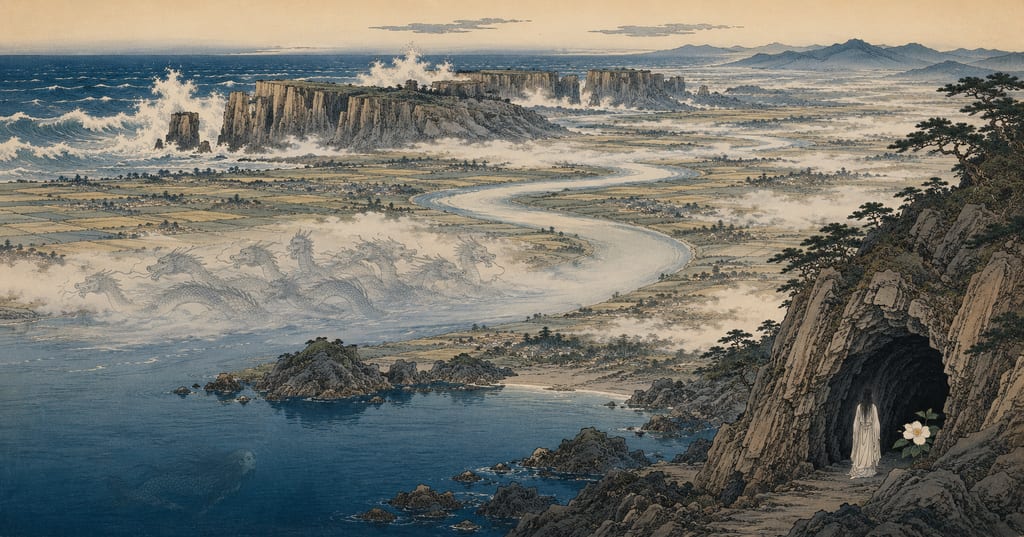
Fukui Prefecture is a land rich in memories of water, embraced by Wakasa Bay cutting deep into the Sea of Japan, and the Kuzuryu River, which originates from Mount Haku and pierces through the plains. In the south of the prefecture, Obama with its ria coast was known in ancient times as *Miketsukuni* (the province of royal food), continuously providing salt and seafood to the capital. To the north on the coast of Sakai stands Tojinbo, where columnar joints of pyroxene andesite rise sharply like a folding screen. And flowing through the center of the prefecture is the great river bearing the name of a nine-headed dragon. Both the sea and the river harbor the presence of the otherworldly.
Running through the yokai culture of this region is a single thread: 'water, and unending life.' A girl who tasted mermaid flesh in the sea of Wakasa lived for eight hundred years before entering eternal meditative absorption in a cave in Obama. A raging dragon was transformed into a benevolent god by spiritual power, and its figure became the name of the great river. Before an *ama* diver, another self appears, alternating top and bottom between the sea surface and the sea floor. The strange phenomena of Fukui all speak of the moments when those standing at the water's edge lose the contours of 'time' or 'self'.
Mermaid Flesh and Unending Life ── Yao Bikuni of Obama's Kuuinji Temple
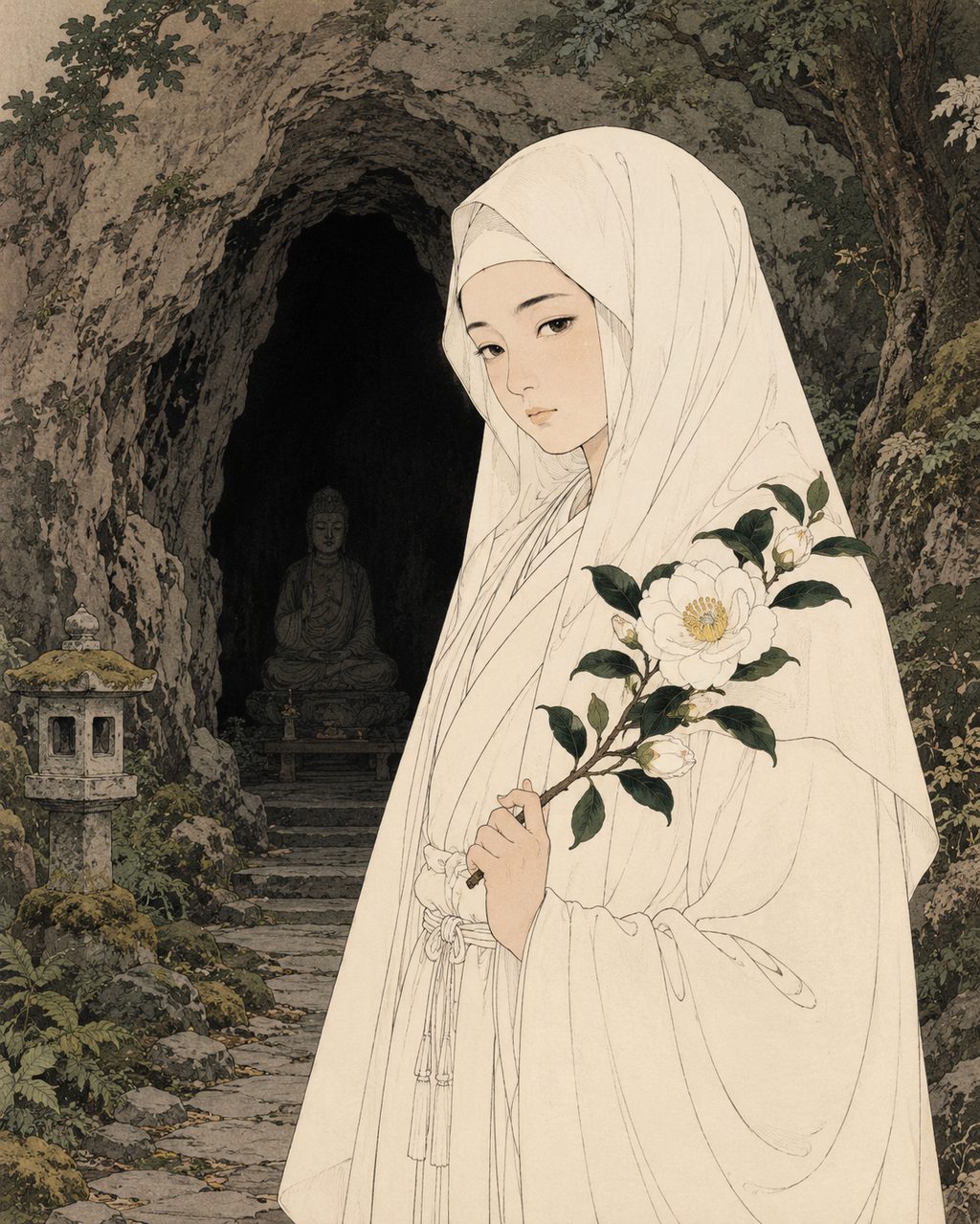
Behind the Soto Zen Kuuinji Temple[1] in Obama City, Fukui Prefecture, lies a small cave about eight meters deep and the size of four tatami mats. This rocky hollow, known as the cave where Yao Bikuni entered eternal meditative absorption (*nyujo*), is the terminus of the most widely recounted mermaid legend in Japan. Kuuinji Temple also served as the family temple for the Sakai clan, lords of the Obama domain, and under the domain's patronage, the legend was formalized during the early modern period.
The story begins when a man is invited by a stranger to their home and receives a feast. In many variants, that night is a gathering for a Koshin-ko[2] vigil, and the destination he is guided to is an otherworldly realm such as the Dragon Palace or an island on the sea. There, the man witnesses a creature with a human face and a fish's body ── a mermaid ── being prepared for the meal. Finding it eerie, he refrains from eating the flesh and secretly brings it back in his robes. Upon returning home, whether the man simply forgot where he placed it or the daughter mistook it for a souvenir, she unknowingly eats it. From here, the tale of unending life is set into motion.
Yao-bikuni
Yao-bikuni is the legend of a Buddhist nun who lived for an astonishing span of time, told in Wakasa and throughout Japan. The best-known story tells of a girl who eats mermaid flesh, grows old only very slowly, enters religious life, and travels the provinces. The surviving records, however, do not contain one single story: her appearance, age, and reason for longevity all vary. The most important early records place her in Kyoto in 1449. The entry for the twenty-sixth day of the fifth month of Bun’an 6 in *Yasuyoshi-ki* describes a “Shiro-bikuni” from Wakasa as more than two hundred years old and says that many people came to see her. In the entry for the twenty-sixth day of the seventh month of the same year, *Gaun Nikkenroku* calls a nun from Wakasa an “eight-hundred-year-old nun” and says that people in Kyoto paid to see her. Neither account mentions mermaid flesh; both foreground a long-lived nun who had become a sensation in the capital. The explanation of longevity through mermaid flesh becomes a clear story in the early modern period. In Hayashi Razan’s *Honchō Jinja Kō*, a father receives a mermaid from a stranger in the mountains, brings it home, and his daughter eats its flesh, becoming more than four hundred years old. The sequence of father, otherworld, mermaid, and daughter became a defining form of later Yao-bikuni stories, though even here the lifespan is not fixed at eight hundred years. Yao-bikuni’s name also became attached to old trees, temples, and caves. Before Kūin-ji in Obama, Wakasa, lies a sacred cave associated with her entering meditation; at Jigen-ji in Musashi, a great Chinese hackberry was said to have been planted by Yao-bikuni. The long-lived nun is both a traveler and a name through which distant places tell the age of their own landscapes. In the major medieval and early-modern sources, Yao-bikuni is not a ghost but a legendary person in whom wonder at longevity, fear of otherworldly food, and memories of itinerant female religious practitioners overlap.
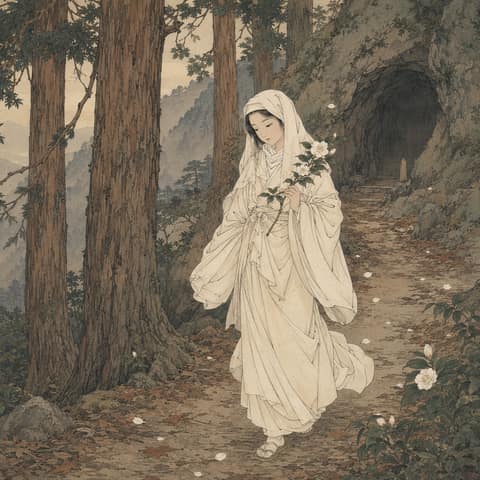
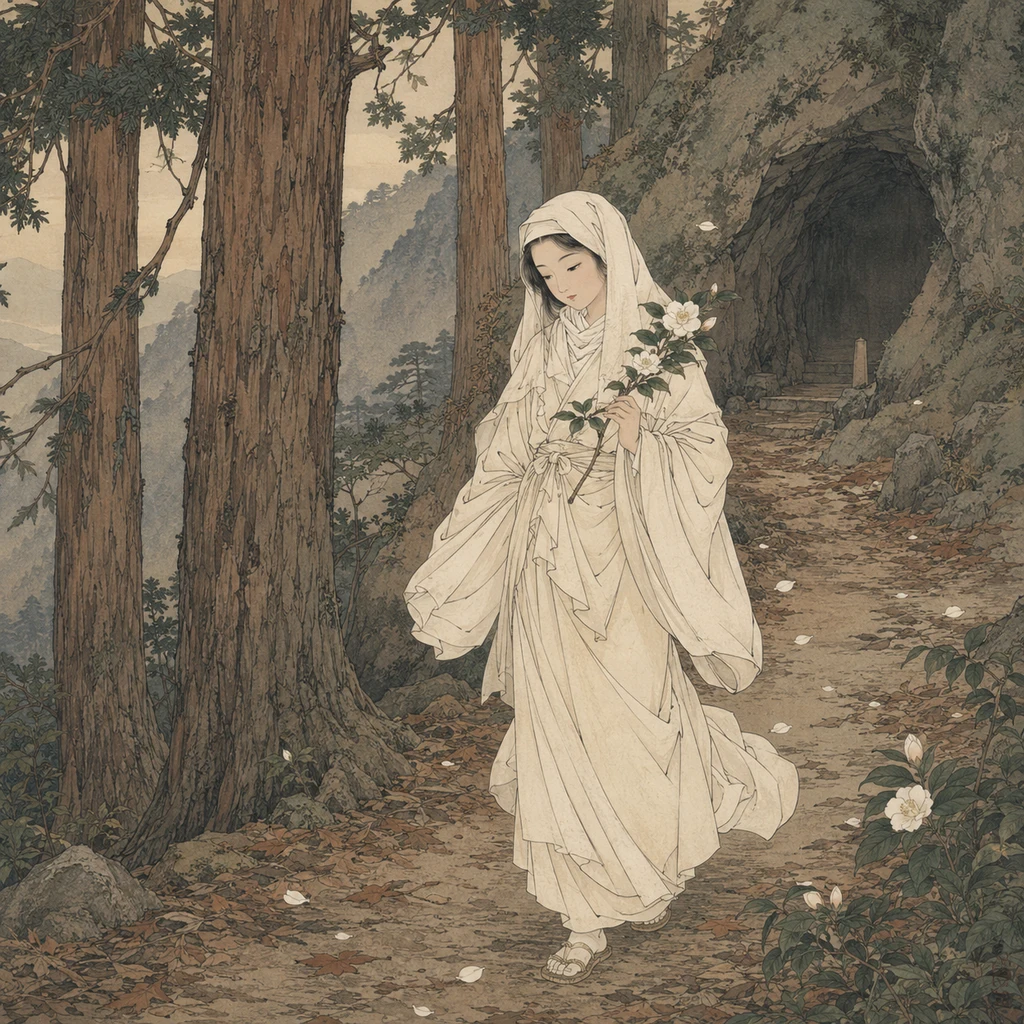
Read moreThe daughter who ate the flesh stopped aging from that moment on. Remaining in the form of a sixteen or seventeen-year-old girl without growing older, she watched her husband die, her children die, and after repeatedly seeing off all her loved ones before her, she realized the impermanence of the world, took the tonsure, and became a *bikuni* (Buddhist nun). Because her skin remained eternally white and youthful, she was also called "Shira Bikuni" (White Nun). According to one theory passed down in Obama, she was the daughter of Takahashi Choja[1]. The nun is said to have wandered throughout the country, accumulating good deeds such as planting white camellias wherever she went, building bridges, and helping the poor. Finally returning to Wakasa at the age of eight hundred, she planted a single white camellia in front of the cave and left behind the words, "When this camellia withers, consider my life to have ended as well." She then entered the rocky hollow, fasted, and achieved *nyujo*. The camellia in front of the *nyujo* cave still blooms in the spring today.
Why a camellia? Evergreen, never dropping its leaves even in winter, and blooming with red and white flowers amidst the cold, the camellia has been considered a symbol of "eternal life" since ancient times. In folklore studies, it is believed that the ones who carried this legend across the country were the Kumano Bikuni (Uta Bikuni)[3] who wandered through various provinces from the medieval to the early modern period. Traveling to solicit funds for the Kumano faith, they planted camellias wherever they went and spread the tale of the ageless nun ── viewed in this light, the three elements of the camellia, the nun, and the nationwide distribution are tied together as one. The tale of Yao Bikuni thus spread across the archipelago, riding the network of solicitation and wandering, with Wakasa serving as its core terminus.
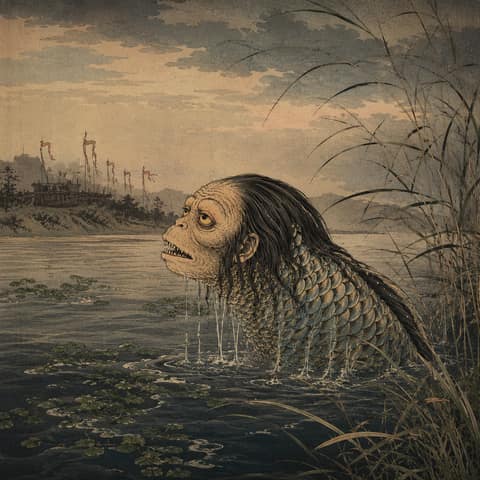
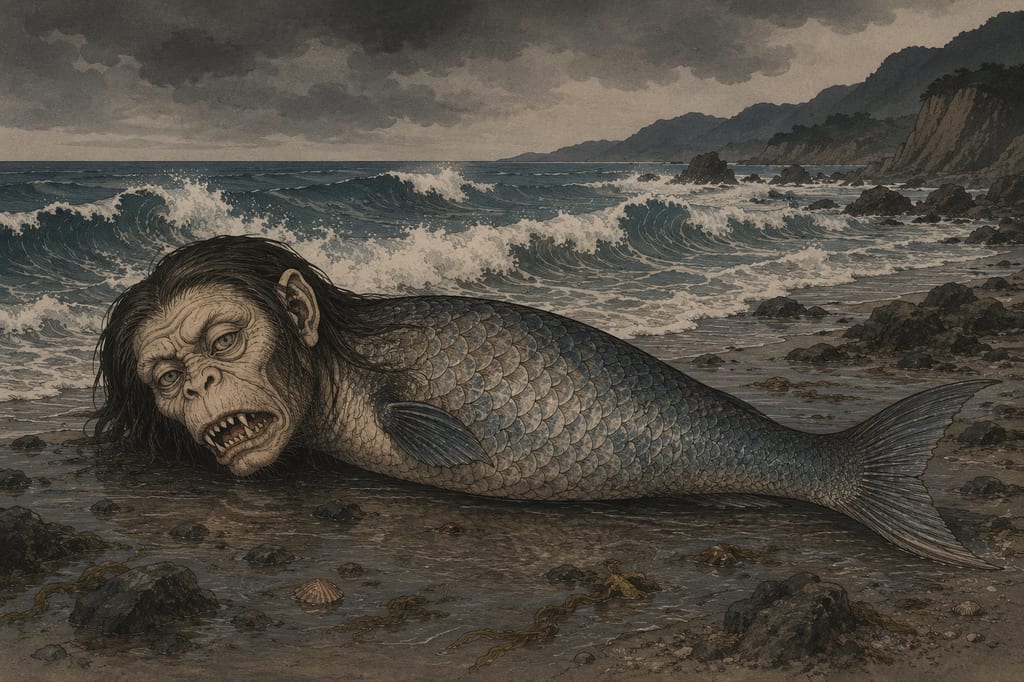
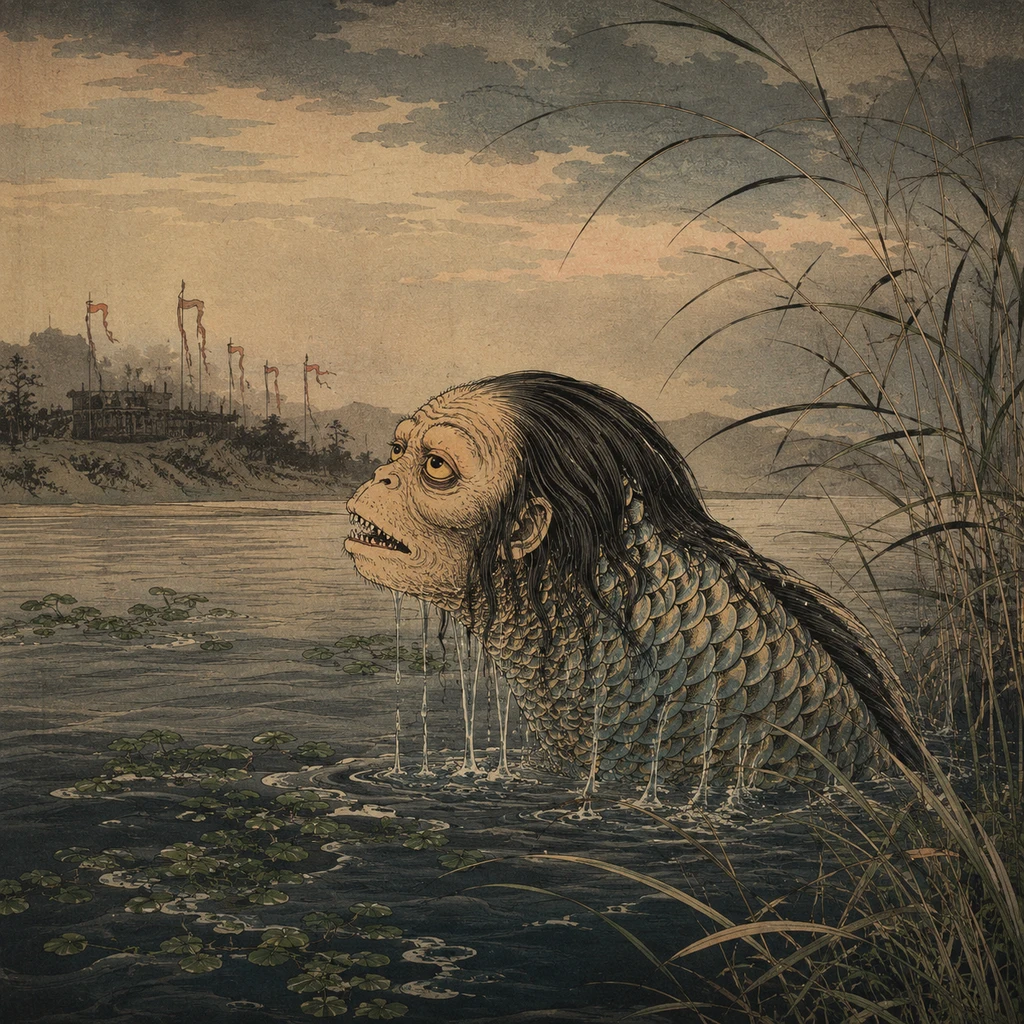
At the core of this legend is the mermaid. The mermaid depicted in classical Japanese literature bears no resemblance to the beautiful mermaid figures of the West. It is a grotesque creature with a monkey-like face, a fish's body, and sharp teeth; if washed ashore, it was considered an ill omen of war or plague, and feared by the authorities of the time.
Ningyo
Ningyo (lit. "Human-Fish") are half-human, half-fish yokai said to inhabit the seas and rivers. In Japanese folklore, they are peculiar entities bearing two completely opposing faces: "eternal youth" and "an omen of disaster." Unlike beautiful Western mermaids, the Ningyo appearing in ancient Japanese texts are often depicted as grotesque creatures with "monkey-like faces and fish bodies" and "sharp teeth and horns." When washed ashore, they were regarded as a dark omen predicting ominous events such as wars and plagues. Conversely, there was an intense belief that their meat acted as an "elixir of immortality"; the legend of "Yao-bikuni," a woman who allegedly lived for 800 years after eating Ningyo meat, is widely distributed throughout Japan. Entering the Edo period, Ningyo suddenly transformed from an object of fear into a "sideshow attraction" and a "rare beast" of curiosity. Craftspeople manufactured massive quantities of "Ningyo mummies" by ingeniously stitching the upper half of a monkey to the lower half of a fish, sparking a massive boom as these artifacts circulated both domestically and internationally.
Read moreRecords of mermaids appearing in Japanese literature are old. The *Nihon Shoki*[4] notes that in the 27th year of Empress Suiko (619), a mermaid-like creature described as being "like a child" was caught in the Gamo River of Omi Province and the Horie of Settsu Province. This is the oldest recorded example. Interestingly, both were found in freshwater rivers rather than the sea, and because their appearance resembled that of a child, the naturalist Minakata Kumagusu deduced that they were likely Japanese giant salamanders. The image of the mermaid as a marine anomaly grew even richer in coastal areas like Wakasa, using these old records as a matrix.
However, its flesh was also believed to be a miraculous elixir that granted immortality. This contradiction ── being both an ill omen and the source of eternal life ── makes the existence of the mermaid unique. Entering the peaceful Edo period, the mermaid suddenly transformed from an object of awe to one of curiosity. In sideshow tents, "mermaid mummies" drew crowds. These were cleverly crafted fakes combining the upper half of a monkey and the lower half of a fish[5], and when brought back to Europe by Philipp Franz von Siebold and others, the Japanese mermaid became known overseas as a marvel symbolizing a "land of wonders." But the mermaid of Obama is no sideshow curiosity. It is a much heavier, more sorrowful entity that bestowed unending time upon a single girl, forcing her to endure eight hundred years of solitude.
In folklore studies, the tale of Yao Bikuni is often read in contrast to Urashima Taro. Urashima spent time in an otherworldly realm, returned to reality, opened the jeweled box (*tamatebako*), and instantly grew old ── it is a story of losing time by entering the otherworld. Yao Bikuni, on the other hand, incorporated the life of the otherworld (the mermaid's flesh) into her body and stopped time while remaining in reality. Though the directions are diametrically opposed, both share the theme that "contact with the otherworld shatters the order of time." The taboo against partaking of otherworldly food also echoes the mythological concept of *Yomotsuhegui* (eating the food of the underworld). It is also worth noting that the otherworldly realm where the man initially brings the meat back from is set on the very night of the Koshin-ko vigil. The night of Koshin is a folk practice of staying awake so that the three *sanshi* worms within the body do not escape; the character of this "sleepless night" or "night that keeps death at bay" likely made it a fitting stage for receiving the flesh of immortality.
This nun may not have been merely a character in a fairy tale. In an entry from May of the 6th year of Bun'an (1449) in the *Yasutomi-ki*[6], the diary of the Muromachi period nobleman Nakahara no Yasutomi, there is a record of a nun claiming to be two hundred or eight hundred years old coming up to the capital from Wakasa. It is a valuable contemporary historical source suggesting the possibility that rumors of an actual wandering nun became the core of the legend. Since Kunio Yanagita, the tale of Yao Bikuni has been confirmed to be distributed across 121 locations in 28 prefectures[2] nationwide, centered on the Sea of Japan coast but extending inland to areas like Shikoku, Owari, and Aizu. The privilege of this region lies in the fact that these nationwide tales uniformly point to "Wakasa Obama as the terminus."
The Dragon with Nine Heads ── The Name of the Kuzuryu River and Heisenji Temple
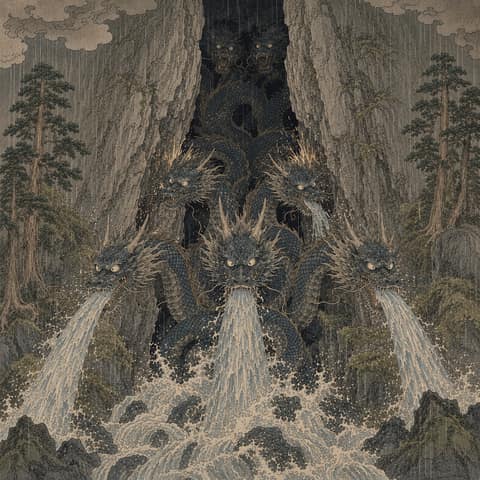
Piercing through the Fukui Plain and flowing into the Sea of Japan, the Kuzuryu River is extraordinary from its very name. A dragon with nine heads ── why is the great river called such?
Kuzuryū
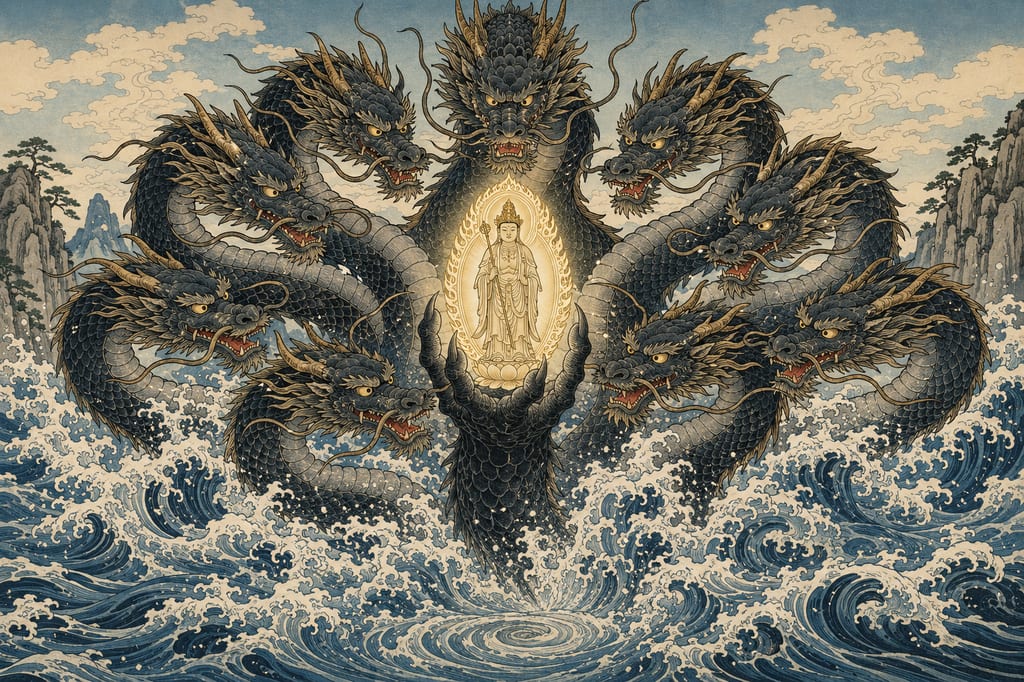
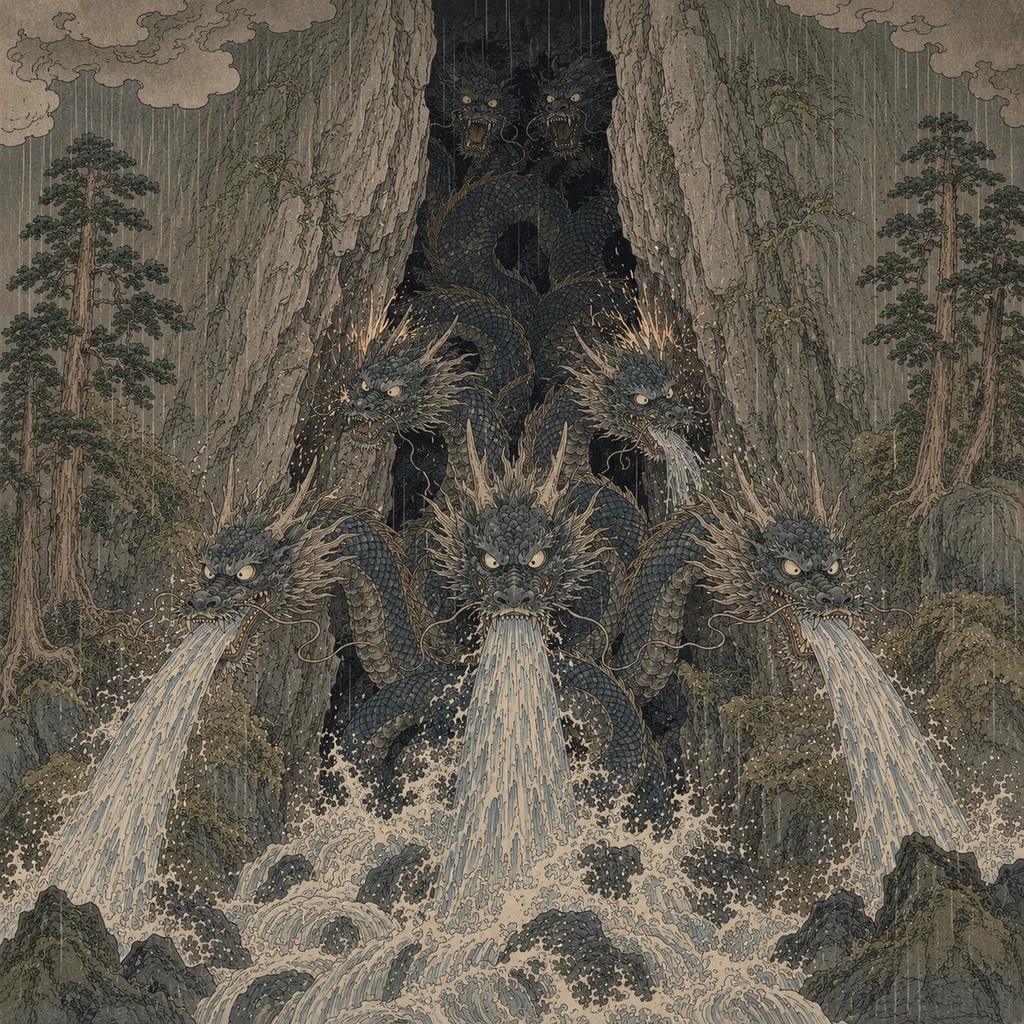
Kuzuryū, also written with the character for 'dragon' in an older form, is a nine-headed dragon worshipped as a water and rain deity and as a guardian of particular landscapes. Many traditions turn on the same transformation: a poisonous or violent dragon that once harmed people is subdued by an ascetic or eminent monk, abandons its demonic nature, and becomes a benevolent god. At Togakushi in Nagano, a nine-headed, dragon-tailed demon is said to have been sealed in a rock chamber through the merit of the Lotus Sutra by the ascetic Gakumon, also known as Gakumon Gyōja. It then settled as the local tutelary deity Kuzuryū Ōgami. At Hakone in Kanagawa, the monk Mangan is said to have subdued the poisonous dragon of Lake Ashi in the Nara period and enshrined it as the lake's guardian. In Echizen, Fukui, a Hakusan Gongen origin story tells of a nine-headed dragon swimming with a sacred image on its head, an episode said to explain the name of the Kuzuryū River. Rainmaking and flood control remain central, but regional worship also seeks relief from toothache, good relationships, and peace for the realm.
Read moreThe most frequently recounted origin is the legend associated with the Hakusan Gongen of Heisenji Temple. According to the *Echizen no Kuni Meiseki-ko*[7] relayed by the local national highway office, in June of the first year of Kanpyo (889), the Hakusan Gongen of Heisenji Temple manifested before the monks. When its sacred image was floated on the river, a dragon with one body and nine heads appeared, held the image aloft, and swam downstream to the opposite bank of the Kurotatsu Daimyojin Shrine. It is said that since then, this river has been named the Kuzuryu River. The power of raging waters transforms into a benevolent dragon in accordance with the Gongen of the sacred Mount Haku ── the river's name itself carries a narrative of water deity worship.
The theory of its origin is not singular. One theory states that around the time of Shohei (circa 931), when the Four Gods were placed at the four corners of the country for national protection, the north was assigned to the Kurotatsu Daimyojin in Echizen, and the river was called the "Kurotatsu River" because it flowed before its enshrined deity, the Kurotatsu King. Another toponymic theory notes that an illustrated map in the *Daijoin Jisha Zojiki*[7], written during the manor period, lists it as "Kuzure River," and since the *Taiheiki* refers to the Kurotatsu Myojin as "Kuzure Myojin," it is believed that "Kuzure" corrupted into "Kuzuryu." The depth of this river's name lies in the overlapping of mythological and phonological origins.
The deity Kurotatsu Daimyojin is enshrined at Keya Kurotatsu Shrine, situated at the foot of Mount Asuwa in Fukui City. According to shrine traditions, when Emperor Keitai[8] was in Echizen, he carried out extensive flood control on the three great rivers of Hino, Asuwa, and Kurotatsu to develop the Echizen Plain. For the protection of the Kurotatsu River (later the Kuzuryu River), which was the most violent river in the Hokuriku region, he is said to have enshrined the two deities governing water, Takaokami no Kami and Kuraokami no Kami, in Kurotatsu Village. Eventually, this Kurotatsu Daimyojin was revered as one of the Four Great Myojin of Japan guarding the nation since the dawn of heaven and earth ── Kashima of Hitachi in the east, Kumano of Kii in the south, Itsukushima of Aki in the west, and Kurotatsu of Echizen in the north. The name of the Kuzuryu River still bears the memories of such ancient flood control and the enshrinement of water deities today.
The worship of the Kuzuryu is not unique to Echizen. The narrative trope of a raging venomous dragon being subdued by a high priest or *shugenja* (ascetic) and transforming into a benevolent god has spread nationwide. In Togakushi, Shinshu, the *Asabasho Shoji Ryakki* from the mid-Kamakura period[9] recounts that the ascetic "Gakumon," who founded the site in the second year of Kasho (849), sealed a nine-headed, one-tailed demon in a rocky cave using the merit of the Lotus Sutra, turning it into a benevolent god; this became the local deity Kuzuryu Okami. In Hakone, Sagami, it is told that in the first year of Tenpyo-hoji (757), the holy monk Mangan subdued a nine-headed venomous dragon of Lake Ashi through 21 days of prayer, ending the practice of human sacrifice and enshrining it as the guardian deity of the lake. The Kuzuryu of Echizen is one of the most splendid examples of this "subjugation of venomous dragons and enshrinement of water deities" trope distributed nationwide. The framework of a raging dragon turning into a benevolent god through dharma can be said to be the product of combining the subjugation concepts of Shugendo and esoteric Buddhism with the water deity worship of agrarian societies that revere water as a blessing while fearing it.
What cannot be overlooked here is Heisenji Temple (currently in Katsuyama City), which appears in the origin of the Kuzuryu River's name. When Taicho, born in Asouzu, Echizen, opened Mount Haku in the first year of Yoro (717)[10], the Kuzuryu King emerged from Midorigaike Pond at the summit, and it is said to have been the incarnation of Izanami no Mikoto, the Hakusan Myori Daibosatsu. The dragon with nine heads stands here again at the boundary of water and the sacred mountain ── it is no coincidence that the legend of Hakusan Gongen that gave rise to the Kuzuryu River's name and the manifestation of the Kuzuryu King at the opening of Mount Haku share the same iconography. Heisenji, the base of Hakusan worship opened by Taicho in that same year, flourished as the Echizen-side starting point of the *zenjodo* (meditative path) climbing Mount Haku from the three *banba* of Echizen, Kaga, and Mino. In the Middle Ages, it grew into a massive religious city boasting thousands of monks' quarters and eight thousand warrior monks. However, in the second year of Tensho (1574), the entire mountain burned down during battles with the Echizen Ikko-ikki. The current former precincts, with their moss-covered stone pavements and foundation stones, are a national historic site conveying memories of that glory and ruin to the present day, serving as yet another nexus in Fukui's folklore of the strange.
The Ocean Cliff and the Rough Monk ── The Monk Named Tojinbo
On the coast of Mikuni in Sakai City lie the cliffs of Tojinbo, battered by the rough waves of the Sea of Japan. Approximately 25 meters high, this landscape woven by columnar joints of pyroxene andesite is a geological marvel said to exist in only three places in the world. Yet, the name of this famous site is told to originate not from its topography, but from the name of a single monk.
There was a monk named Tojinbo at Heisenji Temple. He was a rough monk who repeatedly acted violently, relying on his great strength, and it is also said that he vied with a monk named Magara Kakunen over the love of a beautiful woman named Ayame[11]. The monks of Heisenji, who did not think well of him, lured Tojinbo to this cliff for a scenic viewing and held a banquet on April 5th of the first year of Juei (1182). When he fell asleep drunk, Kakunen pushed him off the cliff into the sea. Since then, the sea became rough around the time of Tojinbo's death anniversary, and it was feared as his vengeful spirit. According to legend, Kakunen, who pushed him, was also dragged into the cliff, the sky suddenly clouded over, the earth violently shook, and thunder and torrential rain did not cease for 49 days. It is handed down that a poem of consolation was offered in later years to calm the raging sea.
Incidentally, a place called the "Ruins of Tojinbo's Residence" still remains in the former precincts of Heisenji Temple in Katsuyama City, passed down alongside tales of a well said to have been stained with blood. It is fascinating that Heisenji, which gave the Kuzuryu River its name, and the cliff that bears the name of Tojinbo are connected, sharing the same ancient temple as a nexus. Memories of Fukui's water's edge often trace back to this temple.
Off the coast of Tojinbo floats Oshima Island, and on the opposite shore is Antou (currently Mikunicho, Sakai City), which has long been a village of *ama* divers. On Oshima stands Ominato Shrine, said to be the general guardian of Echizen Province, and many of Antou's folktales revolve around this island and the sea. And among these *ama* divers, another aquatic apparition is handed down.
Another Person Before the Ama Diver ── Tomokadzuki and the Sea of Wakasa
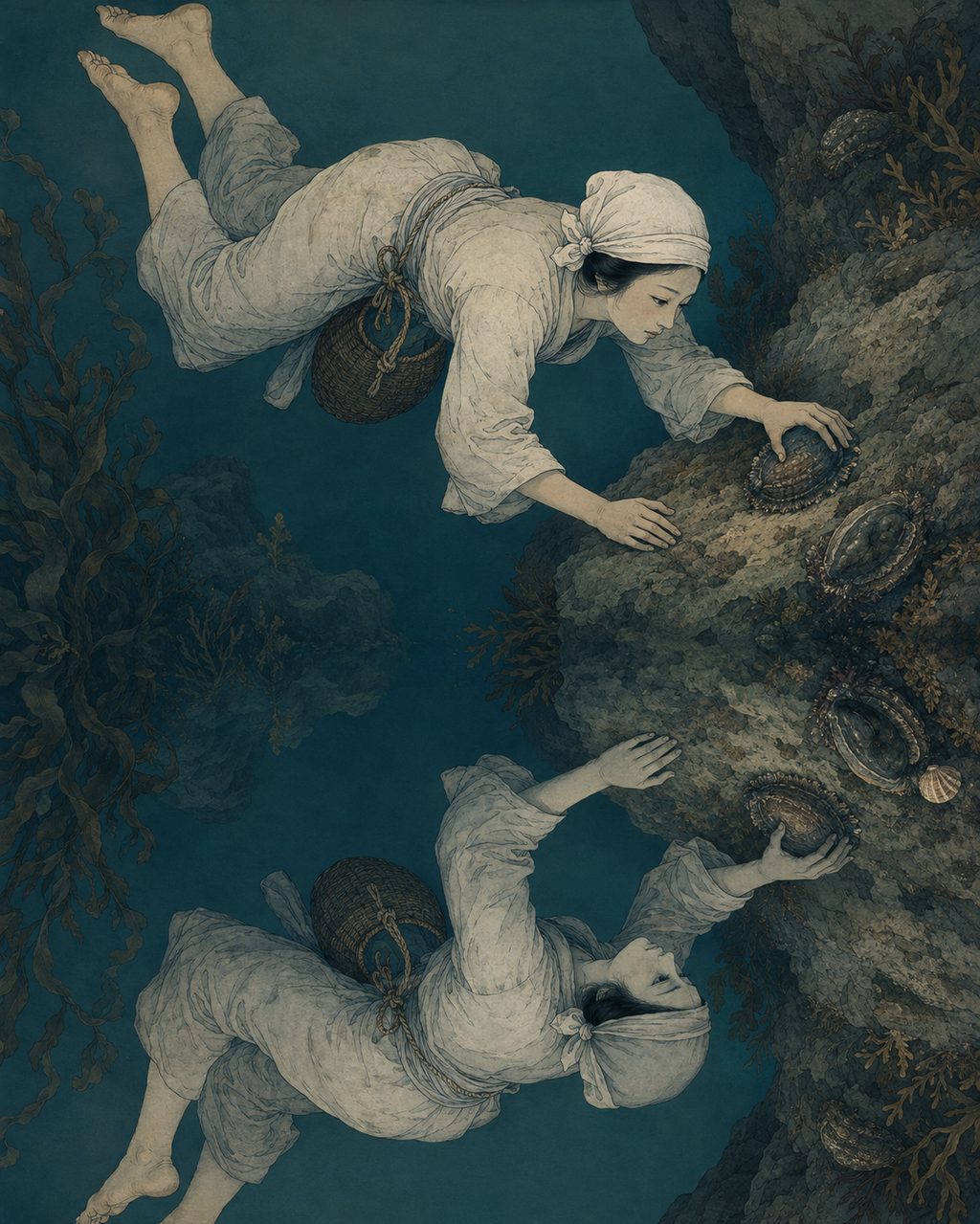
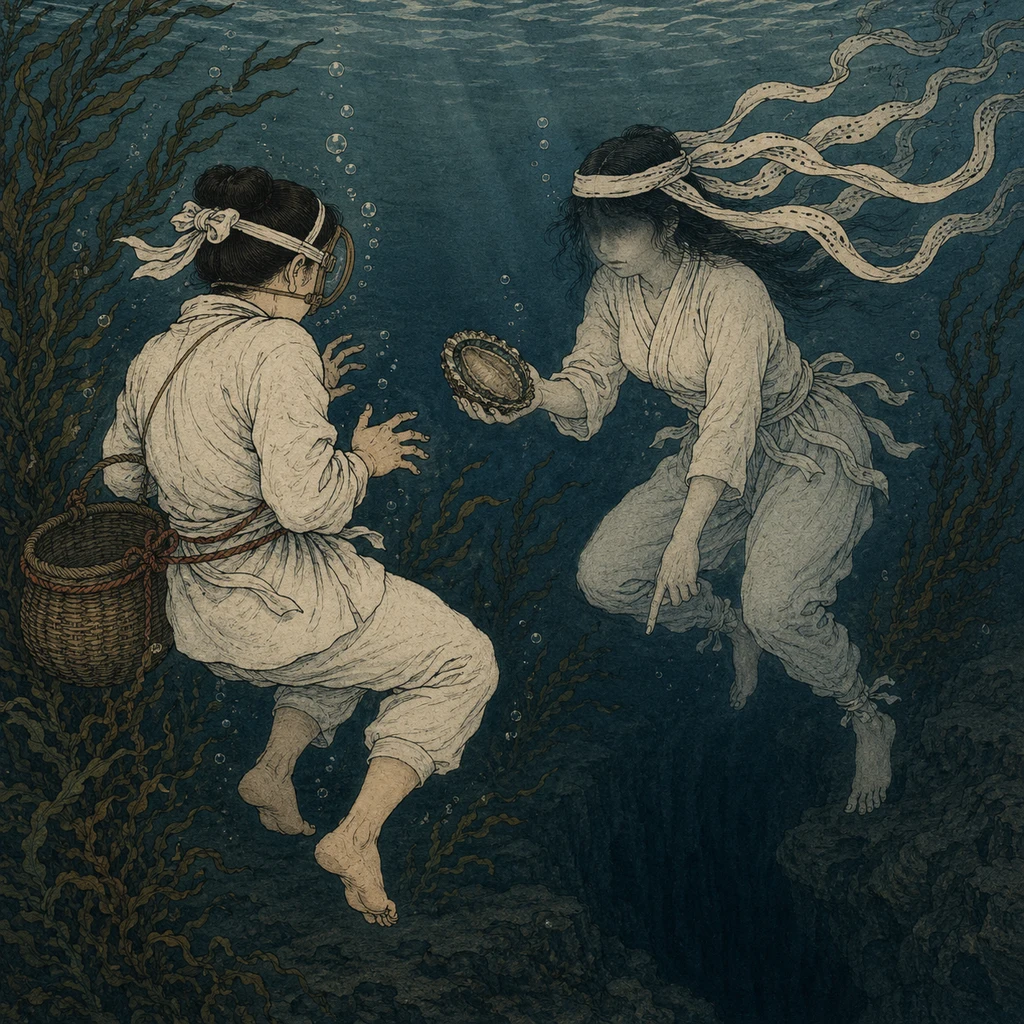
Before someone diving into the sea, an entity looking exactly like themselves appears. This is the Tomokadzuki.
Tomokadzuki
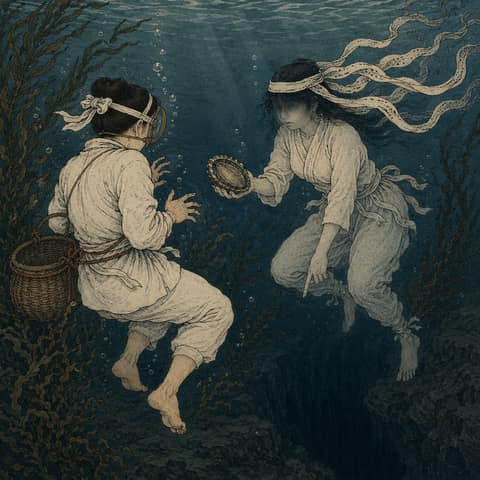
Tomokadzuki is a sea apparition from the coast of Shima that appears in exactly the same form as the person diving below. Encounters are said to be most common under an overcast sky. The telltale difference is the unnaturally long end of the double's headcloth. It may hold out an abalone or beckon the diver toward darker water, and accepting the invitation is feared to end in death. Ama divers wore towels and garments marked with a pentagram and lattice design as protection. No single explanation of the apparition is known; alongside stories of a sea ghost, people have also described it as a vision brought on by exhaustion and prolonged work in the water.
Read moreTomokadzuki is well known as an apparition handed down among the *ama* divers of Shima (Mie Prefecture), but similar examples exist in the seas of Fukui. In the sea of Antou, Oshima Village, Sakai District (currently Sakai City)[12], this apparition wearing a backward headband was called "Umi Ama" (Sea Ama). When the diver dives to the ocean floor, another version of herself rises to the sea surface, and conversely, when the diver surfaces, the other dives. Because they are always swapping top and bottom, its figure cannot be seen clearly. It is said that it never appears when working in large groups, only showing itself to someone diving entirely alone. It was also told that sighting it would bring about illness.
In Shima folklore, Tomokadzuki offers abalone or lures divers into the darkness, and it was feared that responding to this invitation would result in losing one's life. As a charm against evil, the *ama* divers wore towels dyed with a pentagram and a lattice (Seiman-Doman)[12]. It is said that the pentagram, which can be drawn with a single stroke, signified "returning to the original place = returning safely," while the grid pattern meant "evil spirits get tangled and cannot enter." Its true identity is unknown, and some say it might be a hallucination seen by those diving long in the sea amidst hypoxia and solitude. The fact that it only appears during solitary work bolsters this interpretation. The Umi Ama of Antou, too, stands only before solitary divers—perhaps another self born of the sea's solitude. That an almost identical "other self" appears in the distantly separated *ama* culture spheres of Shima and Wakasa, the Sea of Japan and the Pacific Ocean, reveals a universal apparition of the sea people born from the shared extreme experience of free-diving.
The four apparitions discussed so far all feature those who stand at Fukui's water's edge as their subject. Let us list them here.
Miketsukuni,
Wakasa ── The Water Vein Connecting the Sea and the Capital
Why did such dense legends of mermaids and immortality develop in the sea of Wakasa? In the background lies the history of this region being deeply connected to the capital since ancient times. Wakasa Bay is a ria coast sheltering numerous deep inlets against the rough open sea, where complex tide lines intertwine; it was a topography that made people feel the bottomlessness of the sea itself alongside the abundance of seafood. The bounty of the sea and the fear of the sea meeting at the same shoreline ── this geography became the fertile ground for cultivating tales of grotesque creatures coming from the ocean.
Wakasa, alongside Shima and Awaji, was one of the *Miketsukuni*[13] that offered tributes of food to the Imperial Court. Seafood nurtured by the high-quality ria coast of Wakasa Bay was salted and transported to the capital along with salt. This fact is corroborated by numerous wooden slips excavated from the ruins of Heijo-kyo. The routes transporting marine products to the capital eventually came to be called the "Saba Kaido" (Mackerel Road). Among them, the most frequently used was the Wakasa Highway, spanning 18 *ri* (about 70 kilometers) from Obama through Kumagawa-juku and Kutsuki to Demachi (Demachiyanagi) in Kyoto; it is said that mackerel caught in Wakasa was lightly salted, carried on the back, and walked overnight to reach Kyoto just as it became perfectly ready to eat. This traffic connecting the sea and the capital was recognized as a Japan Heritage site in 2015 under the title "Wakasa's Traffic Culture Heritage Group Connecting the Sea and the Capital ── Miketsukuni Wakasa and the Saba Kaido." Precisely because it was a prosperous fishing village where the bounty of the sea gathered, the memories of the anomalies from the sea ── mermaids ── also accumulated densely.
The connection to the capital also remains as a water vein of faith. At Jinguji Temple in Obama, the Shinto ritual of Omizuokuri[14] (Water Sending) is held every year on March 2. Led by *yamabushi* (mountain ascetics) and monks in white robes, a procession of some three thousand torches heads two kilometers upstream to Unose accompanied by the sound of conch shells. After a *goma* fire is lit on the riverbank, the chief priest pours fragrant water from a bamboo tube into the Onyu River. This water is said to flow through an underground water vein over ten days and gush forth into the Wakasai well at Nigatsudo in Nara's Todaiji Temple on March 12. Todaiji's "Omizutori" (Shunie ritual) is performed waiting for this water from Wakasa. According to the *Nigatsudo Engi Emaki*[15], when Jitchu, who initiated the Shunie, read out the names of the gods nationwide, only the Onyu Myojin of Wakasa was out fishing and arrived late; in apology, the deity promised to send fragrant water to Nigatsudo. The ground then split, and two cormorants, one white and one black, flew out, and clear water sprang from the spot ── this is said to be the Wakasai well. The pair of white and black ── this also brings to mind the pair of Hakusan Gongen and Kurotatsu Daimyojin appearing in the origin of the Kuzuryu River. The waters of Wakasa do not merely flow; they were a sacred pulse reaching all the way to the prayers of the capital.
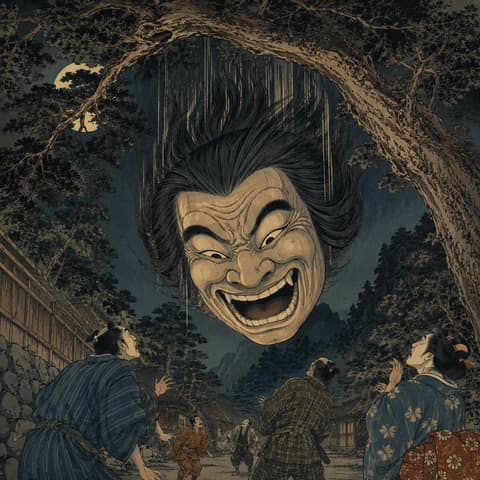
The apparitions at the water's edge are by no means limited to these "four representatives." Throughout Echizen and Wakasa, yokai common across the archipelago have also been handed down, such as monsters swelling like mountains on night roads to block one's path, the Kasha that snatches the dead from funeral processions, and the Kappa (Kawataro) of the riverbanks. In recent years within Fukui Prefecture, initiatives have progressed to unearth local apparitions from ancient documents and introduce them alongside Echizen *washi* paper and Echizen lacquerware, shedding new light on strange tales that had slumbered in the land. Yet, it is still water that forms the backbone of Fukui's yokai culture. The immortal flesh coming from the sea, the benevolent dragon descending the river, the spiritual water traveling underground to Nara, and the other self standing before the *ama* diver ── the yokai of Fukui are unfailingly recounted through the medium of water. Standing on the shores of Wakasa Bay and watching the flow of the Kuzuryu River, one can see that this land was "a place where the contours of time and self melt at the water's edge." Yao Bikuni living for eight hundred years, the nine-headed dragon becoming a river's name, and the *ama* diver encountering another self ── they are all different manifestations of the same single dream of Fukui, a land deeply embraced by water.