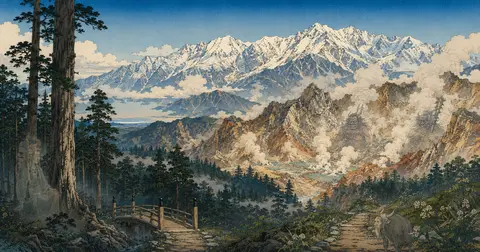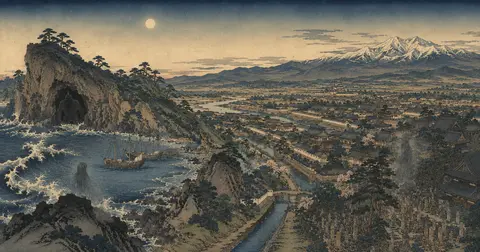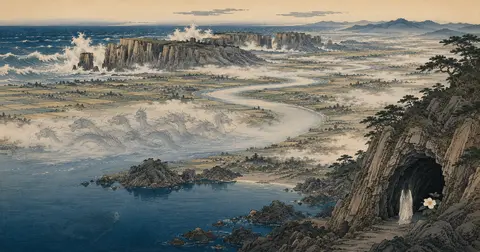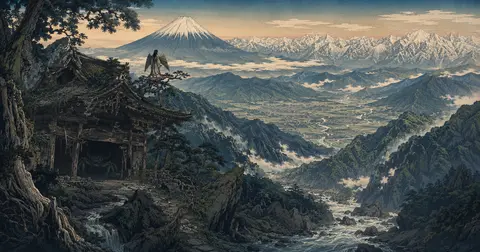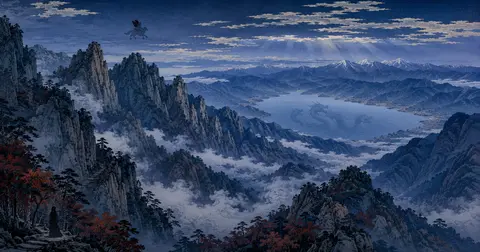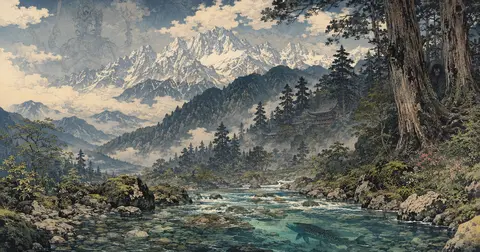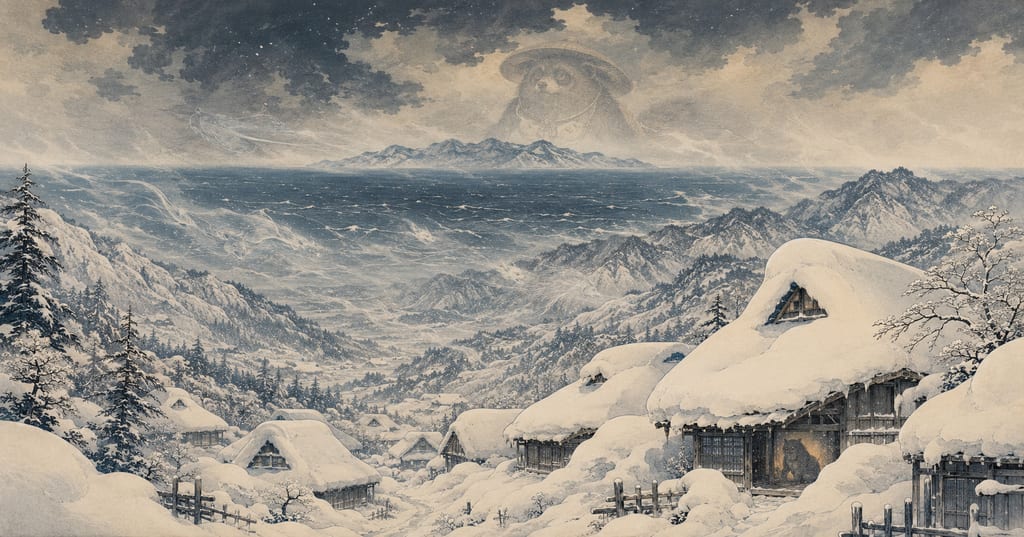
Niigata Prefecture, stretching long along the Sea of Japan, holds two contrasting landscapes within its borders. One is the mountain villages of Echigo, buried in some of Honshu's heaviest snows. The other is Sado, an island of gold and exile floating across the sea. The region's yokai culture directly mirrors this geographical duality.
In Echigo, the snow and wind themselves gave birth to strange phenomena. Blizzards that steal away vision, whirlwinds crossing the valleys, and the long winter nights passed in houses buried under snow ── it is here that the kamaitachi, yuki-warashi, and strange beasts of the mountains make their appearance. Bokushi Suzuki's *Hokuetsu Seppu* (1837)[1], a meticulous record of life in snow country, is also a treasure trove of these mysterious tales. Sado, on the other hand, nurtured a unique ecology and folklore due to its separation from the mainland. This fox-less island is ruled by the great tanuki Danzaburo, counted among Japan's three most famous tanuki. The people and wealth drawn to the Sado gold mines, along with the island's shadow history as a place of exile for capital nobles, have seeped into the tales of seaside apparitions.
This encyclopedia traces the yokai passed down in this prefecture across three chapters: "Apparitions of Snow Country," "Demons and Watersides of Echigo," and "Sado ── The Kingdom of Tanuki and Isle of Exiles." Spirits born of snow, a tanuki kingdom across the sea, and an island for those banished from the capital ── these three facets form the backbone of Niigata's yokai culture.
Apparitions of Snow Country ── Kamaitachi,
Yuki-warashi,
Ijuu,
and *Hokuetsu Seppu*
When speaking of the yokai of Echigo, snow is indispensable. In the mountain villages of Uonuma and Kubiki, locked in snow for half the year, the snow and wind themselves became the womb for the supernatural. At the center of these records is *Hokuetsu Seppu* by Bokushi Suzuki[1], a crepe fabric merchant in Shiozawa (modern-day Minamiuonuma City). Wishing to convey the realities of snow country to the world, Suzuki consulted Edo literati like Kyoden Santo regarding its publication, yet faced multiple setbacks, taking a full 40 years from conception to complete this essay. Finally, with the help of Bakin Takizawa's pupil Kyozan, the first three volumes were published in 1837 by the Chojiya Bun'endo in Edo, later expanding to a total of seven volumes with the addition of a four-volume second part. Meticulously detailing everything from sketches of snow crystals to snow clearing, avalanches, local dialects, the crepe weaving industry, and the strange tales passed down in the region, the book became a contemporary bestseller. It conveyed the realities of a snow-bound life unimaginable to those in snowless lands. The book's unparalleled value lies not in serving as a collection of curious local tales meant for idle curiosity, but in being written from within the lived experience of coexisting with the snow.
The foremost of these snow-country apparitions is the kamaitachi, which rides the whirlwind to slash people.
Kama-itachi
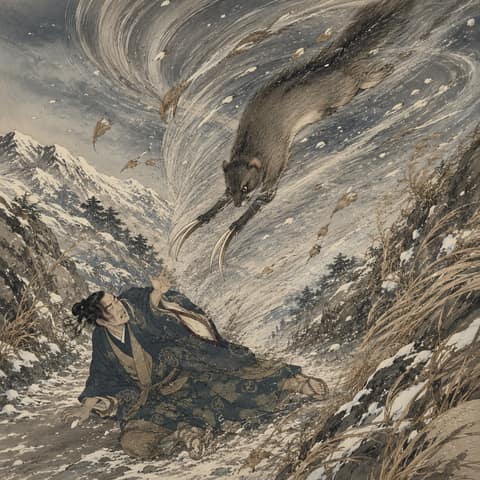
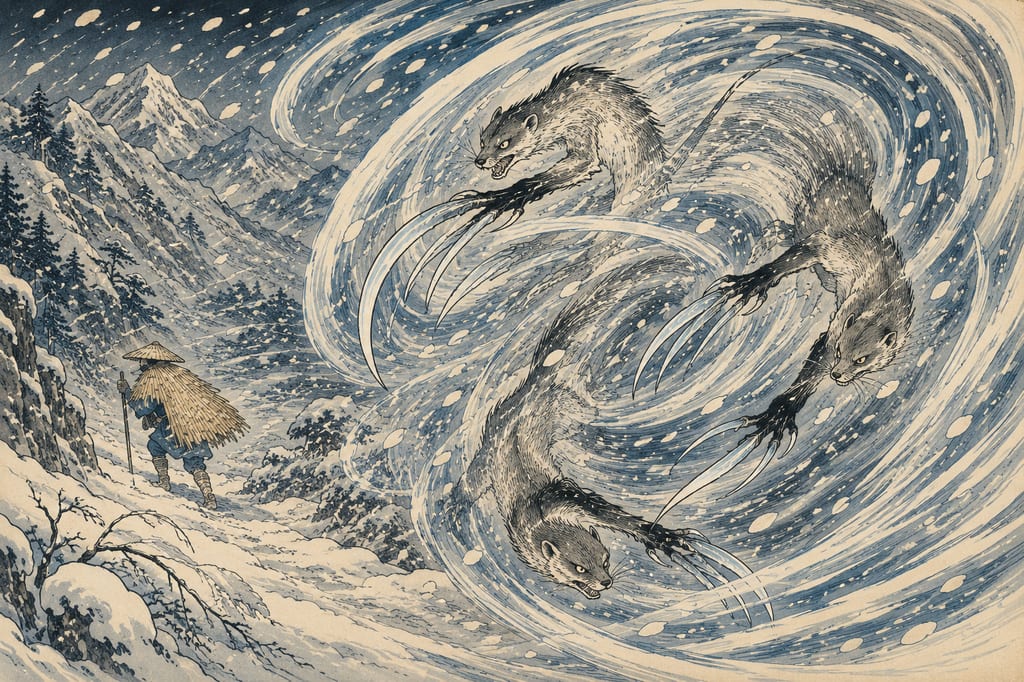
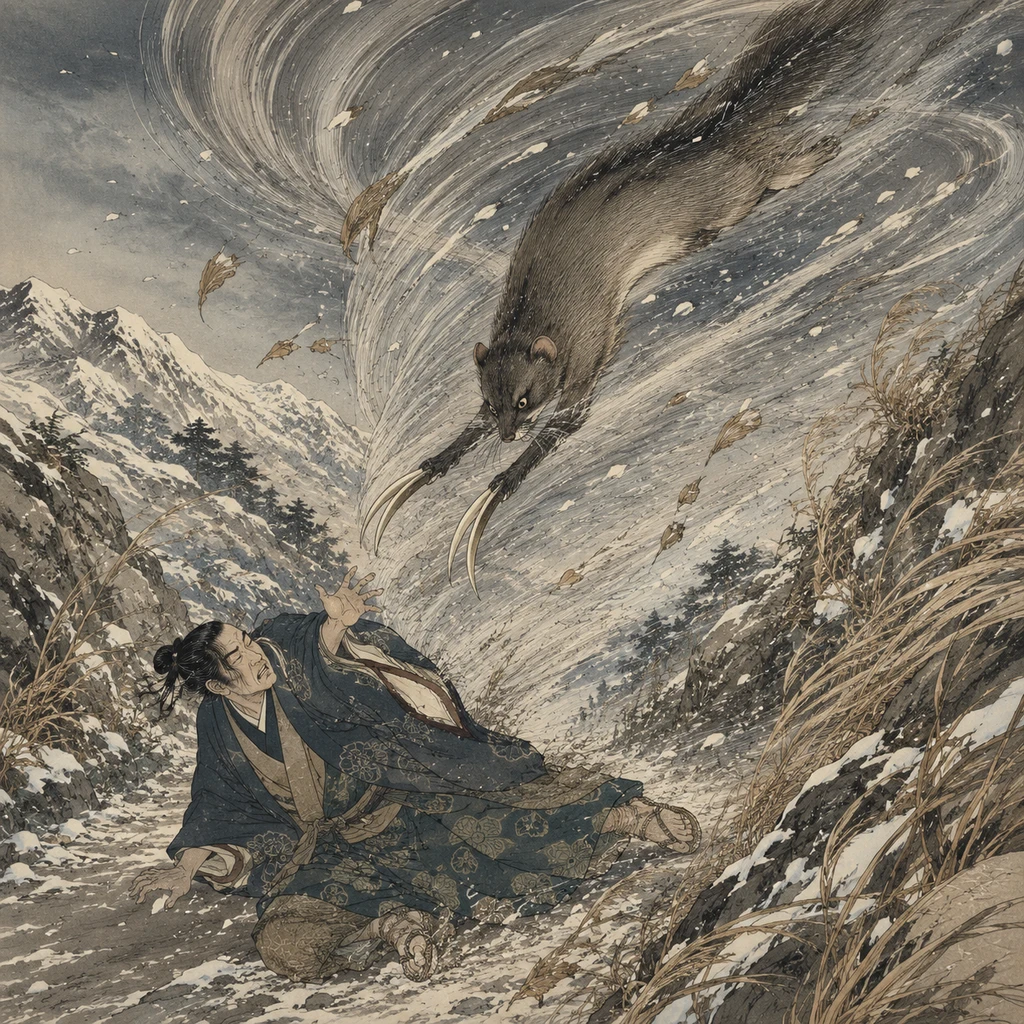
Kama-itachi are yokai said to ride dust devils or sudden whirlwinds, slicing human skin as if by a blade. Victims often feel little pain at first and may not bleed until later. From the Edo period on, they’re depicted as weasels with sickle-like claws, though explanations vary by region—some attribute the cuts to the phenomenon itself, to wind deities, or to minor spirits. The term is also a classical winter seasonal word.
Read moreThe kamaitachi appears in the center of a whirlwind, slicing human skin as if swept by a blade. It was passed down primarily in the deep snow regions of Shin'etsu, Hokuriku, and Tohoku. A distinct characteristic of this monster is that immediately after being cut, there is little pain or blood. Similar interpretations remain across various regions, but in Hida, it was said that three gods appear together: the first trips the person, the second slashes with a blade, and the third applies medicine, resulting in neither pain nor blood[2]. From the Edo period onward, it was depicted as a weasel with sickle-like claws, and Sekien Toriyama[3] applied the reading "kamaitachi" to the name of the Chinese monster "Qiongqi."
In the Shin'etsu region, this apparition was considered the deed of an evil god, and stepping on a calendar was warned to bring the kamaitachi's curse. In Tohoku, it is also passed down that applying the charred remains of an old calendar to the wound will cure it. Similar names and interpretations exist nationwide, such as the nogama of Kochi, the kamakaze of Kanagawa, and the kazekama of western Japan. While it is generally considered invisible, in Echigo and other snow countries, the sharpness of the crosswinds blowing across the snowy surface made the image of this monster exceptionally vivid.
The "vacuum theory" often cited as the true identity of the kamaitachi ── explaining that skin tears due to low pressure generated at the center of a whirlwind ── is a modern hypothesis proposed after the Meiji era. Though introduced by the pioneering yokai researcher Enryo Inoue, physicist Torahiko Terada rejected it in his essay "The Evolution of Monsters," proposing instead that it was a laceration caused by high-speed collisions of flying debris in strong winds. Today, the vacuum theory is considered a popular myth, and the kamaitachi is understood purely as a folk belief surrounding a wind apparition. Often used as a winter kigo (seasonal word in poetry), this monster arose directly from the tangible reality of life in snow country, standing as a representative nature yokai of Echigo.
Snow gives birth to more than just monsters of the blade. A fleeting child spirit that visits on a snowy night and vanishes with the spring also came to the snows of Echigo.
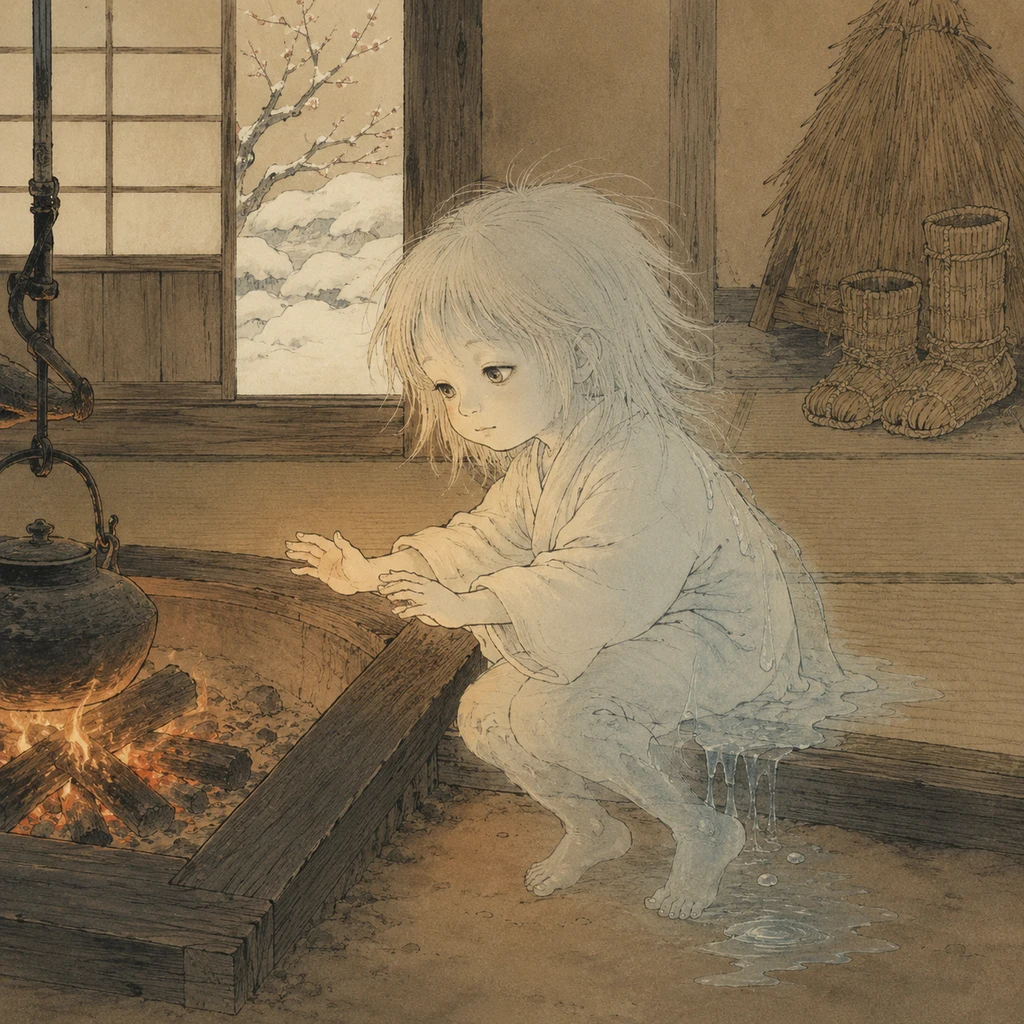
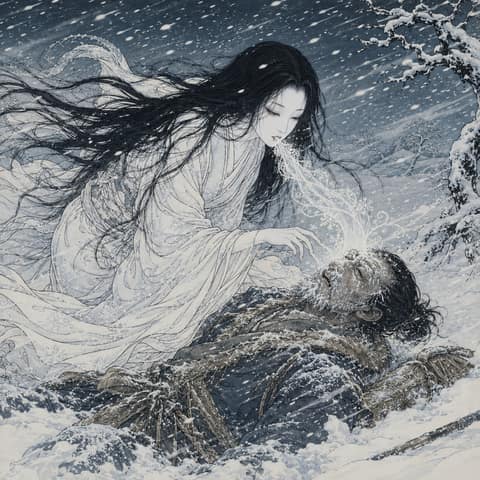
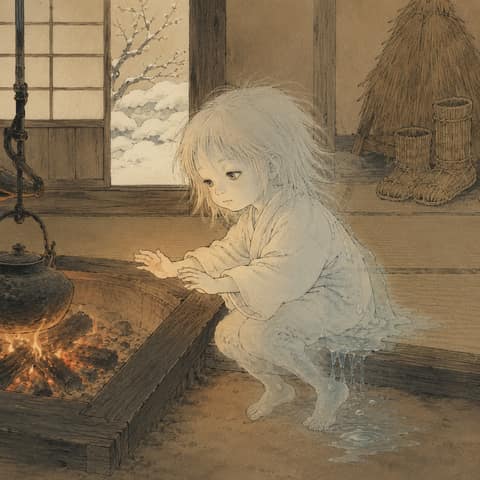
The yuki-warashi (snow child) is a snow spirit in the form of a child that appears with heavy snowfall or blizzards. In Echigo, there is an old tale of a childless elderly couple who made a snow doll on a snowy day. On a stormy night, a child visited them; they raised the child as their own, but when spring came, the child vanished. After that, it is said the child would appear every winter and disappear in the spring, until returning no more after several years. This child is interpreted as a spirit residing within the snow doll, appearing to comfort the old couple. Some regions associate it as a minion or child of the yuki-onna, but it lacks the extensive documentary backing of the yuki-onna and exists primarily as oral variants. It is a spirit of solace, embodying the ephemerality of snow in human form.
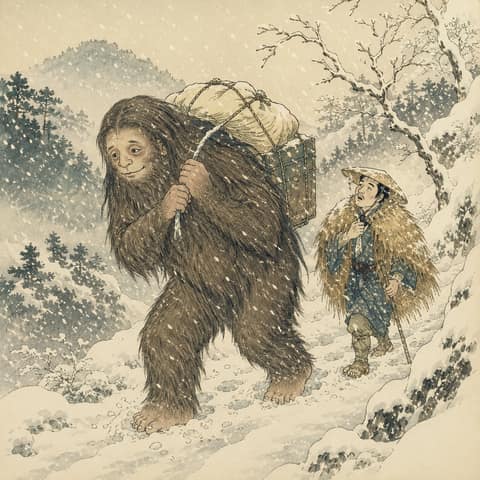
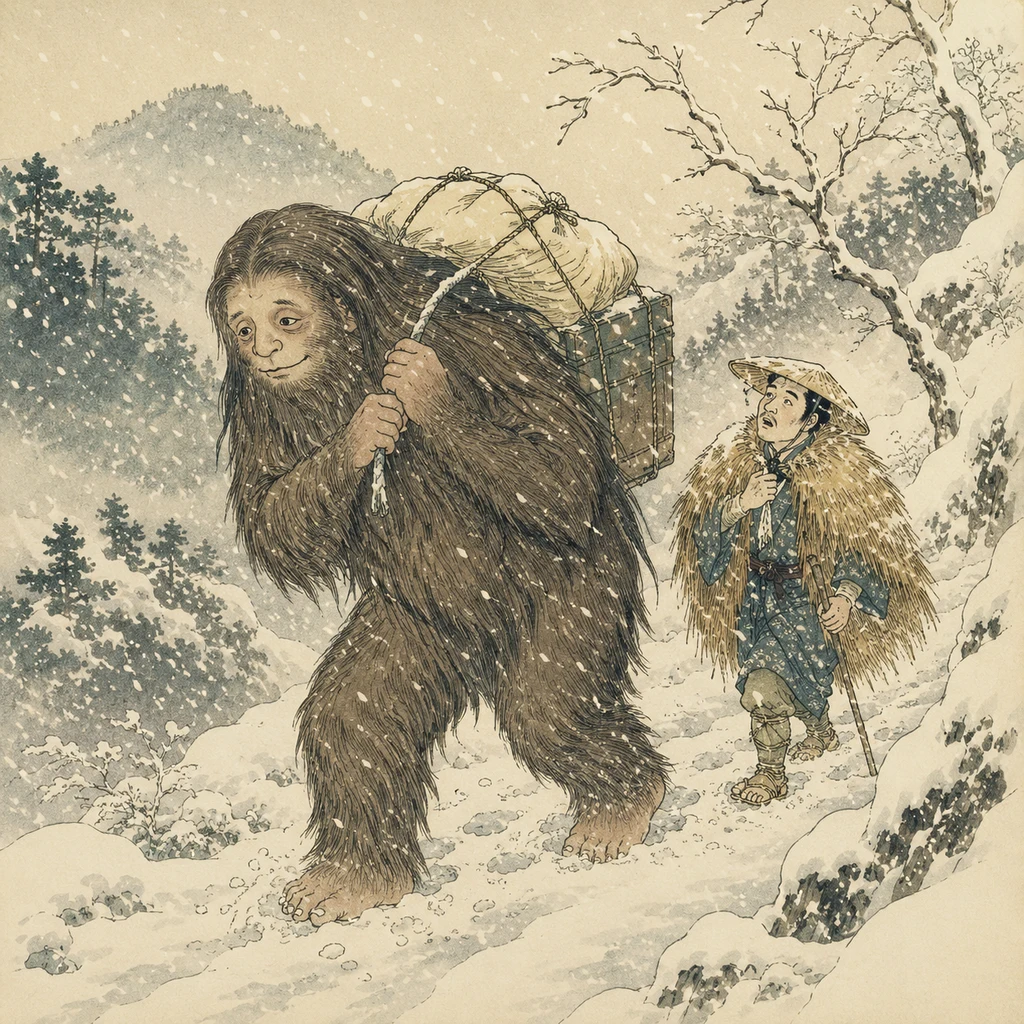
There is another unforgettable record in the mountains of snow country: the ijuu (strange beast). Volume Four of the Second Part of *Hokuetsu Seppu*[1] describes a strange beast appearing in the mountains of Uonuma District, Echigo Province, as "resembling a monkey but not a monkey." Its hair was long, hanging down its back, and its stature was larger than a human's. When a man named Takesuke, working for a wholesaler, was resting in the mountains, this strange beast appeared begging for food. After Takesuke shared his rice, the beast took up his heavy load, guided him on the path, and left the load near the village of Ikeya before vanishing into the mountains. It also frequently appeared at the home of a weaver girl in Ikeya, begging for rice balls. When the girl was struggling with a sudden rush order, the beast appeared; thereafter, her loom ceased malfunctioning, and she was able to complete her work safely.
Rather than harming people, it begs for food and sometimes assists human labor ── it is a strangely warm beast that aligns itself with the mountain labor and weaving communities of snow country. Uonuma was the heartland of Echigo crepe, and weaving was the livelihood by which women survived the snowy winters. That this beast was frequently spoken of in the oral traditions of this weaving region reflects a worldview where interaction between humans and the mountains was a daily occurrence in snow country. The true identity of the ijuu remains unrevealed, considered either a mountain spirit or a rare type of animal. To modern eyes, it reads somewhat like an unidentified primate, but Suzuki Bokushi recorded it plainly not as a monster, but as one of the mysteries held by the snow-covered mountains. The emergence of tales about a "helpful mountain beast" in Echigo, where the snow confines and tests people, deeply reflects the psychology of snow country.
Demons and Watersides of Echigo ── Ibaraki-doji,
Nure-onna,
Azuki-arai,
and Kiri-ichibee
Alongside the snow, demons and waterside apparitions color Echigo's yokai lore. Echigo, in particular, holds memories as the "birthplace of demons" connected to the Shuten-doji legends of Mount Oe. The prime example is Ibaraki-doji, said to be Shuten-doji's right hand.
Ibaraki-dōji
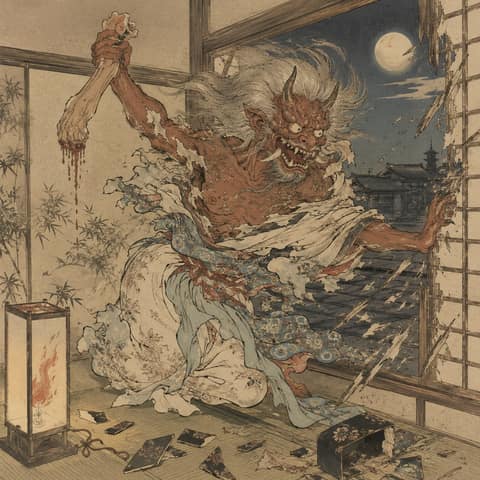
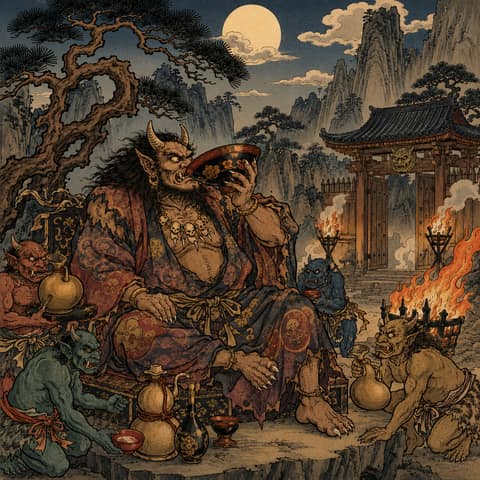
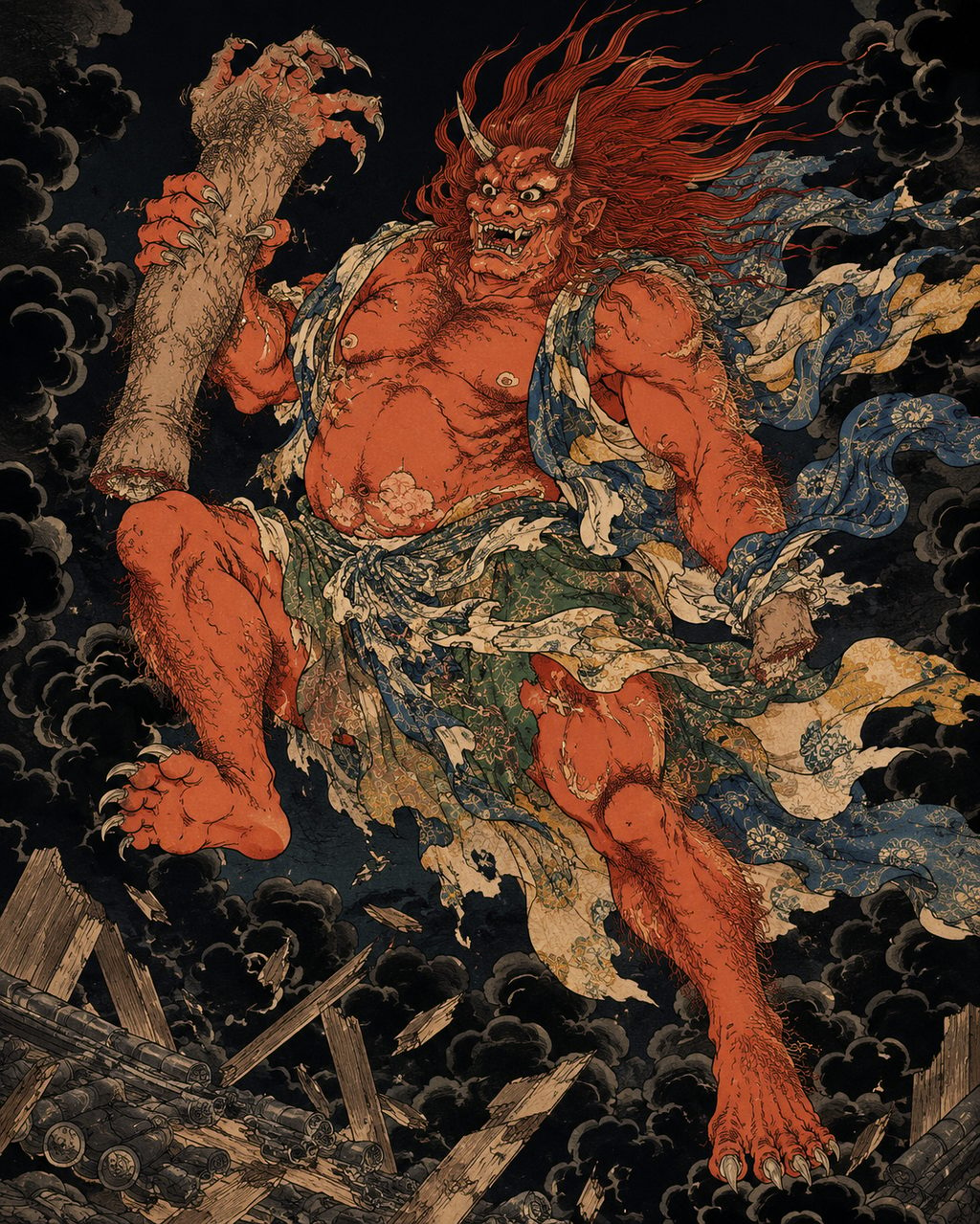
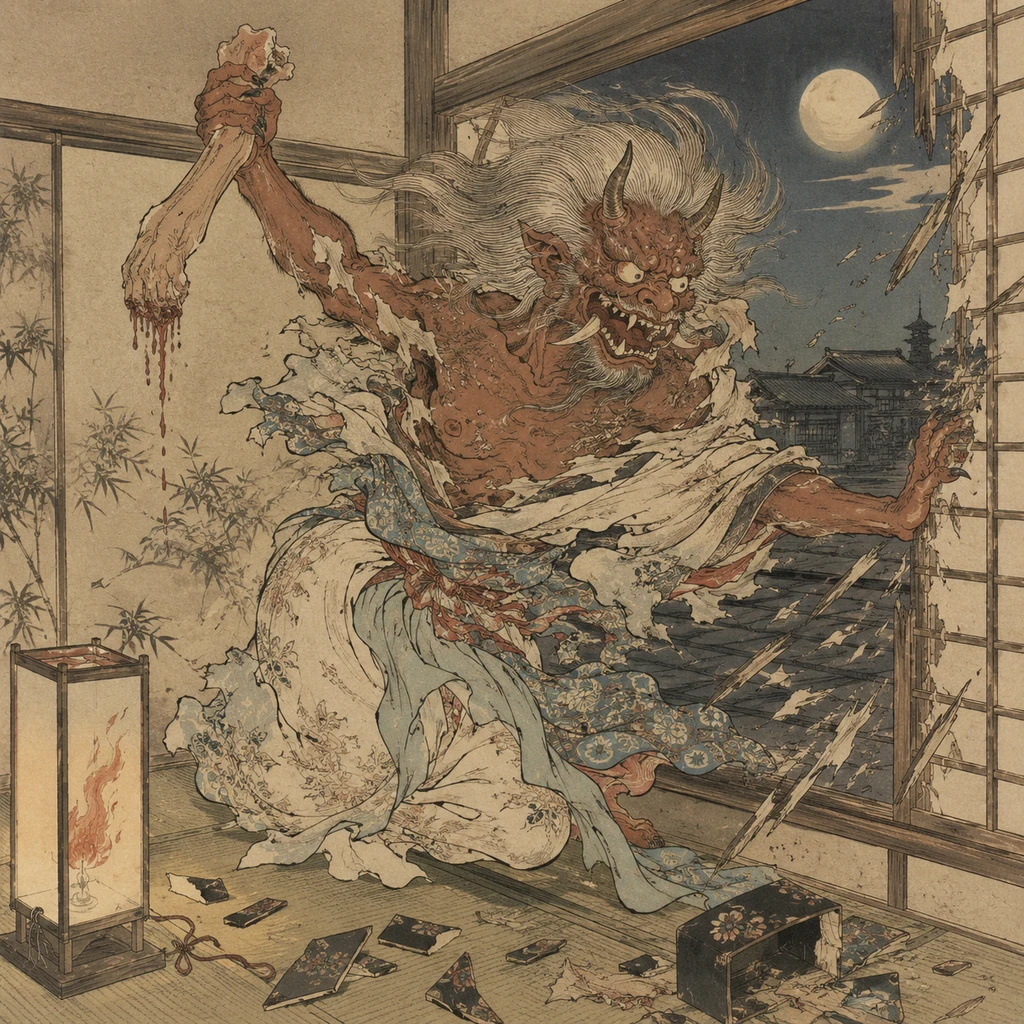
A demon (oni) of the Heian period, famed as the right-hand of Shuten-dōji. Accounts place Ibaraki-dōji’s birth either in Settsu (Tomatsu/Ibaraki) or Echigo (Koshi District, Karuizawa). From childhood the figure showed an uncanny appearance and prodigious strength. Joining the bandits of Mount Ōe, Ibaraki-dōji helped terrorize the capital until Minamoto no Yorimitsu (Raikō) and his retainers crushed the gang, whereupon Ibaraki narrowly escaped. Later, the warrior Watanabe no Tsuna cut off the demon’s arm; in later tales, the demon disguises itself and steals the arm back—episodes retold across medieval setsuwa, Noh, and Kabuki.
Read moreIbaraki-doji is a demon passed down as Shuten-doji's trusted confidant and second-in-command among the bandits of Mount Oe. There are two theories regarding its birthplace: Settsu Province (Tomatsu/Ibaraki villages) and Echigo Province. The Echigo tradition claims it was born in Karuizawa, Koshi District (modern-day Karuizawa, Nagaoka City), and entrusted to Yahiko Shrine as a child[4]. This contrasts with the Settsu origin theory of Shuten-doji, who is said to have been born in Sunagozuka, Kanbara District (modern-day Tsubame City), and served as an acolyte at Kokujo-ji Temple. Within Niigata Prefecture, there are places said to be where the two wrestled, and even a small shrine dedicated to Ibaraki-doji remains. However, these are largely localized embellishments from the early modern period onward, and the historical layer and folkloric layer must be examined carefully.
This demon is most famous for the tale of having its arm severed by Tsuna Watanabe in Kyoto. In the "Tsurugi-no-maki" (Sword Chapter) of the *Tale of the Heike*[5], when Tsuna Watanabe puts a beautiful woman he met at Modori-bashi Bridge on his horse, she transforms into a demon, grabs his topknot, and tries to snatch him away to Mount Atago. Tsuna slices off the demon's arm with the famed sword Higekiri (which was thereafter called Onikiri). Tsuna brings the arm back and undergoes ritual purification, but when he invites in his visiting aunt (foster mother), her true identity is the demon; she snatches back her arm and flies away. The "Tsurugi-no-maki" itself does not specify the demon's name; identifying this demon as Ibaraki-doji is a later addition. The topography *Setsuyo Gundan*[6] records the Settsu birth tale, stating that remnant place names remain around Amagasaki and Ibaraki. Widely performed in the Noh play *Rashomon*, as well as in Kabuki and Joruri, it continues to be spoken of today as a demon bearing two hometowns: Echigo and Settsu.
The watersides of Echigo also nurtured their own unique apparitions. A female monster standing by the shore, and an apparition that echoes only as a sound by the river ── two waterside yokai of differing natures are passed down here.
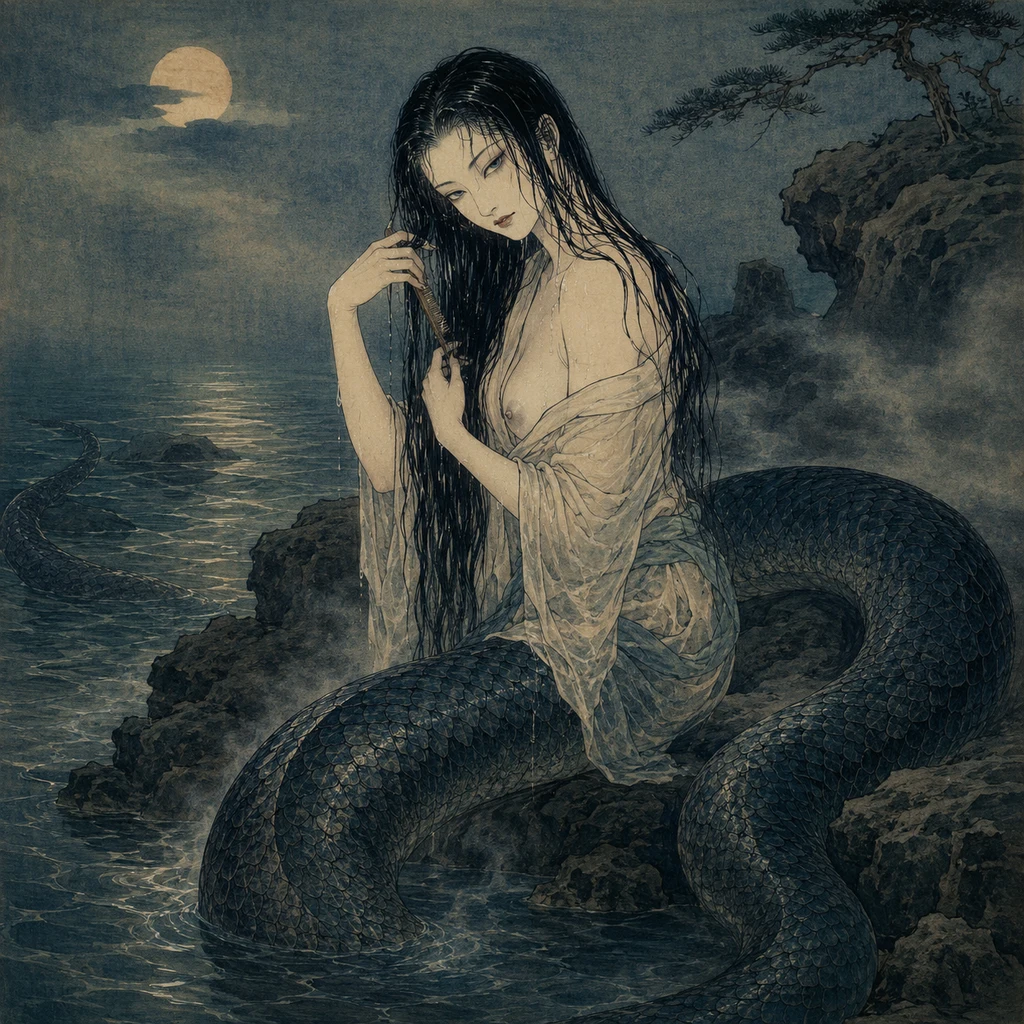
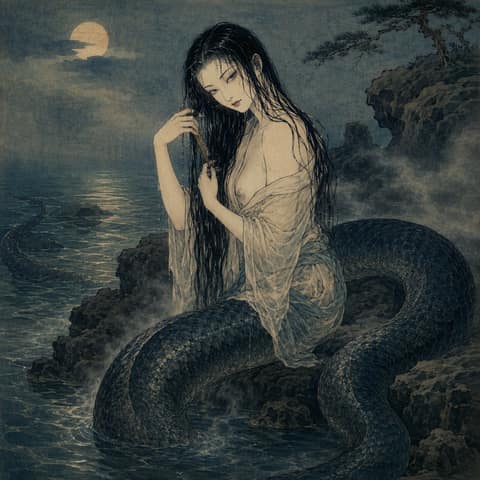
The nure-onna (wet woman) is a monster with a serpent's body and a woman's head that appears by the sea or river. From the waist down, it is a massive serpentine body covered in scales, always letting down long, perpetually wet black hair. Sekien Toriyama's *Gazu Hyakki Yagyo* (The Illustrated Night Parade of a Hundred Demons)[7] depicted it in the "Wind" volume as a serpent body with a woman's face dipping its long hair into the water, solidifying the nure-onna image from the picture scroll lineage. Its connection to Echigo lies in Morihiko Fujisawa's *Yokai Gadan Zenshu Nihon-hen*, which lists the nure-onna as a tale from Echigo Province during the Bunkyu era (1861-1864). However, the primary source is not specified, suggesting that its image was formalized during the process of modern yokai research compiling fragments from various regions. It belongs to a typology of waterside female monsters, sharing a narrative pattern with the iso-onna and nure-onago of the western Japanese coasts.
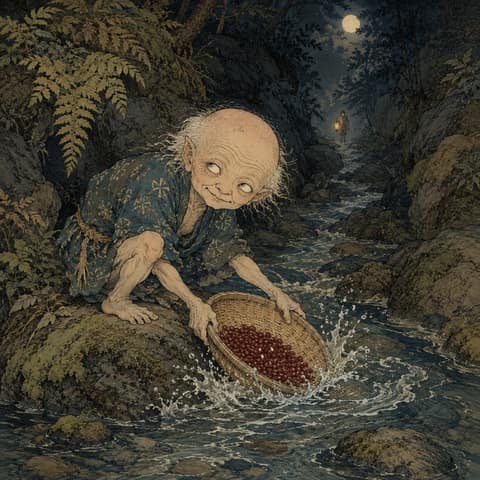
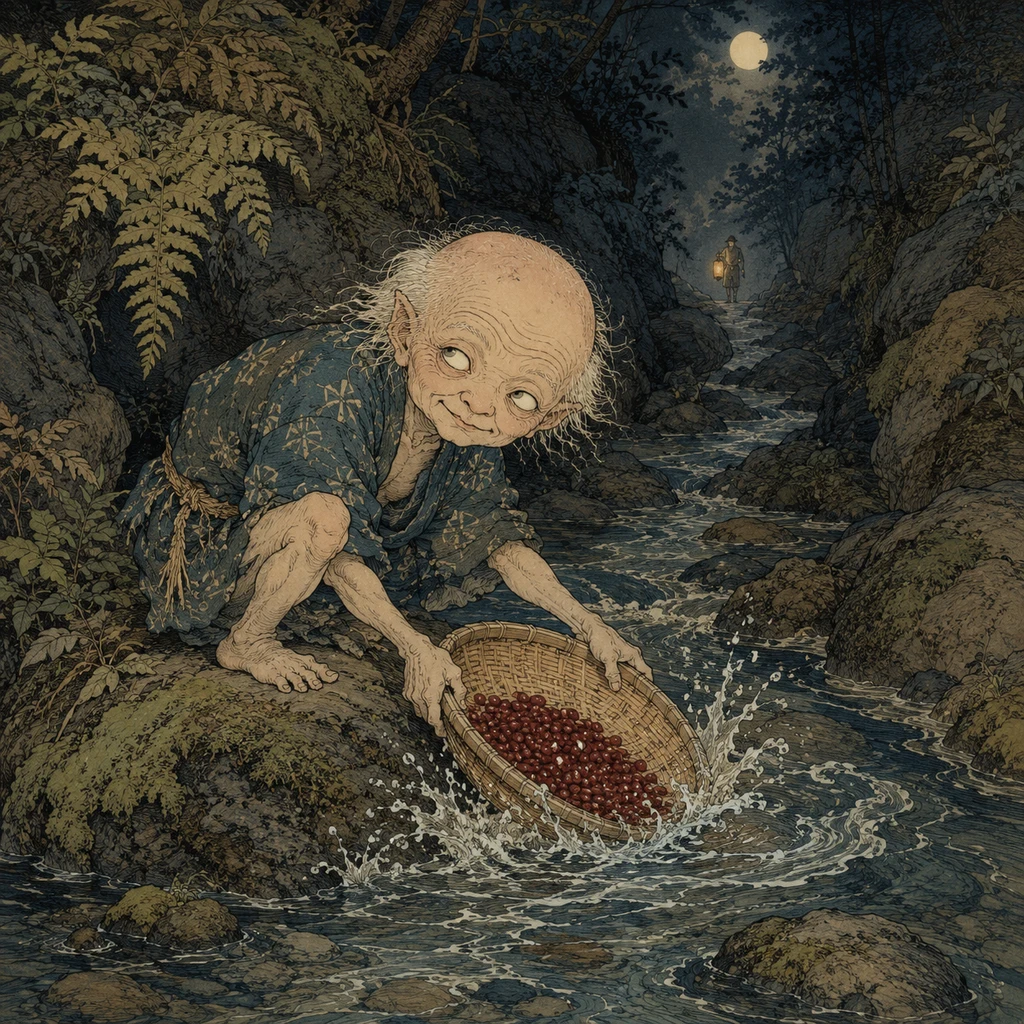
In contrast, the azuki-arai (red bean washer) is a monster whose true form is only a sound, never showing its figure. Late at night by rivers or streams, it echoes with a "shoki-shoki," "zaku-zaku," or "shari-shari" sound, like washing azuki beans. As someone approaches, the sound stops abruptly, and those distracted by the noise slip and fall into the river or valley. Along with Yamanashi and Nagano, Niigata is a dense distribution area for this apparition within the Koshin'etsu region. The most well-known documentary appearance is in Volume 5 "Azuki-arai" of *Ehon Hyaku Monogatari* (1841)[8], which tells of a young monk at a mountain temple who was skilled at washing azuki beans. Jealous of him, an evil fellow monk pushed him down a valley stream to his death; ever since, his spirit has made the sound of washing beans every night. There is also a tradition regarding its meticulousness, accurately counting the beans from one *go* to one *sho* without mistake, retaining traces of its personality in life transferred into the apparition.
Meanwhile, in the realm of folklore, rational interpretations attribute the sound to animals like weasels, foxes, river otters, and badgers (mujina), or natural phenomena like water sounds and the rustling of bamboo leaves. These coexisted, and it has been passed down with the boundary between monster and nature remaining ambiguous. There is no illustration of the azuki-arai transmitted in Sekien Toriyama's yokai drawings; its widely known modern image of a little monk was instead cemented by modern illustrators, notably Shigeru Mizuki, who drew it accompanied by the onomatopoeia "shoki-shoki." It is a monster that appeals more to hearing than vision, heavily carrying the folkloric function of warning children of the dangers of the waterside.
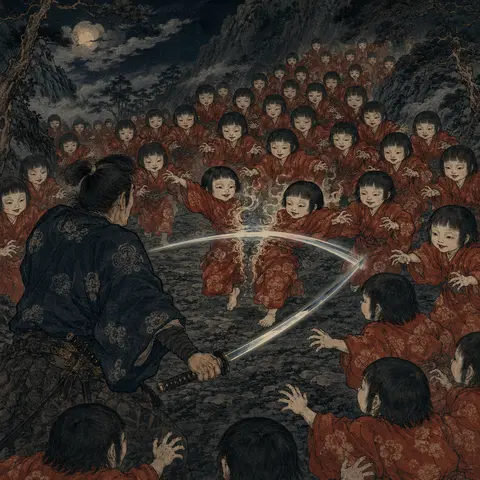
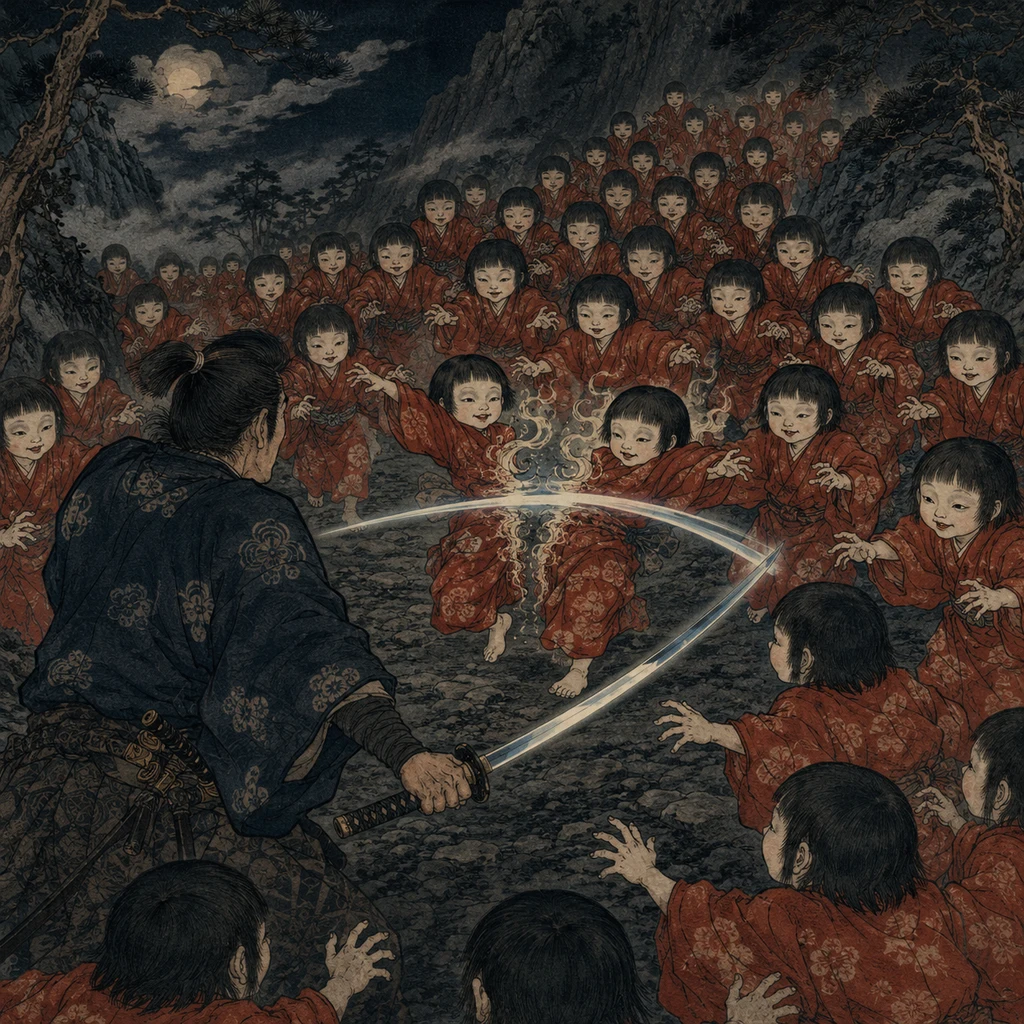
And another, leaving a unique narrative in the mountains of Niigata, is the Kiri-ichibee. When a samurai was crossing a small mountain pass, a young child chased after him, saying, "Walk faster and let father hold you." Suspicious, the samurai slashed the child, but it split into two, each further multiplying until they formed a swarm that surrounded him. As he fled in terror, a rooster crowed, and the monsters vanished, saying, "It's morning, let's go home." Later, the samurai realized the crowing had come from a rooster carved into the menuki (hilt ornament) of his own sword. Similar narratives are recorded throughout Niigata, with the name written as "Kiri-ichibee" or "Kiri-ichibai" (Cut One-Fold). The name derives from its nature of doubling each time it is cut, an earth-rooted monster that speaks of the eeriness of night passes through the form of multiplication.
Sado ── Kingdom of Tanuki and Isle of Exiles
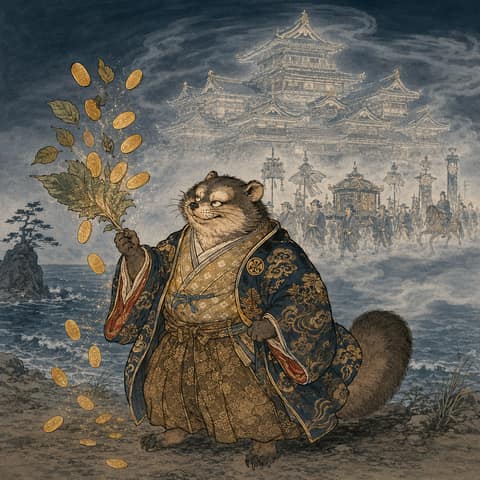
Cross the sea, and the landscape changes entirely. Sado, being an island separated from the mainland, nurtured a unique yokai ecology. Standing at its apex is the great tanuki Danzaburo-danuki, counted as one of Japan's three great tanuki.

Danzaburō-danuki
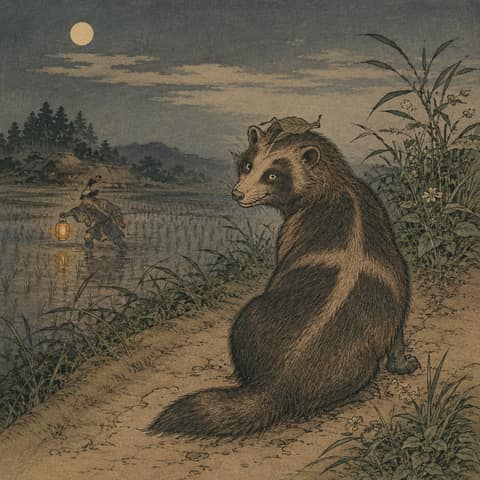
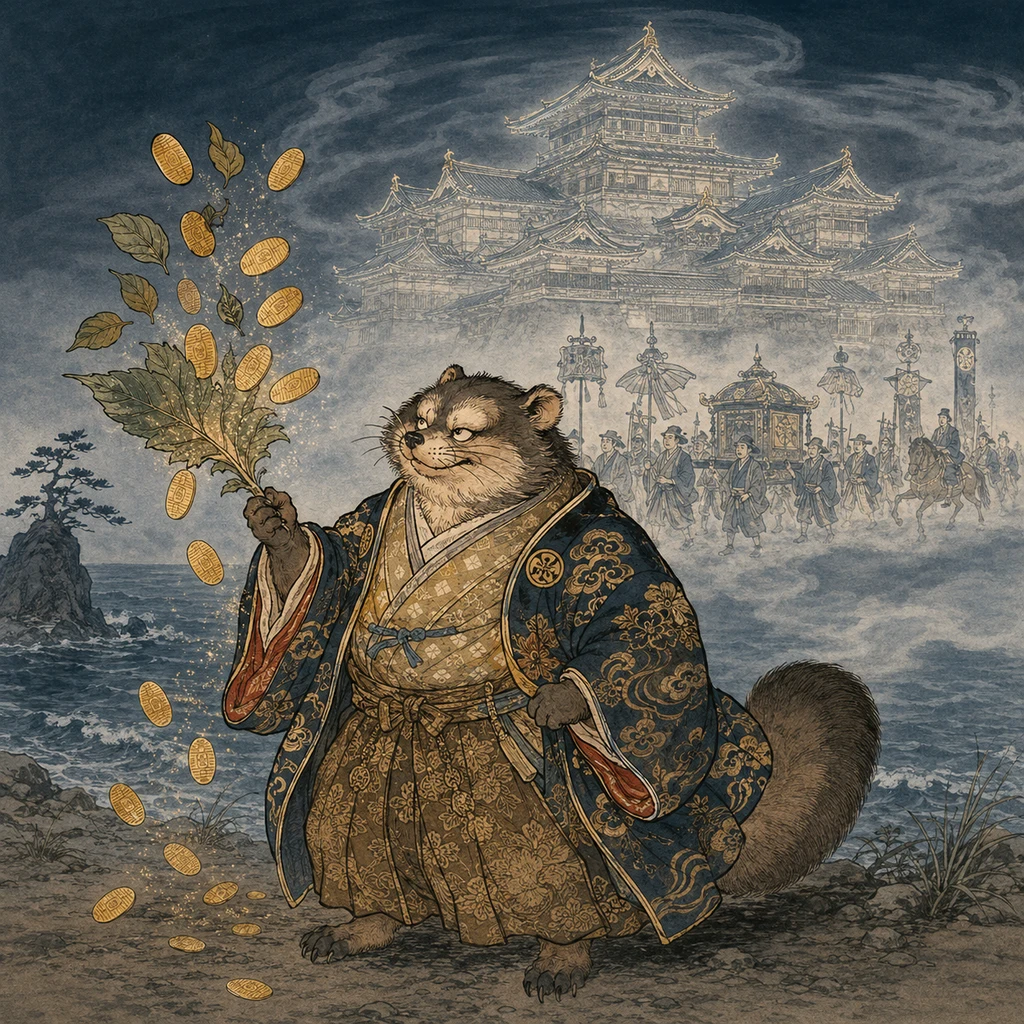
The supreme bake-danuki (shape-shifting raccoon dog) of Sado. Also called a mujina in some tellings, he bewilders people with mirages and phantoms, famously paying for goods by making fallen leaves appear as gold. He cast illusions over his burrow to resemble a lavish mansion and invited guests inside. Conversely, he was said to lend money to the needy—leave a written note and real coins would appear by morning. Later he was enshrined as Futatsuiwa Daimyōjin in Aikawa and came to be venerated.
Read moreDanzaburo is the supreme commander of the shape-shifting tanuki passed down in Sado (modern-day Aikawa, Sado City). Also referred to as a mujina, he is said to have led hundreds of kin, erected illusions of walls and processions on night roads, bewildered people with mirages, and made purchases using leaves disguised as gold. His dwelling was said to be in the village of Orito in Aikawa; if one left a promissory note with the amount, repayment date, and name stamped with a seal, the note would vanish by the next morning and the money would be left in its place[9]. This gold was also said to have been earned by him shapeshifting into a human and working in the gold mine. Aikawa was under the direct control of the Edo Shogunate, housing the Sado Magistrate, and prospered through the mining tunnels and smelting of the Sado Gold Mine ── that Danzaburo was a "money-lending tanuki" is not unrelated to this being a land driven by gold. While a compassionate tanuki who lent money without interest to the destitute, records also note tales where, after losing a battle of wits with a farmer, he refrained from bewitching people, and stories of him shapeshifting to visit a doctor. Ranked alongside Shibaemon-tanuki of Awaji and Tasaburo-tanuki of Sanuki as Japan's three great tanuki, Danzaburo eventually became worshipped as Futatsuiwa Daimyojin of Aikawa[10], gathering the fervent faith of the people. Despite being a shape-shifting tanuki, his transformation into a guardian deity of the land perfectly illustrates his character. The Futatsuiwa shrine still stands quietly in the depths of Aikawa, attracting worshippers as a god of business prosperity and wealth.
A symbolic legend demonstrating Danzaburo's dominion over Sado is the origin tale of "why there are no foxes in Sado." It is told that because Danzaburo repelled foxes at sea and drove them away from Sado[9], there are no fox bewitchments on this island. While foxes and tanuki form the dual pillars of bewitchment on the mainland, in Sado, the tanuki (mujina) monopolize the domain of deception ── this exceptional ecology pushed Danzaburo to become the island's supreme commander. In Sado, the mujina is called "Tonchibo (Danzaburo-mujina)" and revered as a being akin to a mountain god.
Drawing from that mujina lineage is the mujina, a general term for shape-shifters, while strange fires and an old woman apparition are passed down by the seaside.
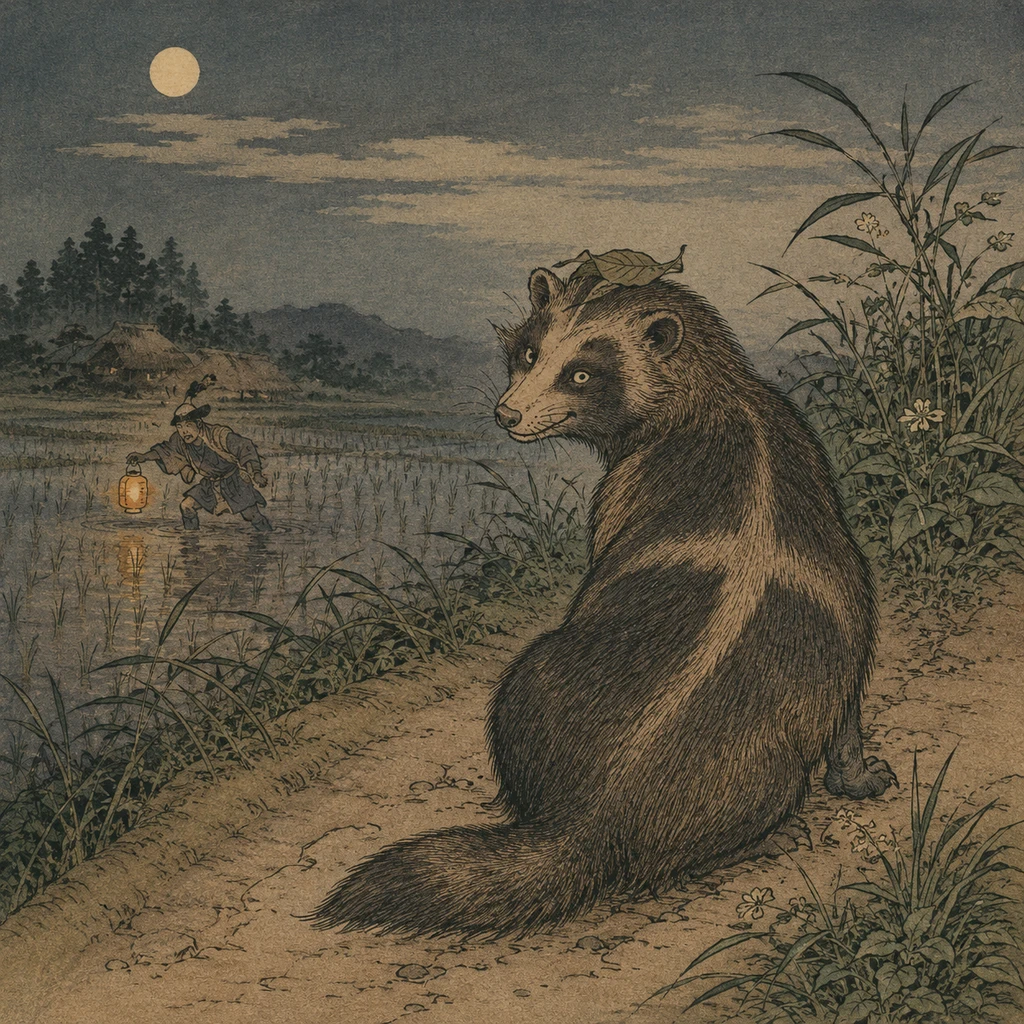
Mujina originally referred to the badger, but depending on the region and era, it has been conflated with tanuki and masked palm civets, serving as a blanket term for unidentified beasts. Their methods of bewitchment are generally categorized into three types ── making people perceive fields or roads as deep rivers, stranding them; making horse manure appear as steamed buns or manure pits as baths, urging people to eat or enter; and warping a sense of direction to disorient people on night roads. Its first documentary appearance is old, noted in the *Nihon Shoki*, Empress Suiko Year 35 (627), Spring, 2nd month[11] as "There are mujina in Mutsu Province. They transform into humans and sing," indicating that the concept of shape-shifting mujina was established before the Nara period. It was also given an entry in Toriyama Sekien's *Konjaku Gazu Zoku Hyakki*[3]. In Sado, as mentioned earlier, the mujina was called "Tonchibo (Danzaburo-mujina)," feared as a being akin to a mountain god, and spoken of as part of Danzaburo's lineage. Badgers and tanuki look similar and sometimes share the same burrows, leading to such confusion that the phrase "mujina of the same hole" (birds of a feather) was born ── this history of conflation forms the ambiguous outline of the mujina's existence. Furthermore, Lafcadio Hearn's piece "Mujina" in *Kwaidan*[12] depicted a faceless "noppera-bo" as a transformed mujina, widely introducing the name to the English-speaking world. However, Bon Koizumi points out the possibility that this was Hearn's creation, weaving his own childhood experiences into the foundation of Japanese folklore.
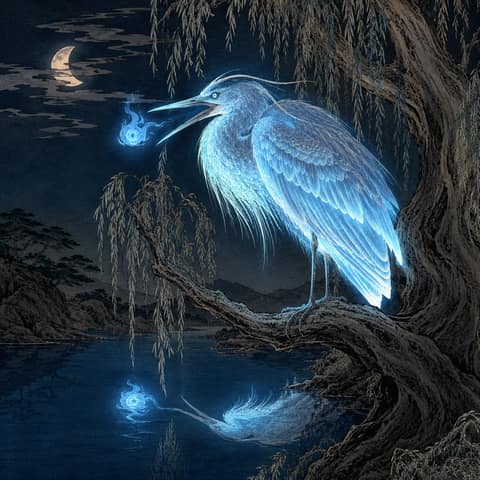
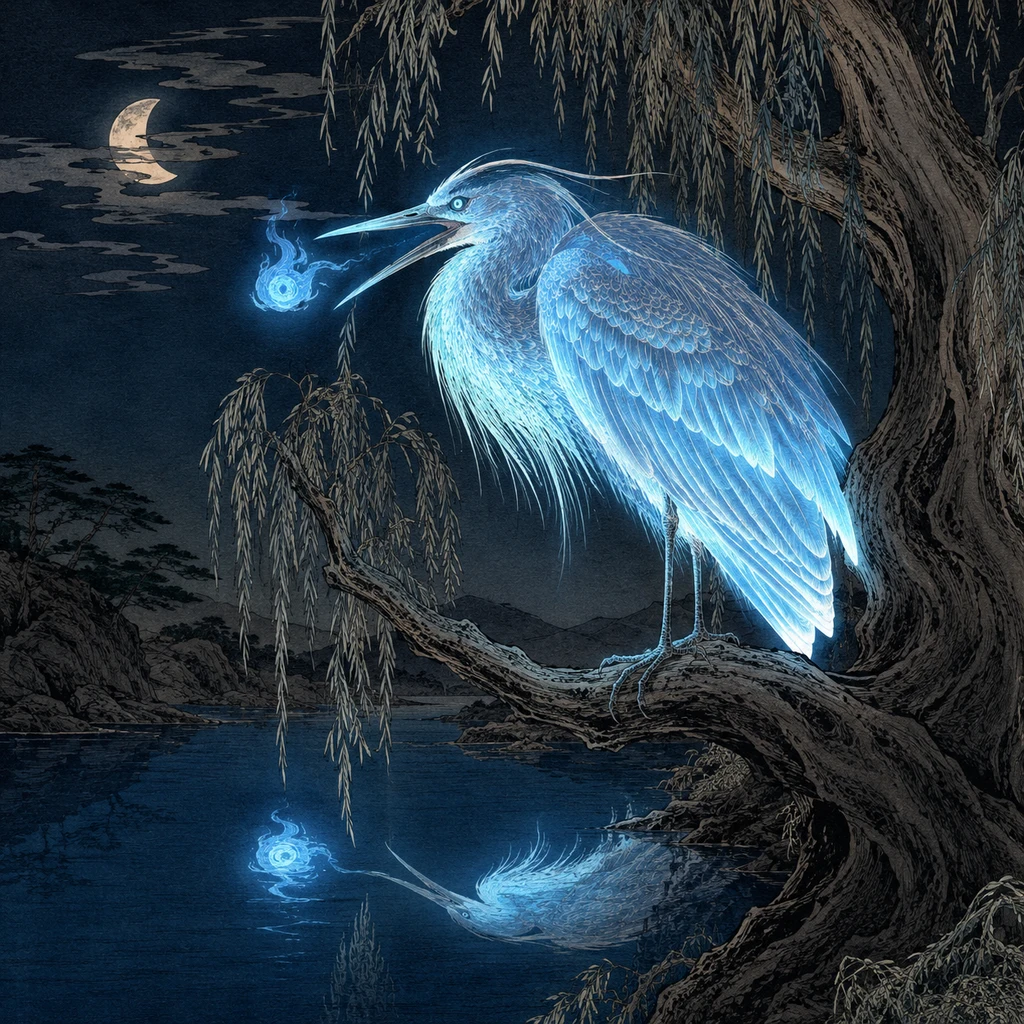
The aosagibi (blue heron fire) is a mysterious fire where the body of a heron appears to glow pale blue at night. Also known as the fire of the goisagi (black-crowned night heron) or the light of the goisagi, its true identity is often cited as the night heron. Appearing in Sekien Toriyama's illustrations and Shunsen Takehara's *Ehon Hyaku Monogatari*, it became widely known in the late Edo period. A specific setting remains in Sado ── it is told that every night, a ryuto (dragon lantern, a phantom fire said to be lit by the dragon god) flew to a large plum tree at Konpon-ji Temple in Aikawa. When a suspicious observer shot it down with a bow, its true identity was a heron. In Yamato Province, it is said a blue fire appeared in a large willow tree, and upon approaching, the entire tree glowed blue, showing variations in the tree depending on the region. Connecting with the description in the *Wakan Sansai Zue* that a night heron flying on a moonlit night looks like fire, its luminescence is sometimes explained by reflections from water-dwelling substances or feathers. Yet, the blue light suddenly floating in the darkness of the countryside and temples was seen by the people of Sado as a dragon lantern and passed down as a mysterious fire. A familiar waterbird like the heron transforming into a miraculous light in the dark of night ── this working of the imagination perfectly expresses the texture of Sado's beliefs.
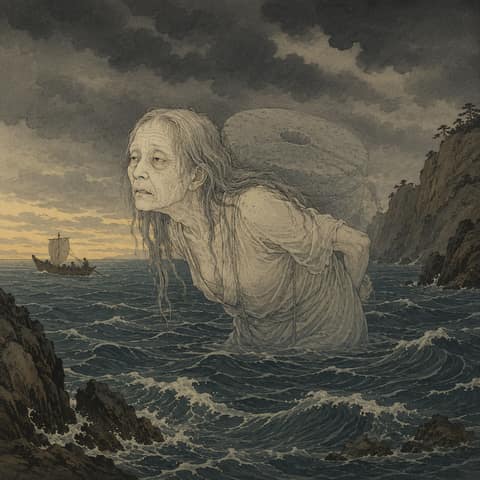
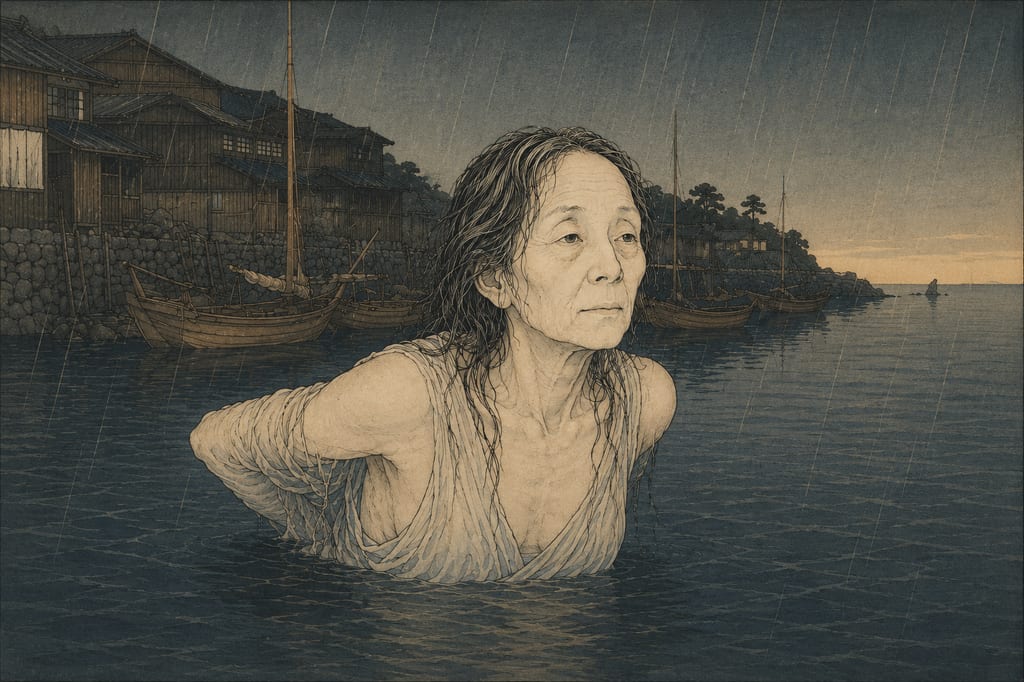
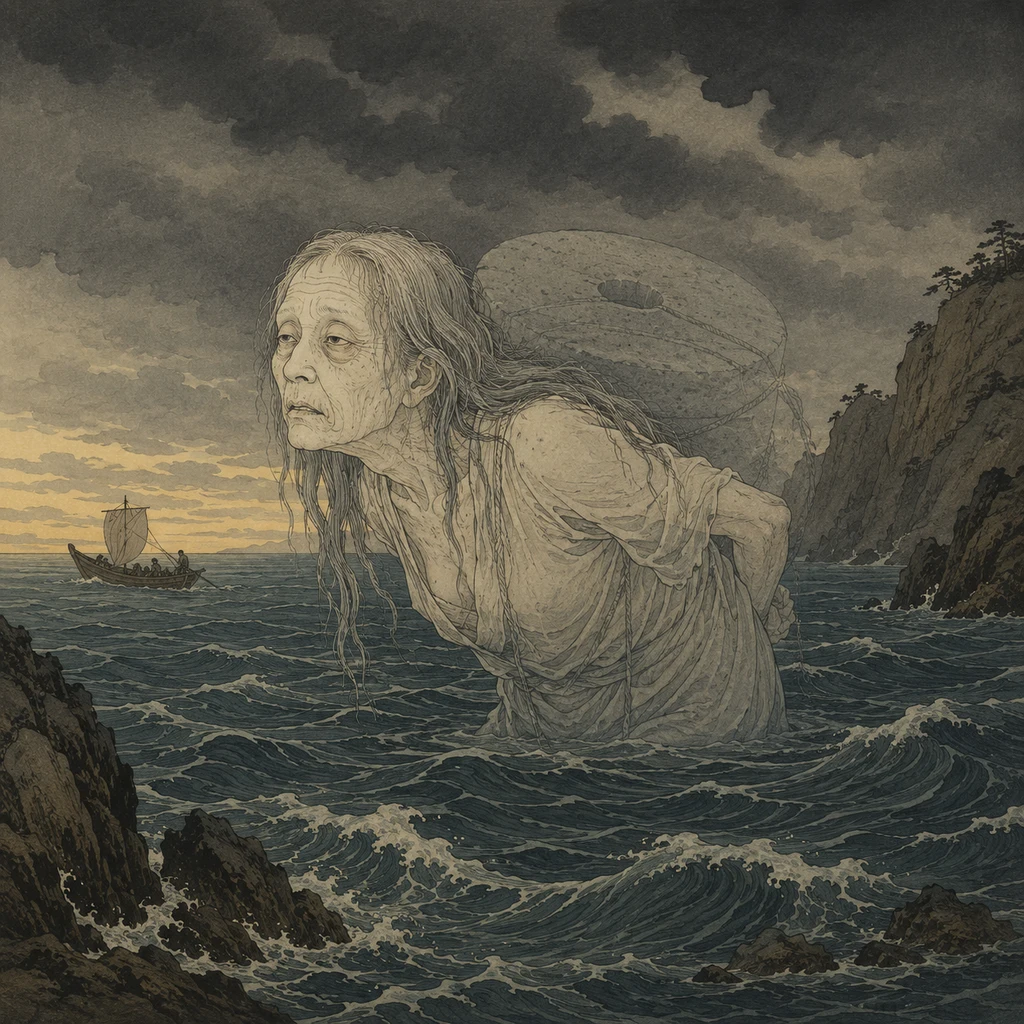
And on the seaside of Sado, an apparition appears as if carrying the memories of a life at sea on its back: the usuoi-baba (mortar-carrying hag). *Sado Kaidan Moshiogusa*[13] records an eyewitness account at the "Akae no Kyo" in Shukunegi. When a fishing spot renowned for good catches was struck by poor fishing and rain, and dusk began to fall, an old woman with white skin emerged from the seabed, looked around, and sank back down. A companion identified it as an "ayakashi" that appears once every few years, called it the "usuoi-baba," and noted it did no particular harm. In the original text, what she carries on her back is just "something"; concluding it to be a mortar (usu) is rather seen in later-year classifications. Floating on the water's surface with both hands clasped behind her back as if carrying something, this monster is often considered akin to the iso-onna and nure-onna. Shukunegi is a small cove village that prospered through the shipping trade, with a uniquely dense townscape that remains today. The people who lived with the sea and entrusted much to it gave a name to the old woman of the sea they happened to glimpse in the twilight of a poor catch, passing her down as a harmless entity ── therein lies the quiet charm of this apparition.
Sado was also an island where nobles and intellectuals of the capital, such as Retired Emperor Juntoku, Nichiren, and Zeami, were exiled. The blending of the capital's culture brought by the exiles with the local beliefs nurtured by the island gives Sado's supernatural tales their distinct hue. Worshipping a tanuki as a god, seeing dragon lanterns in a temple's plum tree, and calling an old woman of the sea an "ayakashi" ── all of these are stories richly fermented precisely on an island severed from the mainland.
Conclusion ── A Prefecture Where Three Facets Intersect
Niigata's yokai culture cannot be summarized on a single axis. In the heavy snows of Echigo, the snow and wind themselves birthed the kamaitachi and yuki-warashi, and *Hokuetsu Seppu*, which recorded the snow-country life, even jotted down strange tales like the ijuu. The demons of Echigo hold the birth legend of Ibaraki-doji connected to the Shuten-doji lore of Mount Oe, while its watersides pass down the nure-onna, azuki-arai, and Kiri-ichibee. And across the sea in Sado, Danzaburo-danuki rules an island without foxes, the aosagibi glows in the darkness of temples, and the usuoi-baba floats in the sea of Shukunegi.
Spirits born of snow, a tanuki kingdom across the sea, and an island for those banished from the capital ── the richness of Niigata's yokai culture lies in the intersection of these three facets within a single prefecture. The snows of Echigo and the seas of Sado both nurtured apparitions that test, bewilder, and sometimes assist humans.