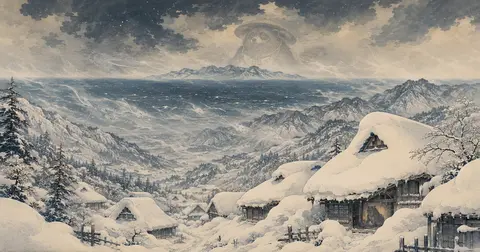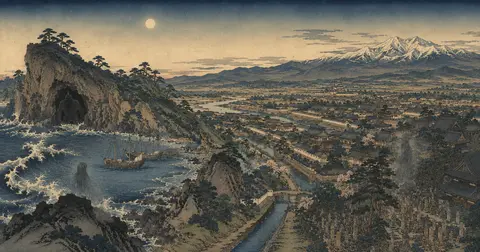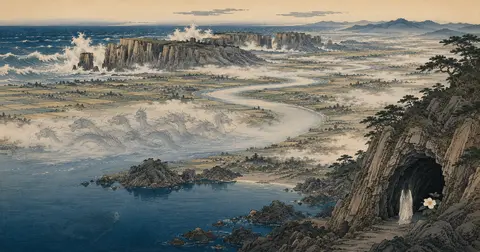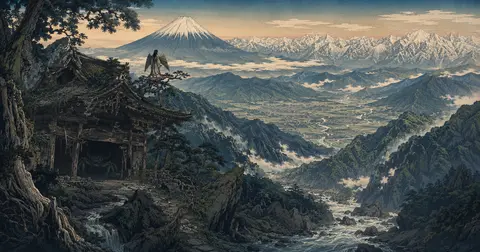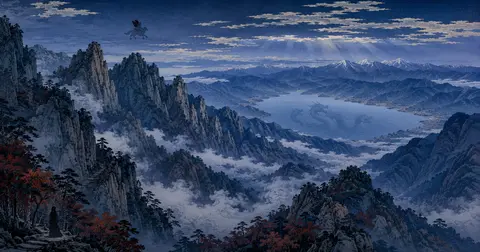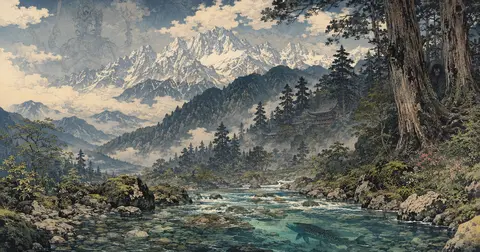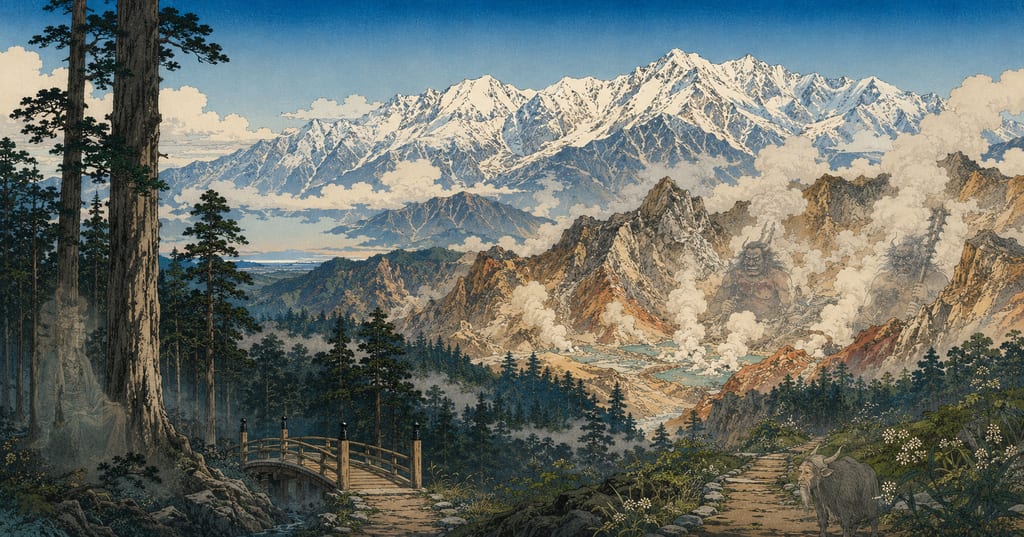
Toyama Prefecture, formerly known as Etchu Province, is a land of extraordinary elevation differences rarely seen in Japan, sweeping from the sea-level Toyama Bay to the 3,000-meter peaks of the Tateyama Mountain Range. The single axis running through the yokai culture shaped by this landscape is Mount Tateyama itself. Tateyama was a hell, and at the same time, a pure land. The sulfurous fumes erupting from Hell Valley were seen as the torments of the underworld, while its summit was revered as the Pure Land of Amida Buddha. When these conflicting visions of the afterlife overlaid a single mountain, the demons who govern hell, the old goddess who saves women, and the prophetic beast that appears before herb gatherers to foretell plagues were all born around the periphery of the same sacred ground.
The view of the afterlife on Mount Tateyama[1] was carried beyond Etchu by the Tateyama Mandalas painted by early modern *oshi* (pilgrim guides) and the *etoki* (picture storytelling) they performed as they traveled across the country. Focusing on three entities—the demons of Hell Valley, the Ubagami of Ashikuraji, and the Kutabe of Etchu Tateyama—this article traces how Toyama's yokai culture is seamlessly connected to the mountain worship of "death and rebirth."
The Mountain Where Hell and Pure Land Coexist:
The Legend of Tateyama's Founding
To discuss the yokai culture of Tateyama, we must first begin with the story of how this mountain was "opened." According to the traditions of Oyama Shrine, Mount Tateyama was opened in the first year of Taiho (701) by a youth named Ariyori, the son of Saeki no Ariwaka, the governor of Etchu Province[2]. The young Ariyori, having entered the mountain in pursuit of a white hawk, tracked a bear he had shot with an arrow. Inside a cave, he came upon a golden Amida Nyorai with an arrow piercing its chest. The bear had been an incarnation of Amida Buddha—it is said that the boy, moved by this revelation, entered the priesthood and opened the mountain[3].
This founding legend was not fixed as a single, completed narrative from the start. In the older *Iroha Jiruisho*[2], the founder is said to be his father, Ariwaka, while in the Kamakura period's *Ruiju Kikensho*, it was told in a simpler form where a nameless hunter shot a bear that transformed into Amida[2]. The very process by which the figure was refined into the youth Saeki Ariyori during the Edo period is proof that Tateyama faith has been retold across different eras.
What is important is that this founding tale harbored a reversal of "taking life and offering salvation," or "beast and Buddha," from the very beginning. The reversed structure of the shot beast turning out to be a Buddha would later connect to the unique view of the afterlife in Tateyama, where the demons of Hell Valley and the Pure Land of Amida coexist on the same mountain.
What distinguishes Tateyama from other sacred mountains is that its view of the afterlife was organized in an extremely visual and geographical manner. The 3,000-meter summit of Mount Oyama corresponded to the Pure Land of Amida, while Hell Valley at its foot corresponded literally to hell, with the Sai-no-Kawara and the Sanzu River placed in between. The Buddhist concept of the Six Realms of Reincarnation—the worldview that beings are reborn through the six worlds of Devas, Humans, Asuras, Hungry Ghosts, Animals, and Hell—was superimposed exactly onto the elevation differences of an actual mountain[4]. Demons, Ubagami, and Kutabe all had their places somewhere within this vertically stacked afterlife.
Demons of Hell Valley:
Hell Wardens of a Volcanic Underworld
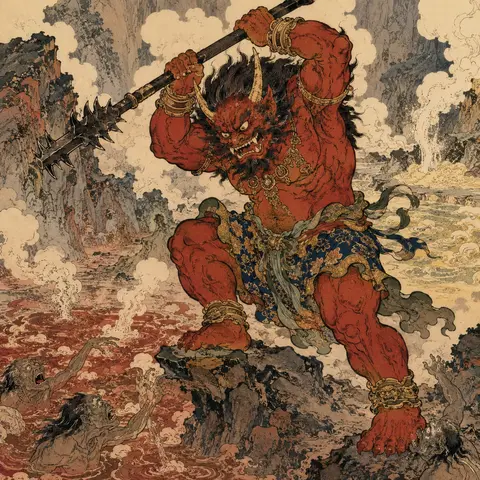
Tateyama's Hell Valley still features erupting fumaroles roaring from the ground, the lingering smell of sulfur, and a desolate, sparsely vegetated volcanic landscape[1]. Since ancient times, people have perceived this bizarre terrain not metaphorically, but literally as "hell." It is said that there are altogether 136 hells[5] in Tateyama, and the wardens with ox and horse heads who govern these hells and torment the dead are the very demons of Tateyama Hell[6].
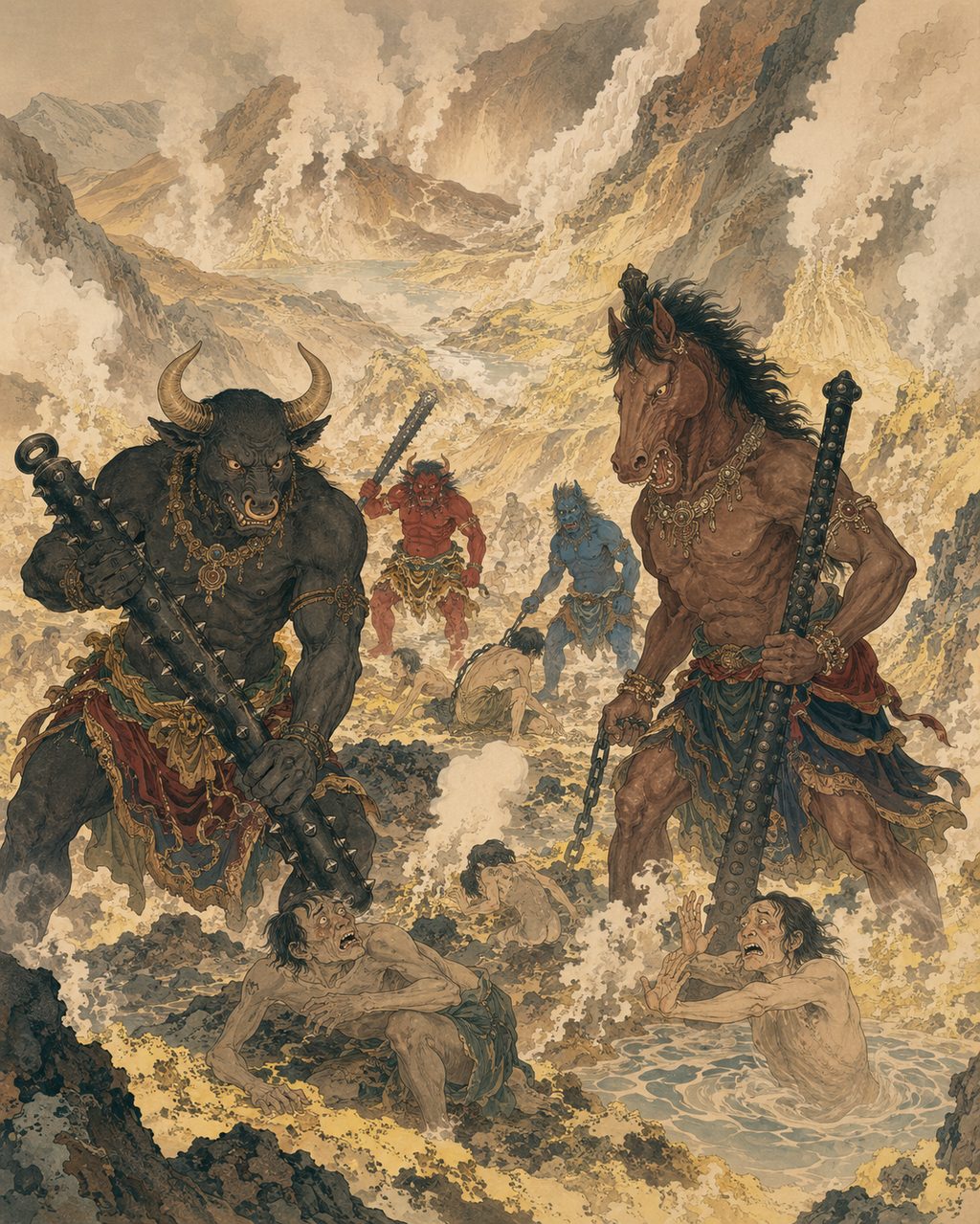
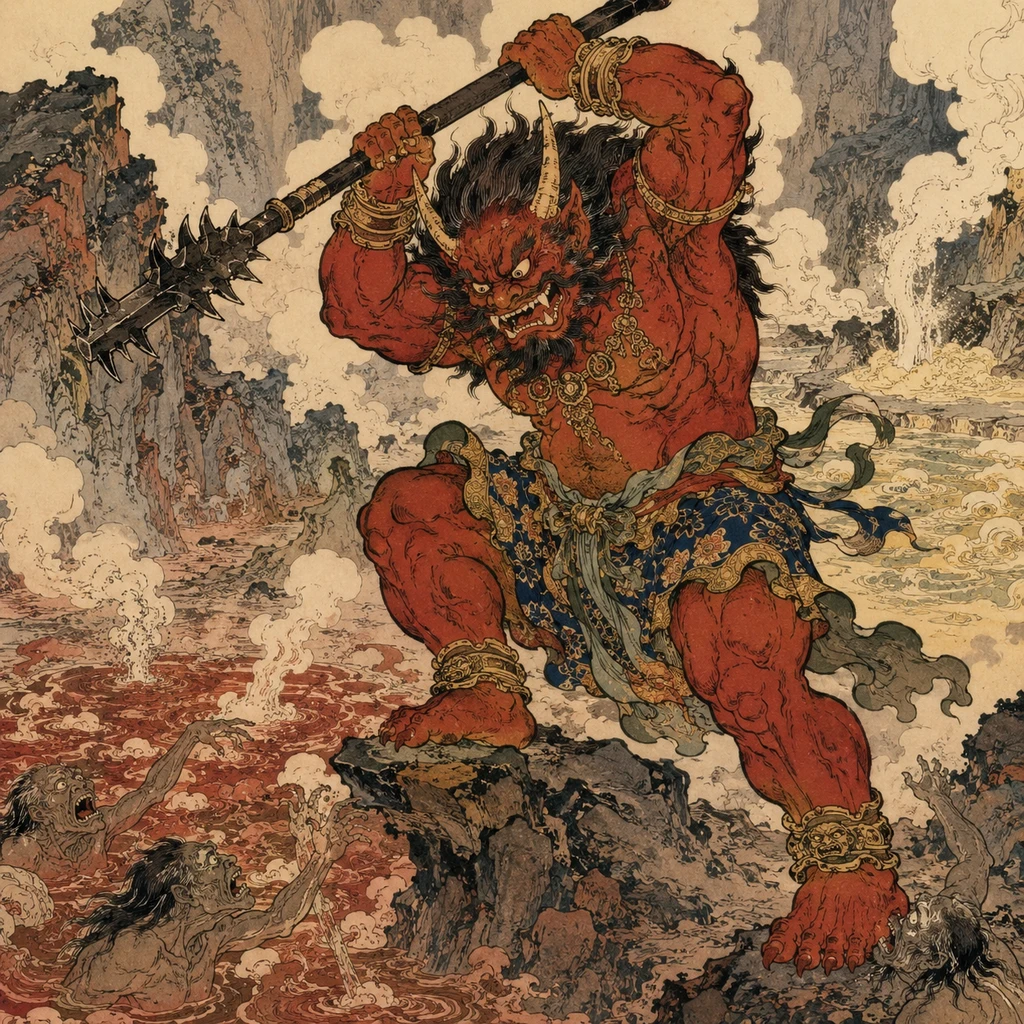
Demons of Tateyama Jigoku
Within the Tateyama faith, which viewed the Jigokudani (Hell Valley) of Etchū's Mount Tateyama as the underworld itself, the Demons of Tateyama Jigoku are the jailers (gokusotsu) depicted in the Tateyama Mandala tormenting the dead. Even today, Tateyama's Hell Valley roars as fumaroles erupt from the earth, the stench of sulfur hangs thick in the air, and a desolate, sparsely vegetated volcanic landscape stretches as far as the eye can see. Since ancient times, people have perceived this otherworldly terrain as a literal "hell," and it was even said that there were 136 hells in total across Mount Tateyama. The demonic jailers, such as Gozu and Mezu (Ox-Head and Horse-Face), who rule over these hells and subject the dead to being boiled in cauldrons or to various tortures, are precisely the Demons of Tateyama Jigoku referred to here.
Read moreWhat makes these demons decisively different from demons in other regions is that their "hells" correspond one-by-one to actual geographical features. Mikurigaike Pond was likened to the Blood Pond Hell into which women were inevitably believed to fall, and Mount Tsurugi (Sword Mountain) was likened to the Mountain of Swords Hell as its name suggests[1]. Along with the Sai-no-Kawara, the Sanzu River, and the Realm of Asuras, the Tateyama Mandala vividly depicts the demons tormenting the dead in these hells[6]. A walkable volcanic landscape was entirely reinterpreted as famous landmarks of the underworld.
The people of the temple lodgings (*shukubo*) in Ashikuraji and Iwakuraji traveled across the country carrying these mandalas, preaching the terrors of hell and the salvation of climbing Tateyama while pointing to the illustrations[6]. By showing hell to instill fear, and simultaneously preaching that pilgrimage to the Pure Land of Tateyama was the true salvation—the demons of Tateyama Hell solely bore the terrifying side of Tateyama faith, where terror and salvation were two sides of the same coin[7]. One could say the demon was not merely a monster, but half of a mechanism designed to carry faith.
Tateyama Mandala and Etoki:
Pictures That Carried Hell's Demons Nationwide
The greatest medium through which Tateyama's demons and Ubagami became known outside Etchu was the Tateyama Mandala. This is a hanging scroll painting that condenses the worldview of Tateyama faith into a single screen, depicting against the backdrop of Tateyama's alpine landscape the founding legend of Saeki Ariyori, the Tateyama Hell where King Enma and demons torment the dead, the descent of the Amida triad, and the Nunobashi Kanjo-e ceremony for the salvation of women[4]. To date, fifty-four Tateyama Mandalas have been confirmed, and their contents differ slightly depending on the era, region, and the temple lodging that commissioned them[4]. For example, the version held by Daisenbo[4] is a massive work consisting of a pair of four silk scrolls, measuring 133 centimeters vertically and 157 centimeters horizontally[4].
*Etoki* is the oral performance of storytelling while pointing to each scene on this mandala. From the Edo period to the early Showa period, the monks and laymen at the foot of Mount Tateyama walked across the country carrying these paintings on their backs. They spread Tateyama faith by narrating everything from the origins of its founding to the torments of Tateyama Hell[6]. Thus, the demons of Hell Valley appeared before people as paintings on hanging scrolls and were breathed into life by the spoken word. A volcanic landscape was reinterpreted as the underworld, that underworld was captured in a painting, and the painting was carried to villages nationwide through oral performance—the demons of Tateyama Hell only circulated as yokai after passing through these multiple layers of translation.
Ubagami and the Nunobashi Kanjo-e:
The Old Goddess Who Saves Women
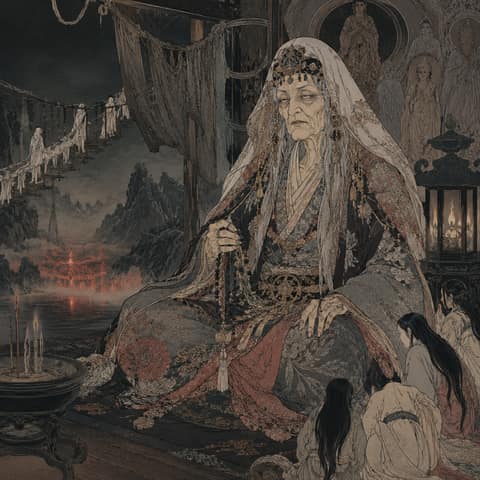
Mount Tateyama was forbidden to women until the early modern period. Enshrined in the Ubadō of Ashikuraji at the foot of the mountain to save the women who could not make the pilgrimage was the old goddess, Ubagami[6]. Ubagami was superimposed with the wife of King Enma or the Datsueba of the Sanzu River, and was depicted as an ambivalent old goddess who stands at the boundary after death to both judge and save the deceased[6]. If the demons of Hell Valley bore the side of terror, Ubagami bore the side of salvation. Tateyama's view of the afterlife was stretched between these two poles.
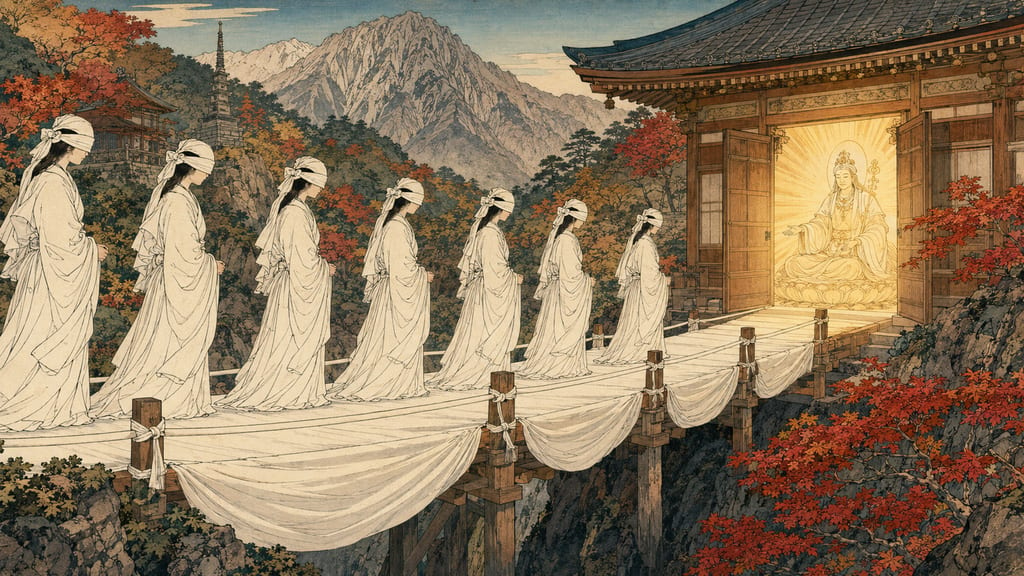
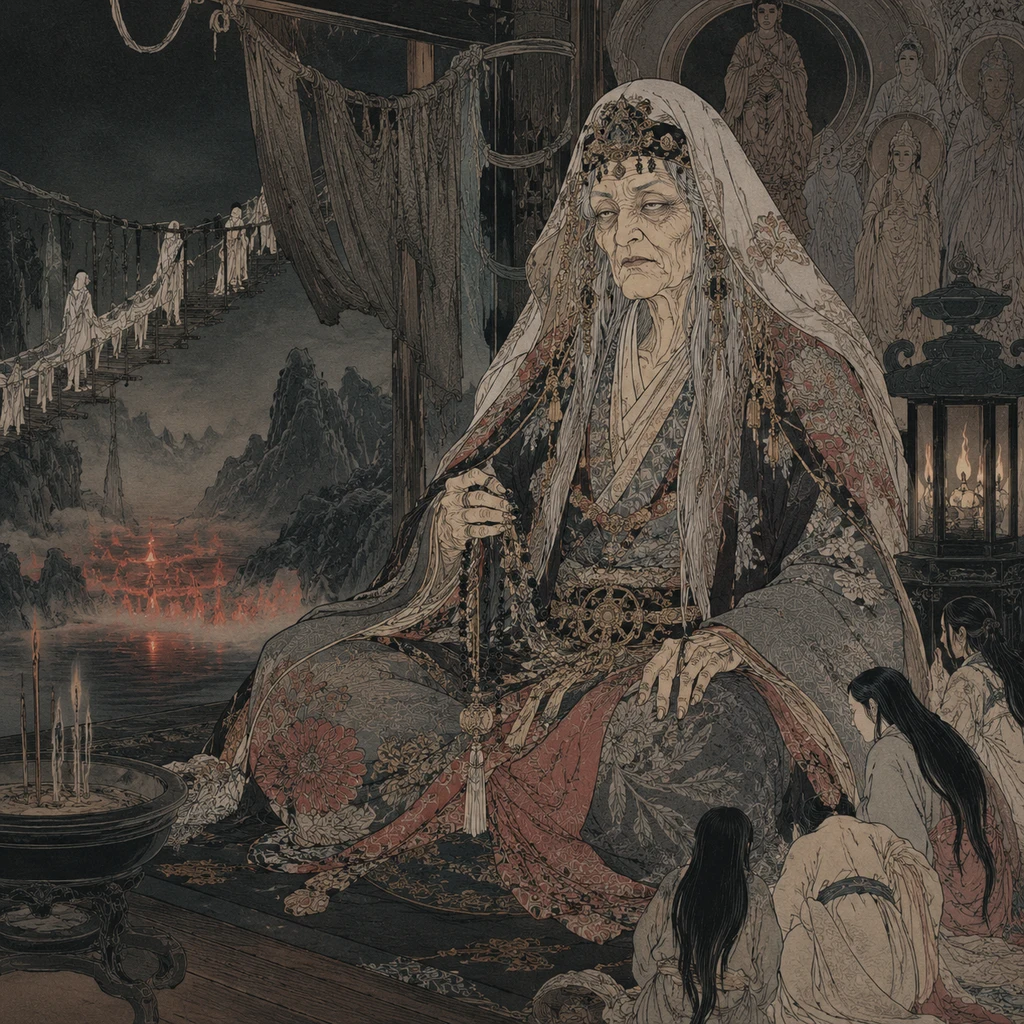
Ubagami
Ubagami is an old goddess enshrined at the Ubadō (Hall of the Old Woman) in Ashikuraji, at the foot of Mount Tateyama in Etchū Province. Because of the steam and sulfur venting from Jigokudani (Hell Valley), Tateyama was feared as the "Mountain of Hell"; concurrently, it was revered as a sacred mountain believed to harbor the Pure Land of Amida Buddha. Until the modern era, women were strictly forbidden from climbing Tateyama, and the Ubagami faith was established to save these female devotees who could not make the ascent. It is said that sixty-six statues of Ubagami were enshrined within the Ubadō, where women would pray to each statue one by one in the darkness. Often conflated with the wife of Enma Daio (Yama, the King of Hell) or Datsueba (the old woman who strips the dead of their clothes at the Sanzu River), Ubagami was depicted as an ambivalent goddess standing at the boundary of the afterlife—both judging the dead and offering them salvation.
Read moreThe core of Ubagami faith manifests in a ritual of simulated death and rebirth called Nunobashi Kanjo-e (Cloth Bridge Consecration)[8]. On the middle day of the autumn equinox, women dressed in white burial clothes first entered the Enmadō[8] to repent their sins before the statue of King Enma. Afterward, they crossed the cloth bridge blindfolded[9]. This side of the bridge was seen as "this world," and the destination as "the other world." It is said that the bridge laid with 108 wooden planks represented the 108 earthly desires[9].
The women who finished crossing the bridge entered the Ubadō on the opposite shore, enclosed in darkness. Inside, sixty-six statues of Ubagami were enshrined, and the women prayed intently to each one[6]. Eventually, the doors of the hall were opened, and in the pouring light, they were "reborn." Salvation from the Blood Pond Hell and rebirth into the Pure Land were promised through this single night's ritual[6]. Wearing burial clothes to die once, crossing the bridge to reach the other shore, and being reborn into the light—it was a ritual where the composition of hell and the pure land depicted in the Tateyama Mandala was acted out through the bodies of women.
This faith was supported by the existence of Ashikuraji, a base settlement. Ashikuraji in the Edo period was a prayer site for the Kaga Domain and a village where over thirty temple lodgings and commoners lived in front of the gates as a base for Tateyama pilgrimage[10]. It is noteworthy that while the masters of temple lodgings in mountain faiths in other regions were generally called *oshi*, the people of Ashikuraji intentionally called themselves *shuto* (monk-followers), placing heavy emphasis on the study of scriptures and religious rituals[10]. They were half-monk, half-laymen, farming while traveling to distribute talismans, and their scholarly inclination gave birth to the elaborate didactic paintings of the Tateyama Mandala and supported the systematic women's salvation ritual of Ubagami faith.
Under the patronage of the Kaga Domain in the late Edo period, the *shuto* of Ashikuraji spread this faith nationwide through talisman distribution, explaining the Tateyama Mandala to preach that it was a "sacred site for the salvation of women"[7]. The prohibition of women on Tateyama was lifted by a decree of the Dajō-kan in the fifth year of Meiji (1872), and the Nunobashi Kanjo-e was temporarily lost, but it was revived by the people of Ashikuraji in the eighth year of Heisei (1996) and is passed down to this day[9]. The demons of hell and the saving Ubagami must be understood not as separate yokai, but as two sides of the single Tateyama faith.
Kutabe of Etchu Tateyama:
The Prophetic Beast Before the Herb Gatherer
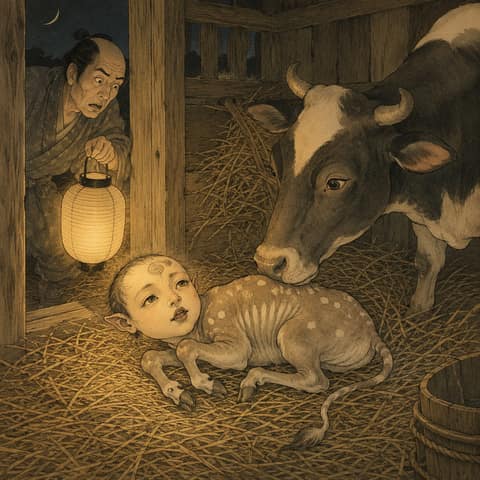
Mount Tateyama was an afterlife of hell and pure land, and at the same time, a treasure trove of medicinal herbs for the people at its foot. Born from the sites of this herb gathering was the prophetic beast of Etchu Tateyama, Kutabe. A variant of the Kudan, it was a widely circulated prophetic beast in the late Edo period with a human face and a beast's body that was said to foretell the world's affairs and plagues before dying shortly after.
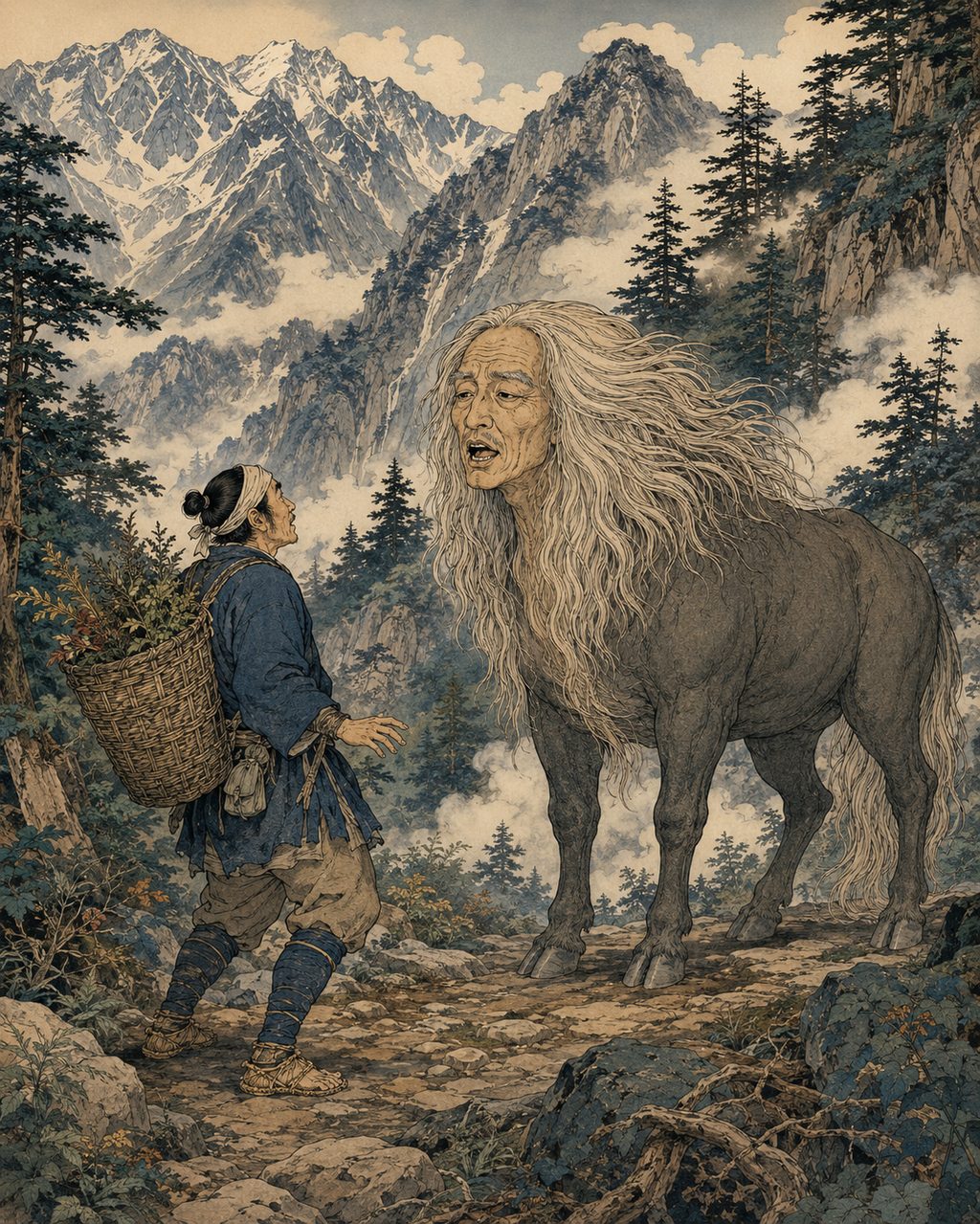
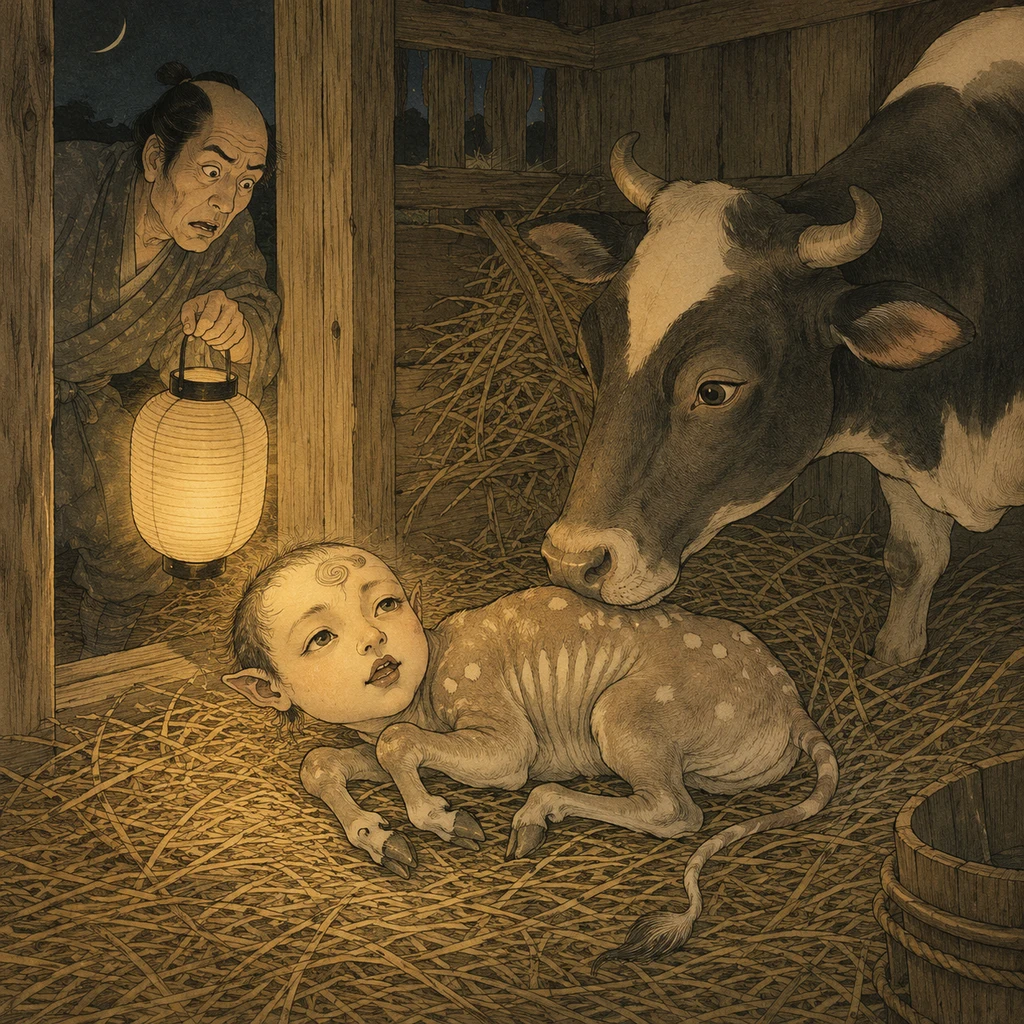
Kudan (Prophetic Human-Cow Yokai)
Kudan is a half-human, half-cow prophetic creature that spread widely in the late Edo period. It has a human face on a bovine body and is said to appear, deliver prophecies about public affairs or harvests, and soon die. Broadsheets and printed books from the Tenpō era record varying locations and appearances. Some notices claimed that displaying its image brought protection from calamity and prosperity at home, though accounts differ by region and source. The supposed link to the legal phrase ‘ken no gotoshi’ (“as stated above”) is considered a folk etymology.
Read moreThe records of the Kutabe that appeared in Etchu Tateyama are specific. According to the Toyama Prefectural [Tateyama Museum], from the winter of the tenth year of Bunsei (1827) to the spring of the eleventh year (1828), Kutabe appeared before someone who entered Tateyama to gather medicinal herbs[11][11]. It is said that Kutabe prophesied a mysterious disease would spread within a few years, announced that "those who see my figure will escape the disaster of that disease," and left behind the command, "Draw me and distribute it widely" for those who could not see its figure[11]. This event is recorded as an epidemic in the winter of the tenth year of Bunsei in the *Kyojitsu Mujinzo*, and the circulation of its illustrations in April of the eleventh year of Bunsei is recorded in the *Kansei Bunsei-kan Nikki*[11].
Why did the Kudan choose "Etchu Tateyama" as the place of its appearance? Research by the Tateyama Museum places importance on the fact that Tateyama was originally a sacred mountain perceived as an afterlife and underworld, and that it possessed an interface between humans and the mountain through herb gathering[12]. A human venturing in search of medicine on a mountain bordering hell and the pure land encounters an anomaly with a human face and beastly body and receives a prophecy—one can interpret that the appearance of Kudan in Tateyama was not coincidental, but an inevitable consequence of the otherworldly nature this mountain possessed.
The appearance of Kutabe varies across historical materials. Some depict a female face with long hair, while others depict an old man's face, with only the basic combination of a human face and a beast's body common across various texts. Research by the Tateyama Museum cites the fact that Tateyama was a sacred mountain perceived as an afterlife and underworld, and that it possessed a vivid interface between humans and the mountain through herb gathering, as reasons for it being chosen as the site of Kutabe's appearance[12]. A human venturing in search of medicine on a mountain bordering hell and the pure land encounters an anomaly with a human face and beastly body and receives a prophecy—one can interpret that the appearance of Kudan in Tateyama was not coincidental, but an inevitable consequence of the otherworldly nature this mountain possessed.
The two commands given by Kutabe—"see my figure to escape disease" and "draw and distribute it"—well illustrate the core of faith in prophetic beasts: countering the invisible terror of plagues through seeing and copying. The Bunsei era was actually a time when epidemics spread across various regions, and that anxiety caused the illustrations of Kutabe to spread rapidly[12]. Just as the demons of Tateyama Hell were a storytelling device to "show to instill fear, and save through pilgrimage," Kutabe was also an entity that banked on the power of pictures to "show and save." In the aspect of saving people through imagery, the demons of hell and the prophetic beast deeply connect at the foot of Tateyama.
It should be noted that the leading theory posits the Chugoku region as the origin of the Kudan, and we must reserve that Etchu was merely one part of its dissemination. The direct connection to the customary closing phrase "As aforementioned" (kudan no gotoshi) at the end of deeds is also considered a later popular belief[11]. Nevertheless, it is highly significant that the essence of Kudan—the prophecy of a plague and its transformation into a talisman by copying its figure—was clearly recorded on Tateyama, a mountain of the afterlife. Amabie, which spread nationwide in the Reiwa era, also traces its lineage to prophetic beasts, but Etchu had its own prophetic beast over a century earlier.
Between the Mountain and the Sea:
The Sense of the Afterlife Nurtured by Etchu's Geography
To understand Toyama's yokai culture, one should look at the geography of this province itself. Etchu Province is surrounded by mountains on roughly three sides, opening only to Toyama Bay to the north, forming a giant mortar-like terrain. To the south tower the Tateyama Mountain Range and the Kurobe Gorge, whose snowmelt becomes numerous rapid streams that plunge all at once into the bay. This extreme elevation difference, reaching 3,000-meter ridgelines within a distance of just a few dozen kilometers from the sea-level coastline, is unparalleled in Japan.
This geography directly gave form to the people's sense of the afterlife. Looking up, the white peaks of Tateyama, retaining snow even in summer, constantly occupied the southern view as an unreachable pure land. Looking back, the northern sea floated pavilions on clear days and brought blue lights from the deep sea in spring. Right above and just beyond the everyday living sphere, a vertical afterlife (the mountain) and a horizontal afterlife (the sea) opened simultaneously. That the faith of hell and pure land in Tateyama was so elaborately organized, and that a prophetic beast like Kutabe appeared at the site of herb gathering, cannot be separated from the condition of this land where "the afterlife is close." The yokai of Etchu can be said to be the very outlines of the afterlife forced upon human imagination by its peculiar terrain.
Mirages of Toyama Bay:
Another Otherworld Shown by the Sea
If Tateyama was an afterlife pointing to the heavens, Toyama Bay was a sea projecting an otherworld beyond the horizon. The coast of Uozu has been known as a famous spot for mirages since the Edo period, and on clear spring days, the scenery on the opposite shore appears to stretch and shrink, looking as if pavilions are floating in mid-air[13]. Today, it is explained as atmospheric light refraction, but we cannot overlook that the very name of this phenomenon, *shinkirō*, is derived from yokai.
The *shin* in *shinkirō* (mirage) refers to a legendary creature considered to be a giant clam or a type of dragon[14]. In ancient China, it was believed that this *shin* breathed out *ki* (air/energy) to manifest pavilions in the sky, and its origins can be traced to Sima Qian's *Records of the Grand Historian*, "Treatise on the Heavenly Offices"[14]. In other words, "pavilions made of breath (shinki) exhaled by the shin" is how the word was formed. A giant clam lurking at the bottom of the sea spews forth a phantom capital—what the people of Toyama Bay saw every day was a phenomenon bearing the name of such an anomaly.
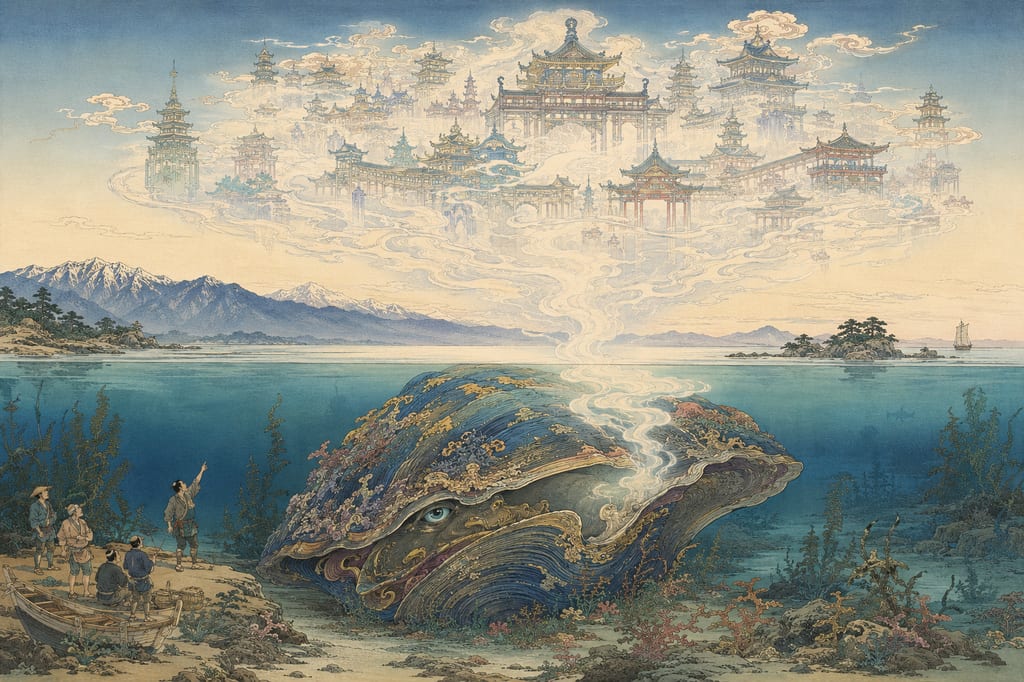
Toyama Bay is also a sea where swarms of firefly squids (*hotaruika*), glowing blue, approach in early spring. The sight of countless cold lights rising from the deep sea also emitted the aura of a "somewhere else," akin to the fumaroles of Tateyama's Hell Valley or the pavilions exhaled by the *shin*, from the direction of the sea. It is said that there are three "wonders" in Toyama Bay—mirages, submerged forests, and firefly squids—all phenomena born of the unique geography of this sea, where the seabed off the coast drops sharply. Standing on the shore, the deep sea begins right beneath one's feet, and its depths simultaneously spew out phantom pavilions and blue lights. It was a sea fitting for an anomaly like the *shin* to dwell. The geographical foundation of Etchu's yokai culture is that windows to the afterlife were open on both the mountain and the sea.
Medicine and Yokai:
The Talisman Culture Carried by Etchu Medicine Peddlers
Reading the lore of Kutabe merely as a tale of the bizarre misses the unique characteristics of Toyama. The fact that Kutabe commanded, "Draw me and distribute it widely," resonates deeply with Toyama being precisely a province of medicine and talismans.
The origins of Etchu medicine peddling are traditionally traced to Maeda Masatoshi, the second lord of the Toyama Domain[15]. Born sickly and deeply interested in medicine, Masatoshi obtained the prescription for Hangontan (Resurrection Pill) at the end of the 17th century and had it peddled nationwide as a domain enterprise[15]. There is an anecdote that in the third year of Genroku (1690), when the lord of Miharu Castle suddenly collapsed with a stomachache at Edo Castle, the Hangontan Masatoshi offered worked instantly, prompting various daimyo to request it be sold in their domains[15].
The medicine peddlers of Etchu spread the placement-sales system of "use first, pay later" (*sen'yō kōri*) across the country, where they placed medicines in homes in advance and collected money only for what was used later[15]. They carried more than just medicine. Paper balloons as souvenirs, and talismans to ward off plagues—the pictures of Kutabe were also part of a cultural substrate capable of spreading through such a distribution network of people and paper. The *oshi* of Tateyama traveled with the Tateyama Mandala to expound on hell and the pure land, and the medicine peddlers of Etchu left Hangontan and talismans in homes nationwide. The depth of this "walking and distributing" culture is precisely the background against which the prophetic beast Kutabe was recorded in Etchu, and its likeness copied and distributed.
Conclusion:
Anomalies Born of the Mountain of Death and Rebirth
The yokai culture of Toyama converges on the single mountain of Tateyama. The founding legend of a shot beast turning into Amida, the demons of Hell Valley who viewed volcanic terrain as the underworld, the Ubagami saving women through rituals of death and rebirth, and the Kutabe appearing before herb gatherers to foretell plagues—these are not disparate yokai, but a group of anomalies sharing the same root, derived from Tateyama's afterlife views of being both hell and a pure land.
The mirages of Toyama Bay reflecting an otherworld from the sea, and the medicine peddlers of Etchu carrying talisman culture nationwide, are also seamlessly connected to this view of the afterlife. To walk through Toyama is nothing other than rereading the fumaroles of Hell Valley, the darkness of the cloth bridge, and the phantom pavilions of the spring sea as the tale of a single sacred mountain.
Terror and salvation, hell and pure land, seeing and copying—the uniqueness of Etchu's yokai culture lies in these pairs constantly reversing within a single sacred mountain. From the moment the shot bear transformed into Amida, this mountain has continued to generate stories of reversal. On the same mountain where the demons of Hell Valley tormented the dead, Ubagami helped women be reborn, and Kutabe revealed a path to survive sickness to herb gatherers. Rather than viewing Toyama's anomalies individually, when read as the front and back spun by the single apparatus of Tateyama, these seemingly disparate yokai are connected by a single thread for the first time.
Furthermore, even deeper memories closely tied to Tateyama will eventually be traced on the page for Etchu Province as a historical province. As an entrance binding the whole picture, this article has guided you through the anomalies born from the mountain of hell and pure land.