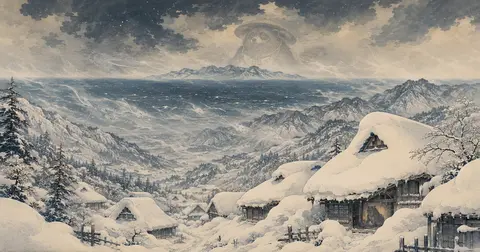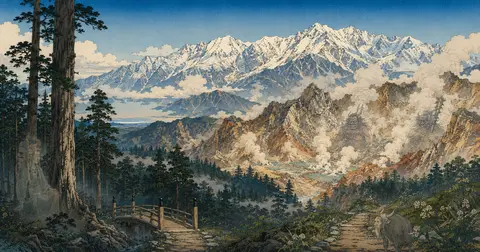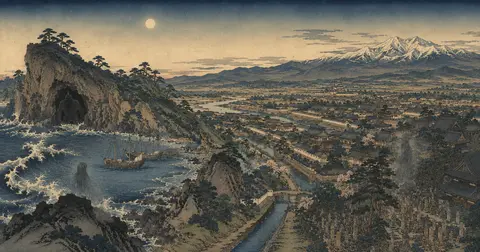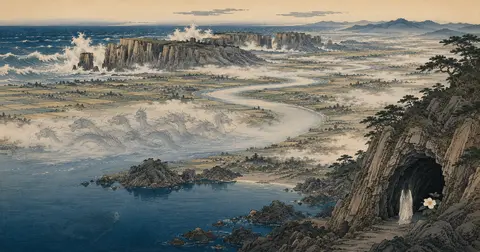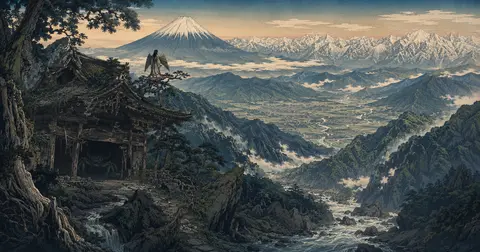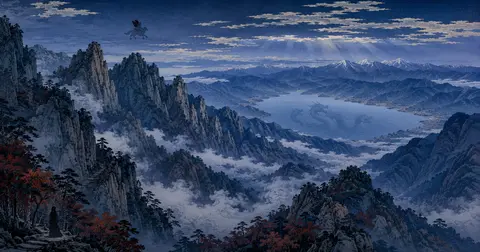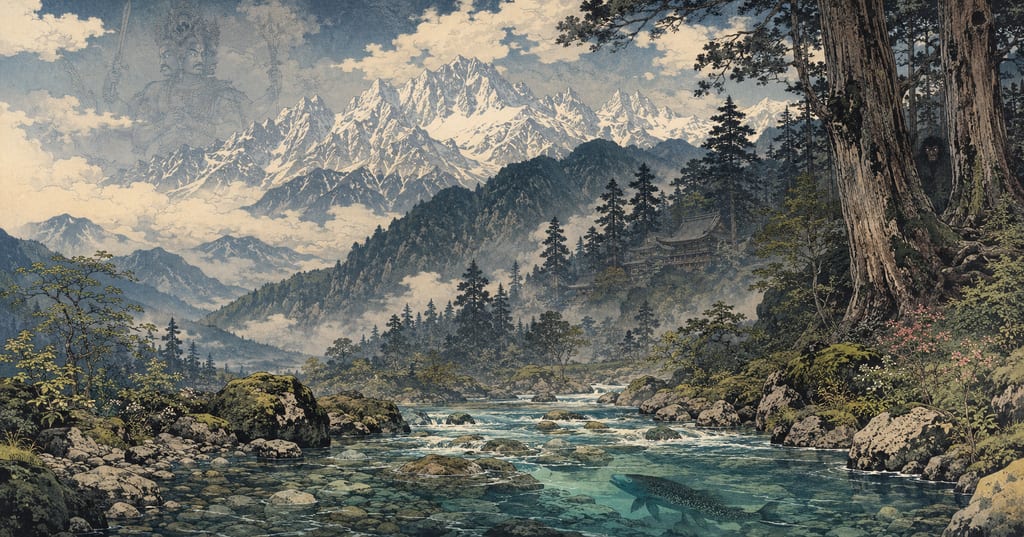
Located near the center of Honshu, blocked to the north by the white walls of the Northern Alps and nourished to the south by the waters of the Three Kiso Rivers, Gifu Prefecture is a land that binds together two ancient provinces with entirely different characters. The northern region of Hida is a province of deep mountains, lined with peaks reaching 3,000 meters in elevation, locked in snow, and lacking in flatlands. The southern region of Mino is a province of villages, where the fertile plains carried by the Nagara, Ibi, and Kiso Rivers spread out, bustling with traffic along highways and post towns. The yokai here directly reflect this duality of topography.
In the mountains of Hida dwell anomalies that transcend human reason. The two-faced Ryomen Sukuna, the mind-reading Satori, and the sacrifice-demanding Sarugami—all are existences from the "other side" that emerge from the depths of high peaks where humans cannot easily tread. On the other hand, in the villages and rivers of Mino, there are apparitions that question the ethics of daily life. The Iwana-bozu that admonishes against taking life, and the Tsurube-otoshi that drops from old trees at dusk. If the anomalies of the mountains are apparitions of "awe and terror," the apparitions of the villages are those of "admonition." This article traces the yokai culture of Gifu around the dual phases of Hida and Mino.
Anomalies of Hida:
Is Ryomen Sukuna a Rebel or a Hero?
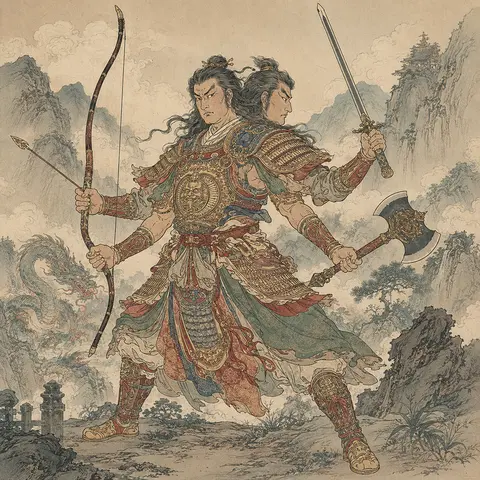
When discussing the yokai of Gifu, the first to stand out is a singular anomaly. With two faces turned away from each other on a single torso, each equipped with arms and legs, the Ryomen Sukuna is one of the few "anomalies" whose name remains in ancient Japanese historical records.
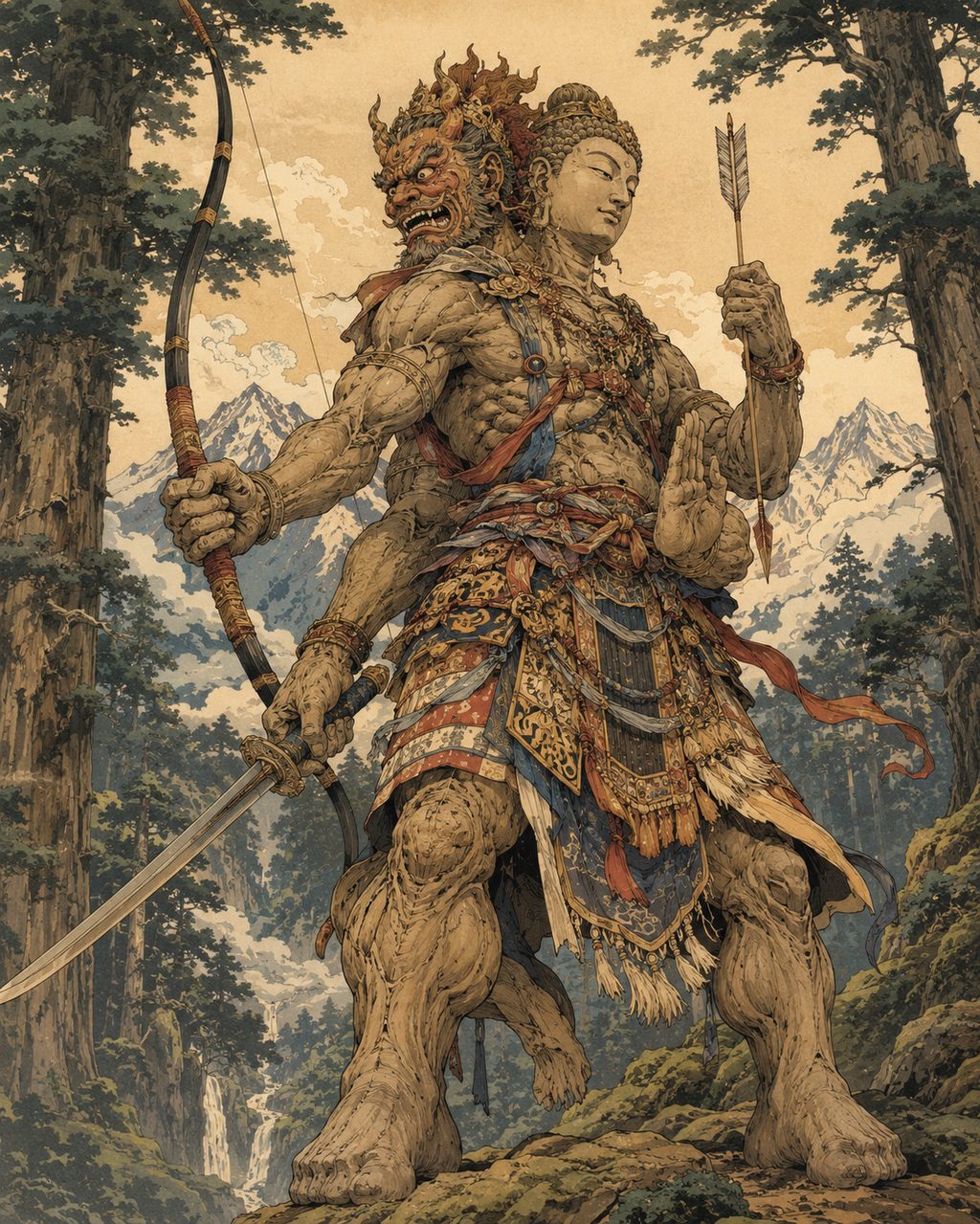
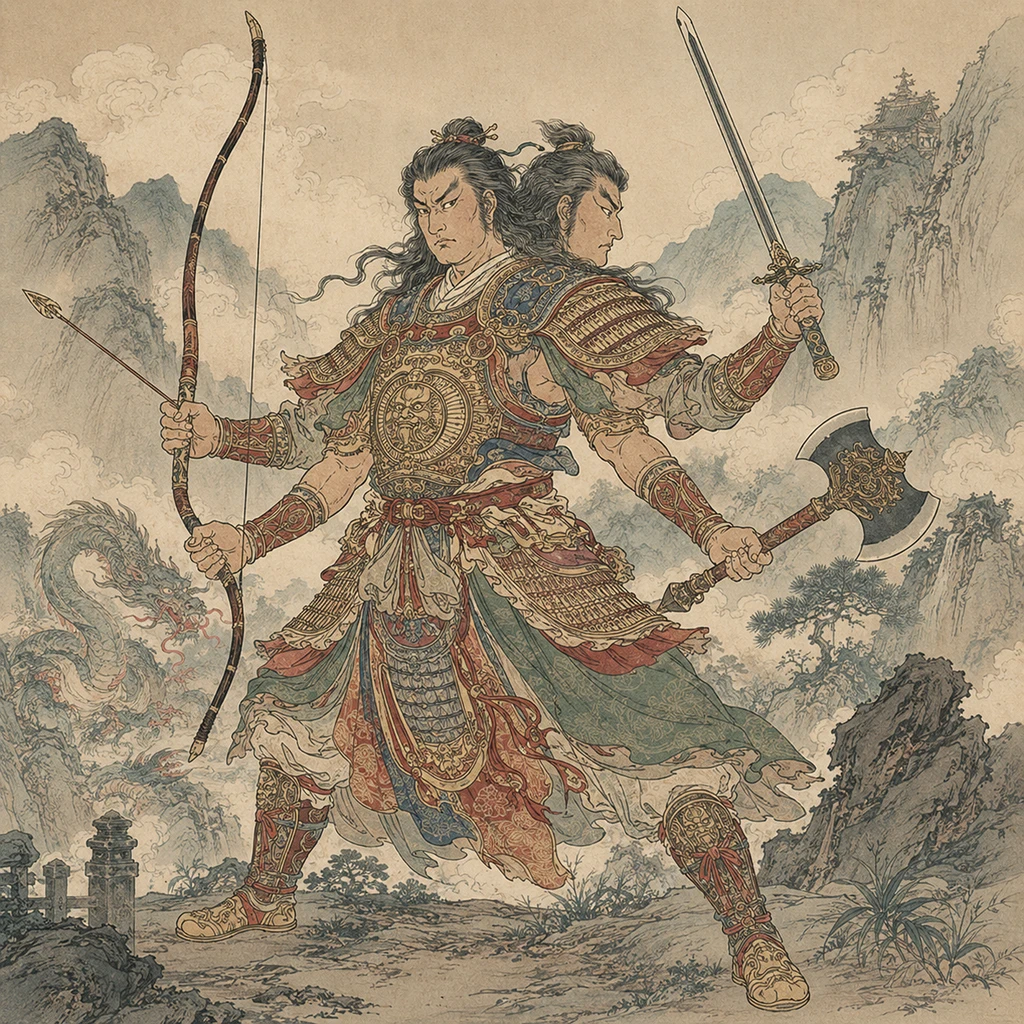
This figure is first described in the imperially commissioned official history, the *Nihon Shoki*, Volume 11, in the 65th year of Emperor Nintoku's reign[1]. It states, "There was one body with two faces, the faces turned away from each other," and depicts Sukuna wielding a bow and arrows with four hands and carrying swords on both hips. It even adds the inhuman detail that he had knees but no heels. The tone of the *Nihon Shoki* is cold—this anomaly was a rebel who disobeyed the imperial court's orders and plundered the people. Emperor Nintoku dispatched Naniwa-no-Neko Takefurukuma-no-Mikoto, an ancestor of the Wani clan, to defeat Sukuna.
Ryōmen Sukuna
Ryōmen Sukuna is an extraordinary figure from Hida Province described in the Nihon Shoki and remembered in later Hida and Mino traditions as a temple founder, guardian of Buddhism, and dragon-defeating hero. Often presented today as an oni or monster, the entry for the sixty-fifth year of Emperor Nintoku in Book Eleven of the Nihon Shoki merely says, “In Hida Province there was a man named Sukuna”; it does not call him an oni, demon deity, or brigand. It says that he defied the imperial command and delighted in plundering the people, and that Naniwa no Neko Takefurukuma, an ancestor of Wani no Omi, put him to death. The chronicle thus portrays him as an adversary of imperial authority. The brief entry describes his body with unusual specificity: one torso bore two faces turned away from one another; their crowns met, leaving no nape; and each had hands and feet. He had knees but no backs of the knees or heels. Strong and agile, he wore swords at his sides and used bow and arrows with four hands. Four legs are a widespread interpretation of “each had hands and feet,” but the text does not explicitly state their number. This must be distinguished from later images with two faces, four arms, and two legs, and from Zenkyūji’s tradition of two faces, four hands, and four legs. Hida Senkōji still tells of Sukuna opening its mountain sanctuary in Emperor Nintoku’s reign. Its official history says he opened an ancient place of prayer later established as a Buddhist temple by Prince Shinnyo. At Zenkyūji, an appearance account says Sukuna emerged from a cave and became Eleven-Headed Kannon. At Nichiryūbu-ji in Mino, he drove away a divine dragon that harmed the people, founded the temple, and left a cypress staff that became the “Thousand-Cypress Tree.” These portraits come from temples and local communities, not the Nihon Shoki. Neither the adversary of official history nor the protective hero of regional tradition can simply be declared the sole truth. They are separated by a long span of time, and the dates when temple traditions were put into writing also need scrutiny. Yet one name has been retold as an extraordinary figure killed by imperial authority, a founder associated with Kannon, a dragon-defeating hero, and an object of devotion carved by Enkū. The two faces do not assign good and evil neatly to opposite sides; they let us see the different memories that different eras and storytellers attached to one name.
Read moreHowever, upon descending to the land of Hida where these events took place, the image of Sukuna completely reverses. In Hida, Ryomen Sukuna is not a rebel to be defeated. He has been passed down as a hero who protected villages, imparted agricultural and civil engineering techniques, and exterminated a poisonous dragon. Senko-ji Temple[2] on Mount Kesa in Shimoho, Nyukawa-cho, Takayama City, transmits a temple legend naming Ryomen Sukuna as its founder and venerates him as an incarnation of Kannon. Nichiryubu-ji Temple in Shimonho, Seki City, also claims to have been founded due to Sukuna's merit in subduing the poisonous dragon of Mount Takasawa. The same Senko-ji houses over sixty Buddhist statues carved by Enku, a wandering monk of the early Edo period, and among them is a statue of Ryomen Sukuna carved by Enku's own hands.
The existence that the central official history recorded as a "defeated anomalous rebel," the local people have continued to venerate as the "founding hero who saved the village" for over a thousand years—this duality is the very paradox that embodies the name Ryomen Sukuna itself. Why is there such a stark divide in evaluation between the imperial court and the local region? One perspective is that Sukuna represents the memory of a local powerful clan in Hida that did not submit to the Yamato Imperial Court. While the conquering side recorded him as an "anomalous rebel," the conquered side continued to remember their leader as a benefactor. A single line written by the victors of history, and a faith preserved by the defeated. The two faces of Ryomen Sukuna are indeed the manifestation of these two perspectives fused together. The only undeniable fact is the existence of the *Nihon Shoki*'s description and the legends of various temples, while whether Sukuna was a real person or group remains to be reserved. But there is no doubt that this gap between rebel and hero lies at the core of Hida's narratives.
Visiting Sukuna's footprints in Hida, his heroic tales are surprisingly specifically etched into the land. Nyukawa-cho, said to be his birthplace; Senko-ji Temple, which holds the legend of his founding; Nichiryubu-ji Temple in Shimonho, Seki City, where he allegedly defeated the poisonous dragon—all of these are actual sacred sites in Hida and Mino that can be traced on a map. Sukuna is not a deity enshrined in a single place, but a memory dispersed and carved into the very land of Hida itself. The anomaly that was dismissed as "defeated" in a single line of central historical narratives survived for over a thousand years locally as temple legends, place names, and wooden statues carved by Enku. The two-faced appearance seems to have declared from the beginning the fate of this existence, which turns into either a rebel or a hero depending on the angle from which it is viewed. In recent years, the name has become widely known as a character in manga, and the number of worshippers visiting Senko-ji to see the Sukuna statue has increased, but it is surprisingly little known how deeply its roots spread in the mountains of Hida.
Apparitions That Read Minds in the Mountains:
Satori and Sarugami
The mountains of Hida were places where a person stepping in alone would immediately be forced to face their own mind. The isolation and fear gave birth to apparitions that read human minds.
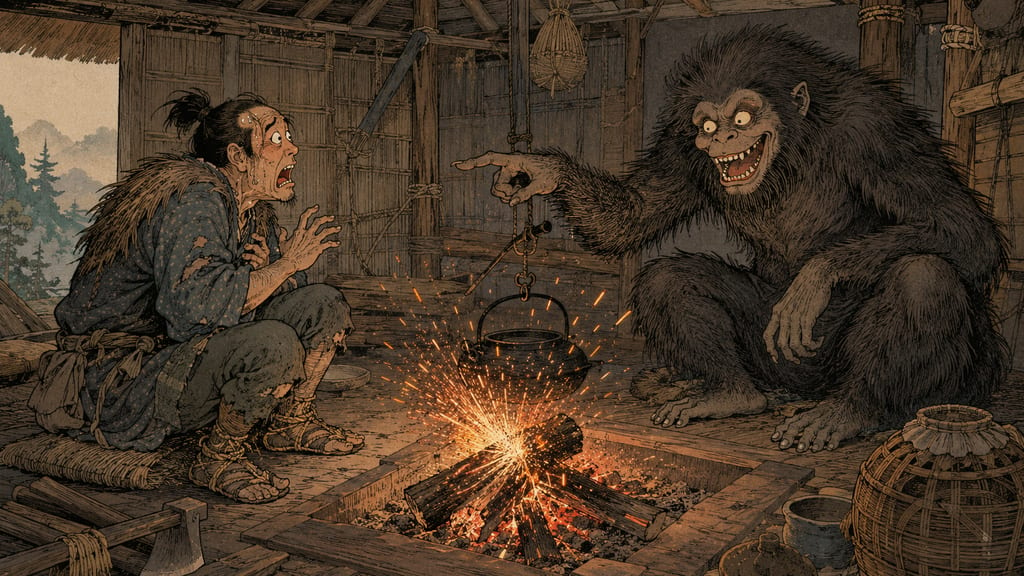
Satori is an apparition specifically focused on the single trait of "reading minds." Toriyama Sekien, a painter of the Edo period, wrote in his *Konjaku Gazu Zoku Hyakki*[3]: "There are *kaku* in the deep mountains of Hida and Mino. Mountain folk call them Satori. They are dark-skinned with long hair, can speak human words well, and can perceive human thoughts well. They do not dare to harm people." What is noteworthy is that Sekien explicitly named "the deep mountains of Hida and Mino" as the habitat of this apparition. Although Satori is a yokai passed down in mountains nationwide, its homeland was primarily identified as the mountains of Gifu.
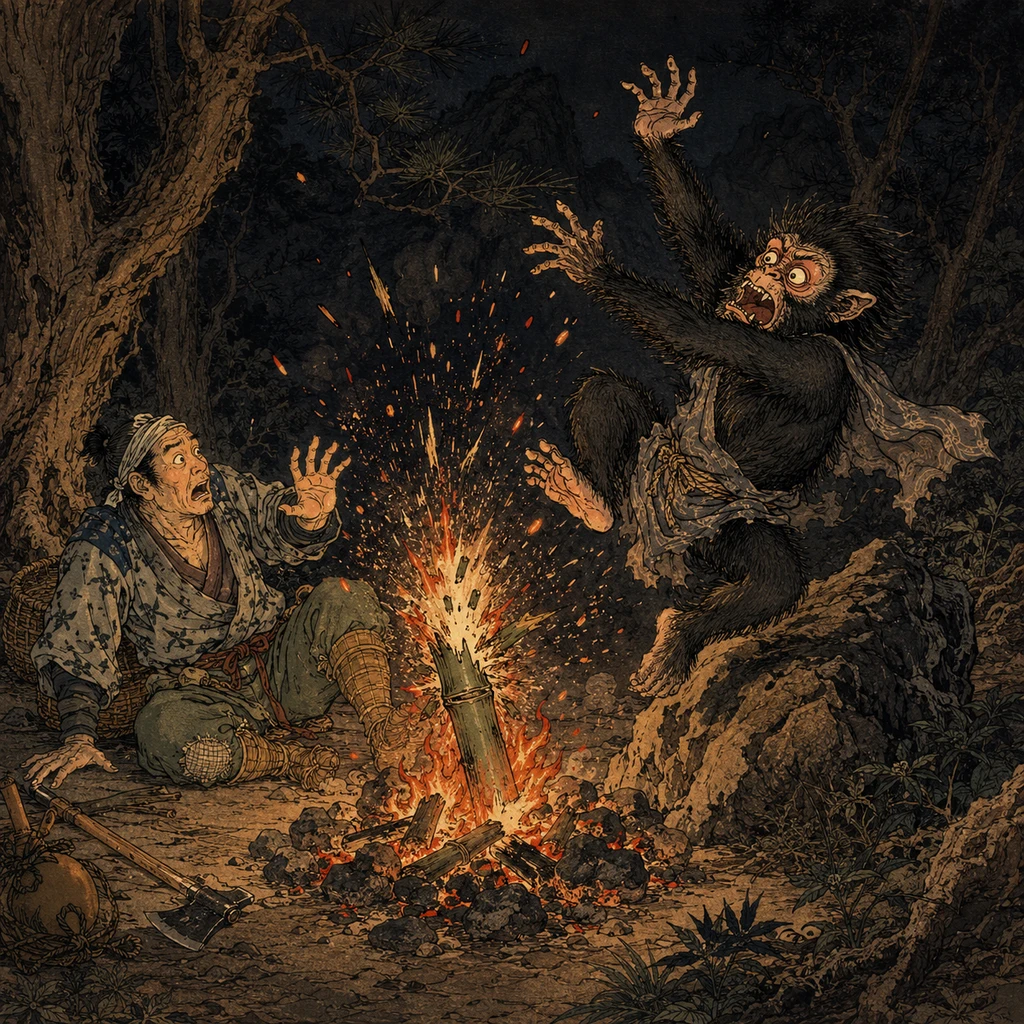
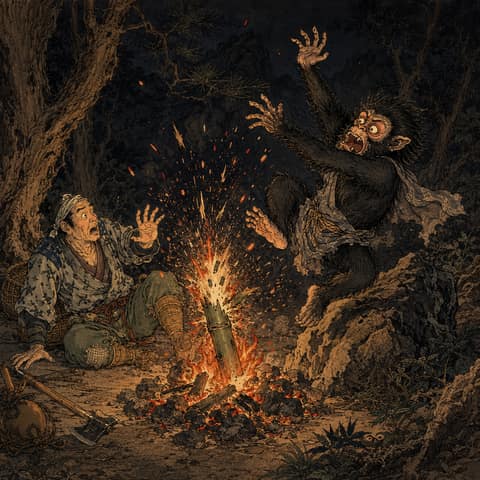
The narrative pattern surrounding Satori carries a somewhat sorrowful absurdity. A dark, hairy monster appears before a woodcutter or hunter staying in a mountain hut. When the man thinks, "Should I run away?", the monster predicts, "You are trying to run away." When he thinks, "Should I strike it with my ax?", the monster says beforehand, "You intend to strike me with your ax." Having all his thoughts read, the man is immobilized. However—a piece of firewood in the hearth pops, and a fragment accidentally flies at the monster. "You can read a person's mind, but you cannot read what is not in their mind." Surprised by the unexpected event, the Satori flees, leaving behind the words, "It is terrifying because humans do things not in their minds." An apparition of mind-reading that transcends human intellect is defeated by a human's unpredictable accident—in this reversal, the awe of the mountain and the resilience of humans who survive it coexist.
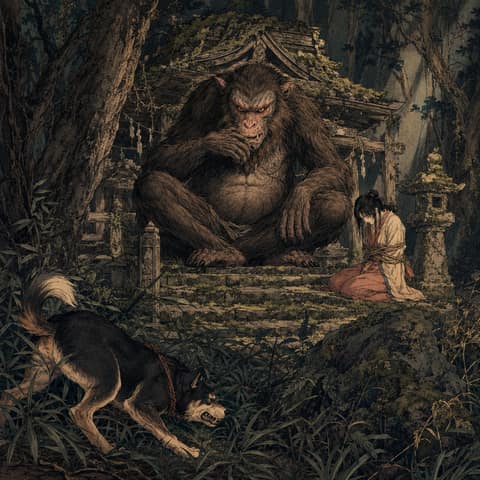
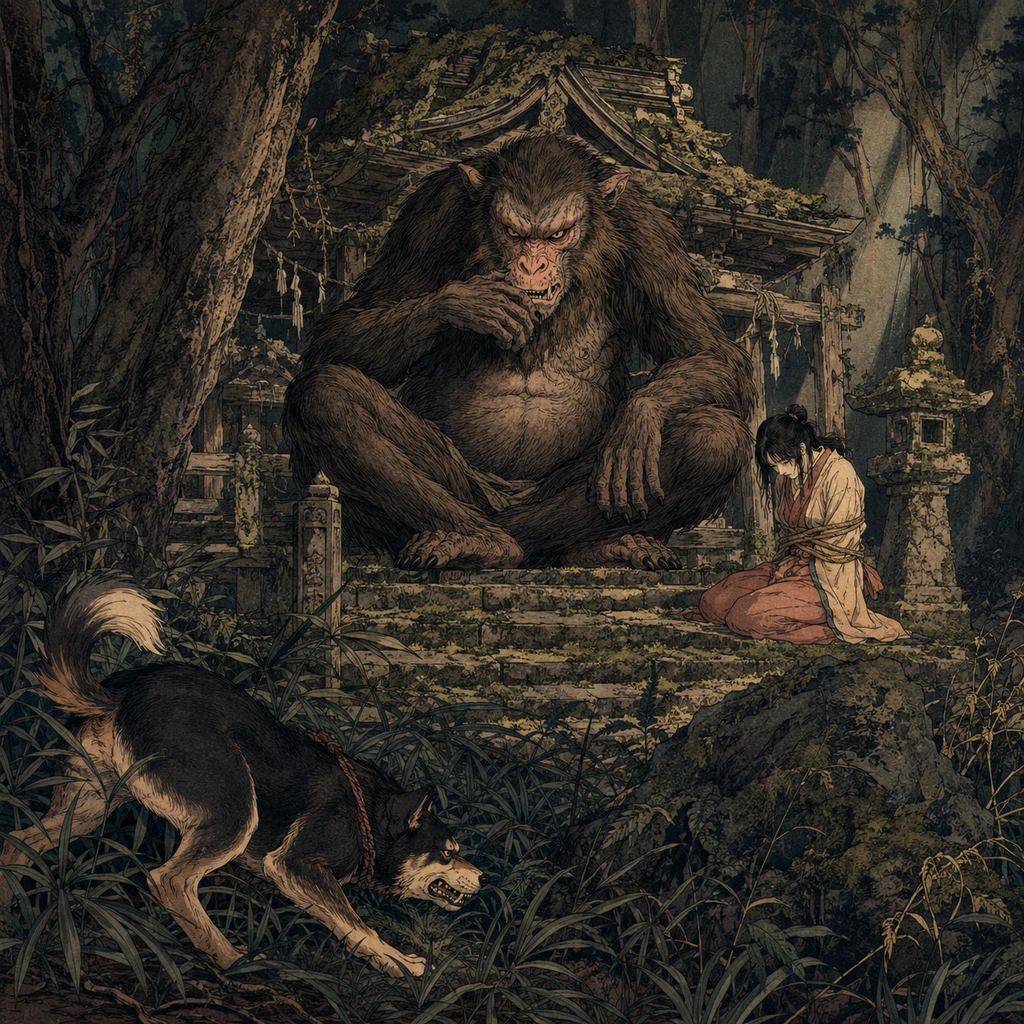
On the other hand, the Sarugami (Monkey God) was a mountain deity that took human lives much more directly. The late Heian period collection of tales, *Konjaku Monogatarishu*, Volume 26[4], contains a tale of human sacrifice set in Hida Province. What is noteworthy is that placed right before this—in the seventh tale—is the tale of the extermination of the Sarugami in Mimasaka Province[5]. In the Mimasaka story, a giant monkey, the deity of Mount Nakayama, demands a young maiden as a sacrifice once a year. A hunter from the eastern provinces arrives, brings dogs trained to defeat monkeys, takes the maiden's place in the chest offered as the sacrifice, jumps out to pin down the giant monkey, and finally ends the custom of human sacrifice. Dogs almost invariably appear in tales of monkey god exterminations—a sentiment flows at the base of this archetype that the only thing capable of countering the mountain god is the obedient beast closest to humans. The fact that the two tales of Sarugami from Hida and Mimasaka were compiled together in the same volume tells us that the ancient memory of human sacrifice was deeply rooted in the deep mountainous lands of this country.
The fact that Sekien called Satori with the character "玃" (kaku) also reveals the true nature of this apparition. "玃" is a character used in Chinese classics to refer to large monkeys, and Satori is often depicted as a dark, hairy monkey. The beast that most closely resembles a human in the mountains—the monkey. The setting that this monkey speaks human words and perceives human thoughts is a direct manifestation of the anxiety of the deep mountains where the boundary between human and beast blurs. The fear of having one's mind read by Satori is, ultimately, the sensation that "one's inner self is being entirely seen by the 'other' that is the mountain," a pure psychological anomaly experienced only by those who enter the mountains in isolation.
Both Satori and Sarugami are traces of the sensation of perceiving a "will that sees through the mind" or a "will that demands tribute" when humans step into the domain of the other that is the mountain. The deep mountains of Hida were feared not merely as terrain, but as an existence that stared back at humans. It is also suggestive that the same beast, the monkey, was spoken of in two ways: on the one hand as the mind-reading Satori, and on the other as the sacrifice-demanding Sarugami. Monkeys, possessing an intelligence close to humans, stimulated the imagination of mountain folk most strongly as ambivalent beings that could become either gods or apparitions.
Wind and Snow of Hida:
Kamaitachi,
Ichimokuren,
and Yuki-warashi
If mountain apparitions are "anomalies with a will," Hida has another lineage of belief that grasps "the forces of nature themselves" as gods or apparitions. These are wind, snow, and fire.
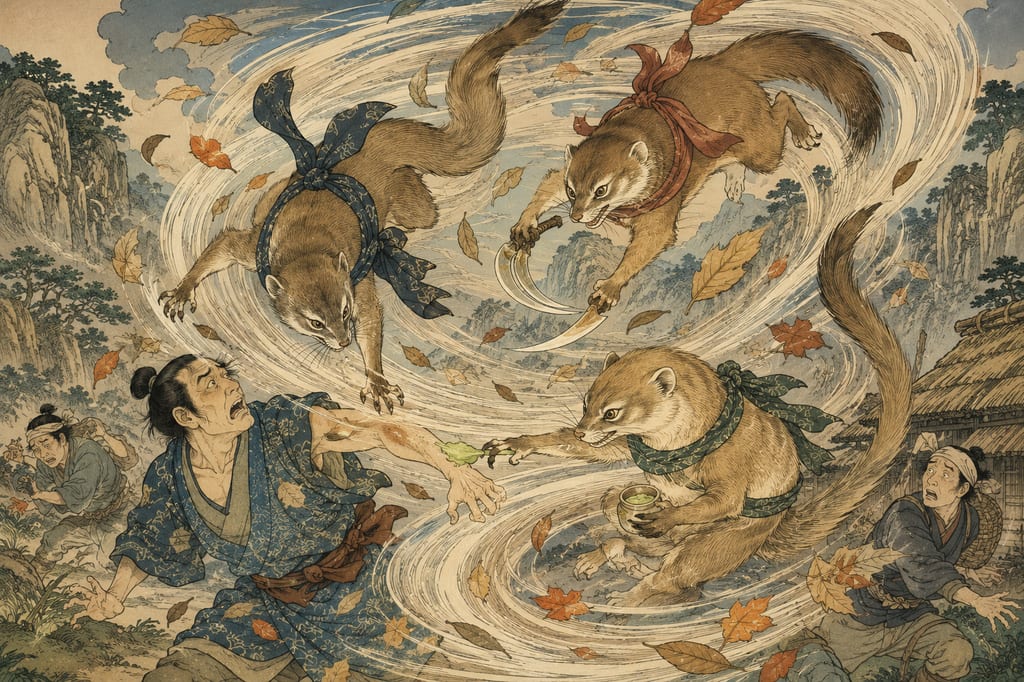
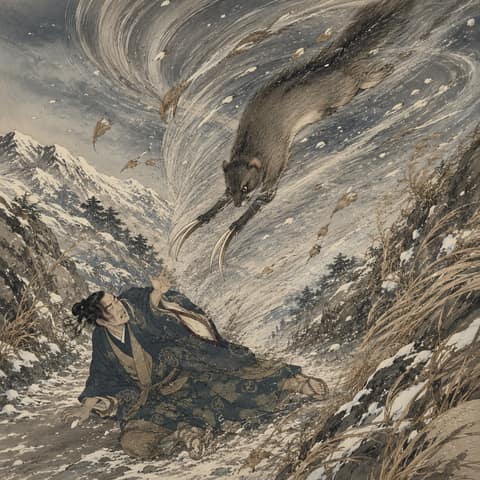
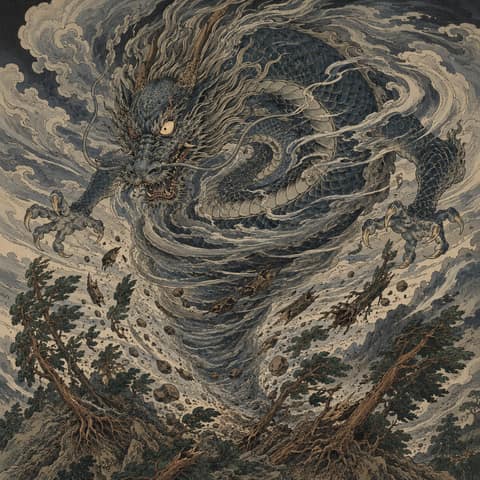
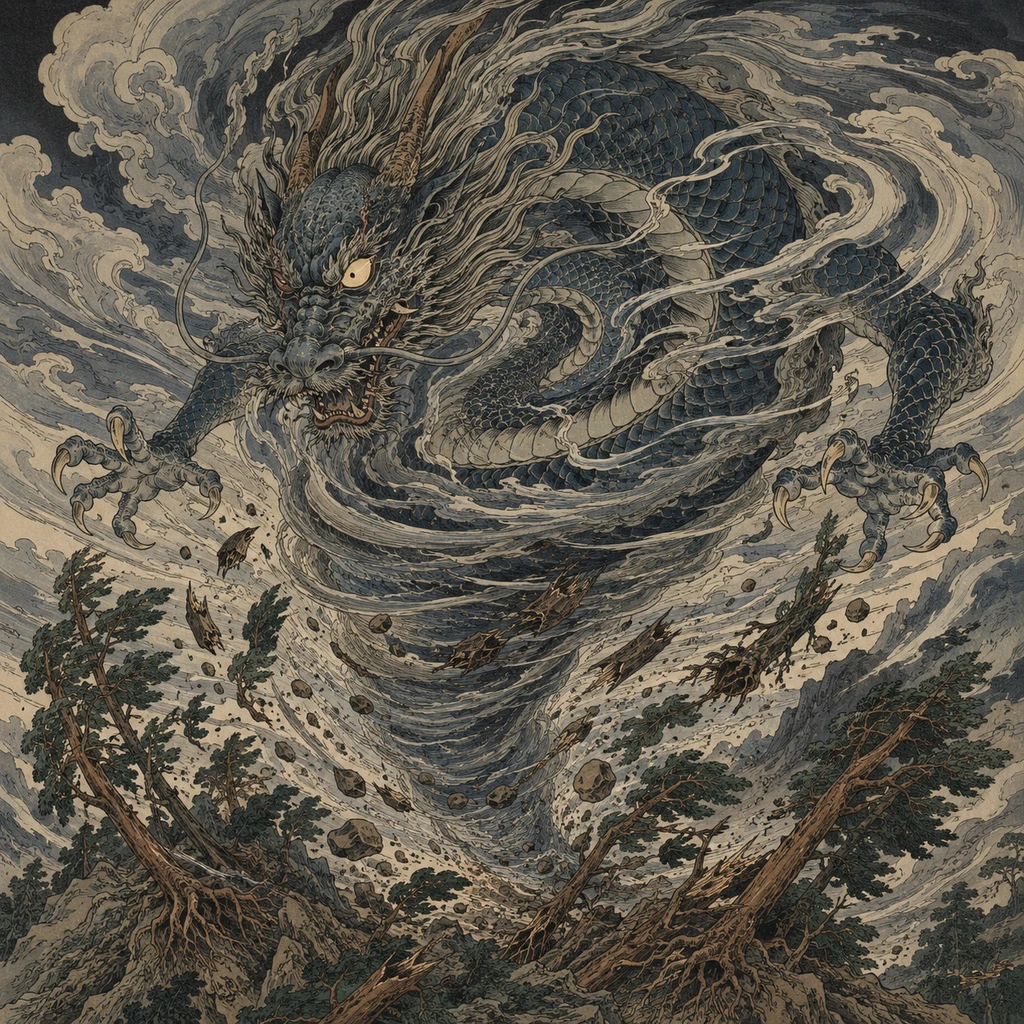
The Kamaitachi is an apparition that appears with a whirlwind and inflicts wounds as if cut by a sickle before one realizes it. While distributed nationwide, it was none other than the folklore of Hida that explained its true identity as "the work of a trio of gods." According to the theory of three deities in the Hida Nyukawa basin[6], there are three evil deities traveling together in a crosswind; the first deity strikes a person down, the second deity slashes with a blade, and the third deity immediately applies medicine—which is why the wound does not bleed or feel pain. This is a highly rational view of anomalies unique to Hida, precisely explaining the inexplicable phenomenon of a wound torn open unnoticed in a sudden whirlwind as a division of labor among deities. The use of the characters for "sickle weasel" (kamaitachi) is likely because the movement of the swiftly passing whirlwind evoked the agility of a weasel running across the ground with its slender body. Considering the topography of Hida, which has many localized gusts blowing down through valleys, it is natural that the sensation of viewing whirlwinds as the work of living creatures developed. In neighboring Shinshu (Shinano), the Kamaitachi was considered the work of a single evil deity, and a popular superstition passed down that stepping on a calendar would invite this disaster. Even though it is the same apparition, the cooperation of three deities in Hida versus the taboo of the calendar in Shinshu—the individuality of local imagination can be seen in how the explanation changes depending on the province.
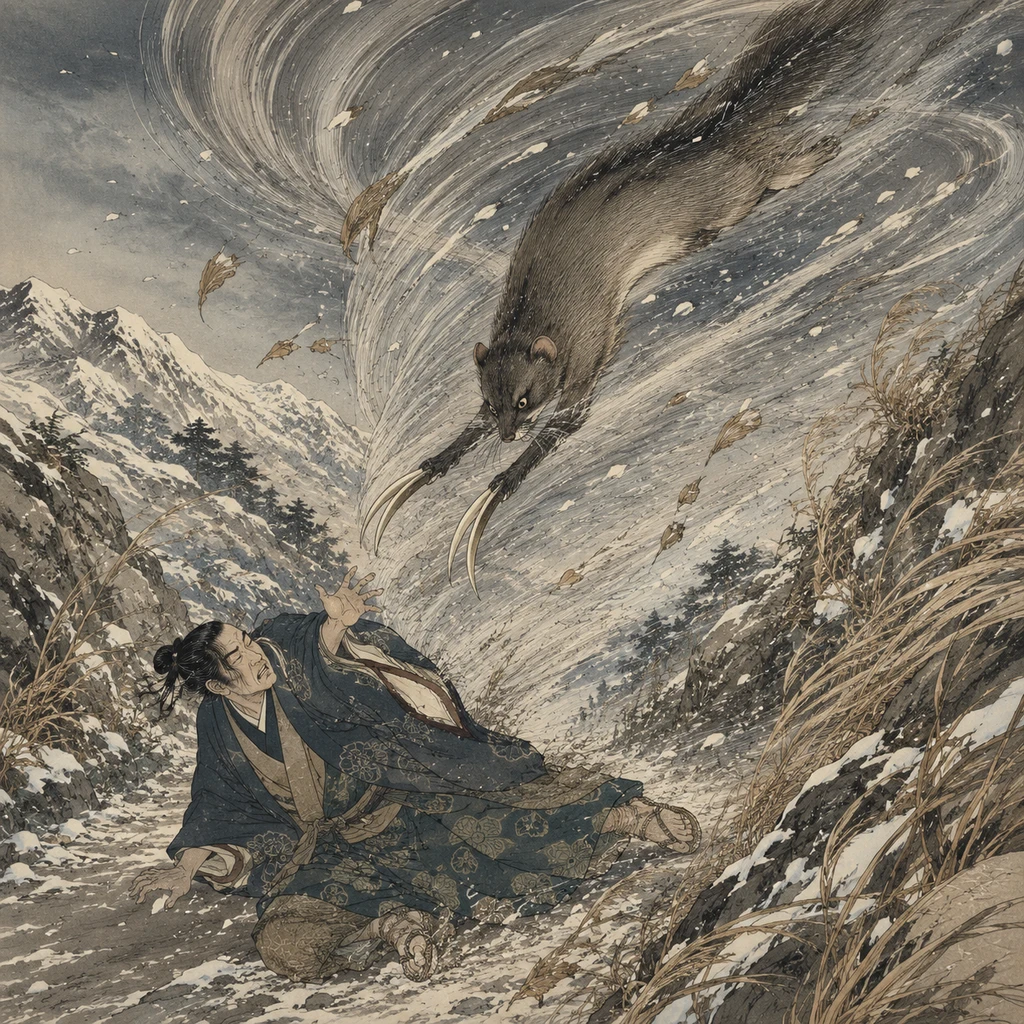
Kama-itachi
Kama-itachi are yokai said to ride dust devils or sudden whirlwinds, slicing human skin as if by a blade. Victims often feel little pain at first and may not bleed until later. From the Edo period on, they’re depicted as weasels with sickle-like claws, though explanations vary by region—some attribute the cuts to the phenomenon itself, to wind deities, or to minor spirits. The term is also a classical winter seasonal word.
Read moreThe belief in wind is also connected to the deity of blacksmithing. Ichimokuren is a one-eyed wind god and a blacksmith deity. Its origin lies in an ancient ancestral deity of blacksmithing called Ame-no-Mahitotsu-no-Kami[7], which later syncretized with Ichimokuren, a one-eyed dragon god, becoming a deity that governs wind and rain. Why is the blacksmith deity one-eyed? There is a pressing reality behind this. Ancient blacksmiths kept their eyes narrowed and focused on the fire to determine the color of the melting iron in the furnace, sometimes losing the sight of one eye to flying sparks and heat. The one-eyed deity is considered a deification of the physical price paid for that profession. Hida has historically been a land of the "Artisans of Hida" who provided craftsmen to the imperial court, and the iron sleeping in the mountains and the techniques of fire to forge it were deeply rooted. The wind fans the fire of the furnace, and the fire transforms the iron—Ichimokuren is a deity that embodies the chain of wind, fire, and iron in a single body. Incidentally, the headquarters enshrining Ichimokuren is the detached shrine of Tado Taisha in Ise Province, and there is no unique shrine inherent to the land of Gifu, but the concept of a one-eyed blacksmith deity resonates deeply with the iron and fire culture of Hida.
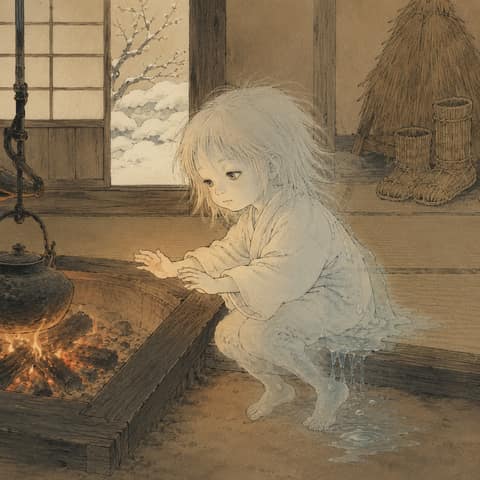
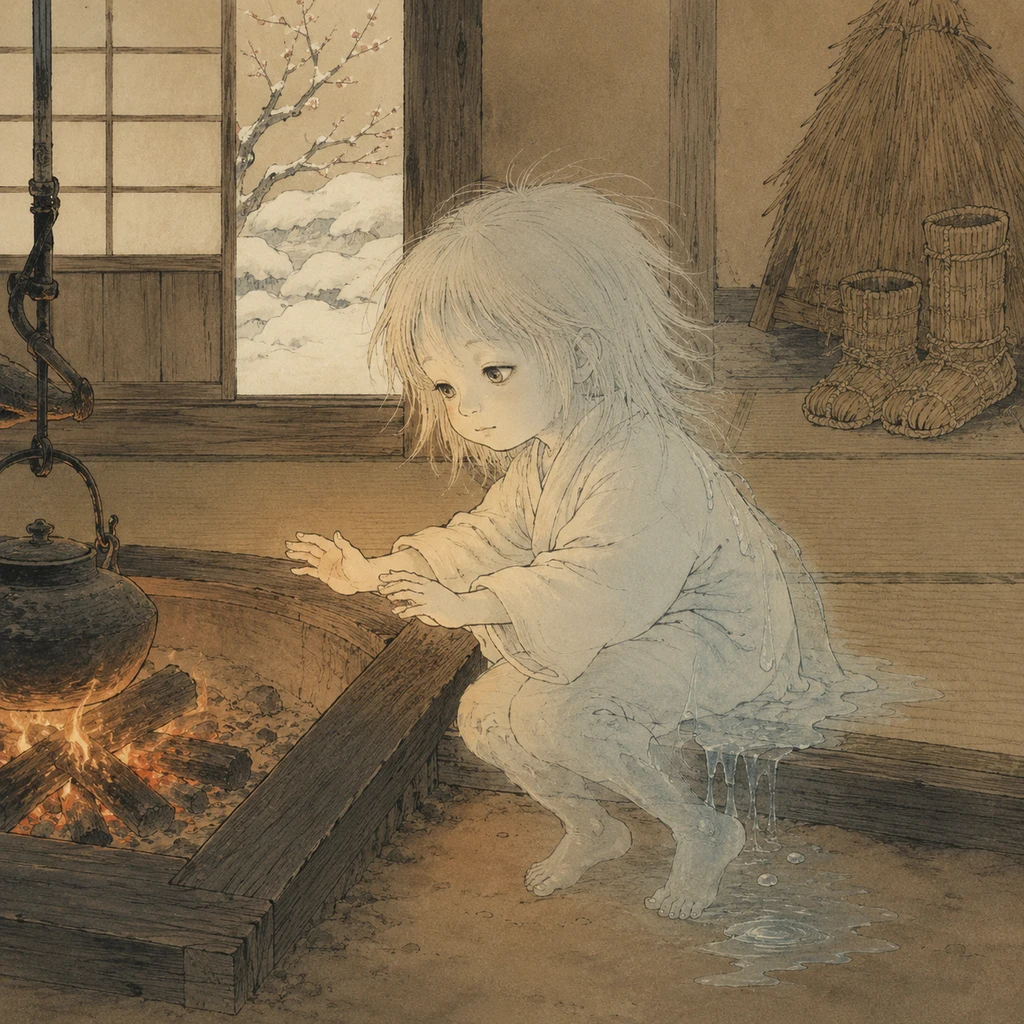
And then there is the snow. Hida, backed by the Northern Alps, is one of the heaviest snowfall areas in Japan, as represented by Shirakawa-go. The deep snowy winters gave birth to the Yuki-warashi (Snow Child). In the appearance of a young child wearing white snow garments, it is said to suddenly appear on snowy nights and wander around fields and houses. In the folktales of snow country[8], a sorrowful story is told: on the night a childless old couple made a doll out of snow, a real child appeared with the blizzard and was raised by the couple, but as spring approached, the child grew emaciated and vanished, only to return the following winter. The Yuki-warashi is said to be the child of the Yuki-onna (Snow Woman) or an incarnation of the winter god. Its appearance reflects both the fear and the affection that the people of the snow country, enduring long winters, entrusted to the snow. Since folklorist Kunio Yanagita recorded the traditions of snow spirits and mountain folk in *The Legends of Tono*[9], the existence of such winter children has been deciphered as the faith of deep snowy mountain villages.
Villages and Rivers of Mino:
Iwana-bozu and Tsurube-otoshi
Crossing the mountain passes to the south and descending to the villages and rivers of Mino, the character of the yokai completely changes. While the anomalies of the deep mountains were apparitions of "awe and terror," the apparitions of Mino question the "ethics" of human life.
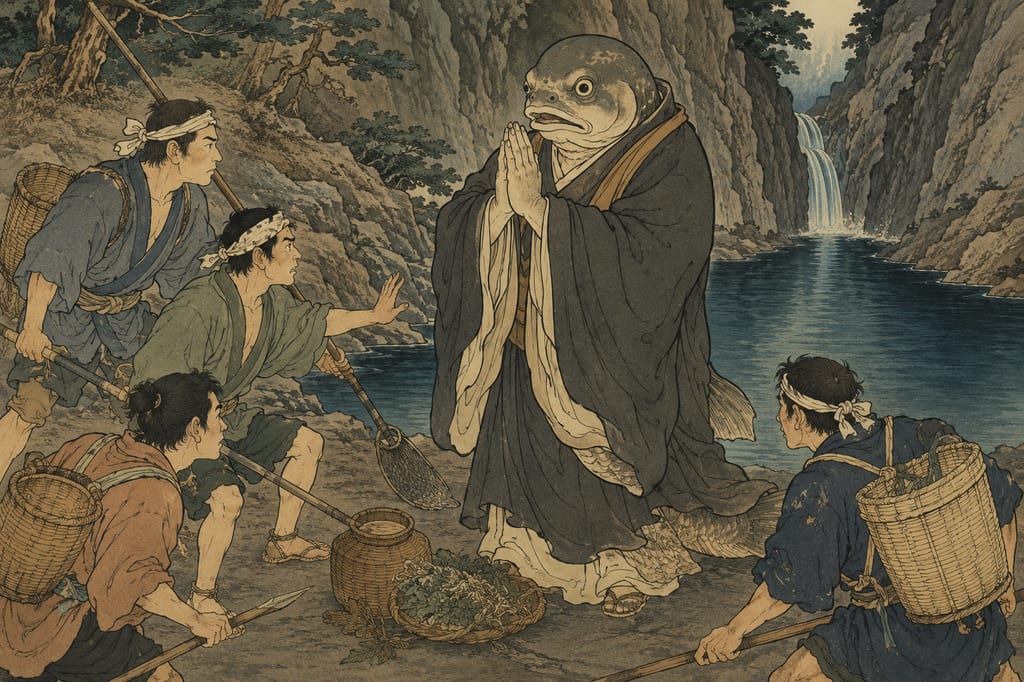
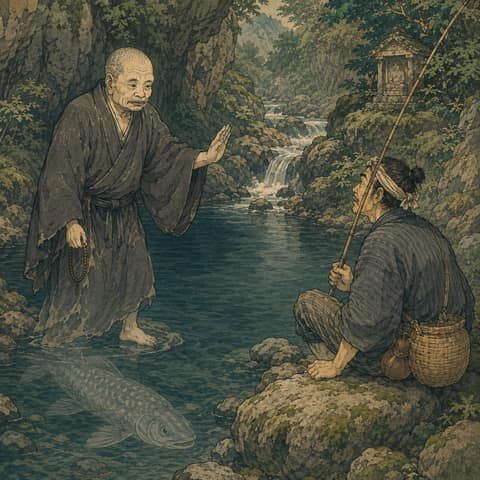
A representative of this is the Iwana-bozu. In the late Edo period, it was recorded as a tale passed down in Ena District, Mino Province—around present-day Tsukechi and Kashimo in Nakatsugawa City, Gifu Prefecture—in the essay *Soyama Chomonkishu*[10], published in the third year of Kaei (1850) by Soyama Miyoshi, an Owari clan samurai who favored strange tales. When the young men of a village were about to perform *dokumomi* (a fishing method of pouring poison into a mountain stream to catch all the fish at once), an unfamiliar monk appeared and began to preach earnestly to them to stop taking lives. The young men treated the monk to dumplings and rice to tide over the situation. However, the next day, when the young men started *dokumomi*, a giant *iwana* (char) as large as a human floated up showing its belly. When they cut open its belly—from inside came the dumplings and rice they had treated the monk to the day before.
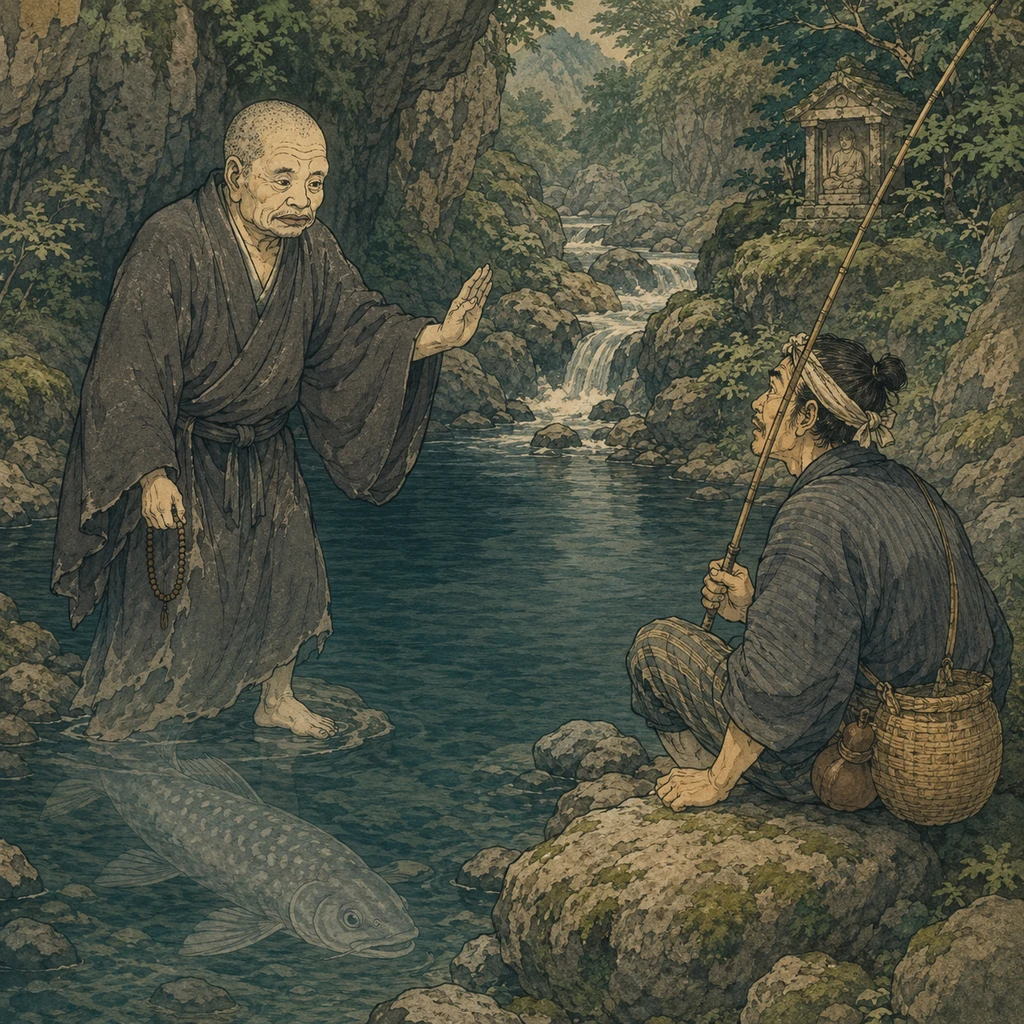
Iwanabōzu (Monk Trout)
Iwanabōzu is a waterside apparition said to be an aged, oversized char (iwana) that takes human form—often appearing as a Buddhist monk. It approaches anglers, scolds them for fishing on temple lands or chats amiably before leaving. Later, when a giant char is caught and cut open, rice, mochi, or other foods previously offered to the “monk” are found in its belly. Recorded in the Edo-period miscellany Sōzan Chobunki with an example from Ena District in Mino; similar tales are told in Fukushima, Tokyo, and elsewhere. The motif reflects awe toward water tutelary beings and a moral against needless killing.
Read moreThe true identity of the monk was the giant char dwelling in the abyss—the master of the river. A long-lived fish transformed into a human and, facing a crisis of its own life, came to preach the wrongs of taking life to humans. The beauty of this tale lies in the point that the transformed fish never curses humans, but merely quietly admonishes them. The Iwana-bozu is the embodiment of the river's ethics, combining the awe of the master dwelling in the depths of the abyss beyond human reach with the admonition against overfishing that indiscriminately takes lives.
Tsukechi and Kashimo in Ena District, the setting of this legend, were both villages in deep gorges carved by the tributaries of the Kiso River, and since ancient times had been lands of forestry and fishing producing high-quality timber and clear-stream char. *Dokumomi* is an efficient fishing method that kills many fish at once, but it is also an overfishing practice that roots out the ecology of the abyss. The fact that the story of the Iwana-bozu was told specifically in this region, explicitly naming the concrete fishing method of *dokumomi*, reveals the earnest self-admonition harbored by the villagers themselves who lived on the river's bounty. The apparition does not threaten, but merely preaches "do not kill," and dies leaving the treated dumplings in its belly—that modesty touches the hearts of readers all the more. Similar stories are told not only of char but also of yamame trout, eels, and cod, all said to be long-lived fish transformed. The fact that such legends of the "master of the abyss" grew so deeply in the lands from Mino to Hida, which hold many deep mountain streams, is a manifestation of the self-admonition of people who lived dependent on the river for their lives. As represented by cormorant fishing on the Nagara River, Gifu is a land with an exceptionally deep relationship between rivers and people. That gratitude and awe toward the river gave birth to apparitions like the Iwana-bozu.
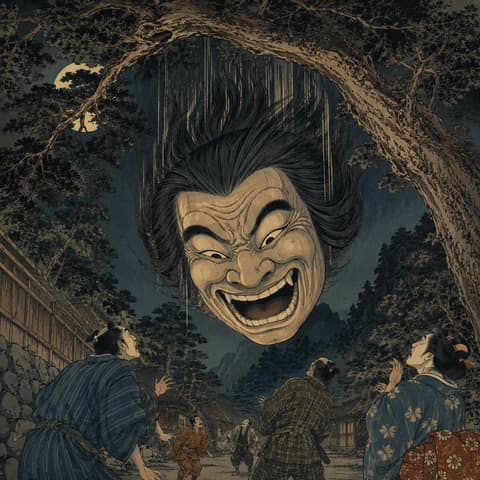
Another apparition passed down in the villages of Mino is the Tsurube-otoshi. This is an arboreal apparition widely known from the Chubu to Kinki regions, including Kyoto, Shiga, Aichi, and Wakayama. It hides in the treetops of large trees that are dim even in daytime, and when a person passes below, it suddenly drops down heavily, as if dropping a well bucket (*tsurube*). In the legend of Tsukumi, Kuze Village, Ibi District, Mino Province (present-day Ibigawa-cho)[11], it was said that the Tsurube-otoshi resided in the dim large trees of Tsukumi. Dropping down in the form of a giant severed head to startle people, and sometimes spoken of as devouring them, it is a purely threatening type of apparition.
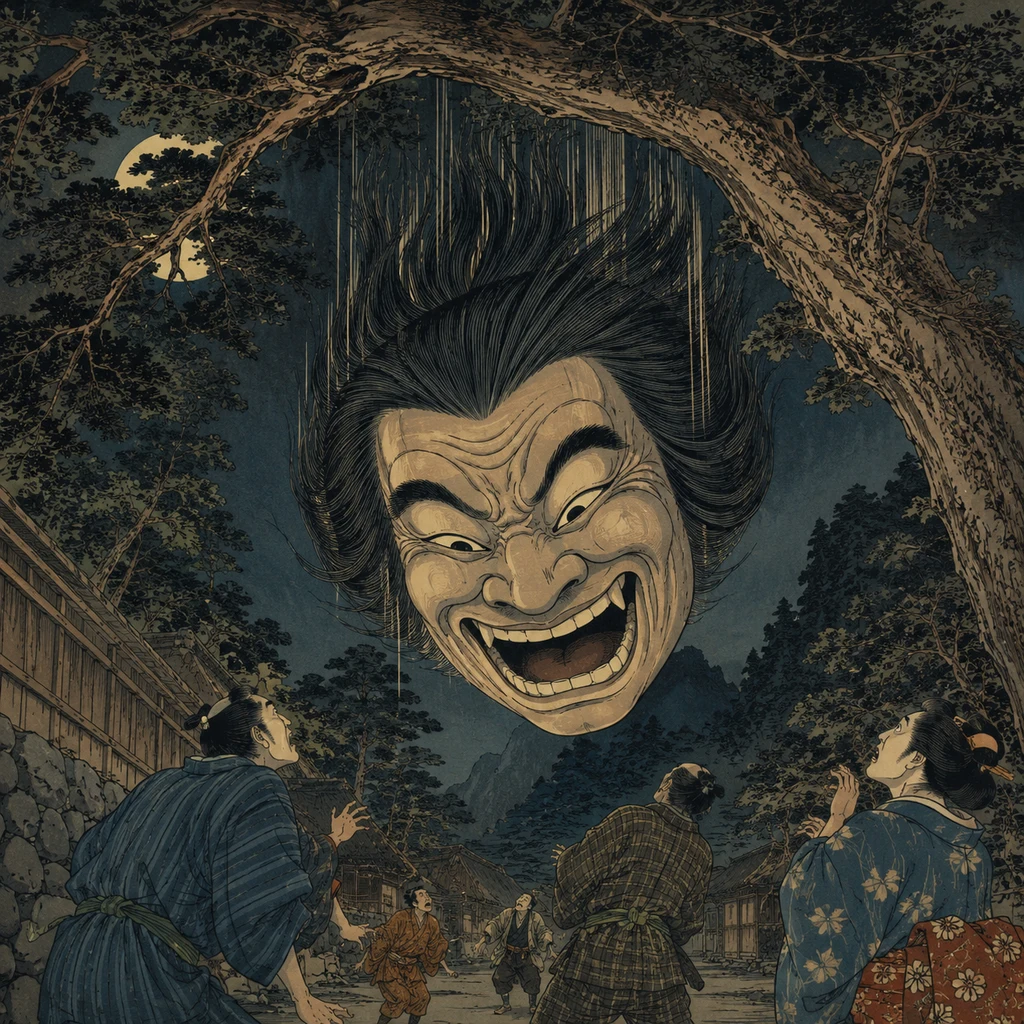
This Tsurube-otoshi is not a yokai exclusively harbored by Mino, but forms a corner of the distribution sphere of "apparitions dropping from trees" that continuously stretches through the adjacent Omi, Yamashiro, and Owari provinces. In the village of Sogabe in Kyoto, the Tsurube-otoshi drops from a kaya tree, laughs loudly, chants "Is the night work done? Shall I drop the bucket?", and climbs the tree again. Mino, connected to the capital by highways, was also a pathway through which the narratives of the Kinai region's anomalies transmitted eastward. While Hida was an isolated province separated from the outside world, Mino is a province of exchange where people, goods, and stories intersect—that geographical difference is directly etched into the lineages of their yokai.
Incidentally, regarding the Tsurube-otoshi, an important point has been made from the side of yokai research in recent years. While it is often circulated as a common view that the "Tsurube-otoshi" is depicted in Toriyama Sekien's art collections, it has become clear from checking primary historical sources that this yokai is not included in Sekien's *Konjaku Gazu Zoku Hyakki*[12], and that the Tsurube-otoshi is strictly a local apparition passed down as oral tradition in various regions. The fact that it was spoken of in connection with specific trees and lands, like Tsukumi in Ibi District, is precisely the original form of this yokai. The true value of the Tsurube-otoshi lies not in the brush of a named painter, but in the simple fear villagers felt looking up at large trees at dusk. The physical sensation of the people rushing through the dimness beneath the trees on an autumn evening when the sun sets as abruptly as a dropping well bucket must have directly become the name of this apparition.
Two Provinces,
One Yokai Culture
Hida and Mino. Isolated deep mountains, and open villages and rivers. The yokai of Gifu Prefecture grew in two lineages upon these contrasting landscapes.
In northern Hida, from the depths of high peaks that reject human approach, arose anomalies like Ryomen Sukuna, "willed mountain existences" like Satori and Sarugami, and "deifications of nature's forces" like Kamaitachi, Ichimokuren, and Yuki-warashi. These are generally crystallizations of fundamental awe toward what humans cannot control. In particular, the fact that Ryomen Sukuna continued to hold two faces—a rebel in the center and a hero locally—symbolizes the independence of Hida, which, being a frontier, was never fully subsumed by the central narratives.
In southern Mino, apparitions like the Iwana-bozu and Tsurube-otoshi were spoken of, standing close to the ethics and fears of human life. The master of the abyss admonishing against overfishing, the arboreal apparition striking at the carelessness of dusk—in these seep the daily admonitions and laughter of the village people who lived with the rivers and highways.
And between the two, there is the common winter of snow. The snow of the Northern Alps closes the mountain villages of Hida in white, and its meltwater fills the rivers of Mino to nourish the villages. Winter spirits like the Yuki-warashi grew in the heavy snowfall areas of Hida, but they were also symbols of the cycle where snow turns to water and descends to the villages. The awe of the mountains and the admonitions of the villages are by no means two unrelated lineages, but are connected by a single flow of water—this vertical axis of water and snow that pierces the province of Gifu from top to bottom might be the invisible spine connecting the two yokai cultures.
The awe of the deep mountains, and the admonitions of the villages. The yokai of Gifu encompass both within a single prefectural border. When walking the old streets of Takayama, looking up at the snow-buried gassho-zukuri houses of Shirakawa-go, or watching the bonfires of cormorant fishing on the Nagara River—deep within any of these sceneries, the presence of anomalies and apparitions passed down over a thousand years quietly breathes to this day. Just as the two faces of Ryomen Sukuna question us, here a single entity transforms into a rebel or a hero, a god or an apparition, depending on the angle from which it is viewed. Having embraced that wavering wholeheartedly is the greatest depth of the yokai culture of Gifu, which holds the two provinces of Hida and Mino together.