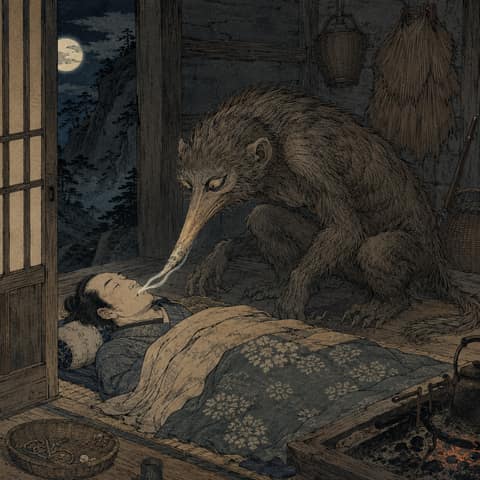
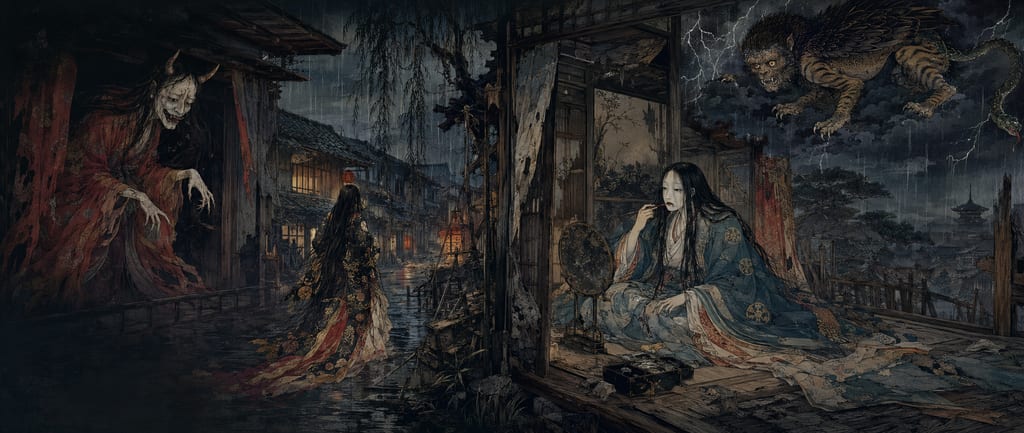
A mind-reading yokai recorded in the Edo-period scroll Konjaku Gazu Zoku Hyakki. Said to dwell in the remote mountains of Hida and Mino, it appears like a dark-skinned, shaggy, ape-like creature that understands human speech and speaks aloud a person’s inner thoughts. It does not wish to harm people, but if threatened with death it flees first. The creature has been linked to the "kaku/jué" (玃) of Chinese lore and to local tales of mind-reading mountain beings.
Folklore & Legends
Across Japan there is a folktale type known as “Satori no Wappa,” in which a traveler meets an ape-like monster—sometimes a mountain man, tengu, or tanuki—that unnerves them by voicing each thought as it arises. In many versions the creature is startled and driven off by an unexpected sound, such as bamboo popping in the campfire. Images like the dark boy in Wakan Sansai Zue and Sekien’s depiction helped popularize the satori as a mind-reading mountain yokai, though details vary by region.
A simian-form apparition modeled on Sekien Toriyama’s Konjaku Gazu Zoku Hyakki entry and natural-historical notes in Sino-Japanese texts. It appears on remote mountain paths, instantly voices the thoughts of woodcutters and travelers, and gauges their behavior. Disinclined to harm humans, it withdraws swiftly when sensing danger, in line with Sekien’s text. In folktales its figure varies by region—monkey, mountain man, tengu, or tanuki—but its core is “mind reading” and retreating at sudden noises. Its mind reading mirrors the other’s thoughts and repeats them, closer to a warning than provocation. It reads presences in mountain stillness yet proves vulnerable to the unexpected—sparks from a campfire or a flying splinter. The name Kakku is linked to the character 玃 through phonetic conflation, from which an independent yokai image emerged. Traditions span Chubu to Kanto, Tohoku, Chugoku, and Kyushu, telling of a being that measures the boundary between people and the otherworld in the mountains.
Character Profile
This section is our own creative profile for storytelling. It is not historical fact or scholarship.
The diagram below is a diagnostic evaluation chart for Traditional Version: Kakku of Hida and Mino. The higher the value of each item, the stronger that characteristic is expressed.