Yokai Encyclopedia

Encyclopedia of Japanese Yokai

56 Yokai|14 Category|Page 1 of 3
Localization in Progress - More content available in Japanese version
View Japanese
Sort by: NameAscending
山野の怪
  • Aburasumashi

    Aburasumashi

    Rare

    あぶらすまし

    The Voice of Kusazumigoe: Aburasumashi

    Apparitions of Mountains and FieldsKumamoto

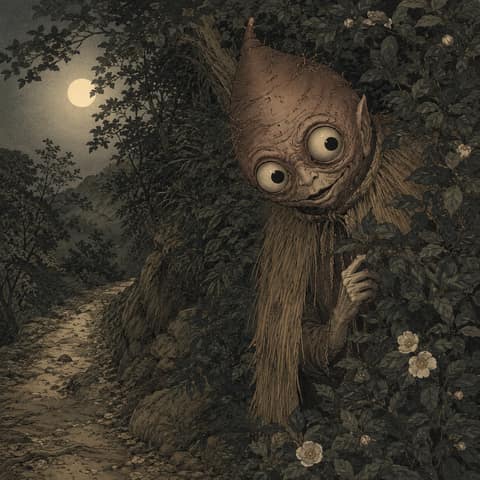
    The core of the aburasumashi is not its "appearance" but its "response." The moment someone mentions a rumor about it at the pass, it replies, "I still appear now" ── the very act of speaking becomes a summoning. It is a yokai that possesses words. The imagery of the straw raincoat, hat, and potato head was a later creation popularized by Shigeru Mizuki; the original Amakusa lore was purely about a voice and a presence. The backdrop to this legend is the local lifestyle of pressing "katashi oil" from the seeds of camellias and sasanquas in Amakusa. A leading theory suggests that the warning against those who stole or wasted the scarce oil crystallized into the shadow of a figure carrying an oil bottle in the darkness of the pass, sharing a lineage with oil-related apparitions like Aburabo and Aburabozu across Japan. While linking the nameless stone statue at Kusazumigoe in Sumoto to its "grave" is a modern reinterpretation, it serves as an excellent example of local memory coming to inhabit a physical object.

  • Atago-san Tarōbō

    Atago-san Tarōbō

    Legendary

    Atago-san Tarōbō

    Supreme Commander of the Tengu — Atago-san Tarōbō

    Mountain & Wilderness SpiritsKyoto

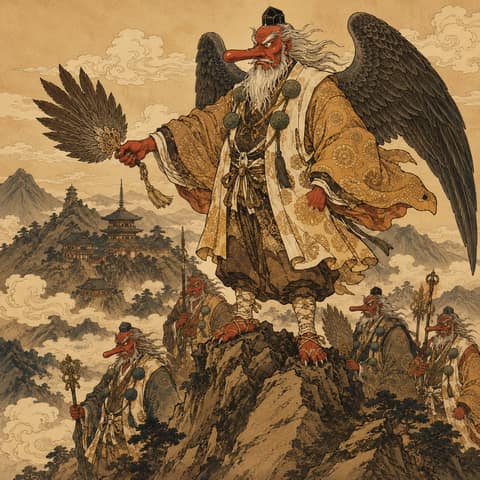
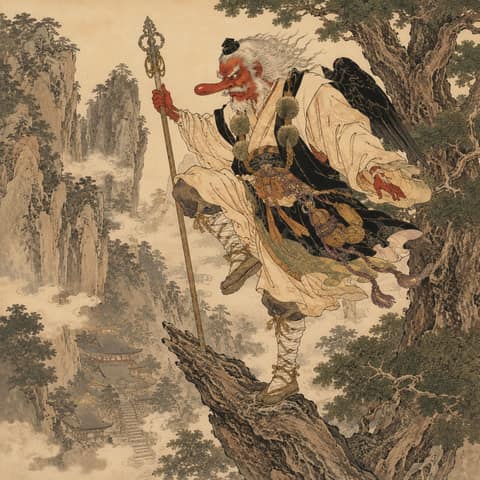
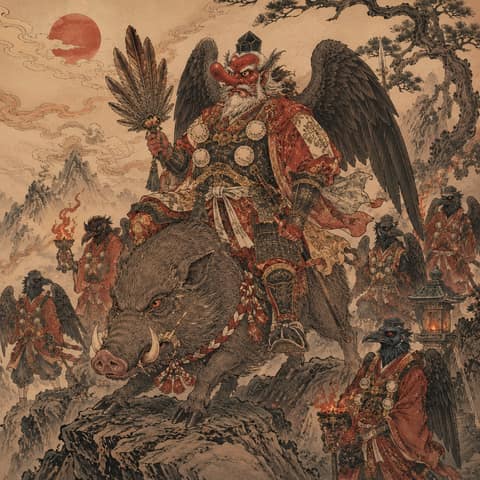
    What made Atago-san Tarōbō "the supreme commander of the tengu"? The question lies in the overlap between the history of the Atago cult and the figure of this single tengu. As a sacred mountain of fire-warding, Mt. Atago was the center of the Atago Gongen cult, syncretized with its original Buddhist form, Shōgun Jizō. The Hakuun-ji engi, which transmits its founding, tells of the ascent of En no Ozunu and Taichō, the shrine on Asahi Peak, and the syncretism with Shōgun Jizō. Shōgun Jizō is an armored Jizō mounted on horseback, joining victory in war with protection from fire. Bearing the numinous power of this Atago Gongen, Tarōbō took on the character of a thaumaturge and guardian deity surpassing any mere mountain apparition. The star-anise flower against fire, the talismans above each hearth, the Atago confraternities (kō) across the land—this density of folk practice was the foundation that raised Tarōbō to the summit of the tengu of every province. The oldest-class textual witness to his proper name is found in the Engyō-bon Tale of the Heike (transcribed 1309–10), where he appears as "the foremost great tengu of Japan" and "Tarōbō of Mt. Atago." As to his identity, the theory in the Genpei Jōsuiki of the fallen Shinzei (Kakimoto no Ki Sōjō) is renowned; but Shinzei was a man of the early Heian period, and since the dates do not match the era the Jōsuiki sets, this is an undeterminable "tradition." It should be read as a tale that lays over Tarōbō the Buddhist notion that arrogance casts a high monk down into a tengu, and his origin cannot be fixed to a single source. His standing as supreme commander is attested by both the performing arts and the scriptures. The Noh play Kurama Tengu of the Muromachi period chants the great tengu of the provinces in geographical order, and the early-modern Tengu-kyō arrays the forty-eight tengu and places Tarōbō at their head. The image of him leading a retinue of crow-tengu and commanding the lords from Hira-san Jirōbō downward rests upon this accumulation of medieval tengu tales. An iconography of him armed and astride a boar is also transmitted, yet his essence lies in being a Gongen-like presence enthroned on the peak, guarding the sacred precincts across Yamashiro. Chigiri Kōsai of tengu scholarship likewise set Tarōbō at the apex of the great tengu of all the mountains.

  • Borrowed Sieve Hag

    Borrowed Sieve Hag

    Uncommon

    mee-KAH-ree bah-BAH

    Lore-Faithful Edition

    Mountain & Wilderness SpiritsKanagawa

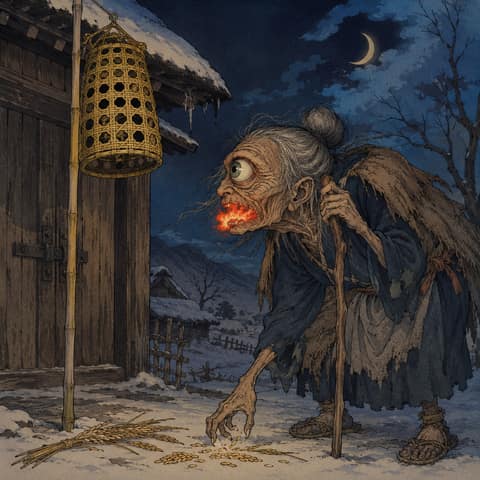
    A整理 of the Mikari-bā (Mikakari-bā) yokai as preserved in folklore. She appears on Koto-yōka (the eighth days of the month) as a one-eyed crone, enforcing restraint on housework and outings. Her act of “borrowing” winnowing baskets and human eyes links to avoidance of mesh-patterned tools and symbols with many eyes, giving rise to countermeasures like placing baskets or sieves at the gate, or fixing a mesh basket to a pole on the roof ridge. In the Kōhoku, Yokohama accounts, her greed extends to gleaning even fallen ears of grain, and depictions of her carrying fire in her mouth serve as a caution against conflagration. In southern Chiba, customs of taboo and house-seclusion called “Mikari” (body-substitution) recast pre-festival liminality as a yokai rule. Despite regional variation, these tales share a framework that transmits norms of household safety, fire prevention, and labor abstinence at seasonal thresholds from winter to spring. Creative embellishments are set aside in favor of points attested in Kanto eyewitness reports and folklore records.

  • Bunagaya

    Bunagaya

    Uncommon

    ぶながや

    Bunagaya, Forest Spirit of Yanbaru

    Mountain and Field ApparitionsOkinawa

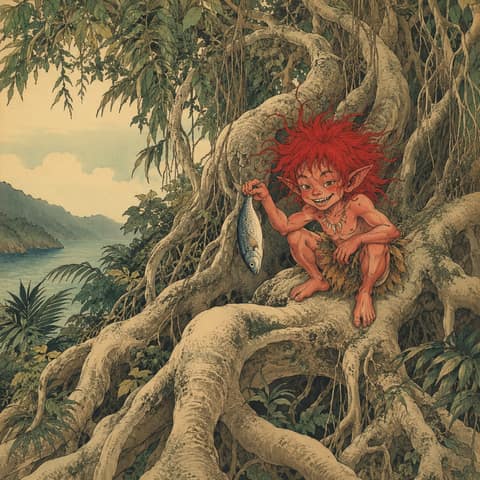
    The Bunagaya is a red-haired spirit dwelling in the deep forests and mountain streams of Yanbaru. Appearing as a semi-naked child, it lights fires (Bunagaya fire) in the mountains at night, and people would once test their courage by going to view these flames in a custom known as *arami*. While closely related to the [[yokai:kijimuna]], which resides within ancient trees, the Bunagaya is distinguished by being a master of the forests and rivers themselves, as well as by its ability to manipulate fire. It loves sumo and catching fish, and although it is known to trick humans, it readily curses those who harm its trees. Today, Ogimi Village embraces this red-haired spirit as the symbol of the "Village of the Bunagaya."

  • Doro-danbō (Mud Rice-Field Wraith)

    Doro-danbō (Mud Rice-Field Wraith)

    Rare

    DOH-roh-dahn-BOH

    Sekien Iconography Conformant Edition

    山野の怪Uncertain (Toriyama Sekien notes “the northern provinces”); otherwise Japanese folklore

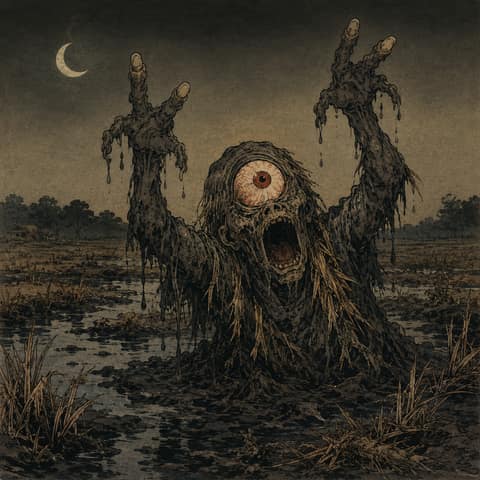
    This version adheres to Toriyama Sekien’s image and brief note, centering on a one-eyed, three-fingered figure rising upper-body first from a muddy paddy. It avoids expanding later folkloric claims and emphasizes allegory. It appears as a voice rebuking impiety and neglect of farming after fields are sold off, standing by the paddy ridge at night and repeating in a low voice, “Return the fields.” Given the scant early modern corroboration, this is a reconstruction mindful that Sekien may have intended wordplay and social satire, without asserting ties to specific places or people. Visual traits include a mud-smeared monk-like upper body, a single eye, a wide mouth, and three-fingered hands.

  • Escorting Sparrow

    Escorting Sparrow

    Uncommon

    oh-KOO-ree soo-ZOO-meh

    Systematized Folklore Edition

    Mountain & Wilderness SpiritsWakayama

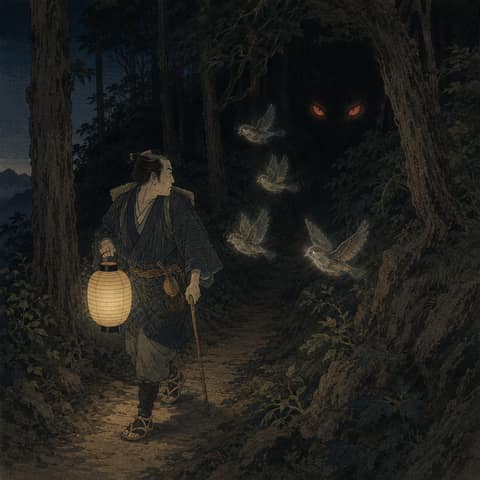
    Okuri-suzume has been framed as a harbinger and ill omen warning of dangers on mountain roads. Its calls precede, and are said to lead into, appearances of wolves or the escorting wolf, forming a narrative that encourages careful footing and avoiding delays in the wilds. The name “kuzusuzume” aligned with the real bird Black-faced Bunting (Aoji) is recorded, though its supposed nocturnality is debated. Sightings of its form are scarce, leaving its appearance unsettled, and in parts of Nara it is conflated with the night sparrow. Stories place it around Myohosan in Wakayama, and it is said to draw near lantern light. More than a threat itself, the lore centers on its “foreboding call,” giving it a strong character as a sound-based apparition.

  • Female Tengu

    Female Tengu

    Uncommon

    OHN-nah TEN-goo

    Annotated Tradition Edition: Female Tengu

    Mountain & Wilderness SpiritsTokyoYamanashi

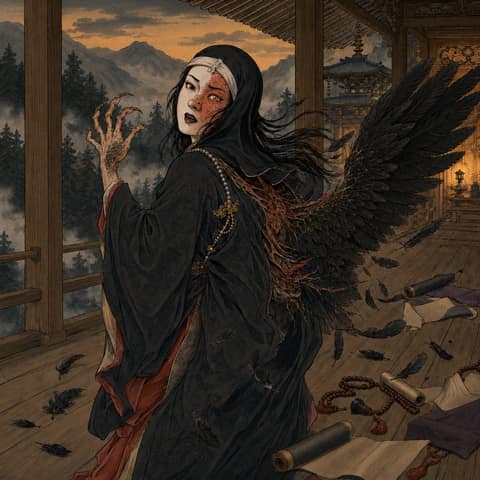
    The Female Tengu is a strand within the broader image of tengu sporadically referenced in texts and oral lore. She is depicted in women’s attire such as kosode, light robes, or scarlet hakama, yet her back-borne wings and supernatural power mark her as a tengu. In The Tale of the Heike and its offshoots, the nun-tengu appears as a metamorphosis born from religious decline, providing a female counterpart to the monk-tengu. Edo-period mountain-encounter tales often stress prohibitions against women, noting the absence of female tengu, while river-tengu lore sporadically mentions married pairs or feminine features. Claims tracing their lineage to the goddess Amanozakoyahime appear in early modern natural-history writings but remain interpretive rather than doctrinal. Regional variation is great and no single image dominates, yet they share the general tengu attributes of might, illusion, and flight. Stripped of creative exaggeration, the Female Tengu is best seen as a projection of womanhood within the tengu world, with specific names and genealogies largely unknown.

  • Five-Limbed Face

    Five-Limbed Face

    Rare

    goh-tai-MEN

    Iconographic Tradition Version

    Mountain & Wilderness SpiritsJapanese folklore

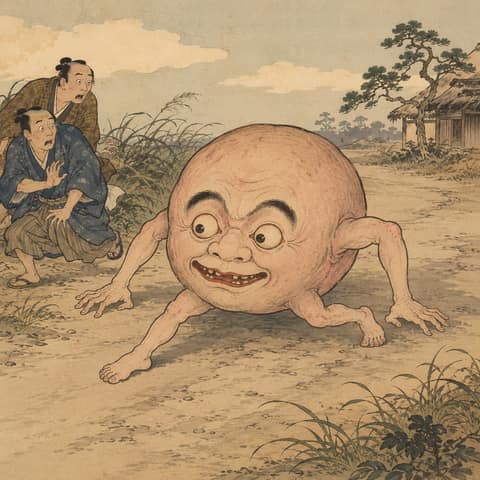
    A version based on the recurring grotesque motif in Edo-period yokai picture scrolls: a head with limbs attached directly to it. Many sources lack captions, and names vary, such as “Gotaimen” and “People of the Lower Country.” The figure often stands bowlegged and sidesteps, heightening visual dissonance and comic effect. Folklorists debate whether such visual oddities caricature social decorum and misalignment, yet no direct oral tradition is recorded. This version prioritizes the repetition of the image and the spread of names, avoids attaching behavior or powers, and limits the setting to generic outdoor scenes. Later studies and commentaries are consulted, but attributes beyond primary sources are not added.

  • Guiding Lantern (Okuri-chōchin)

    Guiding Lantern (Okuri-chōchin)

    Uncommon

    oh-KOO-ree CHOH-cheen

    Honjo Seven Wonders Tale: Okuri-Chochin (Guiding Lantern)

    Mountain & Wilderness SpiritsTokyo

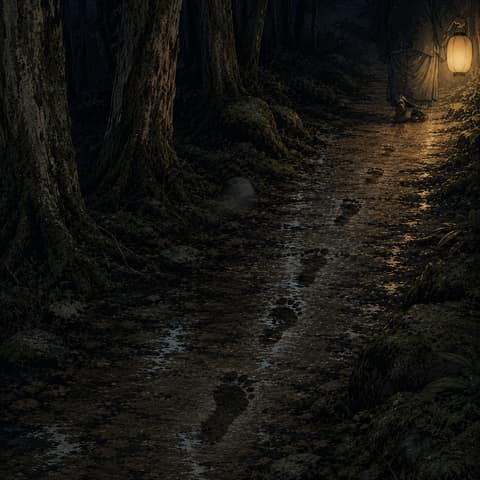
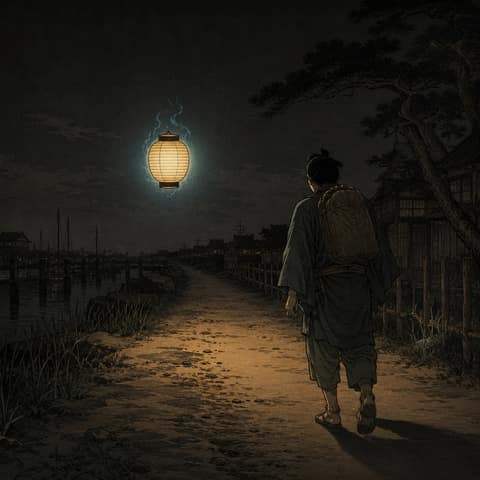
    Passed down around Edo’s Honjo district, the Okuri-Chochin is understood as a strange guiding fire that appears between safety and dread on night roads. Its light sways with a person’s steps and breath, keeps its distance while leading ahead, yet never allows touch. At times it slips to one’s rear or flank to upset direction, and when accompanied by a clapper-like sound it is recorded under the alias “Okuri Hyojiki.” The “Lantern Boy” of Ishihara Warigesui is a formless Odawara-lantern flame that circles on all sides and vanishes when approached, regarded as the same phenomenon as the Okuri-Chochin. In Mukojima it is called the “Okuri-Chochin Fire,” believed to light one’s footing and ensure safe passage, with cases linked to offerings at Ushijima Myojin. Though it rarely causes direct harm, it can lead travelers astray, so locals advise not to chase it, to keep a set distance and pass it by, or to bow at a shrine or temple to seek protection.

  • Hair-Cutter

    Hair-Cutter

    Uncommon

    KAH-mee-KEE-ree

    The Hair-Cutter of Edo Streets

    山野の怪MieTokyo

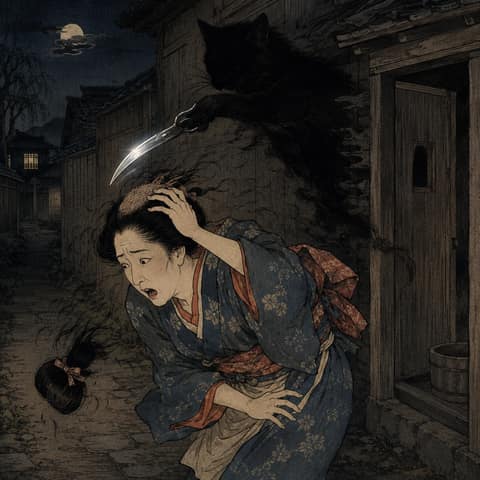
    An amalgam of hair-cutting incidents reported from Edo and other early modern towns. At night, in the street or at the threshold of an indoor privy, there is a sudden brush of contact, and moments later the victim’s hair falls away still neatly tied, without their noticing. Witnesses describe a figure black from head to toe, catlike, or with the feel of velvet, yet its true form remains uncertain. Servant girls and maids were often noted as victims, with rumor-mongering and official crackdowns recorded side by side. Folklorically, taboos surrounding hair as part of the body overlap with notions of impurity tied to night roads and privies, casting an unseen assailant as a yokai. Its method and motive are never stated in tradition, placing it among urban horrors shaped by fear and unease.

  • Hand-Eyes

    Hand-Eyes

    Uncommon

    TEH-no-meh

    Traditional Picture-Scroll Reference Edition

    Mountain & Wilderness SpiritsKyoto

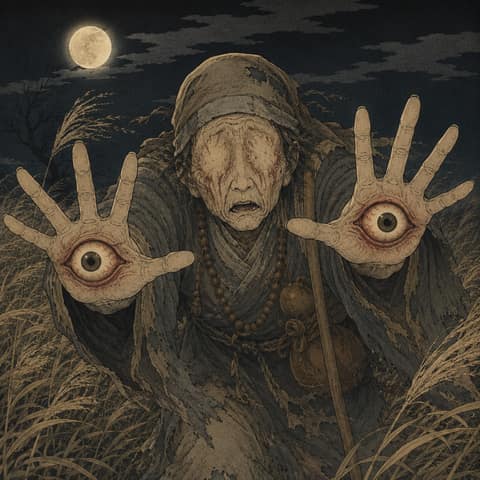
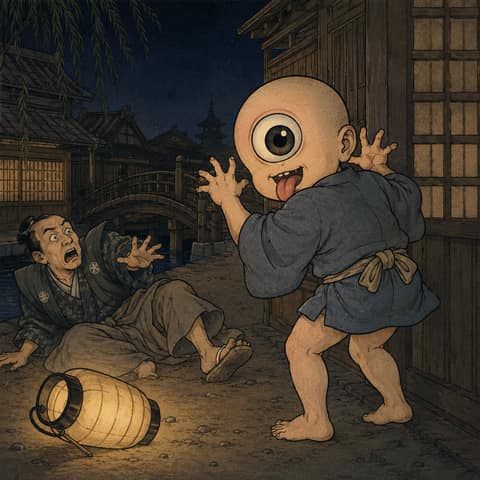
    An interpretation grounded in the imagery found in Sekien’s Gazu Hyakki Yagyō and night-parade picture scrolls from the Tenpō era onward. It is depicted as a shaven-headed figure like a blind monk, with large eyeballs set in both palms, standing in a moonlit wasteland. Narrative explanations are sparse, but linked to the illustration and tale in Shokoku Hyaku Monogatari, it is assumed to locate targets in darkness with the eyes in its hands and to sniff out those who have fled and hidden. In collected folklore it sometimes connects to vengeful spirits of the blind, and is often read as a symbol of exchanged sight and touch, witnessing and exposure. Etymological wordplay has been suggested (raising a hand-eye, bald monk), but none is definitive.

  • Hidden Hamlet

    Hidden Hamlet

    Rare

    kah-koo-reh-ZAH-toh

    Sekien Zue Version: Hidden Village

    山野の怪Japanese folklore

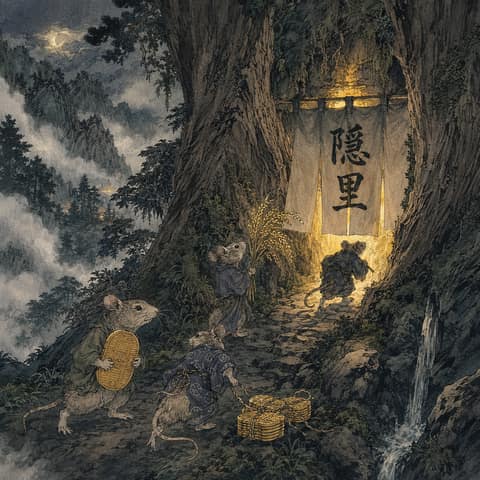
    An interpretation based on Toriyama Sekien’s Konjaku Hyakki Shūi entry “Kakurezato” (Hidden Village). The mouse and koban coins at the lower right recall tales in which subterranean mice carry wealth (the so‑called Nezumi Jōdo legend), hinting at ties between the village and chthonic or underworld realms. The shop curtain reads “Kakurezato,” expressing a boundary that opens suddenly as an extension of the everyday. The Hidden Village is not a single yokai but a boundary acting as if it has will, repeating wayfinding confusion, temporal slippage, the granting of fortune, and cycles of manifestation and disappearance. Outcomes swing with a visitor’s conduct and greed, from generous hospitality to wealth turning into leaf-litter, resonating with mountain otherworld tales and views of the beyond.

  • Hidden Zato (Kakurezatō)

    Hidden Zato (Kakurezatō)

    Uncommon

    kah-KOO-reh-zah-TOH

    Tradition-Faithful

    Mountain & Wilderness SpiritsŌu and Kantō regions (Hokkaidō, Akita, Kantō)

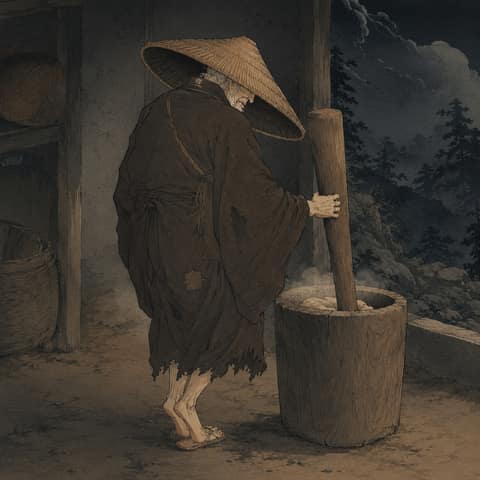
    This version frames the Hidden Zato as a blind minstrel-yokai lurking in the mountains and caverns of Tohoku and Kanto. At midnight it pounds out sounds like a foot-operated mortar or rapid rice polishing, yet the source stays unseen and household tools are said to be “borrowed.” In some tales, peeking reveals the noise coming from a neighbor’s house. Some regions call it a child-snatcher, while others give it a benevolent face as a dispenser of mochi or treasure to the honest, making them prosperous. From early modern times, the idea of hidden villages merged with a mystique around blind guilds, recasting it as an unseen people dwelling in caves. Modern folk explanations liken the racket to insect wingbeats, but as a bearer of the uncanny it endures as a spirit in the form of a zato.

  • Hiko-san Buzenbō

    Hiko-san Buzenbō

    Legendary

    Hiko-san Buzenbō

    Chief of the Tengu of Kyūshū — Hiko-san Buzenbō

    Mountain & Wilderness SpiritsFukuoka

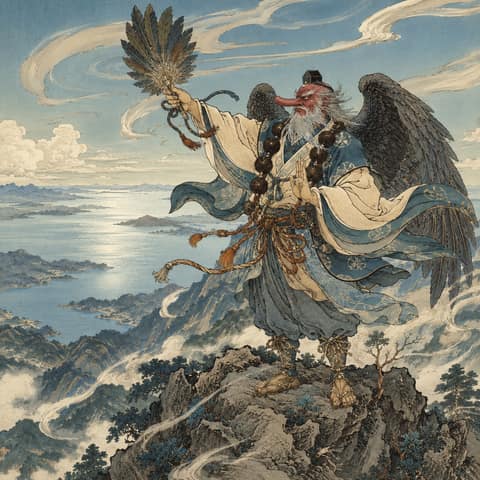
    The key to reading Hiko-san Buzenbō lies in Hikosan—the vast sacred site that is one of the three great centers of Shugendō in Japan—and in the tengu's character of two faces, reward and punishment. The history of Hikosan Shugendō issues from the Nara-period monk Hōren. Taking as founder this monk, whom the Shoku Nihongi records as having been granted forty chō of field in Buzen Province in the third year of Taihō (703), Hikosan grew into a great center of Shugendō ranking with the Dewa Sanzan and Ōmine. The name of Buzenbō appears with certainty in the Kamakura-period engi the Hikosan Ruki (1213). This work likens the forty-nine grottoes bored into the peaks of Hikosan to Miroku's Tosotsu Heaven and made the eighteenth the "Buzen-kutsu," the seat of Buzenbō. This very system of grottoes is the matrix of the faith in Buzenbō as chief of the tengu of Kyūshū. The Edo-period scale of the "Three Thousand Eight Hundred Bō of Hikosan" tells of this sacred site's prosperity. What characterizes the tengu Buzenbō is the sternness of his reward and punishment. As the history of Takasumi Shrine transmits, upon those of greedy and evil heart he carries off children and sets fire to houses in chastisement. Conversely, the wishes of the upright and deeply devout he hears and grants, and them he guards. These two faces of reward and punishment symbolize, as a tengu's judgment, the strict precepts that a Shugendō mountain imposes and the grace shown to those who keep them. The dread of a child-snatching tengu and the faith of parents praying for their children's safety were the front and back of one and the same Buzenbō. The separation of Shintō and Buddhism in the first year of Meiji and the prohibition of Shugendō in Meiji 5 (1872) scattered the yamabushi of Hikosan and dismantled the world of the three thousand eight hundred bō. The institution of Shugendō was lost, but the tengu faith of Buzenbō lives on at Takasumi Shrine; chanted in the Muromachi Noh play Kurama Tengu and standing among the forty-eight tengu of the Tengu-kyō as the great tengu of Kyūshū, he is still feared as one who sits upon the peak of Hikosan. Chigiri Kōsai of tengu scholarship, too, placed him within the system of the great tengu of the many mountains.

  • Hira-san Jirōbō

    Hira-san Jirōbō

    Legendary

    Hira-san Jirōbō

    The Second-Seat Great Tengu — Hira-san Jirōbō

    Mountain & Wilderness SpiritsShiga

    The key to reading Hira-san Jirōbō lies in the meaning of the rank "second seat, next after Tarōbō," and in the medieval sources particular to Mt. Hira. In the tengu hierarchy, Jirōbō is held to be the second after Atago-san Tarōbō. This ordering appears almost in common both in the forty-eight tengu of the Tengu-kyō and in the Eight Great Tengu framework, and the very names Tarōbō and Jirōbō derive from the ordinals "one" and "two." Rather than being told of alone, Jirōbō appears more often paired with Tarōbō as the twin pillars of the tengu world. The firm ancient layer of Hira's tengu lies in the Hirasan Kojin Reitaku (by Keisei, 1239). This dialogue, in which the aged tengu of Mt. Hira answers Keisei's questions and speaks of the tengu world and the afterlife, is a primary source particular to Mt. Hira, showing that Hira held a firm place as a tengu sacred mountain in the medieval age. Here one common confusion should be set right. Jirōbō is often bound to the tale of the Chinese tengu Chira Eiju (= Zegaibō), but the original story in the Konjaku Monogatarishū, Book 20 runs on the plot of a tengu of Shintan defeated by a monk of Mt. Hiei, and does not name Mt. Hira as the seat of the Japanese tengu. Making Chira Eiju the tengu of Hira is a later arrangement; the tradition proper to Mt. Hira itself should rather be sought in the aforementioned Kojin Reitaku. The tale of relocation from Mt. Hiei is likewise understood not as historical fact but as a later narrative telling the changeover of a sacred mountain's leadership. Based at Mt. Hira, the sacred peak of Ōmi, fearing Buddhist law while testing human conceit—this coexistence of modesty and fortitude is the image of Jirōbō. Chigiri Kōsai of tengu scholarship, too, set Jirōbō in the place next after Tarōbō.

  • Iizuna Saburō

    Iizuna Saburō

    Legendary

    Iizuna Saburō

    The War-God Who Rides a White Fox — Iizuna Saburō

    Mountain & Wilderness SpiritsNagano

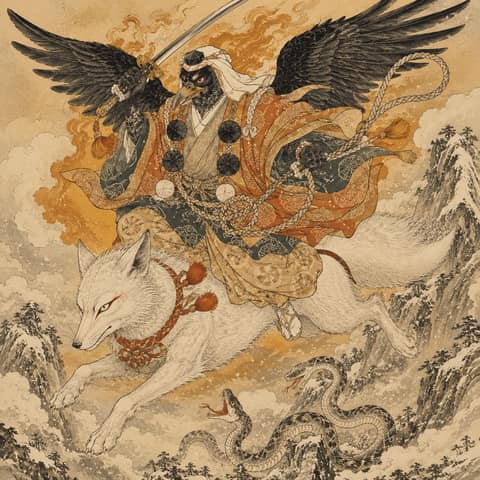
    To read Iizuna Saburō, one must overlay three strata: the syncretic honzon-image of "Izuna Gongen," the heterodox art of the "Izuna method," and the devotion of the Warring-States commanders. The antiquity of this faith is backed by the texts. The Asabashō of the first year of Kenji (1275) carries the name of Mt. Iizuna and its founding ascetic; the Togakushi-san Kenkō-ji Ruki (1458) records "Izuna Saburō" and "the third tengu of Japan"; the Iizuna-san Meguri Saimon (1546) gives the origin as the Chira Tengu come from Tenjiku; and the Iizuna-san Ryaku Engi transmits the honji-butsu and the lineage of the Sennichi-dayū. From Kamakura to Edo, it is a faith handed down in layers. The iconography of the honzon is profoundly distinctive. A crow-tengu holding a sword and a rope rides upon a white fox, with a snake often coiling about the fox. Its honji-butsu is expounded now as Fudō Myōō, now as Dakini-ten, varying by source. It is precisely this composite character—"tengu, fox, Fudō and Dakini" joined in a single body—that is the reason Izuna Gongen, surpassing a mere mountain tengu, became a point of concentration of esoteric ritual power. At Takaosan Yakuō-in, the Iizuna Shrine of Shinshū, Jinya-ji on Mt. Kano in Chiba and elsewhere, the faith is especially deep in Kantō and to the north. The "Izuna method" is the practical face of this ritual power. This sorcery, which employs tengu and kuda-gitsune to heal illness and, by possession, to deliver oracles, was counted a heterodox art alongside the Atago Shōgun-hō and the Dakini-ten-hō, and those who wielded it were called Izuna-tsukai. The folk belief that one kept and employed kuda-gitsune within a bamboo tube made the very name "Izuna" a byword for witchcraft. And it was the devotion of the warrior houses that raised Iizuna Saburō to a war-god. It is famous that the crest of Uesugi Kenshin's helmet was an image of Izuna Gongen; there is also the case of Takeda Katsuyori granting the name Nishina to the adopted son of the Sennichi-dayū, and commanders such as Hosokawa Masamoto who practiced the Izuna method itself. As a god who governs victory in war, Iizuna Saburō is, even among the forty-eight tengu of the Tengu-kyō, the seat most bound to this-worldly benefit. Chigiri Kōsai of tengu scholarship placed this many-sided Iizuna Saburō within the system of the great tengu of the many mountains.

  • Ippon-Datara

    Ippon-Datara

    Epic

    EE-pohn dah-TAH-rah

    Kii–Kumano Tradition Variant

    Mountain & Wilderness SpiritsWakayamaNara

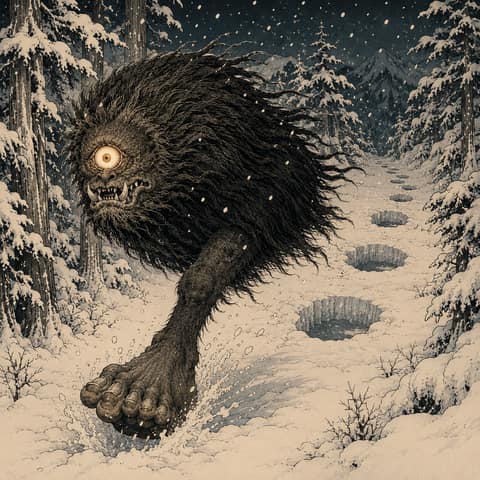
    A portrayal of the Ippon-datara based on records from Kii and Kumano through Nara. It is said to be one-eyed and one-legged, but firsthand sightings are rare; in many regions a single large track left after snowfall is taken as proof of its presence. Its most notable trait is appearing on December 20, the “Hate-no-Hatsuka,” a day overlapping taboos of mountain deities and roads, effectively discouraging entry into the mountains. In its link to smithing, folklore explains the one-leg one-eye form as derived from the tatara blower treading the bellows with one foot and watching the furnace with one eye. In the Obagatōge lineage it is equated with the oni-god Inosasao, once a terror of the peak but sealed by a monk and released only once a year. In Kumano and Itsukushima it is said “only footprints appear, not the body,” feared yet seldom directly harmful. While stories of one-legged snow spirits (such as Yuki-nyūdō and Yukibō) have blended with it, this entry centers on the Kumano–Nara stream, emphasizing three points: the taboo day, the single track, and the blacksmith-origin theory.

  • Kasho Tengu

    Kasho Tengu

    Epic

    Kasho-tengu

    Venerable Chuhoson, the Great Tengu of Mount Kasho

    Apparition of the Mountains and FieldsGunma

    The Kasho Tengu distinctively stands apart from the common noun "tengu"; it is an entity unique to Kashozan Miroku-ji. At its core lies an actual historical high monk, the Venerable Chūhōson. This reflects a "monk-deification type" of tengu faith, wherein a holy man with superhuman ascetic powers settled into the mountain as a tengu (an incarnation of Kasho Buddha) after his death. Its ranking as one of the Three Great Tengu of Japan (alongside those of Mount Takao and Kurama), the boastfully largest Great Tengu mask in the country, and the unique votive custom of borrowing a mask and returning two the following year distinguish this tengu from other mountain tengu. Combined with its historical prestige as a prayer site for the Tokugawa family, the Kasho Tengu is deeply rooted in the Numata region as a tengu of worldly benefits, governing victory in battle, traffic safety, and the fulfillment of all wishes.

  • Kodama (Japanese Tree Spirit)

    Kodama (Japanese Tree Spirit)

    Epic

    kodama

    Kodama (Ancient Tree and Echo Spirit)

    Mountain and Forest SpiritsTokyoOkinawa

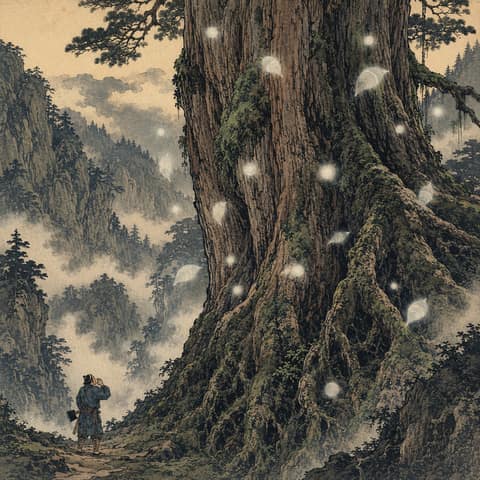
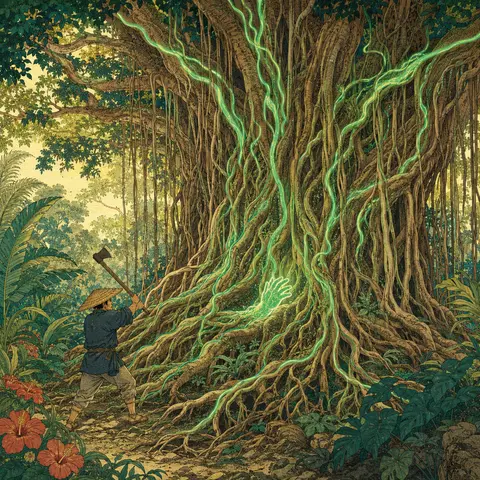
    This is the classical kodama: not a mascot-like creature, but the unseen presence of an old tree and the voice that seems to answer from the mountain. It draws on older ideas of tree divinity, on the belief that ancient trunks hold spiritual force, and on the folk reading of yamabiko, the returning mountain echo. The kodama may remain invisible, showing itself only through sound, silence, unease, or the taboo surrounding a tree that should not be cut without ceremony. This version emphasizes the traditional boundary: kodama can be described as a tree spirit, a forest yokai, or a lingering kami-like presence, but its power lies precisely in not fitting only one category.

  • Kodama (Japanese Tree Spirit)

    Kodama (Japanese Tree Spirit)

    Epic

    kodama

    Kidama-sama of Aogashima

    Mountain and Forest SpiritsTokyoOkinawa

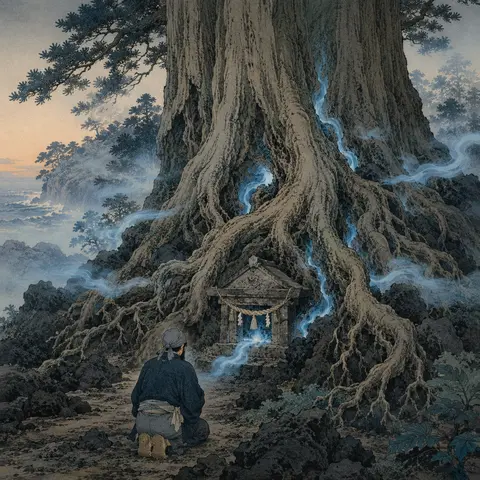
    A wood spirit from Aogashima in the Izu Islands, long honored by islanders as “Kidama-sama” or “Kodama-sama,” enshrined at small altars set at the roots of great cedars. The island forest drinks sea wind and volcanic breath, driving deep roots through shallow soil. The spirit dwelling there is not a mere echo, but an ancient memory woven from the age of the tree itself. At dawn mist, if you call its name before the shrine, the reply comes only once, a slightly damp sound, taken as a sign of assent. If it returns twice or thrice, uneven and jarring, it warns that the season is wrong—do not cut. Before felling wood, locals offer a handful of rice, sea salt, and a cup of shochu, tap the trunk three times, and state the reason and the count. Kidama-sama honors this rule: when respect is paid, it sets the wind fair, keeps blades from dulling, and prevents workers from losing their way. If slighted, the mountain’s sounds grow muddy, blades kick against knots, and toil is shadowed by illness. Its form is uncertain, yet elders speak of a “shadow of rings”: when the bark reddens in the evening glow, a single pale eye like a water mirror appears deep in the grain and melts away. Before great winds or earth-rumblings, pebbles at the shrine rearrange themselves, a sign of the forest’s breath in disorder; those who heed it halt farm and boat work and lessen harm. It is not closed to outsiders: give your name, bring salt as a gift, keep your voice low before the shrine, and the returning echo softens and the mountain path confuses less. Laughing and shouting bring a delayed, high, splintered reply that lingers in the ear and upsets your sense of direction. When a tree’s life nears its end, Kidama-sama may appear in dreams to say, “Now I change worlds.” Villagers take this as a good omen, planting three saplings after a fall and moving the shrine to the new root to carry the breath onward. Thus the island forest renews by generations, and the spirit moves without fading, a vivid afterimage of the old tree gods living strong on a sea-bound isle, quietly listening as a mediator between mountain rites and ocean sustenance.

  • Kodama (Japanese Tree Spirit)

    Kodama (Japanese Tree Spirit)

    Epic

    kodama

    Southern Island Kinushi-Haunted Kodama

    Mountain and Forest SpiritsTokyoOkinawa

    Among the kodama whose echoes are heard across Japan, a southern island variant dwelling especially in Okinawa’s Yanbaru and sacred utaki groves is known as the Kinushi-Haunted Kodama. As its name implies, it settles like a lord within each individual tree, living in sync with the tree’s breath, the flow of sap, and the spread of its roots. Old lore says that if a woodcutter lightly taps the trunk before the first axe bite and offers a name and prayer, the kodama will tune the sound within the wood, align the wind with the intended fall, and guide the work safely. Strike in silence, however, and the tree will creak and cry, hollow tones will stutter across the mountains, and within days the surrounding leaves will lose color as if scorched. On uneasy nights, a heavy thud may carry through the mountain village though no tree has fallen; this is said to be the cry of a Kinushi-Kodama in unbearable pain. The tree where that sound is heard will soon shed dieback from its crown, white mycelium will gather at the roots, and its life will end. Witnessing this, elders understood that sound is the true form of the kodama, and passed down taboos: do not raise your voice at the forest’s threshold, and when calling a tree by name, pause to await its answer. Though it has no body, at dusk the air around the roots will sometimes shimmer like water and a childlike laugh may echo twice or thrice; islanders take this as a good omen and offer salt and black sugar to that tree. If a small child naps in its shade, mosquitoes and midges keep away and the sea breeze softens. Elders say that when winds from beyond the sea make their rounds among the mountain gods, the kodama resonates with the wind and guards the village bounds. Often confused with mountain echoes, the Kinushi-Haunted Kodama differs in that it does more than repeat a voice: by the timing and tone of its reply it foretells fortune. A clear prompt note means a good day for work, a heavy delayed reply is a sign to rest, and a muffled response from within the trunk portends sickly leaves. The islands also keep rites for transplanting trees. On the eve of root-pruning, stroke the trunk three times and name the soil of the new site; the kodama will fold the root tips and slim itself so it will not thirst during the journey. Neglect this and hollow knocks will sound nightly at the new place and the household may fall to fever. In coastal banyans dwell playful spirits known as Kijimunā. In older thought, Kijimunā are those Kinushi-Kodama that took on a more human-like notion of form: the kodama is the voice of the roots, the Kijimunā the laughter of the branches. Both are tree divinities at heart, guiding the respectful and chastening the careless with sound. Thus in the southern island forests, sound is law, and people and trees have long lived by each other’s breath.

  • Konaki-jiji

    Konaki-jiji

    Legendary

    konaki-jiji

    The Crying Old Man of Tokushima: Konaki-jiji

    山野の怪Tokushima

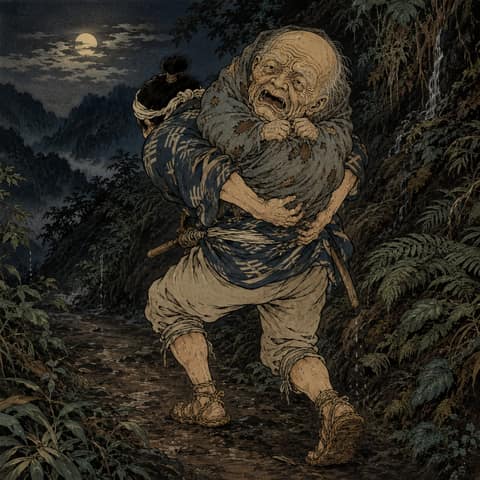
    The Folkloric Cliché of the "Crying Baby on a Mountain Path". While the basic overview outlines the structure of the Konaki-jiji legend, this deep dive probes the dark undercurrents of the "crying baby on a mountain path" cliché. Historically, in Japan's rugged mountainous regions, practices like infanticide (mabiki), child abandonment, and high infant mortality rates cast a long, daily shadow over village life. Experiencing auditory hallucinations of a baby crying on a lonely mountain road was a universally shared psychological trauma among these communities. This is exactly why legends of the *Ubume* (the ghost of a woman who died in childbirth) are distributed so widely across the country. Hearing an infant's cry at liminal spaces—mountain passes, riverbanks, or forest paths—serves as the foundational, deep-rooted material for ghost stories across Japan. The Konaki-jiji is Shikoku's unique, composite yokai, created by welding this primal auditory fear to the "form of an old man" and the "crushing weight" motif. Kunio Yanagita's Structural Methodology. The methodological genius of Kunio Yanagita's *Yokai Dangi* (1956) lies not in treating a yokai in isolation, but in reading it structurally alongside its relatives. By aligning the Konaki-jiji's "getting heavier" mechanic with the *Obariyon* and the *Ubume*, Yanagita illuminated a developmental history: the fusion of the primal "crying baby" archetype with the later addition of the "crushing weight" narrative. This comparative approach became the gold standard for post-war folkloristics, heavily influencing later yokai scholars like Kazuhiko Komatsu and Noboru Miyata. The Gogya-naki and the Shikoku Folklore Sphere. The fact that "Gogya-naki"—a cousin of the Konaki-jiji—is distributed entirely across Shikoku highlights the uniqueness of the island's folkloric sphere. In Mima District, Tokushima, records detail a Gogya-naki that hops through the mountains on one leg, its cries powerful enough to trigger earthquakes; Yanagita rightly identified this as identical to the Konaki-jiji. Shikoku's mountain folklore possesses traits distinct from Honshu (the central highlands) and Kyushu (sacred mountain cults). It forms a highly complex religious ecosystem where Shugendo (mountain asceticism), the 88-Temple Pilgrimage, and indigenous Shinto are stacked in multiple layers. The Konaki-jiji is a direct product of this intense Shikoku mountain folklore. The "Real-Life Old Man" Theory and the Mechanics of Monsterification. The local account recorded by historian Masahiro Takita—suggesting that a real, eccentric old man used to mimic baby cries—is highly suggestive when analyzing how yokai are born. The phenomenon where a marginalized villager with abnormal behavior (due to mental illness, isolation, or dementia) is sublimated into a yokai legend over several generations is seen throughout Japan. "Yokai" often function as social devices used to process and mythologize a community's memory of its peripheral members (the elderly, beggars, foreigners, or the disabled). The local Konaki-jiji lore is a rare case that brings this folkloric mechanism to the surface, offering prime material for reading yokai studies through the lens of social history. Shigeru Mizuki's Post-War Yokai Revival Movement. Shigeru Mizuki (1922-2015) was the driving force behind the revival of yokai culture in post-war Japan. Through *GeGeGe no Kitaro* (serialized prominently in Weekly Shonen Magazine from 1968), he elevated half-forgotten, hyper-local folklore into household names across the nation. Within the Kitaro family, the Konaki-jiji was reconstructed as a "good-natured yokai from Tokushima," gaining massive popularity as a bearded, staff-wielding elder in a monk's robe. The transformation of the Konaki-jiji from a malicious, crushing murderer in local folklore to an agent of justice in modern pop culture is a subject of intense academic debate, serving as a prime example of how an author's intervention can fundamentally alter the DNA of a traditional legend. Regional Revitalization and Applied Yokai Studies. In 2001, Yamashiro Town in Tokushima (the legend's birthplace) erected a stone statue of the Konaki-jiji, kickstarting its regional branding as a "Yokai Village." Through initiatives like yokai haunted houses, mascots, and stamp rallies, post-war folkloristics successfully transitioned from an academic discipline into an engine for regional economic growth and tourism. This represents a classic structural model: local yokai (like Ittan-momen in Kagoshima, Sunakake-baba in Nara, and Nurikabe) gain national fame via *Kitaro*, only to be re-imported back to their hometowns as cultural capital for regional revitalization. The Modern History: From Local Lore → Kitaro Fame → Regional Tourism. The modern history of the Konaki-jiji perfectly maps the typical trajectory of Japanese yokai culture. It traces a three-stage cultural metamorphosis: an entity that was merely oral folklore in one specific region before the war, achieves national celebrity through Mizuki's manga in the post-war era, and finally flows back into its birthplace to be monetized as a tourism asset. This exact path is shared by several core members of the Kitaro family. It proves that the Konaki-jiji is not merely a "fairy tale from the past," but a yokai that actively embodies the ongoing, modern processes of cultural production and regional identity building.
  • Konoha Tengu

    Konoha Tengu

    Epic

    KOH-noh-hah TEN-goo

    Konoha Tengu (Classical Depiction)

    Mountain & Wilderness SpiritsShizuoka

    A figure based on Edo-period essays and ghost tales. Ranked below the long-nosed yamabushi-style tengu, it performs menial tasks and is described as birdlike or as a human-faced bird. Accounts vary by region and source: flocks seen at night catching fish on the Ōi River in Suruga, references to them as white wolves within the tengu realm and as elder wolves elevated in rank, and tales of trickery such as a hunter in Iwakuni being toyed with by a tengu disguised as a boy. Overall, rather than causing great harm to people or livestock, they tend to interact through shapeshifting and bewilderment. Ukiyo-e sometimes shows them resting in trees, suggesting they are not invariably violent. Their nature is tied to the mountain borderlands, quick to sense human intrusion and retreat.

  • Konpira-bo

    Konpira-bo

    Epic

    konpira-bo

    The Forty-Eight Tengu Guarding Mount Zozu, Konpira-bo

    TenguKagawa

    Konpira-bo is a yokai that embodies the history of Kotohira-gu (Matsuo-dera Konpira Daigongen) as a sacred mountain of Shugendo during the era of Shinto-Buddhist syncretism. Listed as one of the "Forty-Eight Tengu," he is revered as the great tengu commanding Mount Zozu in Sanuki. His true form is either a yamabushi who accumulated harsh austerities and transformed into a tengu, or a familiar (guardian deity) of Konpira Daigongen. This duality represents a typical structure of tengu legends in mountain beliefs across Japan. Particularly within the Konpira faith, which holds aspects of a maritime guardian and water deity, he assumes the role of warding off evil and dispensing divine punishment while enshrined in the deep mountains behind the shrine. Although Kotohira-gu is a Shinto shrine today, ascending the stone steps to the inner shrine and walking along the approach lined with ancient trees still profoundly conveys the majesty of the forest once believed to be the domain of Konpira-bo, imbued with the atmosphere of Shugendo.

Showing 1 - 24 of 56 yokai