Yokai Encyclopedia

Encyclopedia of Japanese Yokai

56 Yokai|14 Category|Page 2 of 3
Localization in Progress - More content available in Japanese version
View Japanese
Sort by: NameAscending
山野の怪
  • Kosame-bō (Little Rain Monk)

    Kosame-bō (Little Rain Monk)

    Rare

    koh-sah-meh-BOH

    Sekiens Iconography Edition

    Mountain & Wilderness SpiritsNara

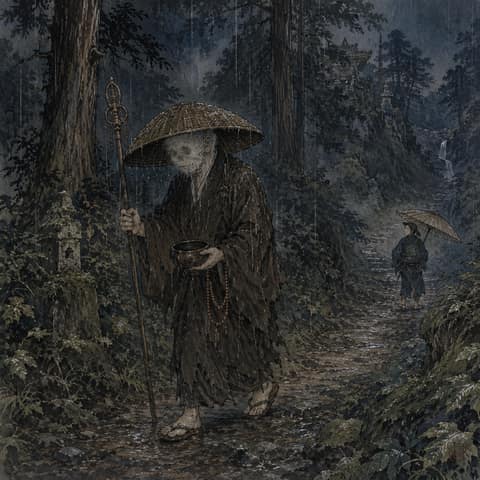
    A reconstruction based on Toriyama Sekien’s image and brief note. It appears as a small monk drenched by rain, emerging on rainy nights in the mountains. It softly asks passersby for offerings due to a monk, but refusal does not necessarily bring harm. Its place is tied to the sacred Shugendō ranges of Ōmine and Katsuragi, yet no verified lore links it to specific temples or persons. Later sources that say it begs for food or small coins likely simplify Sekien’s term “sairyō” (offerings), with little direct oral backing. Its wandering is said to occur only on fine-threaded rainy nights, and reports from clear nights or downpours are uncertain. Methods to banish or summon it are unknown, and meetings on mountain paths are told merely as fleeting oddities.

  • Kurama-yama Sōjōbō

    Kurama-yama Sōjōbō

    Legendary

    Kurama-yama Sōjōbō

    Kurama-yama Sōjōbō, Who Taught the Art of War to Ushiwaka

    Mountain & Wilderness SpiritsKyoto

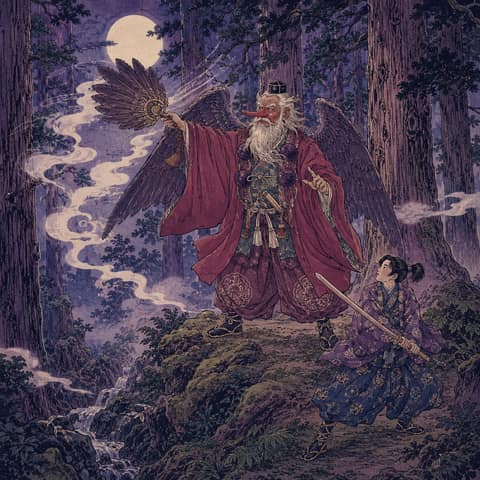
    The legend of Kurama-yama Sōjōbō is a subject to be read with careful separation of historical fact from later accretion. The credibility of its setting rests in the history of Kurama-dera. The Kurama-buki-dera engi relates that Ganchō built a hermitage in the first year of Hōki (770) and that Fujiwara no Iseto raised the temple halls in the fifteenth year of Enryaku (796). This ancient sacred mountain holds the valley of Sōjō-ga-tani where Sōjōbō dwells, and was held to be the place of descent of Gohō Maō-son. The firm dramatization of the tale of martial transmission to Ushiwakamaru begins with the Muromachi-period Noh play Kurama Tengu. In its plot the great tengu of Kurama teaches the art of war to Ushiwaka, who, pursued by the Heike, had taken refuge at Kurama-dera; performed as a fifth-category Noh, it unfolded widely into later kabuki and ukiyo-e. Yet this transmission tale does not exist in the older Gikeiki. What the Gikeiki transmits is the tale of Ushiwaka's acquiring the books of strategy (the Rikutō and Sanryaku) treasured by the onmyōji Kiichi Hōgen—no tengu appears. The identification that binds the two, "Kurama Tengu = Kiichi Hōgen," arose in early-modern times. Its source is the jōruri Kiichi Hōgen Sanryaku no Maki (1731, premiered at the Takemoto-za), which has a scene calling Kiichi Hōgen "the tengu who long ago taught swordsmanship to Ushiwaka on Mt. Kurama." Here the Gikeiki's Kiichi Hōgen and the Noh's tengu-transmission tradition were fused into one. Thus the story widely known today—that Ushiwaka learned the art of war from the Kurama tengu—is rightly seen not as deriving from the Gikeiki, but as a layered legend that began with the Muromachi Noh and was bound to Kiichi Hōgen in the Edo jōruri. One further point to note is the relation to Gohō Maō-son. The grand present-day doctrine by which Kurama-dera links it to Sōjōbō is a modern teaching arranged only after the temple became independent of the Tendai school and founded Kurama-kōkyō in Shōwa 24 (1949)—a lineage apart from the medieval Sōjōbō tradition. The Sōjōbō of the medieval tradition was, as one of the forty-eight tengu, a master tengu who imparted the martial arts and the way of the mountains.

  • Momonji (the Hundred-Old Man)

    Momonji (the Hundred-Old Man)

    Rare

    MOH-mohn-jee

    Iconographic and Textual Standard (Sekien Line)

    Mountain & Wilderness SpiritsUncertain; depicted in Edo-period picture scrolls

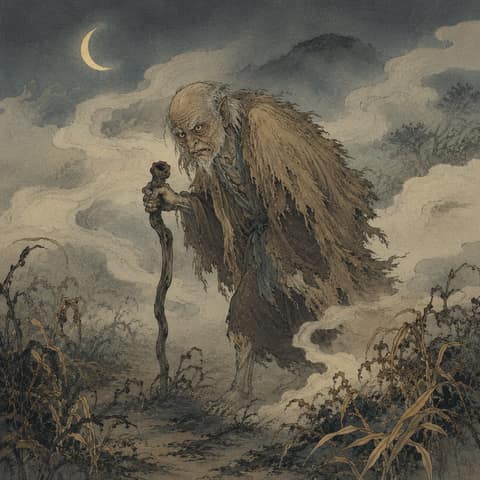
    Based on Toriyama Sekien’s image and notes, this version frames the entity as an old man–shaped specter appearing on open fields at midnight. Its name is taken as a blended form of child language like “momon-ga” and “gagoji,” embodying generalized fear of monsters. The belief that witnesses fall ill aligns with older notions that contact with the uncanny brings impurity and sickness, with no concrete acts of harm described. Early modern taboos against eating game and the euphemism “momonjii” may have encouraged its visualization through name association. Later readings place it as dwelling in mountains yet appearing at street corners to startle people, or as the city-going form of the nobusuma, but primary tradition is scant and no broad folktale type is attested. Accordingly, this version treats specifics as unclear, emphasizing its scenic traits—encounters on nighttime fields, fog, and wind—and its feared power to bring illness.

  • Mountain Sprite (Sansei)

    Mountain Sprite (Sansei)

    Rare

    SAHN-say

    Traditional Account (Wakan Sansai Zue and Sekien Lineage)

    Mountain & Wilderness SpiritsChina – around Anguo County, Hebei Province

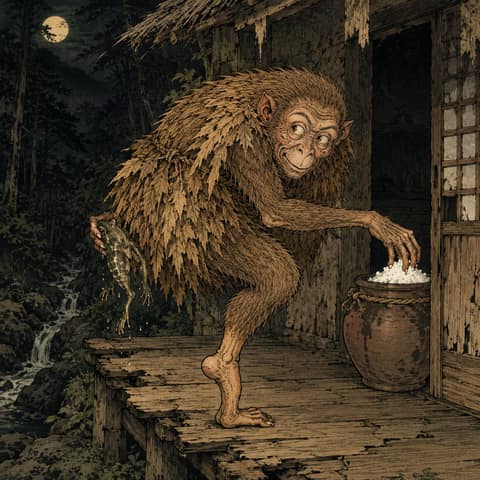
    This version draws on Chinese materials cited in the Edo-period encyclopedic Wakan Sansai Zue and on Toriyama Sekien’s pictorial interpretation. The mountain spirit lurks in the hills, watching mountain huts where salt is set out for cooking or work and edging closer to them. Sources differ on size, some saying about one shaku while others claim three to four shaku. Its hallmark is a single leg with a heel set backward, making its tracks hard to read. It favors small wetland creatures like crabs and frogs and appears along stream gullies. It is said to bring lustful harm at night, but will retreat if the drought deity’s name “Batsu” (Hatsu/Boatsu, the Chinese demoness Ba) is spoken, a type of name-utterance apotropaic. Those who harm or consort with it suffer illness or fires, functioning as a cautionary taboo against contact. In Japan, Sekien labeled it “Yamaki” (mountain demon) and depicted it peering into a hut with a crab in hand, providing visual cues; local oral lore is scant, and treatment remains largely bibliographic. Modern reinterpretation is restrained, keeping to the contours of old records.

  • One-Eyed Boy Monk

    One-Eyed Boy Monk

    Epic

    hee-TOH-tsu-meh koh-ZOH

    Traditional Aspect (Hitotsume-bō)

    山野の怪Across Japan (Edo, Aizu, Tanba, Bizen, etc.)

    A整理 based on Edo-period picture scrolls such as Hyakkai Zukan and Bakemono-zukushi depicting the figure known as Hitotsume-bō. It takes the form of a shaven-headed child monk, appearing suddenly in parlors, on bridges, slopes, and crossroads, then vanishing once satisfied with the onlooker’s reaction. Though often associated by inference with the one-eyed, one-legged monk of Mount Hiei, direct identification is avoided. Folklore links it to food by claiming it dislikes beans, and later images show it carrying tofu, yet it rarely intends harm to people or livestock. Its appearances vary by season and weather; in some regions, its single eye is said to glow dimly on rainy nights in late autumn. Names vary by locale, including “Hitotsu-managu” in Ōshū and the widespread “Hitotsume-kozō” and “Hitotsume-bō.”

  • Oni of Hemp Fiber (O-uni)

    Oni of Hemp Fiber (O-uni)

    Rare

    OH-oo-NEE

    Iconographic Tradition, Sekien Lineage

    Mountain & Wilderness SpiritsUncertain (derived from an Edo-period picture scroll)

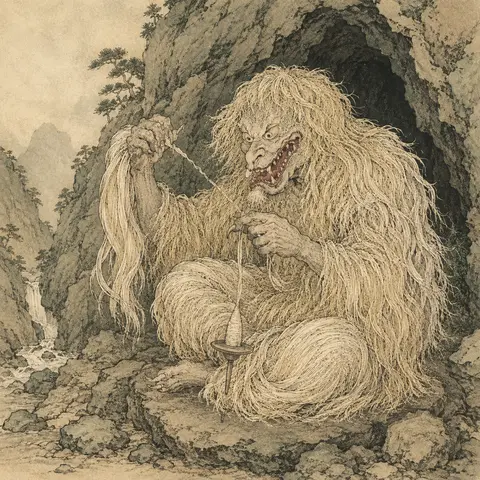
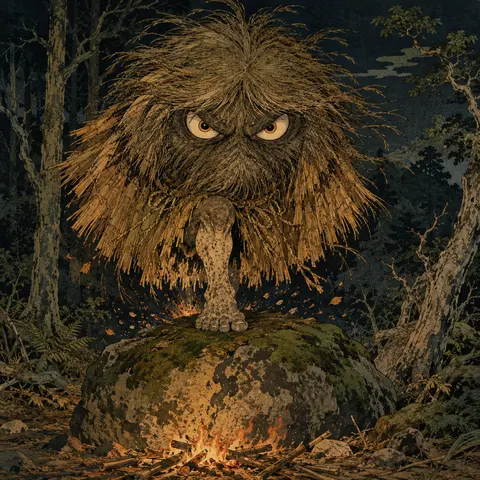
    Rather than arising chiefly from oral accounts, Ouni has been recognized through a lineage of images in picture scrolls. A precursor appears as the “Wau-wau” type in Sawaki Suushi’s Hyakkai Zukan (1737), and in the late Edo Hyakki Yagyō Emaki (Oda Gōchō, 1832) it is rendered as “Uwan-uwan.” Toriyama Sekien drew on this visual genealogy, exaggerating the hair and emphasizing a fiber-bundle texture suggestive of o, then named the figure accordingly. The term o denotes a tufted bundle of ramie or hemp fibers, serving as a visual sign tied to the creature’s mass of body hair. From the Heisei era onward, commentators increasingly connected Ouni with folktales of mountain hags who comb and spin fibers, treating it as a subtype of yama-uba. Yet Sekien gives no locality or deeds, and evidence for attaching it to specific place-based traditions is scant. It is safest to regard Ouni as a yokai defined by the iconographic core of a shaggy demon-woman appearing in the mountains, loosely linked to ideas surrounding women’s fiber work in upland communities.

  • Red-Head

    Red-Head

    Uncommon

    AH-kah-gah-shee-rah

    Red-Head

    Mountain & Wilderness SpiritsKochi

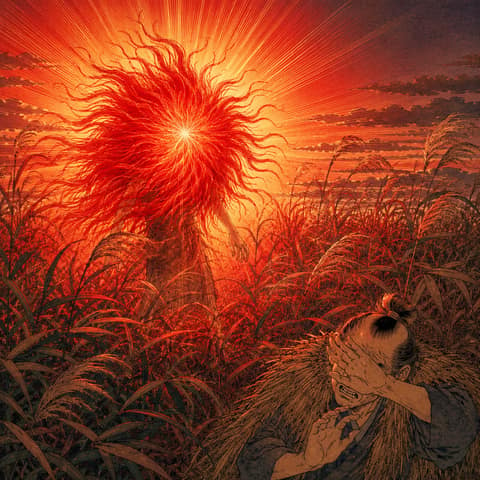
    A red-haired apparition said to appear in the fields and hills of Katsugase in Tosa Province. It walks upright like a human, yet hides among tall bamboo grass and reeds, making its full form elusive. Its most striking trait is hair that shines like the sun; approaching and staring directly at it is said to dazzle the eyes and cause temporary visual impairment. Tales rarely attribute malice to it, focusing instead on discomfort caused by its visual impact. It is named in the late Edo to early Meiji Tosa Bakemono Picture Book, listed alongside local figures such as the Laughing Woman of Yamakita and the White Crone of Motoyama. The “Aka-gashira” in Hyakki Yagyo picture scrolls is sometimes cited as iconography, though identification remains cautious. Sightings are told of at dusk through dawn in the open country and survive mainly in local oral tradition.

  • Satori

    Satori

    Epic

    sah-TOH-ree

    Traditional Version: Kakku of Hida and Mino

    Mountain & Wilderness SpiritsGifu

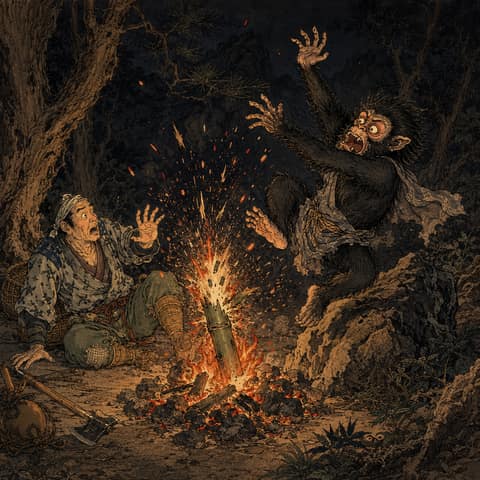
    A simian-form apparition modeled on Sekien Toriyama’s Konjaku Gazu Zoku Hyakki entry and natural-historical notes in Sino-Japanese texts. It appears on remote mountain paths, instantly voices the thoughts of woodcutters and travelers, and gauges their behavior. Disinclined to harm humans, it withdraws swiftly when sensing danger, in line with Sekien’s text. In folktales its figure varies by region—monkey, mountain man, tengu, or tanuki—but its core is “mind reading” and retreating at sudden noises. Its mind reading mirrors the other’s thoughts and repeats them, closer to a warning than provocation. It reads presences in mountain stillness yet proves vulnerable to the unexpected—sparks from a campfire or a flying splinter. The name Kakku is linked to the character 玃 through phonetic conflation, from which an independent yokai image emerged. Traditions span Chubu to Kanto, Tohoku, Chugoku, and Kyushu, telling of a being that measures the boundary between people and the otherworld in the mountains.

  • Shidai-daka (Ever-Rising Tall One)

    Shidai-daka (Ever-Rising Tall One)

    Uncommon

    SHEE-dye-DAH-kah

    Canonical Folkloric Type

    Mountain & Wilderness SpiritsShimane

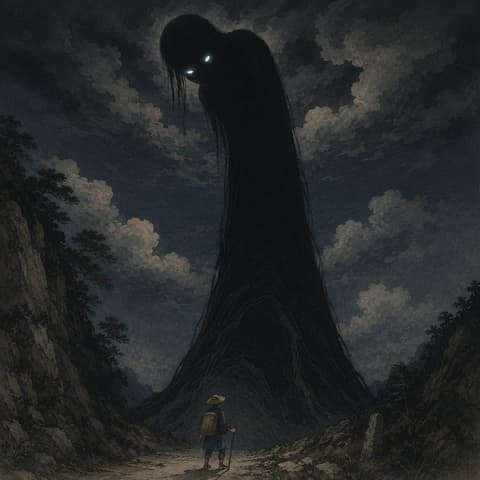
    A baseline profile of Shidaidaka as a roadside, look-up-type apparition recorded across the Chugoku region. It resembles a human silhouette with head and shoulders dissolving into darkness, and its height stretches or shrinks in response to one’s gaze. Harmfulness varies by tale, but fear intensifies through the act of looking up. Countermeasures include keeping your gaze lowered, watching the ground, or peering between your legs, which causes the figure to diminish and dissipate. It is linked to the Mikoshi-nyudo, and tales of the similarly named “Shidai-zaka” are viewed as slope or mountain-path variants. Hunter stories connect it with the nekomata, and identifications differ by locale. Creative embellishments are common, but the core taboo warns that one’s gaze amplifies the phenomenon.

  • Shiramine Sagamibō

    Shiramine Sagamibō

    Legendary

    Shiramine Sagamibō

    The Tengu Who Guards the Mausoleum of Sutoku — Shiramine Sagamibō

    Mountain & Wilderness SpiritsKagawa

    Shiramine Sagamibō is, among the Eight Great Tengu, the tengu most firmly bound to a single person—the Retired Emperor Sutoku. His image cannot stand apart from the story of Sutoku's vengeful spirit. The Retired Emperor Sutoku, defeated in the Hōgen Rebellion (1156), was exiled to Sanuki and died in the second year of Chōkan (1164) without ever being permitted to return to the capital. At his place of exile he copied out the five Mahāyāna sutras and sent them to the capital, but, suspected of a curse, had them flung back at him; in fury he swore an oath written in blood and is said to have become, while still living, a great tengu and a great demon (daimaen). Sagamibō guards the Shiramine mausoleum of this Sutoku, whom Yoritomo called "the greatest tengu in Japan." Shiramine-ji is the eighty-first station of the eighty-eight temples of Shikoku, the Shiramine mausoleum is the only imperial tomb in Shikoku, and beside it stands the Tonshō-ji-den, which enshrines the spirit of Sutoku-in. It was literature that made Sagamibō immortal. Its original source is the mid-Kamakura Senjūshō, attributed to Saigyō, whose "On the New Retired Emperor's Tomb at Shiramine" carries a tale of Saigyō mourning Sutoku's tomb at Shiramine. The Noh play Matsuyama Tengu, which dramatized it, takes Sutoku-in as the shite and Saigyō as the waki, and depicts Sagamibō as a tengu attending Sutoku. Further, the "Shiramine" of Ueda Akinari's Ugetsu Monogatari is a story in which Saigyō mourns Sutoku's spirit at the Shiramine mausoleum and converses with the wrathful Sutoku-in; Sagamibō became the being running through this lineage since the Senjūshō. The vengeful spirit and the tengu who stays beside it—the relation of Sutoku and Sagamibō is a rare point where the faith in goryō (vengeful spirits) and the faith in tengu meet. There are two theories on Sagamibō's origin: that it derives from Sagami Ajari Shōson, who sided with Sutoku in the Hōgen Monogatari, and that he was a tengu who came from Mt. Ōyama in Sagami. The latter forms a pair with the seat-transfer tradition arranged by Chigiri Kōsai—that the Sagamibō of Ōyama, in devotion to Sutoku, removed to Sanuki, and Hōkibō entered the vacant Sagami Ōyama. Either way, Shiramine Sagamibō sits at the western end of the Eight Great Tengu, transmitted at Shiramine in Sanuki as the tengu who keeps guarding the soul of Sutoku, one of Japan's three great vengeful spirits.

  • Suiton

    Suiton

    Uncommon

    すいとん

    The One-Legged Yokai of Hiruzen: Suiton

    Mountain / Field YokaiHiruzen in Mimasaka Province (Present-day Hiruzen, Maniwa City, Okayama Prefecture)

    *Suiton* is a one-legged yokai unique to the Hiruzen Highlands, based on local folklore recorded in the *Yatsuka-son Shi*. Its name derives from the way it flies in with a "*sui*" and lands on its single leg with a "*ton*". It belongs to the lineage of mind-reading yokai like the *Satori*, reading human hearts to tear apart and devour only the wicked. On the other hand, it has functioned as a moral guardian of the land, protecting the good and keeping the evil away. The anecdote of it fleeing in terror from the sound of bamboo bursting in a fire adds a touch of comedy—showing that despite its powerful mind-reading ability, it is easily frightened by sudden noises. This perfectly illustrates its character as a local yokai that serves as both a warning and a beloved figure. Today, statues of the *Suiton* are erected in various places as a symbol of Hiruzen tourism.

  • Sunakake-baba

    Sunakake-baba

    Legendary

    sunakake-baba

    The Invisible Sand Hag: Sunakake-baba

    山野の怪Nara

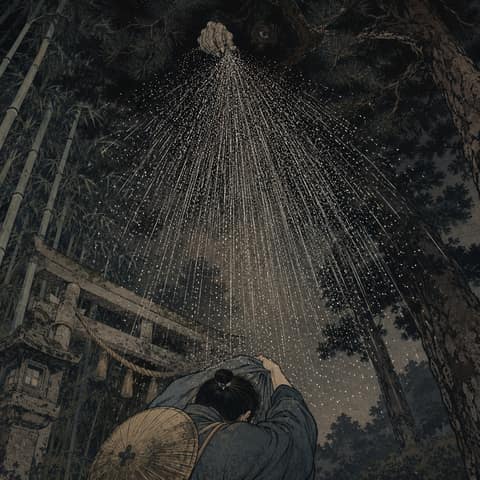
    The Folkloric Anomaly of the "Formless Yokai". While the basic overview highlighted the Sunakake-baba's narrative structure, this deep dive explores the profound academic significance of her "lack of visual representation." The mid-to-late Edo period saw a massive wave of yokai visualization (cataloging via illustration), spearheaded by Toriyama Sekien's *Gazu Hyakki Yagyo*. The Sunakake-baba is a remarkably rare entity that entirely missed this wave. She appears in no classical picture scrolls, and prior to Shigeru Mizuki, she was represented solely by "the sound of falling sand and the sand itself." When Kunio Yanagita explicitly noted in *Yokai Dangi* that "no one has ever seen her form," he was recognizing this visual absence as a critical academic subject. The Sunakake-baba holds a vital position in folkloristics because she preserves the primal archetype of the yokai concept: an invisible presence felt only through atmosphere, sound, and touch. Sandbar Topography and Boundary Spiritualism. It is no mere coincidence that the Sunakake-baba's primary lore locations—Nara (the Yamato River basin), Amagasaki (Ebisu Bridge, Josho-ji Temple, which sit on former sandbars), and Nishinomiya (coastal pine groves)—are all areas where "sand is exposed on the earth's surface." Sandbars, beaches, and sandy geological strata have historically commanded a strong folkloric presence as boundaries between water and land, serving as liminal corridors between humans and the otherworld. As highlighted by a Kobe Shimbun field report (December 2022), the phenomenon of sand liquefaction erupting in Amagasaki's former sandbar areas during the 1995 Great Hanshin Earthquake proves that yokai lore is deeply entwined with geological and topographical history. The Sunakake-baba is a textbook case of geographical yokai studies. The Festival Origin Theory: Mechanisms of Yokai Generation. Bintaro Yamaguchi's proposed "Hirose Shrine Sunakake Festival Origin Theory" provides a crucial perspective for unpacking how yokai are generated. A Shinto rainmaking ritual where participants throw sand to simulate rain, playfully jeering "It's the Sunakake-baba!", may have served as the incubator for the legend of a "sand-throwing hag." This illustrates the folkloric process where a yokai is generated on the margins of a festival—a phenomenon similarly observed with Setsubun demons, Obon spirits, and autumn festival tengu. It reinforces the view that religious rituals are not merely ceremonies, but active generators of folkloric imagination. Shirosaku Sawada and the Role of Local Folklorists. Dr. Shirosaku Sawada's *Yamato Mukashibanashi* is a prime example of folklore collection by local intellectuals during the pre-war and wartime eras. The development of Japanese folkloristics relied heavily on a network where local doctors, teachers, and historians collected oral traditions in the field and forwarded them to central figures like Kunio Yanagita and Shinobu Orikuchi. The Sunakake-baba's inclusion in Yanagita's *Yokai Dangi* is the direct result of this "center-periphery" collaborative research system. The excavation of local materials that supports 21st-century yokai studies is built entirely upon the painstaking groundwork laid by these local folklorists. Shigeru Mizuki's "Visual Reconstruction" and Cultural Ethics. Shigeru Mizuki (1922-2015) bestowed the Sunakake-baba with the appearance of an old woman in a kimono, creating a wholly original iconography inspired by the "Ondaiko" demon masks of Sado Island. This is a definitive example of post-war yokai culture, where mass media assigns a visual form to a traditionally formless entity. In *GeGeGe no Kitaro*, she was depicted as a righteous ally of the Kitaro family, completely erasing the localized, malicious trait of "startling humans." This Mizuki intervention sparks divided opinions in the modern history of yokai culture: while lauded for contributing to the national popularization and preservation of local lore, it is simultaneously criticized for altering the fundamental meaning of the original legend. It serves as an excellent case study for examining the ethical dilemmas of cultural production at the intersection of folkloristics and pop culture. Fukusaki, Koryo, and Hanshin: The Modern Geography of Yokai Tourism. In the 21st century, the Sunakake-baba has been aggressively developed into a tourism asset across her legendary homelands. Fukusaki Town in Hyogo Prefecture (Yanagita's birthplace) launched a "Yokai Bench" series, featuring a highly popular Sunakake-baba bench. The Sunakake Festival at Hirose Shrine in Koryo Town, Nara, garners significant tourism attention as an Intangible Folk Cultural Property. In the Hanshin cities of Amagasaki and Nishinomiya, yokai walking tours linking local history with toponymy have been established. In the context of post-war regional revitalization—where yokai function not merely as "old tales" but as modern regional brands, tourism drivers, and educational tools—the Sunakake-baba stands as an iconic symbol alongside Konaki-jiji and Ittan-momen. The Modern Paradigm Shift: From "Yokai Studies" to "Yokai Culture". The contemporary discourse surrounding the Sunakake-baba represents an intersection of two paradigms: the traditional view of treating yokai as academic subjects (folkloristics, historical verification), and the modern view of treating yokai culture as a living, breathing phenomenon (mass media, tourism, education). The modern trajectory—from the collection records of Yanagita and Sawada, through Mizuki's post-war visual reconstruction, and circulating back into 21st-century regional revitalization and tourism—proves that yokai are not "faiths of the past," but "cultural productions in progress." Modern yokai studies demands an approach that does not simply consume her as a "minor legend from Nara and Hyogo," but actively interrogates the history of knowledge, geology, and cultural production that stands behind her.

  • Taimatsumaru

    Taimatsumaru

    Rare

    tie-MAHT-soo-mah-roo

    Sekien Iconography Edition

    Mountain & Wilderness SpiritsJapanese folklore

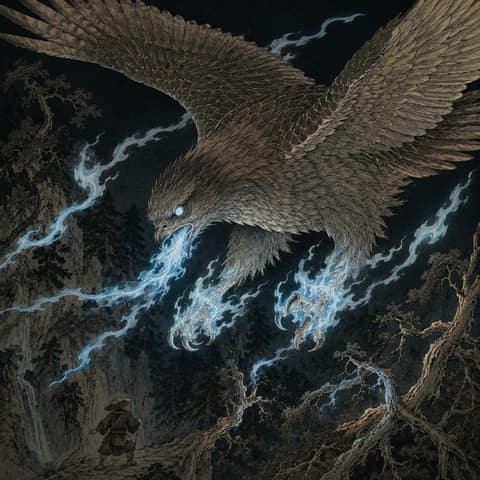
    An interpretive version based on Toriyama Sekien’s Hyakki Tsurezurebukuro image and notes. It bears a raptor’s body wreathed in ghostly flame, tongues of fire trailing from beak and talons. Its glow is not a guiding light but a will-o’-the-wisp that scrambles sight and sense of direction. Sekien links it to the glow of “tengu pebbles,” weaving puzzling mountain lights into tengu lore. Said to break the chanting and meditation of yamabushi and devotees, it was feared less for wounds than for unsettling the mind and leading feet astray. Though local oral traditions are scarce, it is understood in line with common notions of phantom fires and tengu fire.

  • Tanuki Bayashi (Raccoon Dog Festival Drums)

    Tanuki Bayashi (Raccoon Dog Festival Drums)

    Uncommon

    tah-NOO-kee bah-YAH-shee

    Honjo Baka-bayashi (Edo Tradition)

    Mountain & Wilderness SpiritsTokyo

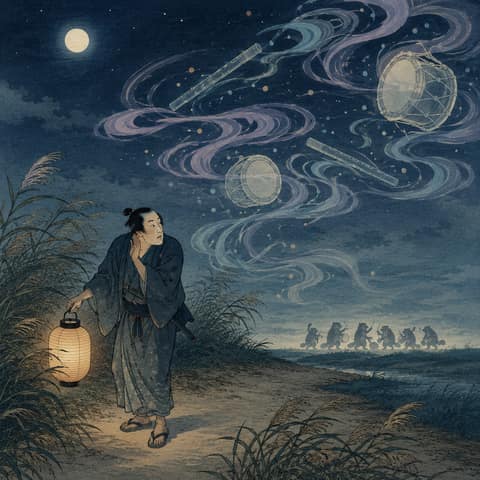
    A classic case of tanuki-bayashi reported around Honjo in Edo. The sound layers like flute, drum, and shamisen, seeming to recede as you approach and shifting direction when you turn a corner. It often cuts off abruptly near waterways and moat edges. While common folk sometimes explained it as refraction and echoes caused by wind and terrain, people of the time also took it as the work of tanuki. Counted among the Seven Wonders of Honjo, it was frequently mentioned in sideshows and popular literature, with the names “Baka-bayashi” and “Tanuki-bayashi” used interchangeably. Notably, there are no accompanying sightings of a physical form, making it a sound-only apparition of high record value. Folklore warns that chasing it can leave you lost and wandering into the outskirts by dawn, so one should stop midway and cover the ears.

  • Tengu

    Tengu

    Legendary

    Tengu

    What Is a Tengu? An Overview of Types and Iconography

    Mountain & Wilderness SpiritsKyotoShiga

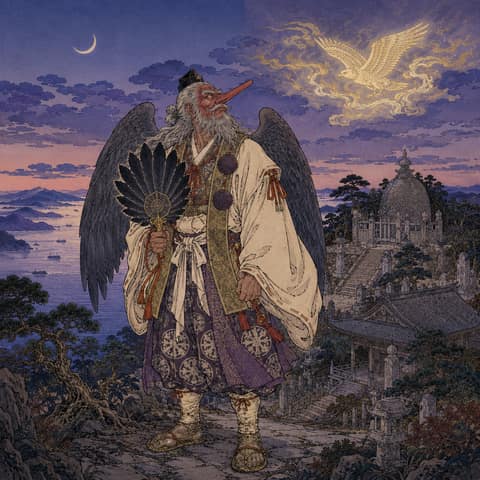
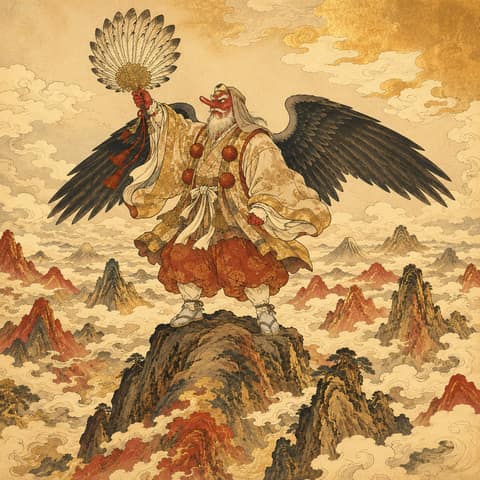
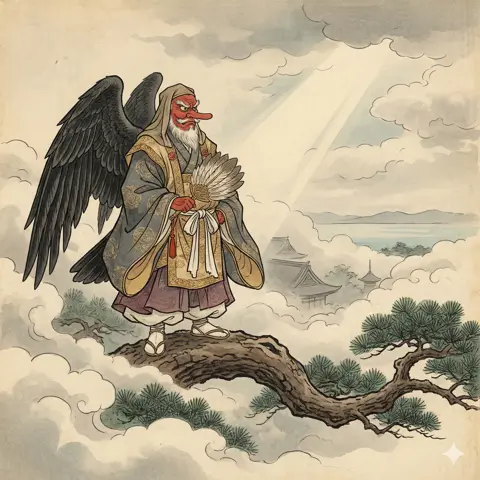
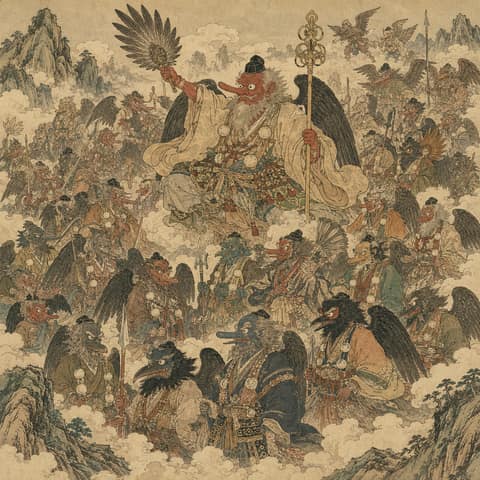
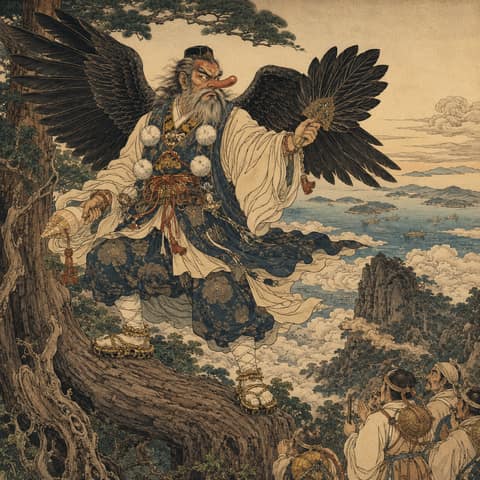
    This edition is not about a single seat on a particular sacred mountain, but a general treatise that thoroughly unravels "what a tengu is" from the history of its iconography and types. The individual traditions of each seat are left to the page of each great tengu. The form of the tengu is not uniform. The first type is the long-nosed tengu—ruddy face and high nose, clad in the ascetic's headcloth (tokin) and the suzukake robe, a feather fan in hand and one-toothed high clogs on the feet. The second is the crow tengu, with a crow's beak and wings, grasping a sword or a vajra staff. The third are the lesser tengu called leaf tengu and wood-chip tengu, held to be weak and numerous kin. Rather than a fixed classification, these reflect the breadth of the tengu image across eras and regions. The iconography shifted over time. The Heian-period tengu was first conceived as a bird like a black kite, and the image of the crow tengu retains that vestige. The long nose grows prominent only from the late Kamakura period; the Zegaibō Emaki depicts a scene in which a tengu that had disguised itself as a human has its nose lengthen as it returns to bird form. As for the origin of the long nose, there are theories that derive it from the high-nosed Jidō mask of gigaku and link the crow tengu to the Karura (Garuda) mask, and a view that sees the long nose as an iconographic vestige of a bird's beak—but none can be called settled doctrine. It was overlaid with the god Sarutahiko, described in the Nihon Shoki as having a nose seven hand-spans long, and the custom arose of using a tengu mask for the role of Sarutahiko in festivals. The tengu's dual nature is rooted in the Buddhist notion of the way of the tengu. Because it studies the Buddhist path it does not fall into hell, and because it handles heterodox arts it cannot reach paradise either—an intermediate state, and the one who falls there was held to be the arrogant monk. The Tengu Zōshi depicts this notion as satire of the monks of the seven great temples, yet Chigiri Kōsai too warns that the simplification "only arrogant monks become tengu" goes too far. Demon though it is, once subdued it turns to guardianship, and it was held that if a Shugendō practitioner recites the Tengu Sutra he may summon the tengu of the various provinces to grant his wishes—this amplitude between guardian and demon is the very core of the tengu. The certain medieval source for the grouping called the "Eight Great Tengu" lies in the libretto of the Muromachi-period Noh play Kurama Tengu. The passage in which the great tengu calls up the tengu of the provinces he commands in geographical order—"In Tsukushi, Buzenbō of Hiko-san; in the four provinces of Shikoku, Sagamibō of Shiramine; Hōkibō of Ōyama; Saburō of Iizuna… the host of Zenki of Ōmine, Takama of Katsuragi"—shows that the Eight Great Tengu were rooted in medieval belief and performing arts, not an Edo invention. Still, the composition wavers by source, with a variant that adds Hōkibō of Ishizuchi-san; it is no fixed roster.

  • Tengu

    Tengu

    Legendary

    Tengu

    Hieizan Hōshōbō, Great Tengu of Mount Hiei

    Mountain & Wilderness SpiritsKyotoShiga

    Hōshōbō of Mount Hiei is a great tengu who ranges the peaks of Hiei, where the capital meets the lake, dwelling between cedar and cypress crowns and the sea of clouds. Cloaked in the ridge winds of the Sannō shrines, he bears crow’s wings and a feather fan like a yamabushi’s ritual tool, said to appear at midnight with the lingering echo of a conch. His face is severe, ruddy with a high nose, eyes keen as if seeing through the ages. Yet his bearing recalls a monk, and the folds of his robes carry the scent of sutras. Named among the forty‑eight tengu of the Tengu Sutra since olden times, he guards Enryakuji’s teachings and the mountain’s vital currents, and in the era of the monastery’s ascendancy was said to guide and correct the conduct of its students both openly and unseen. Hōshōbō is not merely masterful in martial arts but cuts through the frayed edges of words to reveal a thing’s true nature. When a seeker loses their way, he thickens the mist and erases the markers, or lures an unsettled heart into the shadows of halls and pagodas—not to mislead, but to teach that wavering within is what leads one astray. When that is realized, the fog clears at once and Hiei’s ridgeline turns blade‑bright. Conversely, those who climb seeking fame and profit or who slight the Sannō deities are driven off by winds that make leaves into blades, never again permitted a frivolous ascent. Elders of Hiei whisper that Hōshōbō entrusts the essence of Lotus and Esoteric teachings to the wind, marshals flocks of birds to the cadence of chanting, and governs prayers for rain and for clearing skies. If Enryakuji’s bell tolls strangely, it is a sign of his feather fan stirring on the heights, and there were nights when sutra characters trembled across the lake’s ripples. At times he appears at a young ascetic’s bedside, delivering a single thunderous admonition that severs the root of delusion, leaving at dawn a single drop of white dew—medicine when diligence holds, poison when sloth prevails. He most abhors when urban rumors and power struggles spill onto the mountain, and bears an art that stills the blades of speech. When people wound each other with slander, a downslope wind rattles the town eaves and falsehoods collapse under their own weight; thus those who guard their tongues gain his protection. Yet he shows no mercy to those who hide pride behind practice: he lightens their footsteps until they lose the ground and wander forbidden paths of empty theory, and only when they admit their fault do their feet return to earth. On nights when the bush warbler in Hiei’s forest falls suddenly silent and distant thunder rings pure, Hōshōbō is near. If pilgrims bare their heads and pay full respect before the Sannō, the ridge wind softens and a single shaft of light breaks the clouds. This is called the Return of Hōshō—a sign that prayers in the mountain have been rightly answered. Hōshōbō is both guardian of the mountain and tester of the teaching; fear becomes reverence, and reverence opens the way. Only those who grasp this find his wings a sheltering shade for the road.

  • Tengu

    Tengu

    Legendary

    Tengu

    Kakukai-bō of Yokogawa

    Mountain & Wilderness SpiritsKyotoShiga

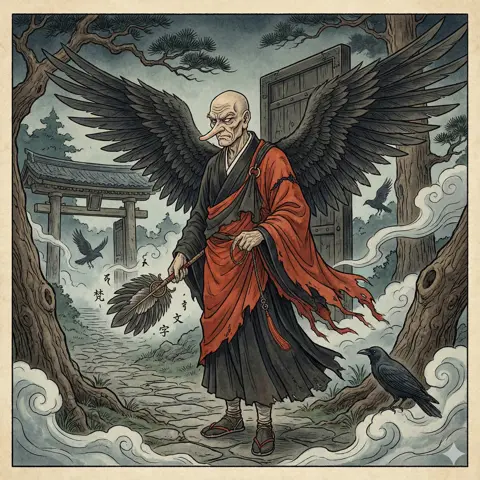
    Kakukai-bō of Yokogawa is said to be a tengu variant who turned from human monk to winged guardian of the Dharma from the late Heian into the early Kamakura era. Once a virtuous priest of deep Shingon lineage, he ran himself ragged settling mountain disputes until he grasped a boundary no worldly rule could protect, becoming a winged keeper of sacred law. In Kōya’s inner precincts, they tell how one night a gale whirled through a hall and the middle gate shuddered, then its doors shed their hinges, unfurled as twin feathers, and split the black clouds to fly off. Those doors became Kakukai-bō’s wings. Ever since, he appears with the comings and goings at temple gates, raising a fierce wind before those who disturb the rule and presenting a single line of precept. He resembles a karasu-tengu, yet his face keeps the gaunt trace of an old monk and his long nose curves like a mountain ridge. His feathered robe echoes priestly vestments, layered in cinnabar and ink, its cuffs frayed like the edges of ancient sutras. He carries a feather fan akin to a monk’s staff, and when he sweeps it, seed-syllables rise like chaff off paper, racing along the ground as ropes of warding. He speaks sparingly, but his words hang like a bell’s aftertone, stopping the feet of those who have strayed. He guards the mountain’s thresholds—the shrine and temple gates, the bends of approach paths, the joins of ridge and valley—where human law brushes mountain law, serving as their mediator. When a practitioner keeps purity, he lets fall a single white feather from the cloudbreak as a sign of safe passage. But if pride sprouts, the vigil lamp flickers once and a cold wind runs down the back. Feeling this thrice, one must follow his guidance to descend the mountain or doff one’s robe and return to first intent. He also teaches the ‘Doctrine of Drying’: to clear the heart, remove needless damp—a metaphor tied on the mountain to drying beans for stores and keeping offerings pure. Though unproven, it stands as a sign of turning the mountain’s rigor into daily sustenance. Late at night when mist pools in the valleys, he patrols with a train of crows. They are his eyes and ears, giving short signals to those swayed by rumor. Read rightly, the signs lead one off the wandering path, read wrongly, one circles the same ground three times. This is called Kakukai’s Rounds, and on the third turn, if one straightens the crook in the heart, the eastern ridge pales and the path opens naturally to the main gate.

  • 👹

    Tengu

    Legendary

    Tengu

    The Forty-Eight Tengu – The Great Tengu of the Provinces in the Tengu Sutra

    Mountain & Wilderness SpiritsKyotoShiga

    The tengu do not stop at the Eight Great Tengu. Each of the sacred mountains of the provinces was believed to have its own great tengu, and the early-modern esoteric prayer-scripture the Tengu Sutra lists their representatives as forty-eight seats—the "Forty-Eight Tengu." This edition is an overview that surveys the full roster and the provenance of the scripture itself. The Tengu Sutra is an esoteric, Shugendō-lineage prayer text said to have been compiled in the Edo period. It is not an orthodox sutra of the Buddhist canon, but belongs to the lineage of incantation-scriptures that a yamabushi recites in his devotions to summon (invoke the descent of) the tengu of the sacred mountains of the provinces, borrowing their numinous power to pray for the dispelling of demons, the subjugation of enemies, and the fulfillment of all wishes. The text begins with the chant "Homage to the great tengu and the small tengu," lists the names of the various tengu, then gives the total of the tengu as "one hundred twenty-five thousand five hundred in all," and closes with the mantra "On aromaya tengusumanki sowaka." This "one hundred twenty-five thousand five hundred" is not a real count but a symbolic number representing innumerable tengu, and the forty-eight seats named by their proper names are positioned as the representatives among them. As for the transmission of the manuscripts and printed editions of the Tengu Sutra, there are philological studies such as Takahashi Sei's "The Tengu Sutra: Its Present State and Whereabouts" (2016), and it is difficult to fix the date of compilation strictly to a single point. The roster of the Forty-Eight Tengu runs in the form of "bō" titles (sacred-mountain name + the name of the bō). The opening begins with the great tengu of the Kinai—Atago-san Tarōbō, Hira-san Jirōbō, Kurama-san Sōjōbō—and is followed by the tengu of the Shugendō sacred mountains across the land such as Fuji, Nikkō, Haguro, Akiba, Hikosan, and Ishizuchi. Below are listed all forty-eight seats, collated against two confirmable lines of sources, together with the bō title, sacred mountain, and province (present-day prefecture). ★ marks the Eight Great Tengu that have their own pages in this encyclopedia. 1. ★Atago-san Tarōbō (Mt. Atago, Yamashiro / Kyoto) 2. ★Hira-san Jirōbō (Mt. Hira, Ōmi / Shiga) 3. ★Kurama-san Sōjōbō (Mt. Kurama, Yamashiro / Kyoto) 4. Hiei-zan Hosshōbō (Mt. Hiei, Yamashiro / Kyoto) 5. Yokawa Kakkaibō (Yokawa, Mt. Hiei, Yamashiro / Kyoto) 6. Fuji-san Daranibō (Mt. Fuji, Suruga / Shizuoka) 7. Nikkō-san Tōkōbō (Mt. Nikkō, Shimotsuke / Tochigi) 8. Haguro-san Konkōbō (Mt. Haguro, Dewa / Yamagata) 9. Myōgi-san Nikkōbō (Mt. Myōgi, Kōzuke / Gunma) 10. Tsukuba-san Hōinbō (Mt. Tsukuba, Hitachi / Ibaraki) 11. ★Hiko-san Buzenbō (Mt. Hiko (Hikosan), Buzen / Fukuoka) 12. Ōhara Sumiyoshi Kenbō (Kengamine, Mt. Daisen (disputed), Hōki / Tottori (tentatively identified)) 13. Etchū Tateyama Nawadarebō (Mt. Tate, Etchū / Toyama) 14. Amanoiwafune Dantokubō (Amanoiwafune, location unknown) 15. Nara Ōku Sugisakabō (unknown, location unknown) 16. Kumano Ōmine Kikujōbō (Kiku-no-iwaya, Mt. Ōmine, Yamato / Nara) 17. Yoshino Minasugi Kozakurabō (Mt. Yoshino, Yamato / Nara) 18. ★Nachi Takimoto Zenkibō (Nachi Takimoto, Kii / Wakayama) 19. Kōya-san Kōrinbō (Mt. Kōya, Kii / Wakayama) 20. Niitayama Satokubō (Mt. Niita (disputed), Kōzuke / Gunma (tentatively identified)) 21. Kikaigashima Garanbō (Kikaigashima, Satsuma / Kagoshima (tentatively identified)) 22. Itatōyama Tondonbō (Mt. Itatō, location unknown) 23. Saifu Takagaki Kōrinbō (Mt. Kamado (Mt. Hōman), Chikuzen / Fukuoka (tentatively identified)) 24. Nagato Fumyō Kishukubō (unknown, Nagato / Yamaguchi (tentatively identified)) 25. Tsudoki Oki Fugenbō (Oki Island (disputed), Oki / Shimane (tentatively identified)) 26. Kurokenzoku Konpirabō (Mt. Zōzu, Sanuki / Kagawa) 27. Hyūga Obata Shinzōbō (unknown, Hyūga / Miyazaki (tentatively identified)) 28. Iōjima Kōtokubō (Iōjima, Satsuma / Kagoshima (tentatively identified)) 29. Shiōzan Rikyūbō (Mt. Shibi, Satsuma / Kagoshima (tentatively identified)) 30. ★Hōki Daisen Seikōbō (Mt. Daisen, Hōki / Tottori) 31. Ishizuchi-san Hōkibō (Mt. Ishizuchi, Iyo / Ehime) 32. Nyoigatake Yakushibō (Nyoigatake, Yamashiro / Kyoto) 33. Tenmanzan Sanmanbō (Mt. Tenman (disputed), Mino / Gifu (tentatively identified)) 34. Itsukushima Sankibō (Mt. Misen (Itsukushima), Aki / Hiroshima) 35. Shiragayama Kōshakubō (Mt. Shiraga, Tosa / Kōchi (tentatively identified)) 36. Akiba-san Sanshakubō (Mt. Akiba, Tōtōmi / Shizuoka) 37. Takao Naigubu (Mt. Takao, Yamashiro / Kyoto) 38. ★Iizuna Saburō (Mt. Iizuna, Shinano / Nagano) 39. Ueno Myōgibō (Mt. Myōgi, Kōzuke / Gunma) 40. Higo Ajari (Mt. Kinpō (disputed), Higo / Kumamoto (tentatively identified)) 41. Katsuragi Takamabō (Mt. Kongō (Katsuragi), Yamato / Nara) 42. ★Shiramine Sagamibō (Shiramine, Sanuki / Kagawa) 43. Kōra-san Chikugobō (Mt. Kōra, Chikugo / Fukuoka) 44. Zōzu-san Kongōbō (Mt. Zōzu, Sanuki / Kagawa) 45. Kasagi-san Daisōjō (Mt. Kasagi, Yamashiro / Kyoto) 46. Myōkō-san Adachibō (Mt. Myōkō, Echigo / Niigata) 47. Ontake-san Rokkokubō (Mt. Ontake, Shinano / Nagano) 48. Asamagatake Kinpeibō (Mt. Asama, Kōzuke / Gunma (tentatively identified)) Three cautions are needed in reading this roster. First, the bō titles (the names of each seat) agree across multiple sources and are reliable, but errors mixed into secondary web information mar the identification of the province and prefecture. For instance, Mt. Shibi is in Kagoshima Prefecture (Satsuma), and "Hyūga" is the old province name of Miyazaki Prefecture—misattributions confusing these with places in the Kantō or Tōhoku are in circulation. In this roster, "tentatively identified" is appended to seats whose identification has latitude, and "location unknown" to seats whose whereabouts cannot be confirmed among the sources. Second, there are seats such as Amanoiwafune Dantokubō, Nara Ōku Sugisakabō, and Itatōyama Tondonbō whose location multiple sources hold to be "unknown," and no place name has been forced upon these. Third, there is variation between the bō titles of the Eight Great Tengu and the wording of the Tengu Sutra text. For example, the Ōyama Hōkibō of the Eight Great Tengu appears in the text as "Hōki Daisen Seikōbō," and Ōmine Zenkibō appears in the "Nachi Takimoto Zenkibō" / "Kumano Ōmine Kikujōbō" line of wording. The Eight Great Tengu are commonly explained as eight representative seats drawn from among these forty-eight, but the bō titles do not agree word for word. The framework of the Forty-Eight Tengu shows most plainly that the tengu was not a solitary yokai but a deity of mountain worship seated throughout the sacred mountains of the whole country. Chigiri Kōsai, who compiled the study of tengu, likewise organized these mountain tengu into a single system. Each seat of the Eight Great Tengu (★) is treated in detail on its own page, but they too are simply the especially high peaks within this sea of one hundred twenty-five thousand five hundred tengu.
  • Thread-Spinning Maiden

    Thread-Spinning Maiden

    Uncommon

    EE-toh-hee-kee MOO-soo-meh

    Traditional Account

    Mountain & Wilderness SpiritsTokushima

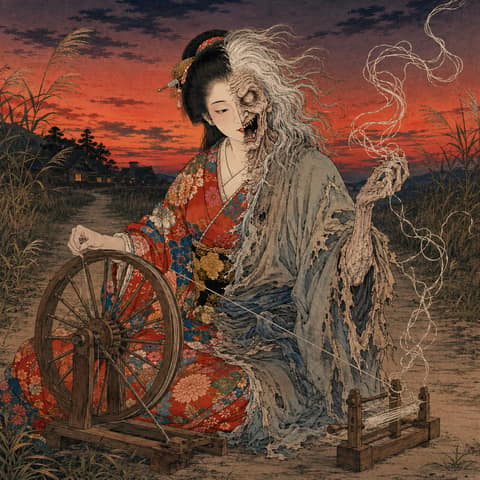
    Based on records from Horie Village in Awa Province, this version organizes the image of the Itobiki-Musume as a young woman operating a spinning wheel by the roadside. The moment someone looks her way, she transforms into an old crone and bursts into loud laughter. No harm beyond revealing her true form is reported, and she neither touches nor pursues people. Stories most often place her from dusk to midnight in spots where foot traffic thins—village outskirts, field paths, and crossroads. Folklorically she belongs to roadside怪異 tales, told as a warning not to be deceived by looks and not to dawdle off one’s route. The trigger for the change is acts like “staring” or “approaching,” and the silent switch to an old-woman figure is the core of the fright. The spinning wheel is an everyday tool, and her realistic working motions heighten the uncanny shock of a chance encounter. Parallels exist outside the region, but the named example from Awa is the best known.

  • Trailing Boy

    Trailing Boy

    Uncommon

    AH-toh-oh-ee koh-ZOHH

    Trailing Boy Monk (Tradition-Faithful)

    Mountain & Wilderness SpiritsKanagawa

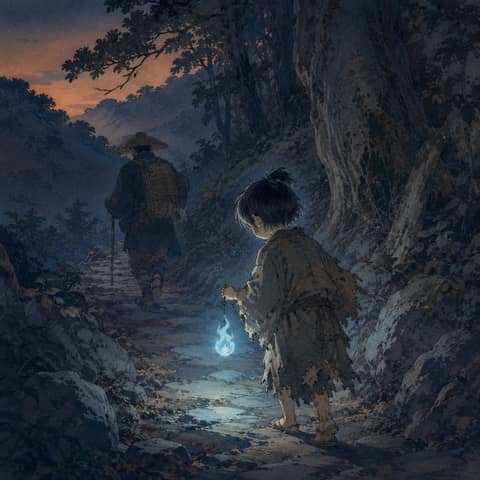
    A version organized from folklore materials of a child-shaped mountain spirit seen in the eastern Tanzawa mountains. Generally harmless, it simply follows quietly behind travelers, yet at times steps ahead at forks to guide them onto the right path. It wears rough straw matting or homespun, sometimes pelts, blending into the forest’s shadow and vanishing when one turns back. It is said to appear most often in the afternoon, and at night to carry a small light like a lantern. Those who meet it repeatedly often think of lost children and leave rice balls, yams, sweets, or dried persimmons on rocks or stumps as offerings. Some accounts say it fades away as one nears the villages, others that it withdraws when called to at night, and none describe it as vengeful. Rooted in overlapping ideas of mountains and the dead, it stands as a symbol of the boundary nature of the mountain realm.

  • Tsurube-otoshi

    Tsurube-otoshi

    Uncommon

    つるべおとし

    Severed Head Falling from Ancient Trees: Tsurube-otoshi

    Monsters of Mountains and FieldsKyotoGifu

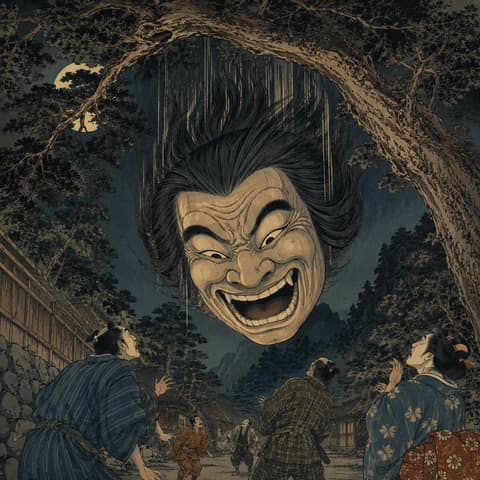
    Academic Correction (Most Important Note for this Species): The monsters included in the "Mei" volume of Toriyama Sekien's *Konjaku Gazu Zoku Hyakki* (1779) are Nue, Itsumade, Jami, Moryo, Mujina, Nobusuma, Nozuchi, Tsuchigumo, Hihi, Dodomeki, Buruburu, Gaikotsu, Tenjo-sagari, Ohaguro-bettari, Okubi, Dodomeki, Kanedama, and Amanozako (18 entities in total), and Tsurube-otoshi is not included. What Sekien drew was the related yokai Tsurubebi, which was included in *Gazu Hyakki Yagyo* (1776) — the predecessor to Zoku Hyakki. The original text for Tsurubebi is Yamaoka Genrin's *Kokon Hyaku Monogatari Hyoban* (published in 1686; the "Tsurube-oroshi of Nishinooka" tale in Nishiyama, Kyoto), which theorized the strange phenomenon of a large tree's spirit turning into a fireball and descending from the tree on rainy nights using the Five Elements theory (Wood generates Fire). In other words, the "Yokai Tsurube-otoshi (a severed head or demon mask falling from a tree)" and "Sekien's Tsurubebi (a mysterious fire dropping from a large tree)" are separate lineages that diverged after the Showa era, and Sekien did not directly depict the former. No primary visual sources with the name "Tsurube-otoshi" from the Edo period exist, and it mainly appears as local folklore in Taisho period topographical records and folklore collections. This is a critical correction that must be specified to maintain the academic quality of yokai.jp, and the widespread "1779 Sekien iconification theory" should be explicitly denied. The primary records of Tsurube-otoshi are Taisho period local materials and folklore collections. The Kyoto regional study *Kuchidanba Kohishu* (a Taisho era collection of folklore from Minamikuwada and Funai Districts) serves as the core historical document, recording it as a local legend of mountain roads, passes, and old trees in the Chubu and Kinki regions. The fact that the primary source is not Edo period iconography but local folklore oral collection is a unique characteristic of this yokai, making it an exceptional case that does not fit the generalization that "yokai originate from Edo period iconification." The local folklore of Tsurube-otoshi is concentrated in the Chubu and Kinki regions: 1. Kyoto Prefecture — Hoki, Sogabe Village, Minamikuwada District (present-day Sogabe-cho, Kameoka City; drops from a kaya tree, laughs "Finished your night work? Shall I drop the bucket? Squeak, squeak" and rises again), Tera, Sogabe Village (a severed head descends from an old pine, devours people, and disappears for 2-3 days when full), Tomimoto Village, Funai District (present-day Yagi-cho, Nantan City; a pine tree covered in ivy), Tsuchida, Ooi Village (present-day Ooi-cho, Kameoka City; eats people) — documented in the Taisho period regional study *Kuchidanba Kohishu*. 2. Kuze Village, Ibi District, Gifu Prefecture (present-day Ibigawa-cho) — drops a bucket from a large tree that is dim even during the day. 3. Hikone City, Shiga Prefecture — drops a bucket from tree branches aiming at passersby. 4. Kuroe, Kainan City, Wakayama Prefecture — similar lore. 5. Tamba-Sasayama City, Hyogo Prefecture. 6. Mikawa mountainous region, Aichi Prefecture (folklore in Toyone Village, etc.). It has a geographic characteristic of concentrating around ancient trees (pine, kaya, cedar, zelkova) along mountain roads, passes, and shrine grounds in the Chubu and Kinki areas. Its behavior is bifurcated by region: The Kyoto lineage is predatory (eating people and staying full for 2-3 days), making it a lethal yokai; the Gifu-Shiga lineage is intimidating (only dropping a bucket to scare people), causing little real harm. The Kyoto lineage features a specific predatory pattern of "not appearing for 2-3 days when satiated," and was feared as a murderous monster rather than a mere scarer. On the other hand, the Gifu-Shiga lineage, as its name suggests, simply drops a "tsurube (well bucket)" from a tree to startle people, a relatively harmless yokai positioned between a "supernatural threat" and a "laughing matter." Despite sharing the name "Tsurube-otoshi," the entity itself varies significantly depending on the region, providing an excellent example of the regional diversity of local legends. The modern visual of a "red-faced, bearded, disheveled old man's head" depends heavily on Shigeru Mizuki's artwork and is not the original standard form in local folklore. The original form varies widely by region, splitting into three lineages: 1. A solitary severed head (Tera, Sogabe Village, Kyoto), 2. A formless monster that drops a well bucket itself (Gifu and Hikone, Shiga), and 3. A spirit type accompanied by laughter and speech (Hoki, Sogabe Village, Kyoto). The image of the "red severed head" was popularized through Shigeru Mizuki's manga and anime such as *GeGeGe no Kitaro* and *Akuma-kun*, becoming fixed as the modern general image, but from a folkloric perspective, the standard form changed pre- and post-Mizuki. This is also a perfect illustration of the decisive impact "Mizuki Yokai Culture" had on Japanese people's perception of yokai. The idiom "autumn days drop like a tsurube" (a metaphor comparing the rapid darkening of the autumn sunset to the motion of a well bucket and rope plunging down at once) has no direct lineage connection to the yokai Tsurube-otoshi. They share the same metaphorical source of "a well bucket = something that falls rapidly," but the idiom was established independently as a meteorological expression. However, the fact that the concept behind the yokai's naming (the three elements of falling speed, darkness, and surprise) stands on the same metaphorical foundation as the idiom is noteworthy in cultural history — demonstrating the richness of Japanese metaphorical culture, where an everyday tool like a "well bucket" evolved into both a meteorological phrase and a yokai name. Distinctions from similar yokai: 1. Tsurubebi (the mysterious fire dropping from a tree in Sekien's *Gazu Hyakki Yagyo*, which, as mentioned, is the Edo period origin lineage that diverged from Tsurube-otoshi in modern times), 2. Kodama (tree spirits in general; Tsurube-otoshi is an "individual monster dwelling in a specific ancient tree," a variant of the kodama lineage), 3. Kosoma (an acoustic supernatural phenomenon making axe and falling tree sounds in the mountains, different in nature from Tsurube-otoshi which primarily relies on visual dropping attacks), 4. Severed head lineages (Otoshikubi, Kubikireuma, etc.; they share the "head" aspect, but the Kyoto lineage's severed head in Tsurube-otoshi is an independent yokai entity, not a monster of decapitation). Toriyama Sekien's four-part yokai series consists of *Gazu Hyakki Yagyo* (1776) -> *Konjaku Gazu Zoku Hyakki* (1779) -> *Konjaku Hyakki Shui* (1781) -> *Hyakki Tsurezure Bukuro* (1784), and all images are publicly available on the National Diet Library's NDL Image Bank. Tsurubebi is included in the "In" volume of *Gazu Hyakki Yagyo*. When listing Tsurube-otoshi on yokai.jp, it should be clearly stated that typeOfSource = "Local folklore (Chubu/Kinki)" and firstAttestedSource = Taisho period *Kuchidanba Kohishu*, while explicitly denying the widespread misinformation of the "Edo period Sekien iconification theory." In modern yokai culture, it was popularized by Shigeru Mizuki's *Yokai Zukan* and the bronze statue on *Mizuki Shigeru Road* (Sakaiminato City, Tottori Prefecture), and appears as a Kyoto yokai in *GeGeGe no Kitaro* (3rd season VA: Masato Hirano, 5th season: Hisao Egawa) and *Nura: Rise of the Yokai Clan*. As an excellent example of a grassroots yokai originating from local oral tradition being popularized by Shigeru Mizuki's artwork, Tsurube-otoshi is an important case study showing the modernization mechanism of Japanese yokai culture — a fascinating yokai situated at the intersection of folklore studies, art history, and media theory, demonstrating a modern yokai circulation route from unillustrated Edo period local folklore to Taisho period oral collection, Mizuki's popularization, and modern anime and games.

  • Uyauyashi

    Uyauyashi

    Rare

    oo-yah-oo-YAH-shee

    Iconographic Tradition Edition

    Mountain & Wilderness SpiritsJapanese folklore

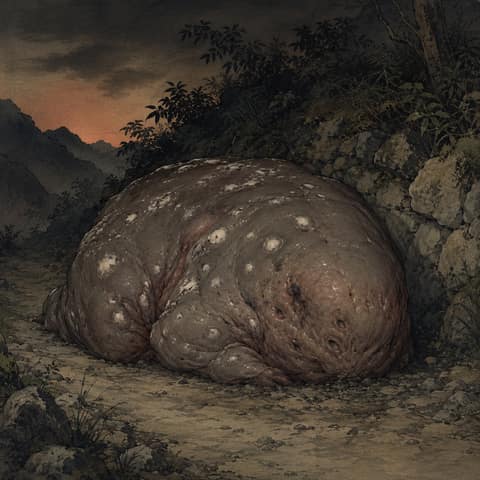
    A reconstruction based on imagery from picture scrolls. It kneels low to the ground, the body slack, skin ashen-brown mottled with pale spots. The face is indistinct, the line between mouth and nose blurred, with a damp sheen. In keeping with rare records that preserve little more than its name, no guiding motive is assigned. Said to be seen as a crouching lump by mountain paths or along thickets, it inspires awe and a sense of distance. If approached, it withdraws before its form can be fixed, making pursuit difficult. No confirmed harm is attributed to it, and encounter tales remain general.

  • Waira

    Waira

    Uncommon

    WAH-ee-rah

    Emaki Tradition Conformant

    山野の怪Ibaraki

    A reference version reconstructed from 18th–19th century yokai picture scrolls that depict the figure without commentary. Only the massive upper body of a beast is shown, bearing large single hooked claws on each forelimb. Color varies by example from dark green to earth tones, with some renderings appearing amphibian. The name is associated with a word meaning fear and is set alongside Otoroshi in works like Hyakkai Zukan and Gazu Hyakki Yagyo. No behavior, ecology, or moral alignment is recorded, presenting it merely as an eerie presence of the mountains. Concrete folk traditions remain unknown, and later embellishments are excluded for lack of sources.

  • Weeping Stone

    Weeping Stone

    Uncommon

    yo-NAH-kee ee-shi

    Legend of Sayo no Nakayama

    Mountain & Wilderness SpiritsShizuoka

    A representative form from the Tokaido’s Sayo no Nakayama. The spirit of a pregnant woman murdered on her journey is said to have possessed a stone and cried each night for her unborn child. People performed memorial rites, and in time the spirit was soothed. Folklorically, it is tied to roadside memorials, Koyasu child-protection faith, and the erection of stone steles, reflecting an older belief that spirits dwell within stones.

Showing 25 - 48 of 56 yokai