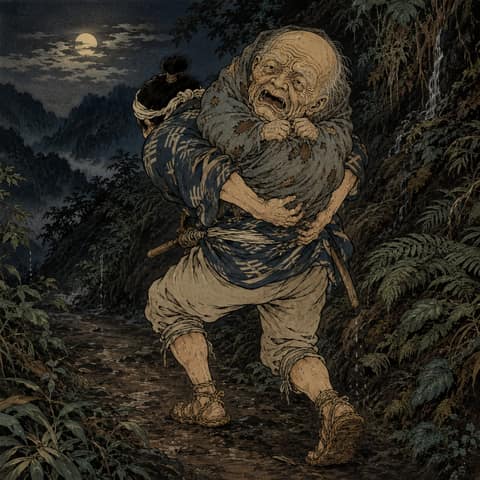
The Folkloric Anomaly of the "Formless Yokai". While the basic overview highlighted the Sunakake-baba's narrative structure, this deep dive explores the profound academic significance of her "lack of visual representation." The mid-to-late Edo period saw a massive wave of yokai visualization (cataloging via illustration), spearheaded by Toriyama Sekien's *Gazu Hyakki Yagyo*. The Sunakake-baba is a remarkably rare entity that entirely missed this wave. She appears in no classical picture scrolls, and prior to Shigeru Mizuki, she was represented solely by "the sound of falling sand and the sand itself." When Kunio Yanagita explicitly noted in *Yokai Dangi* that "no one has ever seen her form," he was recognizing this visual absence as a critical academic subject. The Sunakake-baba holds a vital position in folkloristics because she preserves the primal archetype of the yokai concept: an invisible presence felt only through atmosphere, sound, and touch.
Sandbar Topography and Boundary Spiritualism. It is no mere coincidence that the Sunakake-baba's primary lore locations—Nara (the Yamato River basin), Amagasaki (Ebisu Bridge, Josho-ji Temple, which sit on former sandbars), and Nishinomiya (coastal pine groves)—are all areas where "sand is exposed on the earth's surface." Sandbars, beaches, and sandy geological strata have historically commanded a strong folkloric presence as boundaries between water and land, serving as liminal corridors between humans and the otherworld. As highlighted by a Kobe Shimbun field report (December 2022), the phenomenon of sand liquefaction erupting in Amagasaki's former sandbar areas during the 1995 Great Hanshin Earthquake proves that yokai lore is deeply entwined with geological and topographical history. The Sunakake-baba is a textbook case of geographical yokai studies.
The Festival Origin Theory: Mechanisms of Yokai Generation. Bintaro Yamaguchi's proposed "Hirose Shrine Sunakake Festival Origin Theory" provides a crucial perspective for unpacking how yokai are generated. A Shinto rainmaking ritual where participants throw sand to simulate rain, playfully jeering "It's the Sunakake-baba!", may have served as the incubator for the legend of a "sand-throwing hag." This illustrates the folkloric process where a yokai is generated on the margins of a festival—a phenomenon similarly observed with Setsubun demons, Obon spirits, and autumn festival tengu. It reinforces the view that religious rituals are not merely ceremonies, but active generators of folkloric imagination.
Shirosaku Sawada and the Role of Local Folklorists. Dr. Shirosaku Sawada's *Yamato Mukashibanashi* is a prime example of folklore collection by local intellectuals during the pre-war and wartime eras. The development of Japanese folkloristics relied heavily on a network where local doctors, teachers, and historians collected oral traditions in the field and forwarded them to central figures like Kunio Yanagita and Shinobu Orikuchi. The Sunakake-baba's inclusion in Yanagita's *Yokai Dangi* is the direct result of this "center-periphery" collaborative research system. The excavation of local materials that supports 21st-century yokai studies is built entirely upon the painstaking groundwork laid by these local folklorists.
Shigeru Mizuki's "Visual Reconstruction" and Cultural Ethics. Shigeru Mizuki (1922-2015) bestowed the Sunakake-baba with the appearance of an old woman in a kimono, creating a wholly original iconography inspired by the "Ondaiko" demon masks of Sado Island. This is a definitive example of post-war yokai culture, where mass media assigns a visual form to a traditionally formless entity. In *GeGeGe no Kitaro*, she was depicted as a righteous ally of the Kitaro family, completely erasing the localized, malicious trait of "startling humans." This Mizuki intervention sparks divided opinions in the modern history of yokai culture: while lauded for contributing to the national popularization and preservation of local lore, it is simultaneously criticized for altering the fundamental meaning of the original legend. It serves as an excellent case study for examining the ethical dilemmas of cultural production at the intersection of folkloristics and pop culture.
Fukusaki, Koryo, and Hanshin: The Modern Geography of Yokai Tourism. In the 21st century, the Sunakake-baba has been aggressively developed into a tourism asset across her legendary homelands. Fukusaki Town in Hyogo Prefecture (Yanagita's birthplace) launched a "Yokai Bench" series, featuring a highly popular Sunakake-baba bench. The Sunakake Festival at Hirose Shrine in Koryo Town, Nara, garners significant tourism attention as an Intangible Folk Cultural Property. In the Hanshin cities of Amagasaki and Nishinomiya, yokai walking tours linking local history with toponymy have been established. In the context of post-war regional revitalization—where yokai function not merely as "old tales" but as modern regional brands, tourism drivers, and educational tools—the Sunakake-baba stands as an iconic symbol alongside Konaki-jiji and Ittan-momen.
The Modern Paradigm Shift: From "Yokai Studies" to "Yokai Culture". The contemporary discourse surrounding the Sunakake-baba represents an intersection of two paradigms: the traditional view of treating yokai as academic subjects (folkloristics, historical verification), and the modern view of treating yokai culture as a living, breathing phenomenon (mass media, tourism, education). The modern trajectory—from the collection records of Yanagita and Sawada, through Mizuki's post-war visual reconstruction, and circulating back into 21st-century regional revitalization and tourism—proves that yokai are not "faiths of the past," but "cultural productions in progress." Modern yokai studies demands an approach that does not simply consume her as a "minor legend from Nara and Hyogo," but actively interrogates the history of knowledge, geology, and cultural production that stands behind her.
Character Profile
This section is our own creative profile for storytelling. It is not historical fact or scholarship.
Yokai Type - Traditional Yokai
Category - Mountain & Wilderness Spirits
Rarity - Legendary
Personality - In ancient legends, she is a mischievous entity that delights in startling humans. Post-Mizuki, she is reimagined as a cautious, tight-lipped old woman with a piercing gaze. She possesses an ambiguous, dual personality: the shame of "not wanting her form to be seen" coexisting with the curiosity of "wanting to test humanity."
Compatibility - She has strong ties with those who respect shrines, ancient roads, and night travel, as well as those sensitive to liminal spaces and sandy environments. She resonates deeply with individuals who appreciate local Shinto rituals like the Sunakake Festival, and those who seek to understand local geological history.
Abilities - The anomalous power to throw and scatter sand from above (without revealing her form).Manifestation in liminal boundary zones: shrine groves, pine trees, bamboo thickets, and under bridges.The infliction of terror through the combination of sudden sound and falling sand.The ability to possess sandbar topographies and ancient pine groves.Deep connections to religious festivals and rituals (syncing with the Hirose Shrine Sunakake Festival).
Weaknesses - Bright lights, crowds, and daytime traffic. An extreme shame of being visualized (she absolutely never shows herself in classical folklore). In the post-Mizuki context, her integration into the human community and solidarity with allies has effectively erased the concept of "weaknesses."
Habitat - Shrine groves in the Yamato region of Nara, Hirose Shrine, the Ebisu Bridge and ruins of Josho-ji Temple in Amagasaki (former sandbars), pine groves in Nishinomiya, and bamboo thickets in Kusatsu. Today, her primary habitat is the media space of 'GeGeGe no Kitaro' and yokai tourism destinations.