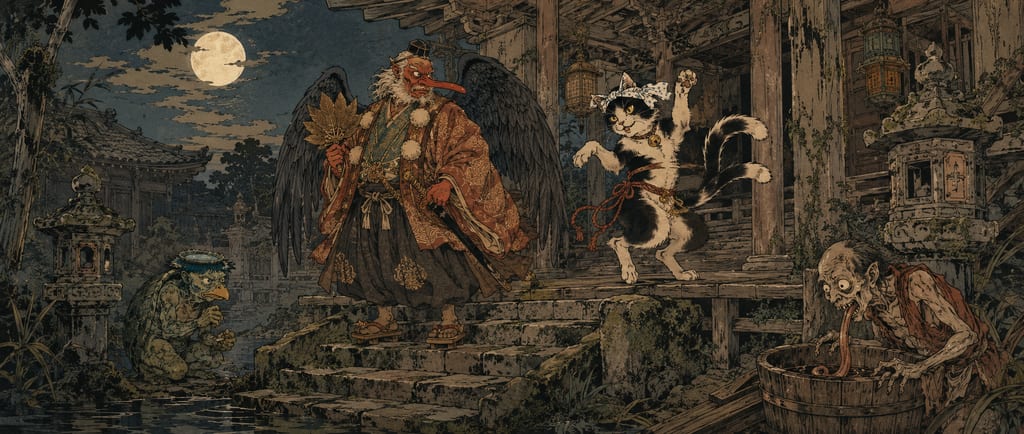
A nocturnal mischief-maker that appears in bedrooms to flip pillows or switch a sleeper’s head and feet. Most records date from the Edo period onward. Its form varies—sometimes a child, a monk, or left undefined. In Toriyama Sekien’s Gazu Hyakki Yagyō it resembles a small guardian-statue figure. Having one’s pillow reversed was once feared as a sign of disorder between body and soul, linked to illness or death.
Folklore & Legends
In Tōhoku it’s blamed on the pranks of zashiki-warashi, with tales of tiny footprints and raised tatami. Many regions say a vengeful spirit of a murdered traveler or someone who died in that room becomes a pillow-flipper. Temples tell of special “pillow-flipping rooms” and hanging scrolls that cause sleepers to turn so their heads face the principal image. Some traditions attribute the phenomenon to animals—tanuki, monkeys, or cats (kasha).
A pillow-flipping subtype rooted in old beliefs that pillows are linked to the movement of the soul and to boundaries. It manifests at thresholds between sacred and secular spaces such as certain parlors, pillars, or Buddhist rooms, turning sleepers’ heads toward a Buddha or principal icon, or simply inverting the pillow to signal a reversal of order. Noted in essays and picture scrolls from the Edo period onward, it often ties into temple Seven Wonders and scroll-haunt tales. In some regions it is read as the play of a zashiki-warashi, the sign of a spirit of someone who died in the house, or a guise of a shapeshifting animal. The fear it inspires has shifted over time: once viewed as a portent of deadly curse, in modern times it tends to be treated as a lighter bedroom haunting and prank.
Character Profile
This section is our own creative profile for storytelling. It is not historical fact or scholarship.
relatively quiet toward those who observe proper manners
Abilities
stealthy approach to the sleeping area and pillow inversionreversing a sleeper’s head-to-feet orientationrepositioning the sleeper so the head faces the Buddhist altar or principal iconslight movement of tatami or bedding with uncanny strength
Weaknesses
observance of etiquette and ritual recitation, mindful orientation toward the Buddhist altar and careful setting of directions, protective talismans or prayers placed by the pillow
Habitat
Buddhist rooms and guest halls of temples, tatami rooms of old houses, rooms in traditional inns
The diagram below is a diagnostic evaluation chart for Traditional Type – Temple and Shrine Anomaly Affiliation. The higher the value of each item, the stronger that characteristic is expressed.