ba-ku
The Baku of the Pillow
Divine SpiritsChinese in origin; nationwide in Japan (Edo-period dream-warding custom)
The name “Baku of the Pillow” comes from this beast having been cherished, above all, as a guardian charm at the bedside. Here, rather than the tale of eating dreams, let us turn to the baku drawn upon the pillow itself. A baku pillow is a pillow on whose box-shaped side a picture of the baku or the character for baku was drawn, or on which a baku was worked in maki-e lacquer; rest your head on it to sleep, it was believed, and through the whole night nothing evil would draw near. According to Yano Ken’ichi’s study of the pillow, the baku pillow was no mere ornament but a practical charm, made to guard the most defenseless stretch of time — the hours of sleep.
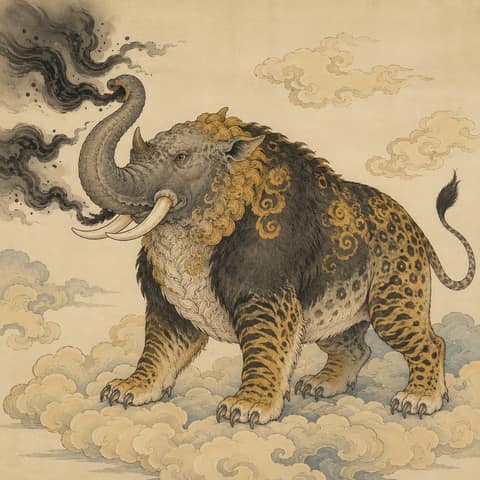
Trace the baku’s form to its roots and two streams run mingled within it. One is the figure transmitted by the Shuowen Jiezi and the commentary on the Erya: a bear-like body mottled black and white that eats even copper, iron, and bamboo. This derives from a real beast of Sichuan in China (most likely the panda). The other is the figure in the text Bai Juyi attached to a screen painting — “trunk of an elephant, eyes of a rhinoceros, tail of an ox, feet of a tiger.” Japanese painters and encyclopedias drew the baku by joining these two. That familiar figure — a black-and-white mottled bear’s body with a long trunk and short legs — is the result of the two becoming one.
The baku was drawn on more than pillows and charm-cards. Carvings of the baku are often found on shrine and temple buildings as well. On the kibana that support the roof and on the kaerumata (the gable-shaped member above the beam), baku were carved, charged with keeping fire and calamity at a distance. As the baku at the bedside guards sleep, the baku on the building guards the house. Both arise from the same idea — placing a baku at the threshold where evil would enter — and so it appears on pillow and on building alike.
The baku is often mistaken for another spirit-beast, the baize, and here too I would make the difference plain. The baize is a beast said to understand human speech and to know every yokai in the world — originally a thing apart from the baku. The trigger for the confusion lay in the line Bai Juyi added about the baku, that “in common speech this is called the baize.” Because both were alike in being “beasts that drive off evil,” the mix-up occurred in pictures too, and there is even a known case where an image called the “Baku King” was in fact a baize to begin with. The baku and the baize are best kept apart in thought as separate beasts — alike in office, but different in origin.
Seen this way, the Baku of the Pillow is neither a monster that steals dreams nor a yokai that attacks people. It is a sentinel, charm-like, set at the “gaps where evil slips in” — the bedside as one sleeps, the doorway of the house. Together with the way the Wakan Sansai Zue spread the baku’s form and its evil-warding power through the world, people drew the baku on pillows, on charms, and on the beams of shrines and temples, setting it to keep watch over bad dreams and calamity without end. What the name “pillow-beast” reflects is this face of the baku as a quiet keeper of watch.