Yokai Encyclopedia

Encyclopedia of Japanese Yokai

148 Yokai|14 Category|Page 4 of 7
Localization in Progress - More content available in Japanese version
View Japanese
Sort by: NameAscending
Uncommon
  • Medochi

    Medochi

    Uncommon

    me-do-chi

    The Kappa Lurking in Tsugaru’s Waters — Medochi

    Water SpiritsFukushima

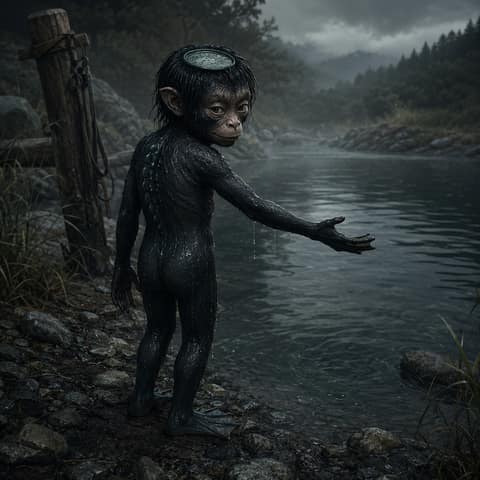
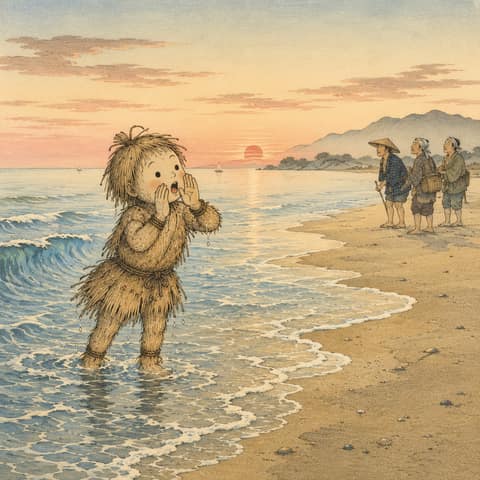
    This version looks closely at how the medochi, though merely “a dialect name for the kappa,” carries a face all its own, belonging to the land of Tsugaru. Begin with the name. Medochi derives from mizuchi (蛟), which once meant a water-serpent deity. How it came to be the name of the kappa traces a larger current in waterside belief — a water-god declining over the ages, descending step by step from a revered deity into a dreaded yokai. The name medochi carries that memory of decline down to the present day. In its image, too, the Tsugaru medochi stands apart. Where the Edo artists drew the kappa with a beak and a shell, the people of Tsugaru told of a monkey face and a black body. Around Towada they say the medotsu has a red face; color and form waver from place to place. All that holds constant is the stature of a child, and that eerie pull toward the water. What must not be overlooked in matters of belief is its two-sidedness with Suiko-sama. In Tsugaru, the medochi that drags people under (the demon) and the Suiko-sama that quells it (the water-god) are often spoken of as two faces of one same being. In 1934 Orikuchi Shinobu saw with his own eyes the Suiko image at Nagata, had a copy made of it, and held a river festival at Kokugakuin. The figure of “one Suiko-sama for forty-eight” has no scholarly grounding, yet the sense of rank — the medochi governed by a “chief” — is truly rooted in the water-god belief of Tsugaru. Its weaknesses, and the means of quelling it, all come back to its bond with the river. It dissolves at the touch of a hemp stalk; offer the first cucumber of the season and it takes no one; enshrine Suiko-sama and the deep pool grows calm. The people of Tsugaru lived by the water and feared it too — and the medochi, this kappa, is something like the knot they tied of those days in their hearts.

  • Metsuhō Shell (Metsuhō-gai)

    Metsuhō Shell (Metsuhō-gai)

    Uncommon

    MEH-tsu-hoh-gai

    Emaki-Accurate Depiction

    Aquatic SpiritsJapanese folklore

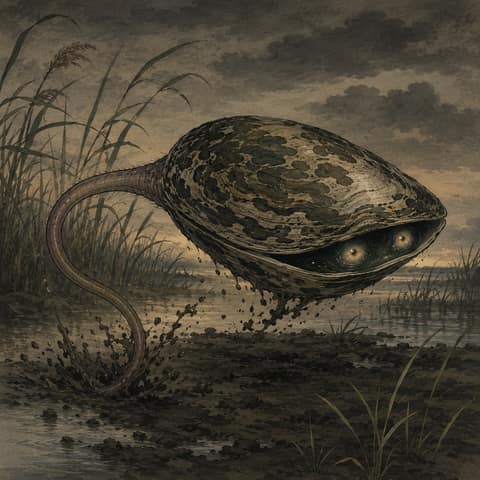
    In texts, the Metsuhō Shell appears solely as an image: an enigmatic shell-dwelling creature that emerges around rivers, marshes, and ponds. Eyes peer from the rim of its shell, and a tail-like appendage sways as if propelling it. Its behavior, malice, and omens are not recorded. Late Edo picture scrolls omit explanatory captions, inviting readers to infer origins from its name and form, and set it alongside other water spirits. The term metsuhō evokes a sense of lawlessness or being out of bounds, but no firm source, orthographic variants, or toponymic links are attested. Accordingly, this entry confines itself to minimal notes based on iconographic traits and extant sources.

  • Mill-Bearing Hag

    Mill-Bearing Hag

    Uncommon

    OO-soo-oh-ee BAH-bah

    Sado Shukunegi Tradition

    Aquatic SpiritsNiigata

    A maritime apparition told along the coves of southern Sado Island. It appears as a white-haired old woman who rises to the surface at dusk when weather breaks and dimness falls. Her hands are held behind her back as if bearing a burden, though the original account names no specific object. Sightings are said to occur once every two to five years, and merely seeing her is not believed to bring illness or immediate disaster. Modern yokai encyclopedias place her in the lineage of Iso-onna and Nure-onna, yet tales of luring or predation are absent; instead she is spoken of as a harbinger of poor catches or sudden shifts in weather. The name is rarely attested outside local ghost-story collections and is likely a region-specific term.

  • Minobi (Rain-cloak Fire)

    Minobi (Rain-cloak Fire)

    Uncommon

    MEE-noh-bee

    Canonical Folklore Standard

    自然現象・自然霊Shiga

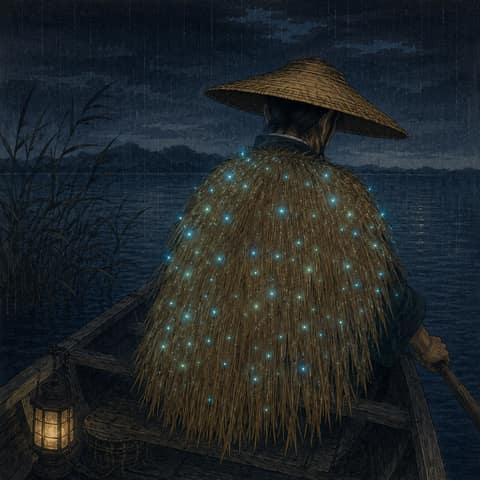
    Typified by records tracing to Lake Biwa, it is a collective form of strange lights that cling in faint specks to rain cloaks, umbrellas, and garments on rainy nights. They carry no heat and increase in brightness and number when brushed at, yet disperse naturally when garments are removed, a flame is lit, or time passes. Names and interpretations vary by region, with some seeing them as spirits of drowning victims, others as animal tricks or natural bioluminescence. Rather than causing harm, they are said to bewilder and unsettle, and are often visible only to solitary individuals.

  • Mishige (Enchanted Rice Paddle)

    Mishige (Enchanted Rice Paddle)

    Uncommon

    MEE-shee-geh

    Meshibitsu – Tradition-Accurate Version

    Animated Objects & UndeadOkinawa

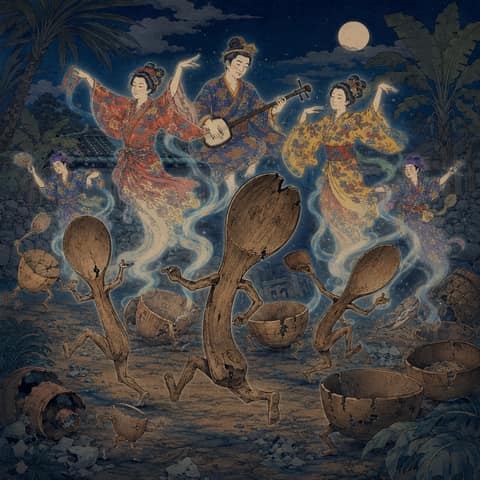
    Based on the tsukumogami image of the meshibitsu told across Okinawa. A rice bin long used or cast aside gains a spirit and becomes active at night. It may appear alone or with kindred utensils like pot bins, forming circles to dance and make lively sounds in empty squares or dumping grounds. To human eyes they can look like young men and women, inviting passersby to join their revel if approached, then returning to their utensil forms at dawn. Some tales tell of beguiling illusions such as appearing as a cow or other odd shapes, but they are not killers, serving more as a warning against mistreating old tools. Households were advised not to discard aged rice bins or pot bins carelessly, but to dispose of them quietly or offer words of thanks.

  • Mizo-Idashi

    Mizo-Idashi

    Uncommon

    MEE-zoh-ee-DAH-shee

    Ehon Hyaku Monogatari Version

    Ghosts & SpiritsKanagawa

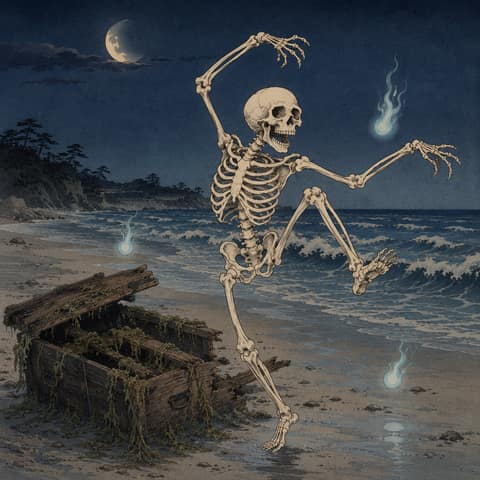
    Based on the depiction of Mizude in Takehara Shunsen’s Ehon Hyaku Monogatari. As censure for the abandonment of a corpse, bare bones rise of their own accord to sing and dance, symbolizing that mistreating the dead invites the uncanny. Closer to a tale of vengeful spirits than to a mere monstrosity, it manifests signs from the unoffered dead. Though the dancing and singing appear comical, the didactic thrust is strong, urging proper funerary rites. Specific places and names—Yuigahama, Hachirō of Tone, Hōjō Tokiyuki—anchor the story in the memory of war chronicles. The plot in which temple monks bury the bones to quell the anomaly exemplifies the temple’s social role of pacifying spirits through memorial rites.

  • Momijigari (The Demon of the Maple Viewing)

    Momijigari (The Demon of the Maple Viewing)

    Uncommon

    moh-MEE-jee-GAH-ree

    Demoness Momiji (Performing Arts Tradition)

    鬼・巨怪Nagano

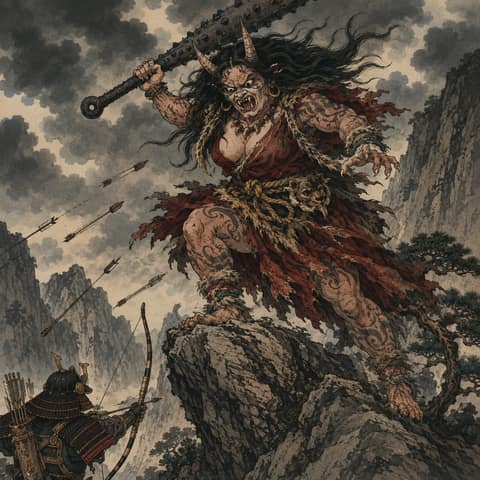
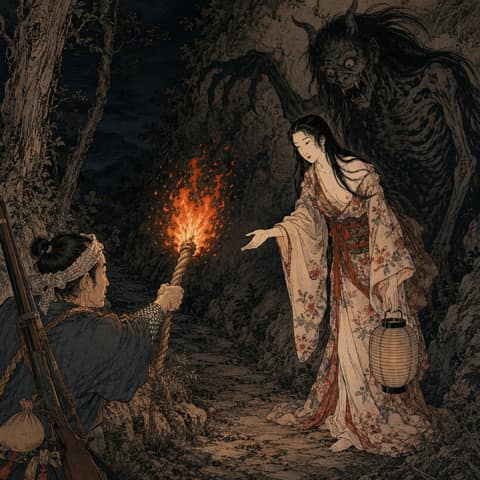
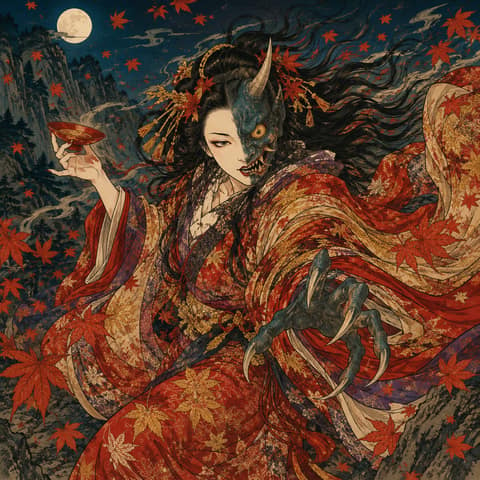
    A demoness archetype fixed in Noh, joruri, and kabuki from the Muromachi to Edo periods. She appears under the pretext of autumn leaf viewing as a courtly lady-in-waiting or princess’s attendant, lulling suspicion with music and dance. At the feast she inebriates warriors, but near midnight her nature is exposed by divine protection or a sacred blade, and she reveals her true form in the wilds of Mount Togakushi. Commonly called Momiji, she bears aliases such as Princess Sarashina depending on the work. Her slaying tales extol martial virtue and reflect awe of the mountains, inheriting Togakushi worship and the rhetoric of oni-hunting lore. On stage, the contrast between the elegant disguise of the first act and the ferocious demon visage of the second is emblematic.

  • Mosquito-Net-Hanging Tanuki

    Mosquito-Net-Hanging Tanuki

    Uncommon

    kah-yah-TSOO-ree dah-NOO-kee

    Mosquito-Net-Hanging Tanuki (Traditional Tale)

    Animal ShapeshiftersTokushima

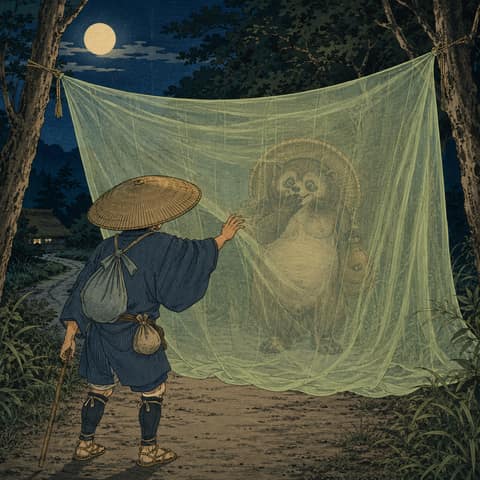
    A classic example of illusion craft attributed to the tanuki of Awa. It presents indoor furnishings incongruously outdoors and compels the target to keep “lifting” or “peeking,” eroding their sense of direction and time. The number thirty-six is sometimes linked to shugendō numerology, but local tales give no strict rationale, instead advising a practical countermeasure: stay calm and brace the belly. It causes no harm, and at dawn the spell breaks and the path appears as if nothing happened.

  • Muku-Mukabaki (Awakened Gaiters)

    Muku-Mukabaki (Awakened Gaiters)

    Uncommon

    MOO-koo MOO-kah-bah-kee

    Traditional Edition

    Household SpiritsEdo period

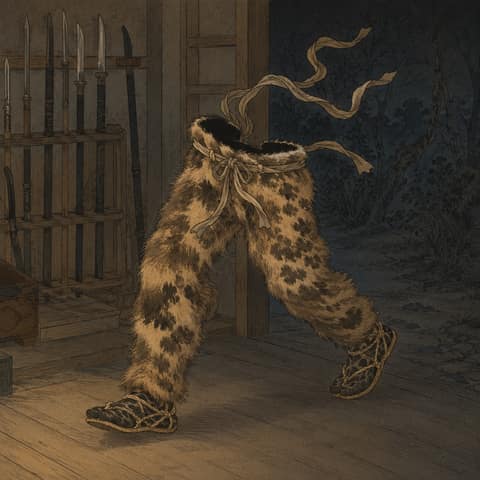
    An edited version consolidating Edo-period pictorial sources of the “Inugake” apparition. Inugake are fur leggings worn from the waist to the legs for warmth and protection in hunting gear, placed within the lineage of tool-spirits that gain sentience after long use or separation from their owner. In Sekien’s illustration only the legs seem to walk independently, with the caption evoking the inugake of Kawazu Saburō in The Tale of the Soga. This is a literary hint by the artist rather than evidence of a specific vengeful-ghost tale. In early modern Night Parade of One Hundred Demons and tsukumogami scrolls, yokai wearing inugake appear, emphasizing the uncanny form of the gear. Its nature is generally to show up at night and startle people, with no clear record of harm or benefit. Localized traditions are scant, and most examples belong to urban pictorial culture. It is understood as a classic example of the idea that aged implements come to house spirits.

  • Night Sparrow

    Night Sparrow

    Uncommon

    YOH-soo-ZOO-meh

    Night Sparrow (Tosa, Iyo, Kii Consolidated Tradition)

    Animal ShapeshiftersKochi

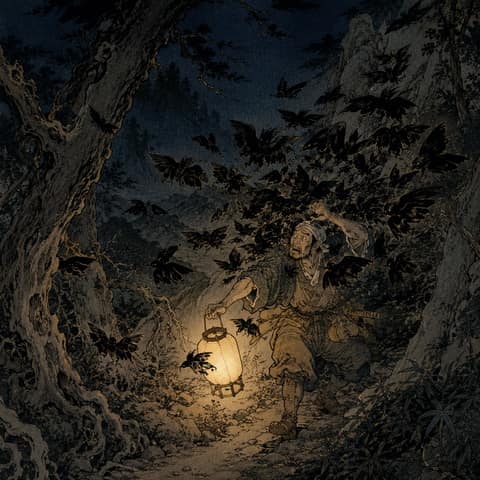
    The Night Sparrow is a nocturnal attendant yokai widely told of in the mountains of western Japan, marked by revealing itself through its call. In Tosa it is said to look like a small bird, in Kitagawa and Iyo like a moth or butterfly, and its appearance is not fixed. When someone walks alone, it alternates between the rear and the front, chirping close to the ear and throwing off the walker’s rhythm. In Toyama Village a banishing chant is preserved, and people are warned that rashly trying to catch it brings night blindness. In Wakayama, by contrast, it is taken as a sign that wolves are near and as a protective omen against mountain evils. Related tales include the “okuri-suzume” of Nara and Kii and the “tamutori-suzume” of Kochi and Ehime. In Tsunoyama and Johen they are treated as the same, and avoidance methods include gripping one’s sleeve, setting three twigs upright, or reciting specific mantras. Its folkloric traits are its ambiguous visual form, interference through sound, and regional differences in whether it is seen as ill or auspicious.

  • Nyoi Jizai (Will-at-Will Scepter Spirit)

    Nyoi Jizai (Will-at-Will Scepter Spirit)

    Uncommon

    NYOH-ee jee-ZAI

    Emaki Edition

    Animated Objects & UndeadJapanese folklore

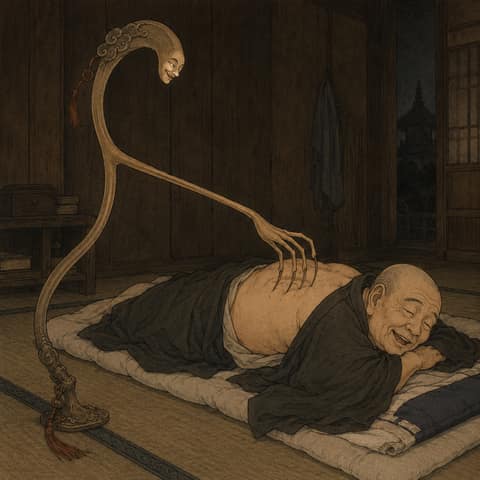
    A consolidation based on the nyoi monster depicted in Muromachi-period Night Parade of One Hundred Demons scrolls and on Toriyama Sekien’s Hyakki Tsurezure Bukuro images and captions. Following the tsukumogami belief that tools gain spirit with age, the nyoi’s original function of “reaching at will” is exaggerated as occult power. Two iconographic lines exist: one shows a humanoid with a tea-brown body and long claws that scratch a person’s back with extended arms, the other shows the nyoi itself sprouting wings and drifting in midair. Both appear late at night in bedrooms or Buddhist rooms, said to seek out itchy spots and places the hand cannot reach. Some readings hold that the morally wanting are left with claw marks, yet region-specific oral lore is scant, and the figure relies mainly on pictorial sources and later yokai commentaries.

  • Oitekebori

    Oitekebori

    Uncommon

    oh-EE-teh-keh-BOH-ree

    Ochikohori (Curated Traditional Tales Version)

    Aquatic SpiritsTokyo

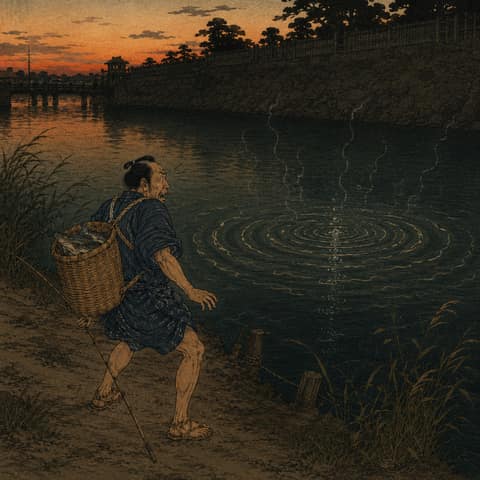
    Spoken of as a haunting tied to canals and irrigation ditches in Edo’s low wetlands, it functioned as both a warning against greedy overfishing and a folkloric device marking taboos on the water. The entity has no fixed form and is often only a voice, though in some regions it is identified with known shapeshifters like kappa or tanuki. Its stage centers on Honjo’s Kinshi-bori and Sendai-bori and along the Sumida River, with variants in Kameido, Horikiri, and Kawagoe. A typical pattern is the three-step “big catch—departing voice—loss of fish,” accompanied by etiquette tales that aver misfortune can be avoided by sharing the catch or releasing a few fish. It appears in curious tale collections and local lore around the Kansei era and later took root through rakugo storytelling. Natural sounds and animal behavior became the raw material of the uncanny, and the tale served to symbolize rules for ditch maintenance and norms for shared resources.

  • One-Eared Pig

    One-Eared Pig

    Uncommon

    kah-tah-KEE-rah-OO-wah

    Consolidated Folklore Edition

    Animal ShapeshiftersKagoshima

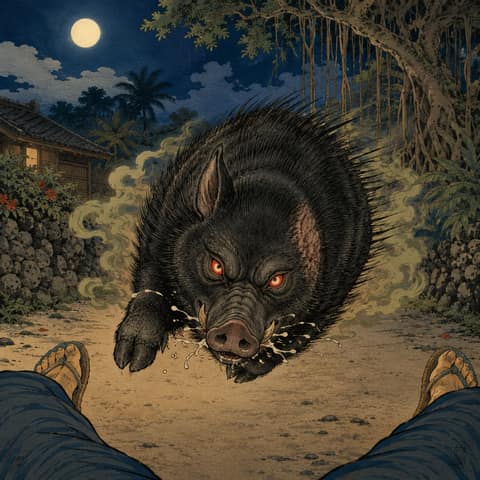
    An organized synthesis of the one-eared pig yokai found in Amami strange tales, presented alongside related lore of earless pigs and one-eyed pigs. The shared core is soul extraction by “passing through the crotch,” in which it closes the distance with a sudden leap and slips through from behind. It is told as a local, site-bound apparition that emits a strong animal-like stench and casts no shadow. Some accounts say it appears before lone women or pairs of women. Practical know-how to avoid it includes standing or walking with legs crossed to prevent it from passing through the crotch. Capture is said to be difficult, as it escapes pursuit with speed and powerful leaps.

  • Oni Bear

    Oni Bear

    Uncommon

    OH-nee KOO-mah

    Tradition-faithful Oni-Bear

    Animal ShapeshiftersNaganoHokkaido

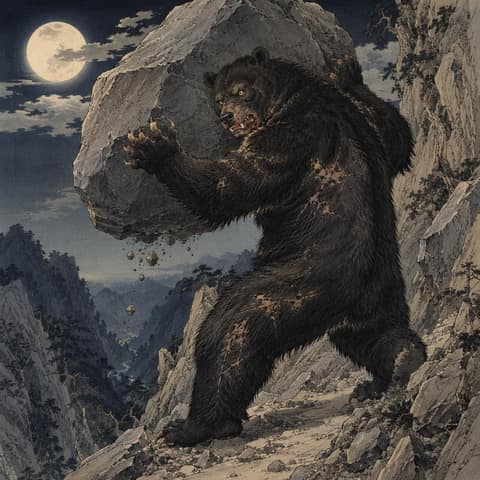
    Based on Edo-period sources, this depicts an old bear transformed into a yokai. It usually keeps to deep mountains and avoids human presence, but during famines or seasonal shifts it slips down to villages under cover of night to carry off livestock. Its upright gait can be mistaken for a human silhouette, and its tracks mingle human and bear prints. Tales of great strength tie it to local megalith lore, serving as an unspoken boundary marker for dangerous mountain zones. In slaying legends, communal coordination, selective use of hunting tools, and reverence for the mountain deity are emphasized, and the Oni-Bear is told as more than a mere beast—a symbol that brings calamity to those who break the laws of the mountain. Descriptions in early modern illustrated compilations heighten its uncanny nature while reflecting memories of real bear attacks, showing the intersection of folk environment and ghostly tale.

  • Oni Hitokuchi

    Oni Hitokuchi

    Uncommon

    OH-nee HEE-toh-KOO-chee

    Tradition-Faithful Edition

    Demons & GiantsOsaka

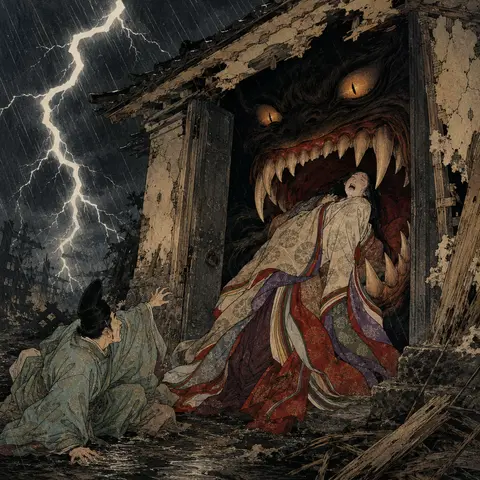
    Oni Hitokuchi appears in pre-medieval tales less as a fixed figure than as a term for a demonic being that fells a human with a single bite. It typically emerges in liminal scenes—at night, in thunderstorms, near storehouses or by the roadside—often intruding upon lovers’ trysts or flights. In The Tales of Ise (the Akutagawa episode), thunder drowns out the screams, and the lack of remains underscores the instantaneous “one bite.” Nihon Ryōiki and Konjaku Monogatari depict its mimicry as a man, serving as a warning against deviating from social bonds such as marriage or vows. After Sekien’s imagery fixed the name, folklore used it to reframe wartime, famine, and disaster disappearances as otherworldly devourings. Thus “Oni Hitokuchi” here is a type-name: its form is not fixed, and its essence is speed of consumption and absence of traces.

  • Paper Dance

    Paper Dance

    Uncommon

    KAH-mee-mai

    Documentary Compilation Edition

    Household SpiritsJapanese folklore

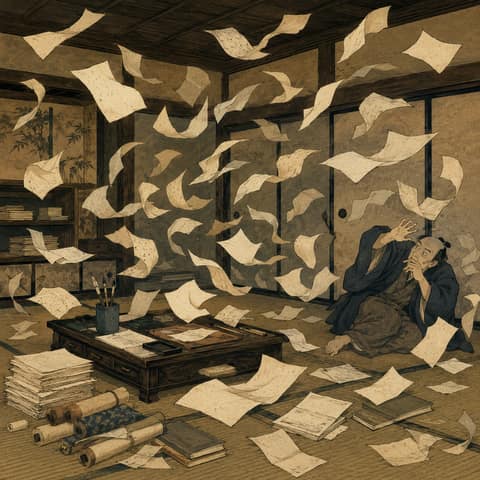
    Rather than an independent entity, Kamimai is a later整理 as a label for a household anomaly in which paper moves and scatters on its own. Fujisawa Eihiko is cited as authority and places its appearance in the tenth lunar month, yet his illustration reuses a scene from Ino Mononoke Roku, and the original source does not limit it to any particular month. Since the Showa era, folklore and ghost-story collections have introduced cases of contracts or manuscripts lifting and swirling, naming them “Kamimai,” but firsthand credibility and regional distribution remain unconfirmed. Accordingly, this entry treats Kamimai as a generic yokai image signifying inexplicable motions tied to dwellings and objects, specifically the self-propulsion or levitation of paper, with no fixed form or clear place of origin. In lore it rarely harms people or livestock, tending instead toward startling or teasing behavior.

  • Penghou

    Penghou

    Uncommon

    POONG-hoh

    Edo-Period Scholarly Edition (Bibliographic and Picture Scroll Tradition)

    Natural Phenomena SpiritsIntroduced from China (appearing in Japanese bibliographies and picture scrolls as a foreign yokai)

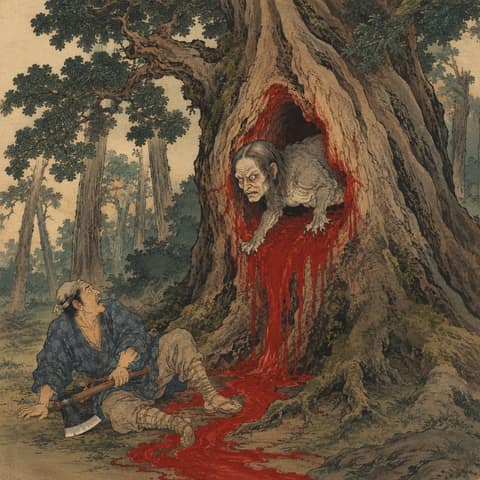
    An Edo-period rendering of Penghou, organized within the Japanese concept of kodama after scholars and painters absorbed Chinese narratives. It is depicted as a dog with a human face, tied to venerable camphors and other old trees. Echoes in the mountains were taken as the work of tree spirits, and notes on Penghou informed dog-shaped variants within yamabiko imagery. Early modern natural histories cite Chinese texts explicitly, layering foreign entries atop local lore rather than reporting concrete regional怪談, so place-specific tales are scarce. Japanese accounts treat it as a “tree spirit,” equating kimoki with kodama, linking it to taboos on felling and the cult of ancient trees. Details vary across sources, but two elements persist: it appears bleeding from an old tree, and it bears a human-faced canine form. This version eschews embellished fiction to show how Chinese originals were received in Japanese encyclopedias.

  • Phantom Locomotive

    Phantom Locomotive

    Uncommon

    nee-SEH-kee-shah

    False Locomotive (Traditional Type)

    General ClassificationsTokyoEhime

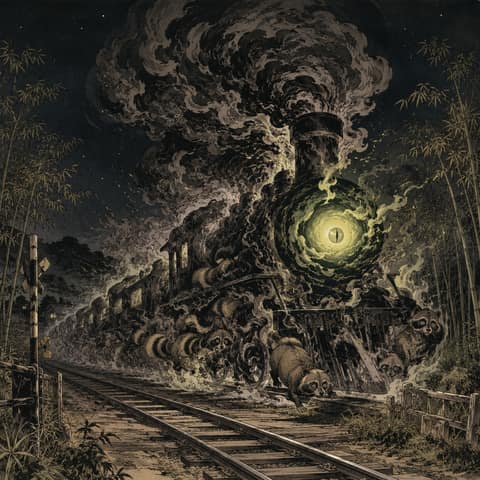
    Accounts of the False Locomotive cluster around the era when the alien sounds and sights of steam engines entered rural life, understood through beliefs in beastly transformations and mimicry. Across regions the plot is similar: at night a whistle and pounding wheels approach from ahead, even lights are seen, but everything vanishes just before impact. Soon after, a dead tanuki or badger is found and given memorial rites. Folklorists place it alongside beings like Azukiarai and Sand-Throwers, extending the idea that uncanny noises are the work of animals. Rumors spread not only by word of mouth but also via newspapers, producing uniform distribution and content. Even when tied to specific locales or temples, the core remains threefold: the match of sound and phantasm, and the tangible animal corpse. It declined as modern transport expanded, yet survives in trackside ghost tales.

  • Pillow-Flipper

    Pillow-Flipper

    Uncommon

    mah-koo-rah-GAH-eh-shee

    Traditional Type – Temple and Shrine Anomaly Affiliation

    Household SpiritsAcross Japan

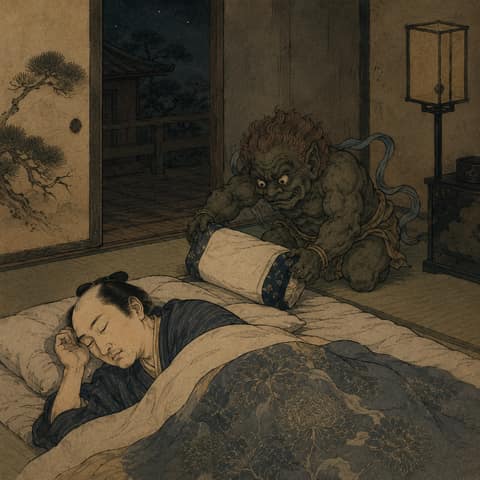
    A pillow-flipping subtype rooted in old beliefs that pillows are linked to the movement of the soul and to boundaries. It manifests at thresholds between sacred and secular spaces such as certain parlors, pillars, or Buddhist rooms, turning sleepers’ heads toward a Buddha or principal icon, or simply inverting the pillow to signal a reversal of order. Noted in essays and picture scrolls from the Edo period onward, it often ties into temple Seven Wonders and scroll-haunt tales. In some regions it is read as the play of a zashiki-warashi, the sign of a spirit of someone who died in the house, or a guise of a shapeshifting animal. The fear it inspires has shifted over time: once viewed as a portent of deadly curse, in modern times it tends to be treated as a lighter bedroom haunting and prank.

  • Poverty God

    Poverty God

    Uncommon

    BEEN-boh-gah-mee

    Classical Folktale-Concordant

    Household SpiritsAcross Japan

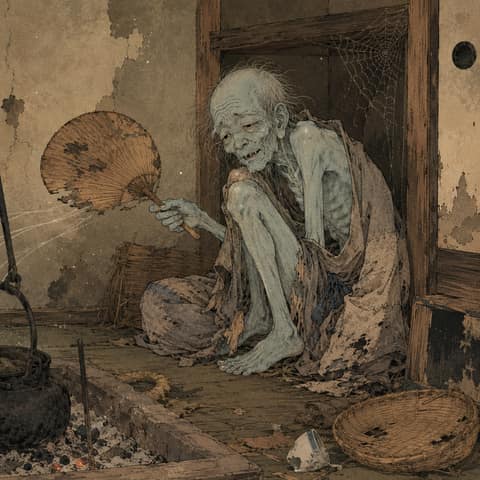
    The Binbōgami traces its roots to the personification of medieval poverty and began to be named explicitly from the Muromachi period onward. It commonly appears as a gaunt old man carrying a plain paper fan, believed to dwell in closets or the corners of tatami rooms. Banishment is not easy, and ritual sending-off is preferred over force. Saishōshi records guiding it outside the gate with a branch on the last night of the month, Tankai describes setting grilled rice and roasted miso on a wooden tray and letting them drift downriver from the back door, and Nihon Eitaigura tells of honoring it respectfully on the Night of the Seven Herbs so that, appeased, it turns to bring fortune. Numerous folk beliefs link it with fire and household order, as in Niigata’s New Year’s Eve hearth customs and Ehime’s taboos against disturbing the fire. Miso, said to be its favorite, is cited both as an attractant and a taboo, with roasted miso rites preserved in many regions. Though a punitive deity, it is said to grow uncomfortable where diligence, cleanliness, and frugality are observed, and in folk religion it functions as the counter-concept to household gods of fortune, serving as a barometer of family luck.

  • Rainfall Page-Boy

    Rainfall Page-Boy

    Uncommon

    ah-meh-FOO-ree koh-ZOH

    Rain-Attendant Page

    Household SpiritsEdo period

    Based on Toriyama Sekien’s imagery, this version foregrounds the character of a page serving the Rain Master. It appears with a Japanese umbrella stripped of its ribs worn like a hood and a lantern in hand. Its origins lie more in printed books than in oral folk tradition, and in yellow-covered comic books it shows up as a menial helper. The ideas of rain and service to nobility converge, shaping it as an attendant akin to small child-deity retainers. It does not wield an explicit divinity that summons rain, remaining subordinate to a being that governs rain’s power. Depictions vary—one eye, hat, lantern—depending on period and source, with no single fixed image. Lacking a known local provenance, it spread notably through Edo’s publishing culture.

  • Red-Head

    Red-Head

    Uncommon

    AH-kah-gah-shee-rah

    Red-Head

    Mountain & Wilderness SpiritsKochi

    A red-haired apparition said to appear in the fields and hills of Katsugase in Tosa Province. It walks upright like a human, yet hides among tall bamboo grass and reeds, making its full form elusive. Its most striking trait is hair that shines like the sun; approaching and staring directly at it is said to dazzle the eyes and cause temporary visual impairment. Tales rarely attribute malice to it, focusing instead on discomfort caused by its visual impact. It is named in the late Edo to early Meiji Tosa Bakemono Picture Book, listed alongside local figures such as the Laughing Woman of Yamakita and the White Crone of Motoyama. The “Aka-gashira” in Hyakki Yagyo picture scrolls is sometimes cited as iconography, though identification remains cautious. Sightings are told of at dusk through dawn in the open country and survive mainly in local oral tradition.

  • Resurrection Incense

    Resurrection Incense

    Uncommon

    hahn-GOHN-koh

    Canon-Conforming Incense Apparition

    Household SpiritsUnknown

    Rather than a physical substance, the reviving incense is told in narrative tradition as a medium for reunion with the dead. The Chinese motif of seeing a figure within smoke was adopted into early modern Japanese literature and theater, where the handling of censers, incense wood, and ash is rendered with ritual care. In yokai picture compendia it sometimes appears as a type of tool-born apparition, with set-piece depictions of a visage forming in the incense smoke. It is often interpreted not as recalling a spirit itself, but only as manifesting a semblance or shadow. Medicinal virtues are mentioned as apocrypha in materia medica, yet Edo-period notes record skepticism and file it among curious tales. In Kamigata and Edo rakugo, a tryst lasts only until the incense or stick burns out, making the quantity and duration of incense a key stage device.

  • Roaring Cauldron (Narigama)

    Roaring Cauldron (Narigama)

    Uncommon

    nah-ree-GAH-mah

    Ringing Cauldron (Hyakki Tsurezurebukuro)

    Household SpiritsOkayama

    Based on the belief that tools become spirited after a hundred years, this yokai is depicted with an old iron cauldron for a head. It lingers in the night, issuing faint tremors and steam that produce low sounds. The ringing is read as an omen of fortune or misfortune, falling silent if met with careless clamor, and responding when approached with reverence. It embodies divinatory function and the memorial veneration of well-used objects.

Showing 73 - 96 of 148 yokai