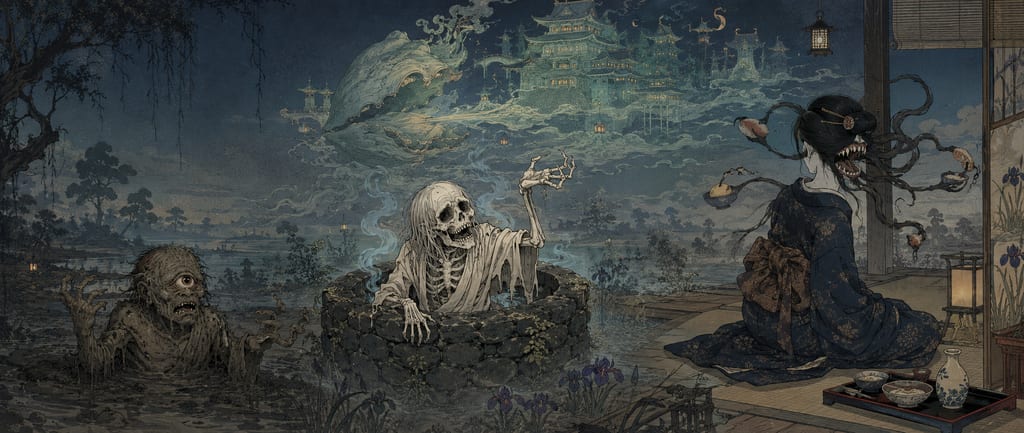
A legendary incense said to reveal the image of the dead within its smoke when burned. Rooted in Chinese anecdote literature, it spread in Japan through Edo-period yomihon, joruri and kabuki plays, and rakugo. Rather than a real substance, it functions as a symbolic, miracle-working incense in ghost tales, letting the bereaved glimpse the departed for a moment. Some stories call it an onmyoji’s secret remedy, but its actual existence is doubtful.
Folklore & Legends
In a poem by the Mid-Tang poet Bai Juyi, Emperor Wu of Former Han has a Daoist burn incense so he can see Lady Li’s form in the smoke. In Japan, works like Ugetsu Monogatari, kusazoshi chapbooks, and the joruri play Keisei Hangonko use it as a prop to summon the visage of the dead. In Koshoku Haidokusan, a man who lost a courtesan claims he saw her by means of this incense. Transmission and recipe remain fictional within the texts, and its real-world existence is unknown.
Yokai Cards1
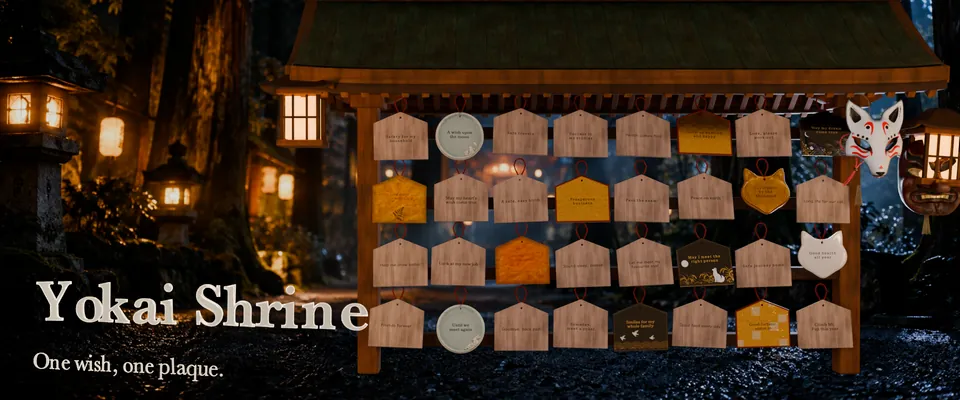
Resurrection Incense across multiple art-style decks
Rather than a physical substance, the reviving incense is told in narrative tradition as a medium for reunion with the dead. The Chinese motif of seeing a figure within smoke was adopted into early modern Japanese literature and theater, where the handling of censers, incense wood, and ash is rendered with ritual care. In yokai picture compendia it sometimes appears as a type of tool-born apparition, with set-piece depictions of a visage forming in the incense smoke. It is often interpreted not as recalling a spirit itself, but only as manifesting a semblance or shadow. Medicinal virtues are mentioned as apocrypha in materia medica, yet Edo-period notes record skepticism and file it among curious tales. In Kamigata and Edo rakugo, a tryst lasts only until the incense or stick burns out, making the quantity and duration of incense a key stage device.
Character Profile
This section is our own creative profile for storytelling. It is not historical fact or scholarship.
those burdened with lingering attachment or deep longing are said to perceive its shadow more easily
Abilities
temporarily reveals the likeness of the dead within incense smokethe clarity and duration of the image are said to vary with how the incense is burnedis thought to respond to the arrangement of censers incense containers and the hearthside setting
Weaknesses
the image vanishes when the incense is spent, moisture or wind that disturbs the smoke disrupts the manifestation, said not to function where lingering attachments are faint
Habitat
scenes in scrolls yomihon joruri and kabuki, temple and shrine incense burners and parlor incense rooms, drawing rooms and alcoves that serve as stages for strange tales
The diagram below is a diagnostic evaluation chart for Canon-Conforming Incense Apparition. The higher the value of each item, the stronger that characteristic is expressed.
Love Yokai Type Test
The diagram below is a diagnostic evaluation chart for Canon-Conforming Incense Apparition. The higher the value of each item, the stronger that characteristic is expressed.