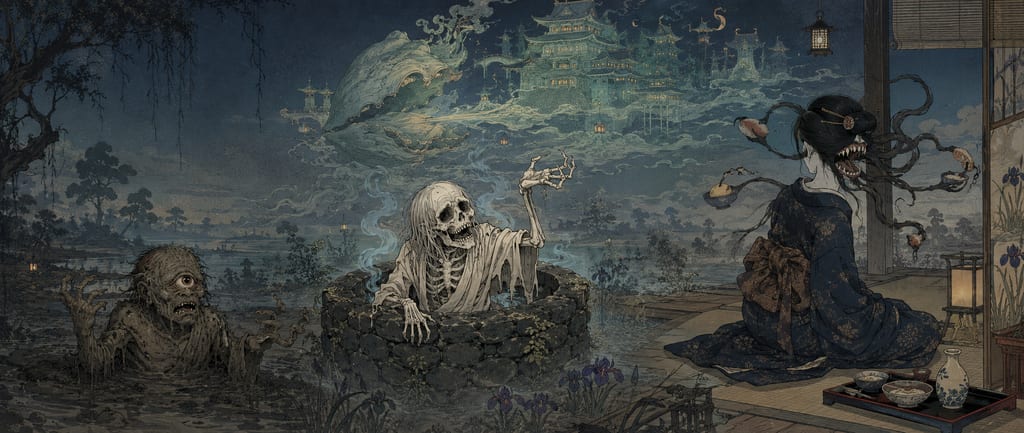
Suzuri-no-tamashii (the Spirit of the Inkstone) is a highly literary and romantic *tsukumogami* (artifact spirit) created by the Edo-period yokai artist Toriyama Sekien in his art collection *Konjaku Hyakki Shui* (Supplement to The Hundred Demons from the Present and the Past). It is not a terrifying monster that threatens or harms people, but rather a beautiful yet sorrowful phantom that appears only in the fleeting moment when the memories dwelling in stationery intersect with the user's deep "immersion in literature."
The greatest charm of this yokai lies in the brilliant fusion of "wordplay" and "historical background" orchestrated by Sekien. In calligraphy, the shallow depression in an inkstone (suzuri) where the liquid ink pools is called the "umi" (sea or ink sea). Sekien established that the inkstone favored by a certain literatus was specifically set as an "Akama stone inkstone" produced in "Akamagaseki" (present-day Shimonoseki City, Yamaguchi Prefecture), known as a masterpiece. Akamagaseki is not merely a production site for high-quality inkstones; it is the very stage of the "Battle of Dan-no-ura," the final decisive battle of the Genpei War, where the Heike (Taira) clan met their tragic end alongside the young Emperor Antoku.
One quiet night, while the literatus was rubbing ink on this Akama inkstone and reading *The Tale of the Heike*, he dozed off. Suddenly, real waves swelled in the "sea" of the inkstone, and amidst the vast ocean of black ink, the warships of the Minamoto (Genji) and Taira (Heike) clans clashed chaotically, vividly recreating the fierce battle of Dan-no-ura as a phantom across hundreds of years. This phenomenon occurs because the Akama stone, steeped in the blood and lingering regrets of the Heike, projected memories of the past through the black sea of ink. It is one of the most poetic supernatural anomalies in the history of Japanese yokai, perfectly uniting the three elements of the "inkstone's sea," the "origin of the Akama stone," and the "fall of the Heike" in flawless aesthetic harmony.
Folklore & Legends
Behind the conception of the "Suzuri-no-tamashii" lies Toriyama Sekien's exceptionally profound education and deep respect for classical Chinese literature. The tale of miniature, grain-of-rice-sized armored warriors appearing on a study desk or inkstone late at night to wage war originally stems from a bizarre phenomenon found in Chinese anomalies fiction (such as the tale of Xu Xuanzhi recorded in *Yiwu Zhilue* and similar works). Sekien did not merely import this classical Chinese vision; by transposing it into the most dramatic historical context of Japan's *The Tale of the Heike* and Dan-no-ura, he masterfully elevated it into a yokai brimming with uniquely Japanese sentiment.
Furthermore, the concept that old stationery tools (brush, ink, inkstone, paper) acquire spiritual power over many years to become *tsukumogami* reflects the "deep reverence for tools of learning" shared among the literati class of East Asia. It was believed that the very tools used to write characters and record history or stories would come to harbor the thoughts and passions of those who used them.
Interpreting "Suzuri-no-tamashii" from a modern perspective, it is not simply a poltergeist phenomenon, but rather a metaphor for the "ultimate trance state (immersive experience)" brought about by the act of reading. In the silence of midnight, enveloped by the faint scent of ink while reading a historical tragedy (*The Tale of the Heike*), the reader's imagination and empathy are honed to their absolute limits. When they happen to cast their eyes down at the rippling ink in the inkstone, they fall into the illusion that they can truly hear the shouts of the Heike warriors and the crashing waves. This yokai is the manifestation of the most beautiful and sorrowful imagination, conjured within the mind of a reader whose soul has been captivated by literature.
Yokai Cards1
Suzuri-no-tamashii across multiple art-style decks
This interpretation remains most faithful to Toriyama Sekien's commentary, transforming the inkstone—a static piece of stationery—into a "screen of phantoms" that projects the dynamism and tragedy of history. This yokai never threatens or curses its owner. It quietly reveals its form only when the owner possesses deep cultivation and a strong empathic connection to history.
In a study enveloped in midnight silence, one pours cold water and gently begins to rub the inkstick. The phenomenon occurs when the flickering candlelight illuminates the surface of the black, glistening liquid ink (the sea of the inkstone). Suddenly, mingled with the rich fragrance of the freshly ground ink, the faint "scent of the sea breeze" and "scent of blood" begin to drift through the air. Then, within the mere few centimeters of the ink sea in the inkstone, pure white crests of waves rise, miniature warships crowd together, and Minamoto and Heike warriors—no larger than grains of rice—appear. They cross swords, loose arrows, and fall into the waves one after another, recreating the decisive Battle of Dan-no-ura. If you listen closely, angry shouts, the sound of crashing waves, and the screams of the court ladies of the Heike echo like a distant auditory hallucination.
This is a physical vision manifested through the resonance between the "kotodama" (spirit of language) in *The Tale of the Heike* read by the literatus and the hundreds of years of sorrowful memories held by the "Akama stone," which was quarried from the very sea where the Heike perished. The Spirit of the Inkstone is a "spirit of literature" of unparalleled beauty, poetry, and bottomless melancholy, proving how the act of reading is a mystical ritual that transcends time and space to converse with the dead.
Character Profile
This section is our own creative profile for storytelling. It is not historical fact or scholarship.
Poetic and quiet, brimming with the profound sorrow of the Heike
Compatibility
Avid readers, lovers of history, people with rich imaginations
Abilities
Vividly manifesting past history (the naval Battle of Dan-no-ura) in the ink sea of the inkstoneMaximizing the user's sense of immersion in literatureMingling the phantom scents of the sea breeze and blood into the fragrance of the ink
Weaknesses
Rough treatment of stationery, indifference to literature or history (to those without imagination, it appears as nothing more than black water)
Habitat
Studies, libraries, archives of temples and shrines
The diagram below is a diagnostic evaluation chart for Phantom of Dan-no-ura / Spirit of the Akama Inkstone. The higher the value of each item, the stronger that characteristic is expressed.