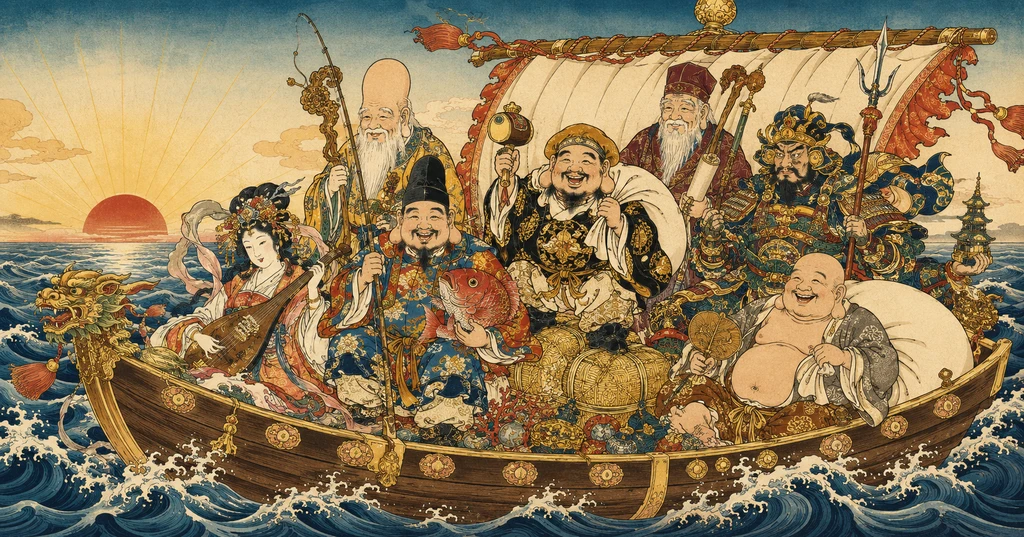
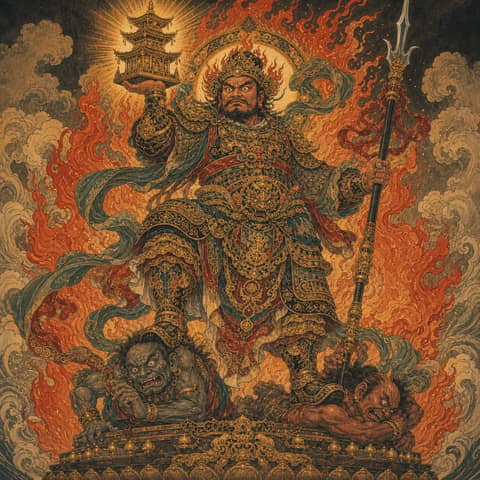
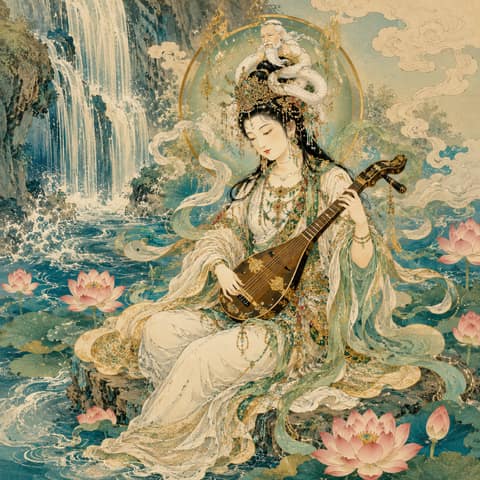
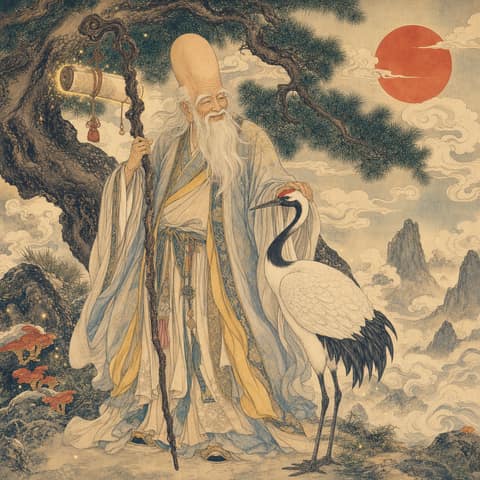
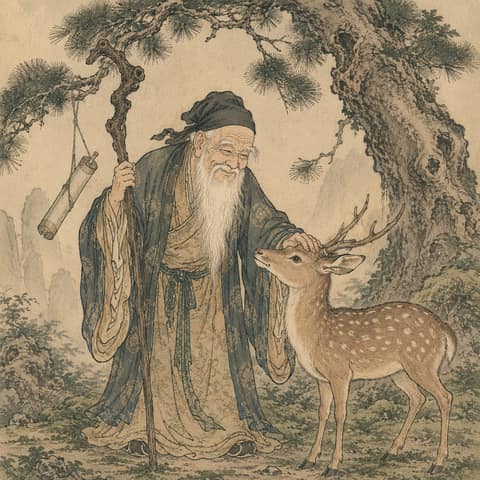
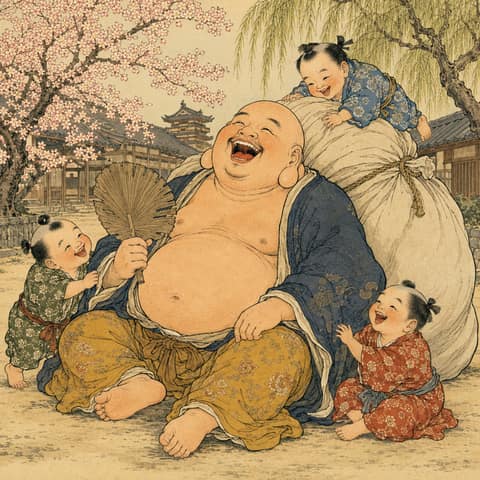
The origin of Hotei is the historical Zen monk Qici (died 917) of the late Tang and Five Dynasties period[1]. Fascicle 27 of the *Jingde Record of the Transmission of the Lamp* (1004) compiled by Daoyuan of the Northern Song provides an independent biography of him, which serves as the fundamental source of the Hotei lore. He is also recorded in fascicle 21 (Section on Miracles) of the *Song Biographies of Eminent Monks* (988)[3] compiled by Zanning, which notes his origin as Fenghua County, Mingzhou (now Fenghua District, Ningbo City, Zhejiang Province), but reports his secular surname and birth year as unknown. His physical appearance was described as short and stout with a bulging belly and deep wrinkles on his forehead. He always roamed the streets carrying a cloth sack (a monk's alms bag or large knapsack), remained warm even when lying in the snow, stored whatever food he begged for in his sack, and was skilled in divination and prophecy. It is said that in the third month of the second year of Zhenming of the Later Liang dynasty (916), he sat on a rock at Yuelin Temple in Fenghua and passed away after reciting the verse: "Maitreya, the true Maitreya, present in billions of forms, continually manifesting to the people of the time, yet the people of the time do not recognize him." Based on this deathbed verse, he became revered as an incarnation of Bodhisattva Maitreya[1]. In subsequent Chinese Buddhism (especially Zen), the image of Hotei as Maitreya became firmly established, giving rise to the custom of enshrining a large-bellied seated Maitreya statue (Maitreya in the form of Hotei) at the main gates and Heavenly King Halls of temples. From the Song dynasty onwards, he was overwhelmingly favored as a subject of ink painting in China, heavily depicted by monk-painters of the Yuan dynasty (such as Yintuoluo and Meng Yujian) and Zen artists. His introduction to Japan accompanied the arrival of Zen Buddhism during the Kamakura period[2]. Monks who traveled to Song and Yuan China brought back Zen paintings (by artists like Muqi and Yintuoluo), and Japanese monk-painters of the late Kamakura and Nanboku-cho periods (such as Mokuan, Ryozen, and Mokudo Shoei) emulated these to establish a lineage of Hotei imagery unique to Japan. By the late Muromachi period, when the Zen monks and artists of the Higashiyama culture[4] (such as Noami, Soami, and Sesshu) formalized the Seven Lucky Gods motif, they incorporated Hotei alongside the previously imported Fukurokuju and Jurojin, combining them with the already localized Ebisu, Daikokuten, Bishamonten, and Benzaiten to form the "Seven Deities of Fortune and Virtue." Entering the Edo period, he became deeply entrenched among the common people as a member of the Seven Lucky Gods Treasure Ship prints[5] and New Year's first-dream pictures, frequently appearing in the woodblock prints of Katsushika Hokusai, Utagawa Kuniyoshi, and Tsukioka Yoshitoshi. His iconographic features—the bulging belly, large sack, and hearty laugh—symbolize in Chinese tradition that "obesity = broad tolerance and a well-rounded personality" and "large sack = the virtue of endlessly giving what is needed despite owning nothing." He represents a unique archetype of "Zen non-attachment as a blessing," distinct from the Daoist deities of longevity (Fukurokuju, Jurojin), martial deities (Bishamonten), and indigenous gods (Ebisu, Daikokuten). In the various Seven Lucky Gods pilgrimages of Edo/Tokyo (such as Yanaka, Asakusa, Nihonbashi, and the Sumida River), the pilgrimage sites are often Zen, Obaku, and Soto sect temples, which have drawn profound devotion from commoners praying for fertility, business prosperity, marital harmony, and good fortune through laughter. Furthermore, Yuelin Temple still exists today in the Fenghua District, and is honored as the "Ancestral Court of Maitreya," being the site of Hotei's birth and passing.
Character Profile
This section is our own creative profile for storytelling. It is not historical fact or scholarship.
Yokai Type - Kami
Category - Deities & Divine Spirits
Rarity - Legendary
Personality - An easygoing demeanor, walking the streets with his bulging belly exposed, laughing heartily, and carrying a single large sack on his back. Possessing neither anger nor greed, a disposition that simply gives and simply laughs.
Compatibility - Highly compatible with those wishing to fill their homes with laughter and tolerance, those wanting to run a business with care, and those praying for fertility and marital harmony. He also answers those who wish to let go of tension and anxiety.
Abilities - Fortune through Laughter (attracting good fortune with the energy of a hearty laugh)Virtue of the Alms Sack (pulling out whatever is needed from an inexhaustible bag)Maitreya's Blessing (bringing the compassion of the future Buddha down to earth)Divination and Prophecy (foreseeing weather and fortunes)
Weaknesses - Incompatible with prayers rooted in solemnity and asceticism (such as Shugendo or austerities). Fundamentally unresponsive to prayers that incite anger or competitiveness.
Habitat - Temples of the Zen and Obaku sects, paintings of the Seven Lucky Gods' Treasure Ship, under pillows on New Year's Day, stops on the Seven Lucky Gods pilgrimage in Kanto and Kinki, and Yuelin Temple in Fenghua District, Ningbo, Zhejiang Province, China (his actual place of passing).