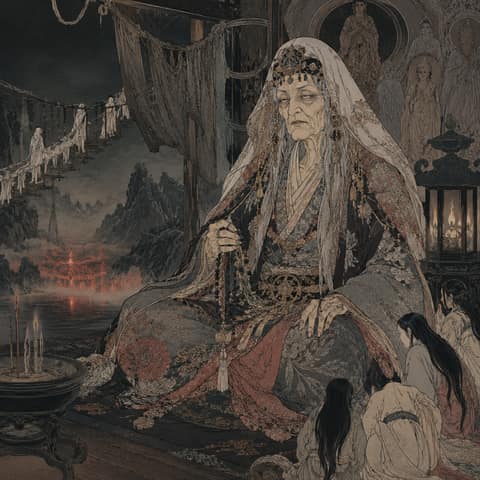
Within the Tateyama faith, which viewed the Jigokudani (Hell Valley) of Etchū's Mount Tateyama as the underworld itself, the Demons of Tateyama Jigoku are the jailers (gokusotsu) depicted in the Tateyama Mandala tormenting the dead[1]. Even today, Tateyama's Hell Valley roars as fumaroles erupt from the earth, the stench of sulfur hangs thick in the air, and a desolate, sparsely vegetated volcanic landscape stretches as far as the eye can see[2]. Since ancient times, people have perceived this otherworldly terrain as a literal "hell," and it was even said that there were 136 hells in total across Mount Tateyama[3]. The demonic jailers, such as Gozu and Mezu (Ox-Head and Horse-Face), who rule over these hells and subject the dead to being boiled in cauldrons or to various tortures, are precisely the Demons of Tateyama Jigoku referred to here[1].
Folklore & Legends
A defining characteristic of the Tateyama hell landscape is that each real volcanic feature was likened to a famous site in the underworld[2]. For instance, Mikurigaike (Mikuri Pond) was seen as the Blood Pool Hell where women were destined to fall, while Mount Tsurugi (Sword Peak) was, true to its name, viewed as the Mountain of Swords Hell[2]. The Tateyama Mandala vividly depicts these demonic jailers tormenting the dead in these hells, alongside the Sai-no-Kawara (Children's Limbo), the Sanzu River, and the Asura Realm[1]. The oshi (pilgrim guides) of Ashikuraji and Iwakuraji temples carried this mandala across Japan. Pointing to the illustrations in a practice known as etoki (picture-explaining), they preached the terrors of hell and the salvation that could be attained by ascending Mount Tateyama[4]. By instilling fear through the sight of hell while simultaneously proclaiming that climbing the "Pure Land" of Tateyama was the path to salvation, the Demons of Tateyama Jigoku singularly bore the burden of the "terror" aspect within this faith, where fear and salvation were two sides of the same coin[1].
Rather than being a single, independent yokai, the Demons of Tateyama Jigoku are an ensemble cast constituting the underworld as projected onto the sacred Mount Tateyama. The Tateyama Mandala consists of five elements: the founding legend, hell, the Pure Land, the ascetic climbing path, and the Nunobashi Kanjō-e ritual. In the scenes of hell, it is these demons who stoke the cauldrons, herd the dead up the Mountain of Swords, and drown them in the Blood Pool[1]. Notably, Tateyama's hell was not purely a product of imagination, but was based on the actual landscape of Hell Valley—its fumaroles, sulfur springs, and desolate volcanic plains[2]. With Mikurigaike as the Blood Pool Hell and Mount Tsurugi as the Mountain of Swords Hell, the visible natural world was directly translated into the iconography of hell, giving the Demons of Tateyama Jigoku a palpable sense of reality as denizens of that very landscape[2]. The etoki preaching tours by Ashikuraji guides flourished in the late Edo period under the patronage of the Kaga domain, spreading the image of these demons to villages nationwide through the mandala[4]. The tortures inflicted by the demons of hell serve to accentuate the salvation offered by their counterparts, Ubagami and Amida Buddha. The view of the underworld in the Tateyama faith is thus constructed upon this tension between punishment and salvation.
Character Profile
This section is our own creative profile for storytelling. It is not historical fact or scholarship.
They torment the dead without mercy, but this ferocity also serves as a mechanism to preach the terrors of falling into hell to the living. They are executors of the underworld, absolutely loyal to the orders of King Enma.
Executing the tortures of hell, such as boiling cauldrons and the Mountain of SwordsHerding the dead to various sections of hellCarrying out the judgments of King Enma (as Ox-Head and Horse-Face)Manifesting the underworld within an actual volcanic landscape
Weaknesses
They lose their power in the face of the compassion of Amida Nyorai and Ubagami, who govern salvation. They cannot lay a hand on those who repent their sins, climb the mountain in worship, and recite the Nembutsu. If the belief in hell itself fades, they disappear.
Habitat
The fumarole zones and sulfur springs of Tateyama Jigokudani, Mikurigaike (Blood Pool Hell), and Mount Tsurugi (Mountain of Swords Hell). Within the hell imagery of the Tateyama Mandala.
The diagram below is a diagnostic evaluation chart for Demonic Jailers of the Tateyama Mandala Hells. The higher the value of each item, the stronger that characteristic is expressed.