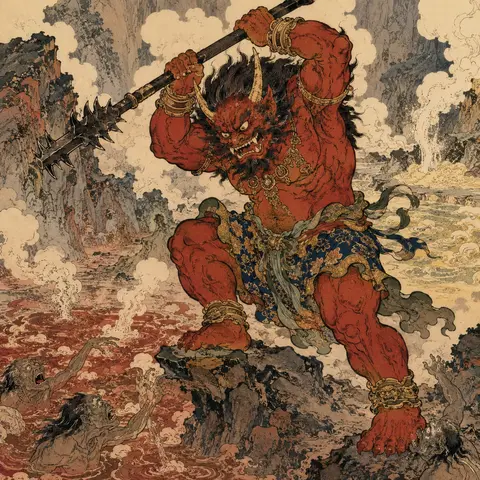
Ubagami is an old goddess enshrined at the Ubadō (Hall of the Old Woman) in Ashikuraji, at the foot of Mount Tateyama in Etchū Province[1]. Because of the steam and sulfur venting from Jigokudani (Hell Valley), Tateyama was feared as the "Mountain of Hell"; concurrently, it was revered as a sacred mountain believed to harbor the Pure Land of Amida Buddha[2]. Until the modern era, women were strictly forbidden from climbing Tateyama, and the Ubagami faith was established to save these female devotees who could not make the ascent[3]. It is said that sixty-six statues of Ubagami were enshrined within the Ubadō, where women would pray to each statue one by one in the darkness[1]. Often conflated with the wife of Enma Daio (Yama, the King of Hell) or Datsueba (the old woman who strips the dead of their clothes at the Sanzu River), Ubagami was depicted as an ambivalent goddess standing at the boundary of the afterlife—both judging the dead and offering them salvation[1].
Folklore & Legends
The true essence of the Ubagami faith was manifested in a ritual of symbolic death and rebirth known as the "Nunobashi Kanjō-e" (Cloth Bridge Consecration Ceremony)[1]. On the middle day of the autumnal equinox, women clad in white burial shrouds would enter the Enmadō (Hall of Enma) to confess their sins before the statue of Enma Daio. Afterward, blindfolded, they would cross a bridge draped in white cloth[3]. This side of the bridge represented "this world," while the far side symbolized the "next world"; the bridge itself was constructed with 108 wooden planks, signifying the 108 earthly desires[3]. Women who successfully crossed the bridge would enter the Ubadō on the opposite shore. By fervently praying before the sixty-six statues of Ubagami, they were promised salvation from the Blood Pool Hell and rebirth in the Pure Land[1].
During the late Edo period, under the patronage of the Kaga Domain, the priests (oshi) of Ashikuraji traveled across the country distributing talismans. Using the "Tateyama Mandala" as a visual aid, they preached that Tateyama was a sacred place for the salvation of women, thereby spreading the Ubagami faith nationwide[4]. The ban on women climbing Tateyama was lifted by a decree of the Dajōkan (Grand Council of State) in the fifth year of the Meiji era (1872), which also caused the Nunobashi Kanjō-e to be temporarily discontinued. However, in 1996, the ritual was revived by the people of Ashikuraji and continues to be passed down today[3].
Ubagami is not a mere yōkai, but a divine entity embodying the very structure of Tateyama—a sacred mountain where Hell and the Pure Land coexist. In the Tateyama Mandala, Ubagami is depicted alongside underworld motifs such as Sai-no-Kawara (Children's Limbo), the Sanzu River, and the Blood Pool Hell. She possesses two faces: that of Datsueba, who judges the dead, and that of a savior who sends women off to the Pure Land[1]. From the Middle Ages onward, the Blood Bowl Sutra (Ketsubonkyō) faith propagated the belief that women were destined to fall into the Blood Pool Hell due to the supposed impurity of childbirth. Amidst this profound terror, Ubagami functioned as the sole savior for female believers[1].
It is said that the sixty-six statues lined up in the Ubadō of Ashikuraji reflect the "Sixty-Six Provinces Pilgrimage" (Rokujūrokubu), an ancient practice of dedicating one copy of the Lotus Sutra to each of Japan's sixty-six historical provinces. During the Nunobashi Kanjō-e, the experience of crossing the bridge blindfolded and praying in the darkness is nothing less than a ritualistic death and rebirth—letting one's earthly self die temporarily in order to be reborn anew before Ubagami[3]. The tradition identifying her as the wife of Enma Daio creates a complementary dynamic: while the husband acts as the King of Hell who judges the dead, the wife, Ubagami, serves as the compassionate mother who saves women. This interplay brings a sense of yin-yang balance to the underworld cosmology of Tateyama.
Character Profile
This section is our own creative profile for storytelling. It is not historical fact or scholarship.
Strict yet deeply compassionate. While she unblinkingly judges the sins of the dead, she exhibits a dual maternal nature by opening the path to the Pure Land for those who truly repent.
Judging and weighing the karma of the dead in her role as DatsuebaRescuing women from the Blood Pool HellPresiding over the symbolic death and rebirth ritual of the Nunobashi Kanjō-eActing as a guide standing on the boundary between this world and the next
Weaknesses
Highly susceptible to losing her original ritualistic purpose due to the lifting of the ban on women and modernization; her power wanes as faith in her diminishes. She cannot extend salvation to sinners who show no remorse.
Habitat
The Ubadō in Ashikuraji at the foot of Mount Tateyama, and the sacred realm of the "next world" located across the Cloth Bridge. She also resides within the underworld imagery of the Tateyama Mandala.
The diagram below is a diagnostic evaluation chart for Ubagami, the Old Goddess Who Saves the Women of Tateyama. The higher the value of each item, the stronger that characteristic is expressed.