The "Half Body" Crossing the Schoolyard
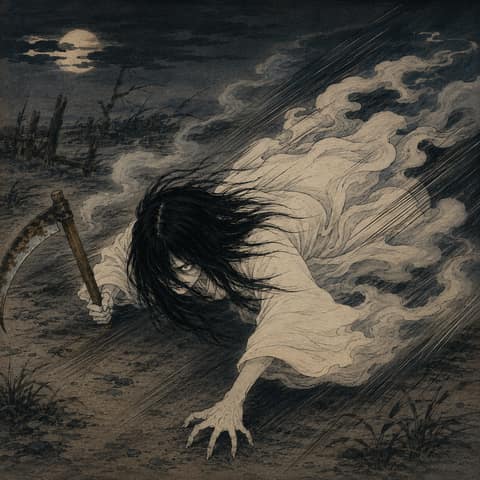
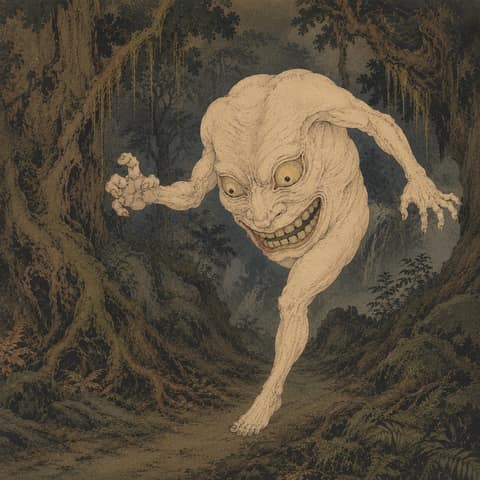
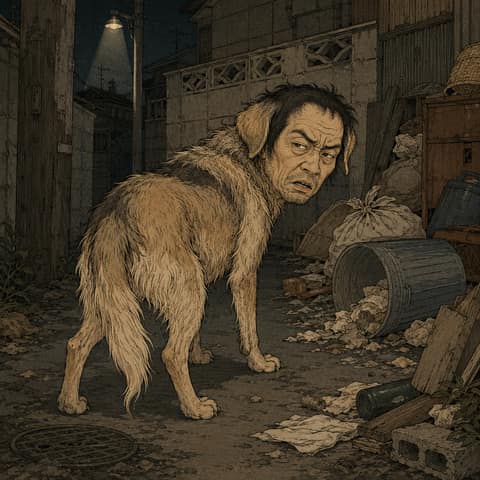
After school, a figure stands in the yard. From a distance, it is still impossible to tell whether only the upper half or the lower half remains. Before that becomes clear, it races across the ground at impossible speed. Chiaki Konaka, who wrote the 1994 television drama *Yōkai Teketeke*, remembered that the creatures in school-ghost-story books of the time could be either upper or lower halves, and were often old women[1]. No name from life, time of accident, or station is given. A thing with only half a body simply races across the schoolyard. That brief scene is enough to set the ghost story in motion.
What frightens is not learning a dead person's history. It is seeing an abnormal outline in the distance and finding that, in the next instant, the distance between it and oneself has vanished. The assumption that a body without its full form should be unable to move collides directly with the claim that it is faster than anyone. Its incompleteness is not a weakness; instead, it becomes proof of a speed no human way of running can explain.
A Sound Heard Before the Name
Teketeke is explained as the sound of arms or elbows striking the floor, of legs alone running, or of the cut edge of a body hitting the ground. Which part makes the sound changes from one account to another, but the repeated two-beat rhythm remains. If a teller tightens the pauses in "teke, teke, teke," listeners can feel it drawing near before they see it. Saying the name is itself a performance of the monster's movement.
Around it are half-bodied apparitions called by other repeated sounds, including Patapata, Kotokoto, and Katakata[2]. They are not a neat list of dialect terms, but a family of related sounds born from particular settings: school floors, dirt schoolyards, roads, and car roofs. Once the name Teketeke became widely visible in print, half-body tales from different places also became easier to explain under that name, and Teketeke's own appearance seems to have grown more varied in turn.
A Half Body That Changes Shape
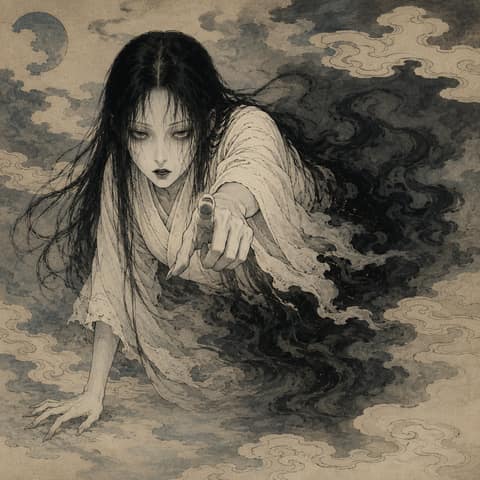
The form most often depicted today is the upper body of a long-haired woman crawling on her arms. Konaka's recollection, however, includes a lower-half apparition, and sources assembled by Tatsuki Asazato include men and old people. The high-school variant recorded by Kikuiro Sato is a man's upper body[3]. "Woman," "upper body," and "train accident" approached one another from separate currents and later formed one powerful portrait.
That the figure has no fixed shape is part of how the story works. Hear that an upper half runs, and one imagines it crawling on its arms. Hear that lower legs alone run, and the absence of a face creates the fear of not being able to read its intent. An old-woman form evokes a creature of an aging school building; a young-woman form is joined to the backstory of an accident victim; a male form reveals a different line of telling passed through teachers and athletic clubs. With just one condition—half a body—the teller can give it an outline suited to a place close to the listener.
The Backstory Offered by a Train Accident
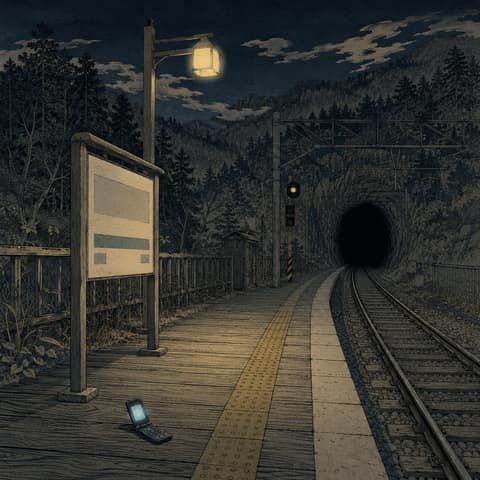
Linking the half-bodied figure to a train accident explains its appearance all at once. A train has the force to sever a body, tracks make a concrete site for an accident, and warning signals amplify the fear of its approach. These backstories acquired a place, season, and even moment of death, such as "a female student was struck at a crossing in Hokkaido" or "she died without noticing her wound in the cold"[2]. Yet no record joins these stories to one real accident; in each telling, a different place becomes the half body's home.
Tatsuki Asazato argues that the urban legend of a woman who lost her lower body after being hit by a train was originally told apart from Teketeke, and was joined to the half-bodied apparition later[2]. Once listeners asked why a creature without an origin was only half a body, the accident story became a second skin that answered the question. The more persuasive the narrative becomes, the more the apparition seems like the memory of a particular dead person. There is a quiet boundary between recognizing it as a backstory created within tradition and treating the reported accident as historical fact.
Where It Blends with Kashima-san
Kashima-san, too, may be associated with a woman missing limbs, trains, and suicide or accidents. The two can therefore overlap in appearance, but the time structure of their stories differs. In Kashima-san accounts, simply hearing the tale opens the curse: she visits on a night within three days, asks about her name or body, and harms those who answer incorrectly[5]. In forms of Teketeke close to the early accounts, it crosses a schoolyard, meets someone's gaze, or begins pursuit from the moment it is seen.
When later tellings say that one dies within three days of meeting Teketeke, or is saved by answering "Kashima-san," the contagion and question-and-answer structure of Kashima-san can be heard within them. The two ghost stories, marked by similar injuries, exchanged rules and came close enough to be told as the history of one person. Even so, a half-bodied apparition that begins pursuit the moment it is seen and a figure that visits a listener later to ask a question mark time in different ways.
How Sound Creates Speed
Teketeke is known as a fast creature, but its speed appears in a teller's mouth and arms before it appears on any speedometer. A chase begins in the classroom when the repeated sound accelerates, the teller says, "Even if you run, it will catch you," and both hands move wildly. Speeds of 100 or 150 kilometers per hour are also told, but they are not shared by every account close to the early tradition. The core of the fear lies not in a number but in the intervals between the sounds continuing to narrow.
The account collected by Sato vividly preserves a contradiction about that speed: its limbs and neck spin at Mach 3, yet it chases at the same speed as a human[3]. Listeners laugh at the contradiction and still fear the creature peering down from the ceiling. In school ghost stories, a monster a teller can reproduce before an audience is more potent than one that is physically consistent.
What happens after it catches someone also differs by story. Some tellings have it only cross a schoolyard; others have it chase the witness, begin pursuit after eye contact in a mirror, follow someone to the toilet, take their legs, cut with a sickle, or kill after a deadline. The 2001 record from Rokko Island High School says only that the person is pursued; it does not add severing or death afterward[4]. In tellings that do not complete the chase, the blank of not knowing what will happen becomes the fear itself.
In 1994,
the Creature Entered the Corridor
Screen media cannot turn a rumor that flashes across a distant schoolyard into a long story unchanged. In his 1994 drama, Chiaki Konaka placed Teketeke in the corridors of a school building and created an identity for it as a composite of an old woman and animal spirits[1]. In a narrow corridor, escape routes are limited, the sound striking the floor echoes from the walls, and the creature's approach can be prolonged. The conditions of film and television changed where the ghost story could live.
The corridor setting carried into a film the following year. A tight passage chosen for the screen became a stage on which it was easy to imagine Teketeke crawling through a school. School ghost stories are not shaped by oral telling alone. Scenes seen on screen can also become new footholds for viewers to relocate a ghost story in their own school building.
The Biography Shaped by the 2009 Film
Koji Shiraishi's *Teketeke* established a rule that those who see a woman without a lower body die within 72 hours, and connected a postwar railway suicide in Kakogawa and Kashima Reiko to the truth of the mystery[6]. Its structure turns the separate elements of "half a body," "railways," "three days," and "a woman's name" into one investigative story. Viewers can learn in sequence who the creature was, where she died, why she pursues people, and when they themselves will die.
That clarity has the power to fix later impressions. Unlike old-woman or male figures without origin stories, lower-half variants, and short accounts in which it merely gives chase after eye contact, the film's woman has one biography extending from life to death. It presented a form easy to summarize and remember, but did not erase the shifting half-bodied images that existed before it. A pursuing apparition without an origin story and an accident victim with a vivid history still coexist under the same name.
Each Retelling Brings It Closer to School
Teketeke's place is not one station on a map; it moves nearer to the place where its listeners are. The teacher interviewed by Sato changed the sighting location every year, bringing the story closer to classrooms and corridors used by the students[3]. Alumni memories mixed in the death of a woman in an accident that the teacher had not told, a rule involving the color red, and another handprint ghost story. Forgetting does not only break a tradition. It makes room for each generation to put another frightening story into the gaps.
Teketeke therefore has no single correct speed, gender, cause of death, weapon, or way to escape. What is most likely to remain is a body that is half present, a repeated sound, and the sudden closing of distance from what has been seen. With those three things, the creature can live in a schoolyard, a mirror, a corridor, or beside railway tracks. Speak the name Teketeke aloud, and its two-beat sound draws near once more. That ease of reenactment, more than any one accident victim, has kept this ghost story alive.
Character Profile
This section is our own creative profile for storytelling. It is not historical fact or scholarship.
Yokai Type - Modern Kaii
Category - Ghosts & Spirits
Rarity - Epic
Personality - It appears as only an upper or lower half and pursues people through schoolyards and school buildings. Its gender, age, history, speed, and form of harm vary from telling to telling.
Compatibility - Well suited to readers who enjoy comparing variants and who appreciate not only the fear but also the sound effects and gestures of the teller.
Abilities - Appears as only an upper or lower half of a bodySome variants move rapidly through schoolyards and school buildingsIs called by names derived from movement sounds, including ‘teke teke’Some variants begin pursuit after being seen or making eye contactLater variants take or sever the legs of those they encounter
Weaknesses - No distinctive weakness or means of escape is shared by every variant. Measures such as crouching, giving a particular answer, or moving away from railway tracks cannot be confirmed as common early rules; they should be kept separate as features of Kashima-san stories, screen works, and later variants.
Habitat - In forms close to the early accounts, schoolyards; after the 1994 television drama, school buildings and corridors; and in regional variants, areas around mirrors and toilets. Later train-accident forms may be set at railway crossings or along tracks, but cannot be fixed to a particular station or accident site.