YOKAI.JP

Hanako-san of the Toilet

といれのはなこさん

Hanako-san of the Toilet

Hanako-san of the Toilet

Their soul is listening — speak, and they will answer.

Basic Description

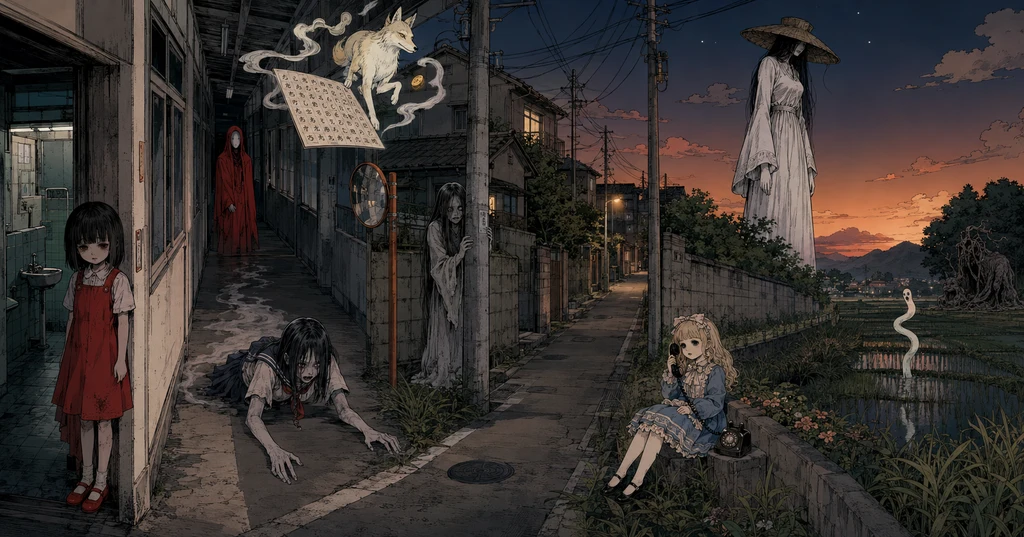
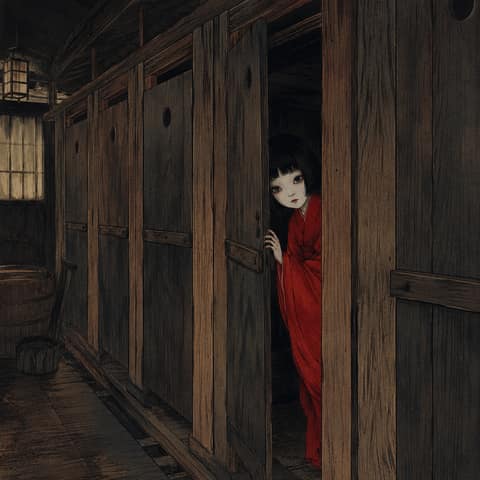
Hanako-san of the Toilet is a female child ghost passed down in Japanese elementary schools since the post-war Showa era. The most representative version goes: "Go to the girls' bathroom on the third floor of the school building, knock three times on the door of the third stall from the entrance, and call out, 'Hanako-san, are you there?' A voice from inside will answer, 'Yes, I am here.'" She is typically described as having a bob haircut and wearing a red skirt or red overalls. The earliest clear records of the modern version (the call-and-response type) date back to the late 1960s. It spread nationwide in the 1970s and became a frequent feature in children's magazines during the 1980s (Ryuhei Hirota & ASIOS, 2022). The starting point for its folklore classification was Toru Tsunemitsu's "School Ghost Stories" (Kodansha KK Bunko, 1990), after which TV drama and film adaptations in 1994-95 established Hanako-san as one of the most iconic urban legends of post-war Japan.

Folklore & Legends

The Oldest Records and the "Sawauchi" Variant. The earliest verifiable related record is found in Miyoko Matsutani's "Modern Folklore Vol. 7: School, Laughter and Ghost Stories, School Evacuation" (Rippu Shobo, later Chikuma Bunko), which recounts a story told around 1948 in Sawauchi Village, Waga District, Iwate Prefecture (now Kitakami City). However, this was a variant where "if you enter the third stall from the back in the gymnasium bathroom, a white hand reaches out from below and calls, 'The Third Hanako-san,'" which differs from the now widely known "summoned Hanako-san." The first appearance of the latter with a definitive date traces back to the late 1960s—this point is detailed in the verification by ASIOS and Ryuhei Hirota in "Decoding 'Urban Legends'" (Saizusha, 2022).

Nationwide Circulation via Children's Magazines in the 1980s. What was sporadically told in elementary schools across the country in the 1970s became a frequent occurrence in ghost story features of children's magazines entering the 1980s. The back-and-forth between oral tradition and print made it a shared knowledge among elementary school students nationwide. In 1990, Toru Tsunemitsu published "School Ghost Stories" (Kodansha KK Bunko), organizing it as the fruit of folkloric fieldwork, after which "school ghost stories" (Gakkou no Kaidan) became established as an academic term. In this book, Tsunemitsu discusses the spatial structure of the school building (the codes of the third floor, the bathroom, and the third stall) in connection with child psychology.

Media Expansion in 1994-95. From January to March 1994, the Kansai TV omnibus series "School Ghost Stories" (11 episodes in total) aired. In August 1994, Pony Canyon released a re-edited VHS series, "School Ghost Stories: Truly Happened!!" in 3 volumes, which included Hanako-san and Teketeke. The following year, on July 1, 1995, Shochiku's film "Hanako-san of the Toilet" (directed by Joji Matsuoka) premiered, followed by Toho's film "School Ghost Stories" (directed by Hideyuki Hirayama) on July 8. Both ran concurrently as children's horror films that summer. Toho's "School Ghost Stories" subsequently produced sequels in 1996, 1997, and 1999, becoming a 4-part series.

Regional Variations and Origin Theories. While the standard appearance is "a bob haircut with a red skirt," there are regional variations such as a "white dress" or "sailor uniform." The stall number is typically "the third," but distinct versions like "the fourth" or "the seventh" have been recorded. Theories of her origin include (1) a death during wartime air raids, (2) a death during the Great Kanto Earthquake, and (3) a murder on school grounds. However, none of these have definitive historical backing and are understood as post-hoc explanations added by narrators to make the ghost story feel complete. There is also oral tradition linking her to a 1948 accident at Kurosawajiri Elementary School in Iwate Prefecture, where a bathroom roof collapsed under heavy snow, but this remains purely hypothetical.

Modern Secondary Works. The manga "Toilet-Bound Hanako-kun" (Square Enix 'Monthly G Fantasy') by AidaIro, serialized starting in 2014, portrays Hanako-san as a "blonde male earthbound spirit," a figure entirely different from the original archetype, becoming a massive hit with over 20 million copies sold. This layering of the original ghost story and secondary creation illustrates that urban legends constantly assume new forms within modern media.

Yokai Cards1

Hanako-san of the Toilet across multiple art-style decks

Card gallery

Detailed Analysis

Post-war School Architecture and the "Closed Water Space". While the basic description traced literary first appearances and nationwide distribution, this deep dive explores why the combination of "school, bathroom, and young girl" became the core of modern ghost stories. Post-war Japanese elementary school architecture standardized around three-story reinforced concrete buildings starting in the 1950s. The fixed layout placed the staff room on the first floor, upper-grade classrooms on the third floor, and bathrooms at the ends of each floor. The third-floor bathroom is furthest from the teachers' watchful eyes, easily becoming an empty space outside of recess. Here, the boundary between the ordinary and the extraordinary runs deep. For children (especially girls), the bathroom is a place where physical vulnerability is exposed, and simultaneously a place to be alone within a communal space. Toru Tsunemitsu positioned this "periphery of school space" as the geographical foundation of the Hanako-san ghost story.

The Code of the Number "Three". The triple "three"—the third floor, the third door, and three knocks—is not a coincidence. It can be read as a carryover into modern ghost stories of the "threshold number three" common in Japanese folkloric summoning rituals (e.g., seven days of the ox-hour visit, three calls, walking around a grave three times). Children unconsciously reenact this traditional summoning structure within the school. This is why playing Hanako-san functions not just as "mere play" but as a pseudo-summoning ritual. It has also been pointed out that the ritualistic format of the Kokkuri-san (ouija board) game, popular in elementary schools in the 1970s, was continuously inherited by the Hanako-san game in the 1980s.

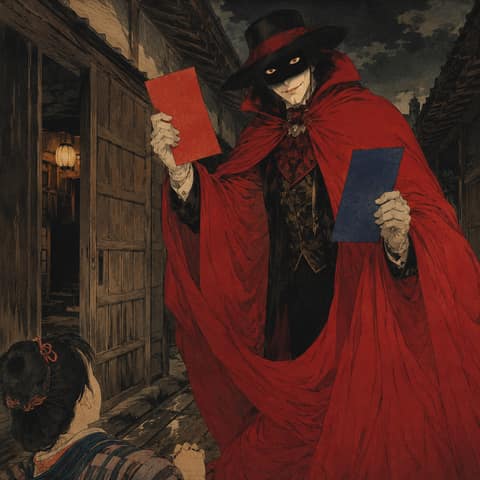
The Color Red and the Lineage of "Red Mantle". Hanako-san is often depicted wearing a red skirt or red overalls. In post-war Japanese depictions of young girls, the color red has three layers of meaning: (1) physical realities like blood or menarche; (2) a sense of foreignness that deviates from standard school uniform colors; and (3) a blending with the pre-war ghost story "Red Mantle" (a voice asking whether you want blue or red paper). The Red Mantle ghost story, said to have originated in Kobe in 1939—a voice in the bathroom asking if you want red or blue paper—has a sisterly relationship with Hanako-san, showing the continuity of ghost story lineages from pre-war to post-war eras. The fact that the Red Mantle elements are strongly mixed into Hanako-san variations in Hokkaido and Tohoku is also evidence that the echoes of pre-war ghost stories transitioned into post-war school buildings.

The Anonymity of the Name "Hanako". Hanako-san bears one of the most common Japanese female names from the Showa era, but her specific life history is never told—this allows her to function as a collective pronoun for "countless nameless schoolgirls." Theories of her death by war, earthquake, or murder all lack a specific individual identity, and can even be read as a personification of "the very history of the school space swallowing up young girls." Folklorist Noboru Miyata argued in "Folklore of Yokai" (Iwanami Shoten, 1985) that post-war school ghost stories serve the function of "the community re-enshrining the nameless dead after the fact."

Details of Media Expansion in 1994-95. In the 1994 Kansai TV omnibus "School Ghost Stories," "Hanako-san" was produced as a single episode, and it was also included in the August Pony Canyon VHS "School Ghost Stories: Truly Happened!!". Shochiku's "Hanako-san of the Toilet" (directed by Joji Matsuoka, starring Etsushi Toyokawa), released on July 1, 1995, was a mystery-horror film combining a serial murder case with the Hanako-san legend. In contrast, Toho's "School Ghost Stories" (directed by Hideyuki Hirayama), released on July 8, was a juvenile adventure horror film. The styles of these two films, running side-by-side that summer, stood in sharp contrast. Toho's version went on to produce sequels in 1996, 1997, and 1999, grossing over 3 billion yen in total box office revenue across the 4-part series.

Modern Toilet-Bound Youth and the Layering of Secondary Works. AidaIro's "Toilet-Bound Hanako-kun" (serialized from 2014) has surpassed 20 million copies, receiving a TV anime adaptation in 2020 and a stage play in 2022. The "Hanako-kun" here is a cheerful, caring, blonde earthbound spirit, completely detached from the original image of the girl ghost. For Generation Z, "Hanako" is primarily recognized as a cute male character rather than a scary ghost girl—an excellent example of the modern phenomenon where a ghost story's secondary creation overwrites the primary legend itself.

Character Profile

This section is our own creative profile for storytelling. It is not historical fact or scholarship.

Yokai Type
Modern Kaii
Rarity
Legendary
Personality
A quiet spirit who answers when called and tests the caller's manners
Compatibility
Responds to proper summoning rituals, punishes frivolous disrespect
Abilities
Answers from inside when the third door is knocked three timesLingers as an inherent locus spirit of the school spacePunishes those who do not follow the formal summoning procedureTakes physical form mediated by the color redAbsorbs post-war collective psychology to alter its form
Weaknesses
Half-joking summons that fail to follow the formal 3-3-3 procedure, school buildings located adjacent to shrines or temples
Habitat
The girls' bathroom on the third floor of post-war three-story reinforced concrete school buildings, specifically the third stall from the entrance
🔮Yokai Compatibility Test

For more detailed information and diagnosis results about The Girl in the Third Stall of the Third-Floor Girls' Bathroom, Hanako-san, please click here.

Sources & References

6
  1. 謎解き「都市伝説」ASIOS 編 / 廣田龍平(彩図社, 2022) [学術書]都市伝説の発祥年代を実証的に検証した書。トイレの花子さんについて、現在型(呼出して応答する型)の明確に年代を遡れる初出は 1960 年代後半とする。
  2. 学校の怪談常光徹(講談社 KK 文庫, 1990) [民俗学書]民俗学者常光徹のフィールドワーク成果。「学校怪談」という学術用語を定着させた書。花子さん怪谈の地理的・心理的基盤を分析する。
  3. 学校の怪談 (テレビドラマ)関西テレビ(関西テレビ放送系オムニバス・全 11 話, 1994) [映像作品]1994 年 1-3 月放送のオムニバス・ホラードラマ。花子さん回を含み、後にポニーキャニオン VHS で「ほんとにあった!!学校の怪談」 として再編集発売された。
  4. 映画『トイレの花子さん』 (1995)松岡錠司 (監督・脚本)(松竹, 1995 年 7 月 1 日公開) [映像作品]連続殺人事件と花子さん伝説を重ねたミステリ・ホラー。主演·豊川悦司。同夏に並走した東宝『学校の怪談』 (平山秀幸) と作風が対照的。
  5. 映画『学校の怪談』 (1995)平山秀幸 (監督)(東宝, 1995 年 7 月 8 日公開) [映像作品]常光徹『学校の怪談』 を原作とするジュブナイル冒険ホラー。1996・1997・1999 年に続編が制作され全 4 作シリーズとなった。
  6. 地縛少年花子くんあいだいろ(スクウェア・エニックス『月刊 G ファンタジー』, 2014 年連載開始) [漫画作品]トイレの花子さんを「金髪の男子地縛霊」 として描いた漫画。累計 2000 万部超、2020 年 TV アニメ化、2022 年舞台化。原型の少女霊像を上書きする二次創作の代表。

Interested in this type of yokai?

Discover the yokai most similar to your personality with our yokai diagnosis

Start Yokai Diagnosis

Meet your guardian yokai at the shrine

Draw an omikuji fortune and discover the yokai watching over you today.