YOKAI.JP

Blue Lady-in-Waiting

AH-oh NYOH-boh

Blue Lady-in-Waiting

Blue Lady-in-Waiting

Their soul is listening — speak, and they will answer.

Basic Description

A lady-in-waiting–type yokai seen in Edo-period monster paintings. In Toriyama Sekien’s Konjaku Gazu Zoku Hyakki, she appears as a youthful court woman with ohaguro (toothed blackening), said to haunt a ruined old palace. The term originally referred to low-ranking young attendants serving at court or in aristocratic households, and was not a fixed monster name. Similar court-attendant figures appear across various Hyakki Yagyo picture scrolls; Sekien likely labeled that iconography as “Ao-nyōbō.” Her nature and origins are unknown.

Folklore & Legends

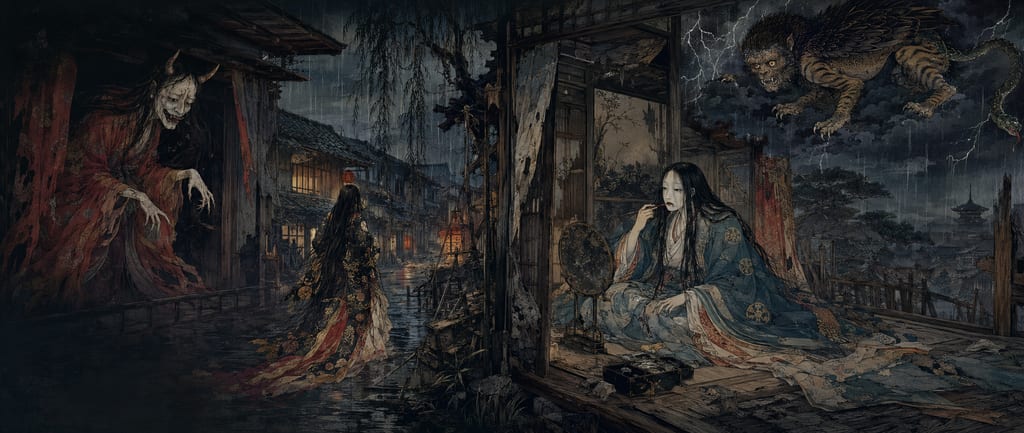
In several Hyakki Yagyo scrolls, a court lady is shown before a curtain stand, gazing into a mirror and applying ohaguro; in the Oda Gōchō version she holds a fan and is labeled “Ao-nyōbō.” A related design appears in Hyakumonogatari Kaie Emaki under the name “Shimokuchi.” A historical note in the Azuma Kagami (entry for Kenryaku 3, 8th month, 18th day) records an apparition in the form of a “blue woman” before Shogun Minamoto no Sanetomo, followed by an earthquake the next day, though no direct link to Sekien’s Ao-nyōbō is established.

Yokai Cards1

Blue Lady-in-Waiting across multiple art-style decks

Card gallery

Detailed Analysis

Aonyōbō here is less a creature of a fixed tale than a court lady’s image turned uncanny and circulated as iconography. Sekien paints her as a lady-in-waiting haunting a ruined old palace, exaggerating obsolete rites and cosmetics—ohaguro and painted brows—to give her a ghostly air. In Night Parade scrolls she often appears with ladies’ accoutrements such as curtains, mirrors, and fans, quietly following the procession. The name derives from the social title aonyo (young lady-in-waiting), making the yokai label largely retrospective. While a record of an “aonyo” exists in the Azuma Kagami, identification is cautious, sharing only the appearance of a young court woman. Local lore offers few concrete episodes, and the setting is typically a decayed palace or the parlor of an old house. Despite its creative coloring, this is a leading example of a pictorial yokai that renders the afterimage of court culture as the uncanny.

Character Profile

This section is our own creative profile for storytelling. It is not historical fact or scholarship.

Rarity
Rare
Personality
taciturn, hollow-eyed, distant
Compatibility
prefers tranquil places, dislikes human clamor
Abilities
seems to vanish by melting into the shadows of curtains and folding screens, suffuses ruined palaces and old parlors with the sense of a human presence, is sometimes said to appear only through a mirror
Weaknesses
bright lamplight and loud noise, exorcising rites or thorough cleaning make her disappear
Habitat
ruined imperial palaces, old family parlors, the procession of the Night Parade of One Hundred Demons
🔮Yokai Compatibility Test

For more detailed information and diagnosis results about Emaki and Sekien Lineage Iconography, please click here.

Interested in this type of yokai?

Discover the yokai most similar to your personality with our yokai diagnosis

Start Yokai Diagnosis

Meet your guardian yokai at the shrine

Draw an omikuji fortune and discover the yokai watching over you today.