Yokai Encyclopedia

Encyclopedia of Japanese Yokai

112 Yokai|14 Category|Page 1 of 5
Localization in Progress - More content available in Japanese version
View Japanese
Sort by: NameAscending
Rare
  • Abumikuchi

    Abumikuchi

    Rare

    ah-BOO-mee-KOO-chee

    Sekien Zue Conformant

    Animated Objects & UndeadJapanese folklore

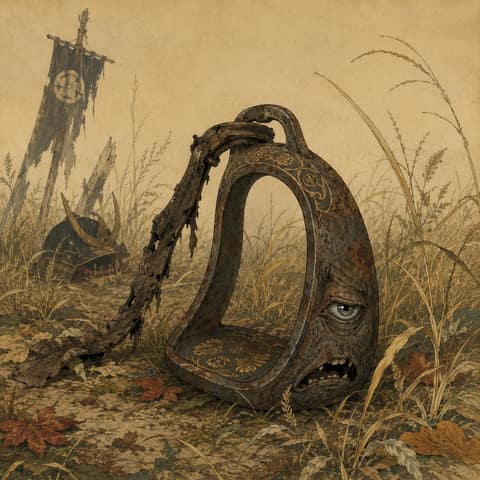
    An abumiguchi depicted per Toriyama Sekien’s Illustrated Bag of a Hundred Tools. An ancient stirrup sprouts eyes and a mouth, shown lying on the ground or dragging its straps. A quoted line from the Noh play Tomonaga invites readings of battlefields and fallen warriors in the background, yet no concrete deeds or harms are recorded. Following tsukumogami conventions, it is the resentment and lingering attachment of a tool long used then discarded given form. This aligns with Edo-period essays that teach “cherish your implements,” and likely reflects the Tsurezuregusa passage warning about horse gear, echoed in its pairing with the Saddle Fellow. The modern retelling that it “awaits its master,” seen in Mizuki Shigeru’s notes, lacks support in older sources and is not adopted here. No verified field traditions are known, and no region is specified.

  • Aburasumashi

    Aburasumashi

    Rare

    あぶらすまし

    The Voice of Kusazumigoe: Aburasumashi

    Apparitions of Mountains and FieldsKumamoto

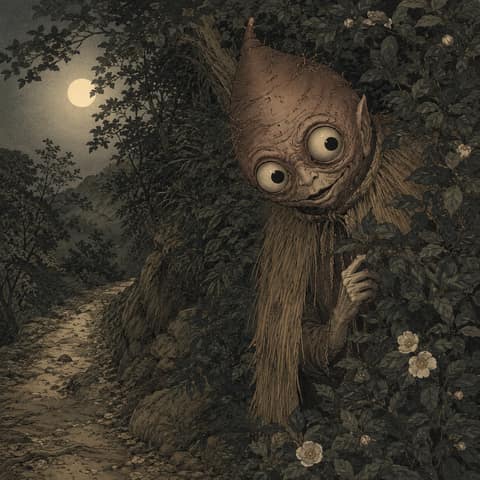
    The core of the aburasumashi is not its "appearance" but its "response." The moment someone mentions a rumor about it at the pass, it replies, "I still appear now" ── the very act of speaking becomes a summoning. It is a yokai that possesses words. The imagery of the straw raincoat, hat, and potato head was a later creation popularized by Shigeru Mizuki; the original Amakusa lore was purely about a voice and a presence. The backdrop to this legend is the local lifestyle of pressing "katashi oil" from the seeds of camellias and sasanquas in Amakusa. A leading theory suggests that the warning against those who stole or wasted the scarce oil crystallized into the shadow of a figure carrying an oil bottle in the darkness of the pass, sharing a lineage with oil-related apparitions like Aburabo and Aburabozu across Japan. While linking the nameless stone statue at Kusazumigoe in Sumoto to its "grave" is a modern reinterpretation, it serves as an excellent example of local memory coming to inhabit a physical object.

  • Akamata

    Akamata

    Rare

    あかまたー

    Night-Visiting Serpent Phantom Akamata

    Animal ShapeshifterOkinawa

    The Akamata is a serpent bridegroom that appears in the Okinawan night. It visits a young woman in the guise of a beautiful youth, but its true form is a massive reddish-brown snake. Suspicious, the young woman secretly pierces the hem of the young man's clothing with a threaded needle, and by following the thread at dawn, she is led to a snake's den—a classic spindle-motif tale passed down across the islands. A maiden visited by the Akamata conceives a serpent's child, but she purifies herself on the third day of the third lunar month by going down to the beach and stepping into the tidal waters to wash the unborn snake away. Fear and purification are intertwined in this single narrative, still recounted today as the origin of the Okinawan *Hamauri* festival.

  • Aobōzu (Blue Monk)

    Aobōzu (Blue Monk)

    Rare

    ah-oh-BOH-zoo

    Aobōzu of Traditional Iconography and Provincial Tales

    General ClassificationsNagano

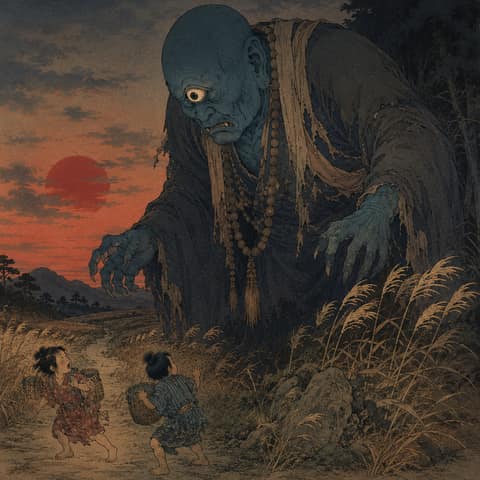
    An Aobōzu type based on images in Edo-period picture scrolls and regional field collections. Depicted as a monk with a bluish hue or as a one-eyed priest, it may be told as an animal in disguise, a manifestation of a mountain deity, or an uncanny being of uncertain nature. It serves to warn children against wandering, anchors tales of hauntings in fields, mountains, and vacant houses, and conveys oral taboos. No fixed proper name or origin is agreed upon, and its conditions of appearance and behavior vary by region. Because Sekien’s print lacks commentary, notes from other sources list it alongside the “One-Eyed Monk” or as an allegory for an unseasoned priest, but neither view is definitive. In premodern oral accounts, concrete images coexist under multiple labels such as “Blue Priest,” “Great Monk,” and “Little Monk.”

  • Ashinaga Tenaga (Long-Legs and Long-Arms)

    Ashinaga Tenaga (Long-Legs and Long-Arms)

    Rare

    ah-shee-NAH-gah teh-NAH-gah

    Wakan Zu-e Lineage: Long-Leg and Long-Arm Pair

    Half-Human BeingsUncertain (ancient foreign lands as reported in early geography)

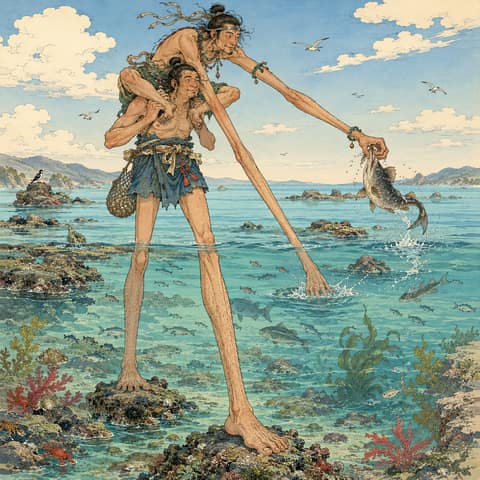
    Grounded in the accounts of Sancai Tuhui and the Wakan Sansaizue, this depiction centers on the paired action of the Long-Leg (Ashinaga) and Long-Arm (Tenaga). The Long-Leg wades far into shallow seas, straddling reefs between waves to provide stable footing, while the Long-Arm extends his reach beneath the surface to gather fish and shellfish and to handle nets and baskets. They are recorded as foreign peoples, unattached to specific locales or clans. Dimensions are often given as legs three jo and arms two jo, though sources vary and no single physique is fixed. In Japan they appear in palace screen paintings, caricatures, and kusazoshi, where a set piece of the two cooperating against rough seas became standard. Religiously, they are sometimes placed in Dragon Palace tales as orderly retainers of the sea deity. As folklore, they symbolize otherworldly labor and the extension of reach across distance, and were consumed as images for maritime safety and plentiful catches. Reports of a solitary “Long-Leg” appearing as a weather portent are a separate tradition borrowing the name and should be distinguished from this paired form with Long-Arm.

  • Bake no Kawagoromo

    Bake no Kawagoromo

    Rare

    ba-ke no ka-wa-go-ro-mo

    The Dipper-Worshipping Fox of Transformation — Bake no Kawagoromo

    Animal ShapeshiftersUnknown (a fox-transformation figure recorded in Sekien’s Hyakki Tsurezure Bukuro)

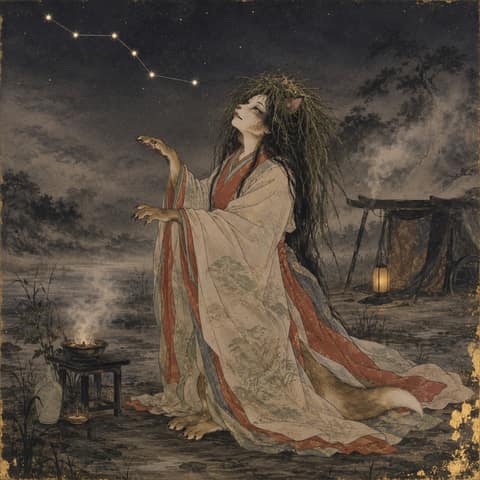
    This version reads the Bake no Kawagoromo through a single point — the fox that transforms by worshipping the Dipper — and follows the rite of its making and the layers of wit folded into the picture. The passage in the Nuogaoji of the Youyang Zazu, the other source, speaks of more than a skull and the Dipper. There the wild fox is called the “purple fox,” and it is said that “when it strikes its tail at night, fire comes forth.” This stroke of fire from a fox’s tail runs continuous with the foxfire so familiar in Japan; behind the Bake no Kawagoromo, too, stands a fox that should by rights be eerie — kindling fire at its tail in the dark, a skull upon its head. When Sekien exchanged that skull for algae, the dread of the bones faded, and in its place came the comedy and pathos of a creature crowned with weed from the water’s floor. That the picture of transformation leans toward the droll rather than the uncanny is the effect of this single substitution. The word “kawagoromo” itself carries the literary turn Sekien favored. Speak of a kawagoromo, and the most famous in the classics is the “fire-rat’s robe” of the Tale of the Bamboo Cutter — that treasure which burns when set to flame and, if counterfeit, betrays the fraud. It and this fox, whose disguise is about to peel, answer one another twice over through the words “kawagoromo” and “bake no kawa.” There is no written proof that Sekien meant to invoke the allusion, but given how thoroughly his picture-books tread upon classical puns, it is hard to take for mere chance. The placement of the image, too, shows the author’s intent. In the first volume it sits between the “Kutsutsura” and the “Kinu-danuki.” Flanked on both sides by transforming beasts, this run forms a small province set within a book of tool-spirits, given over to the transformations of animals. A fox could crowd in among the spirits of old utensils only because “kawagoromo” could be read as a garment, a thing; and by closing with “mused within a dream,” Sekien made this forced pairing follow, naturally enough, the logic of dreams. Its powers and its failings, too, are all rooted in this one picture. The rite of transformation requires prayer toward the Dipper and a vessel borne on the head (a skull, or algae); should the vessel fall, the change does not take. Dressed though it is as a beautiful woman, it cannot quite clear away the beast in its tail, its paws, its attendants — and that “about to peel” is this fox’s appointed weakness. The lowly wild fox, striving three thousand years to reach the figure of a beautiful woman, bears in itself all the longing and all the shortfall of that road.
  • Bake-jizo

    Bake-jizo

    Rare

    ばけじぞう

    Narabi Jizo of Kanmangafuchi Abyss, Whose Number Changes Every Time They Are Counted

    Spirit/GhostTochigi

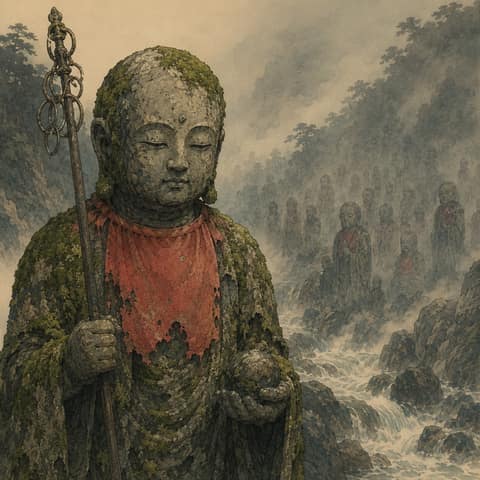
    Along the banks of Kanmangafuchi Abyss, Jizo statues wearing red bibs line the river. Walking while counting them one by one, and counting them once more on the way back, the numbers somehow do not match—hence they are called Bake-jizo (Ghost Jizo) and Narabi Jizo (Lined-up Jizo). The sight of moss-covered stone Buddhas quietly sitting in this rugged gorge carved from the lava of Mount Nantai evokes a sense of time distortion unique to sacred grounds. Many Jizo were washed away by a flood during the Meiji era, and only their pedestals remain here and there in the broken lines. In the single aspect of not being able to determine their number, this is indeed an anomaly, while simultaneously remaining a place of deep prayer.

  • Banana-Plant Spirit

    Banana-Plant Spirit

    Rare

    bah-SHOW-noh-SAY

    Tradition-Faithful, Sekien Illustrated Edition

    Natural Phenomena SpiritsNagano

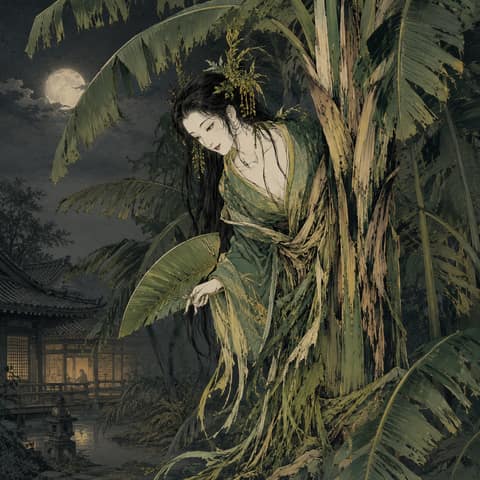
    A整理 based on the plant-spirit of banana (bashō) as pictured in Toriyama Sekien’s Konjaku Hyakki Shūi. The broad leaves rustle and cast uncanny shadows in wind and rain, thought to summon the strange, with the belief that an aged clump comes to harbor a spirit. It takes the form of a beautiful woman to unsettle both clergy and laity, posing the riddle of whether grasses and trees can attain Buddhahood, and vanishes depending on one’s response. Tales include encounters in Ryukyuan banana groves, an apotropaic rule that those who carry blades are spared, and Shinano stories where striking it leaves the bashō stalk wounded by morning. It is not consistently harmful, more often serving as a warning through shock and confusion. Typical settings are temple gardens, banana plots, and manor yards.

  • Blue Lady-in-Waiting

    Blue Lady-in-Waiting

    Rare

    AH-oh NYOH-boh

    Emaki and Sekien Lineage Iconography

    Half-Human BeingsJapanese folklore

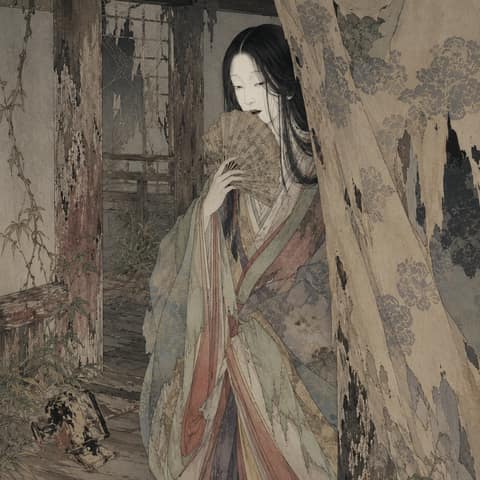
    Aonyōbō here is less a creature of a fixed tale than a court lady’s image turned uncanny and circulated as iconography. Sekien paints her as a lady-in-waiting haunting a ruined old palace, exaggerating obsolete rites and cosmetics—ohaguro and painted brows—to give her a ghostly air. In Night Parade scrolls she often appears with ladies’ accoutrements such as curtains, mirrors, and fans, quietly following the procession. The name derives from the social title aonyo (young lady-in-waiting), making the yokai label largely retrospective. While a record of an “aonyo” exists in the Azuma Kagami, identification is cautious, sharing only the appearance of a young court woman. Local lore offers few concrete episodes, and the setting is typically a decayed palace or the parlor of an old house. Despite its creative coloring, this is a leading example of a pictorial yokai that renders the afterimage of court culture as the uncanny.

  • Bone Woman

    Bone Woman

    Rare

    HOH-neh-ON-nah

    Bone Woman (after Sekien Toriyama)

    Half-Human BeingsEdo period (print tradition)

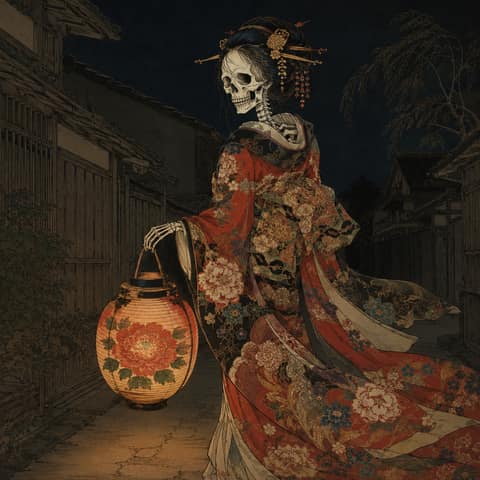
    This version is based on the Bone Woman image in Toriyama Sekien’s Konjaku Gazu Zoku Hyakki. She is a skeletal woman who carries a peony-patterned lantern and visits the home of her beloved in the late night. The source is the ghost tale “Peony Lantern” in Asai Ryōi’s Otogi-bōko. Sekien visualized its core motifs—the inversion of a lovely face and a skeletal body, and the link between lamplight and erotic affection. Rooted in Edo-period notions of vengeful fixation and shifting appearances common to yomihon and kaidan, the figure is an iconographic type rather than a legend tied to specific locales or persons: not a land deity or beast, but a visualization of a passion-bound revenant. Peonies, lanterns, and night roads are its key nodes. While later lore speaks broadly of walking skeletons, this image stresses appearances born of yearning and nocturnal trysts.

  • Boroboroton

    Boroboroton

    Rare

    boh-roh-boh-roh-TOHN

    Sekien Zufu Edition

    Animated Objects & UndeadEdo period, Japan

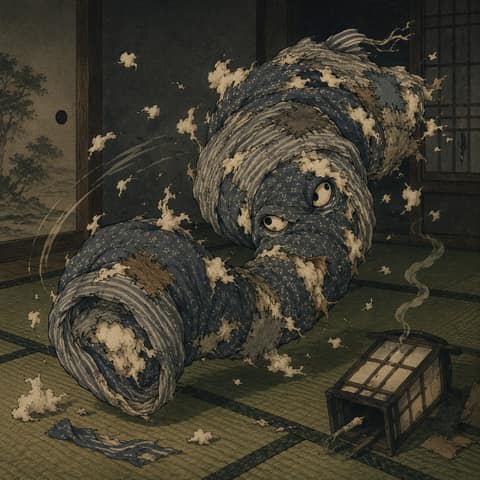
    An image based on Toriyama Sekien’s Hyakki Tsurezure-bukuro. A futon long used and then cast aside rises at night, bounding about the room to startle its former owner. Its malice is mild, acting mainly as a chastening presence that creates a commotion to spur repentance. The name is often read as a play on the tattered fabric’s “boro-boro” and the term for Fuke Zen monks, intertwining beliefs about spirits inhabiting tools with literary wit. Though local folk attestations are scarce, iconographically it is treated as a link in the lineage of tsukumogami tales.

  • Byōbu-Nozoki (Screen-Peeker)

    Byōbu-Nozoki (Screen-Peeker)

    Rare

    BYOH-boo no-ZOH-kee

    Iconographic Tradition–Conforming Version

    Animated Objects & UndeadJapanese folklore

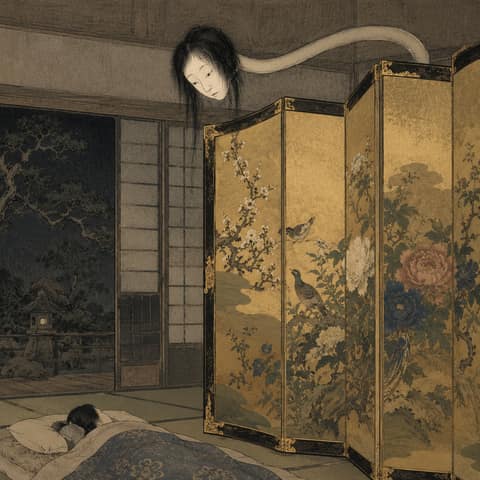
    Centered on the commentary in Toriyama Sekien’s Konjaku Hyakki Shūi, this reading emphasizes the habit of peering in from beyond the folding screen. Rather than causing harm directly, it primarily spies on hidden affairs. Some note that the image of lofty screens in Chinese classics shaped its formation, while in Japan it became linked to the belief that bedroom furnishings can accrue spirit, with a folding screen that has long reflected human lives aging into a yokai. It is not a fixed local deity but is understood as a type of haunted implement tale (tsukumogami).

  • Ceiling-Dropper

    Ceiling-Dropper

    Rare

    TEN-joh-KOO-dah-ree

    Sekien Gazu Edition

    Household SpiritsEdo period

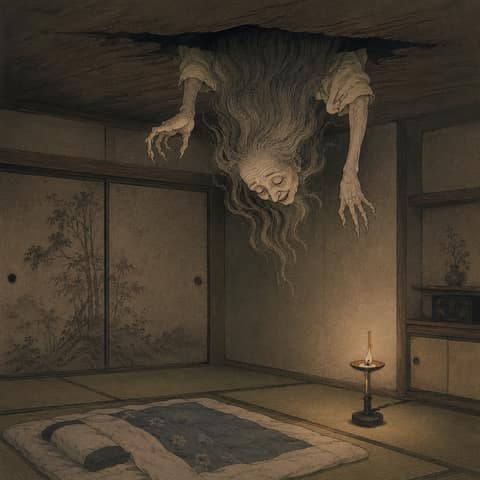
    An interpretation grounded in Toriyama Sekien’s iconic prototype. The house ceiling marks a boundary between inside and outside, the mundane and the otherworld; its upside‑down descent symbolizes an inversion of that threshold. It appears mostly at midnight when human activity has stilled, and is said to cause visual shock without actual harm. Early modern readers linked it to wordplay and household safety, reading it as an allegory that quietly warns of neglect, filth, and hazards in the crawlspace above. Later traditions reinterpreted creaks, drafts, and animal sounds in the ceiling as this apparition, placing it within the broader lineage of domestic yokai.

  • Chokuboron

    Chokuboron

    Rare

    CHOH-koo-BOH-ron

    Conforming to Traditional Iconography

    Animal ShapeshiftersEdo period

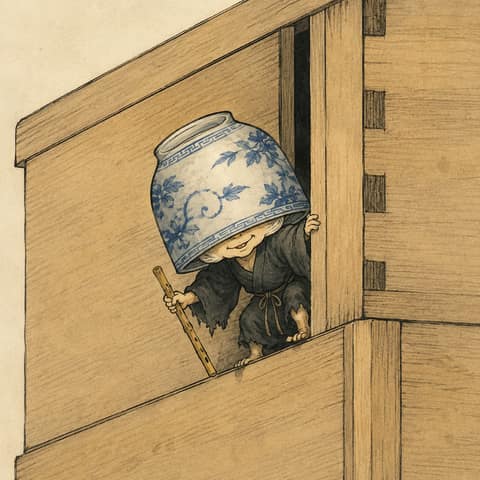
    Guided by Sekien’s imagery and captions, this reading foregrounds its nature as a tsukumogami, a spirit of aged utensils. The little goblin, komusō-like with a sake cup as a hat, emerging from a box accords with the belief that long-used drinking vessels and tools gain spirit and appear at set times. The caption’s citation of Xuanzong and the Spirit of Ink bolsters the idea that spirits arise in objects such as calligraphy, painting tools, and sake ware, with Chokoburo composed pictorially as one of that kind. It does not point to a concrete religious entity of komusō or boro, but playfully borrows half-monk, half-lay visual cues, with a name born of puns and association. No locale of oral tradition is identifiable; its character is chiefly that of a visual怪 within Edo print culture.

  • Daidarabotchi

    Daidarabotchi

    Rare

    Daidarabotchi

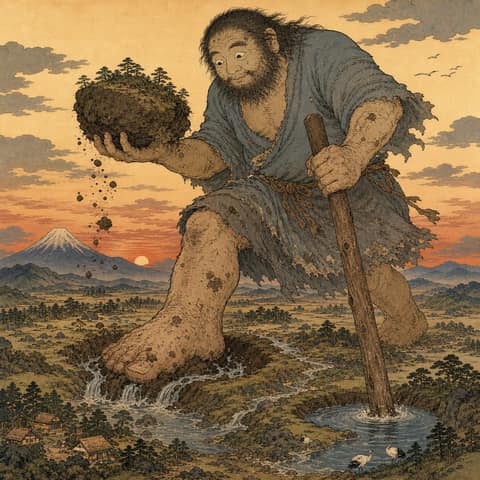
    The Terrain-Shaping Giant Who Trampled the Lands of Musashi

    Oni / Giant MonstersSaitamaTokyo

    Daidarabotchi is not so much a terrifying monster as a giant whose existence serves to explain the origins of the land. He has been debated both as a degraded folk version of the nation-building deities from the *Kojiki* and *Nihon Shoki* myths, and as a product of ancient peoples' imagination trying to explain Jomon period shell mounds or natural terrain features. Musashi Province is one of the areas where these legends are particularly strong, dotted with origin stories of place names—such as "Ootakubo" in Saitama City—where his footprints turned into depressions, marshes, and wells. Even massive geographical features like Mount Fuji, Lake Biwa, and Lake Haruna are attributed to this giant's deeds, operating on a scale far exceeding a single prefecture. Ever since Kunio Yanagita compiled the footprint legends from across the country, Daidarabotchi has become a "giant bearing the memory of place names and terrain," blending seamlessly into the very landscape of Japan.

  • Demons of Mt. Ichiya

    Demons of Mt. Ichiya

    Rare

    ichiyazan-no-oni

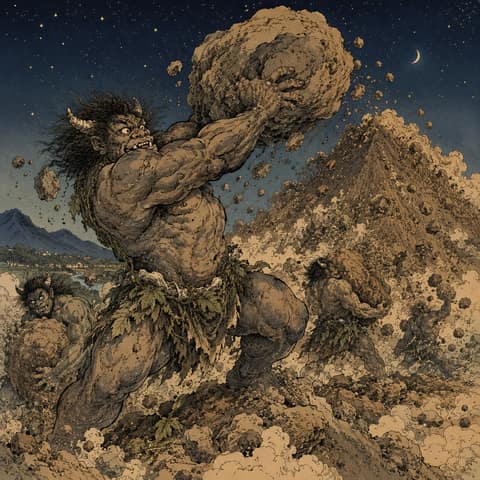
    The Demons of Kinasa Who Built a Mountain in One Night

    Demons / Giant MonstersNagano

    Unlike the demoness Momiji, who was refined on the Noh and Kabuki stages, the demons of Mt. Ichiya are indigenous demons who bear the very origin of the place name. Their action is singular—to build a mountain overnight and block the arrival of the capital. The desperation of a local existence refusing to be stripped of its home is condensed into this single point. While the Momiji legend is a story of descent—'a noblewoman exiled from the capital falls into a demon'—the demons of Mt. Ichiya are depicted as entities that existed in the village from the beginning and resist the capital coming from the outside. The name of the real-life general Abe no Hirafu overlaps with the quasi-historical framework of Emperor Tenmu's capital relocation, giving the legend a strange sense of reality. The conclusion, where the demons are defeated and the name 'Kinasa' is born, is also a story of renaming the land from the perspective of the victor (the center), and the bitter aftertaste of this legend lies in the fact that the defeat of the demons itself was permanently carved as a place name. The cluster of Kyoto-derived place names remaining in Kinasa are scattered in the valley even today, serving as evidence of the victor's memory.

  • Demons of Tateyama Jigoku

    Demons of Tateyama Jigoku

    Rare

    Tateyama-jigoku-oni

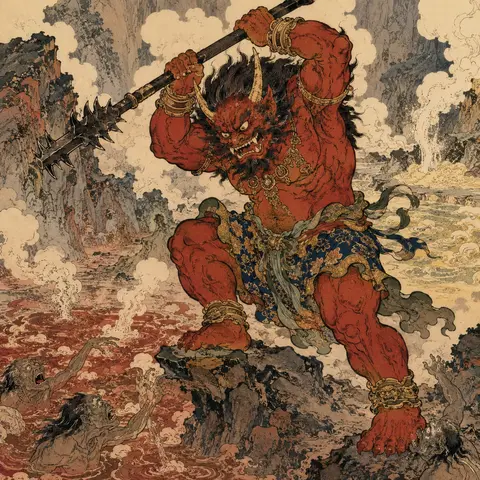
    Demonic Jailers of the Tateyama Mandala Hells

    Oni / Giant MonstersToyama

    Rather than being a single, independent yokai, the Demons of Tateyama Jigoku are an ensemble cast constituting the underworld as projected onto the sacred Mount Tateyama. The Tateyama Mandala consists of five elements: the founding legend, hell, the Pure Land, the ascetic climbing path, and the Nunobashi Kanjō-e ritual. In the scenes of hell, it is these demons who stoke the cauldrons, herd the dead up the Mountain of Swords, and drown them in the Blood Pool. Notably, Tateyama's hell was not purely a product of imagination, but was based on the actual landscape of Hell Valley—its fumaroles, sulfur springs, and desolate volcanic plains. With Mikurigaike as the Blood Pool Hell and Mount Tsurugi as the Mountain of Swords Hell, the visible natural world was directly translated into the iconography of hell, giving the Demons of Tateyama Jigoku a palpable sense of reality as denizens of that very landscape. The etoki preaching tours by Ashikuraji guides flourished in the late Edo period under the patronage of the Kaga domain, spreading the image of these demons to villages nationwide through the mandala. The tortures inflicted by the demons of hell serve to accentuate the salvation offered by their counterparts, Ubagami and Amida Buddha. The view of the underworld in the Tateyama faith is thus constructed upon this tension between punishment and salvation.

  • Doro-danbō (Mud Rice-Field Wraith)

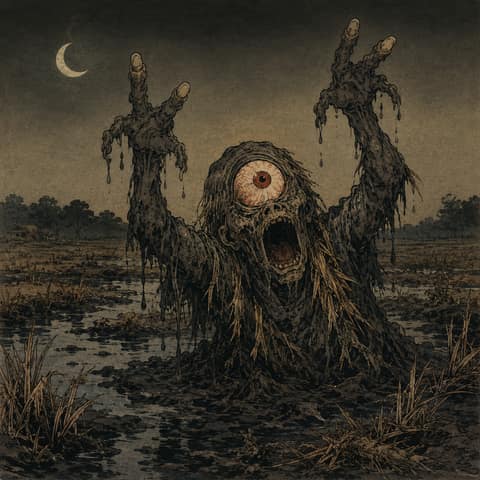
    Doro-danbō (Mud Rice-Field Wraith)

    Rare

    DOH-roh-dahn-BOH

    Sekien Iconography Conformant Edition

    山野の怪Uncertain (Toriyama Sekien notes “the northern provinces”); otherwise Japanese folklore

    This version adheres to Toriyama Sekien’s image and brief note, centering on a one-eyed, three-fingered figure rising upper-body first from a muddy paddy. It avoids expanding later folkloric claims and emphasizes allegory. It appears as a voice rebuking impiety and neglect of farming after fields are sold off, standing by the paddy ridge at night and repeating in a low voice, “Return the fields.” Given the scant early modern corroboration, this is a reconstruction mindful that Sekien may have intended wordplay and social satire, without asserting ties to specific places or people. Visual traits include a mud-smeared monk-like upper body, a single eye, a wide mouth, and three-fingered hands.

  • Dust-Heap Demon King

    Dust-Heap Demon King

    Rare

    chee-ree-ZOO-kah KAI-oh

    Iconographic Origin – Sekien Edition

    Animated Objects & UndeadJapanese folklore

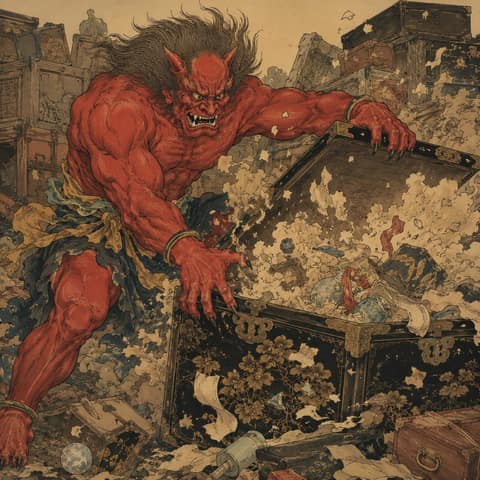
    In literature, Chinzuka Kaiō is known chiefly from Toriyama Sekien’s Hyakki Tsurezurebukuro image, with no concrete deeds or sayings recorded. The painting shows a strongly muscled, red-hued oni prying open a kara-bitsu chest as dust and paper scraps swirl. Sekien appended a note calling it the “chief of the mountain hags formed from piled-up dust,” echoing the Noh play Yamanba’s line “clouds’ dust piles up and becomes a mountain hag.” However, no tradition directly links this yokai to Yamanba, leaving its placement ambiguous. Similar images appear in Meiji-era copies and anonymous picture scrolls, sometimes renamed as “kaiki” (monstrous oni). Since the Heisei era, some explain it as “king of dust and garbage tsukumogami,” but this is a later interpretation without proof in older sources. Iconographically, it is viewed as an early modern creation merging the “splitting the treasure chest” motif from Night Parade of One Hundred Demons scrolls with phrasing quoted from Essays in Idleness.

  • Elder Shamisen

    Elder Shamisen

    Rare

    SHAH-mee-CHOH-loh

    Sekien Zue Version

    Animated Objects & UndeadEdo period

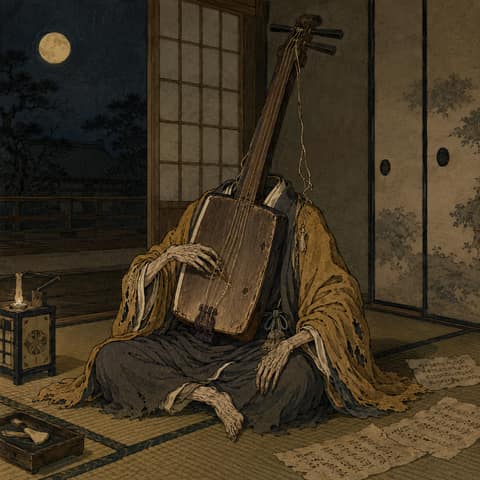
    An interpretation grounded in the pictorial tradition of Toriyama Sekien’s Hyakki Tsurezure-bukuro. A shamisen that has gained a soul through long use is depicted like an aged monk, with robe-like garb and staff-like fittings. It plays on the proverb “a novice cannot leap straight to elder,” reinforcing the lesson that one must advance step by step in the arts, and it also cautions against mistreating tools. Similar images appear in Tsukioka Yoshitoshi’s prints, and later yokai encyclopedias introduce it as a representative tsukumogami. Lacking many named folktales, it spread chiefly through paintings and printed books.

  • Enkou

    Enkou

    Rare

    enkou

    The Hairy Kappa of Nanyo: Enkou

    Water YokaiEhime

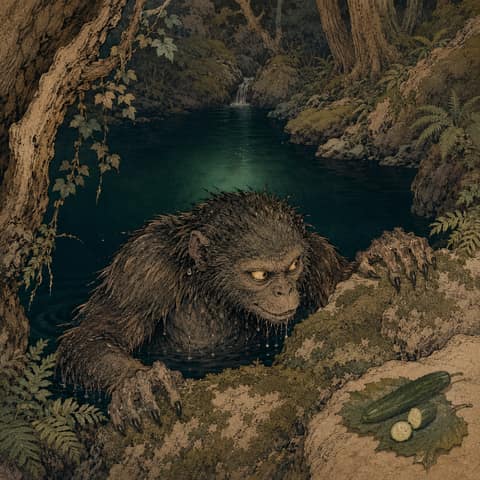
    The *Enkou* is a representative variant from the Nanyo region, illustrating how the entity known as the *kappa* was spoken of with different forms and names depending on the region. Neither the dish nor the shell is prominent; instead, emphasis is placed on its hairy, monkey-like body, agile swimming, and its habitat in the deep pools of rivers. This image is formed by overlapping with the ecology of an actual beast, the Japanese river otter (*oso*). The legend of Mima Mugiusubuchi features the standard elements of *kappa* tales, such as sumo, cucumbers, *shirikodama*, and horse-pulling, while possessing a localized ending where it is tied to a stone mortar by a monk from Mantoku-ji Temple and reforms. 'Osogoe' on the Sadamisaki Peninsula and the Enkou Festival in Yawatahama convey that this water monster still breathes within place names and annual events today.

  • Eye Standoff

    Eye Standoff

    Rare

    MEH-koo-RAH-beh

    Sekien Iconography Standard

    Ghosts & SpiritsHyogo

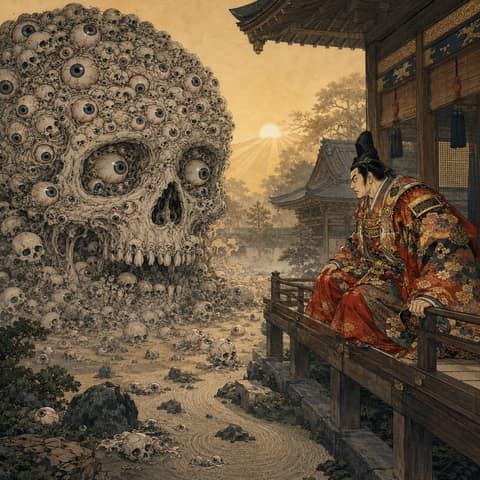
    An image systematized from Toriyama Sekien’s iconography and the Heike Monogatari’s accounts of the uncanny. Multitudes of bones unite into a single giant skull, its countless sockets facing the living as if to pierce them. Individual dead bear no names; their fused gaze is read as a trial of the powerful. It appears most at daybreak or in hushed gardens, amplifying fear through sheer visual pressure. The countermeasure is to hold steady and return its gaze. Ritual banishments are poorly attested, and some speak of it as a kind of psychic vision. Said to be memory given form from mass deaths in war and upheaval, its size shifts with the onlooker’s nerve.

  • Fire-Quenching Crone

    Fire-Quenching Crone

    Rare

    hee-KEH-shee-bah-bah

    Sekien Iconography Edition

    Half-Human BeingsEdo

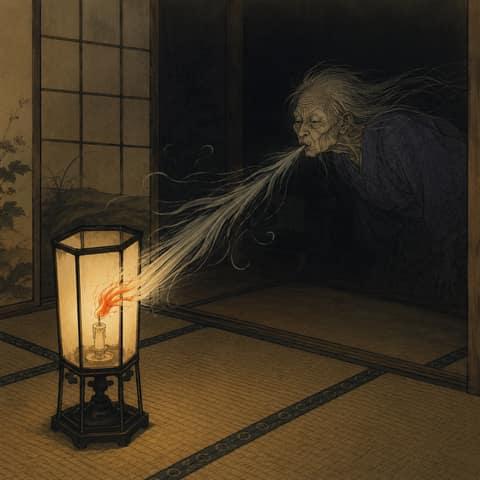
    Anchored in Toriyama Sekien’s depiction of an old woman, this reading frames her as a being that bears Edo-period anxieties about fire use and the terrors of night. Fire was believed to purge impurity with a yang nature, yet accidental blazes became great calamities, so lamplight was strictly managed. The Fire-Dousing Crone personifies an “invisible hand” that presses upon daily vigilance. When a lamp at a banquet or in an inn’s parlor goes out, the event is narrated not as neglect or misfortune but as yokai intervention, symbolically restraining the vigor of flame. Sources vary on the name—“Fukkeshi,” “Fukikesh(i)”—all deriving from the act of blowing out a light. No tutelary deity or local origin tale is attached; references are mostly secondary, and in folklore taxonomy she sits as a variant of “lamp-light apparitions” or “parlor-room ghosts.”

  • Five-Limbed Face

    Five-Limbed Face

    Rare

    goh-tai-MEN

    Iconographic Tradition Version

    Mountain & Wilderness SpiritsJapanese folklore

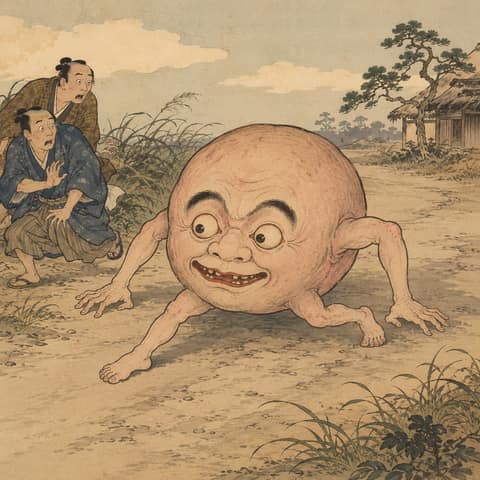
    A version based on the recurring grotesque motif in Edo-period yokai picture scrolls: a head with limbs attached directly to it. Many sources lack captions, and names vary, such as “Gotaimen” and “People of the Lower Country.” The figure often stands bowlegged and sidesteps, heightening visual dissonance and comic effect. Folklorists debate whether such visual oddities caricature social decorum and misalignment, yet no direct oral tradition is recorded. This version prioritizes the repetition of the image and the spread of names, avoids attaching behavior or powers, and limits the setting to generic outdoor scenes. Later studies and commentaries are consulted, but attributes beyond primary sources are not added.

Showing 1 - 24 of 112 yokai