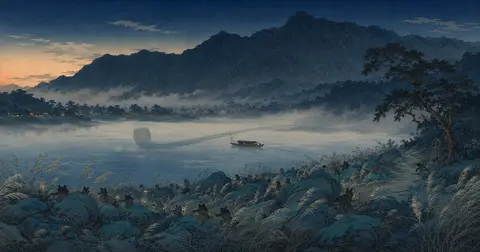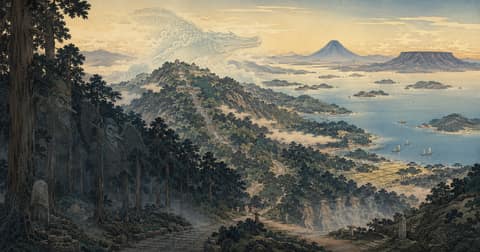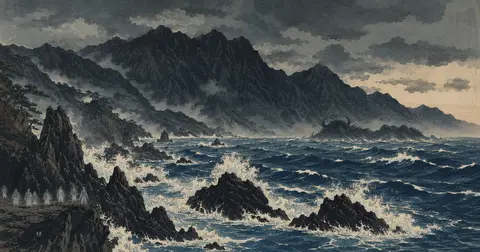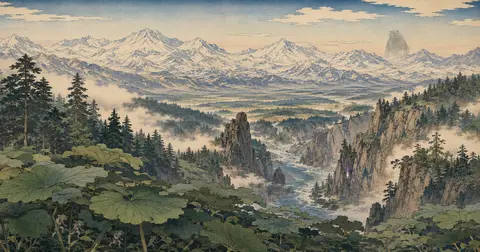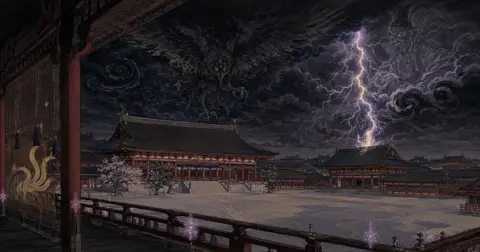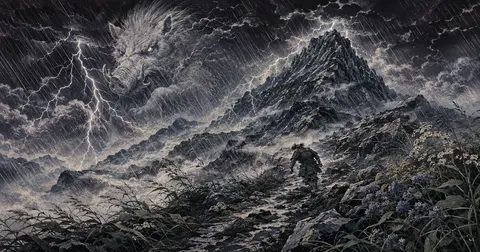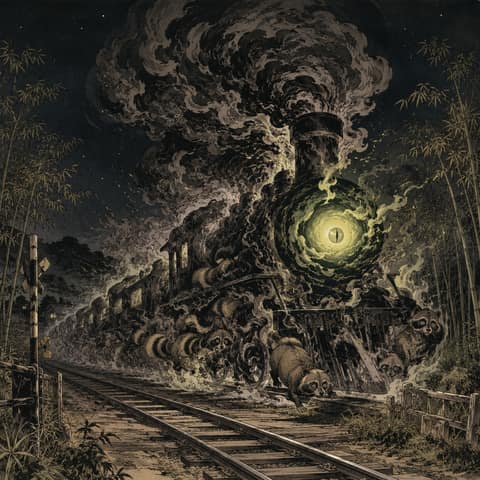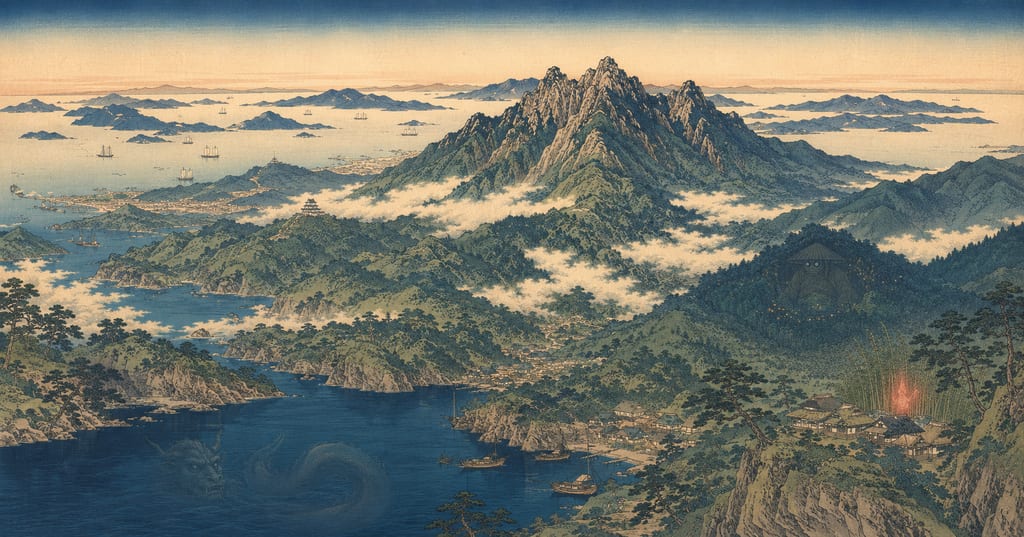
Ehime—formerly known as Iyo Province. Embraced by the Seto Inland Sea and the Uwa Sea, it is backed by the steep peaks of the Ishizuchi Mountain Range, which includes Mount Ishizuchi, the highest peak in western Japan. Since ancient times, this land has been perceived as a continuous spiritual domain connecting the sea and the mountains. On Omishima, an island floating in the Seto Inland Sea, rests the grand head shrine of the nationwide Oyamatsumi and Mishima faiths, while along the Uwa Sea coast in Uwajima, giant demon-cows with long necks parade through summer nights. In the deep mountain grottos of Kuma, the patriarch of bake-danuki (monster raccoons) is said to dwell with his 808 followers, and on the railways of the Meiji era, phantom steam trains would appear only to vanish moments before collision.
The single thread running through the anomalies of Iyo is the flow of people between the sea and the mountains. Naval forces crossing the waters, ascetics treading the sacred peaks, and festival demons running through the towns—Ehime's yokai stand on these very boundaries. From mountain and sea gods elevated to divine status, to possessing spirits reflecting the dark side of lineages, and bake-danuki transforming into modern trains, the anomalies of this land can be read as an unbroken path from antiquity to the modern era. This article walks that path as far as historical records permit, carefully distinguishing speculation from corroborated fact.
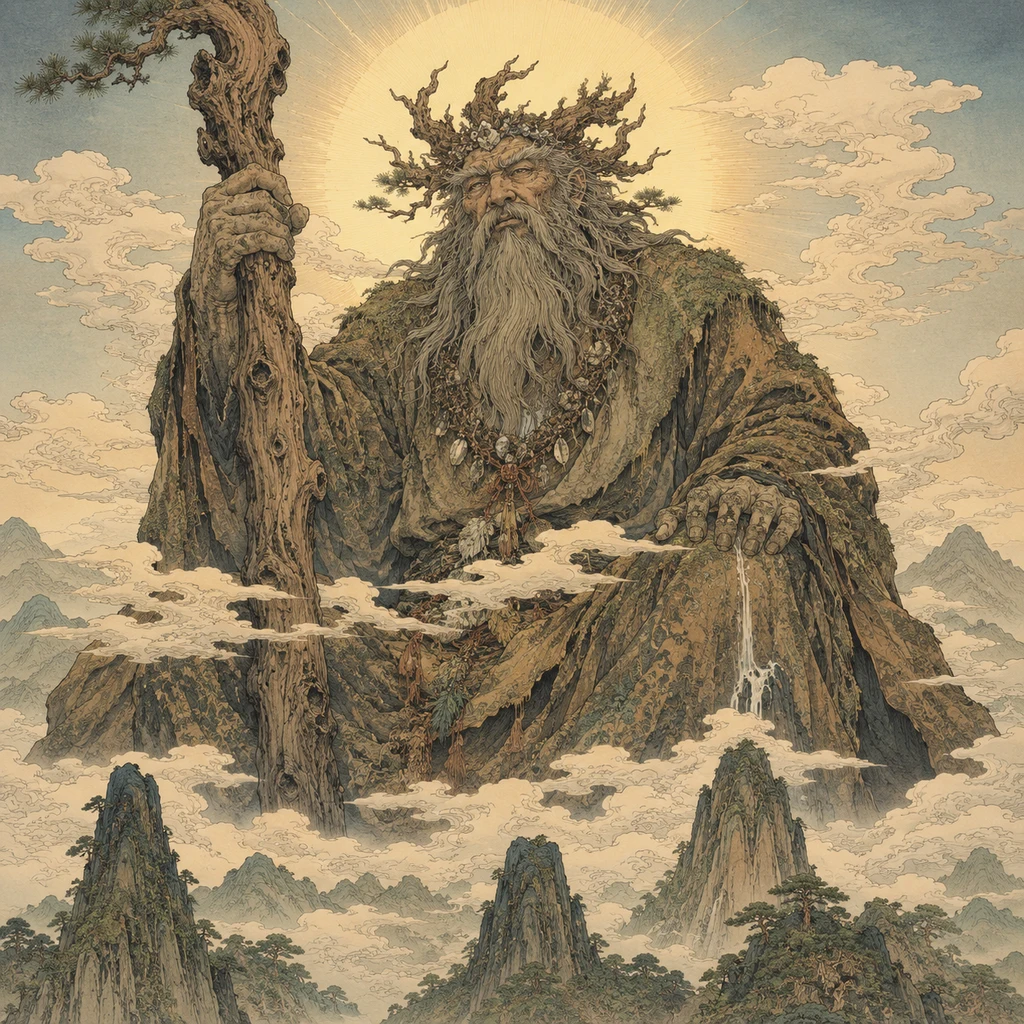
Oyamatsumi
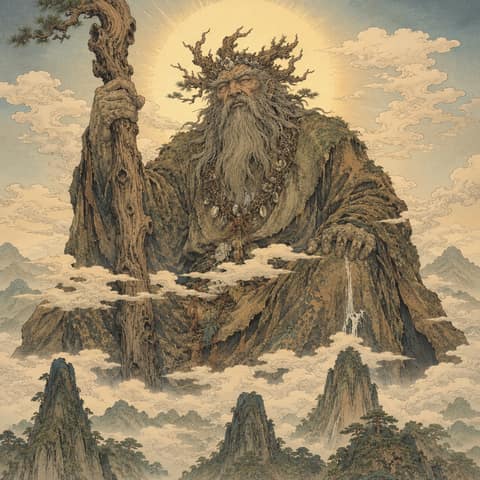
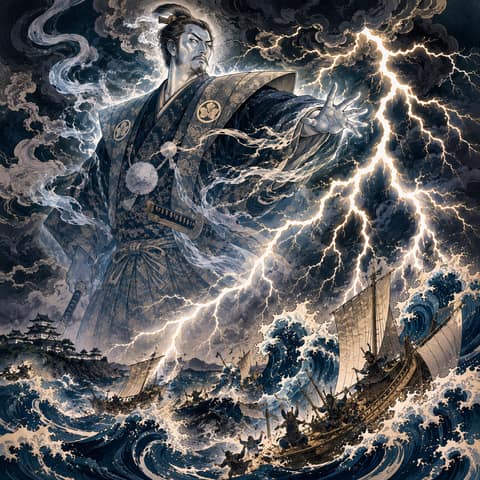
Oyamatsumi-no-kami is the great god of mountains in Japanese mythology, born from the "kamiumi" (birth of the gods) by Izanagi-no-mikoto and Izanami-no-mikoto. The "O" in his name is an honorific, "yama" means mountain, and "tsumi" means divine spirit, designating him as the supreme deity who governs vast mountain ranges in their entirety. In myth, he is also known as the father of Konohanasakuya-hime (who married the Heavenly Grandson Ninigi-no-mikoto) and her elder sister Iwanaga-hime. The choice he presented regarding his two daughters serves as an important origin myth explaining why human life is finite (short-lived). However, in folklore and historical tradition, he is far more than a mere mountain god; he possesses a highly multifaceted character as a god of the sea, agriculture, and warfare. He is widely worshipped nationwide as a presence that embodies Japan's ancient view of nature.
Read moreTwo Seas and a Sacred Peak:
The Land of Iyo
Before delving into the main subject, it is essential to outline the contours of the land of Iyo. Yokai are born from the land itself. Without understanding the topography and history a region bears, one cannot truly interpret its anomalies.
Ehime occupies the northwestern part of Shikoku. To the north, it faces the Seto Inland Sea, stretching from the Hiuchi-nada and Itsuki-nada seas toward Bingo and Aki provinces, while to the west it looks out over the Bungo Channel, opening toward Kyushu, and the embracing Uwa Sea. In the center of the prefecture rises Mount Ishizuchi (1,982 meters), the highest peak in western Japan, which has gathered ascetics since ancient times as a sacred mountain of Shugendo. The Seto Inland Sea side is a calm archipelago, dotted with the islands of the Geiyo chain. Meanwhile, the Uwa Sea side features a continuous, intricate ria coastline, where deep bays and sheer terrain have nurtured a unique maritime village culture.
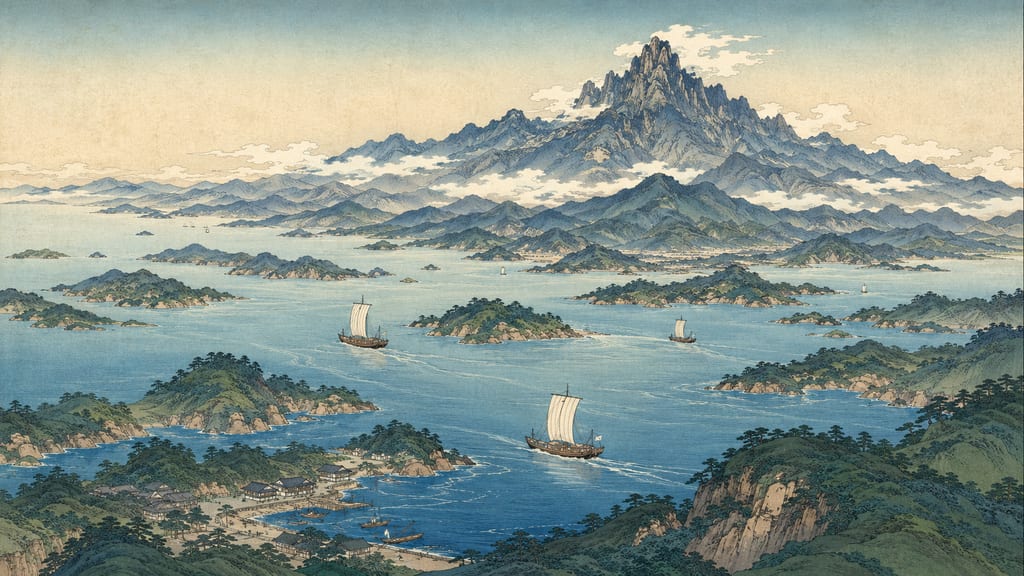
This three-part geography—"Seto Inland Sea, Uwa Sea, and Ishizuchi"—divides the yokai of Iyo into three distinct lineages. The islands of the Seto Inland Sea are home to divine anomalies tied to naval faith, the Uwa Sea coast harbors giant sea monsters feared by fishermen, and the mountain villages of the Ishizuchi range are inhabited by possessing spirits and phantom mountain birds. Furthermore, in the early modern castle town of Matsuyama, a culture of bake-danuki deceiving people flourished right alongside human society. These three faces of Iyo—sea, mountain, and town—map directly onto its yokai landscape.
In addition, one must not overlook that Iyo has been a vital hub for the movement of people and culture since antiquity. The Seto Inland Sea has long been a major artery connecting the Kinai region (capital area) with Kyushu and the Asian continent. Positioned midway along this sea route, Iyo absorbed both capital culture and continental faiths through the ocean. In the Middle Ages, maritime forces like the Murakami Suigun held hegemony over the seas, and in the early modern period, the Uwajima and Matsuyama domains built thriving castle towns. These multiple layers of human endeavor have accumulated memories of anomalies in the land. Let us begin by looking at the sea, starting with the highest-ranking entities elevated to divine status.
The Mountain God Crossing the Sea:
Oyamatsumi of Omishima
When discussing the anomalies of Ehime, one must first revere a god, not a yokai. On Omishima, an island floating in the Geiyo chain of the Seto Inland Sea, rests the Oyamatsumi Shrine[1], the grand head shrine for approximately 400 Mishima and Oyamatsumi shrines nationwide. Serving as the Ichinomiya (highest-ranking shrine) of Iyo Province, it is an ancient sanctuary granted the exceptional title of "General Guardian of Japan" by the Imperial Court[2].
In the mythologies of the Kojiki and Nihon Shoki, Oyamatsumi is a mountain god born during the divine procreation of Izanagi and Izanami, and is the father of both Konohana-sakuya-hime, who married the heavenly grandson Ninigi-no-Mikoto, and her elder sister Iwanaga-hime[3]. Because Ninigi-no-Mikoto only married the beautiful younger sister Sakuya-hime and returned the ugly elder sister Iwanaga-hime, the descendants of the heavenly grandson—humanity—who rejected the eternal life symbolized by Iwanaga-hime, were destined to have lifespans as fleeting as blossoms. In this famous origin myth, it is Oyamatsumi who offered his two daughters. From the earliest stages of mythology, he has been a solemn deity standing at the crossroads of life and death, eternity and impermanence.
However, the core of his worship on Omishima lies in the fact that this deity is revered not merely as a mountain god, but simultaneously as a god of the sea and martial prowess. Shrine legends state that Oyamatsumi's descendant, Ochi-no-Mikoto, crossed over to Futana-shima (Shikoku) in Iyo prior to Emperor Jimmu's eastern expedition. While protecting the safety of the Seto Inland Sea, he designated Mishima (Omishima) as sacred ground and enshrined the god there[2]. The very origin of being enshrined on an island as a protector of maritime safety speaks to this deity's nature as a sea god. Because mountains were used as navigational landmarks in the Seto Inland Sea, the mountain god gazed upon from the waters doubled as the guardian deity of voyages. The deep devotion shown by Iyo's maritime clans (such as the Ochi and Kono families) stemmed from this ancient perspective that "mountain and sea form a continuous spiritual domain."
This view of nature propelled Oyamatsumi Shrine into a major center of warrior faith. During the Middle Ages, when those who controlled the Seto Inland Sea controlled the realm, warriors nationwide—from the Minamoto and Taira clans to other warlords—dedicated armor and swords to pray for victory. It is said that the shrine's treasury still houses roughly 40% of Japan's armor and weaponry designated as National Treasures or Important Cultural Properties[4]. The fact that a single shrine holds four-tenths of the nation's national-treasure-class armaments speaks volumes about how deeply it attracted the reverence of martial figures.
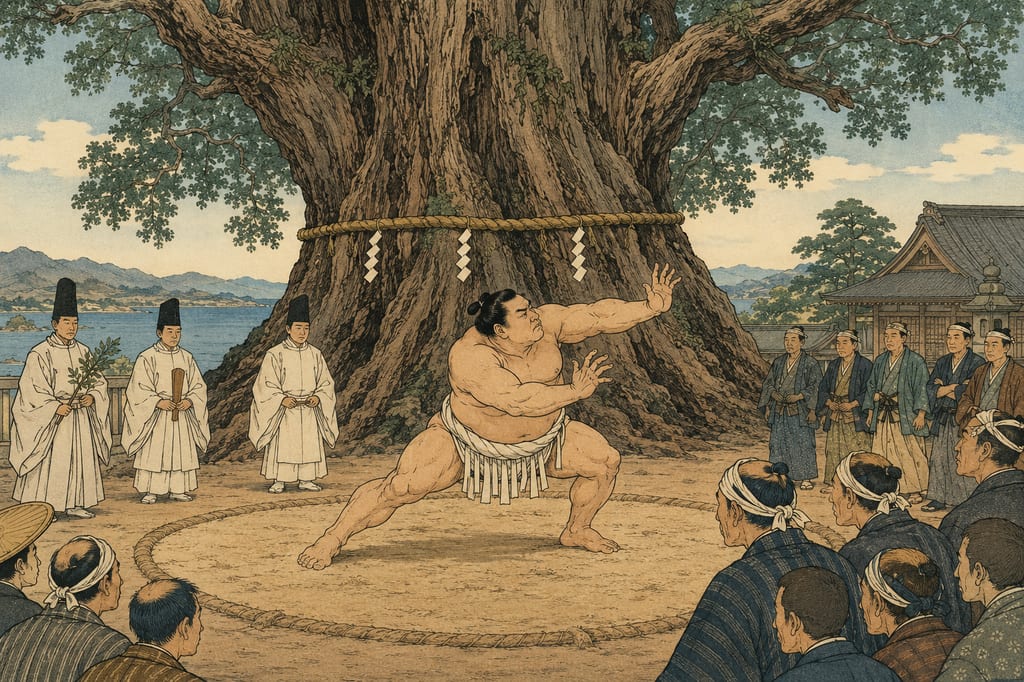
The forms of prayer here are also unique. In front of the main shrine stands a giant camphor tree estimated to be over 2,600 years old, said to have been planted by Ochi-no-Mikoto himself, and the surrounding primeval camphor forest is designated as a National Natural Monument. During the rice-planting and harvesting festivals, a ritual called Hitori-zumo[5] (one-man sumo) is dedicated, wherein a single wrestler grapples with the invisible spirit of the rice plant. The wrestler engages in a best-of-three match with the unseen spirit, orchestrated so that the spirit wins twice—if the spirit is victorious, a rich harvest is assured. This sacred ritual of taking on an invisible opponent and purposely losing to pray for a good crop beautifully encapsulates the mindset of Iyo, which takes coexistence with the otherworldly as a given. From these divine heights, let us finally descend into the world of Iyo's true anomalies.
The Two Great Monsters of the Uwa Sea:
Ushi-oni and Umibozu
The Uwa Sea coast, centered around Uwajima, is another heartland of Ehime's yokai culture. Its complex ria coastline, deep bays, and the maritime village lifestyle built on fishing provided ideal soil for nurturing sea anomalies.
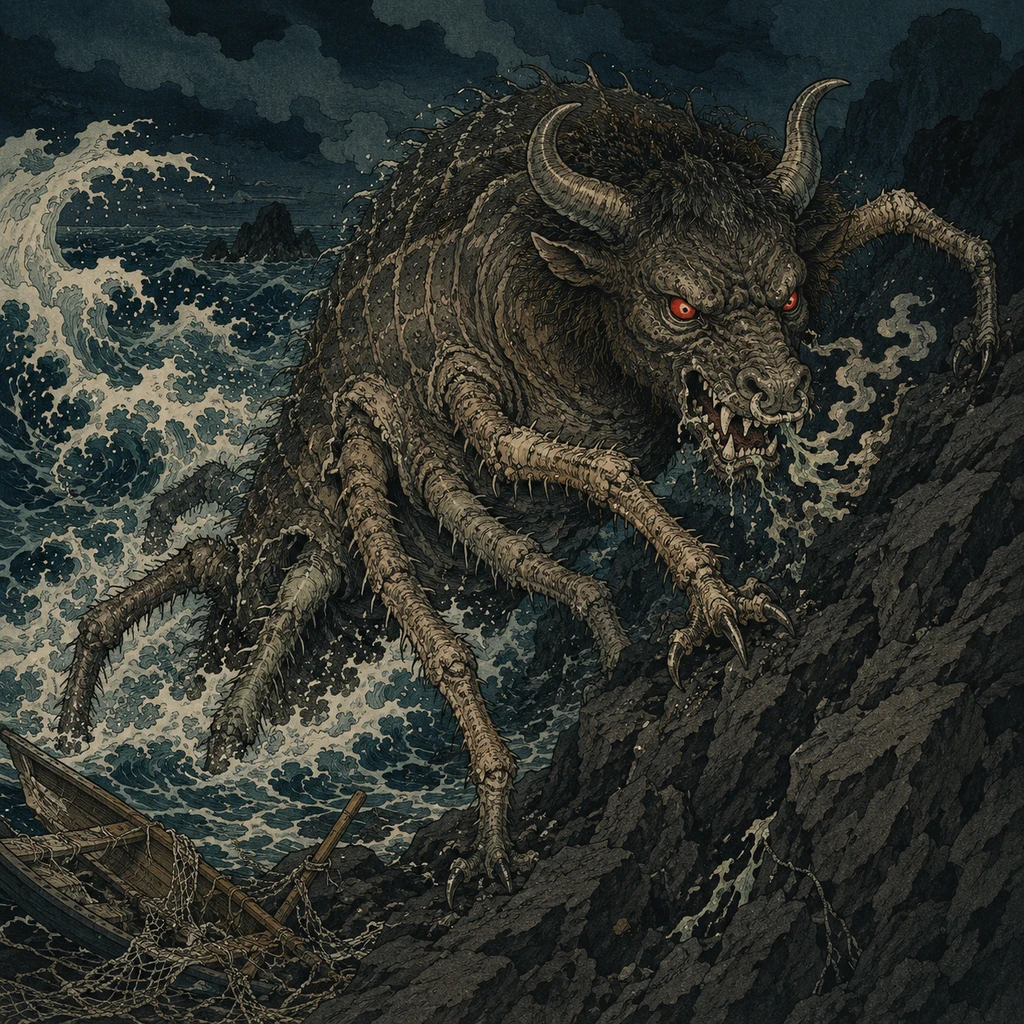
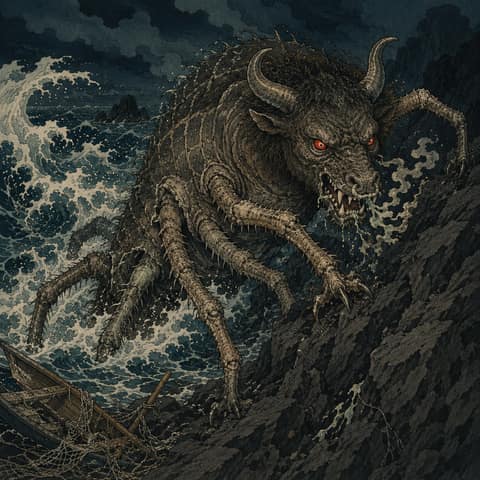
The representative sea monster of Iyo is, without a doubt, the Ushi-oni (ox demon). Described in grotesque forms—a demon's body with an ox's head, or a spider's body with an ox's neck—it is one of western Japan's most notorious fiends, listed as early as the Heian period in *The Pillow Book*[6] under "terrifying things." Frequently appearing in medieval literature, it was dreaded across various regions as an indiscriminate man-eater and a plague god spreading toxic miasma. Yet in Uwajima, this raging demon has dramatically transformed into the star of a festival. This is the most crucial point when discussing the Ushi-oni of Iyo.
Uwajima's Warei Taisai[7] is the summer festival of Warei Shrine, which enshrines Yanbe Seibei—a chief retainer of the Uwajima domain who met a tragic, untimely death amidst political strife. It is said to have begun when the first domain lord, Date Hidemune, built the shrine to appease Seibei's spirit and held a grand festival in the second year of Joo (1653); it is now celebrated in late July (a month late by the lunar calendar)[7]. Elevating a wrongfully slain dead person to a god is itself a classic example of Goryo (vengeful spirit) worship, much like that of Sugawara no Michizane or Taira no Masakado. And the centerpiece parading through the town during this festival is the giant, long-necked Ushi-oni float (*nerimono*).
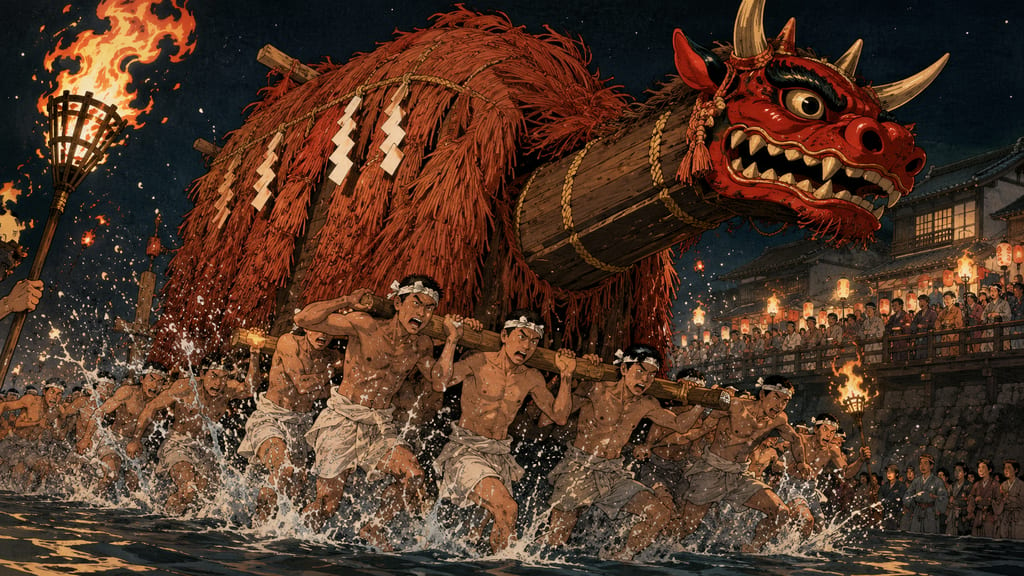
Regarding the origin of the Ushi-oni float's design, a local theory suggests it dates back to the "turtle shell chariots" devised by Kato Kiyomasa during Toyotomi Hideyoshi's invasions of Korea, which were later introduced to Uwajima by Todo Takatora, the founding lord of the Uwajima domain. These were siege weapons consisting of sturdy wooden boxes covered in ox hide, with a real ox's severed head hoisted on a pole. However, it must be noted that this is merely a legend and not an established historical fact. What is certain is that the demon-cow, expected to ward off plagues and evil spirits, has become the symbol of Uwajima summers—especially during the heroic "hashirikomi," where portable shrines that have crossed the sea charge vigorously into the Suga River in front of Warei Shrine. The logic of Goryo worship—that the most ferocious entities make the strongest guardians once properly enshrined—lives a double life here, applying both to the enshrined Yanbe Seibei and the festival's star, the Ushi-oni.
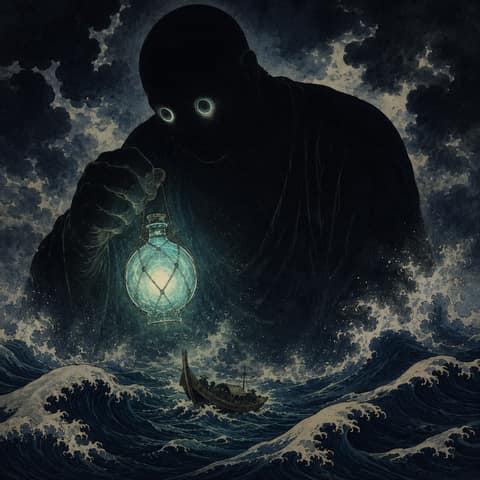
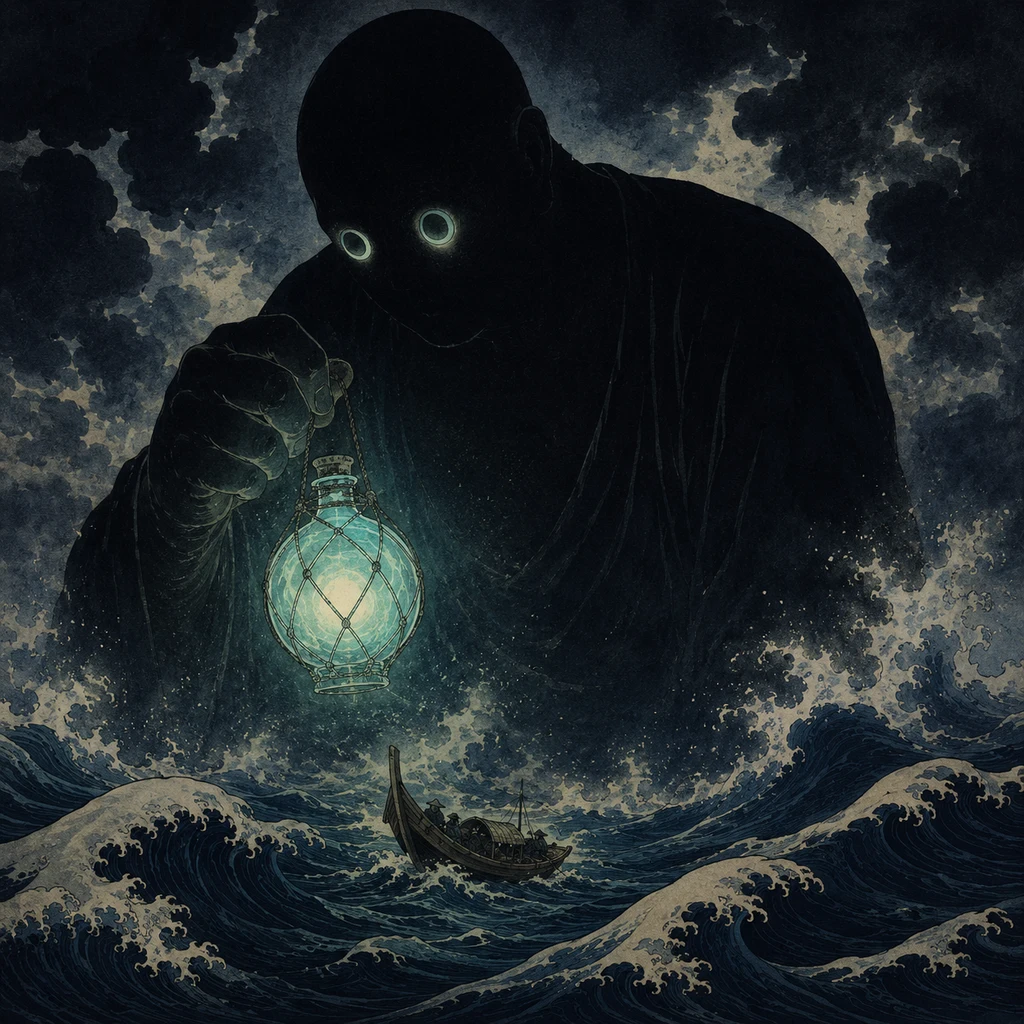
The other giant sea monster is the Umibozu (sea monk). The calm surface of the sea suddenly swells, and a colossal, black, bald-headed figure blocks the path of ships. Mentions of this colossal sea entity can be found in Edo-period documents such as the *Wakan Sansai Zue*[8] (1712), and legends of it are widely distributed among fishing villages nationwide, from the Goto Islands to Ehime, Okayama, Tottori, Wakayama, and Miyagi. In Ehime as well, it was feared by the fishermen of the Uwa Sea.
The Umibozu passed down in Ehime features a narrative motif where it demands, "Lend me a dipper." The Umibozu asks for the dipper claiming it "wants to drink water," but if handed over honestly, it uses the dipper to bail seawater into the boat to sink it. There is only one way to escape: hand it a dipper with the bottom knocked out. No matter how much it scoops, the water simply falls through, preventing the Umibozu from sinking the ship. This motif of quick-wittedness is shared with Umibozu tales from regions like Tsushima, and the fishermen's wisdom in outsmarting sea monsters with human intellect forms the core of the story. On the other hand, in Oshima of Ochi District, an Umibozu that challenges fishermen to sumo wrestling—much like a kappa—has been recorded, showing that a monster of the same name can wear different faces depending on the specific region within Ehime.
Rather than a yokai with a clearly defined outline, the Umibozu should be described as the "bottomless terror of the sea itself" manifesting in human form. Theories explaining its true identity as the ghosts of the drowned or as fallen dragon gods and sea deities demanding sacrifices have been told precisely because of this boundless terror. The description of a calm sea suddenly swelling without warning perfectly mirrors the sudden squalls and high waves—the very mortal dangers fishermen faced daily. The Umibozu legends serve as a folkloric record that the rich fishing grounds of the Uwa Sea were simultaneously places intimately adjacent to death. Incidentally, while Toriyama Sekien did not draw the Umibozu itself, he included the Umi-zato (Sea Blind-monk)—a blind monk standing on the waves—in his *Gazu Hyakki Yagyo*, showing how the awe and fear of the sea repeatedly crystallized into images even in early modern yokai artwork.
Possessing Spirits of the Mountain Villages and the Fire-Breathing Phantom Bird
Turning our eyes from the sea monsters to the mountains, an entirely different lineage of anomalies breathes in the mountain villages of the Ishizuchi range. One is a possessing spirit that reflects the darkness of human society, and the other is a phantom bird that colors the bamboo groves at night.
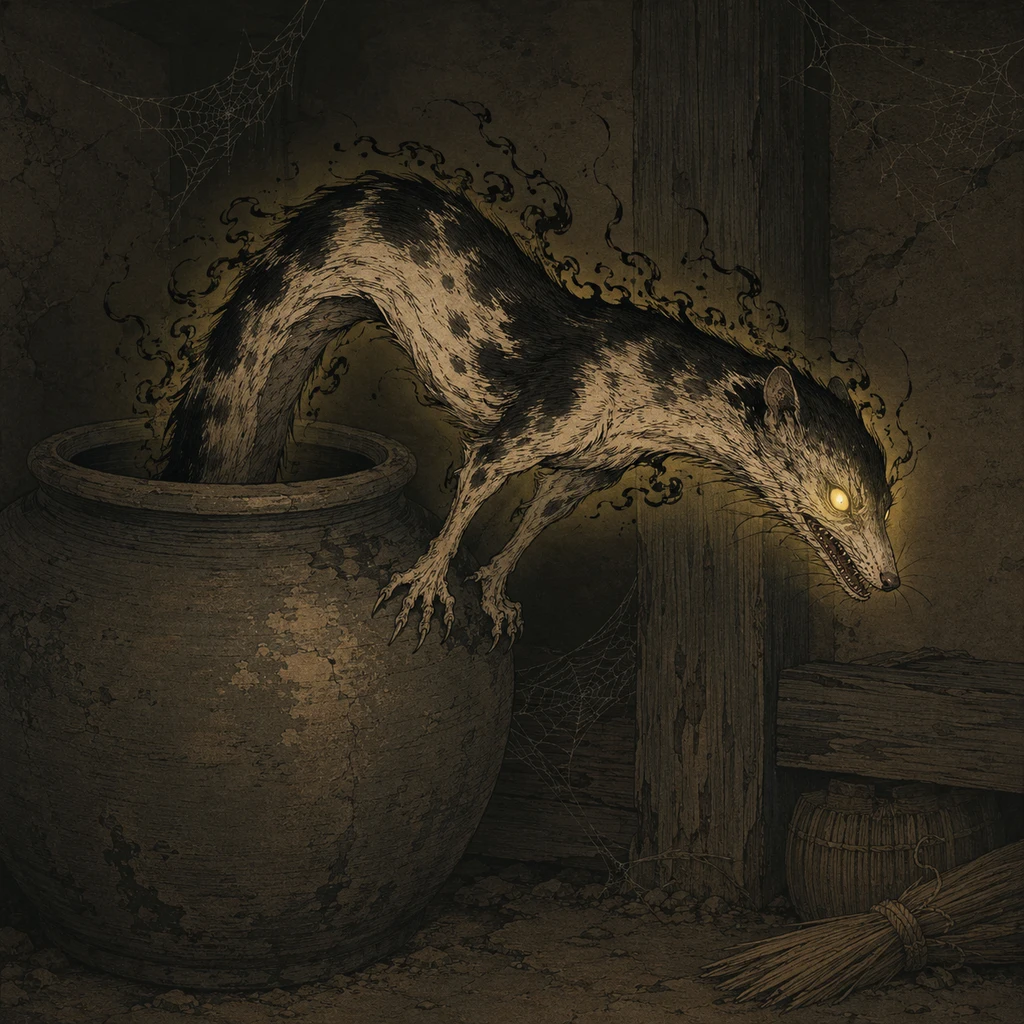
Shikoku is the heartland of Inugami (dog god) beliefs. Alongside Tokushima and Kochi, Ehime is also a land that speaks of Inugami—a possessing spirit similar to fox possession or kuda-gitsune (pipe foxes), yet considered even more powerful. The defining characteristic of the Inugami is that it was believed to possess family lineages rather than individuals. Families labeled as "Inugami lineages" were thought to harbor these spirits for generations, and the Inugami would allegedly read its master's intent to possess other families, causing illness and ruining their fortunes.
The problem lies in how this concept birthed severe social discrimination. Families branded as Inugami lineages had their backgrounds scrutinized during marriage proposals, and intermarriage was actively avoided[9]. In certain areas of Shikoku, it was considered standard practice to verify that a prospective partner's family was not an Inugami lineage before marriage—carrying a heavy social history deeply connected to buraku discrimination issues. Those possessed by an Inugami were said to exhibit symptoms like chest and limb pain, making dog-like sounds, and in some regions, fierce gluttony. It was believed that medicine could not cure them and that only prayers could exorcise the spirit. Kenmi Shrine in Tokushima is famous throughout Shikoku for warding off Inugami, and it is recorded that people traveled from Iyo specifically to have these spirits purged. Even in the Iyo villages at the foot of Mount Ishizuchi, interviews regarding Inugami possession have been the subject of folklore and psychiatric studies, documenting phenomena where possession manifested as personality alterations. There are superstitious tales detailing the spirit's creation—such as burying a starved dog's head at a crossroads to let the foot traffic amplify its grudge into a cursed object. However, one must note that these are retrospective narratives meant to explain the Inugami's origins rather than historical facts, serving instead a function to justify the discrimination against those labeled as Inugami lineages. The logic of village society, seeking to explain uneven distributions of wealth or the rise and fall of families, was simply projected onto the yokai known as Inugami. It is a sobering example of how the dark underbelly of a community is etched into seemingly quaint folk tales.
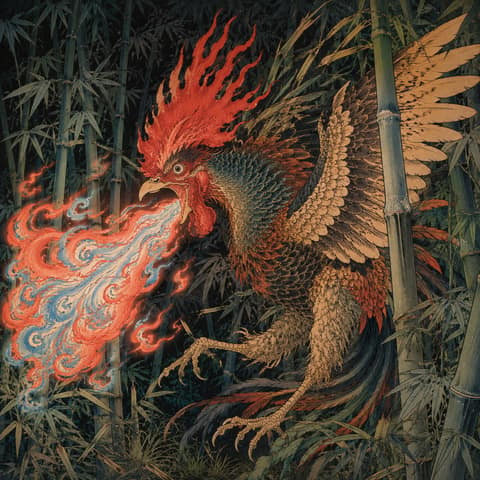
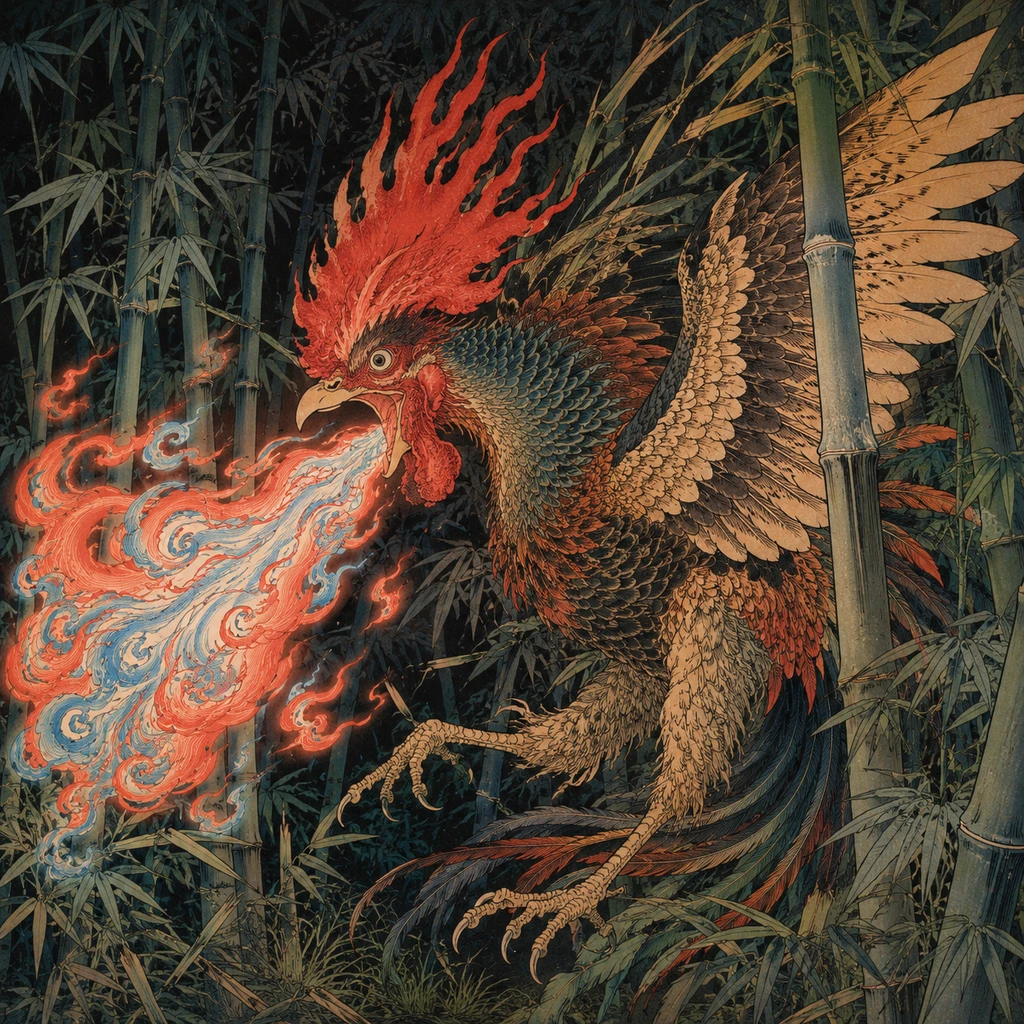
In stark contrast, almost entirely harmless and somewhat humorous is the Basan. This phantom bird passed down in Iyo is also known as Basa-basa or Inu-hoo (Dog-Phoenix). It sports a red crest and breathes bright red fire from its beak, but this flame is akin to foxfire—lacking heat and incapable of burning objects. Usually lurking in deep mountain bamboo groves, it rarely shows itself to humans, but occasionally flies into villages late at night, making a loud rustling sound, *basa-basa*. When people notice the noise and peek out their doors, it reportedly vanishes abruptly, leaving only the sound and the light behind. Because it causes no harm, the mountain villagers respected it as the work of the Basan but only ever drove it away. The names "Basan" and "Basa-basa" themselves are explained to derive from the sound of its wings.
This phantom bird became widely known because it was included in the *Ehon Hyakumonogatari (Tohoujin Yawa)*[10], published in the twelfth year of Tenpo (1841), featuring text by Tohoujin and illustrations by Takehara Shunsen. This collection of strange tales, often ranked alongside Toriyama Sekien's yokai illustrations, has influenced later yokai artists such as Shigeru Mizuki, passing on the Iyo illusion of a fire-breathing red chicken in a night-time bamboo grove to future generations along with its visual iconography.
What makes the Basan fascinating is that its core nature lies in "causing no harm." While many yokai injure humans or inflict curses, the Basan simply vanishes, leaving only the sound of its wings and cold fire. The fact that it dwells in bamboo groves—spaces forming the boundary between human settlements and the wild mountains—is also highly suggestive. Bamboo groves are intimately close to village life, yet at night they sink into darkness and repel human approach. Placing a harmless yet unidentified entity in the darkness of that boundary reveals the workings of the human mind, which could not help but interpret inexplicable noises and lights as "the doing of something." The fact that a harmless anomaly has been spoken of for so long, based solely on inexplicable wing flaps and fire, perfectly demonstrates the shapes human imagination gave to the darkness of the night in their purest form.
The Bake-danuki of Matsuyama Castle Town:
Inugami Gyoubu and the 808 Raccoons
Furthermore, one cannot discuss Ehime's yokai culture without mentioning the bake-danuki (monster raccoons) of Matsuyama. Shikoku is the heartland of tanuki—famous for the Awa Tanuki Battle—but Iyo Matsuyama was also a premier "Capital of Tanuki." Right next door to the human world of the castle town, it is said that these tanuki deceived people and, at times, protected the castle.
Inugami Gyōbu
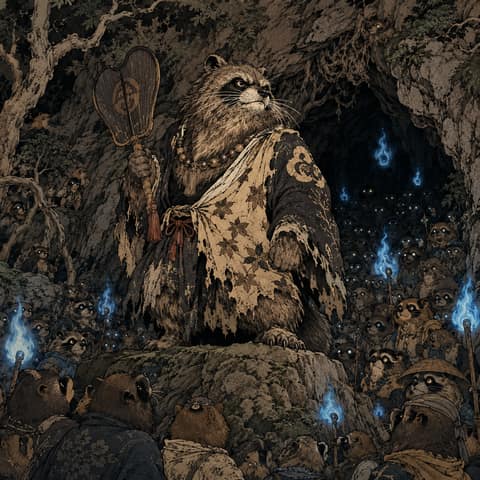
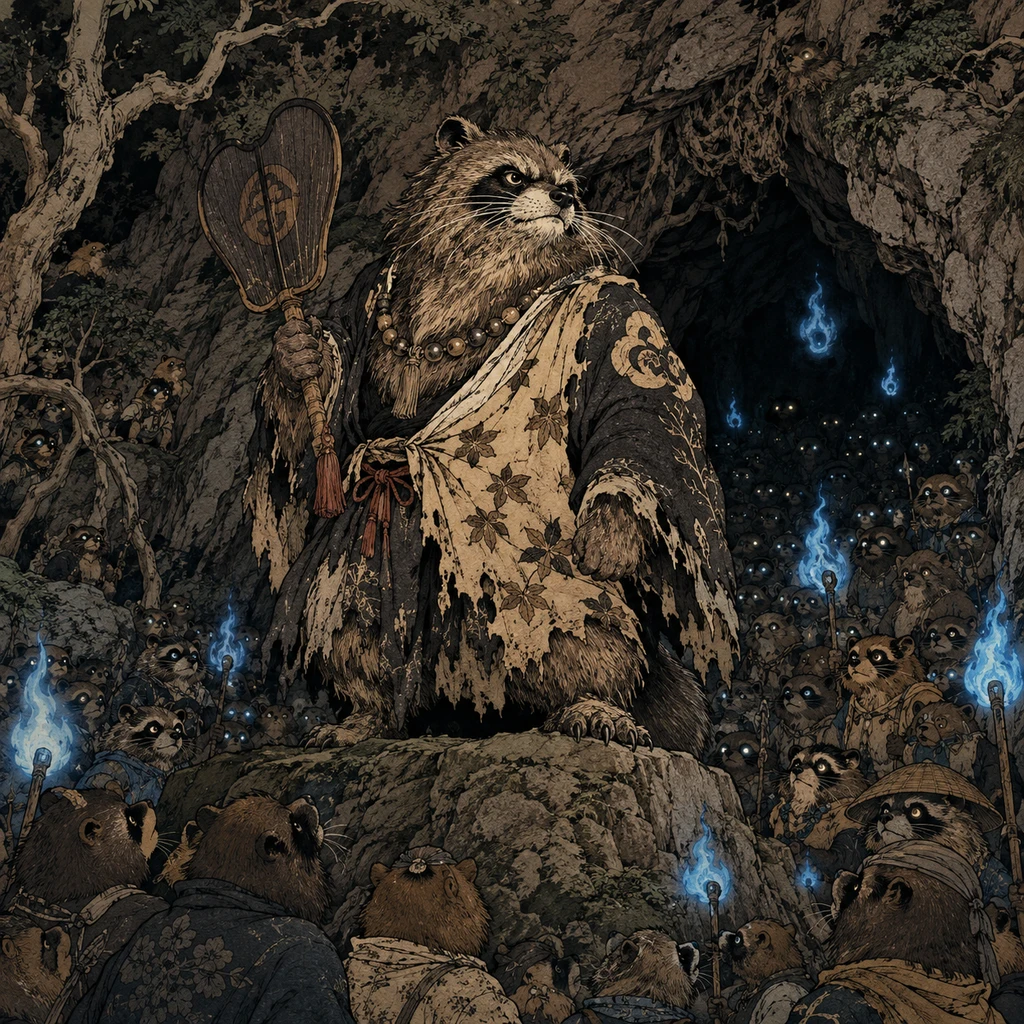
The chief of the shape-shifting tanuki in the Matsuyama region of Iyo. Said to dwell in a rock grotto on Mt. Kuma and to have acted as a guardian of Matsuyama Castle, he commands as many as 808 followers. The title “Gyōbu” was reportedly bestowed by the castle lord’s ancestor, and townspeople and retainers revered him. Popularized in late Edo-period storytelling, he appears in The Tale of the 808 Tanuki of the Matsuyama Disturbance as the tanuki leader who works sorcery and causes wondrous phenomena.
Read moreTheir patriarch is Inugami Gyoubu. Residing in an ancient grotto in the Kuma Mountains, he was said to protect the Matsuyama castle town while leading 808 followers, and from this number, they are also known as the 808 Bake-danuki[11]. He is an elite bake-danuki, counted among the Three Great Tanuki of Japan alongside Danzaburou Danuki of Sado and Shibaemon Danuki of Awaji. It is surely no coincidence that all Three Great Tanuki appear in places like islands or castle towns—lands where the sea and human society intersect. The title "Gyoubu" is said to be connected to the lords of Matsuyama Castle, and legends say he was revered by the townspeople as a sacred beast protecting the stronghold.
However, one must not overlook that his figure is less of an ancient, simple folktale and more of an exaggerated narrative expanded during late-Edo period *kodan* (storytelling), based on family turmoil within the Matsuyama domain during the Kyoho era. In the story, the bake-danuki Inugami Gyoubu intervenes with illusions in the political strife surrounding the embezzlement and tyranny of the domain's senior retainers, causing a series of castle-shaking supernatural events. In response, domain samurai Ino Budayu, blessed with a divine staff from Usa Hachiman, admonishes Gyoubu and ultimately seals him and all 808 tanuki inside the Kuma Mountain grotto—a widely known plotline[11]. Budayu, of course, is the figure known from Hiroshima's ghost story *Ino Mononoke Roku* as the fearless boy who remained unfazed by consecutive nights of yokai, appearing here once again as a hero who pacifies monsters. The foundation of this narrative is said to be the 1805 historical record *Iyo Nagusa*, which was later reworked by the late-Edo storyteller Tanabe Nanryu into the tanuki and yokai tale *Matsuyama Sodo Happyakuya-danuki Monogatari*[11].
In other words, the tale of Inugami Gyoubu is a legend with a thick layer of fiction—composed of a core of historical family strife covered in many layers of narrative storytelling flesh. There are numerous variant accounts regarding Budayu's involvement or the circumstances of the sealing, and the line between historical fact and fiction is no longer clear. Nevertheless, the grotto in the Kuma Mountains where they were reportedly sealed is still enshrined today as Yamaguchi Reishin in Kutani, Matsuyama City, drawing worshippers. Stories invite telling, telling creates sacred sites, and sacred sites gather faith—the very process of how yokai take root in a land can be observed right here.
The lore of bake-danuki did not vanish as the modern era arrived. Instead, it survived by taking the form of new technological conveniences. The prime example of this is the Phantom Train.
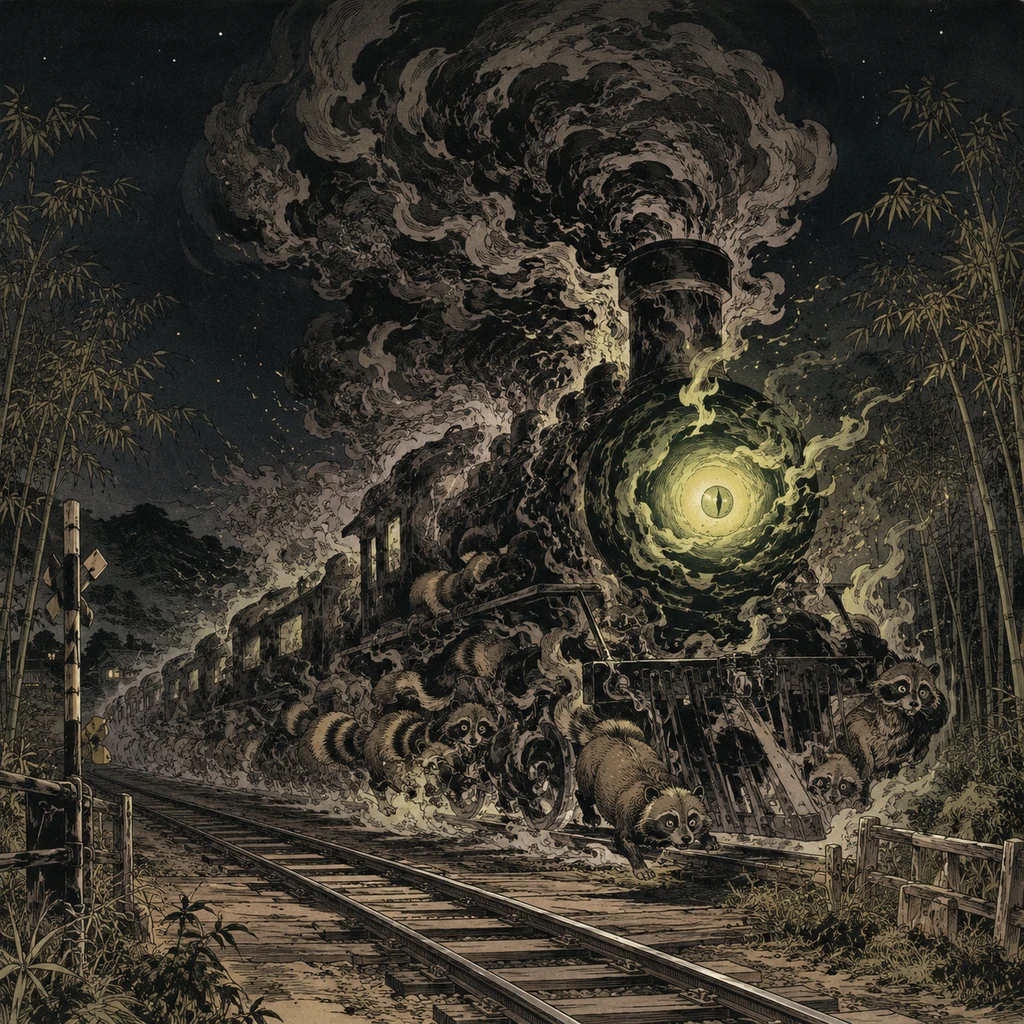
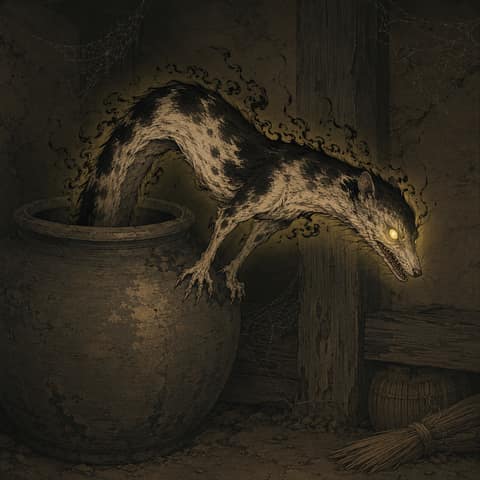
During the Meiji era, as steam locomotives proliferated across the country, tales of non-existent trains approaching on the tracks and vanishing just before a collision began to spread in various regions. Most were interpreted as foxes, raccoons, or especially badgers (mujina) shapeshifting into trains to bewilder people, often accompanied by a plotline where the mangled corpse of a beast is found beside the tracks after the train disappears. The folklorist Kunio Yanagita positioned these phantom trains as an extension of the folklore that attributed inexplicable mountain sounds to tanuki, treating them as analogous examples of tanuki imitating the sound and appearance of night trains to trick humans. Miyoko Matsutani pointed out that there were no stories of tanuki being run over during the early days of railways when foreign engineers drove the trains; phantom train tales only emerged after Japanese engineers took over from the 12th year of Meiji (1879) onwards, suggesting that these anomalies were born in tandem with the domestication of the technology.
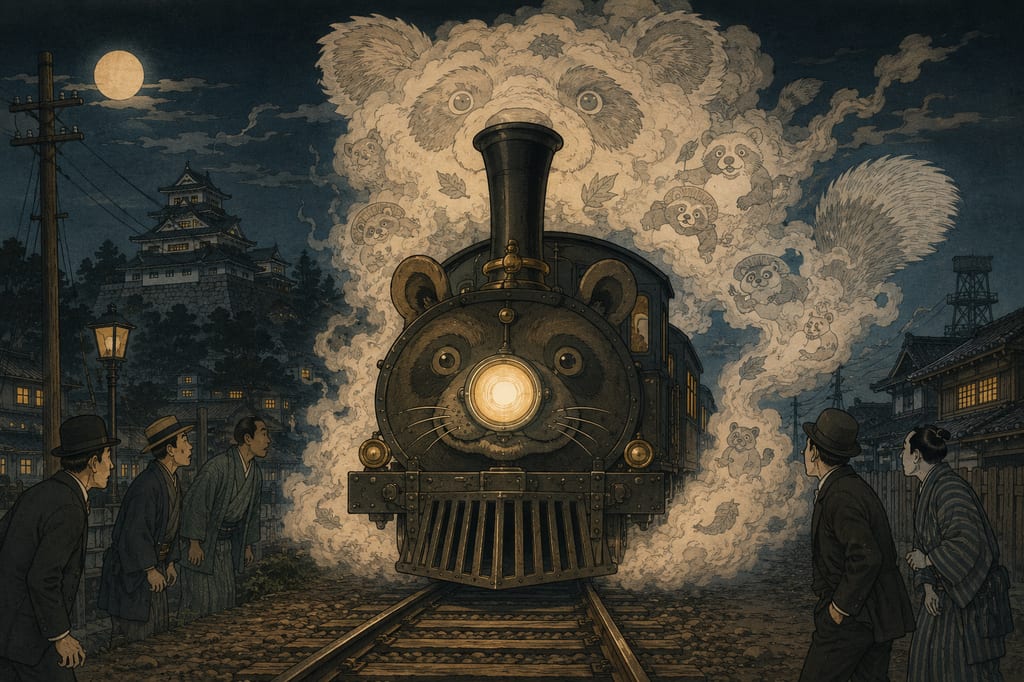
In Iyo Matsuyama, this phantom train was also incorporated into the tanuki culture. A story exists within Matsuyama's tanuki legends about Bishamon-danuki, who shapeshifted into the light railway famous from Natsume Soseki's novel *Botchan*—the so-called "Botchan Ressha"—to startle passersby. True to the capital of the 808 Bake-danuki, even the modern railways symbolizing civilization and enlightenment became a stage for tanuki. The folkloric imagination that perceived novel sounds and sights as the transformations of beasts assimilated the unknown entity of the train into the familiar framework of tanuki anomalies. The phantom train is a peerless example demonstrating how traditional yokai perspectives digested the modern era.
Conclusion:
Iyo's Anomalies Standing Between Sea and Mountain
From the sea god of Omishima and the demon-cow of Uwajima, to the Umibozu of the Uwa Sea, the Inugami and fire-breathing phantom bird at the foot of Mount Ishizuchi, and the bake-danuki of the Matsuyama castle town—Ehime's yokai were born where the two seas of Seto and Uwa intersect with the deep mountains towering behind them. Naval forces used the mountains as navigational marks, ascetics walked the sacred peaks, festival demons ran through the towns, and tanuki transformed into modern trains. Precisely because this land has seen an unceasing flow of people between the sea and the mountains, such an incredibly diverse cast of yokai was nurtured, ranging from anomalies elevated to divine status to possessing spirits reflecting the darkness of family lineages and bake-danuki that swallowed the wave of modern civilization.
These anomalies are not mere superstitions of the past. Gods still dwell in the camphor forests of Omishima, Ushi-oni parade through the town during Uwajima's summers, and bake-danuki are still enshrined in the Kuma grottos, drawing worshippers. Changing their forms, the yokai of Iyo continue to breathe in this land to the present day as mirrors reflecting its rugged history, geography, and the lives of its people. The anomalies standing between the sea and the mountains will undoubtedly remain a part of Iyo's landscape for generations to come.