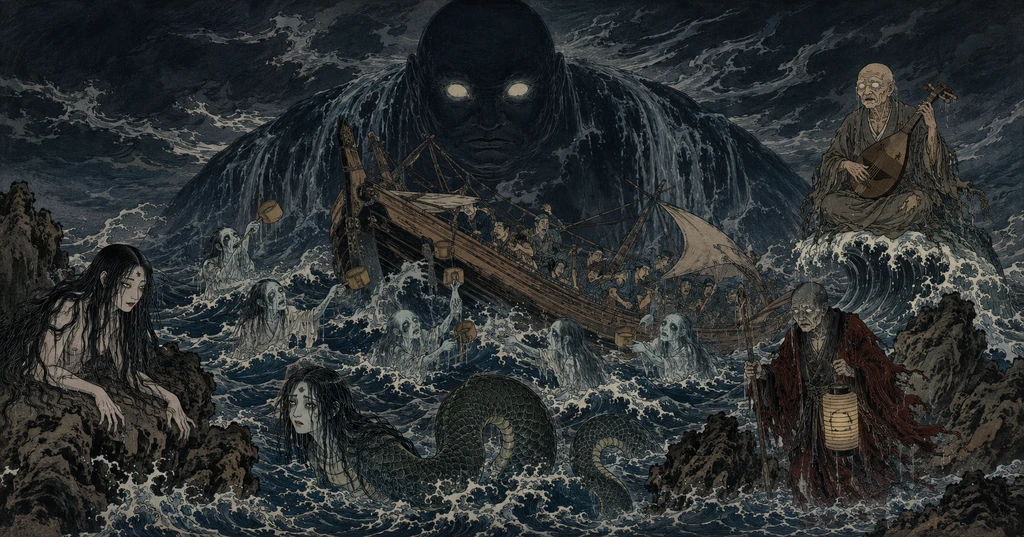
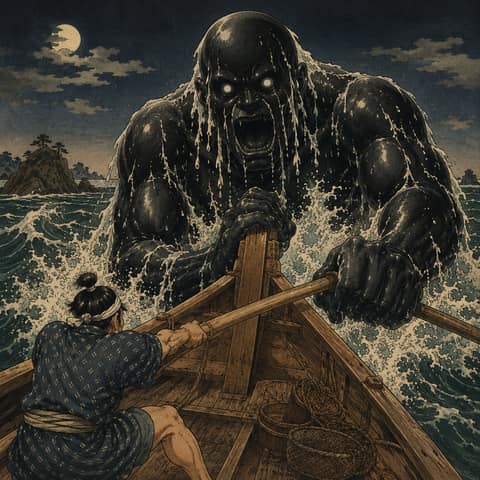
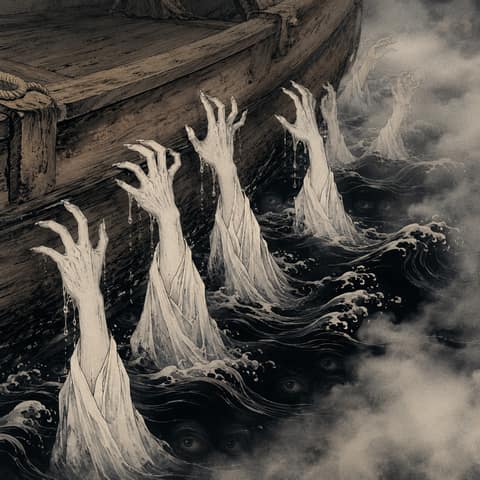
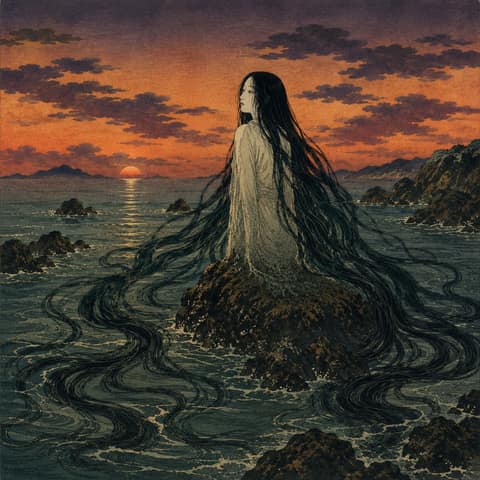
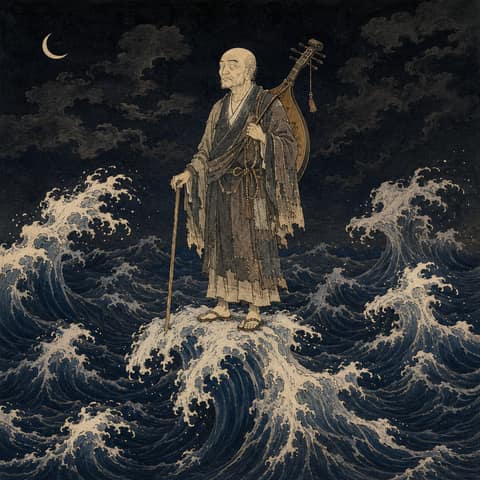
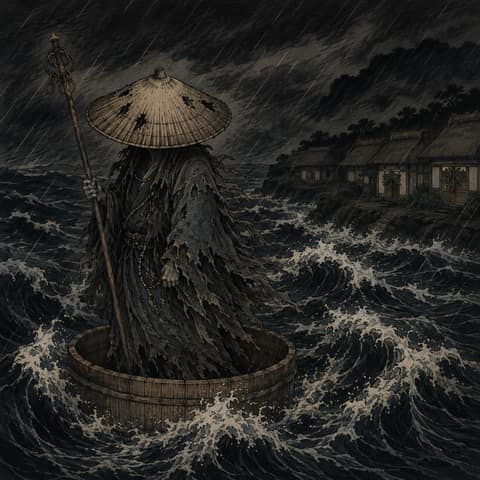
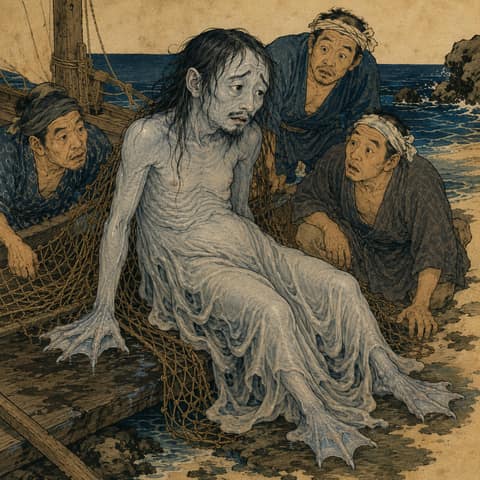
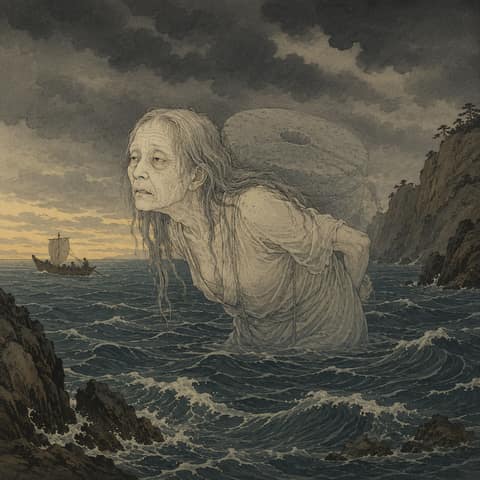
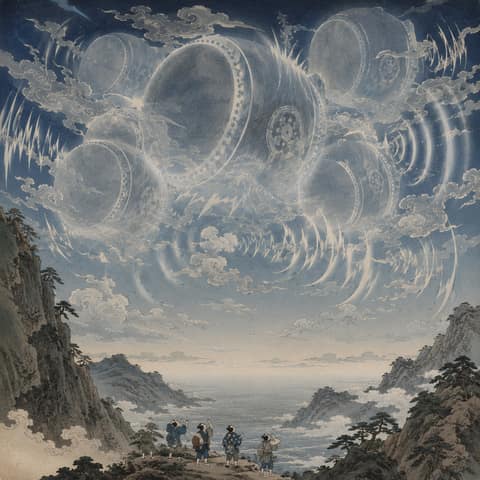
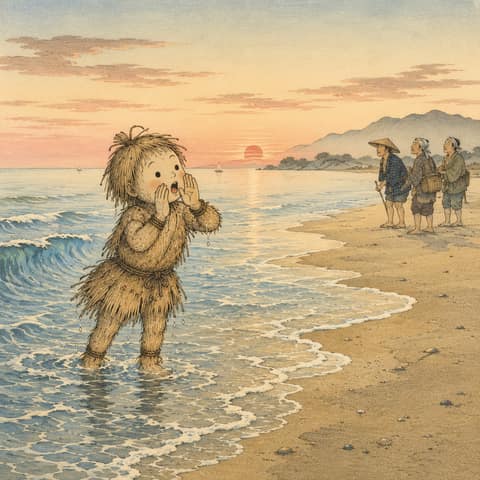
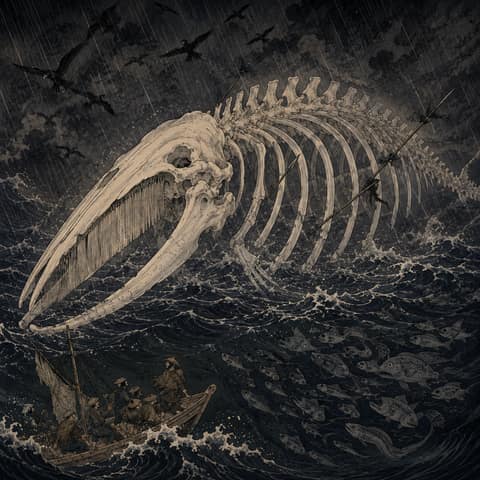
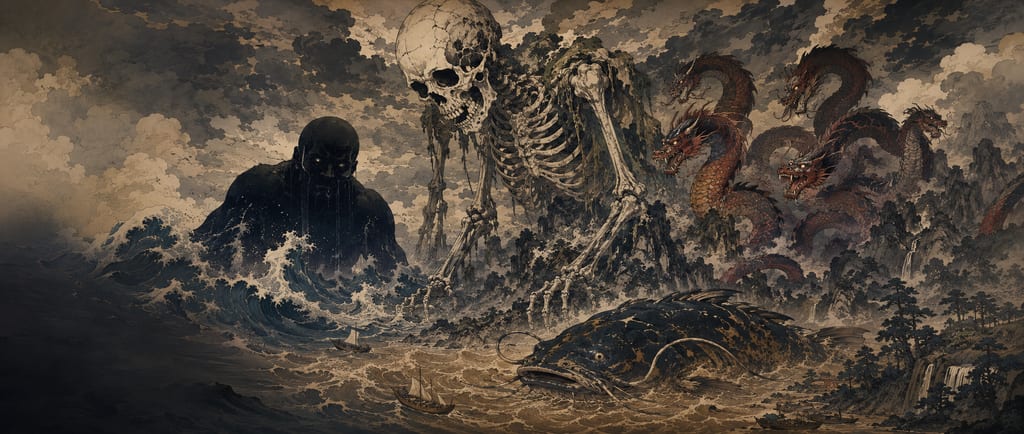
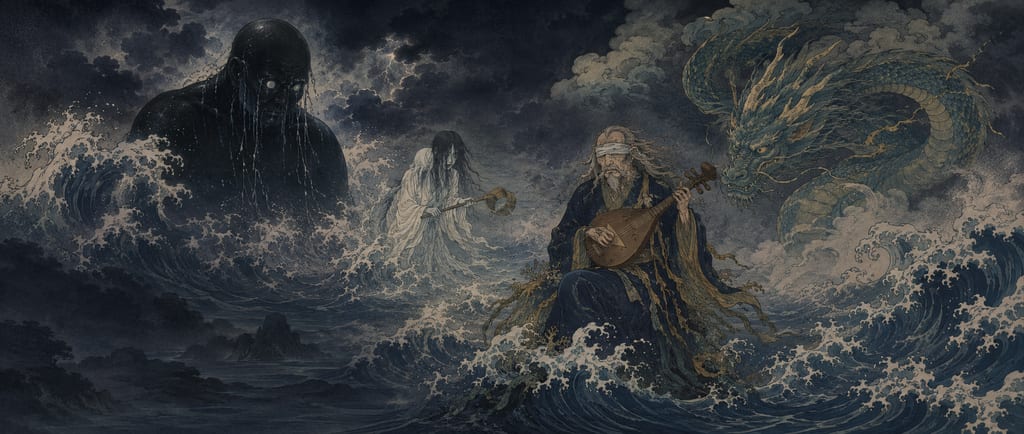
Umibōzu is a maritime apparition known along coasts throughout Japan and long feared especially by fishers. A calm sea is said to heave without warning, becoming an immense black shadow or the bald form of a Buddhist monk that blocks a vessel's path. Accounts rarely show a whole body; most describe only a head and shoulders rising above the water. It appears at night or in heavy seas, overturning boats and dragging people into the depths. Edo-period sources including the Wakan Sansai Zue (1712)[1] and the Butsurui Shōko (1775)[2] also record the name of a giant apparition standing at sea.
Its identity has been explained in several ways. One account treats it as the transformed ghost of someone who drowned[1], while another imagines a fallen dragon or sea deity demanding a sacrifice. Toriyama Sekien did not draw Umibōzu itself, but his Gazu Hyakki Yagyō includes Umi-zatō, a blind monk standing at sea[4]. Early modern yokai art repeatedly gave shape to fear of the unknown offshore. The enormous head and unreadable black form came to embody the terror of the sea itself.
3 different forms of Umibōzu have been confirmed. Each has unique characteristics and personality, with various ways of interacting with people. Details of each form are introduced below.
The Umibōzu That Whispers, “Lend Me Oil”
To explain The Umibōzu That Whispers, “Lend Me Oil” in detail:
Umibōzu is often understood as a yokai born from the fear and unease of people at sea. It has no single fixed form: sometimes it is no more than a black shadow, while in other stories it rises from the water as a colossal monk. One well-known variant has it draw close to a boat and whisper, “Lend me oil.” If the crew complies, it is said to kindle a fire and sink the vessel.
Later variants add different details. Some say it has a collector's habit, gathering wrecked boats and fishing nets and piling them on the seabed; others describe it appearing with a glowing bottle or lantern in hand. It frightens those who meet it, yet it also stands for the unfathomable mystery of the sea and is regarded with awe as well as fear.
Character Profile
This section is our own creative profile for storytelling. It is not historical fact or scholarship.
Silent and capricious. When calm it merely watches from a distance; when angered it becomes terrifying.
Compatibility
People who respect the sea and try to live within the limits of nature are most likely to understand the warning it represents.
Abilities
Rocking or capsizing boatsTesting a person's courageCollecting wrecks and fishing netsControlling wavesGiving visible form to human fear
Weaknesses
Bright lights such as lanterns and lighthouses, and the composure of someone who does not panic before the sea.
Habitat
Offshore waters, stormy nights, and the legendary depths of the seabed.
Sea Monk of Kyushu and Shikoku
To explain Sea Monk of Kyushu and Shikoku in detail:
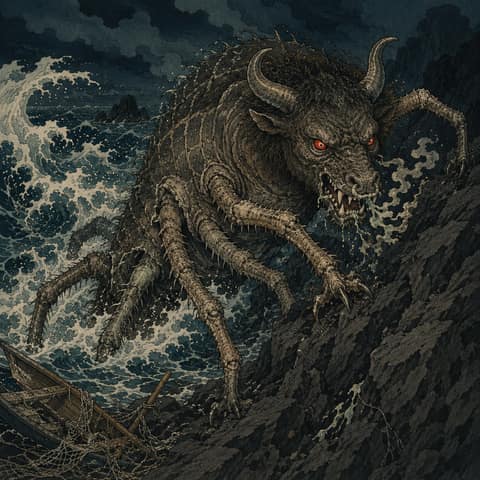
A Sea Monk told along the coasts of Kyushu and Shikoku. It appears on boats and asks for a ladle, yet it never climbs aboard from the stern, always emerging at the bow. When it clings to the oar, if the crew keeps rowing, the oar bites in like a blade and it cries out “Aitata!” In Uwajima, many tales say it harms people, yet those who see a Sea Monk are also said to live long lives.
Character Profile
This section is our own creative profile for storytelling. It is not historical fact or scholarship.
fierce and aggressive, dual-natured, can bestow longevity
Compatibility
sailors, sea voyagers, fishermen
Abilities
haunts boatssteals ladles and forces crews to bail seawatertransforms into a woman to attack peoplegrants longevity
Weaknesses
can be cut at the oar’s edge, protection of the stern-seated Ship King deity
Habitat
seas around the Goto Islands, coastal waters of Uwajima in Ehime Prefecture
Sea Monk of the Chugoku Region
To explain Sea Monk of the Chugoku Region in detail:
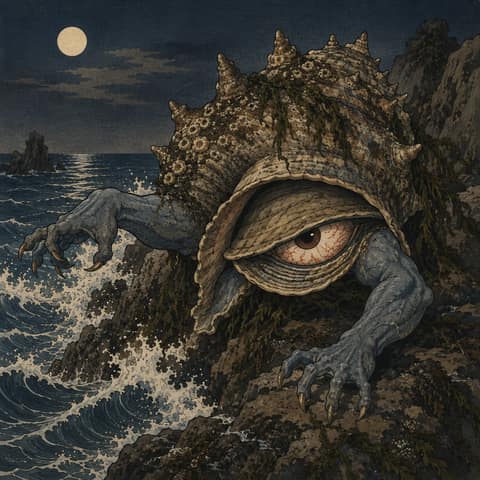
A sea monk told across the Chugoku region. In Nagato it appears to snuff out watch fires, while in Okayama’s Bisan Seto it is called “Nurarihyon,” taking a bead-like form to bewilder people. Along the San’in coast it clings to beachgoers and tries to pull them into the sea. The Tottori collection Inaba Kaidan-shu recounts a one-eyed, post-like sea monk that torments people with its slick, slimy body.
Character Profile
This section is our own creative profile for storytelling. It is not historical fact or scholarship.
mischievous, teasing toward people, also dangerous and prone to drag victims into the sea, takes many forms such as a slimy figure or a one-eyed monster
Compatibility
fishers, people walking along the shore, sailors
Abilities
extinguishing watch firesslipping away with a bead-like bodyclinging to people on the shoredragging victims into the seafrightening people in a one-eyed form
Weaknesses
strong fire, can sometimes be captured in close combat
Habitat
Nagato (Koutsugu Kawashiri in Yamaguchi Prefecture), Bisan Seto in Okayama Prefecture, beaches of the San’in region, Tottori Prefecture
The Umibōzu That Whispers, “Lend Me Oil” — Yokai Soul Match
The diagram below is a diagnostic evaluation chart for The Umibōzu That Whispers, “Lend Me Oil”. The higher the value of each item, the stronger that characteristic is expressed.
Sea Monk of Kyushu and Shikoku — Yokai Soul Match
The diagram below is a diagnostic evaluation chart for Sea Monk of Kyushu and Shikoku. The higher the value of each item, the stronger that characteristic is expressed.
Sea Monk of the Chugoku Region — Yokai Soul Match
The diagram below is a diagnostic evaluation chart for Sea Monk of the Chugoku Region. The higher the value of each item, the stronger that characteristic is expressed.