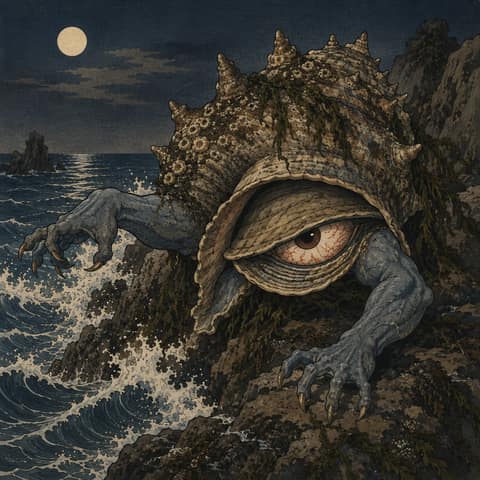
Sazae-oni appears in Toriyama Sekien's Hyakki Tsurezure-bukuro[1] (1784) as a turban shell that has aged into an oni. Human arms extend from its shell, while an eye grows on the operculum. Sekien's caption quotes the old transformation lore that 'sparrows enter the sea and become clams, while field mice become quail'[1], a line derived from the monthly observances in the Chinese Book of Rites. If the classics allow a sparrow to become a clam and a mouse to become a quail, why should a turban shell not become an oni? The creature is therefore an idea and a pictorial conceit born from wonder at the transformations of nature, rather than a report of a local encounter[2].
Sazae-oni gives visual form to the principle that a natural thing can pass into an uncanny state. Some Hyakki Yagyō picture scrolls also show a shell-like yokai leading a smaller clam creature by the hand, placing Sekien's invention within a larger procession of personified beings from the shore.
Folklore & Legends
Reliable early local traditions are scarce, and Sazae-oni has been known chiefly through Sekien's picture. A later, widely repeated erotic tale tells of pirates who rescue a drowning beauty with lustful intentions. The woman is really a Sazae-oni, who bites off their testicles and returns them only in exchange for an enormous payment in gold. Often presented as a tradition from Namikiri in Kii Province, the story can be traced instead to the Shōwa-period volume Yōkai, Majin, Seirei no Sekai, edited by Yamamuro Shizuka and others and published in 1977[3][2].
No direct connection between that pirate story and Sekien's Sazae-oni has been established, and the episode is not confirmed as a tradition predating the modern period. One of the book's editors was Yamada Norio, who is known for supplying stories to many Sekien yokai that originally had none, making modern invention especially plausible here[2]. Any account of Sazae-oni should therefore separate Sekien's original conceit—a tsukumogami inspired by classical transformation lore—from the bawdy pirate story added in the twentieth century. The older image finds its force in a quieter thought: even a shellfish may, with age, acquire a spirit and become an oni.
Toriyama Sekien drew on a transformation tale in the Book of Rites to imagine a turban shell becoming an oni. His creature retains its shell but grows human arms and opens an eye in its operculum. The point is less an attack upon people than a playful visualization of the idea that anything in nature might change into an uncanny form.
Early modern Hyakki Yagyō scrolls also personify shellfish, making Sazae-oni part of a wider pictorial shore crowded with animate natural things. It is therefore better read as an emblem of spirit residing in coastal nature than as a monster from a specific village's attack story. The bawdy pirate anecdote popularized much later bears strong signs of modern invention and should not be confused with Sekien's original image.
Character Profile
This section is our own creative profile for storytelling. It is not historical fact or scholarship.
The diagram below is a diagnostic evaluation chart for Sazae-oni, the Ogre Growing from a Turban Shell. The higher the value of each item, the stronger that characteristic is expressed.