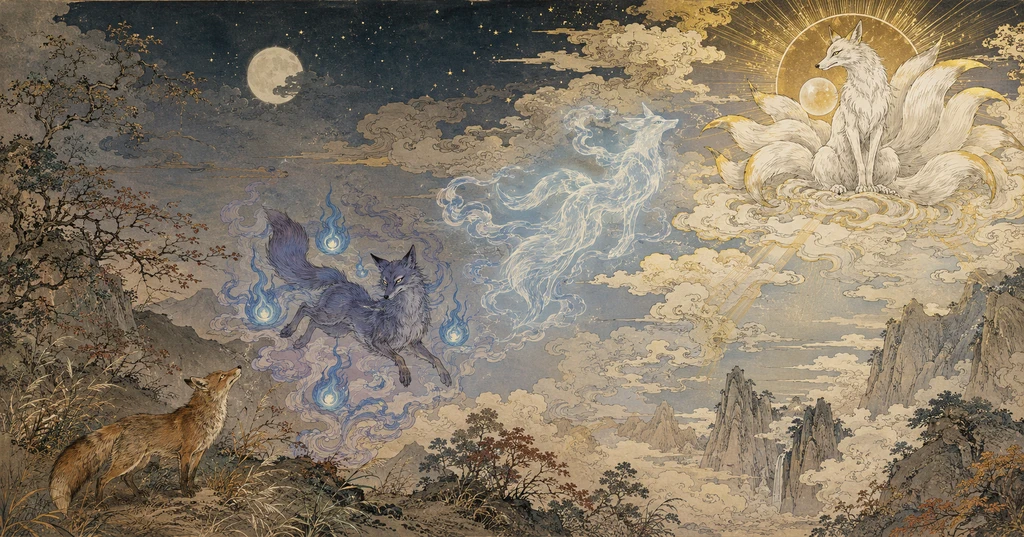
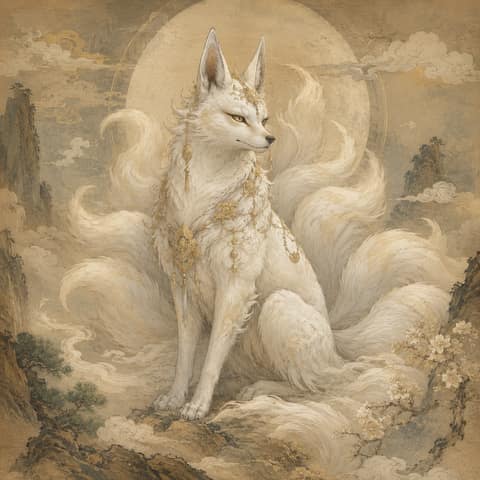
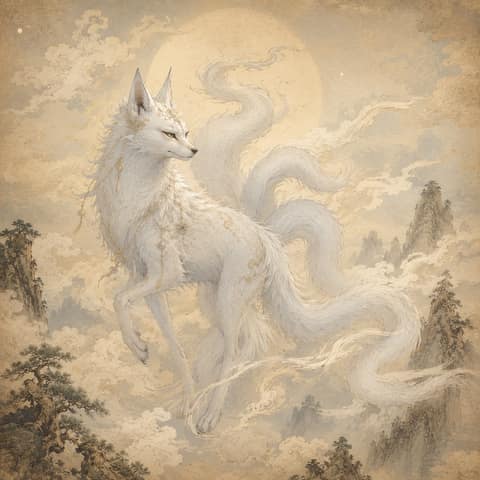
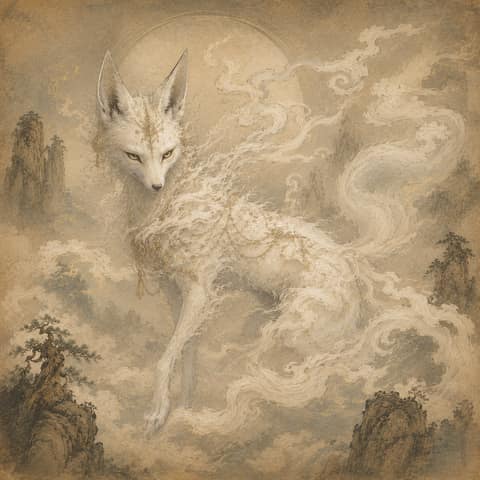
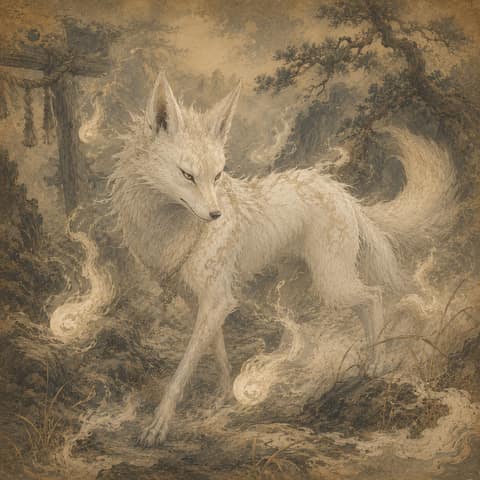
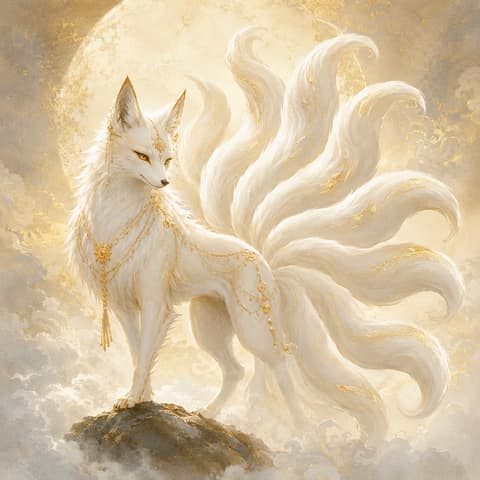
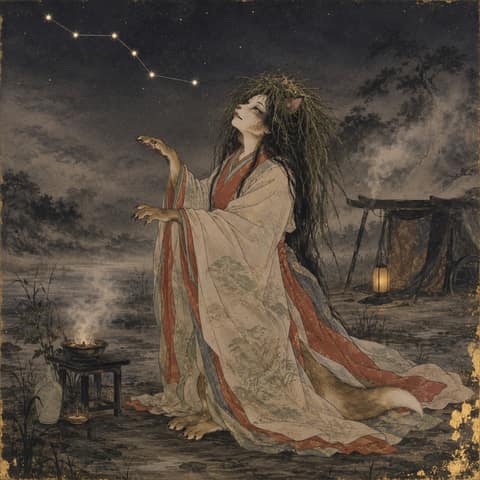
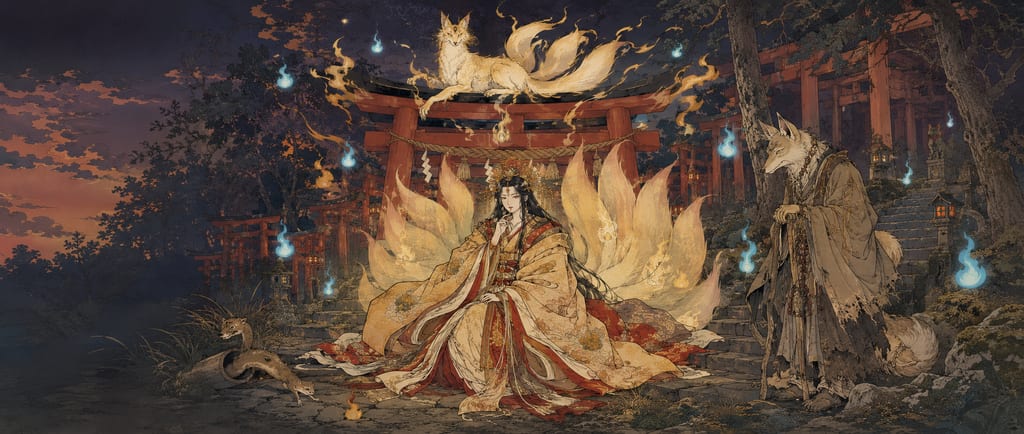
The Kūko is a high-ranking fox spirit said to have refined its supernatural power over long ages until it stood just one step below the near-divine Tenko, the celestial fox. An Edo-period essay sets out a hierarchy that divides foxes into four grades, from highest to lowest: Tenko, Kūko, Kiko, and Yako[1], placing the Kūko in second rank. It is said to command roughly twice the power of the Kiko directly beneath it.
Some accounts hold that the Kūko looks no different from an ordinary fox, while others say that, after living more than a thousand years, it becomes an almost formless spiritual being. Specific anecdotes are scarce; rather than starring in a tale of its own like Tamamo-no-Mae, the name is most often used as a category denoting a fox of exalted standing. A Kūko that has lived three thousand years is called an Inari Kūko, said to possess power second only to the Tenko.
Folklore & Legends
The idea that a fox grows in power as it ages traces back to an old Chinese book of marvels, the Genchūki[2]. There it is explained that at fifty years a fox can transform into a woman, at a hundred into a beauty or a shrine maiden, and after a thousand years it gains passage to heaven. In Japan this notion that rank rises with age developed into a view that graded foxes as Tenko, Kūko, Kiko, and Yako.
It was the essays of Edo-period scholars that first set the four fox ranks down clearly. Minagawa Kien’s Yūhisai Sakki[1] records the order, which was later introduced by Asakawa Zen’an’s Zen’an Zuihitsu[3] and Tachibana Nankei’s Hokusō Sadan[4]. Within this scheme the Kūko stands apart as a benevolent, high-ranking fox, distinct both from the harmful Yako and from the still spiritually shallow Kiko.
The Kūko, however, has left almost no concrete legends tied to a particular form or incident. This is because the word has been used less for one specific creature than as a marker of standing—an indication of just how exalted a given fox is. A fox that has cultivated virtue over a thousand years is sometimes called a senko, an immortal fox, but the Kūko and Tenko represent forms higher still. A fox standing at the very opposite pole from the people-deceiving Yako, dwelling almost in the realm of immortals and divinities: that is what the rank of Kūko signifies.
This version looks a little more closely at what kind of being the Kūko actually is. In the Edo-period ranking of foxes, only the lowest, the Yako, was thought to possess a visible body of flesh; from the Kiko upward, foxes were believed to become formless spiritual beings. Because the Kūko ranks just below the Tenko, its shape as an ordinary beast has lost almost all meaning, and it manifests instead as a presence or an influence. By its very nature it differs from the Yako, which stands before people’s eyes to deceive them.
A high-ranking fox is closer to one that protects and guides than to one that harms. Overlapping with the lineage of white foxes regarded as messengers of Inari, the Kūko and Tenko were revered in the world of belief as wise foxes that serve the gods. The reason the Kūko so rarely causes any concrete incident is not weakness but that it has long since outgrown the stage of meddling with people out of vanity.
Even so, because it wields immense supernatural power, it was thought that to slight it might invite calamity. Gentle toward those who revere it, showing a glimpse of its power only before the arrogant, the Kūko has been spoken of as a mature fox that knows exactly the right distance to keep from human beings.
Character Profile
This section is our own creative profile for storytelling. It is not historical fact or scholarship.
Mature and composed, it rarely involves itself with people. Gentle toward those who hold it in awe, it shows a glimpse of its power to chasten the arrogant.
Compatibility
Communes calmly with the modest and the devout; chastens those who grow conceited
Abilities
immense supernatural power, second only to the Tenkoarts of illusion and transformationmanifesting as a presence rather than a formappearing as a portent of good omens or strange events
Weaknesses
Powerful prayers and the force of the gods and Buddhas
its deceptions gain little purchase on the truly modest
its own restraint in never wielding power carelessly
Habitat
Groves around shrines and temples, old mounds and thickets, mountains far from human dwellings
The diagram below is a diagnostic evaluation chart for The Kūko — High Fox Just Below the Tenko. The higher the value of each item, the stronger that characteristic is expressed.