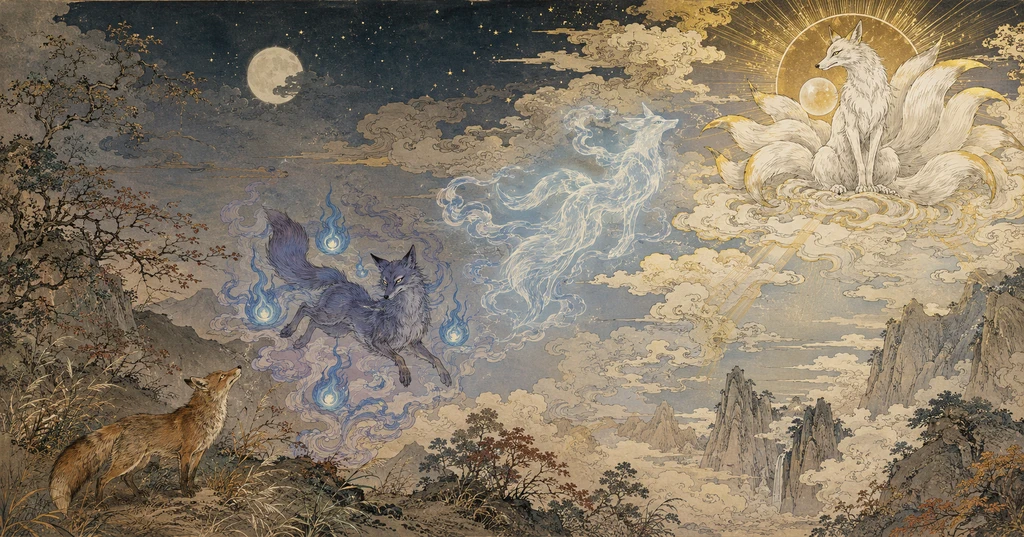
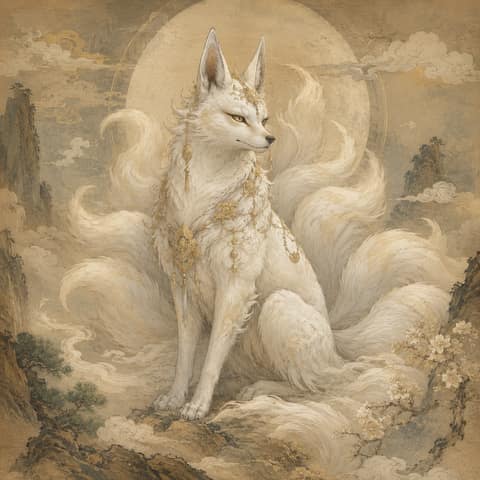
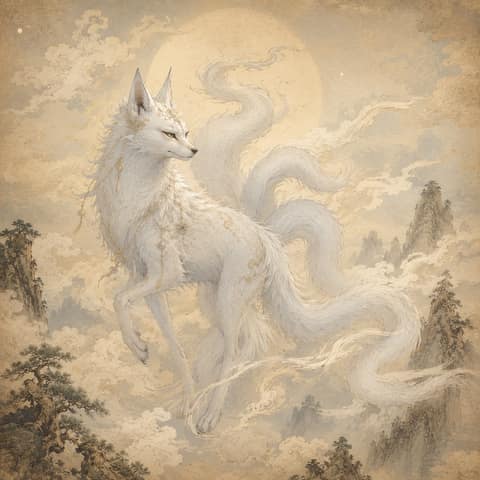
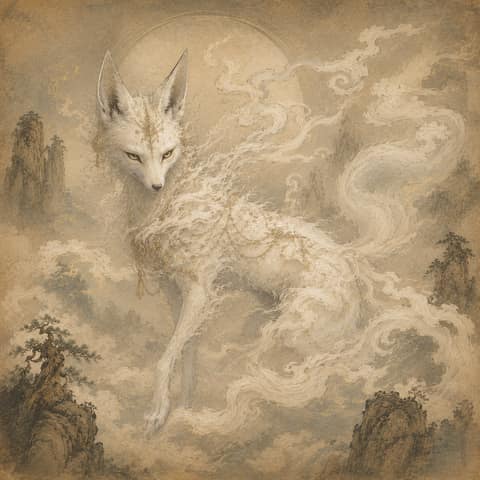
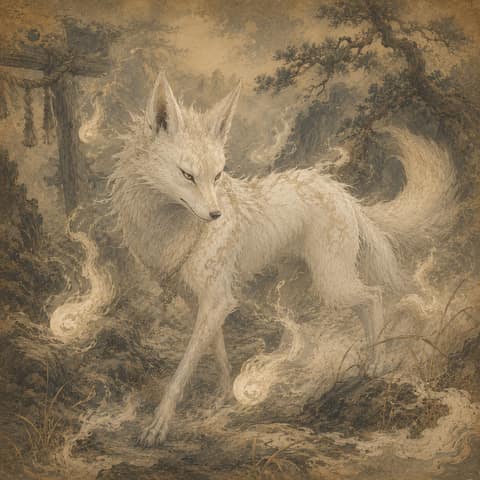
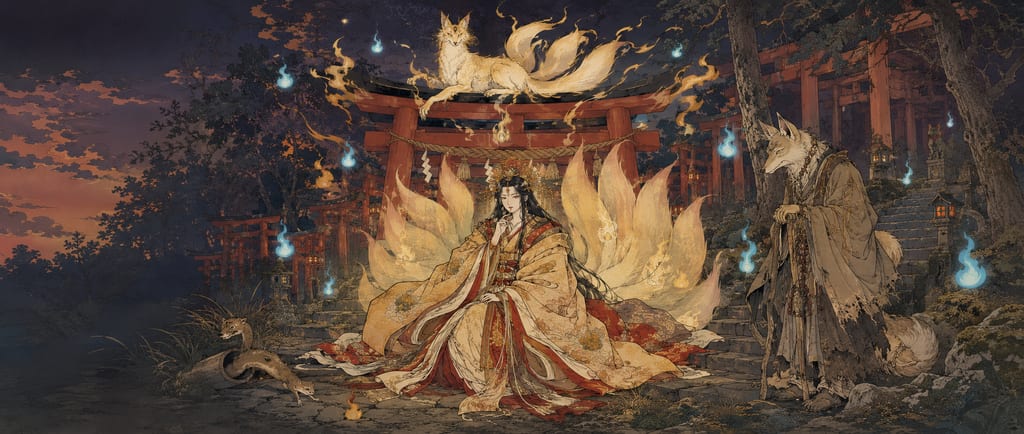
The Yako (also read nogitsune) is held to be the lowest in rank among fox yokai, set at the opposite pole from the white foxes—the benevolent foxes revered as messengers of the god Inari. It is an ordinary wild fox of the hills and fields that, with age, has come to deceive and possess people; in the Edo-period hierarchy of foxes (Tenko, Kūko, Kiko, Yako) it was counted at the very bottom.
Whereas the higher foxes are regarded as formless spiritual beings, the Yako is distinctive as the one rank thought to keep a visible body of flesh. That much closer to the human world, it has long been known for near-at-hand, tangible mischief: leading travelers astray, taking on disguises to startle them, and possessing people. It is also written as yakan, a word that originally referred to the jackal in the Buddhist scriptures[1] but came in Japan to be confused with the fox.
Folklore & Legends
The name Yako is old. The Sengoku-era topography Jinkokuki[2] records that field foxes were numerous around Shinoda Myōjin in Izumi Province and that they bewitched people. The same Shinoda forest is famous for the legend of Kuzunoha, the white fox said to be the mother of Abe no Seimei—but she is a virtuous fox who repays human kindness, of quite different standing from the people-deceiving Yako. A land thick with foxes gave rise to tales of both good and ill.
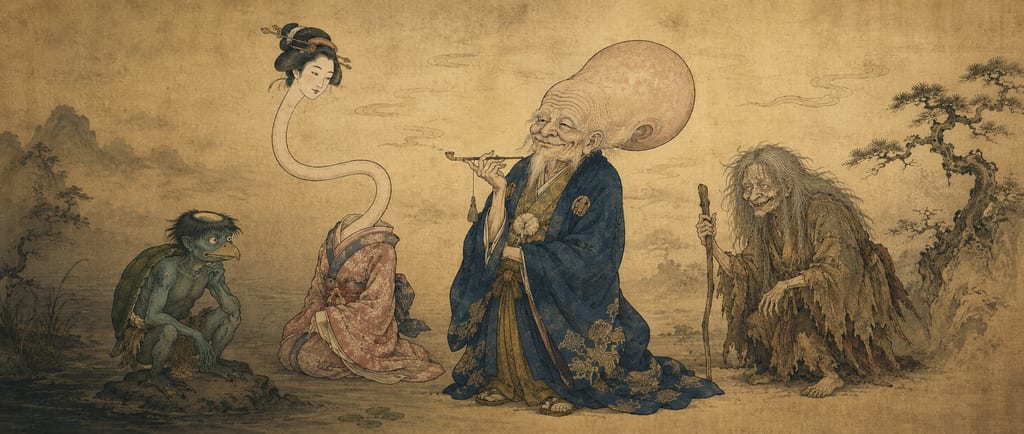
By the Edo period, foxes had come to be clearly distinguished into the benevolent foxes that serve Inari and the Yako that harm people. The Yako appears in yokai paintings as well; its figure can be seen in Sawaki Sūshi’s Hyakkai Zukan[3] (1737).
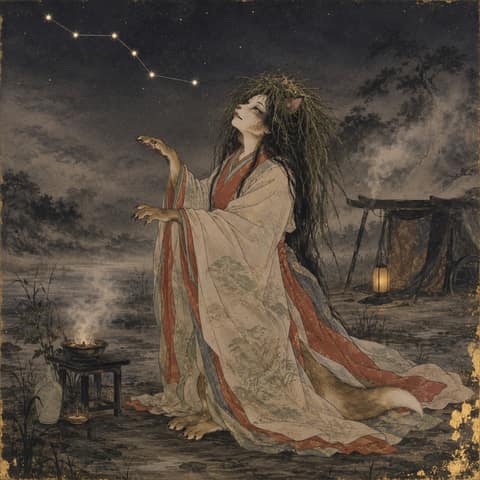
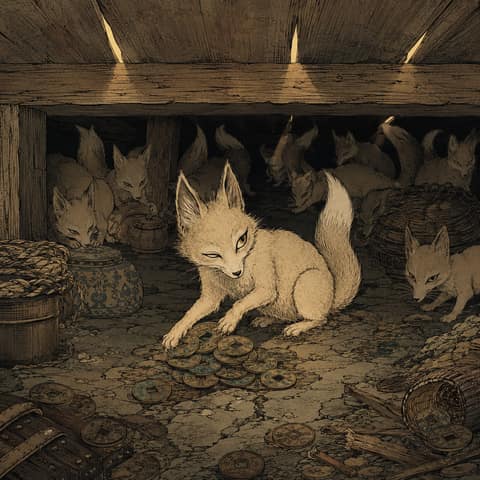
In Kyushu and the Chūgoku region especially, the Yako was feared as a possessing spirit that takes hold of people. In northern Kyushu, being possessed by a yako was said to bring on illness-like symptoms, while on Iki Island it was called yakō—a weasel-like beast believed to hide in a person’s armpit and possess them. To have one lick the scar of a burn or pockmark was said to be fatal, and people warded it off with mosquito nets, the ash of hemp stalks, and blades. In Hirado there was the saying "a thousand yako in train," for the field foxes were thought to travel in large companies. In southern Kyushu there were also traditions of foxes possessing particular family lines for generations—beliefs much like those of other possessing lineages such as the kuda-gitsune and the osaki.
This version turns to how the Yako was spoken of in the Buddhist world, and in Zen in particular. Zen has the term yako-zen, "wild-fox Zen." It is a word of admonition for a half-finished state in which one has not truly attained enlightenment yet believes oneself enlightened.
Its source is the famous tale "Hyakujō and the Wild Fox," recorded in the Song-dynasty Zen collection of dialogues, the Mumonkan[4]. An old man came to listen each time the Tang Zen master Baizhang Huaihai (Hyakujō Ekai) preached. One day the old man revealed his story. Long ago, when he had been abbot of this very temple, he was asked whether one who has attained enlightenment still falls subject to cause and effect (karmic retribution), and he answered, "He does not fall (into cause and effect)." For that single mistaken word he had been cast into the body of a wild fox through five hundred rebirths. The old man begged Hyakujō for the correct answer. When Hyakujō rephrased it as "He does not obscure cause and effect," the old man was freed of his delusion on the spot, shed the wild-fox body, and attained buddhahood.
Here the wild fox becomes a symbol of admonition—the form into which one who has fallen into half-baked enlightenment is transformed. Quite apart from the village field fox that deceives people, the Yako has lived on at length within the language of Zen as well, as "where shallow cleverness ends up."
Character Profile
This section is our own creative profile for storytelling. It is not historical fact or scholarship.
Close to the human world, it delights in near-at-hand mischief such as deception and possession. It moves in packs and holds a grudge.
Compatibility
In conflict with people in general; weak against exorcists and shrine attendants
Abilities
transforming into people and objectsglamours such as losing travelers, phantom money, and ghostly firespossessing people, family lines, and livestockmoving in large packs and causing an uproar
Weaknesses
Prayer and esoteric rites
wards of bladed weapons
the ash of hemp stalks
pure flame and Shinto invocations
Habitat
Around shrines in the hills and fields, the satoyama and footpath ridges, the legendary sites near Shinoda in Izumi, and villages of northern Kyushu, Iki, and southern Kyushu
The diagram below is a diagnostic evaluation chart for The Yako — Low Fox of the Kyushu Packs. The higher the value of each item, the stronger that characteristic is expressed.