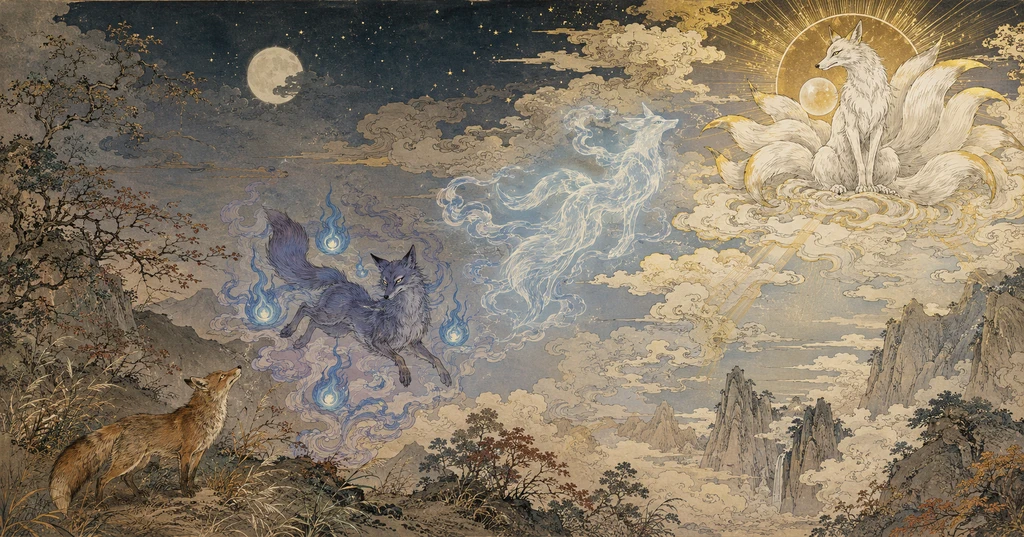
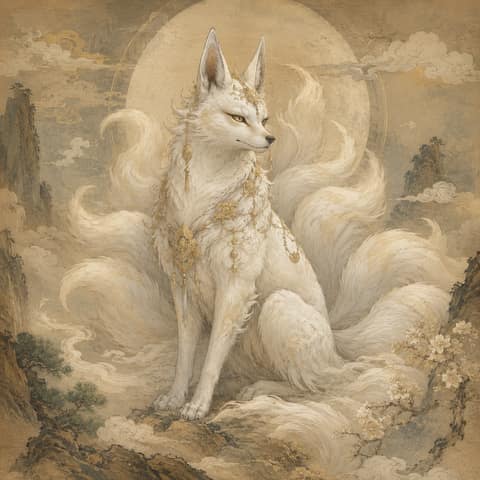
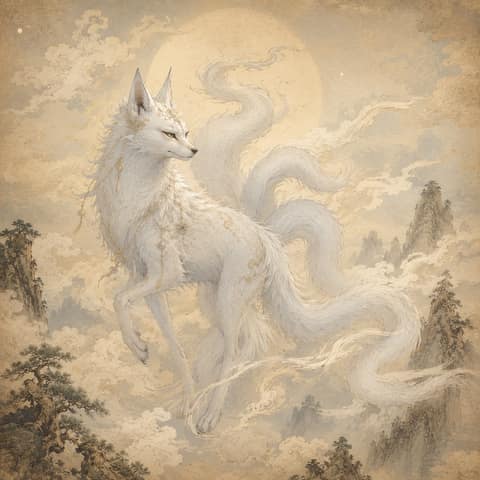
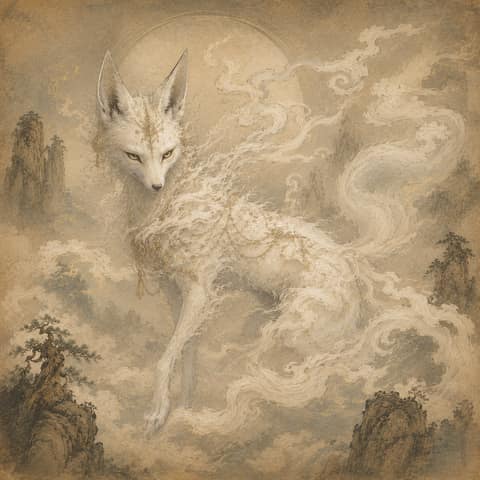
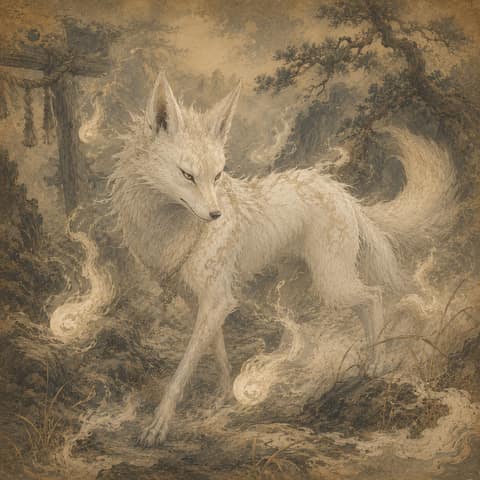
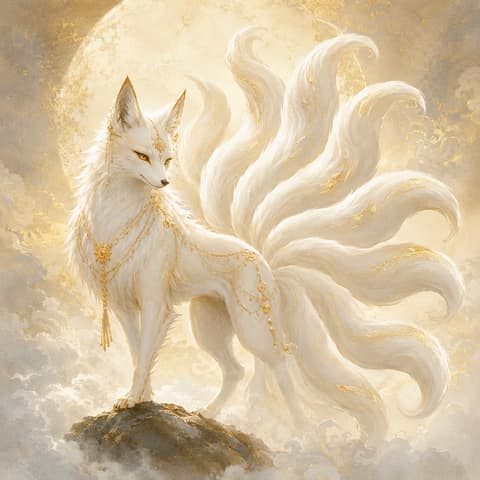
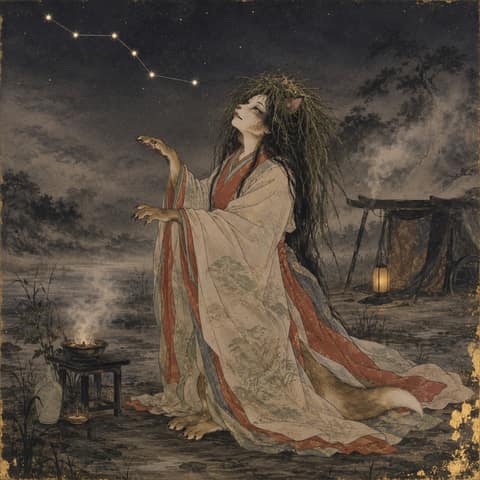
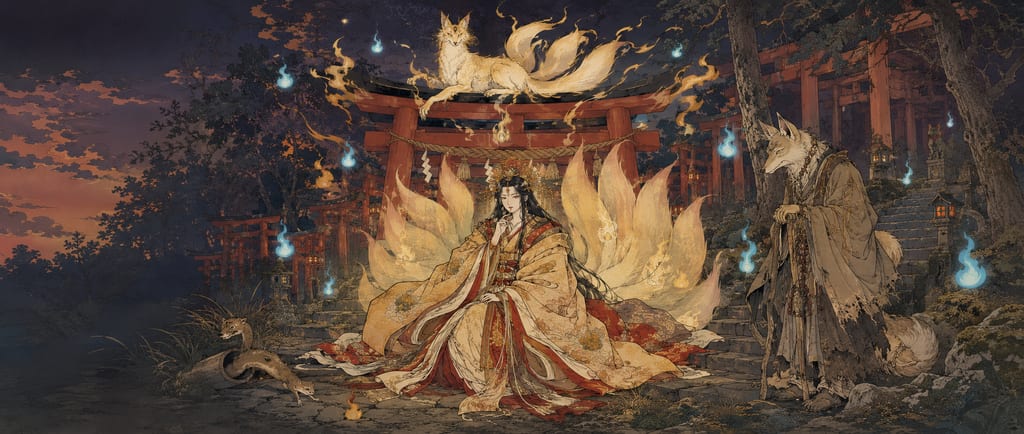
The Kiko is a fox spirit that, having deepened its powers over long years, has at last shed its body of flesh to become a being of pure “ki” (vital breath) alone. Edo-period essays sort the ranks of foxes into four grades — Tenko, Kūko, Kiko, and Yako[1] — and place the Kiko second from the bottom, just above the lowly Yako. Where the Yako is the only one of the four to keep a visible body of flesh, every fox from the Kiko upward is held to be a formless, spiritual being; the Kiko stands precisely on that dividing line — the fox poised at the threshold where beast gives way to spirit. The Kūko one rank above is said to wield roughly twice its power.
Its very name, “ki,” tells of a creature that has already lost its form and become something like a breath of air. Yet it still keeps the power to possess people and lead them astray, and in this it differs in nature from the Tenko and Kūko above, who do not lightly meddle in human affairs.
Folklore & Legends
The notion that a fox grows in power as it ages, until at last it casts off its very form, can be traced back to the old Chinese book of marvels, the Xuanzhongji[2]. There it is said that a fox can turn into a woman at fifty years, into a beautiful woman at a hundred, and commune with heaven once it has passed a thousand. Carried to Japan, this idea of “rank rising with the years” grew into the view that sorts foxes into Tenko, Kūko, Kiko, and Yako[3].
It was the essays of Edo scholars that set these four ranks down in writing. Minagawa Kien’s Yūhisai Sakki[1] first recorded the order, after which Asakawa Zen’an’s Zen’an Zuihitsu[4] and Tachibana Nankei’s Hokusō Sadan[5] carried it to a wider public. Within this scheme the Kiko sits between the flesh-bodied Yako and the Kūko and Tenko, who have all but attained the realm of the immortals.
Like the Kūko, however, the Kiko has left behind almost no concrete legend bound to a particular shape or incident. This is because the Kiko is less a single, specific creature than a name marking a grade — “a fox of about this rank.” When folk tales speak of fox-possession, the culprit is sometimes called a mere Yako, and sometimes a Kiko that has gained a further measure of power — and it is in such tellings that the outline of the Kiko dimly takes shape.
This version digs into the role the Kiko plays among the four fox ranks: that of a boundary.
The fox hierarchy is not merely an order of strength but a single ladder by which the beast draws step by step closer to spirit and to god. The rung on which the Kiko stands is the very seam dividing “the flesh-bodied Yako” from “the form-shedding Kūko and Tenko”[3]. Where the Yako is known for visible mischief — leading travelers astray, taking on a guise to fool them — the Kiko, having already slipped free of its shell, turns its workings further inward: possessing a person, troubling the heart. The view that the fox in tales of possession is no ordinary Yako but a Kiko of deeper attainment is rooted right here.
There is one more thing visible in the Kiko: incompleteness. Where the Kūko holds twice its power and goes on to become the Tenko and depart the human world, the Kiko cannot yet cut its ties to people. Swaying between the instinct of the beast and the detachment of a god, deceiving and possessing by turns, it is in a sense a fox still only halfway through its training. If the higher foxes are beings that watch quietly over the world, the Kiko is the one that, nearest of all to humankind, still struggles on[4].
Character Profile
This section is our own creative profile for storytelling. It is not historical fact or scholarship.
Though it has lost its form, it cannot let go of the human world — possessing people, deceiving them. It never reaches the serene detachment of the higher foxes, but sways between the instincts of the beast and the dignity of a god.
Compatibility
Those midway through a transformation, carrying both doubt and growth
Abilities
Drifts as a formless breath of kiPossesses people (fox-possession)Shapeshifts to bewilder themPower one grade above the Yako
Weaknesses
Power far short of the higher Kūko and Tenko
Still cannot sever its attachment to the human world
Lacks any legend of its own, remaining little more than a category name
Habitat
The borderland between wild hills and the spirit realm; villages where tales of fox-possession are told
The diagram below is a diagnostic evaluation chart for The Kiko — Mid-Ranking Fox Become a Breath of “Ki”. The higher the value of each item, the stronger that characteristic is expressed.