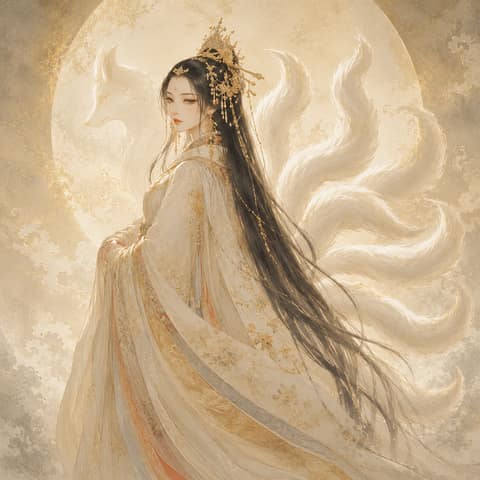
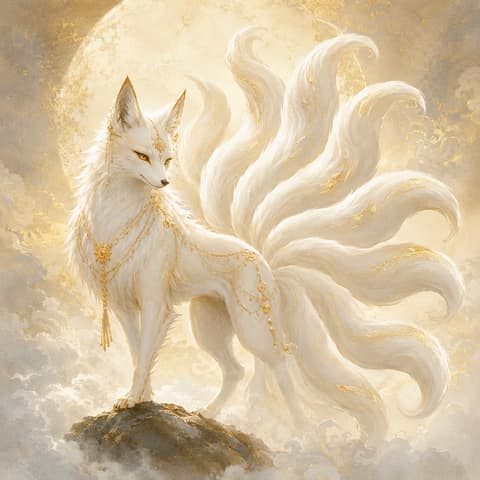
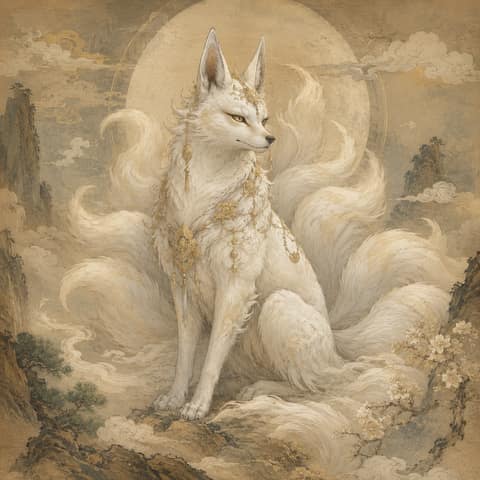
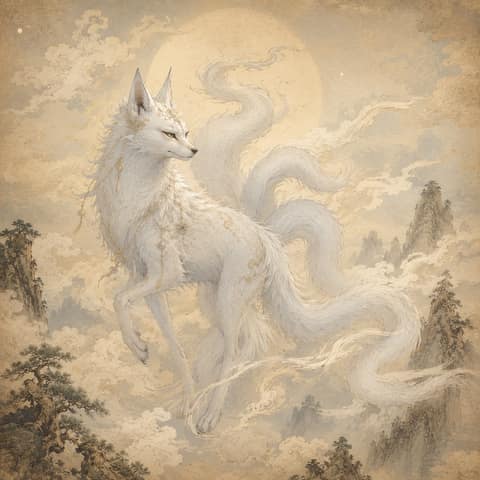
The Bake no Kawagoromo is a fox spirit drawn in the first volume of Toriyama Sekien’s picture-book Hyakki Tsurezure Bukuro[1]. A fox that has lived three thousand years dons water-weed upon its head, bows in worship to the Big Dipper, and by this rite turns itself into a beautiful woman. In his caption Sekien writes, “A fox that has passed three thousand years, wearing algae and worshipping the Dipper, becomes a beautiful woman — surely this is what I have seen in the writings of China,” framing the whole as something mused within a dream.
The Hyakki Tsurezure Bukuro is, by design, a book of tsukumogami — the spirits that dwell in worn-out tools and objects. A fox could slip in among these things only by virtue of its name. “Kawagoromo” means a garment of fur, and so reads almost as a piece of clothing, a “thing”; at the same time it sounds out the idiom “bake no kawa” — the skin of a disguise, which, once it peels away, lays the fox’s true form bare. Through this wordplay Sekien quietly smuggled a transforming beast, in truth an animal, into the ranks of the tool-spirits.
For all that the name suggests the splendor of transformation, the creature carries no local legend tied to any particular place or person. It is, in the end, a fox known only through Sekien’s picture and caption — an image-born yokai that distills into a single illustration the age-old notion, inherited from China, that a fox grows able to become a beautiful woman as it ages.
Folklore & Legends
The idea that a fox can take human form by accumulating years of cultivation goes back early into the strange-tale books of China. The Xuanzhongji[2] holds that “at fifty years a fox can become a woman, at a hundred a beautiful woman, and at a thousand it communes with heaven and becomes a celestial fox.” Half of Sekien’s “three-thousand-year fox” that “becomes a beautiful woman” is drawn from this transformation lore graded by age. Yet in the Xuanzhongji the summit of rank is the thousand-year celestial fox, and the three thousand years Sekien records reach far beyond it. The figure happens to align with the kūko — the “sky fox” of the later four-rank scheme (tenko, kūko, kiko, yako) said to attain three thousand years and to stand just below the celestial fox — though it would be too much to claim Sekien himself meant that rank.
The other half — the rite of wearing something on the head and worshipping the Dipper to take human form — comes from the Nuogaoji chapter of Duan Chengshi’s Youyang Zazu[3] of the Tang. There it is written: “The wild fox is named the purple fox. When it is about to work mischief, it must wear a skull upon its head and worship the Dipper; if the skull does not fall, it transforms into a human.” What the fox sets upon its head is, in the original, a skull — not water-weed. Sekien, or the source he followed, replaced that grim skull with algae. To soften the original’s bones into a handful of water-weed is the single most distinctive stroke of this yokai.
The artistry of Sekien’s picture lies in its catching the very instant before the transformation is complete. The fox is dressed as a beautiful woman, yet a tail peeks from beneath the hem, the hands and feet remain those of a beast, and even the attendant bearing her palanquin cannot hide its fox nature. The water-weed on the head is a wig in mimicry of human black hair. This is the moment when the “skin of disguise” is about to slip, and name and image answer one another in a single jest.
This fox belongs to one branch of the fox lineage[4] that takes the form of a beautiful woman to beguile the world of men. The same “becomes a beauty at a hundred years” notion would later crystallize into Tamamo-no-Mae, who became a favored consort of Retired Emperor Toba, and into the nine-tailed fox with its tails split nine ways. The Bake no Kawagoromo is not the protagonist of that tale, yet it preserves, within a single picture, the very moment a transforming fox turns into a beautiful woman — together with that handful of algae in place of a skull, and the prayer offered toward the Dipper.
This version reads the Bake no Kawagoromo through a single point — the fox that transforms by worshipping the Dipper — and follows the rite of its making and the layers of wit folded into the picture.
The passage in the Nuogaoji of the Youyang Zazu[3], the other source, speaks of more than a skull and the Dipper. There the wild fox is called the “purple fox,” and it is said that “when it strikes its tail at night, fire comes forth.” This stroke of fire from a fox’s tail runs continuous with the foxfire so familiar in Japan; behind the Bake no Kawagoromo, too, stands a fox that should by rights be eerie — kindling fire at its tail in the dark, a skull upon its head. When Sekien exchanged that skull for algae, the dread of the bones faded, and in its place came the comedy and pathos of a creature crowned with weed from the water’s floor. That the picture of transformation leans toward the droll rather than the uncanny is the effect of this single substitution.
The word “kawagoromo” itself carries the literary turn Sekien favored. Speak of a kawagoromo, and the most famous in the classics is the “fire-rat’s robe” of the Tale of the Bamboo Cutter — that treasure which burns when set to flame and, if counterfeit, betrays the fraud. It and this fox, whose disguise is about to peel, answer one another twice over through the words “kawagoromo” and “bake no kawa.” There is no written proof that Sekien meant to invoke the allusion, but given how thoroughly his picture-books tread upon classical puns, it is hard to take for mere chance.
The placement of the image, too, shows the author’s intent. In the first volume it sits between the “Kutsutsura” and the “Kinu-danuki.” Flanked on both sides by transforming beasts, this run forms a small province set within a book of tool-spirits, given over to the transformations of animals. A fox could crowd in among the spirits of old utensils only because “kawagoromo” could be read as a garment, a thing; and by closing with “mused within a dream,” Sekien made this forced pairing follow, naturally enough, the logic of dreams.
Its powers and its failings, too, are all rooted in this one picture. The rite of transformation requires prayer toward the Dipper and a vessel borne on the head (a skull, or algae); should the vessel fall, the change does not take. Dressed though it is as a beautiful woman, it cannot quite clear away the beast in its tail, its paws, its attendants — and that “about to peel” is this fox’s appointed weakness. The lowly wild fox, striving three thousand years to reach the figure of a beautiful woman, bears in itself all the longing and all the shortfall of that road.
Character Profile
This section is our own creative profile for storytelling. It is not historical fact or scholarship.
A wild fox set on becoming a spirit, still only halfway there. It dresses as a beautiful woman, yet cannot quite tuck away its tail or paws — always short by a breath.
Compatibility
Suited to those who delight in classical wordplay and the wit of shapeshifters.
Abilities
Worships the Dipper to become a beautiful womanTransforms through a vessel worn on the head (skull or algae)Strikes its tail to bring forth fire (foxfire)Spirit-power amassed over three thousand years
Weaknesses
Should the head-borne vessel fall, the transformation fails
Cannot hide the beast in its tail, its paws, its attendants
Once the “skin of disguise” peels, the true form stands revealed
Habitat
Night fields beneath a visible Dipper; weed-grown waters; and within Sekien’s painted scroll
The diagram below is a diagnostic evaluation chart for The Dipper-Worshipping Fox of Transformation — Bake no Kawagoromo. The higher the value of each item, the stronger that characteristic is expressed.
Yokai Love Persona
The diagram below is a diagnostic evaluation chart for The Dipper-Worshipping Fox of Transformation — Bake no Kawagoromo. The higher the value of each item, the stronger that characteristic is expressed.