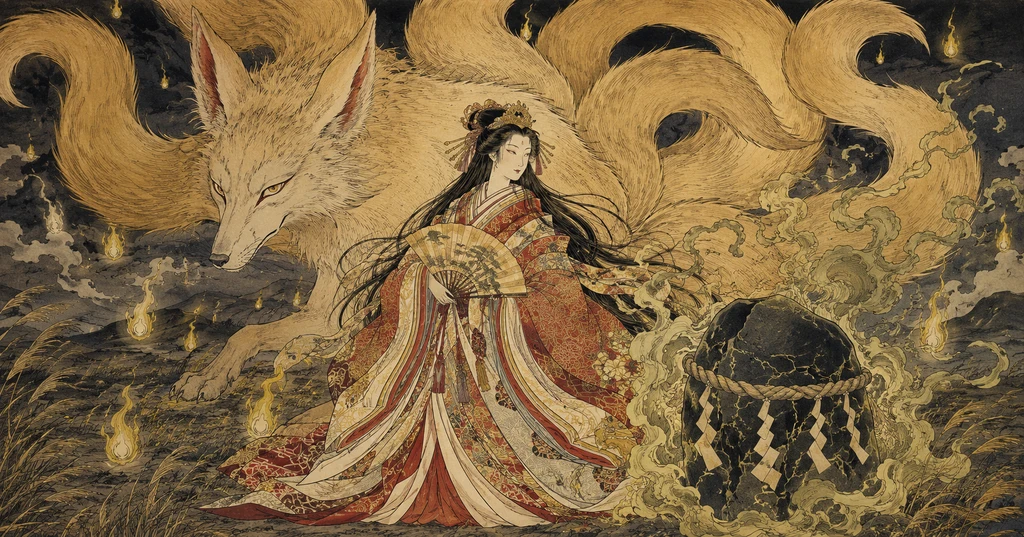
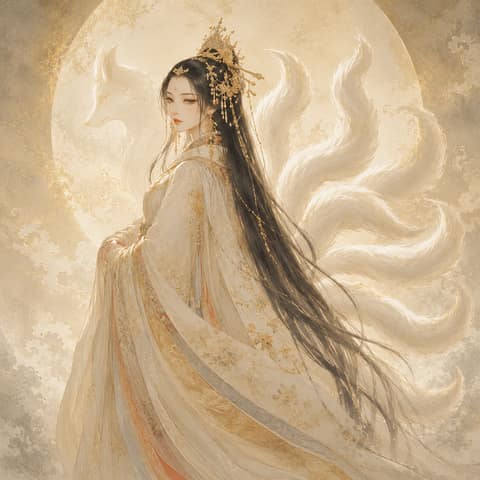
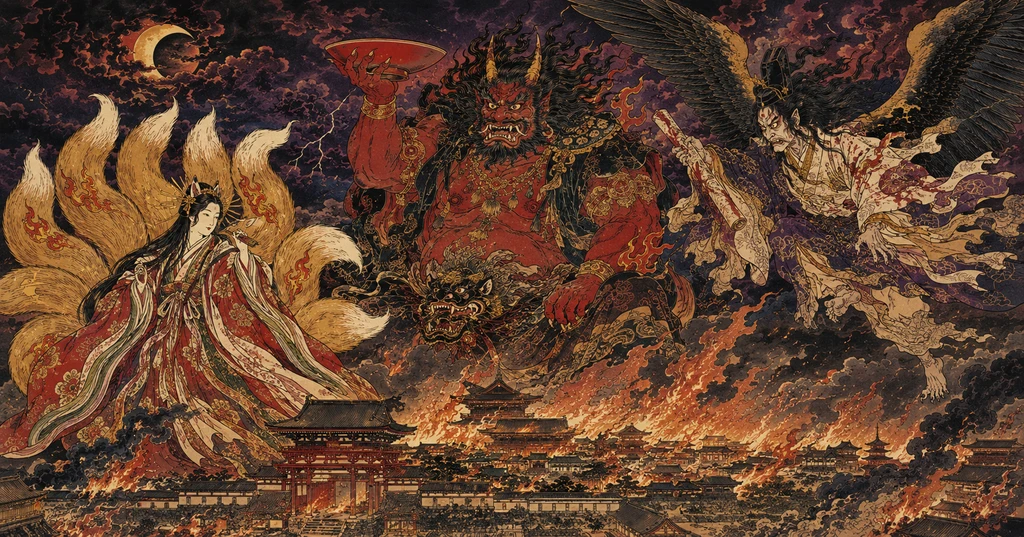
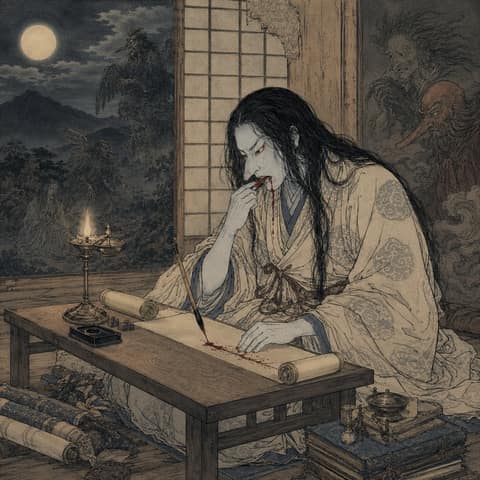
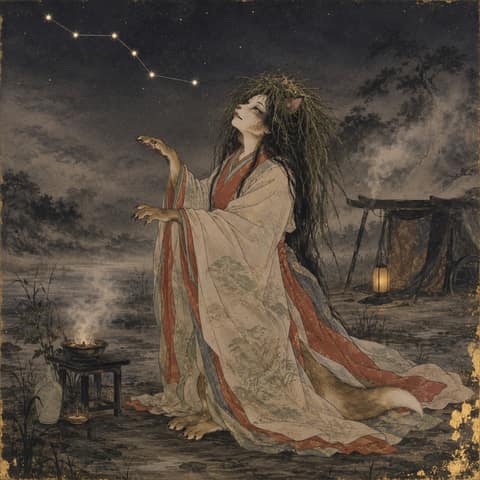
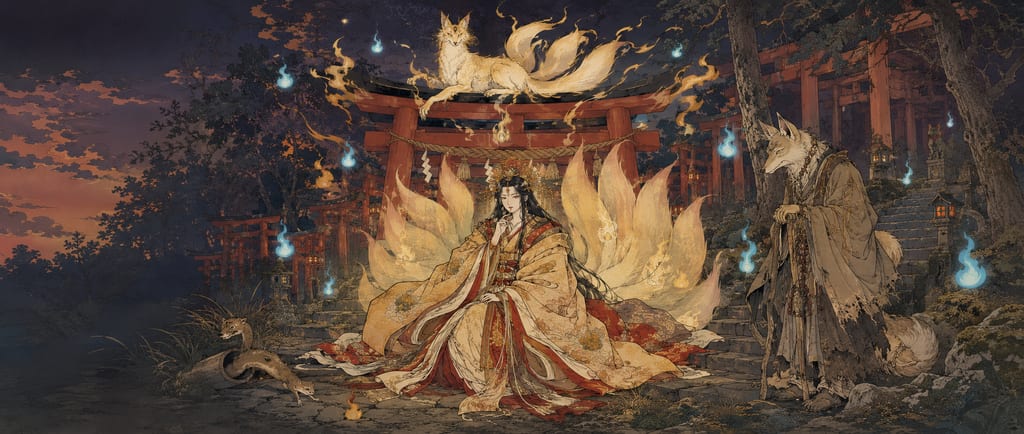
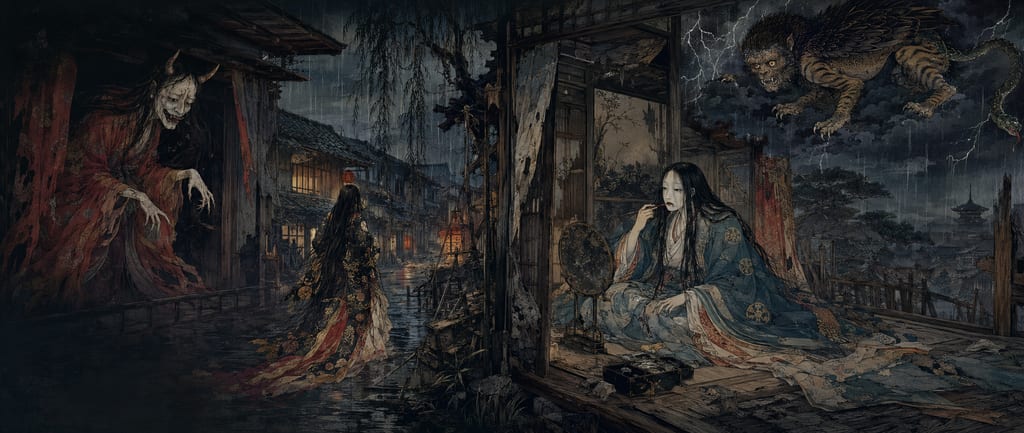
Tamamo-no-Mae is a beauty of unrivaled grace who, in the late Heian period, is said to have served the retired Emperor Toba. Her true form is held to be a nine-tailed fox, yet as a human, Tamamo-no-Mae has above all been remembered as a court lady of rare beauty and deep learning. Poetry and music were a given, but from Buddhist scripture to the old tales of India and China[1], she answered any question without hesitation, astonishing all at court.
The name “Tamamo-no-Mae” carries a story of its own. One night, amid a banquet of poetry and music at the Seiryōden, a gust of wind snuffed out the lamps; in the darkness a dazzling light streamed from her body and lit the hall as bright as day. From this she came to be called “Tamamo-no-Mae,” meaning the lady of the jewel-like, glowing waterweed [1]. Before that, it is said, she had been called Mikuzume. In time she drew all the emperor’s affection to herself, but when he fell ill from an unknown cause, her true nature began to be doubted.
A Glimpse of Tamamo-no-Mae
Behind her beauty, a thousand years of presence shimmers.
Folklore & Legends
The tale of Tamamo-no-Mae is old; her name appears in the Shinmeikyō[2] of the Nanbokuchō period. Yet the grand backstory we now picture—“a nine-tailed fox that roamed the three lands of India, China, and Japan”—was not there from the start. At the stage of the Muromachi-period otogizōshi Tamamo no Sōshi[1], Tamamo-no-Mae was still only an old fox with two tails, drawn simply as a learned court lady. Her fusion with continental femmes fatales such as Daji and Lady Huayang, gathered into a single nine-tailed-fox narrative, came in the late Edo period (around 1800)[3], when popular fiction such as Takai Ranzan’s Ehon Sangoku Yōfuden (Illustrated Tale of the Bewitching Woman of Three Kingdoms)[4] fixed her image.
The episode of her unmasking also has traditions rooted in particular places. Seen through as a spirit-fox by an onmyōji, Tamamo-no-Mae fled the court for the Nasu Plain in Shimotsuke Province. At the Tamamo Inari Shrine[5] in Ōtawara, Tochigi Prefecture, a founding legend still survives: the hunted fox changed into a cicada and hid in the shade of a cherry tree, but its true form, reflected on the surface of the shrine’s Kagami-ga-ike (Mirror Pond), was seen through by the pursuing army.
As the tale spread, Tamamo-no-Mae also became a star of the stage. Beginning with the 1751 puppet play (jōruri) Tamamo-no-Mae Asahi no Tamoto[6], followed by an expanded version of 1806 and the fourth Tsuruya Nanboku’s kabuki Tamamo-no-Mae Mizo no Misogi (1821), she was performed again and again in jōruri and kabuki, and survives today in the bunraku repertoire. In imagery, too, Toriyama Sekien[7] included Tamamo-no-Mae in his Konjaku Gazu Zoku Hyakki (1779).
Some, moreover, see the shadow of historical fact in this plot of a peerless beauty who disorders the realm through royal favor. One theory makes the model for Tamamo-no-Mae the lady Bifukumon’in (Fujiwara no Nariko), the beloved consort of the retired Emperor Toba who stood at the heart of the maneuvering over imperial succession. This, however, is no more than conjecture and has never been confirmed as historical fact.
This version turns to the events leading up to Tamamo-no-Mae’s unmasking and defeat. When the retired Emperor Toba’s illness grew at last grave, the onmyōji Abe no Yasunari (modeled on the historical Abe no Yasuchika), ordered to divine the cause, named Tamamo-no-Mae herself as its source. As Yasunari performed rites at court and cornered her, Tamamo-no-Mae could no longer hold her human shape; revealing her fox form, she fled eastward from the capital.
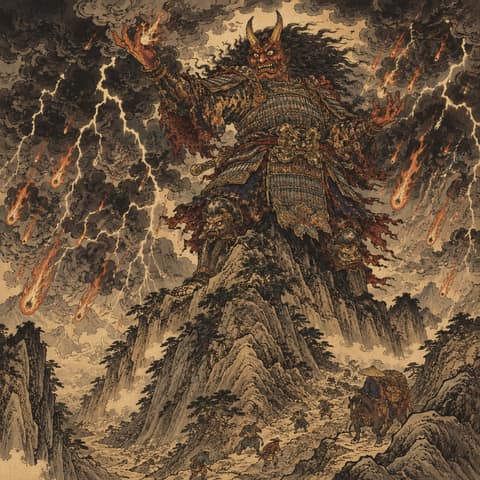
The place she fled to was the Nasu Plain in Shimotsuke Province (the area around present-day Nasu in Tochigi Prefecture[5]). To subdue the spirit-fox lurking in the wilds and harming people and livestock, the court dispatched warriors of the eastern provinces, Kazusa-no-suke Hirotsune and Miura-no-suke Yoshiaki. The warriors surrounded the plain, drove the fox out, and at last brought it down with arrows, so the tradition runs. The names of these warriors who slew Tamamo-no-Mae overlap with those of real Bandō warriors of the Genpei era—an intriguing case of legend and history told as one.
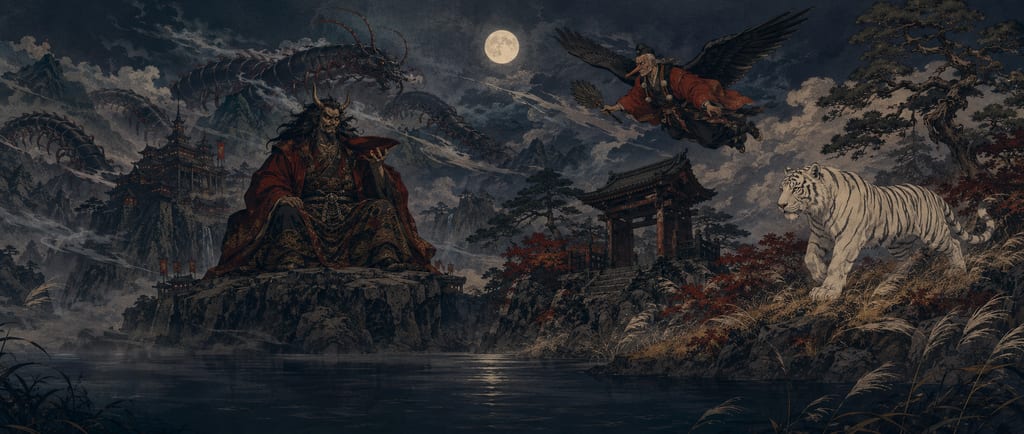
In the story, Tamamo-no-Mae has usually been drawn as the very type of the “beauty who topples nations”—one who, through her beauty and wit, works her way to the summit of the realm and brings it down from within. Yet at the same time, once slain, she was enshrined in a small sanctuary and worshipped as a deity. Dreadful spirit-fox though she is, one cannot help being drawn to her. It is precisely this duality that keeps Tamamo-no-Mae from ending as a mere villain and makes her a figure beloved for ages.
Character Profile
This section is our own creative profile for storytelling. It is not historical fact or scholarship.
She wins hearts with wit and beauty, yet hides a cold resolve that will corrode even the emperor to reach her ends. Graceful and gentle on the surface, within she harbors an obsession that nothing can bend.
Compatibility
The seat of power, the elegant court; her strength is said to grow the nearer she is to human pride and desire
Abilities
Transforming into a beauty without equalWinning royal favor through erudition and eloquenceSickening people with a baleful auraBewildering the human heart with illusion magic
Weaknesses
Her true nature is exposed by the prayers and divination of the onmyōji
the consecrations and subjugation rites of the gods and buddhas
her true form is reflected on water or in a mirror
Habitat
The imperial court, the Seiryōden, the Nasu Plain in Shimotsuke Province
The diagram below is a diagnostic evaluation chart for Tamamo-no-Mae, the Nine-Tailed Fox Beloved of Emperor Toba. The higher the value of each item, the stronger that characteristic is expressed.