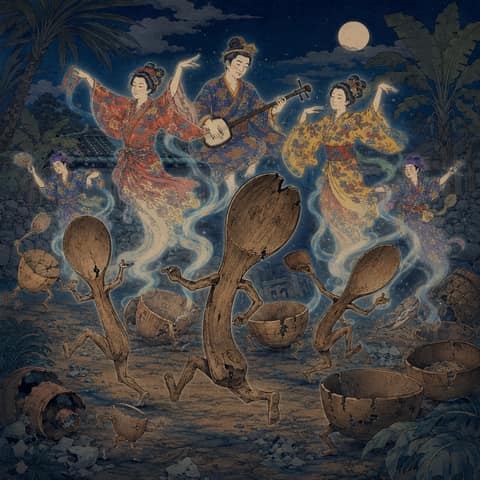
"Mamono" vs. "Majimun": Similar Words, Different Worlds. While the basic overview touched upon the shared etymology with the ancient word "Majimono," this deep dive explores how "Majimun," despite sounding akin to the mainland Japanese "Mamono," operates within an entirely different conceptual framework. The mainland "Mamono" is an abstract concept that absorbed the Buddhist and Onmyōdō notion of "Mara" (demons/impediments to enlightenment). In stark contrast, the Ryukyuan Majimun is rooted in the indigenous, pre-Buddhist animism of the southern islands, holistically encompassing nature spirits, ghosts of the dead, localized spirits, and haunted objects. This reflects the historical trajectory of the Ryukyu Kingdom, which received relatively little influence from the centralized Buddhist cultural sphere, thereby preserving its unique religious ecosystem.
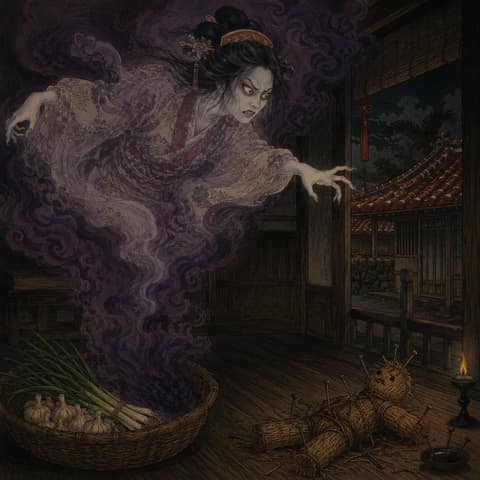
The Logic of Genesis: "The Generation of Demonic Force". While the mainland Japanese *Tsukumogami* relies on the generative logic that "a tool left for 100 years will have a soul dwell within it," the Ryukyuan object Majimun operates on a more abstract dynamic theory: "demonic force is generated from old objects." This aligns perfectly with the Ryukyuan religious concept of *Seji* (spiritual power), grounded in a worldview where invisible forces inherent in all things manifest under certain conditions. Following Chōei Kinjō's classification, Majimun can be understood as the "photographic negative of Seji"—spiritual power turned malignant.
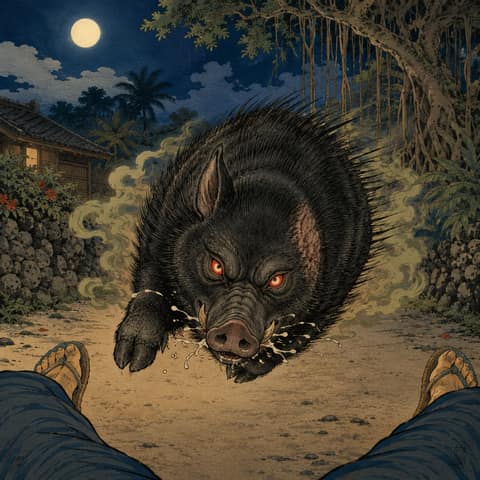
A Structural Analysis of "Crotch-Crawling". The universal Ryukyuan taboo that "you will die if an animal Majimun crawls between your legs" is structurally fascinating. In the schema of the human body, the crotch is a privileged liminal space acting as a "bottom-to-top passageway." For an otherworldly entity to pass through this space signifies an invasion and a violent forced extraction of the soul. While this parallels mainland Japan's spiritual anxieties regarding boundaries like "bridges, crossroads, and borders," Ryukyu is unique in its emphasis on the boundaries of the physical body. In Ryukyuan belief, the *Mabui* (soul) is not fixed to a specific spot but flows in and out; "crotch-crawling" is positioned as a violent connection that forces this extraction.
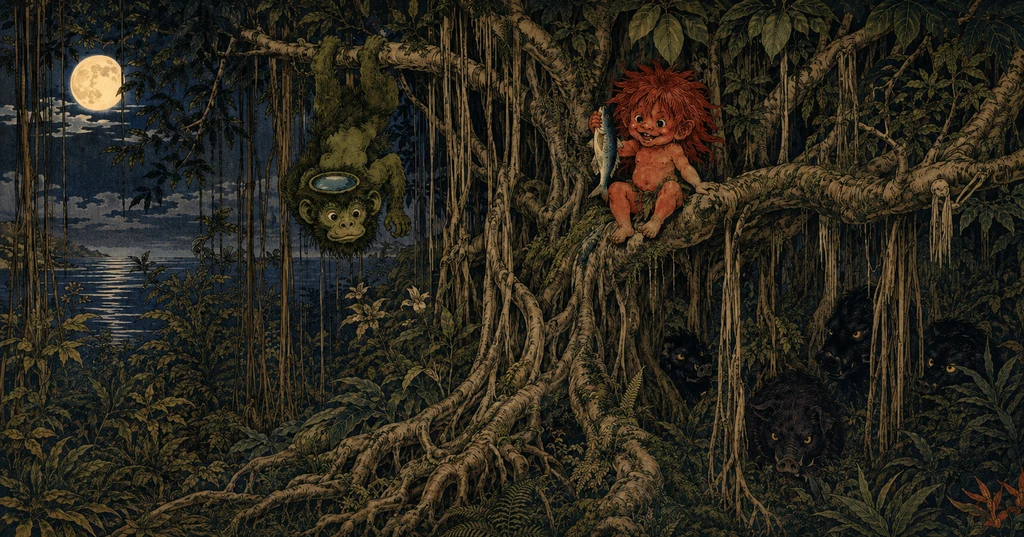
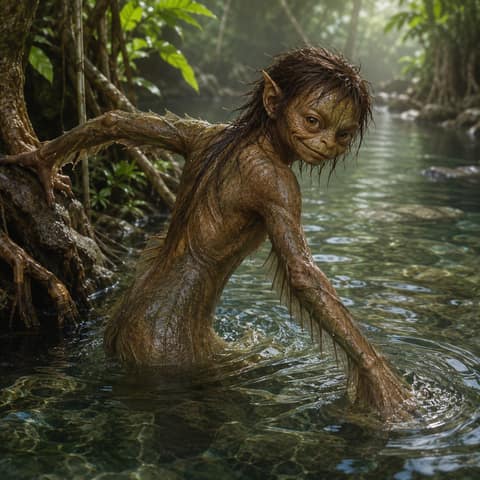
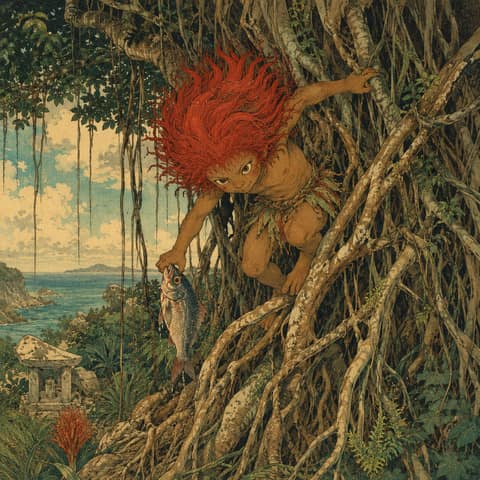
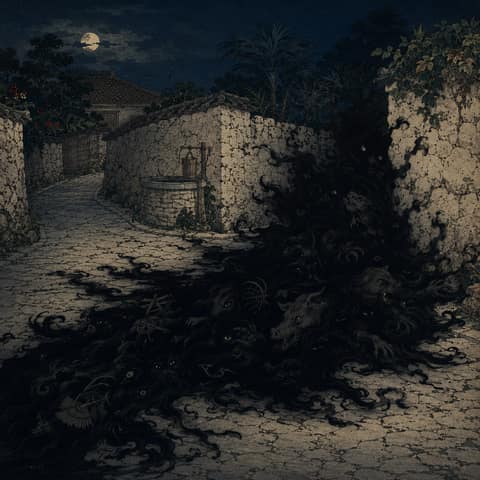
The Epistemological Trait: "Majimun Have No Fixed Form". Surveying the cases in the *Yokai Database*, the greatest characteristic of the Majimun is its "lack of inherent visual form." It is only named by appending "Majimun" to whatever it has possessed or transformed into (a pig, a rice scoop, an infant). There exists no iconographic representation of "Majimun itself." This stands in sharp contrast to mainland Japanese yokai, which, since Sekien Toriyama's *Gazu Hyakki Yagyo* (The Illustrated Night Parade of a Hundred Demons), moved toward solidifying "visual identity as individual characters." Ryukyu retained the Majimun as an abstract concept of "invisible demonic force" until the very end, making it a uniquely challenging subject in comparative yokai studies.
Kinjō, Iha, and Orikuchi: The Lineage of Pre-war Okinawan Studies. In the pre-war era, Majimun research blossomed within the broader context of Okinawan Studies. Sparked by Fuyū Iha's *Ko Ryukyu* (Ancient Ryukyu) in 1911, prominent mainland scholars like Shinobu Orikuchi and Kunio Yanagita frequently visited Okinawa, positioning the southern islands' folklore as a vital comparative mirror to the mainland. Chōei Kinjō's yokai treatises were written amid this academic tide, providing a perspective that read the Majimun not merely as a "bizarre Okinawan oddity," but as a "systematic expression of the Ryukyuan concept of the soul." Post-war scholars like Ken'ichi Tanigawa and Kenji Murakami inherited this mantle, shaping the modern discipline of Ryukyuan yokai studies.
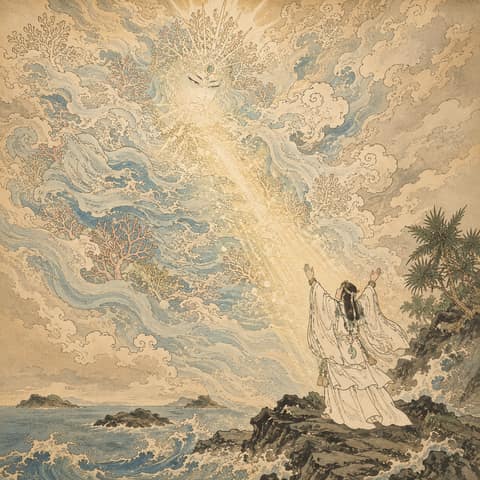
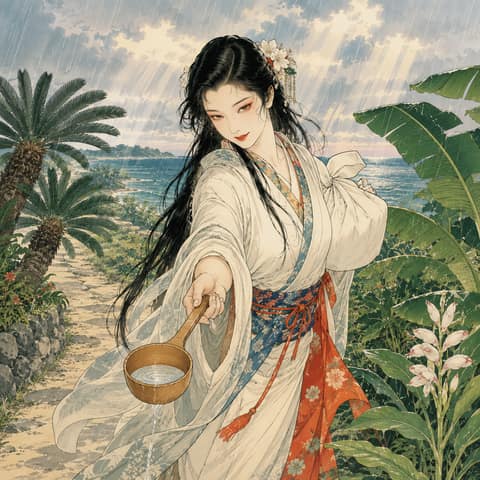
Systemic Integration with Shisa and Utaki Faith. The Majimun concept does not operate in isolation; it forms a cohesive system with the entirety of Ryukyuan religious culture. Majimun shoulder the "demonic power," while the *Shisa* (guardian lion statues), *Utaki* (sacred groves), *Yuta* (shamans), and *Nuru* (priestesses) shoulder the "sacred power." The symmetry and mutual necessity of these two sides construct the Ryukyuan cosmic order of the sacred and the profane, the pure and the impure, and this world and the next. To study Majimun is directly tied to studying the entire worldview of Okinawan folklore, possessing a cultural anthropological scope far beyond a single monster encyclopedia entry.
Modern Legacy: Folkloric Tourism and Entertainment. In post-war Okinawa (and especially after the reversion to Japan), Majimun legends have been adapted into tourism resources, children's books, and manga. They appear in children's literature like *Okinawa no Majimun-zu!* (Border Ink), in exhibits at the Ocean Expo Park's "Native Okinawan Village," and even in mainland exhibitions like the Hyogo Prefectural Museum of History's 2017 showcase on Ryukyuan Yokai. However, because Majimun are inextricably linked to Okinawan living ethics, boundary consciousness, and views on life and death, their consumption in the context of tourism and entertainment demands a respectful attitude toward their profound cultural depths.
Character Profile
This section is our own creative profile for storytelling. It is not historical fact or scholarship.
Yokai Type - Traditional Yokai
Category - Ghosts & Spirits
Rarity - Legendary
Personality - It lacks an individual personality, manifesting purely as an "invisible demonic force." Borrowing the forms of animals, discarded objects, or the dead, it emerges in liminal nocturnal spaces (crossroads, beaches, dark roads) to menace the souls of humans.
Compatibility - It brings no harm to those who observe proper etiquette and respect boundaries (gates, crossroads, beaches), and is effectively repelled by Shisa statues, Utaki faith, and the prayers of Nuru/Yuta priestesses. However, those who lack manners or trespass across spiritual borders are met with violent spiritual assaults, such as the fatal "crotch-crawl."
Abilities - The power to possess or transform into animals, old utensils, and the dead.The ability to extract a person's Mabui (soul) via the fatal 'crotch-crawl'.The capacity to disguise itself as human and infiltrate nocturnal gatherings like the Moashibi.The power to disorient and lose travelers at crossroads and night roads (Hichi-Majimun).The generation of 'demonic force' within ancient, discarded tools (Mishige, Nabige).Specialized manifestations based on categories of the deceased (infants, old women, prostitutes).
Weaknesses - Religious guardianship provided by Shisa (lion statues), Utaki (sacred groves), Nuru, and Yuta. Traditional wards such as salt, Koha (cycad leaves), and Japanese star anise. The crowing of a rooster (the arrival of dawn), and strict adherence to community etiquette and the respect of boundaries.
Habitat - The liminal boundary zones of Okinawa, the Ryukyu Islands, and the Amami archipelago: dark roads, crossroads, beaches, ancient wells, discarded tools, village borders, and graveyards.