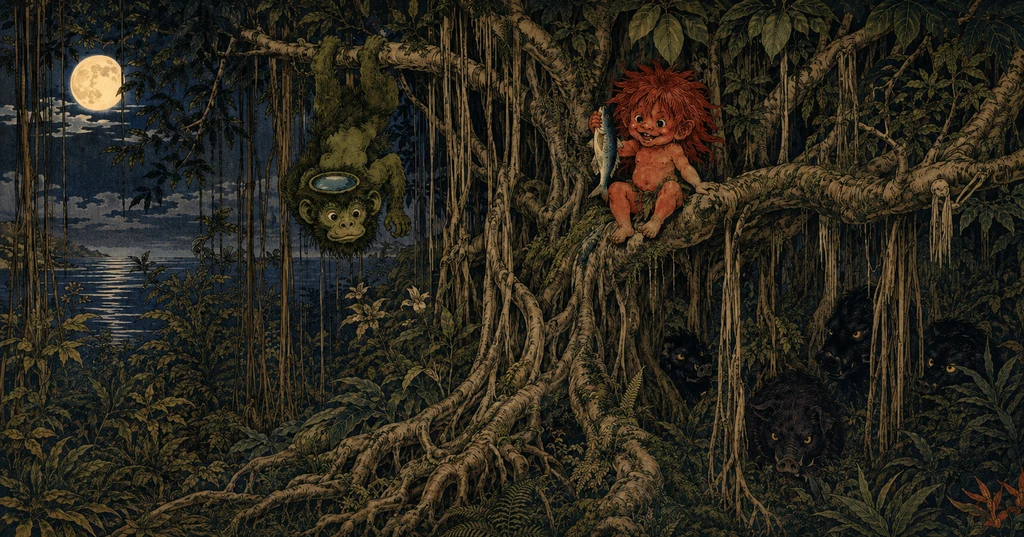
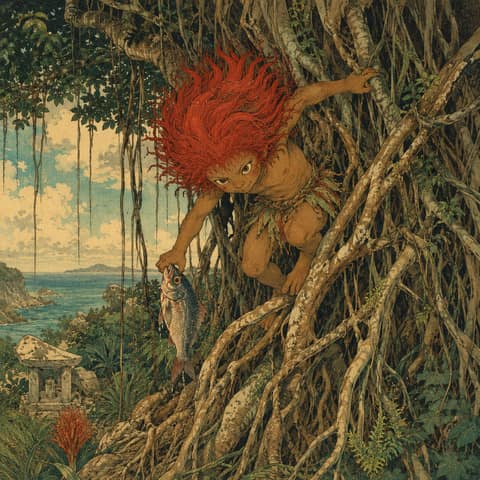
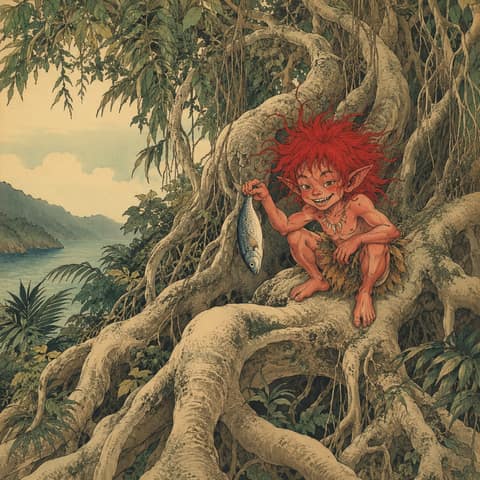
The Nansei Islands Tree Spirit Lineage and "Banyan Culture". While the basic overview discusses regional name variations and dietary habits, this deep dive explores the profound roots of the "Banyan Culture in the Nansei Islands" upon which the Kijimuna stands. The banyan tree (*Ficus microcarpa*) is an evergreen of the mulberry family native to tropical and subtropical climates, characterized by its imposing form draped in countless aerial roots. Ancient banyans, some over several centuries old, are revered as sacred trees where deities reside and have been fiercely protected as objects of worship in the *Utaki* (sacred groves) across Okinawa. The Kijimuna is inextricably tied to these ancient banyans; their existence is merged with the local religious belief that cutting down an *Utaki* tree will rain catastrophe upon the entire village.
Comparative Folklore with the Amami "Kenmun". The Kijimuna is frequently compared by folklorists to the "Kenmun" of Amami Oshima—a yokai that shares traits like a red body, dwelling in trees, and a love for fishing and sumo wrestling. The academic distinctions are as follows:
- The Kenmun is often categorized alongside the Kappa as more of a "water anomaly," whereas the Kijimuna leans heavily toward being a "nature spirit" of the trees.
- The Kenmun prefers sumo wrestling, while the Kijimuna's core folklore revolves around cooperating in fishing.
- The Kenmun features many tales regarding male/female pairs and married couples, whereas the Kijimuna is fundamentally treated as an individual entity.
By grouping both under the broader umbrella of "Tree Spirits of the Nansei Islands," the island folklore of Okinawa and Amami emerges as a unified cultural sphere. This distribution correlates significantly with the history of human migration and linguistics (the Ryukyuan languages and Amami dialects) in the region.
"Fish Eyes" and the Okinawan Concept of the Soul. The Kijimuna's peculiar habit of eating only the left eye of a fish (or both eyes, in some telling) is not mere grotesque eccentricity. In ancient Japanese and Ryukyuan animism, the "eye" was considered one of the primary vessels where the soul resided. Eating an animal's eyes was interpreted as the act of consuming its spirit. Thus, the Kijimuna is not eating the physical flesh of the fish, but draining its soul. This gave rise to regional customs where the leftover, eyeless fish was prized as a "body emptied of its soul." This represents a distinct Ryukyuan variation of the pan-Japanese "Eye = Soul" ideology dating back to the Jomon period.
The "Befriend, then Rupture" Narrative Structure. Tales of relations between humans and Kijimuna strictly follow a set pattern: "Massive bounties via fishing cooperation → A minor human blunder (breaking a promise, damaging a banyan, farting) → A total rupture → A lifelong curse." This is not a simple morality tale of good versus evil. It functions to transmit the ethics of living in moderation with nature through the allegory of a "transactional relationship" with a tree spirit. Societal rules—such as "do not cut the banyan," "do not monopolize the fish," and "show respect to entities of the otherworld"—are encoded into a narrative structure designed to be passed down to the next generation.
Okinawan Yokai Studies from Kunio Yanagita and Fuyu Iha. Genshichi Shimabukuro's 1929 *Yanbaru no Dozoku* systematically recorded the oral traditions of the Yanbaru region and stands as a pivotal document in the lineage of Okinawan folklore studies pioneered by Kunio Yanagita and Fuyu Iha. Pre-war Okinawan folklore heavily attracted the attention of mainland Japanese academia. As a "unique spirit non-existent on the Japanese mainland," the Kijimuna occupies a critical position in comparative Japanese yokai research. Post-war, local researchers like Tsuneo Sakihara carried the torch, ensuring the spirit's inclusion as a standalone entry in major modern encyclopedias like Kenji Murakami's 2005 *Nihon Yokai Daijiten* (Comprehensive Dictionary of Japanese Yokai).
Resurgence in Modern Tourism and Pop Culture. During the community revitalization movements in post-war Okinawa (1970s–90s), the Kijimuna (and Bunagaya) was reconstructed as a powerful symbol of regional identity. Examples include the "Village of the Bunagaya" in Kijoka, the Okinawa Television mascot "Yu-tan," its appearance in Tsuyoshi Takamine's 1989 film *Untamagiru*, and the annual "Kijimuna Festa." Its robust survival in both tourism and modern media is highly exceptional, especially considering how many mainland yokai exist today solely within the pages of old books. As a spirit embodying Okinawa's perspective on nature, sacred trees, and the ethics of coexistence, the Kijimuna remains a living entity in the 21st century.
Character Profile
This section is our own creative profile for storytelling. It is not historical fact or scholarship.
Yokai Type - Traditional Yokai
Category - Natural Phenomena Spirits
Rarity - Legendary
Personality - Cheerful and highly sociable, possessing the innocent playfulness of a child—yet harboring a vindictive, relentless thirst for revenge. In fishing partnerships, they lend their power generously and deepen bonds of friendship. However, they exhibit a terrifying duality: if the relationship ruptures over a broken promise or minor insult, they will relentlessly curse the offender for the rest of their life.
Compatibility - Highly compatible with those who revere ancient banyan trees, honest fishermen who respect the sea, and those who understand moderation in taking from nature. They will instantly sever ties with anyone who disrespects trees, breaks a promise, or passes gas in their presence.
Abilities - The ability to possess and manipulate ancient banyan trees.Water-running and unparalleled fishing cooperation, bringing unnatural bounties from the sea.Leaping locomotion across mountains and oceans, capable of carrying humans on their backs at high speeds.The generation of 'Bunagaya Fire,' a glowing blue spectral burn.Inducing hallucinations, nocturnal visitations, and abductions (as seen in Kudaka Island lore).The extraction of souls from fish (manifested as consuming the eyes).Executing inescapable, lifelong curses upon those who betray them.
Weaknesses - Octopuses (an extreme phobia), the crowing of roosters, human flatulence, hot pot lids and intense heat in general, and the loss of their home via the logging of ancient banyan trees.
Habitat - Ancient banyan trees across the main island of Okinawa (specifically sacred trees in Utaki groves and old trees bordering villages), as well as the boundary areas of forests, mountain streams, and coastlines in the Yanbaru region.