Yokai Encyclopedia

Encyclopedia of Japanese Yokai

22 Yokai|14 Category|Page 1 of 1
Localization in Progress - More content available in Japanese version
View Japanese
Sort by: NameAscending
自然現象・自然霊
  • Banana-Plant Spirit

    Banana-Plant Spirit

    Rare

    bah-SHOW-noh-SAY

    Tradition-Faithful, Sekien Illustrated Edition

    Natural Phenomena SpiritsNagano

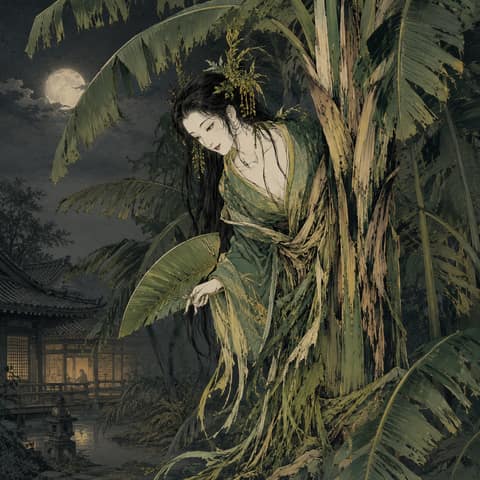
    A整理 based on the plant-spirit of banana (bashō) as pictured in Toriyama Sekien’s Konjaku Hyakki Shūi. The broad leaves rustle and cast uncanny shadows in wind and rain, thought to summon the strange, with the belief that an aged clump comes to harbor a spirit. It takes the form of a beautiful woman to unsettle both clergy and laity, posing the riddle of whether grasses and trees can attain Buddhahood, and vanishes depending on one’s response. Tales include encounters in Ryukyuan banana groves, an apotropaic rule that those who carry blades are spared, and Shinano stories where striking it leaves the bashō stalk wounded by morning. It is not consistently harmful, more often serving as a warning through shock and confusion. Typical settings are temple gardens, banana plots, and manor yards.

  • Chōchin-bi (Lantern Fire)

    Chōchin-bi (Lantern Fire)

    Uncommon

    CHOH-cheen-bee

    Chochin-bi (Lantern-Flame, regional will-o’-the-wisp type)

    Natural Phenomena SpiritsAcross Japan (notably Shikoku, Yamato, and Ōmi traditions)

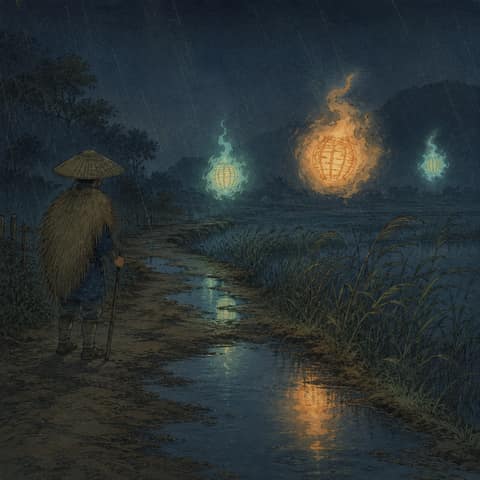
    A regional catch-all name for ghostly lights about the size of a paper lantern. In some areas it is conflated with kitsune-bi and tanuki-bi, its name stemming from the idea of monsters lighting lanterns. It appears on rainy nights along riverbanks, dikes, and graveyards, drifting at a fixed height. Accounts vary by era and locale: vanishing when approached, splitting when struck, or marching in clusters. In folklore it portends untimely death or a curse and marks taboos along the roadside, anchoring tales that warn against pursuit or striking it. It appears in early modern essays and kaidan, sometimes gaining proper names (such as Koemon-bi) and lodging in local memory. Natural ignition and animal-origin theories coexist, and its true nature remains unsettled.

  • Fire of the Akuro-gami

    Fire of the Akuro-gami

    Uncommon

    AH-koo-roh-gah-mee no HEE

    Canonical Folklore Version

    Natural Phenomena SpiritsMie

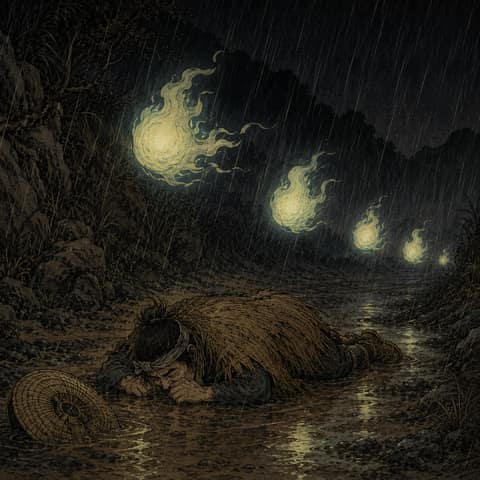
    A figure based on Edo-period records. On rainy nights it drifts low, coming and going like a procession of lantern lights. Rather than misleading travelers, it was dreaded for bringing illness to anyone who drew near, and the only recourse was to lie flat on the ground until it passed. Local names vary, and it is classed as one type of strange fire from Ise Province. Its substance is unknown, it makes little sound, and reports note few sensory details such as heat or odor even at close range.

  • Furari-bi (Wandering Flame)

    Furari-bi (Wandering Flame)

    Rare

    foo-RAH-ree-bee

    Furari-bi

    Natural Phenomena SpiritsJapanese folklore

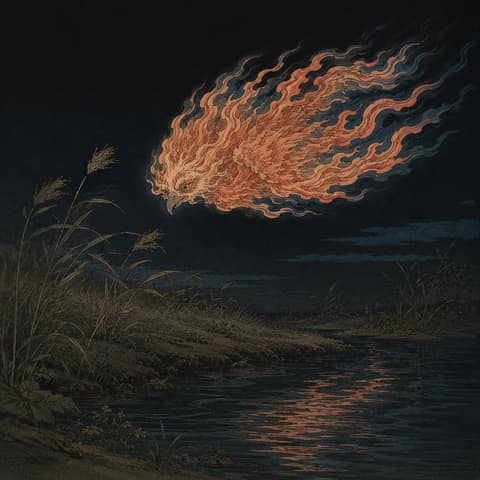
    Based on Edo-period picture scrolls, this version standardizes Furari-bi as a bird-shaped eerie flame wreathed in fire. It behaves more like a phenomenon than a corporeal being, with sightings reported from dusk through midnight. Confirmed cases of causing harm are scarce, and it shares common will-o’-the-wisp traits such as vanishing when approached and reappearing when one retreats. In Toyama it is called “Burari-bi,” often explained as a ghostly fire born from grudges or the unclaimed dead, though interpretations vary by region. The avian visage in the iconography is ambivalent, serving as a symbolic sign of the soul’s metamorphosis.

  • Grave Fire

    Grave Fire

    Rare

    HAH-kah-noh HEE

    Traditional Iconography Edition

    Natural Phenomena SpiritsGraveyards across Japan, notably Kyoto Prefecture

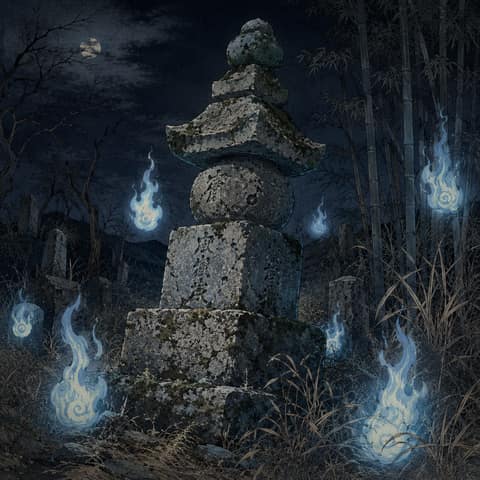
    A grave-fire image based on Sekien’s iconography. The pairing of a ruined graveyard, overgrown thickets, and a five-ring stupa with worn Sanskrit letters symbolizes the idea of fire dwelling in places without kin or proper memorials. Early modern tales describe it as a phosphorescent flame rising from human fat or grave soil, yet also tell of cases where chanting sutras or repairing the stupa makes it vanish, showing the overlap of religious practice and naturalistic views. The flame drifts as if following human silhouettes, but slips away when touched. Malice is rare, and it is rumored to light the path ahead like a guide.

  • Human-Faced Tree

    Human-Faced Tree

    Rare

    neen-MEN-joo

    Illustrated Compendium Tradition—Sekien Design Edition

    Natural Phenomena SpiritsUnknown; said in sources to grow in the distant land of Dashi ("Great Food" country) to the southwest

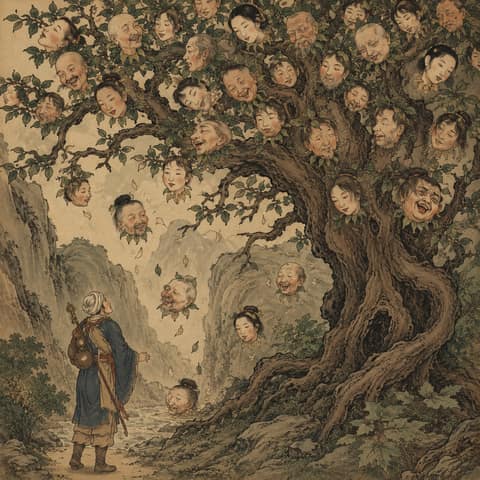
    Based on Edo-period natural history notes and shaped by Toriyama Sekien’s pictorial intent. It is a tree that grows thick in mountain valleys and bears blossoms at the tips of its branches that resemble human faces. The flowers do not understand human speech, but are said to smile at calls or sounds. When laughter overlaps, the petals lose strength and eventually wither and fall. In Japan it was received as a tale of foreign curiosities, lacking specific local toponyms or anecdotes. The faces vary from old to young, often depicted grinning with teeth as they sway in the wind. Its true nature is unclear—treated either as a plant spirit or a rare anomalous tree—and it was recorded more as a curiosity than a source of fear.

  • Jiosenbi

    Jiosenbi

    Uncommon

    じおうせんび

    The Vengeful Fire of the Jiosen Peddler Lit at Izuminawate on Rainy Nights

    Natural Phenomena / Natural SpiritsShiga

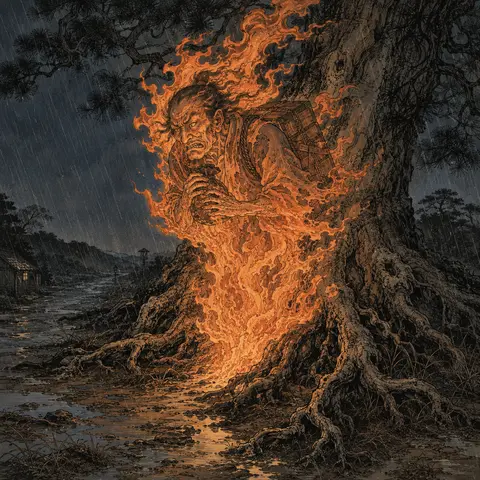
    Even among early modern ghost fire tales, the Jiosenbi is a rare example where "who, where, and why" are told in concrete detail. The victim is not a nameless monster, but a peddler selling a real-life sweet called Jiosen, and the scene is the Hizagashira Pine at Izuminawate near the Tokaido's Minakuchi post town—a large tree whose location people could identify. The conditions for the fire's occurrence are also restricted to "rainy nights." It is thought that the experience of seeing will-o'-the-wisps or fox fires on humid nights became intertwined with memories of murders along the highway, solidifying into a single ghost story. The fire as a symbol of obsession with money connects to the lineage of grudge tales born from the monetary economy of early modern cities. As an apparition rooted in the land of Minakuchi, Koka District, it holds value in being passed down alongside other local entities like the Katawa-guruma and Koka Saburo.

  • Kijimuna

    Kijimuna

    Legendary

    kijimuna

    The Banyan Spirit: Kijimuna

    自然現象・自然霊Okinawa

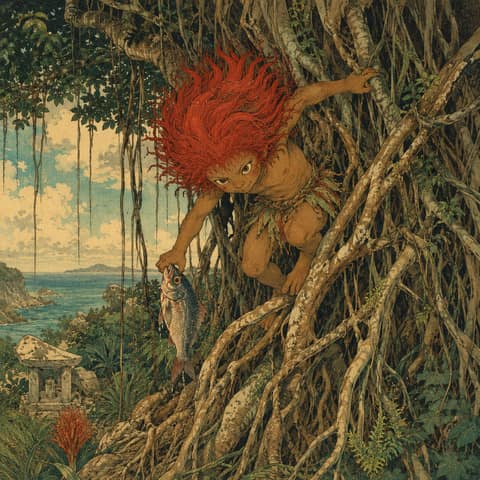
    The Nansei Islands Tree Spirit Lineage and "Banyan Culture". While the basic overview discusses regional name variations and dietary habits, this deep dive explores the profound roots of the "Banyan Culture in the Nansei Islands" upon which the Kijimuna stands. The banyan tree (*Ficus microcarpa*) is an evergreen of the mulberry family native to tropical and subtropical climates, characterized by its imposing form draped in countless aerial roots. Ancient banyans, some over several centuries old, are revered as sacred trees where deities reside and have been fiercely protected as objects of worship in the *Utaki* (sacred groves) across Okinawa. The Kijimuna is inextricably tied to these ancient banyans; their existence is merged with the local religious belief that cutting down an *Utaki* tree will rain catastrophe upon the entire village. Comparative Folklore with the Amami "Kenmun". The Kijimuna is frequently compared by folklorists to the "Kenmun" of Amami Oshima—a yokai that shares traits like a red body, dwelling in trees, and a love for fishing and sumo wrestling. The academic distinctions are as follows: - The Kenmun is often categorized alongside the Kappa as more of a "water anomaly," whereas the Kijimuna leans heavily toward being a "nature spirit" of the trees. - The Kenmun prefers sumo wrestling, while the Kijimuna's core folklore revolves around cooperating in fishing. - The Kenmun features many tales regarding male/female pairs and married couples, whereas the Kijimuna is fundamentally treated as an individual entity. By grouping both under the broader umbrella of "Tree Spirits of the Nansei Islands," the island folklore of Okinawa and Amami emerges as a unified cultural sphere. This distribution correlates significantly with the history of human migration and linguistics (the Ryukyuan languages and Amami dialects) in the region. "Fish Eyes" and the Okinawan Concept of the Soul. The Kijimuna's peculiar habit of eating only the left eye of a fish (or both eyes, in some telling) is not mere grotesque eccentricity. In ancient Japanese and Ryukyuan animism, the "eye" was considered one of the primary vessels where the soul resided. Eating an animal's eyes was interpreted as the act of consuming its spirit. Thus, the Kijimuna is not eating the physical flesh of the fish, but draining its soul. This gave rise to regional customs where the leftover, eyeless fish was prized as a "body emptied of its soul." This represents a distinct Ryukyuan variation of the pan-Japanese "Eye = Soul" ideology dating back to the Jomon period. The "Befriend, then Rupture" Narrative Structure. Tales of relations between humans and Kijimuna strictly follow a set pattern: "Massive bounties via fishing cooperation → A minor human blunder (breaking a promise, damaging a banyan, farting) → A total rupture → A lifelong curse." This is not a simple morality tale of good versus evil. It functions to transmit the ethics of living in moderation with nature through the allegory of a "transactional relationship" with a tree spirit. Societal rules—such as "do not cut the banyan," "do not monopolize the fish," and "show respect to entities of the otherworld"—are encoded into a narrative structure designed to be passed down to the next generation. Okinawan Yokai Studies from Kunio Yanagita and Fuyu Iha. Genshichi Shimabukuro's 1929 *Yanbaru no Dozoku* systematically recorded the oral traditions of the Yanbaru region and stands as a pivotal document in the lineage of Okinawan folklore studies pioneered by Kunio Yanagita and Fuyu Iha. Pre-war Okinawan folklore heavily attracted the attention of mainland Japanese academia. As a "unique spirit non-existent on the Japanese mainland," the Kijimuna occupies a critical position in comparative Japanese yokai research. Post-war, local researchers like Tsuneo Sakihara carried the torch, ensuring the spirit's inclusion as a standalone entry in major modern encyclopedias like Kenji Murakami's 2005 *Nihon Yokai Daijiten* (Comprehensive Dictionary of Japanese Yokai). Resurgence in Modern Tourism and Pop Culture. During the community revitalization movements in post-war Okinawa (1970s–90s), the Kijimuna (and Bunagaya) was reconstructed as a powerful symbol of regional identity. Examples include the "Village of the Bunagaya" in Kijoka, the Okinawa Television mascot "Yu-tan," its appearance in Tsuyoshi Takamine's 1989 film *Untamagiru*, and the annual "Kijimuna Festa." Its robust survival in both tourism and modern media is highly exceptional, especially considering how many mainland yokai exist today solely within the pages of old books. As a spirit embodying Okinawa's perspective on nature, sacred trees, and the ethics of coexistence, the Kijimuna remains a living entity in the 21st century.

  • Koropokkuru

    Koropokkuru

    Legendary

    koropokkuru

    Little People Under the Leaves: Koropokkuru

    自然現象・自然霊Hokkaido

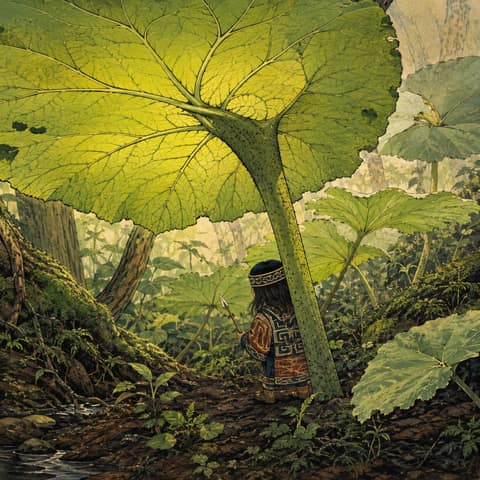
    The Ecological Perspective: "People Under the Butterbur Leaves". While the basic overview touched upon the Ainu etymology, this deep dive explores how the Koropokkuru legend is fundamentally tied to the ecology of Hokkaido and Sakhalin. The giant butterbur (*Petasites japonicus var. giganteus*) native to Hokkaido possesses stalks taller than a human adult, with leaves exceeding 1.5 meters in diameter. The custom of repurposing these massive leaves as umbrellas or roofing is common among northern hunter-gatherers, and the Ainu themselves used them daily for shelter from the rain, drying racks, and containers. The image of "little people living under the butterbur" is a direct symbolic manifestation birthed from the sheer proximity and utility of this giant plant in their daily lives. Silent Trade as a Universal Ritual. The core of the Koropokkuru legend—"leaving goods in the dead of night and departing without ever showing their faces" (silent trade)—is not unique to the Ainu. Herodotus recorded silent trade between the Carthaginians and Libyans in his *Histories*, and identical customs have been confirmed among indigenous groups in Africa, Southeast Asia, and the Arctic. In cultural anthropology, this is defined as a "ritualized distancing to exchange goods across linguistic barriers or hostile relations." The Koropokkuru legend can be read as the narrative mythologization of this universal practice, suggesting it reflects a concrete history of trade rather than a mere fantasy of "imaginary little people." Tsuboi and Watase's Indigenous Theory and Its Refutation. During the 1890s, Shozaburo Watase's 1886 "Pit Dwelling = Koropokkuru Theory" and Shogoro Tsuboi's subsequent anthropological hypotheses ignited a massive academic debate that engulfed the entirety of Ainu studies. The academic world was split between the mainstream camp (descending from Siebold) asserting that "Stone Age Japanese were the ancestors of the Ainu," and Tsuboi's camp arguing that "the Koropokkuru were indigenous, and the Ainu were invaders." Tsuboi's popular serialization of his theories in 1895–1896 leaked the academic debate to the general public, mass-producing the "image of the Koropokkuru" in textbooks, novels, and paintings. While post-war archaeology confirmed the "Jomon to Ainu" lineage and entirely debunked Tsuboi's theory, the debate remains a rare historical instance where an academic dispute successfully molded the national imagination. Takuro Segawa's Paradigm Shift: "The Foreign Ainu". The innovation in Takuro Segawa's 2008 book *Who Were the Koropokkuru?* lies in rejecting the binary "indigenous or not" debate and connecting the legend to the concrete history of the Northern Kuril Ainu in the Middle Ages. He highlights the following points: - Silent trade was actually practiced by the Northern Kuril Ainu. - The Northern Kuril Ainu practically utilized pit dwellings into the Middle Ages. - The use of pottery and long-distance travel to gather clay are archaeological facts of the Northern Kuril Ainu. - The Koropokkuru legend exists everywhere *except* the Northern Kurils (as people do not mythologize themselves into "little people"). By rereading the legend not as "imagination" but as a "concrete memory of a different Ainu group," this perspective illuminates the regional differences and historical diversity *within* the Ainu, serving as an ethnographic achievement that deconstructs the monolithic image of the Ainu people. The Departure Tale and the "Ugly Visage" Motif. The story where a curious Ainu youth grabs a Koropokkuru woman's hand, causing the tribe to flee north in shame, belongs to a universal folklore archetype: "contact with another tribe → erroneous intervention → loss of the relationship." Structurally, it is deeply related to the Greek myth of Echo, the Japanese folktale of the Crane's Return of a Favor, and the taboo of Toyotama-hime in the *Kojiki* (where looking upon the true form brings disaster). The separation caused by "seeing what must not be seen" is the mythologization of the folk ethics governing the maintenance of boundaries and respect for distance between different tribes. Modern Children's Literature and the Ethics of Ainu Representation. Satoru Sato's post-war *Korobokkuru Tales* series (1959–) reconstructed the Koropokkuru as a unique, original fantasy world detached from Ainu folklore, becoming a multi-generational classic of Japanese children's literature. Conversely, in the 21st century, there is a growing movement demanding that mainstream works borrowing Ainu culture respect the voices and agency of the Ainu people themselves. The history of the Koropokkuru image is multi-layered, spanning academic controversies, literary creation, commercial branding (e.g., Jaga Pokkuru), and the ethics of cultural representation. Moving forward, it is necessary to move beyond consuming them merely as "cute little mascots" and to acknowledge the profound indigenous history and academic legacy that stands behind them.
  • Minobi (Rain-cloak Fire)

    Minobi (Rain-cloak Fire)

    Uncommon

    MEE-noh-bee

    Canonical Folklore Standard

    自然現象・自然霊Shiga

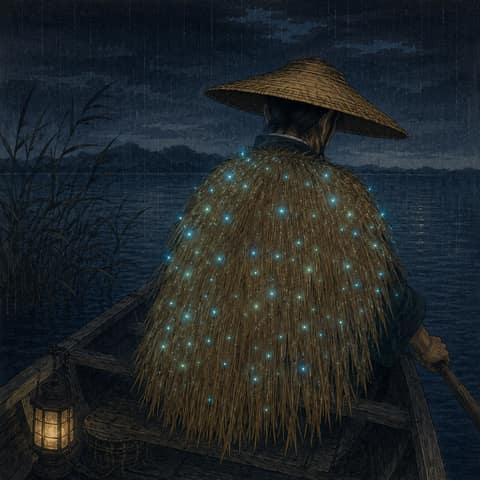
    Typified by records tracing to Lake Biwa, it is a collective form of strange lights that cling in faint specks to rain cloaks, umbrellas, and garments on rainy nights. They carry no heat and increase in brightness and number when brushed at, yet disperse naturally when garments are removed, a flame is lit, or time passes. Names and interpretations vary by region, with some seeing them as spirits of drowning victims, others as animal tricks or natural bioluminescence. Rather than causing harm, they are said to bewilder and unsettle, and are often visible only to solitary individuals.

  • Mirage (Shinkirō)

    Mirage (Shinkirō)

    Epic

    shin-kee-ROH

    Mirage Pavilions Breathed by the Shink (Sekien lineage image)

    Natural Phenomena SpiritsCoastal regions across Japan

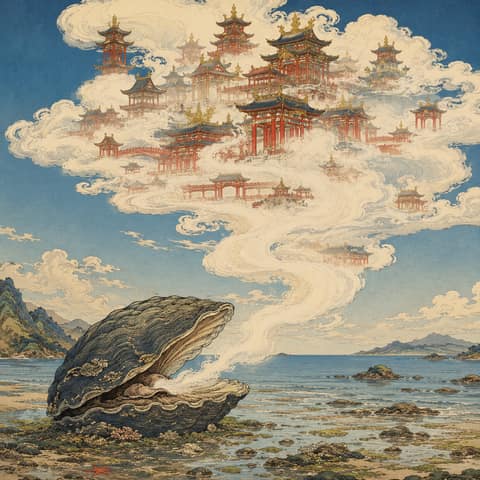
    In the lineage attributed to Toriyama Sekien’s Konjaku Hyakki Shūi, the shink—an enormous clam—exhales a vapor at the shore, which fills the sky and forms images of towers and palace gates. The imagery depicts inverted or elongated castles and gatehouses drifting above the sea, sometimes shown alongside the shink itself or a dragon. In the late Edo period the motif was repeated in surimono and ukiyo-e and became a popular topic among spectators. The tradition is not fixed to a single locale, with sightings told from coasts and tidal flats such as Etchū. As a yokai it lacks a stable body, appearing and vanishing to beguile onlookers while causing little harm.

  • Penghou

    Penghou

    Uncommon

    POONG-hoh

    Edo-Period Scholarly Edition (Bibliographic and Picture Scroll Tradition)

    Natural Phenomena SpiritsIntroduced from China (appearing in Japanese bibliographies and picture scrolls as a foreign yokai)

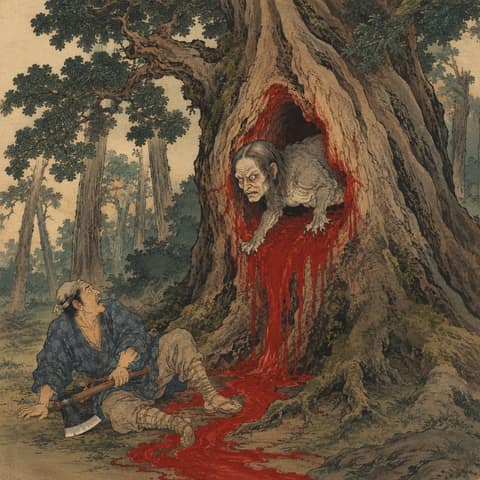
    An Edo-period rendering of Penghou, organized within the Japanese concept of kodama after scholars and painters absorbed Chinese narratives. It is depicted as a dog with a human face, tied to venerable camphors and other old trees. Echoes in the mountains were taken as the work of tree spirits, and notes on Penghou informed dog-shaped variants within yamabiko imagery. Early modern natural histories cite Chinese texts explicitly, layering foreign entries atop local lore rather than reporting concrete regional怪談, so place-specific tales are scarce. Japanese accounts treat it as a “tree spirit,” equating kimoki with kodama, linking it to taboos on felling and the cult of ancient trees. Details vary across sources, but two elements persist: it appears bleeding from an old tree, and it bears a human-faced canine form. This version eschews embellished fiction to show how Chinese originals were received in Japanese encyclopedias.

  • Snow Elder

    Snow Elder

    Uncommon

    YOO-kee-jee-jee

    Elder of Snow Standing in the Mountains

    Natural Phenomena SpiritsMountain regions of Tohoku, Hokuriku, and Koshin (uncertain)

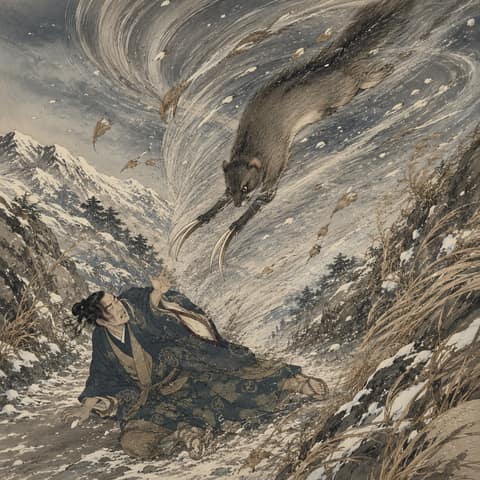
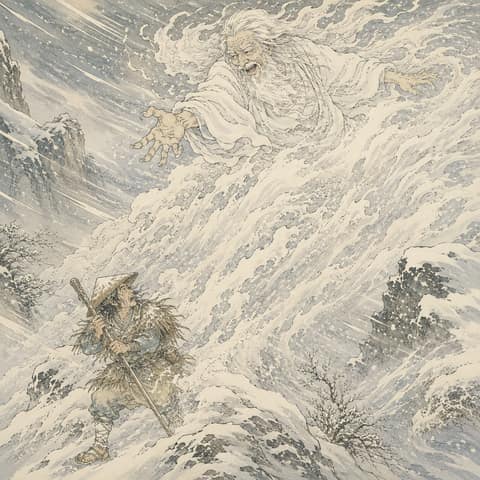
    When the curtain of a blizzard falls, the Snow Elder appears as an old man in white robes, calling from afar to strip travelers of their sense of direction. He belongs to the lineage of snow-related apparitions, overlapping in role with Yuki-onna and Yuki-nyūdō, yet marked by his elder form. His figure is indistinct, fading the closer one approaches, while only his voice is said to echo from behind. In folklore he is understood as a symbolic warning against the perils of winter weather.

  • Spirit of Dreams

    Spirit of Dreams

    Uncommon

    YOO-meh no say-RAY-ee

    Historical Source-Critical Version

    自然現象・自然霊Japanese folklore

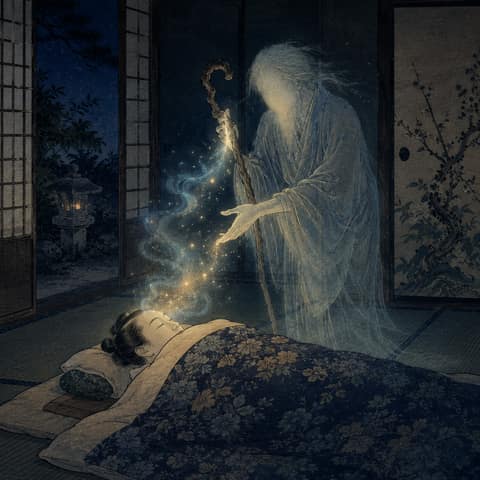
    The name “spirit of dreams” found in pictorial sources is secondhand and not firmly tied to a specific image. Depictions often show an elderly figure leaning on a staff and beckoning, suggesting a symbolic guide of dreams. Some propose it arose from misread characters for a grass spirit or tree yokai, but this is uncertain. Here it is framed as a nature spirit that mediates dreams and portends good or ill, linked to the role of dreams in divination and omens. Personalization and proper names are avoided, positioning it as a numinous rank residing in the power of dreams themselves.

  • Tengu Pebble Shower

    Tengu Pebble Shower

    Uncommon

    TEN-goo TSU-boo-teh

    Tradition-Faithful Edition

    自然現象・自然霊Various regions of Japan (noted in Kaga and Edo records)

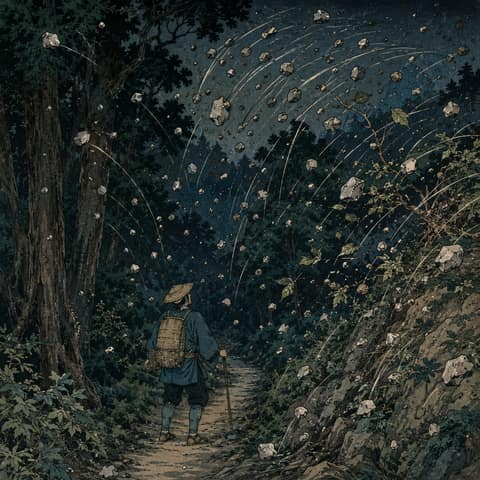
    Tengu-tsubute is told as a formless anomaly whose cause has been variously ascribed to tengu, foxes, or divine intent. Stones fly from all directions though no thrower is seen, impacts and sounds are real yet no stones are found, no marks remain, and the events repeat at set hours. Cases are recorded widely from Kaga, Kanazawa, and Edo in urban quarters to shrine precincts, and some reports note that crowds of onlookers or official patrols led to its quieting. Morally it serves as a warning against misconduct and as an omen of crop failure or illness, and older records link it with thunder as stones cast by Tenjin. Folklore studies connect it conceptually to stone-throwing rites, mass petitions, and indochi stone fights, understanding it as an expression of a supernatural will.

  • The Oak That Never Shed Its Leaves

    The Oak That Never Shed Its Leaves

    Uncommon

    oh-chee-bah-NAH-kee SHEE-ee

    Honjo Seven Mysteries – Traditional Lore Version

    Natural Phenomena SpiritsTokyo

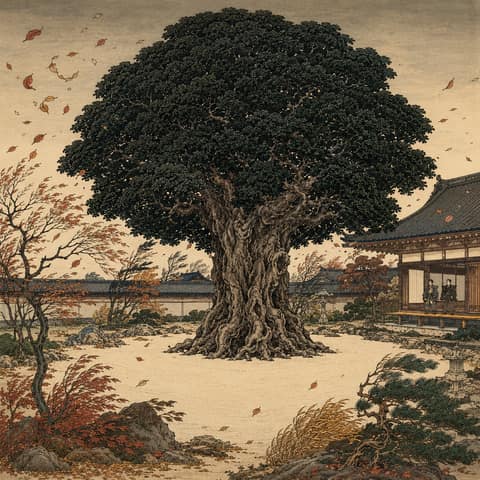
    A recorded marvel revered and feared as the very phenomenon of an ancient chinkapin that shed no leaves. Understood less as a personified will and more as the ambience of the land or the work of a tree spirit, it is told alongside other Honjo Seven Mysteries such as Okehazubori and the Foot-Washing Mansion as an enigma that reveals no cause. Named in Mimibukuro and in local gazetteers and collections of strange tales, it is not remembered for direct harm but for an uncanny presence that keeps people away. It aligns with tree veneration and the notion of household guardian trees, with hyperbole like needing no sweeping of fallen leaves to emphasize the marvel. The identification of the actual tree is debated and unconfirmed.

  • Tsurube-bi (Bucket Fire)

    Tsurube-bi (Bucket Fire)

    Uncommon

    TSOO-roo-beh-bee

    Traditional Aspect (Kaika Will-o’-Wisp)

    Natural Phenomena SpiritsKyoto

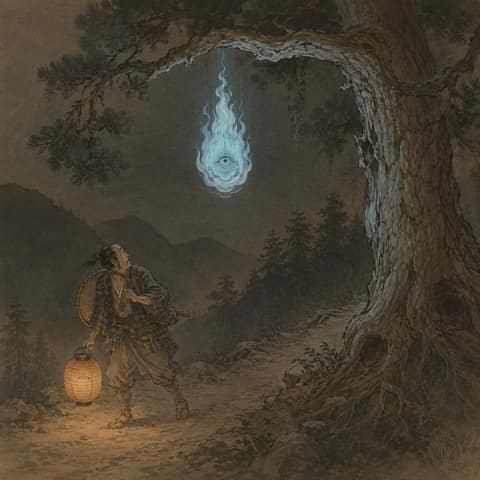
    A traditional reading of the Tsurube-bi based on Edo-period ghost tales and Sekien’s imagery. Told across Japan as a tree-born will-o’-wisp, its bluish-white fire-orbs dangle from branch tips and bob up and down like a well bucket’s pulley, misleading travelers. The flame is weaker than it looks and is said not to catch on clothes or vegetation. Early-modern accounts cite fire apparitions around Saiin in Kyoto, and later yokai encyclopedias file it as a will-o’-wisp akin to Tsurube-otoshi or as a separate kind. Sightings are said to peak on moonless or misty nights; when approached it slips away, when left it drifts back. A shadowed face sometimes appears, causing confusion with hitodama, yet it is remembered as a local, earthbound fire spirit.

  • Ubagabi (Old Woman’s Fire)

    Ubagabi (Old Woman’s Fire)

    Epic

    OO-bah-gah-bee

    Ubagabi (Traditional Accounts Version)

    Natural Phenomena SpiritsOsakaKyoto

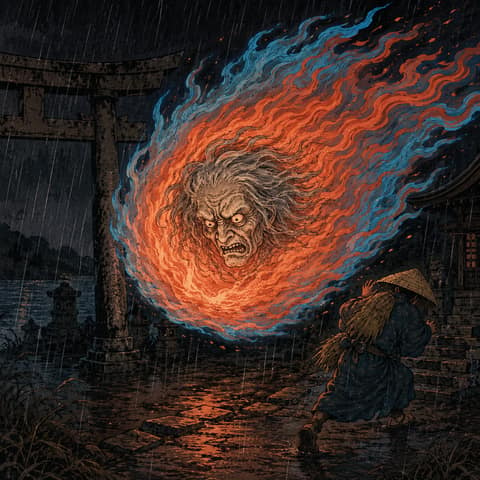
    A reference version based on images of Ubagabi that appear frequently in Edo-period essays and ghost tales. In Kawachi, an old woman who stole oil from a shrine was said to become a ghostly fire after death, drifting around shrine approaches and village paths on rainy nights. In Tanba, it was tied to water calamities on the Hozu River, feared as lights that swarm over the water. It appears as an orange fireball about one shaku in size, at times bearing the face of an old woman or the shadow of a bird. Contact is an omen of misfortune, though accounts note it can be driven off by calling out or by taboo words. With moral contexts of stolen shrine oil, child abandonment tales, and water disasters behind it, the Ubagabi endured as a ghost-fire embodying regional taboos and faith.

  • Yamabiko

    Yamabiko

    Epic

    yah-mah-BEE-koh

    Traditional Figure (Kodama and Mountain-Deity Retainer Interpretation)

    自然現象・自然霊Nagano

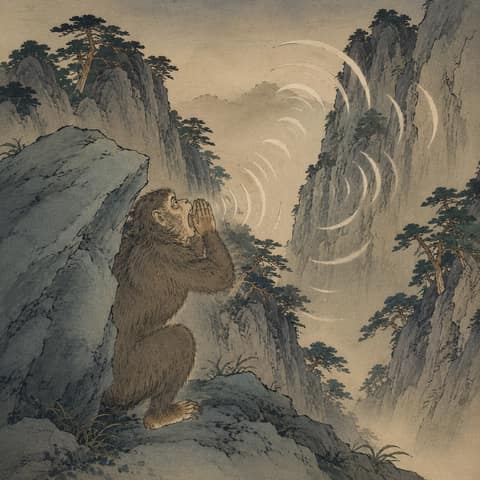
    Yamabiko is the personification of echoes in the mountains, interpreted as a kodama or a retainer of the mountain deity. Its habit of repeating words back is seen as a boundary-marking reply within the mountain domain, warning against reckless shouting that disrupts the mountain’s vital energy. Early modern images depict it as a small beast akin to a dog or monkey; figures in Hyakkai Zukan and Gazu Hyakki Yagyō have been linked to the yama-ko in Wakan Sansai Zue and to Penghou, said to dwell within trees. Depending on region, intermediaries vary—bird calls like the yobukodori or resonant rocks such as “Yamabiko Rock.” Phenomenon, spirit, and monster imagery overlap in layered tradition.

  • Yuki-onna

    Yuki-onna

    Legendary

    Yuki-onna (the Snow Woman)

    The White Apparition of the Snow-Country Night

    Natural Phenomena & Nature SpiritsIwate

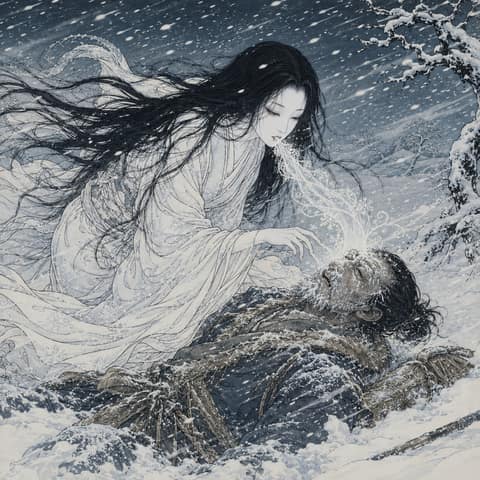
    As a "white apparition," the Yuki-onna is told of as a white figure that suddenly stands in one's path on a blizzard night, leaving no footprints. Before she draws near, the air first turns cold and one's breath freezes white; then, in the glow of the snow, a woman with a long trailing hem floats dimly into view. This sense that "the cold announces her before she comes" is the shared core of encounter-tales across the regions. Her face alone is translucently pale, her eyes glint from within, and she either gives no answer when addressed or asks one's name in a low voice. In many versions the taboo runs thus: answer her question and your life-force is drained; stay silent and you are spared. The tale of Minokichi and O-Yuki that Lafcadio Hearn set down in Kwaidan conveys this white-apparition image most vividly. Having frozen the old woodcutter Mosaku to death in a storm-bound hut, the snow woman leaves the young Minokichi with a single command: tell no one what you have seen tonight. Later Minokichi weds a traveling woman named O-Yuki, fathers children, and lives happily — until one snowy night, watching his wife's pale profile as she sews by lamplight, he sees in her the face of the snow woman of long ago and lets the words slip. O-Yuki reveals herself, declares that she spares him only for the love of their children, and vanishes through the smoke-hole as a white mist. A bond sealed by a single forbidden word comes undone: the sorrow of parting, and the otherworldly woman who longs for a human, crystallize here. In pictorial tradition she is usually painted as a tall woman in white in pale washes, her outline never drawn too firmly, dissolved into a white scarcely distinguishable from the snow. Her feet are blurred into haze and she casts no shadow, lending the air of something not of this world. Less a spirit who sings and dances than a still apparition who stands without sound and vanishes without sound — that is the true nature of the Yuki-onna as a "white apparition."

  • Yuki-warashi (Snow Child)

    Yuki-warashi (Snow Child)

    Uncommon

    YOO-kee WAH-rah-shee

    Echigo Traditions Type Snow Child

    Natural Phenomena SpiritsNiigataGifu

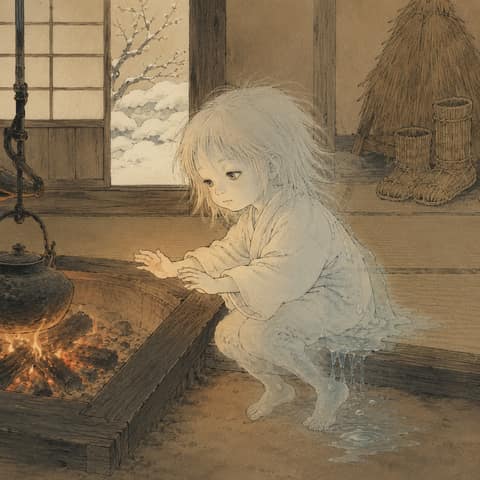
    Based on the Snow Child figure from Echigo Province. It appears as a small child on snowy days, visiting from the doorway on blizzard nights to warm itself by the hearth. When cared for, it comforts the household and may help with chores, yet with the first signs of spring it loses strength and fades. It shows no malice and instead bears the character of a guest deity, a seasonal visitor heralding winter’s presence. Its visits recur but never last, and finally cease, reflecting the impermanence of snow. It is also called “Yuki-warashi” or “Yukiko,” names that all link snow with a childlike form.

  • Yukijoro

    Yukijoro

    Rare

    ゆきじょろう

    The Snow Princess Descended from the Moon: Yukijoro

    Natural Phenomenon / Nature SpiritYamagata

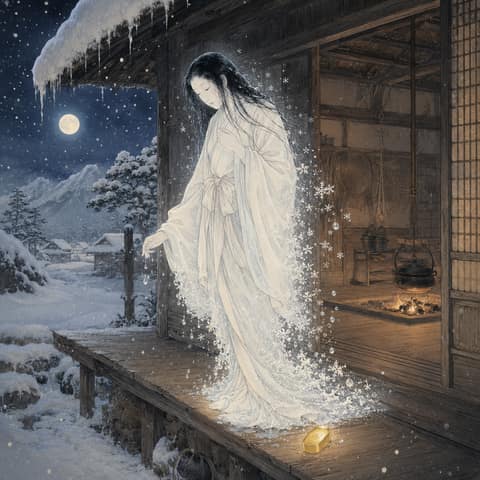
    The *Yukijoro* is a highly unique snow woman nurtured by Yamagata, one of Japan's premier heavy snowfall regions. While snow women nationwide are told of as cruel monsters who freeze travelers to death, Yamagata's *Yukijoro* strongly retains "gratitude-type" tales where she rewards human compassion with blessings. In the Oguni region, her true identity is said to be a princess who descended from the moon world with the snow, losing her way back and appearing on nights lit by the snow's glow—a rare archetype blending East Asian moon worship with the snow woman. In folktales, a house that coldly rejects the white-robed woman begging for lodging falls into ruin, while a house that welcomes her warmly is left with the blessing of a lump of gold. The *Yukijoro*'s body melts upon touching human warmth, leaving grace in the wake of her melting. Furthermore, in the Mogami region, there are tales of an *Ubume*-like snow woman trying to hand over a child, or a snow woman leading a cow, showing that the *Yukijoro* does not fit into a single mold. The terror of the freezing winter, and the emotion of a snow country where one cannot survive without nevertheless cherishing the snow, are superimposed on this multifaceted snow woman.

Showing 1 - 22 of 22 yokai