Is Yuki-onna One Yōkai?
When people hear Yuki-onna, many picture a young woman in white, with long black hair and cold breath. But when the sources are separated by period and place, that image proves not to be an average of the whole tradition, but a powerful line selected by early modern literature, Lafcadio Hearn, and twentieth-century film.
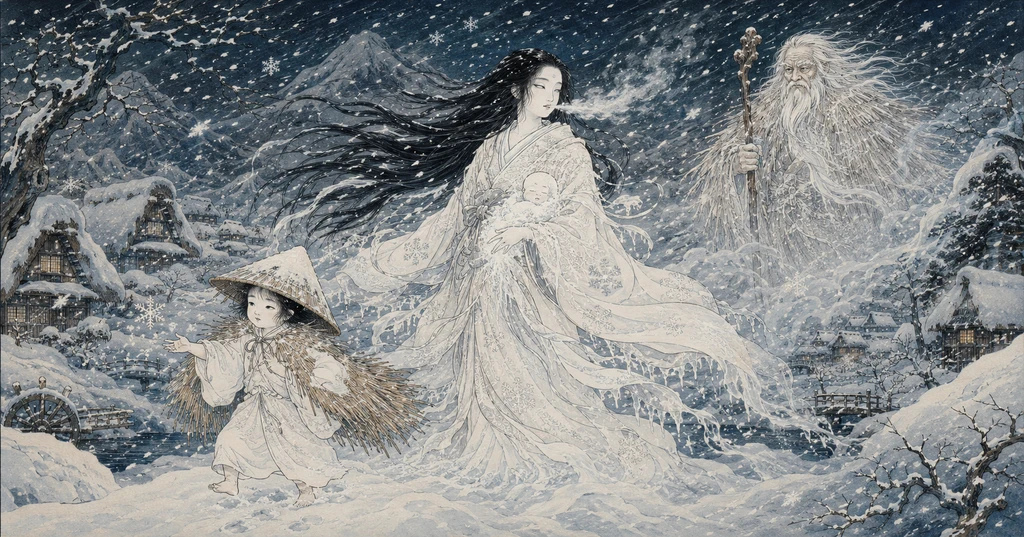
The Yuki-onna of Tateshina makes a bridge from a tree and helps people[1]. In Niigata, she is a frightening encounter marked by bloody footprints[2], while in Gunma she appears in the words used to put children to sleep[4]. The Wakasa record says only that a white woman arrives riding a heavy snowfall[5]. Rather than treating Yuki-onna as one character, it is truer to see her as a broad name gathering female-shaped apparitions that emerge in snowy landscapes.
Yuki-onna in Haikai Before Ghost Stories
The earliest printed example with a confirmed date is a verse in *Takatsukuba* from 1642[6]. Yuki-onna subsequently appears in several haikai books; in *Konzan-shū* of 1651 it is a subject in its own right, and in *Masuyama-i* of 1667 it is called *haigon*.
*Haigon* is a word suited to haikai association and humor rather than the inherited diction of older waka. Seeing snow peaks, drifts, or a white figure in the haze as a “woman” summons color, clothing, hidden feet, and the solitude of winter at once. Yuki-onna grew not only from frightening tales, but also from the power of words to turn snowy scenery into a human form.
A Woman One Jō Tall in Echigo,
1685
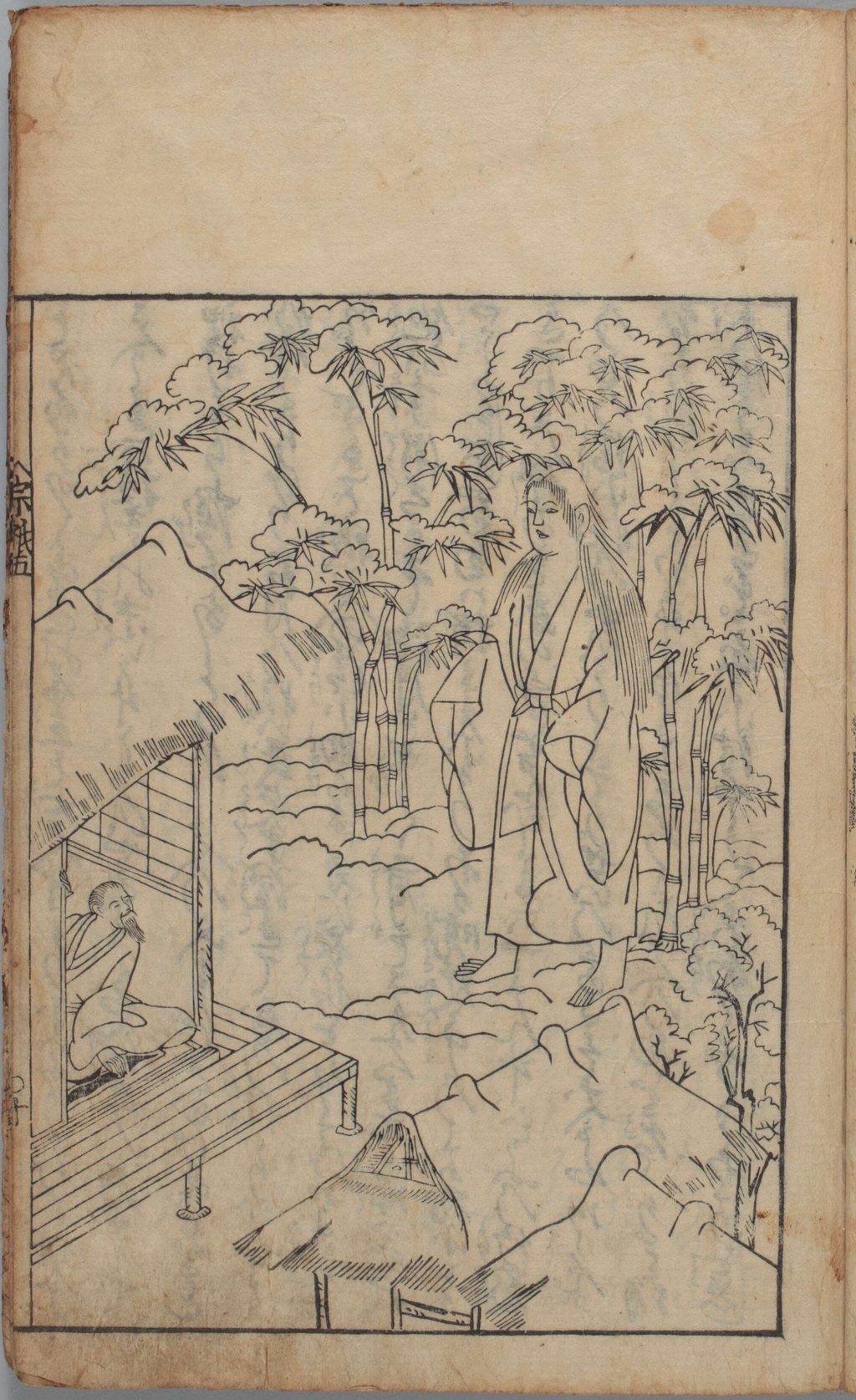
The woman in volume five of *Sōgi Shokoku Monogatari* is one jō—about three meters—tall, not yet twenty, and translucently white from her face, hair, and skin to her unlined white robe[7]. A companion says that a snow spirit has changed its form. Height, a young woman, total whiteness, and a snow spirit come together here in a single encounter.
Sōgi was a fifteenth-century renga poet who traveled throughout Japan, but the work that can be verified is a kana-zōshi published in 1685, roughly two centuries after his death. By borrowing a famous traveler as its narrative frame, it leads readers into strange tales from Echigo. Read not as a sighting record by the historical Sōgi, but as an early modern collection of marvels enjoyed by its readers, the book’s timing and appeal become clearer.
How a Name Became a Single Yōkai
*Kokon Hyaku Monogatari Hyōban* (1686) asks whether a thing called Yuki-onna actually exists, since the word appears often in haikai[13]. The name spread first; explanations for a supernatural being suited to that name were debated afterward. This sequence shows that yōkai do not necessarily pass from ancient oral tradition into books in one direction.
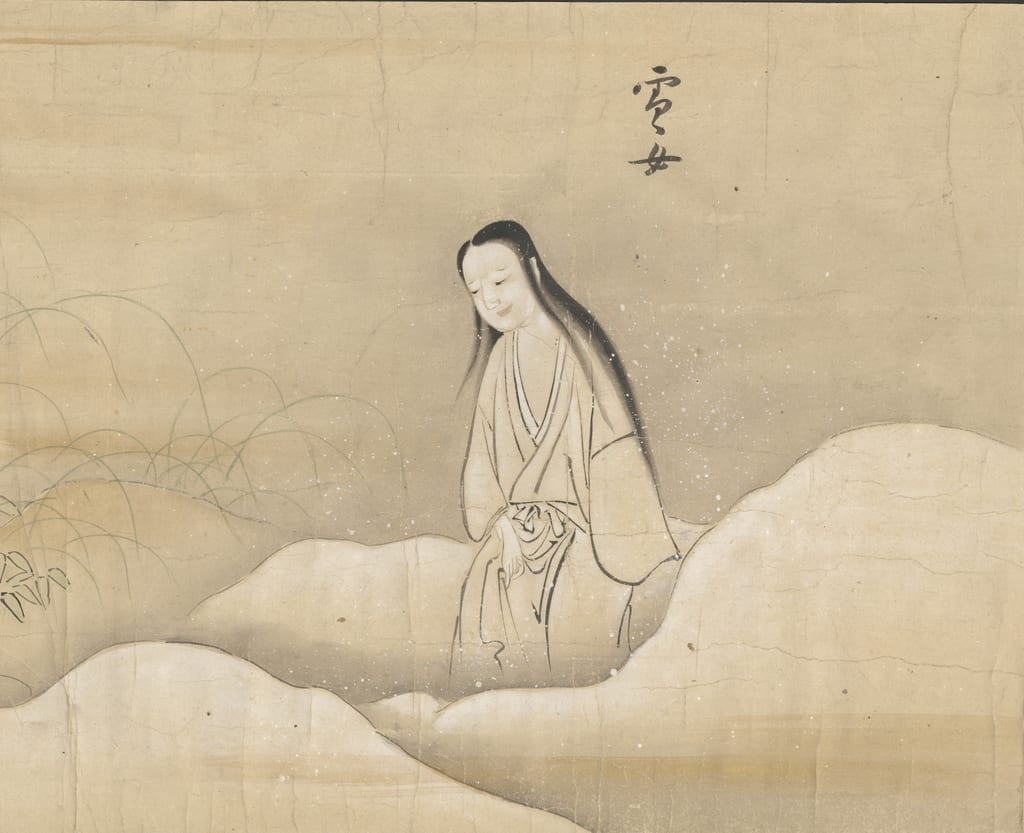
*Hyakkai Zukan* (1737)[8] and *Gazu Hyakki Yagyō* (1776)[9] gave Yuki-onna a named form alongside other yōkai. On opening a handscroll or picture book, readers could recognize “Yuki-onna” at a glance. The outline of a woman standing in snow became shared, while Sekien supplied no long explanatory text. The stillness of the picture also left room for later generations to overlay different stories.
Footprints,
Faces,
and Bodies Are Not One Thing
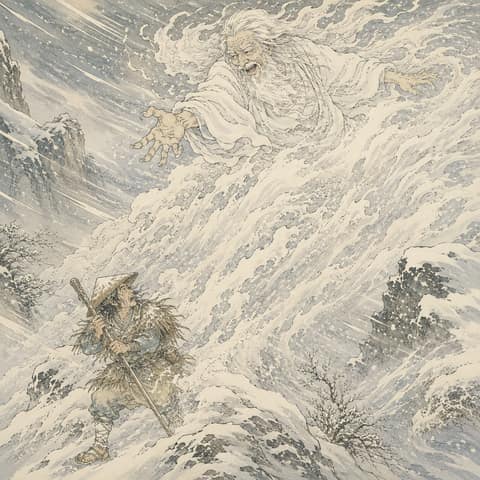
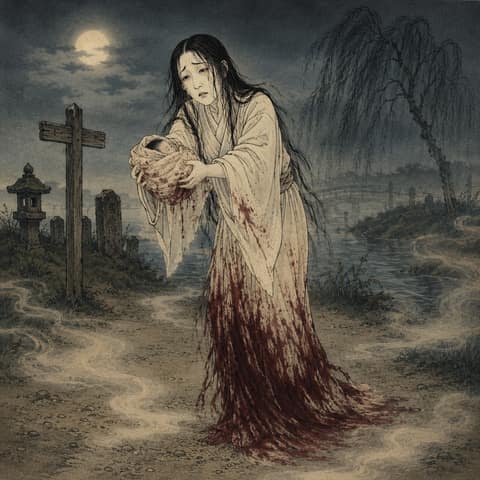
Yuki-onna is often said to have no feet or to leave no footprints. But in a Niigata account, bloody specks on the footprints are precisely what announce her approach[2]. In Akita, a woman with a smooth, featureless face is told of[3], and the form Hearn heard about in Izumo raised a gigantic face from the snow and stood taller than trees at night[16].
The young woman in white is an important image, but it is not a key that fixes Yuki-onna’s body into one form. Traces left on the snow, outlines lost in a blizzard, and a face rising from the whiteness of night each became a body in different places.
A Harmful Woman,
a Bridge-Building Spirit
The Yuki-onna seen by an elder in Tateshina was a flickering, dreamlike shadow who laid a tree felled by woodsmen across a ravine overnight to make a bridge[1]. This account contains no rule that anyone who sees Yuki-onna must die.
By contrast, the Niigata tradition says she kills those she meets[2], and the Yukijorō of Iwaki throws anyone who looks back into a snowy ravine[15]. Life in snowy country includes ravines, night roads, deep snow, and blizzards that take away sight. Yuki-onna gives those dangers a human shape, but she also gives human shape to the force snow brings and to mysterious help in mountain work.
Boundaries with Ubume,
Yuki-baba,
and Yukijorō
Aizu sources describe Yuki-onna as appearing in the form of an ubume[14]. Stories in which she asks someone to hold a child and the child grows heavier draw close to tales of ubume: women who died in childbirth or entrust a child to another person. But this is an overlap found in some places, not a claim that every Yuki-onna originated as an ubume.
Yuki-baba and Yukinba are associated with old women, one leg, child-taking, and winter visits. Yukijorō appears both as an alternate name for Yuki-onna and as an independent name for an apparition in particular places and works. The Icicle Wife is part of a nonhuman-marriage tale in which she becomes a man’s wife and is lost with warm weather or snowmelt. These are useful comparisons, but similar names alone do not make them one family.
The Two Faces Hearn Recorded First
In *Glimpses of Unfamiliar Japan* (1894), Hearn heard from an elderly man in Izumo of a harmless giant Yuki-onna; in a note, he also mentioned a beautiful vampire-like woman from an unspecified region[16]. One makes a face in the snow and only startles people. The other lures young men to lonely places.
The latter may resemble the modern idea of a Yuki-onna who seduces men and drains their vital energy, but Hearn presents it as a single variant without a known region or storyteller. The value of setting the two faces side by side is not to decide which is the original one, but to show that Yuki-onna’s image had already split by the end of the nineteenth century.
The Family Time Created by “Yuki-Onna” in 1904
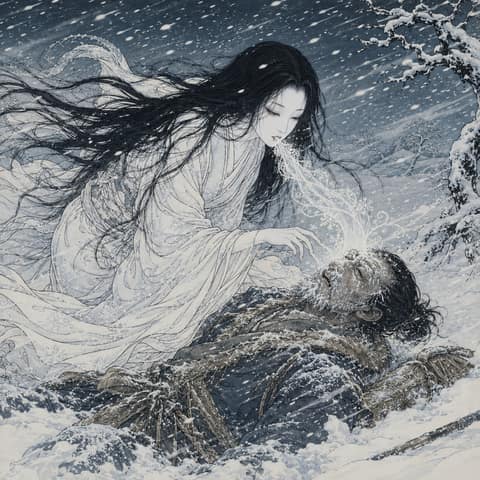
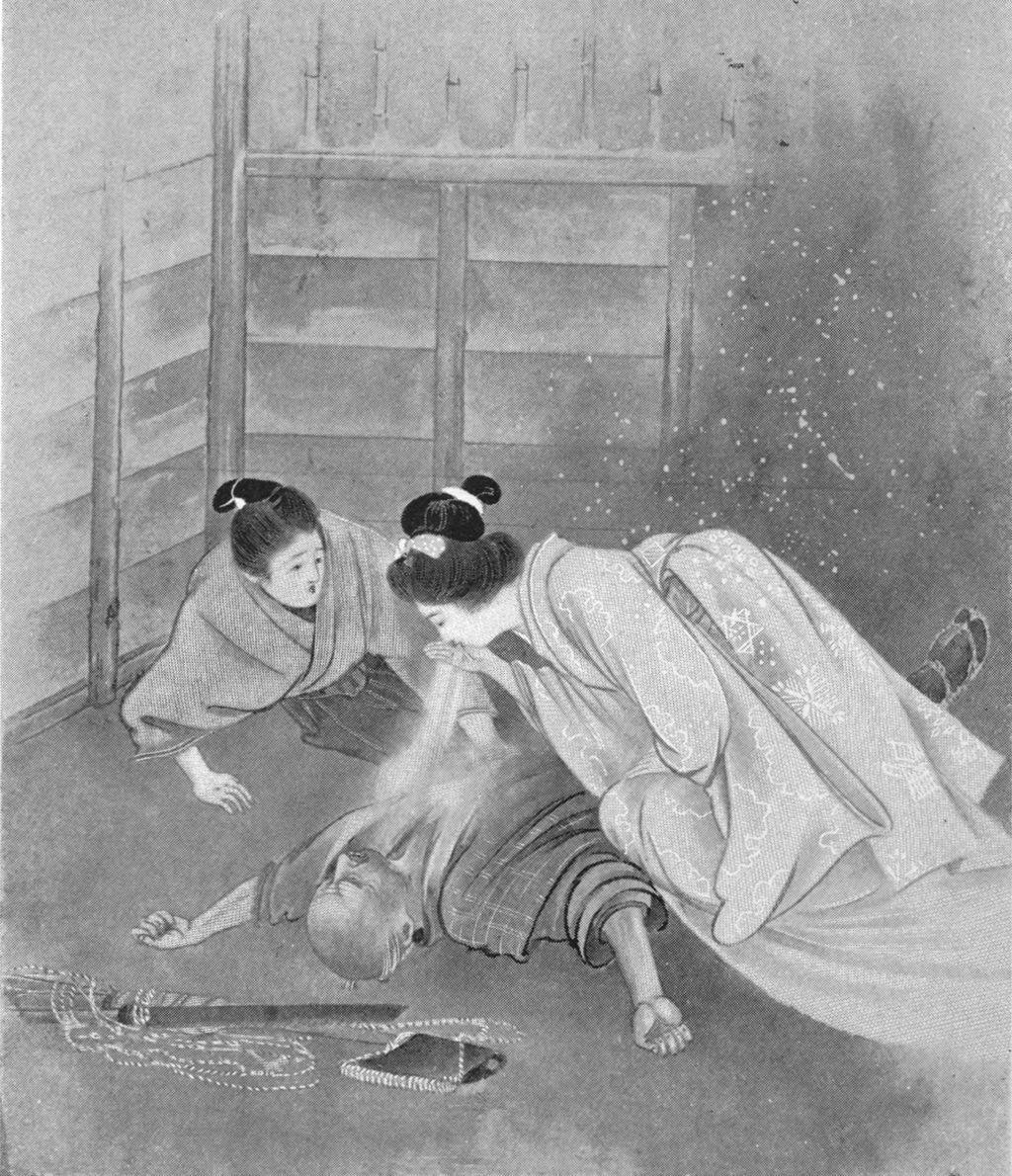
In the preface to *Kwaidan*, Hearn writes that he heard the tale from a farmer in Chōfu, Nishitama District, Musashi Province, as a legend from the farmer’s home village[10]. The story begins in a ferry hut during a blizzard. Yuki-onna kills Mosaku with her white breath, then leaves after ordering the young Minokichi not to speak of the night.
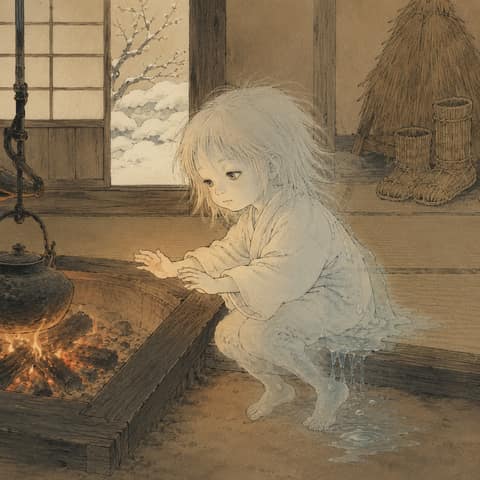
The next winter, Minokichi meets a traveling woman named Oyuki. They marry and raise ten children, but only Oyuki does not grow old. On a snowy night, her husband tells the memory of long ago, and his wife reveals the face of Yuki-onna. She should kill him for breaking his promise, but for the sleeping children she spares his life and disappears as white mist through the smoke vent.
Here Yuki-onna changes from a terror of one night into a nonhuman wife and mother burdened with a secret. Because the family’s happiness has endured for so long, the revelation of her identity becomes not a simple exorcism but an irreversible parting[10]. That depth of time gives Hearn’s Oyuki a powerful character distinct from the other regional variants.
How the Beauty in White Became the Representative Image
Masaki Kobayashi’s *Kwaidan* adapted Hearn’s story through an artificial snowscape, quiet movement, and vivid color[17]. Tokuzō Tanaka’s *Kaidan Yukijorō* likewise brought the blizzard, white breath, an old man’s death, and the warning to a young man to the screen[18]. Even comparing these two works shows how the same Hearn-derived plot can produce different Yuki-onna figures through color, pacing, and the woman’s expression. The modern Yuki-onna is not a single fixed image, but rests on a history in which old names and stories have been reread by each medium.
The Faces Snow Makes in Each Place
Snow covers the terrain, erases roads, blurs distance, and absorbs sound. Trees, houses, and human silhouettes take on different sizes according to day or night, wind strength, and the way snow has fallen. Haikai linked those changes to the word “woman”; ghost stories turned them into the fear of an encounter; yōkai pictures set them into a single figure; and regional tellings returned them to local dangers and ways of life.
What enriches Yuki-onna is not adding more shared powers. It is allowing the one-jō woman of Echigo, the bridge-building spirit of Tateshina, Niigata’s bloody footprints, Gunma’s child-minding phrase, Izumo’s giant face, and Oyuki of Musashi to stand in their own times and places. When different forms resonate under the same name, Yuki-onna emerges as more than one character: a long history of Japanese imagination shaped by looking at snow.
Character Profile
This section is our own creative profile for storytelling. It is not historical fact or scholarship.
Yokai Type - Traditional Yokai
Category - Natural Phenomena Spirits
Rarity - Legendary
Personality - Reserved and liminal. She may appear as a dangerous woman, a harmless spirit, a child-minding phrase, a wife, or a mother, depending on the place and the story.
Compatibility - She speaks gently with those who do not force the variants of snowy regions into a single account and who respect silence and local memory. Only when she speaks as Hearn’s Oyuki do memories of family and secrecy come strongly to the fore.
Abilities - Appears in female form during heavy snow, on snowy nights, and along mountain roadsIn Hearn’s form, freezes people to death with white breathIn an Izumo variant, raises a gigantic white face from the snowIn a Tateshina variant, carries felled trees across ravines to make bridgesIn marriage tales, becomes a human wife and lives among people for many years
Weaknesses - No weakness or means of defeating her is confirmed across every Yuki-onna tradition. Fire, warmth, spring, love, and promises are not universal weaknesses. In Hearn’s story, breaking a secret brings separation, not a way to defeat Yuki-onna.
Habitat - Snowy mountains, mountain roads, snowbound villages, ferry huts, and snowy nights. Settings differ by record and work.