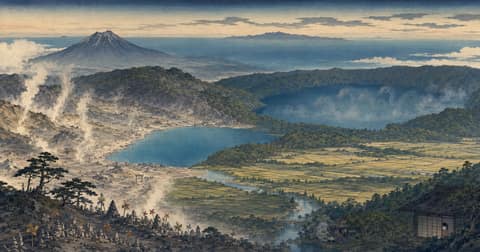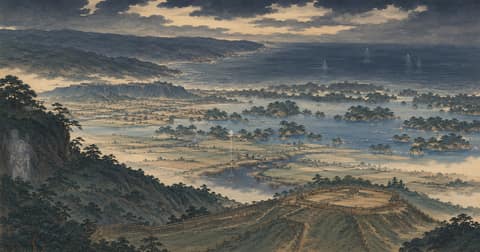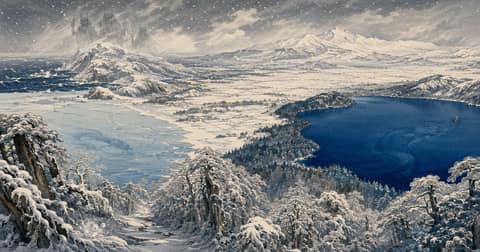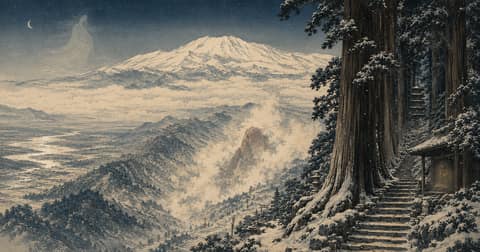
The yokai of Iwate Prefecture rise from two polar opposites. One is the inland basin, Tono-go. When the strange occurrences of this mountain village were written down in a single book, "yokai" and "folklore" became subjects of academic study in Japan. The other is the northern frontier stretching from Isawa to Morioka. In this land, invaded by the imperial court in ancient times, the vanquished were eventually re-narrated as demons (*oni*). The basin that records, and the frontier transformed into tales of demons ── these two poles form the greatest yokai prefecture of the Tohoku region.
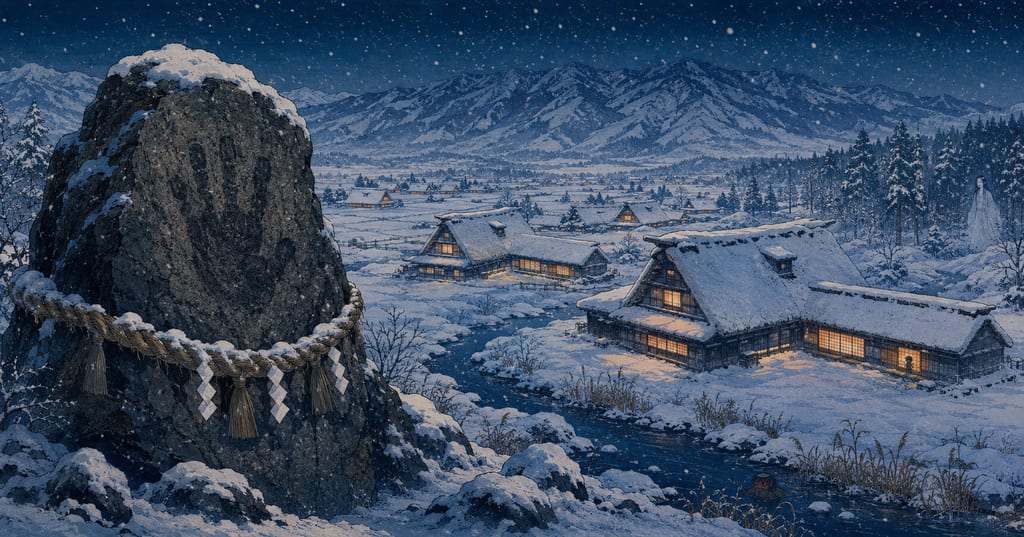
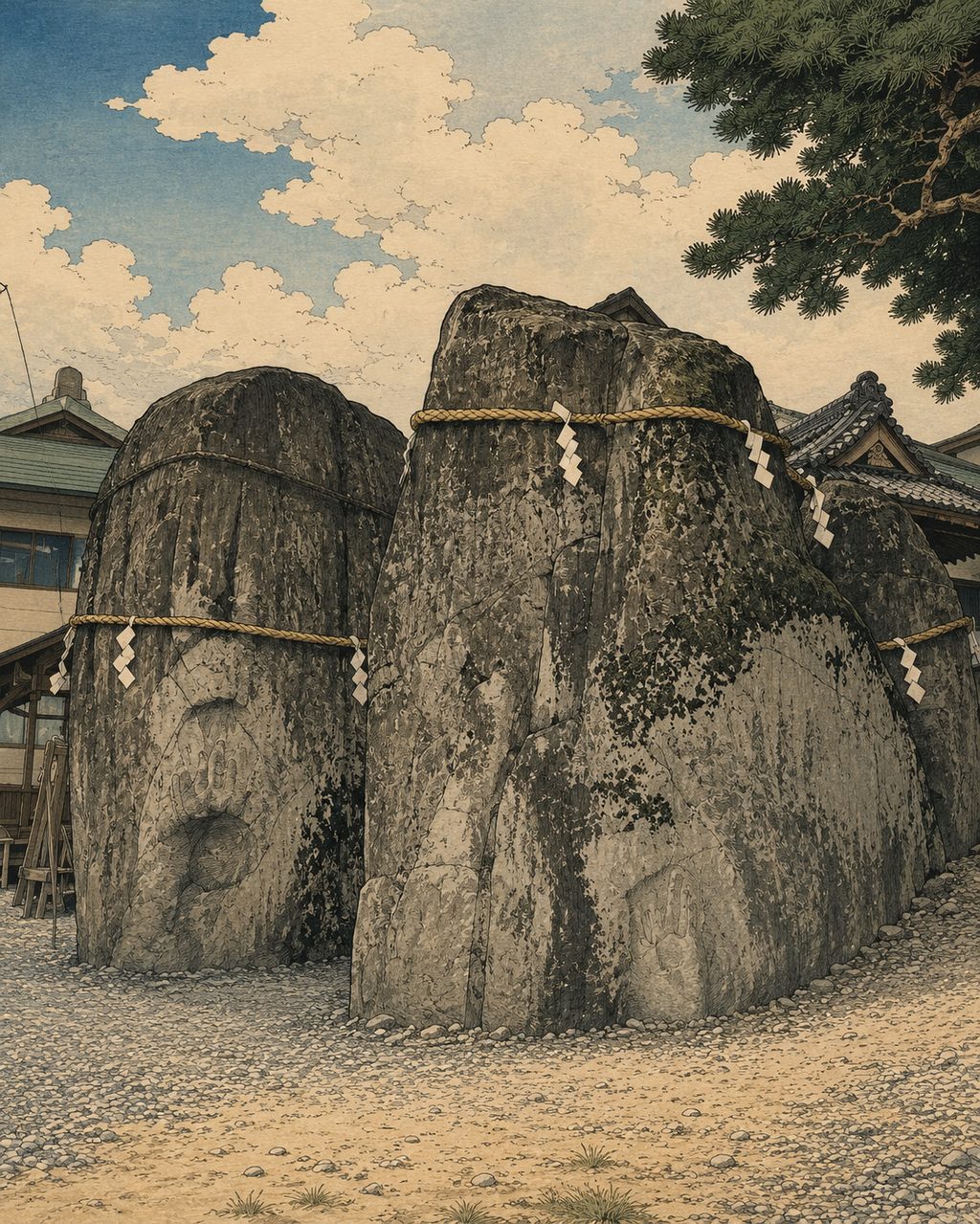
Symbolic of this is the very name "Iwate." It is said that at Mitsuishi Shrine in Morioka, there are three giant rocks; a god bound a demon that had been tormenting the villagers to the rocks and forced it to press its handprint onto the rock as proof it would never return. Because it became a direction from which demons do not come, its ancient name was "Kozukata" (The Direction They Do Not Come), and the dance people performed in joy at the demon's expulsion is said to be the origin of the "Sansa Odori" dance. The name of the prefecture comes from the handprint (*te*) left on the rock (*iwa*). From the coast of Sanriku with its sea to the inland mountains serving as the northern limit of mythology, Iwate has carved tales of demons, gods, and ghosts into every corner of its topography. Let us visit the mysteries of this country stretching to the northern end of Honshu one by one, in the order of the Tono Basin that turned yokai into academia, the Isawa frontier that gave birth to demons, and the Sanriku sea that swallows the dead.
The Basin That Was Recorded ── The Tales of Tono and the Birth of Yokai Studies
To talk about the yokai of Iwate, one must begin with Tono.
Zashiki-warashi
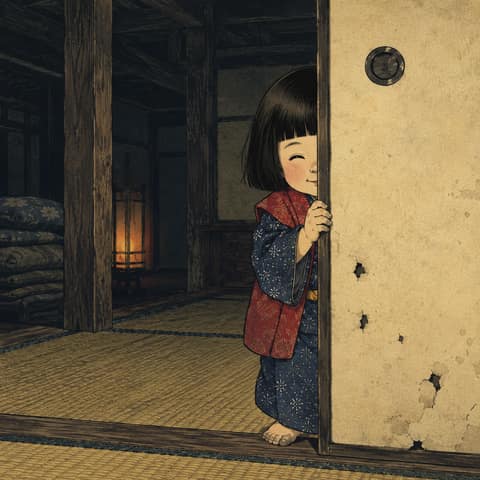
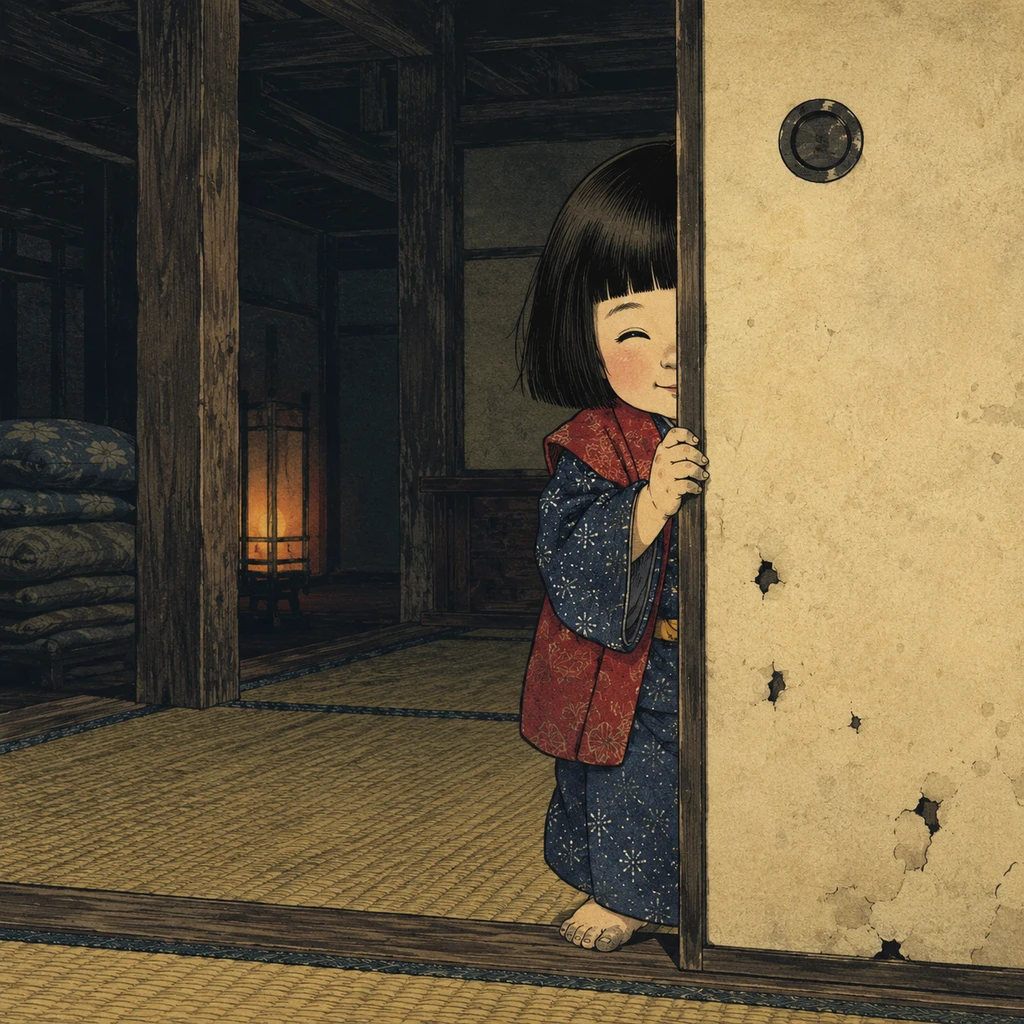
The zashiki-warashi is a household kami or uncanny presence said to dwell in old homes in Tōhoku, especially Iwate. It is often described in a child’s form, but no single appearance defines it. Kunio Yanagita’s Tales of Tōno, Tale 17 records a boy of about twelve or thirteen; in the same tale, an unseen presence makes itself known only by the rustle of paper in the next room and the sound of snuffling. Tale 18 speaks of two young girls, while later local accounts include a child in a red kosode, an old woman, an old man, and beings that show only long, slender hands. The zashiki-warashi is also associated with a household’s prosperity and decline. Tales of Tōno calls it a “kami” and says that a home where it dwells may enjoy wealth and distinction; other stories tell of a household’s fortunes failing after the child has left. This is not a uniform portrait of a capricious being that metes out punishment. It is a folkloric way of linking an inhuman presence felt within a home with that home’s flourishing and decline. The name “zashiki-warashi” seems to have functioned less as the proper name of one being than as an umbrella term for uncanny presences described inside the home. The setting may be a formal room, storehouse, kitchen area, earthen-floored room, or beneath the floor—spaces at the edge of daily life and the house itself. Such a presence may meet a person, or be reported only as a sound, an oppressive sensation, or an unfamiliar shadow. The child figure is an important representative image, not a standard form that erases the range of these accounts. Kizen Sasaki’s collected accounts do not reduce the zashiki-warashi to a simple “child who brings happiness.” They encompass distinct stories associated with formal rooms, storehouses, kitchens, and underfloor spaces, and their names vary from place to place. Some records consider links with the deaths of infants or infanticide, but Sasaki presents these as matters for comparison rather than declaring them the origin of every zashiki-warashi. The term names a broad and varied body of tradition: a sense that someone else is present within the home, carried forward through local memory and stories of a household’s fortunes.
Read moreIn 1910, Kunio Yanagita self-published *The Tales of Tono* (*Tono Monogatari*), transcribing the stories told by Kizen Sasaki (pen name Kyoseki), a native of Tono[1]. It contained 119 stories in total. The encounter between Yanagita and Sasaki in 1908 was through the introduction of the literary figure Yoshu Mizuno. The phrase in the preface, "I desire that these tales be told to make the people of the plains shudder" ── declaring that in an era when urban rationality was discarding regional mysteries as mere superstitions, the true value lay rather in the vivid rawness of those mysteries. Thus, *The Tales of Tono* became the starting point of Japanese folklore studies. Surrounded by mountains, the Tono Basin was a land of horse breeding and highways, yet isolated from the outside world; the child of the parlor (Zashiki-warashi), the kappa of the river, and the woman of the snowy night were believed in as if they were matters of just yesterday ── Yanagita placed that rawness "to make the people of the plains shudder" at the entrance to academic study. The narrator, Kizen Sasaki, later became a folktale collector known as the "Japanese Grimm," compiling *Kikimimizoshi* himself and transcribing a vast number of Tohoku folktales. The one who told, and the one who wrote it down ── the fact that the encounter between these two men occurred in a small basin in the Kitakami Mountains transformed Japanese yokai from superstitions to be laughed at and discarded, into subjects of academia to be recorded and studied. *The Tales of Tono* later added *Tono Monogatari Shui*, becoming a comprehensive collection of over 400 folktales.
Among them, Zashiki-warashi forms the core of *The Tales of Tono*. The 17th tale explains, "The house where this god dwells enjoys wealth and honor at will" ── a house where a child god of about twelve or thirteen lives in the parlor will prosper. However, the 18th tale speaks of the reverse. Right after villagers saw two child goddesses leave the historic Yamaguchi Magozaemon family, the entire family of over twenty masters and servants died in a single day from mushroom poisoning; the only survivor was a seven-year-old girl who happened to return to the house during the day. Enriching a house, and destroying it when leaving ── Zashiki-warashi is the awe of the rise and fall of a family itself, deified. Late at night, the rustling sound of paper comes from the next room, pillows are flipped, and tiny footsteps run across the bed. Behind the pranks of startling people in the form of a child, people simultaneously read the relief that "wealth still dwells in this house" and the anxiety that "it might leave someday." Wealth was not a certainty; it was a fleeting thing entrusted to the whim of a child god. In Iwate, Ryokufuso, a traditional inn at Kindaichi Onsen in Ninohe, enshrines the spirit of Kamemaro, the son of a defeated samurai of the Southern Court, as a Zashiki-warashi, and has long been known as "the inn where you can meet one." It is said that during the Nanboku-cho period, the young older brother Kamemaro, who fled north, died of illness in this land, and his dying words, "I will protect this house until the end of generations," are the true identity of the Zashiki-warashi. Ryokufuso enshrines him not as a monster but as an ancestral guardian deity, Kamemaro Daimyojin, and it was even said that those who saw his figure in the "Enju Room," where sightings were most frequent, would achieve success. Although the main building burned down in a fire in 2009, the shrine enshrining Kamemaro survived and was later rebuilt, with a never-ending stream of people wishing to stay there today.
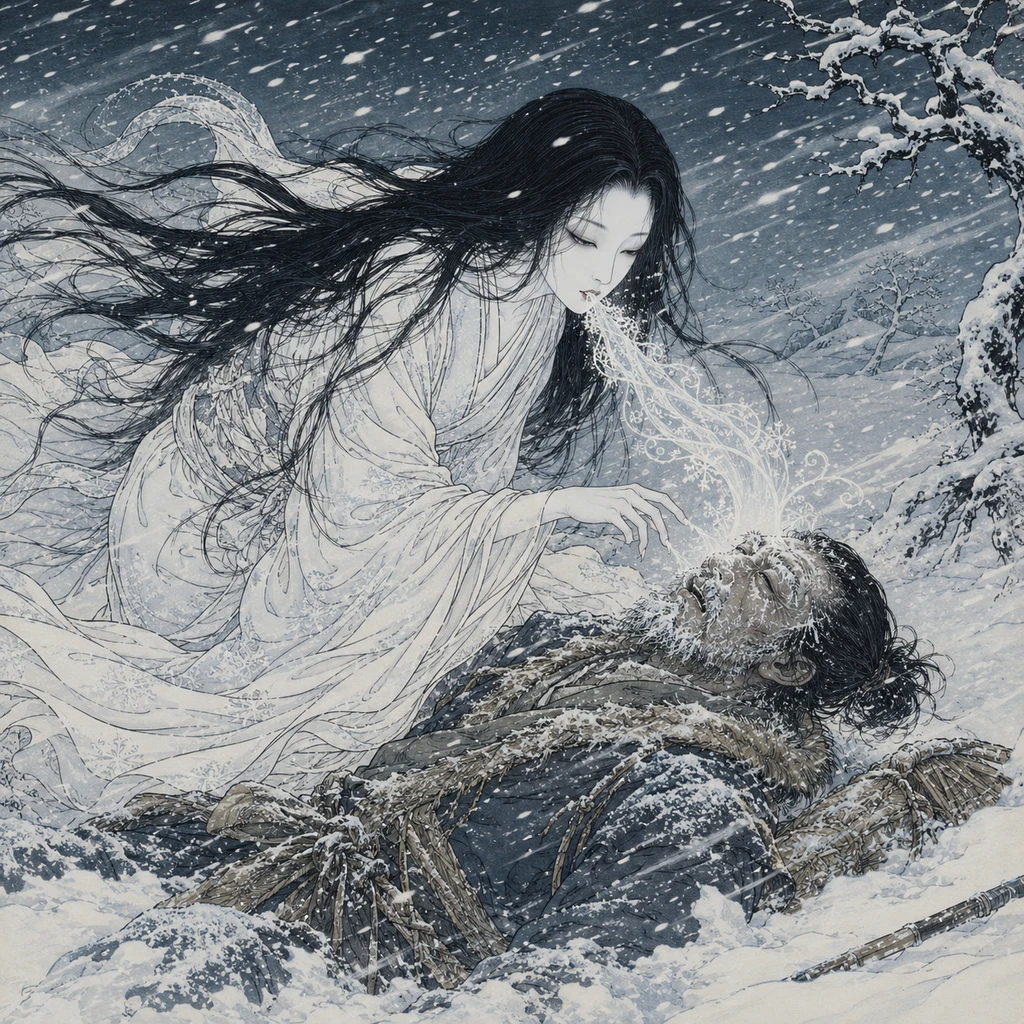
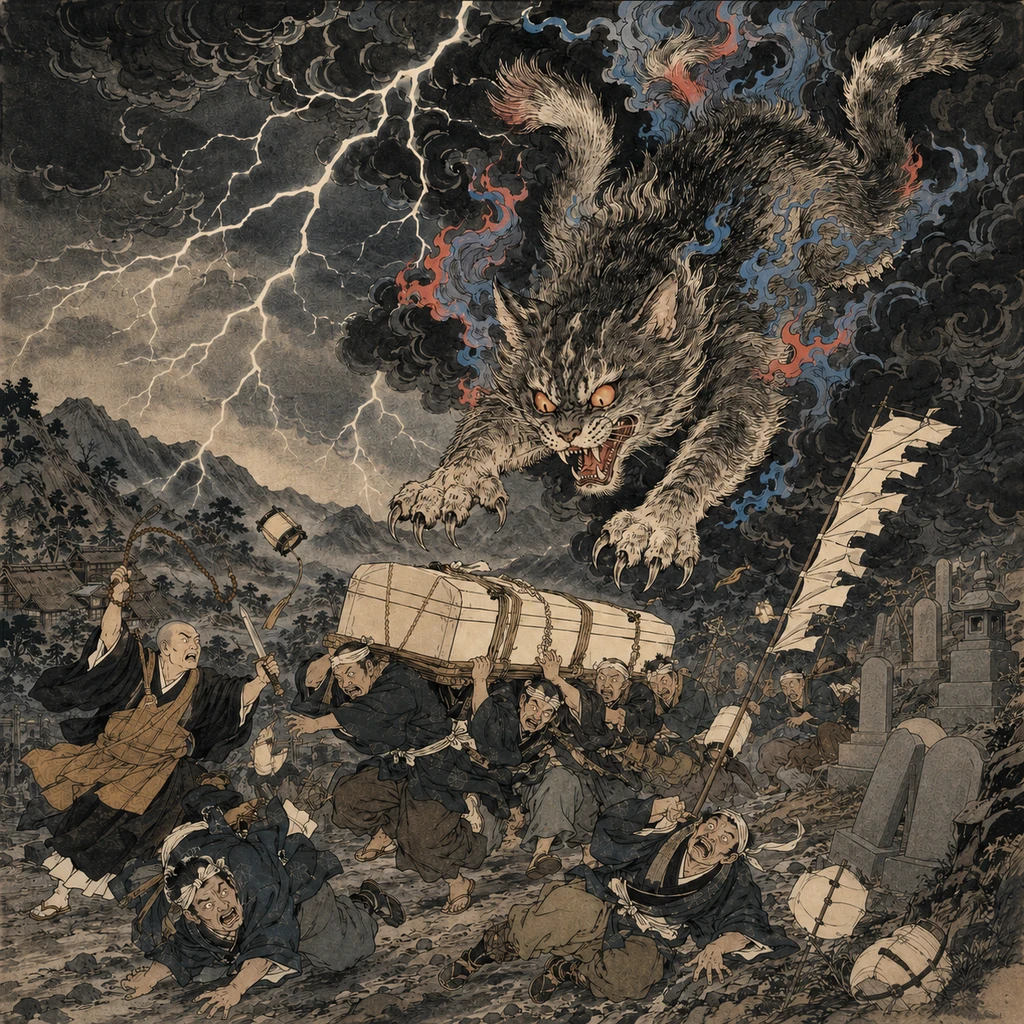
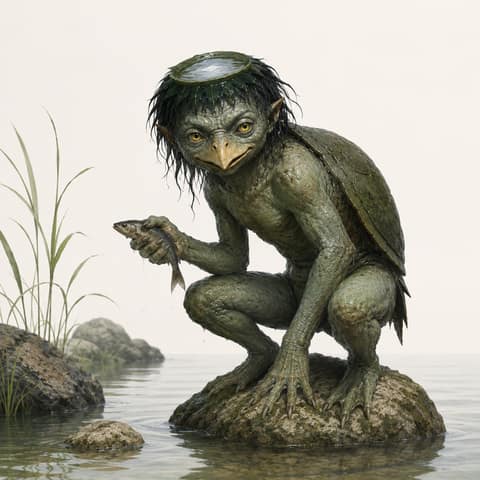
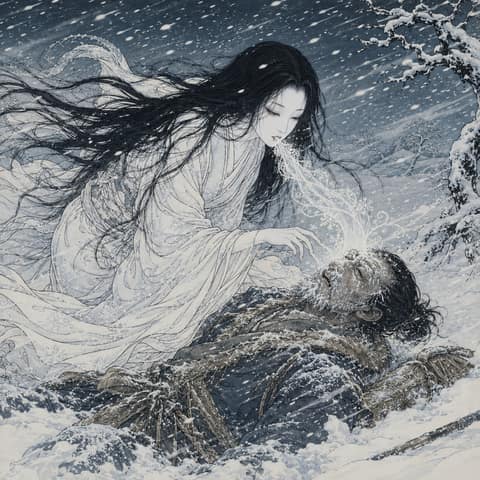
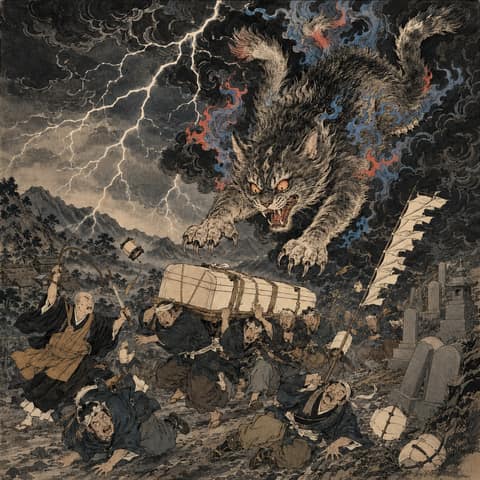
The kappa of Tono are said to have had red faces, unlike the blue kappa of other regions. Many theories have been layered over why they are red. As Yanagita noted, there is a theory linking it to monkeys, a theory that they blush from drinking sake in the summer heat, and a poignant theory that the memories of the red corpses of babies culled by the riverside to reduce mouths to feed during every famine were superimposed onto the kappa ── it is hard to decide which is correct, but the shadows of vanished children flicker behind the jokes of the red kappa passed down in a land of horse breeding and famine. The 55th tale records that many kappa live in the Sarugaishi River, and tells the vivid story of a riverside house where two generations conceived kappa children ── a story with a tragic ending, as the born children were said to have webbed hands or were chopped up and buried. A "horse-pulling" tale, where a kappa tries to pull a horse into the river but fails, is instead dragged to the stable, caught, and made to write a letter of apology, is also passed down in a manner fitting for the horse-breeding region of Tono. At Kappabuchi behind Jokenji Temple, kappa guardian dogs with a depression for a dish on their heads, said to have been enshrined in gratitude for helping extinguish a fire, still sit today, and the spot has become a famous site where "Kappa Catching Permits" are sold, entertaining visitors. The Yuki-onna (Snow Woman) appears in the 103rd tale, said to appear on the night of Little New Year (Koshogatsu) leading a large group of children, and kids were warned to "come home early only on that night" ── it is interesting that the Yuki-onna, spread nationwide, is tied to the annual event of Little New Year in Tono. Therein lies the wisdom of parents warning children not to get absorbed in sledding until dark on snowy nights. However, Yanagita added, "Few people claim to have seen a Yuki-onna"; feared precisely because she could not be seen, she was an existence like the incarnation of the northern winter itself. The Kasha is a cat monster that snatches the dead from funeral processions, distributed nationwide, but in Tono it is called "Kyasha" and leaves the regional difference of being described in the form of a woman. Behind this is the Tohoku funeral taboo against letting cats near the dead or coffins ── the fear that if a pet cat steps over a corpse, the body will rise up, still remains in the memories of the elderly today.
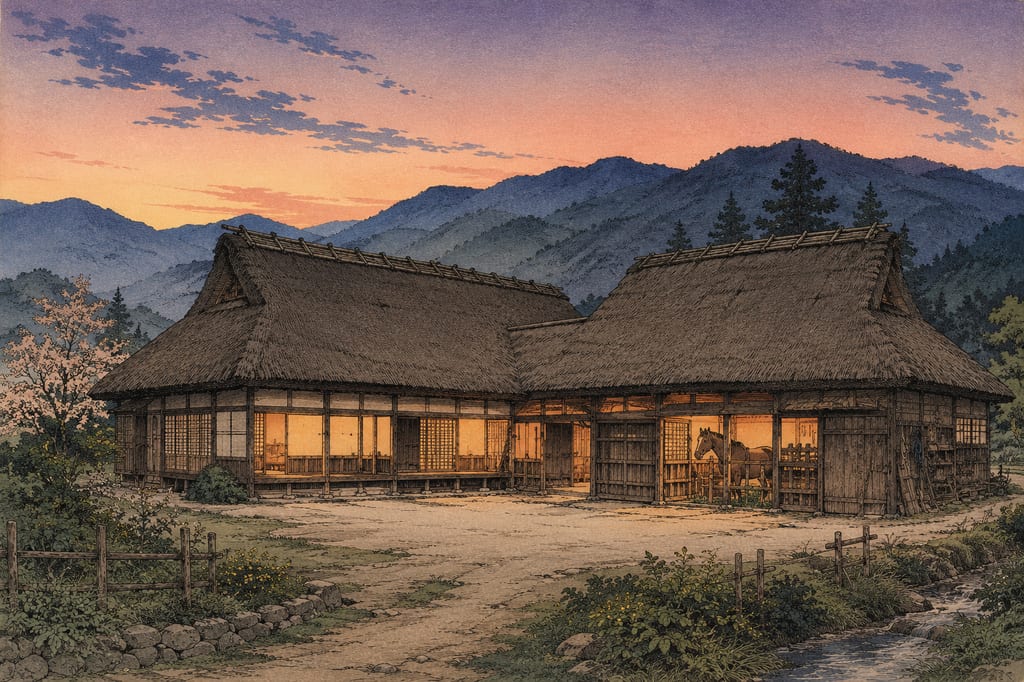
What *The Tales of Tono* conveys are not only yokai. Oshirasama in the 69th tale is a god of tragic love, where a father tore apart his daughter who fell in love with a farm horse, hung the horse's head on a mulberry tree, and the horse's head ascended to heaven, taking the daughter with it. In a sequel conveyed by Kizen Sasaki's *Kikimimizoshi*, the daughter who ascended to heaven appeared in her parents' dream, teaching them to feed the bugs in the mortar with mulberry leaves, which turned into silkworms and produced silk thread ── thus Oshirasama became the god of sericulture. Gods in pairs of a horse head and a princess head, about thirty centimeters tall, with layers of clothing wrapped around a mulberry core stick, are still enshrined in countless numbers at the Oshira-do in the Denshoen today. This story, where the tragic love between a horse and a girl brings silk, unites the sericulture life of the north with affection for non-human beings. Iwate has been a horse-breeding region since ancient times, and humans and horses have lived under the same L-shaped traditional farmhouse (magariya) ── at the root of the idea of a daughter yearning for a horse lay this life of unity between human and horse. The imagination that a kappa targets a horse, and that Oshirasama is born from a horse, is unique to this land that lived alongside horses. The Mayoiga in the 63rd tale, where a person who wandered into a deserted mansion in the mountains and brought back a bowl prospered; Dendera-no in the 111th tale, where old people over sixty were sent ── although it was a place for abandoning the elderly, the old people came down to the village during the day to do farm work and returned in the evening. Coming down to the village was called "Hakadachi" and returning was "Hakaagari," with "Haka" having the double meaning of a grave and the progress of work. This sense of placing the boundary between life and death on contiguous ground also reflects Tono's views on life and death and the otherworld. Regarding the mysteries of Tono, which begin with the story of three goddess sisters dividing the Three Mountains of Tono (Hayachine, Rokkoushi, Ishigami), you can trace them even deeper in the separate Tono Yokai Encyclopedia.
Why is Iwate So Dense with Yokai?
There are both topographical and historical reasons why Iwate has become a land with exceptionally dense yokai culture even within Tohoku. The Kitakami Mountains and the Ou Mountains pierce through the center of the prefecture, with the Kitakami River flowing between them, dropping to the ria coast of the Pacific Ocean to the east. Deep mountains, steep valleys, and rough seas ── nature beyond human power is gathered on three sides. Life here, raising horses, keeping silkworms, and mining iron with tatara bellows, could not be called wealthy; every time a famine struck, people vanished, swallowed by rivers or the sea. If Zashiki-warashi leaves, the house is ruined; a kappa snatches a child by the river; a Yuki-onna appears on the night of Little New Year ── these mysteries directly reflect the anxiety of northern life, where it wouldn't be strange to lose someone without reason at any time.
Historically, the fact that this was long an "unsubmissive land" is significant. The ancient Emishi, the medieval Abe clan, and the Oshu Fujiwara clan ── for the central royal authority, Ou, including Iwate, was a frontier to be conquered, and the people who lived there were frequently narrated as "demons" (oni). The story of the conqueror and the memory of the conquered always form a double exposure in this land. The reason the yokai of Iwate are not just scary, but carry a tinge of sorrow and pride, may be due to this.
The Northern Frontier ── The Conquered Become Demons
If Tono is a basin that records yokai, the inland frontier stretching from Isawa to Morioka is where the vanquished are re-narrated as demons.
Sakanoue no Tamuramaro
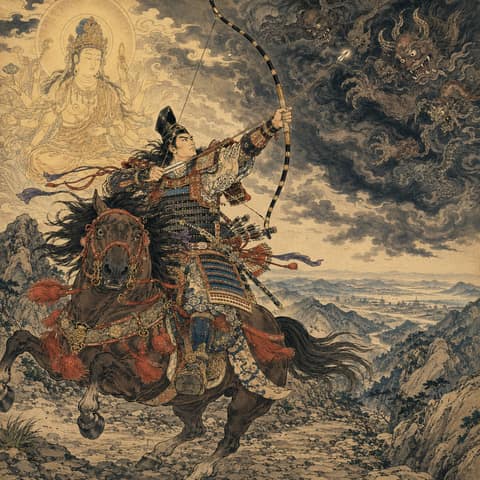
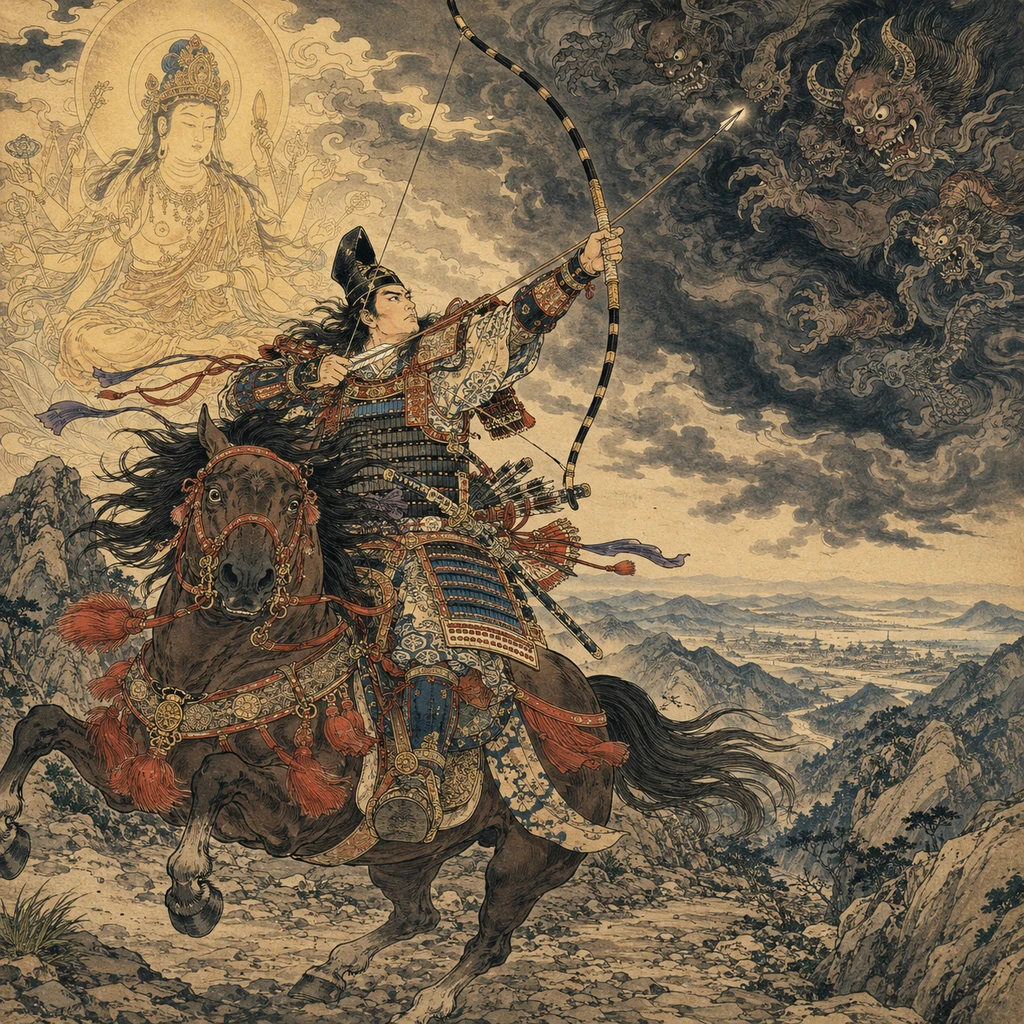
Sakanoue no Tamuramaro was a real military official who was active from the late Nara to the early Heian period, and after his death, he was enshrined as a divine general, Tamura Daimyojin, and a god of war to protect the capital. Historically, he served Emperors Kanmu, Heizei, and Saga, was involved in the Tohoku policy as Seii Taishogun (Commander-in-Chief of the Expeditionary Force Against the Barbarians), and was heavily relied upon during the Kusuko Incident. However, in the tales, war chronicles, and temple origins from the Middle Ages onwards, his figure departed from historical facts, transforming into Tamuramaru or General Tamura, who subjugates demons and ogres under the divine protection of Kiyomizu Kannon and Vaisravana (Bishamonten). Joined with Suzuka Gozen, he is the central figure of the "Tamura-gatari" (Tales of Tamura) that defeats Otakemaru, serving as the axis of heroic legends connecting Kyoto, Suzuka, and Tohoku.
Read moreIn 802, Seii Taishogun Sakanoue no Tamuramaro suppressed the Emishi stronghold of Isawa, built Isawa Castle, and moved the Chinjufu (garrison) from Taga Castle[2]. The Emishi chiefs Aterui and More surrendered leading over five hundred men, and Tamuramaro pleaded with the imperial court for their lives, but the nobles opposed it, saying, "They have wild natures and beastly hearts, their repetition is unfixed," and the two were beheaded in Kawachi. This is historical fact. However, in later ages, the enemy Tamuramaro defeated was narrated as "Akuro-o and Akagashira" who built a fortress at Takkoku-no-Iwaya near Hiraizumi[3], eventually transforming into the demons "Akuro-o" and "Takamaru." The real Aterui and the legendary demons split here and began to run in parallel. Tamuramaro himself, after his death, was said to have been placed in his coffin standing up wearing armor by the order of Emperor Saga, becoming a god of war protecting the royal castle. The real general was deified as Tamura Daimyojin, a god of war who exterminates demons, and as a hero who marries Suzuka Gozen to strike down demons, his story was passed down from the Muromachi Otogizoshi to the Edo Oku-Joruri *Tamura Sandaiki*. Takkoku-no-Iwaya Bishamon-do, where Tamuramaro is said to have enshrined Vaisravana upon pacification, still remains as a cave hall near Hiraizumi. Historically, Aterui was an Emishi hero who fought to protect his homeland, and in recent years a monument honoring Aterui and More was erected in Oshu City. The same history is narrated doubly: from the center as a "heroic tale of slaying demons," and from the northern land as a "memory of those who protected their hometown."
 Fujiwara no Chikata’s Four Onifooj-ee-WAH-rah no chee-KAH-tah no yohn-kee
 Funayūreifunayūrei
 KappaKAH-pah
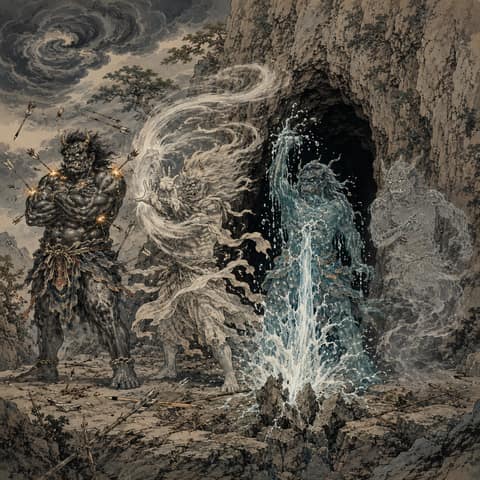
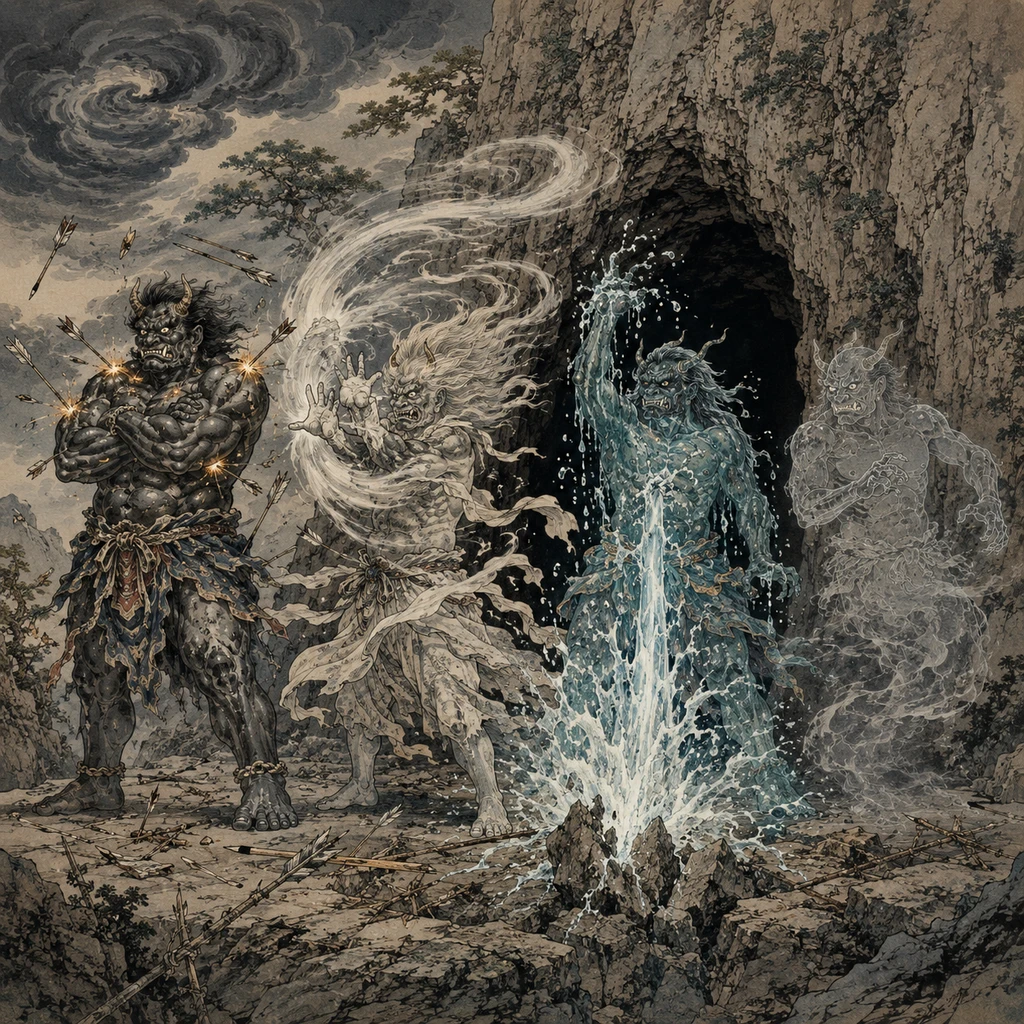
The trend of "conquered northern people becoming demons" does not end once. In the Former Nine Years' War of the 11th century (1051-1062), the Abe clan, an Emishi-descended powerful family that ruled the six districts of Oshu, was destroyed by Minamoto no Yoriyoshi, the governor of Mutsu, and the Kiyohara clan of Dewa. The father, Abe no Yoritoki, fell to a stray arrow at the Toriumi Stockade, and his son Sadato died from battle wounds at the final stronghold, Kuriyagawa-no-Saku (present-day Morioka City). Known for his bravery, Abe no Sadato was later narrated as the "Sadato Demon," becoming viewed as one of the models for the demons of Tohoku. At the beginning of the Kamakura period, after destroying the Oshu Fujiwara clan of Hiraizumi, Minamoto no Yoritomo went all the way north to Kuriyagawa just to set foot on the site of his ancestor Yoriyoshi's victory, as recorded in the *Azuma Kagami* ── subduing the northern land was an act that repeatedly held meaning for the Minamoto samurai clan. After the Abe clan, the Oshu Fujiwara clan built a golden capital in Hiraizumi, only to eventually be destroyed by Minamoto no Yoritomo ── from Aterui to Abe no Sadato to the Oshu Fujiwara clan, the "northern powers that did not yield to the center" were struck down one after another, and each time, tales of demons and vengeful spirits piled up one by one. The lineage of demons in Iwate is inextricably linked to the history of resistance and defeat this land has walked. Originally appearing in the *Taiheiki* of Ise Province, the Four Demons of Fujiwara no Chikata (Gold Demon, Wind Demon, Water Demon, Stealth Demon)[4] also left a variant legend in local Iwate documents, stating they crossed over to Oshu and formed a gang with Akuro-o and Takamaru ── local legends say Fujiwara no Chikata led the four demons ── the Gold Demon impervious to blades, the Wind Demon raising great winds, the Water Demon causing floods, and the Stealth Demon turning invisible ── to Oshu. The lineage of unsubmissive demons intersects time and again at this northern frontier, from Ise to Oshu. The demon at Mitsuishi Shrine in Morioka, where a god tied it to rocks and made it leave a handprint, is also interpreted by some as the shadow of the Emishi struck down by the imperial court. "Iwate," "Kozukata," "Sansa Odori" ── from the prefecture name to the dance, all derive from a single demon extermination tale ── there is no other prefecture where demons have bitten so deeply into the land. Akuro-o, Takamaru, Sadato Demon, the Four Demons of Chikata, and the Demon of Mitsuishi. The demons of Iwate are often another name for the "defeated northern people," and what central history recorded as "conquest," this land has continued to remember as "tales of demons."
The Sanriku Sea ── Ship Ghosts and Memories of Tsunamis
Another face of Iwate is the long Sanriku coast facing the Pacific Ocean.
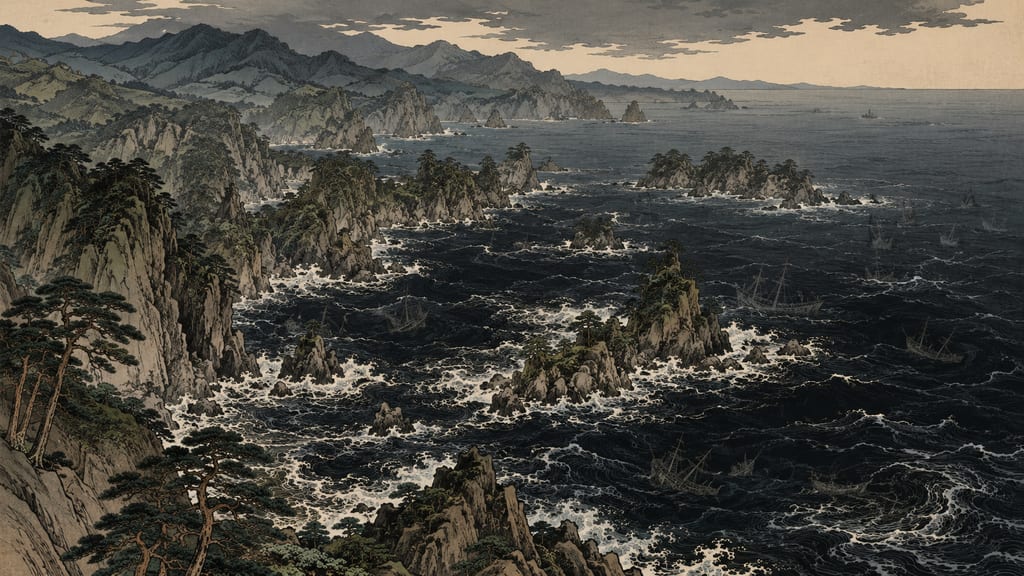
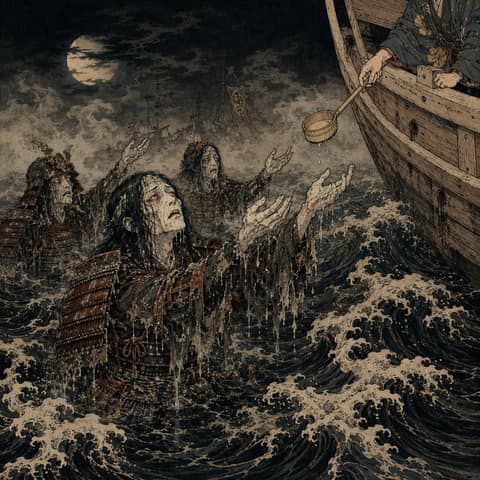
It has been told that in the intricate ria coast seas of Sanriku, Funayurei (Ship Ghosts), the spirits of shipwreck victims or the drowned, appear. On stormy nights, they appear as black shadows on the sea and demand, "Lend me a dipper (*hishaku*)." If you oblige and hand them a dipper, they will scoop seawater into your boat and sink it. Therefore, one must hand them a dipper with the bottom knocked out to let them pass ── this motif is widely distributed in western Japan as well, but in Kosode, Kuji ── a beach known for the ama divers in "Amachan" ── there is a tradition of a black ship monster demanding oars (*kai*) on stormy nights, with warnings not to answer or lend oars. It is said that if you answer the voice, the other party will reach out countless hands, cling to the side of the boat, and pull it in. The admonition not to turn back even if you hear a voice on the rough sea is likely the memory of comrades swept away by the waves, transformed directly into the figure of a monster. In Sanriku, ship ghosts were also called "Ayakashi" or "Dead Men's Ships." The sea was also a place that snatched wives and children. In fishing villages everywhere, tales remain of women who died at sea appearing on the beach, or the spirits of those who suffered sea disasters wandering the shore; the men who went out to sea, while fearing these monsters, still rowed out into the rough waves. Narrating these mysteries was also a wisdom for survival, teaching children and grandchildren the dangers of the sea.
What tells us that the sea monsters of Sanriku were not mere entertainment is the memory of tsunamis. The Meiji Sanriku Tsunami (1896) and the Showa Sanriku Tsunami (1933) ── this coast has been struck by giant tsunamis time and again. It is said that after a tsunami, hearing human voices on the sea and seeing the wreckage of houses drifting by, fishermen feared, "It's ship ghosts; if we answer, we'll be pulled in." The shadows of the dead appearing on the sea are inextricably linked to the memories of countless dead who were actually swallowed by the sea. In Otsuchi Town, a monument was erected after the Showa tsunami, inscribed with "If there is an earthquake, prepare for a tsunami; if a tsunami comes, flee to high ground; do not live in dangerous lowlands." The admonition of ship ghosts that pull you in if you answer, and the teachings of these stone monuments, share the same root ── narrating sea monsters was a wisdom for survival, to ensure the memory of repeatedly striking disasters was not forgotten even by the grandchildren's generation. The yokai of Sanriku have been passed down not to make fear into entertainment, but to protect lives.
Hayachine and Kagura ── Prayers Nurtured by the Mountains
The mountains where the yokai of Iwate dwell were at the same time mountains of prayer and performing arts.
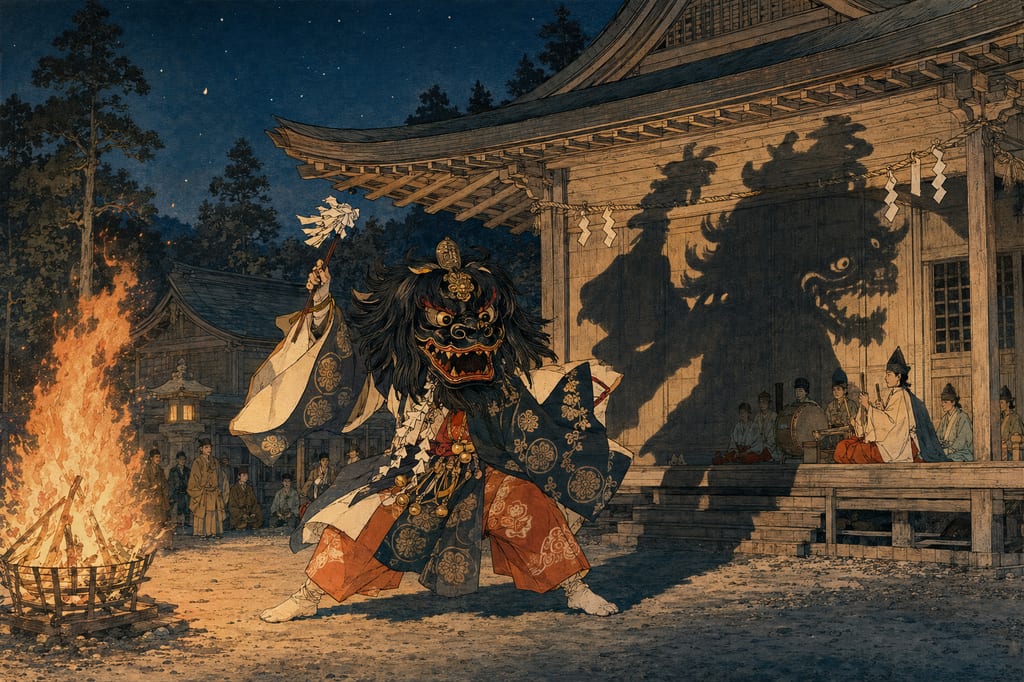
The first tale of *The Tales of Tono* tells the origin of the three goddess sisters dividing Mount Hayachine, Mount Rokkoushi, and Mount Ishigami. On the night the mother goddess took her three daughters to stay at Izu Gongen, she announced that the daughter who had a good dream would be granted the most beautiful mountain. In the middle of the night, the youngest sister, seeing a spiritual flower descend on her eldest sister's chest, secretly snatched it, thus obtaining the highest and most beautiful Hayachine ── the older sisters divided Rokkoushi and Ishigami. The Three Mountains correspond to Hayachine Shrine, Rokushin-seki Shrine, and Ishigami Shrine respectively, still gathering the faith of villagers today. Among them, Mount Hayachine has long gathered faith as a training ground for yamabushi (mountain ascetics). Stemming from its prayer dances, Hayachine Kagura is the collective name for Take Kagura and Otsugunai Kagura[5], registered as a UNESCO Intangible Cultural Heritage in 2009. Wearing a lion head called Gongen-sama, portraying demons and gods, stepping on fire, and exorcising evil spirits, this kagura is said to date back to the Nanboku-cho period, with yamabushi descending to the villages to pass down the dances. The mountains that gave birth to yokai are simultaneously the mountains of prayers and performing arts that calm them ── this duality forms the depth of Iwate's mountain worship. The harshness of life in the Kitakami Mountains, raising horses, keeping silkworms, and burning charcoal for tatara bellows, casts a shadow on both the wealth and downfall brought by Zashiki-warashi, and the tragic love of the horse and daughter in Oshirasama.
The Hometown of Tales ── The Inherited Mysteries
More than a century after *The Tales of Tono* came into the world, the yokai of Iwate are still being narrated today.
Tono City early on utilized the world of *The Tales of Tono* for tourism, branding itself "The Hometown of Folktales." The Tono City Museum exhibits the mysteries of Tono through manuscripts and dioramas; the Nambu magariya in the Denshoen is lined with Oshirasama in its sericulture hall, and Kizen Sasaki's memorial hall is attached. At Kappabuchi, playful catching permits are sold, and elderly storytellers continue to narrate folktales around the hearth. Ryokufuso still has a reputation for being able to meet Zashiki-warashi, and there is a never-ending stream of people wishing to stay. The mysteries of Tono have not remained confined to books, but have been inherited by changing their forms into manga, movies, and modern ghost stories; Zashiki-warashi and kappa are now yokai known nationwide. Tracing their prototypes, it all comes down to the work of two men who carefully transcribed the hearthside tales in a single basin in the Kitakami Mountains.
Iwate, a northern prefecture with a sea, has thus embraced three different yokai cultures. The mountain village basin "records" the mysteries, the inland frontier turns the vanquished into "demons," and the Pacific coast fears the dead as "Dead Men's Ships." The mysteries narrated by Kizen Sasaki and recorded by Kunio Yanagita have not lost their core awe even after becoming attractions in museums and tourist spots. The basin that records, the frontier that birthed demons, and the sea that swallows the dead ── Iwate Prefecture is the turning point that showed Japan a third path: neither "discarding them as superstitions" nor "merely fearing them," but "learning from and passing them down." Carving the handprint of a demon into the prefecture's name, remembering the slain Emishi as demons, and fearing those who vanished into the sea as Dead Men's Ships ── the yokai of Iwate are another face of the history this northern country has walked. Hearing the fleeting nature of wealth in the footsteps of Zashiki-warashi, preserving the memory of the defeated Emishi in the name of Akuro-o, and mourning the sea's dead in the voices of Dead Men's Ships ── to narrate mysteries is nothing other than to know what the people who lived in this land feared, what they mourned, and what they sought to pass down.